1. Introduction
Recent years have seen considerable interest in using Payments for Environmental Services (PES) to finance conservation in developing countries (Landell-Mills and Porras, Reference Landell-Mills and Porras2002; Pagiola et al., Reference Pagiola, Landell-Mills, Bishop, Pagiola, Bishop and Landell-Mills2002; Wunder, Reference Wunder2005; Pagiola and Platais, forthcoming). The PES approach is a market-based approach to conservation financing based on the twin principles that those who benefit from environmental services (such as users of clean water) should pay for them, and that those who contribute to generating these services should be compensated for providing them. The approach seeks to create mechanisms to arrange for transactions between service users and service providers that are in both parties’ interests, thus internalizing what would otherwise be an externality. The PES approach is attractive in that it (i) generates new financing, which would not otherwise be available for conservation; (ii) is likely to be sustainable, as it depends on the mutual self-interest of service users and providers and not on the whims of government or donor funding; (iii) is likely to be efficient, in that it conserves services whose benefits exceed the cost of providing them, and does not conserve services when the opposite is true.
Latin America has been particularly receptive to the PES approach. PES programs are in operation in Colombia (Echevarría, Reference Echevarría2002b), Costa Rica (Pagiola, forthcoming), Ecuador (Echevarría, Reference Echevarría, Pagiola, Bishop and Landell-Mills2002a; Wunder and Albán, forthcoming), El Salvador (Díaz et al., Reference Díaz, Dimas, García, Herrador and Méndez2002), Mexico (Muñoz et al., Reference Muñoz, Guevara, Bulás, Torres, Braña, Pagiola, Bishop and Landell-Mills2006), and others are under preparation or study in several countries. The World Bank is supporting the implementation of PES mechanisms in several countries, including Colombia, Costa Rica, El Salvador, Mexico, Nicaragua, and South Africa, and helping prepare additional projects that use the approach in the Dominican Republic, Panama, Venezuela, and Kenya.
As use of PES approaches grows, there is a need to understand how they affect the poor. Many have assumed that PES will contribute to poverty reduction by making payments to poor land users, while others have warned of potential dangers (Kerr, Reference Kerr2002; Landell-Mills and Porras, Reference Landell-Mills and Porras2002; Pagiola et al., Reference Pagiola, Landell-Mills, Bishop, Pagiola, Bishop and Landell-Mills2002; Grieg-Gran et al., Reference Grieg-Gran, Porras and Wunder2005; Pagiola et al., Reference Pagiola, Arcenas and Platais2005). There has been little empirical verification to date, however. A recent review of the potential linkages between PES and poverty (Pagiola et al., Reference Pagiola, Arcenas and Platais2005) raised three key questions: (1) Who are the actual and potential participants in PES programs, and how many of them are poor? (2) Are poorer households able to participate in PES programs? And (3) are poor households affected indirectly by PES programs?
This paper uses data from a PES project being implemented in Nicaragua to examine the second of these questions: whether poorer households that are eligible to participate in a PES program are in fact able to do so. PES programs pay participating households ‘upon delivery’ of the desired environmental services (or rather, of land use expected to generate the service). The difficulty and cost of the required actions may well prevent poorer households from undertaking them.
The Matiguás-Río Blanco area in Nicaragua provides an interesting setting to study the participation of poor households in a PES program. This area is one of the pilot sites for the Regional Integrated Silvopastoral Ecosystem Management Project, which is using PES to encourage the adoption of silvopastoral practices in degraded pastures areas. This PES program offers a wide range of participation options, ranging from simple and inexpensive land use changes to substantial and complex changes (with correspondingly higher payments). We are thus able to go beyond examining binary participation/non-participation decisions and look at intensity of participation. That some of the choices offered by the project are complex and onerous provides a particularly strong test of poorer households’ ability to participate. Moreover, the study area is characterized by high levels of poverty, with most households falling below the poverty line, and many below the extreme poverty line.Footnote 1
We begin by discussing the factors that might hinder poorer households’ ability to participate in PES projects, drawing on the review by Pagiola et al. (Reference Pagiola, Arcenas and Platais2005) and on the rich literature on technology adoption by smallholders in developing countries, many of whose lessons are relevant to PES. We then describe the Silvopastoral Project and the Matiguás-Río Blanco area. We use data collected at the study site to analyze participation patterns, with particular attention to participation by poorer households. We first examine the extent to which different groups of households participate, and then undertake an econometric analysis to determine the factors that affect participation decisions. We then discuss the implications of our results for the design of PES programs.
2. Constraints to the participation of poor households in PES programs
PES programs pay land users to maintain or switch to land uses that provide environmental services that others value. Participation is voluntary, and participants receive payments for doing so. This creates a prima facie presumption that participants are at least no worse off by joining than they would be by not joining. Were this not the case, they could simply decline to participate. PES payments, in addition to covering opportunity costs, have the further advantage of being highly predictable. Unlike returns to crop production, which vary with weather and market conditions, payment amounts are fixed for the duration of the contract (as long as participants comply with its terms). PES programs have thus often proven highly attractive to land users. About three times more land is typically offered to Costa Rica's and Mexico's PES programs every year than available funding can cover (Pagiola, forthcoming; Muñoz et al., Reference Muñoz, Guevara, Bulás, Torres, Braña, Pagiola, Bishop and Landell-Mills2006).
The potential impacts of PES programs will only be realized by those who participate. The literature on technology adoption and program participation provides many insights into the factors likely to affect participation (Feder et al., Reference Feder, Just and Zilberman1985). The literature on adoption of agroforestry practices (Pattanayak et al., Reference Pattanayak, Mercer, Sills and Yang2003; Mercer, Reference Mercer2004) is particularly pertinent here, as the practices promoted by the Silvopastoral Project are very similar. Pagiola et al. (Reference Pagiola, Arcenas and Platais2005) group the factors that might affect a household's decision to participate in a PES program into three categories: factors that affect eligibility to participate; factors that affect households’ desire to participate; and factors that affect their ability to participate. The three categories form a logical sequence (ability to participate only become an issue for households that wish to do so, and that in turn is only relevant for households that are eligible to participate). In this paper, we focus on examining the factors that affect the participation of eligible households, and particularly on how they affect the participation of poorer households.
Eligibility to participate is affected by the program's targeting and by requirements it may impose. Thus Costa Rica's PES program requires applicants to be located in a priority conservation area (based primarily on biodiversity criteria) or in a watershed covered by an agreement with an individual water user, and to meet a variety of requirements (such as not being in arrears with the country's social security system). For a time, it required most participants to have land titles; this requirement has now been eliminated (Pagiola, forthcoming). Similarly, Mexico's PES program defines eligible areas in terms of their importance to water supplies and other criteria (Muñoz et al., Reference Muñoz, Guevara, Bulás, Torres, Braña, Pagiola, Bishop and Landell-Mills2006).
Some of these eligibility requirements may well affect the poor differentially. As most of Mexico's remaining forests are in land owned by poor ejidos, the fact that Mexico's PES program focuses on conserving existing forests means that many participants will be poor. More generally, geographic targeting has often been assumed to favor the poor, as most of the poor tend to be found in rural areas, and particularly in marginal areas such as the steep slopes of the upper watersheds (CGIAR, 1997; Heath and Binswanger, Reference Heath and Binswanger1996). There have been few efforts to document this presumed spatial correlation between poverty and service provision, however, and these show mixed results. For example, Nelson and Chomitz (Reference Nelson and Chomitz2007) find that watersheds in Guatemala and Honduras where substantial active deforestation is occurring on steep slopes tend to have the highest concentration of poverty. Conversely, Pagiola and Colom (Reference Pagiola and Colom2006) find very little correlation between poverty rates and the importance of an area for water service provision in Guatemala. Other eligibility requirements may also affect the poor differentially. Costa Rica's requirement that applicants have land titles tended to shut out poorer land users while it was in force (Pagiola, forthcoming).
The eligibility of poorer households will thus likely often be an important consideration. It is not an issue in our study, however, as we focus on an area that was selected for inclusion in the project. Moreover, as noted below, we only look at participants, who are by definition eligible.
Assuming that a given household is eligible to participate, the next question is whether it desires to participate. This is likely to depend primarily on whether it expects to be better off as a result. Previous analyses confirm the significance of factors that tend to affect the benefits or the costs of participation, such as prices faced, farm characteristics, and the opportunity cost of household labor, the fit in the farming system, or the risk involved (Pattanayak et al., Reference Pattanayak, Mercer, Sills and Yang2003). Factors such as slope, for example, can affect the extent to which productivity is threatened under current practices, thus increasing incentives to adopt land uses that are less vulnerable to degradation. As developing-country PES programs typically offer fixed payments per hectare for adopting a given practice, the payment itself is unlikely to differentially affect the desirability of participation across households.Footnote 2
A household may want to participate in a PES program and yet be unable to do so, for a variety of reasons. Participation in a PES program requires adoption of the land uses promoted by the program. This may be simple, if the program calls for retaining existing land uses (as in the Costa Rica program's forest protection contract), or it may be complex, if the program calls for switching to new practices (as in the Silvopastoral Program studied here). Tenure issues are often critical, particularly in cases where PES programs require long-term investments, such as reforestation or adoption of silvopastoral practices. Tenure variables were significant in 72 per cent of agroforestry adoption studies that included them, with greater tenure security being consistently associated with greater adoption (Pattanayak et al., Reference Pattanayak, Mercer, Sills and Yang2003). In Costa Rica, both Thacher et al. (Reference Thacher, Lee and Schelhas1997) and Zbinden and Lee (Reference Zbinden and Lee2005) found tenure-related variables to be highly significant in explaining participation in the country's PES program and its predecessors. Programs that require adoption of new practices may also face technical or financial constraints. When the new practices to be adopted are complex, access to technical assistance may be an issue. Access to extension was found to significantly affect agroforestry adoption in 90 per cent of studies that included it (Pattanayak et al., Reference Pattanayak, Mercer, Sills and Yang2003). This was the case in two studies in Costa Rica, for example (Thacher et al., Reference Thacher, Lee and Schelhas1997; Zbinden and Lee, Reference Zbinden and Lee2005). Adopting new land use practices may also prove difficult if households cannot finance the necessary investment. Savings, remittances, or off-farm income may help some households undertake the necessary investments. Assets and credit both tend to increase adoption of agroforestry practices, and their role is very often significant (Pattanayak et al., Reference Pattanayak, Mercer, Sills and Yang2003).
Many of the factors that affect a household's ability to participate in PES may well be more salient for poor households. Poorer households are less likely to have secure tenure, tend to have fewer savings and less access to credit, and are less likely to receive technical assistance (de Janvry and Sadoulet, Reference de Janvry and Sadoulet2000; López and Valdés, Reference López and Valdés2000). Whether poor households will be able to participate in PES programs (assuming that they are eligible and interested in doing so) is thus a legitimate source of concern.
Worries that poorer households may not be able to participate in PES programs have been heightened by recent case studies in Costa Rica, indicating that many participants in that country's PES program are relatively well-off (Ortiz Malavasi et al., Reference Ortiz Malavasi, Sage Mora and Borge Carvajal2002; Miranda et al., Reference Miranda, Porras and Moreno2003; Zbinden and Lee, Reference Zbinden and Lee2005). In Mexico, better-off ejidos were over-represented in terms of their participation in that country's PES program, while very highly marginalized ejidos were substantially under-represented (Muñoz et al., Reference Muñoz, Guevara, Bulás, Torres, Braña, Pagiola, Bishop and Landell-Mills2006).
3. The Silvopastoral Project
The Regional Integrated Silvopastoral Ecosystem Management Project is piloting the use of PES in three areas: Quindío, in Colombia, Esparza, in Costa Rica, and Matiguás-Río Blanco, in Nicaragua (Pagiola et al., Reference Pagiola, Agostini, Gobbi, Haan, Ibrahim, Murgueitio, Ramírez, Rosales and Ruíz2004). The project is financed by a US$4.5 million grant from the Global Environment Facility (GEF), though the World Bank. It is being implemented in the field by local non-governmental organizations (NGOs). In Nicaragua, this work is being conducted by Nitlapan, an NGO affiliated with the Central American University.
Silvopastoral practices, which combine trees with pasture, offer an alternative to prevalent cattle production systems. Cattle production has long been an important cause of the loss of natural habitat and biodiversity in Central America (Downing et al., Reference Downing, Pearson and Garcia-Downing1992; Kaimowitz, Reference Kaimowitz1996). In addition to the environmental problems caused by the initial loss of forest, extensive grazing often suffers from loss of soil fertility and diminishing grass cover, resulting in soil erosion, contamination of water supplies, air pollution, and landscape degradation. Lower income for producers results in continuing poverty and can lead to pressure to clear additional areas.
Silvopastoral practices include (1) planting high densities of trees and shrubs in pastures, thus providing shade and diet supplements while protecting the soil from packing and erosion; (2) cut and carry systems, in which livestock is fed with the foliage of specifically planted trees and shrubs (‘fodder banks’) in areas previously used for other agricultural practices; and (3) using fast-growing trees and shrubs for fencing and wind screens. These practices provide deeply rooting, perennial vegetation which is persistently growing and has a dense but uneven canopy.
The on-site benefits of silvopastoral practices to land users may include: additional production from the tree component, such as fruit, fuelwood, fodder, or timber; maintaining or improving pasture productivity by increasing nutrient recycling; and diversification of production (Dagang and Nair, Reference Dagang and Nair2003). These benefits can be important, but are often insufficient by themselves to justify adopting silvopastoral practices – particularly practices with substantial tree components, which have high upfront planting costs and only bring benefits several years later. Estimates prepared for the project show rates of return of between 4 per cent and 14 per cent (Gobbi, Reference Gobbi2002). Other studies found similar results; White et al. (Reference White, Holmann, Fuijsaka, Reategui, Lascano, Angelsen and Kaimowitz2001), for example, found rates of return to adoption of improved pasture in Esparza, Costa Rica, of 9 per cent to 12 per cent. These estimates, of course, only consider the on-site benefits of silvopastoral practices.
Because of their increased complexity relative to traditional pastures, silvopastoral practices also have important biodiversity benefits (Dennis et al., Reference Dennis, Shellard and Agnew1996; Harvey and Haber, Reference Harvey and Haber1999). They have been shown to play a major role in the survival of wildlife species by providing scarce resources and refuge; to have a higher propagation rate of native forest plants; and to provide shelter for wild birds. They can also help connect protected areas. Silvopastoral practices can also fix significant amounts of carbon in the soil and in the standing tree biomass (Fisher et al., Reference Fisher, Rao, Ayarza, Lascano, Sanz, Thomas and Vera1994; Pfaff et al., Reference Pfaff, Kerr, Hughes, Liu, Sanchez, Schimel, Tosi and Watson2000). Both biodiversity and carbon sequestration benefits are off-site, however, so land users will tend not to include them when they decide which practices to adopt. Silvopastoral practices can also affect water services, though the specific impact is likely to be site specific (Bruijnzeel, Reference Bruijnzeel2004). GEF funding for the Silvopastoral Project is based on the desire to secure these biodiversity and carbon sequestration benefits.
Most PES programs focus on very few land uses. Costa Rica's program, for example, pays for conserving existing forest and for establishing timber plantations (Pagiola, forthcoming).Footnote 3 But pastures with low tree density provide fewer biodiversity and carbon benefits than pastures with higher tree density. Likewise, biodiversity benefits will be greater when a variety of native species with different canopy heights is used. To encourage adoption of more beneficial practices, the Silvopastoral Project offers payments that are proportional to the level of services provided. To do so, it developed indices of the biodiversity conservation and carbon sequestration services that different land uses provide, then aggregated them into a single ‘environmental services index’ (ESI).Footnote 4 The project distinguishes 28 different land uses,Footnote 5 each with its own ESI score, and pays participants according to the change in total ESI score over their entire farm area.
PES will have the desired effect only if they influence land use decisions appropriately. Silvopastoral practices tend to be unattractive to land users, despite their long-term benefits, primarily because of their substantial initial investment and because of the time lag between investment and returns. This leads to the hypothesis that a relatively small payment provided early on could ‘tip the balance’ between current and silvopastoral practice, by increasing the net present value of investments and reducing the initial period in which these practices impose net costs on land users.Footnote 6 By the time payments end, the silvopastoral practices themselves will have begun generating income for land users. The payments also alleviate the liquidity problems faced by many land users and help them finance the required investments. Based on this analysis, the project provides payments of US$75 per incremental ESI point, per year, over a four-year period. In addition, participants receive a one-time payment of US$10/point for the baseline points.
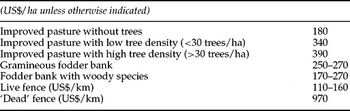
The Silvopastoral Project offers a strong test of ability to participate, as many of the measures it supports are both expensive and technically challenging to implement. Table 1 shows the estimated investment costs of some of the practices concerned at the study site. Many of these practices are also technically complex. Choice of species and appropriate management can have a significant impact on their benefits. At the same time, however, the project also offers several easier and cheaper options. Should either investment requirements or technical capacity prove to be formidable obstacles for poorer households, there would be a clear division in the types of PES-supported activities they implement.
Establishment costs for selected silvopastoral practices, Matiguás-Río Blanco, Nicaragua

Notes: Costs shown are based on switching from degraded pasture; actual costs will vary if the initial land use is different.
Source: Silvopastoral project data.
4. Study site
The Matiguás-Río Blanco area is located in the department of Matagalpa, about 140 km from the capital of the country, Managua. It is located on the southern slopes of the Cordillera de Darien and has an undulating terrain, with an elevation of about 300–500 m above sea level. Average temperature is about 25C and average rainfall between 1700 mm and 2500 mm. Participants are clustered in two adjacent microwatersheds, that of Río Bulbul and that of Río Paiwas.
Land use in the watershed is dominated by extensive grazing.Footnote 7 As shown in table 2, pastures account for about 63 per cent of the area. Of this, about half is degraded pasture, and a little over a quarter has either no or few trees. Annual crops make up a very small part of total area. It is noteworthy that some forest remains, accounting for about 20 per cent of total area; most of this is riparian forest. It is also noteworthy that silvopastoral practices, though not common, were not unknown even before the project: there were some 550 ha of pastures with high tree density, and 88 ha of fodder banks, for example. Farms range in size from 10–30 ha to a few of over 60 ha. Most households are poor, with many falling below Nicaragua's extreme poverty line.
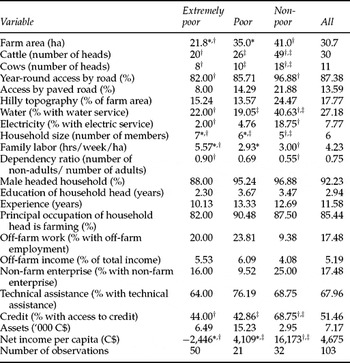
Characteristics of participating households, Matiguás-Río Blanco, Nicaragua
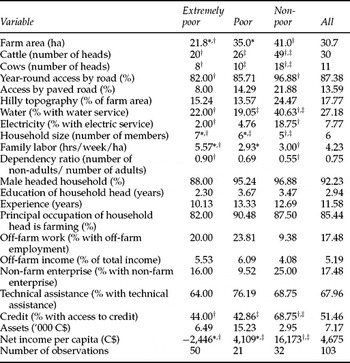
Notes: *,†,‡ indicate means are significantly different in paired t-test at 10% test level.
In 2003 $1US = 14.25 C$. An adult is defined as an individual >12 years.
5. Data collection
To examine participation decisions, we used three data sets. The first is the baseline survey conducted in October–November 2002, during project preparation. This survey included very detailed information on household characteristics. A second survey of participants was conducted in March–May 2004, after the first year of project implementation. This survey collected information on land use changes that occurred in the intervening period.Footnote 8 Our analysis only includes participants with information in both surveys, giving us a total of 103 observations. Information from these two surveys was then complemented with detailed land use data for each farm, derived from maps prepared annually by the project for each farm using remote sensing imagery.Footnote 9 These maps gave us more accurate and consistent measures of area than data from the surveys, and ensured that land uses were classified consistently into the project's categories.
Both the baseline and follow-up surveys included a control group, as does the mapping dataset. The main intended purpose of this group was to attempt to distinguish project-induced land use changes from changes induced by other factors, as recommended by Ferraro and Pattanayak (Reference Ferraro and Pattanayak2006). Upon analysis, however, control group members were found to differ from participants in many important characteristics (such as income, farm size, or herd size). As project participants make up a large proportion of all households in the two microwatersheds in the project area (65 per cent in Bulbul and 35 per cent in Paiwas), non-participants had to be sought elsewhere. Unfortunately, they were poorly chosen. Because of these differences, we decided that using the control group would not be useful. Our analysis, therefore, focuses entirely on participants.
As our interest is on the ability of poorer households to participate, measuring household income is critical. We computed household income by adding all income sources reported by participants, including net income from agricultural, forest, and dairy production; livestock sales; off-farm work; net income from non-farm enterprises; and remittances. Dairy, agricultural, and forest products consumed by the household are included in the calculation of income using market prices, and the value of family labor is imputed using local wage rates for unskilled labor. Expenditure is generally preferred over income as an indicator of household welfare, as it tends to be less variable (Ravallion, Reference Ravallion1992). However, the baseline survey only collected data allowing income to be computed. Moreover, these data are based largely on information self-reported by the farmers, and so are subject to both recall problems and possible biases. As our primary interest is in assessing differences in participation within our sample, these biases are unlikely to affect our results as long they are similar across income groups. We used our estimates of household income per capita to classify households into three groups using the poverty lines given in the World Bank's (2003) report on poverty in Nicaragua: those with incomes below the extreme poverty line (‘extremely poor’), those with incomes between the extreme poverty line and the poverty line (‘poor’), and those with incomes above the poverty line (‘non-poor’).Footnote 10
6. Participating households
All households in the area that met minimal farm and herd size criteria were eligible to participate. Participants were selected on a first-come basis until the maximum number allowed by available funding was reached. The characteristics of participating households are summarized in table 2. The average participating household has about 31 ha of land and about 30 head of livestock, of which a third are cows. The average household is composed of six members. The average per capita income of about C$4,700 is below the poverty line. Other indicators confirm the low living standards of the area's households: few have water or electricity, and education levels are very low. Agriculture is the main economic activity, with few households having off-farm income.
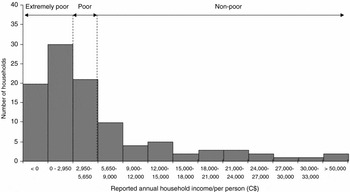
Figure 1 shows the distribution of participating households according to their estimated household income per capita. As can be seen, most participating households are either poor (20 per cent) or extremely poor (46 per cent). Even those above the poverty line cannot be characterized as wealthy (hence our term ‘non-poor’).
Distribution of reported annual household per capita income among Silvopastoral Project participants, Matiguás-Río Blanco, Nicaragua Source: Authors’ computations from Silvopastoral Project baseline survey.

Breaking down participants into income groups shows both similarities and differences. Extremely poor households have significantly less land and smaller herds than poor households, which in turn have significantly less land and smaller herds than non-poor households. Extremely poor and poor households also have larger households and more dependents per adult. They are less likely to have either electricity or water. Particularly important for what follows, they are less likely to have access to credit and extremely poor households also are less likely to have year-round access by road. On the other hand, differences in educational level and experience are minimal and not statistically significant, as are the extent of off-farm employment. The proportion of farm area that is hilly is somewhat higher for poorer households, but the difference is not significant. Likewise, access to technical assistance appears to be slightly lower the poorer the household, but differences are not statistically significant.
Although none of the participating households could be considered wealthy (even the best-off household has per capita income below US$10 a day), there are substantial differences within the group. Even US$10 a day would be riches to the 49 per cent of households that have less than US$0.60 a person a day (the extreme poverty line). In particular, several variables that previous research has shown to have an important effect on participation, such as farm size, access to credit, and access to roads, differ significantly across income groups. Other important variables also vary across the group, though not necessarily in ways that are correlated with income.
7. Changes in land use
The Silvopastoral Project made its first payments, for baseline ESI points, in July 2003. It made its first payment for changes in land use in May 2004. Additional payments have since been made, in 2005 and 2006. Our analysis focuses on land change in the first year of the project.Footnote 11
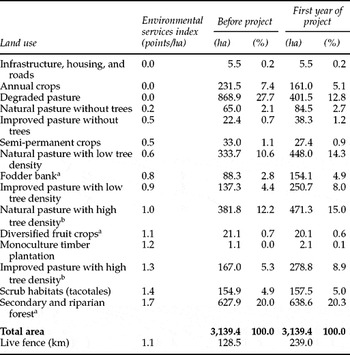
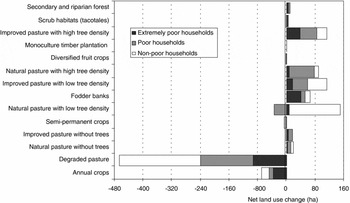
Table 3 compares land use by participants prior to the project and after the first year of the project. Overall, there was substantial land use change: 545 ha (over 17 per cent of the total area) experienced some form of land use change. A wide variety of changes were observed, ranging from minor changes such as sowing improved grasses in degraded pastures to very substantial changes such as planting high-density tree stands or establishing fodder banks.Footnote 12 The area of degraded pasture experienced the largest fall, being reduced by over half (467 ha of the original 869 ha), and the area of annual crops also fell by almost a third (70 ha of the original 232 ha). Pastures with low tree density experienced a net increase of 228 ha, and pastures with high tree density of 201 ha (in addition, substantial areas of natural pastures with either low or high tree density were sown with improved grasses). There was also a substantial increase in the area devoted to fodder banks (66 ha, almost doubling the original area). These changes are also illustrated in figure 2. Overall, these changes increased the total ESI score of participants by 25 per cent.
Land use among Silvopastoral Project participants, Matiguás-Río Blanco, Nicaragua (ha, unless otherwise noted)

Notes: Totals may not add up because of rounding.
Land uses recognized by the project but not found at this site are omitted.
aSimilar land uses with small areas have been aggregated; ESI shown is for use with largest area.
bThe project distinguishes land uses with recently planted trees from the same land uses with mature trees for the purpose of computing the ESI score; here these land uses have been aggregated to their mature state, and the corresponding ESI score is shown.
Sources: ESI score from Silvopastoral Project manual (CIPAV, 2003); land use from Silvopastoral Project, based on analysis of remote sensing imagery verified in the field
Land use change in first year of Silvopastoral Project, by income group, Matiguás-Río Blanco, Nicaragua Source: Authors’ computations from Silvopastoral Project mapping data.

Figure 2 breaks down observed land use changes by household income group. Poor households and extremely poor households accounted for a substantial share of land use changes. They accounted for 51 per cent of the decline in degraded pasture and 70 per cent of the decline in area under annual crops. Moreover, land use changes by poorer households were not limited to adopting technically simpler and less onerous practices. Extremely poor households established 40 ha of fodder banks (61 per cent of the total), for example, and poor households another 11 ha (17 per cent), compared to only 14 ha (22 per cent) by non-poor households.Footnote 13 Poor households were also responsible for the bulk of increase in pastures with high tree density (118 ha, or 59 per cent) with extremely poor households providing another 45 ha (23 per cent). Indeed, it was the non-poor who seemed to focus on the simpler practices: establishing natural pasture with low tree density was the most important single change these households made.
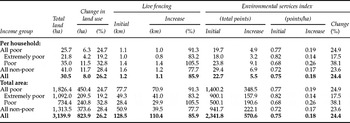
Table 4 examines various indices of household participation across income groups. Non-poor households converted just under 12 ha each, on average, almost twice the average area converted by all poor households. Within the poor, however, there was a wide difference between poor and extremely poor households, with the former converting practically as large an area as the non-poor, and the latter considerably less. The differences shrink considerably in terms of proportion of farm area converted, arguably a better indicator of ability to participate than total area converted, as poorer households tend to have smaller farms. Although extremely poor households converted the smallest proportion of their farm of any of the groups, the difference was less marked. Poor households converted the greatest proportion of their farm. Poor and extremely poor households also increased their use of live fencing proportionally more than non-poor households. A similar pattern can be seen in the changes in ESI points: the increase is greatest in absolute terms for non-poor households, but higher in proportional terms for poor households, with extremely poor households trailing. Extremely poor households had the highest initial ESI/ha, however, so they may have had less scope for substantial improvements.
Participation rates by income group, Matiguás-Río Blanco, Nicaragua

Sources: Computed from Silvopastoral Project mapping data.
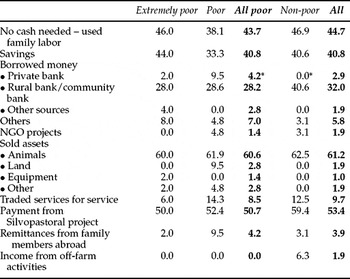
Table 5 shows how different groups financed the investments they made, according to their responses on the first-year participant survey. Some investments were undertaken entirely with family labor and so did not require financing. The most frequently mentioned source of funds was the sale of animals (61 per cent of all households), followed by the project's initial ‘baseline’ payment (53 per cent). A fairly large proportion (41 per cent) was able to finance investments from savings, and a surprisingly large fraction (32 per cent) had access to credit from a local community bank. In general, there were almost no significant differences in the importance of different financing sources across income groups. Surprisingly, the poor had slightly better access to credit from private banks, but the overall importance of this financing source was minimal.
Financing sources for investments in silvopastoral practices, by income group, Matiguás-Río Blanco, Nicaragua (% of households citing source as among two most important sources)

Notes: Percentages do not add to 100 because of multiple responses.
*indicates means are significantly different in paired t-test at 10% test level.
Sources: Computed from data in 1st year participant survey.
8. Household participation decisions
A simple examination of observed land use change indicates that poorer households are in fact able to participate quite extensively in this particular PES program, even though it requires some technically complex and onerous land use changes. To shed further light on participation decisions and the factors that may affect them, we undertook an econometric analysis of participation rates.
The literature on adoption decisions usually looks at the binary choice of whether or not to adopt a given practice, using cross-sectional data on adopters and non-adopters, and the effect of different factors on the probability of adoption (Pattanayak et al., Reference Pattanayak, Mercer, Sills and Yang2003). This approach is not relevant in our case, for two reasons. First, the pilot nature of the Silvopastoral Project means that the participation decision is not entirely up to farm households. Project funding limited the number of participants; many non-participants wanted to participate. Second, a binary adoption/non-adoption choice would fail to capture the nature of participation in the Silvopastoral Project. Rather than participation per se, what is of interest here is the intensity of participation. The formal question we want to pose, then, is how household characteristics affect the intensity of participation, with a particular focus on whether poorer households are less able to participate than better-off households. Our approach is similar to that of Nkonya et al. (Reference Nkonya, Schroeder and Norman1997), who examined the intensity of adoption of improved seed in Tanzania using continuous variables (hectares planted with improved maize seed or amount of fertilizer applied per hectare of maize), and of Rajasekharan and Veeraputhran (Reference Rajasekharan and Veeraputhran2002), who examine the share of farms using intercropping in Kerala, India.
The dependent variable for our analysis can be formulated in many different ways. The simplest is the area converted: the greater the area converted, the higher the participation. Households with little land – including many poorer households – will clearly score poorly on this indicator, however. Using the proportion of farm area converted avoids this problem, but faces others. Converting 5 ha of land to improved practices takes greater effort than converting 1 ha, yet if the first household has 10 ha and the second only 1 ha, the first household (50 per cent converted) will appear to be participating ‘less’ than the second (100 per cent conversion). However expressed, area-based indicators also fail to measure whether changes are large or small. Planting trees at a low density in a plot of degraded pasture requires substantially less effort than converting it to fodder banks, yet will have the same value in terms of either area converted or percentage of farm area converted. Area-based indicators also omit investments in live fencing. One option to incorporate a measure of intensity is to weight the area converted by the ESI of the land use change. The ESI is not intended as a measure of effort, but higher-ESI land uses tend to involve more effort than lower-ESI uses. This measure is also appealing as it is the outcome of interest to the ‘user’ of the environmental services being sought. This measure could also be stated in different ways. The increase in total ESI is the simplest measure (and is readily available, as it is the basis for payments to participants), but like the area converted is constrained by total farm size. Stating it in terms of increase in ESI per hectare or percentage increase in ESI addresses this problem. As each of these alternatives has its advantages and disadvantages, we use them all in separate models.
We thus ran five separate regressions, one with each dependent variable. Similar to Rajasekharan and Veeraputhran (Reference Rajasekharan and Veeraputhran2002),Footnote 14 we employed a one-tailed Tobit to model farm area, as this variable is restricted to non-negative values. Likewise we employed a two-tailed Tobit model to model the percentage of the farm area converted, as this ranges between 0 and 100. Change in ESI, change in ESI per hectare, and percentage change in ESI can take any value, and so are modeled using ordinary least squares (OLS).Footnote 15
Our choice of explanatory variables draws on the factors identified by Pagiola et al. (Reference Pagiola, Arcenas and Platais2005) as likely to affect participation in PES, and by Pattanayak et al. (Reference Pattanayak, Mercer, Sills and Yang2003) and the studies they cite as likely to affect adoption of agroforestry practices, with modifications for the particularities of our case. Eligibility is not an issue here, as we focus on an area that was selected for inclusion in the project. The desire to participate per se is also not an issue, as we are only looking at households who have chosen to participate. However, as the Silvopastoral Project offers a wide range of participation options, variables that affect desire to participate remain relevant, as they may affect the desire to undertake more intensive practices. Our main concern, however, is factors that may impede a household's ability to participate. Within these factors, tenure is not an issue in Matiguás-Río Blanco, as the site was selected partly for the absence of such problems.
The number of explanatory variables that could be included was limited by the relatively small sample size. In this case, increasing the sample was not an option; our data include every single project participant. Fortunately, the small size of the study site means that many potential explanatory variables vary little across households, and thus can be safely omitted.Footnote 16
Many studies have shown that farm characteristics often have an important impact on adoption decisions. Most previous studies report a positive effect of farm size on adoption of various practices, which has been interpreted as indicating higher flexibility of the farming system or the existence of economies of scale (Rajasekharan and Veeraputhran, Reference Rajasekharan and Veeraputhran2002; Thacher et al., Reference Thacher, Lee and Schelhas1997; Nowak, Reference Nowak1987). Labor availability would seem likely to be important, although it is not often significant (Pattanayak et al., Reference Pattanayak, Mercer, Sills and Yang2003). We include a measure of the hours per week worked on the farm. We also include measures of the experience (the number of years managing the farm) and gender of the household head, to capture characteristics of the farmers themselves which have often been found to be important.
As our study area is small, most farms face similar prices for inputs and outputs, and have similar yield potentials. The profitability of the various silvopastoral practices should thus be broadly similar throughout the area. Two factors which do differ across farms may affect the profitability of the practices. Farmers with lower accessibility will tend to face higher input costs and lower output prices at the farm gate. We include a binary variable indicating whether a household has year-round access by road, and expect a positive association with participation. Topography could also affect the profitability of different measures, although the direction of the impact is less clear. Land on steep slopes may benefit more from silvopastoral practices in that it is more vulnerable to degradation under traditional extensive grazing. On the other hand, the cost of implementing practices may be higher. We include a variable on the percentage of farm area with hilly topography, without making any prediction as to how it will affect results.
To examine whether initial investment costs affect ability to participate, we include variables on access to credit and off-farm income. Both have often been found to be significant. Access to credit is included as a binary indicator of whether a household had access to credit during the five years prior to project implementation.Footnote 17 It is expected to be positively related with participation. Off-farm income is measured as the income share of off-farm jobs held by all household members. It can be a financing source for investment in new practices, but can also result in a higher opportunity cost of labor.
Technical complexity of adoption of many practices may be overcome with training in their implementation. Indeed, the Silvopastoral Project provided such technical assistance to a (randomly selected) subset of participants. We include a binary indicator for whether households received such support from the Project.
As poverty is multidimensional, we also include dummies for whether households are poor (with separate dummies for poor and extremely poor households) to capture other aspects of poverty that may not be captured by the previous variables.
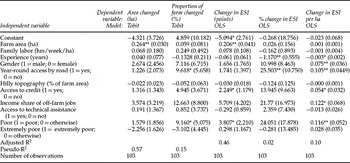
Table 6 summarizes the results of the analysis.Footnote 18 The first two columns report the results of Tobit models for area changed and proportion of farm changed, and the last three columns the results for the OLS models for change in ESI, percentage change in ESI, and change in ESI per hectare. Measures of model fit are relatively low, but this is not surprising with cross-sectional data, particularly when sample sizes are small. They are comparable to those obtained by Rajasekharan and Veeraputhran (Reference Rajasekharan and Veeraputhran2002) and Ervin and Ervin (Reference Ervin and Ervin1982).
Estimation results

Notes: Standard errors in parentheses; robust standard errors for OLS coefficients.
*, **indicates coefficient estimate is significantly different from zero at 90% or 95% confidence level.
Although relatively few explanatory variables are significant, most estimated coefficients have the expected sign, and are largely consistent with the results of other studies. As expected, farm area is positively associated with intensity. This effect is strongest in the models using absolute measures of area adopted or ESI increases, and only significant in those cases. This is not surprising: the larger the farm, the harder it will be to convert a large share of it, offsetting the flexibility and economies of scale that size might provide. Family labor is not significant. Experience shows either a very small or a negative effect on intensity of participation, and is significant in two cases. Other studies have often usually found a positive effect, though rarely a significant one and have generally attributed it to experience reducing the risk of adoption (Pattanayak et al., Reference Pattanayak, Mercer, Sills and Yang2003); perhaps the negative effect we find is due to older farmers being less willing to make changes.Footnote 19 Male-headed households have greater intensity of participation under all measures, but this effect is only significant in one case.
Among the factors that can affect the profitability of adoption, and hence a household's desire to do so, accessibility by road has the expected positive sign, and is significant in several of the models. The proportion of the farm on hilly terrain has a negative impact, but it is not significant. As noted above, there is no strong a priori reason to expect a particular sign on this variable. Among the factors that affect the ability of households to participate in the program, access to credit also has the expected positive sign. It is interesting that it is not significant in explaining area converted but is significant in explaining increases in ESI, which requires greater effort and cost. Access to technical assistance, on the other hand, has very inconclusive and non-significant results. As shown in table 2, none of the silvopastoral practices promoted by the project was unknown in the region. Even the more complex practices, such as fodder banks, were already in use, albeit on a small scale. Almost half of farm households had already established fodder banks, for example. That technical assistance should not be significant is thus not very surprising; many households already knew how to implement them, and the others could probably learn from their neighbors if they did not have access to technical assistance.Footnote 20
Finally, the poverty dummies show some interesting patterns. Poor (but not extremely poor) households have consistently higher intensity of participation than all other groups, and this effect is significant in several models. Conversely, extremely poor households have a lower intensity of participation (except in one model), though this effect is not significant in any model. These results are consistent with those shown in table 4: the group of poor households generally has higher intensity of participation than either extremely poor or non-poor households, even after accounting for a variety of factors. Explaining this result will require further analysis; one hypothesis is that poor households have fewer constraints to participation than extremely poor households, but greater desire to participate than relatively better-off households, who may have better off-farm opportunities. Our results are line with those of Bandiera (Reference Bandiera2004), who found that farmer wealth was not a significant determinant of tree cultivation in Nicaragua.
9. Conclusions
Can poorer households participate in PES programs? The experience of the Silvopastoral Project in Matiguás-Río Blanco indicates that they can. Not only did poorer households participate quite extensively, but by some measures they participated to a greater extent than better-off households. Nor was their participation limited to the simpler, least expensive options: poorer households tended to implement more substantial changes in land use. Extremely poor households do appear to have had somewhat greater difficulty in participating, but even in their case the difference is solely a relative one. Extremely poor households not only were not shut out, but participated at high rates in the project. And again their participation was not limited solely to the simpler and cheaper practices. These results are particularly strong in that the Silvopastoral Project imposes much greater burdens on participants than most PES programs.
This conclusion obviously needs to be approached with some caution. It is possible that the high levels of participation by poorer households are due to self-selection bias: only those households able to participate may have joined. We believe this is unlikely, for two reasons. First, the project offered a very wide range of participation options, including many that are not very onerous, even for poorer households. Indeed, households could in principle have done absolutely nothing; they would then have received the baseline payment but would not have received any payment beyond that. In fact, no household chose that route. Second, as noted previously, a large proportion of all households in the two microwatersheds actually participated, and many of the others wanted to participate as well, but were prevented from doing so by the project's own limits on the number it could accept. But even if there were some self-selection at play, it is significant that in a poor area such as Matiguás-Río Blanco there are many poor households – including many extremely poor households – that are able to participate in a PES program, and even to undertake expensive and technically challenging land use practices.
Nevertheless, one should not jump to the sanguine conclusion that all poor farm households everywhere will always be able to participate in PES programs.Footnote 21 Both PES programs and local conditions differ from case to case, and there may well be cases where otherwise eligible poor households may find it difficult or impossible to participate. Indeed, results in Matiguás-Río Blanco show that extremely poor households do appear to have had greater difficulty in participating as intensively as other households.
Our detailed results help us identify several specific factors that tend to affect participation. This information can help design PES programs to reduce potential obstacles to the participation of poorer households. There is little that a PES program can do about poorer farms being less accessible, but it can do something about financing constraints and technical difficulty.
The significance of credit underlines an important potential constraint for poorer households. This constraint will not always be present in PES programs. When PES programs require maintaining existing practices – as in the majority of contracts in Costa Rica's program, for example – there are no investment requirements. Financing constraints may be important when land use changes are required for participation, however, as in Costa Rica's Reforestation or Agroforestry contracts. Our results suggest that this constraint is not absolute, as it is sometimes made out to be. Even poor households such as those in Matiguás-Río Blanco often have a variety of ways to finance profitable investments, as table 5 demonstrates. Nevertheless, it is likely that poorer households will have fewer such alternatives: fewer savings, fewer assets that might be sold, worse access to credit. Providing some initial financing (such as the baseline payment made by the Silvopastoral Project) may be desirable for PES programs that involve initial investments in areas with many poor households.Footnote 22
The need for technical assistance is far less clear from our results. Again, this need is only likely to arise when PES programs require participants to undertake land use changes, and even then only if these are complex or little known. In the case of Matiguás-Río Blanco, the practices being promoted by the PES program were relatively complex, but were also relatively well known in the area.
The availability of multiple options in the Silvopastoral Project may well have contributed to high participation by the poor, as they were able to choose the options that work best for them, in light of their particular constraints. When there are multiple ways of providing a service (or different levels of a service), it makes sense to offer multiple ways in which households can participate, as long as transaction costs do not increase unduly. It is interesting to note, however, that at Matiguás-Río Blanco the poorer households did not choose the cheaper and easier land uses – in fact, it was the better off households that did so.
In general, transaction costs are likely to be a bigger threat to the participation of poorer households in PES programs then their own ability to participate (Pagiola et al., Reference Pagiola, Arcenas and Platais2005). Our results illustrate this. Consider table 4. All poor households converted almost 25 per cent of their farms, on average, and increased their ESI score by about 25 per cent. These participation rates compare favorably with those of non-poor households, who converted 26 per cent of their farms and increased their ESI score by 24 per cent. But from the perspective of the service buyer, what matters is the absolute increase in environmental service generation (whether proxied by area, as is commonly the case, or by more sophisticated measures such as the ESI), and the unit cost of achieving it. The cost, in turn, has two components: the cost of the payment, which is identical for a given increase in ESI for all households, and the transaction cost of contracting with each household. This second cost is likely to be largely fixed per household, irrespective of farm size. Thus non-poor households converted a total of 374 ha and achieved a total increase in ESI of 222 points. At first glance, poorer households did better: they converted 450 ha and increased ESI by 349 points. On a per contract basis, however, the comparison is less favorable: non-poor households converted 11.7 ha and increased ESI by 6.9 points per contract, while all poor households converted 6.3 ha and increased ESI by 4.9 points per contract. If poor households are distinguished from extremely poor households, the contrast is even starker: extremely poor households only converted 4.2 ha and increased ESI by 3.2 points per contract. The larger the transaction costs, the more attractive it will be for PES programs to focus on large land holdings. As farm size tends to be highly correlated with income, in practice this will mean focusing on better-off households. This is not a purely hypothetical concern: In Ecuador, the PROFAFOR program has decided to adopt a 50 ha minimum size for the forest plantations from which it buys carbon sequestration services (Wunder and Albán, forthcoming).
Keeping transaction costs low – in addition to being desirable in itself – is thus imperative if poorer households are not to be shut out of many PES programs.Footnote 23 But the smaller farm size of many poor households means they will always have relatively higher transactions costs. It is thus important to attempt to devise mechanisms to overcome them. Costa Rica, for example, experimented with collective contracting, under which groups of small farmers joined the country's PES program collectively rather than individually, thus spreading transaction costs over a large group. This approach ran into problems, however, as non-compliance by a single group member resulted in payments being halted to all members. The approach has thus been revised to process the applications of such groups together, but then issue individual contracts; this avoids the partial compliance problem, but has much smaller savings in transaction costs (Pagiola, forthcoming). This is clearly an area in which more work – and some imaginative solutions – will be necessary. This is also an area in which development aid could be used to leverage PES programs by providing support to the participation of poorer households, and in particular by underwriting some of the transaction costs involved.