INTRODUCTION
The diagnosis of cancer and cancer treatment can have a significant negative effect on an individual's quality of life. This is especially true in geriatric populations, because, compared to their younger counterparts, geriatric cancer patients have more comorbid chronic medical conditions and physical and functional limitations (Repetto et al., 1998; Aapro et al., 2000). In the assessment of elderly cancer patients, the comprehensive geriatric assessment (CGA) has been helpful in characterizing elderly cancer patients with respect to functional status, health states, and quality of life (Balducci & Extermann, 2000; Ingram et al., 2002; Repetto et al., 2002). Furthermore, elderly cancer patients may be particularly apprehensive about reductions in their quality of life while undergoing cancer treatment, in the context of physical health, financial concerns, lack of social support, or other reasons. Given these concerns, it would be beneficial to identify ways to maximize their quality of life during this critical time.
There is only limited published information regarding the quality-of-life (QOL) status of elderly individuals with advanced stages of cancer, and even less is known about how elderly cancer patients may respond to QOL interventions. Unfortunately elderly cancer patients are underrepresented in oncological studies (Aapro et al., 2000; Townsley et al., 2005). This exclusion appears unnecessary, as older individuals have been found to be able to answer questions about their quality of life despite cognitive impairment or low scores on the Mini Mental Status Examination (MMSE) and therefore should not be excluded from direct interview studies (Mozley et al., 1999). In examining the limited published literature, one study that investigated QOL of elderly persons with newly diagnosed cancer found that older age was not associated with lower QOL; however, factors that were associated with low QOL were poor economy, having lung cancer, needing help with basic activities of daily living, getting help from grownup children, and experiencing hopelessness (Esbensen et al., 2004). Another study found elderly cancer patients had a lower QOL if they required help, had medical comorbidities present, or had higher levels of pain (Thome & Hallberg, 2004).
Because of the limited published literature regarding the QOL status of geriatric patients actively receiving cancer treatment, we examined potential differences in QOL and treatment response of elderly patients who participated in a randomized controlled clinical trial comparing the effectiveness of a multidisciplinary psychosocial intervention designed to improve the QOL.
METHODS
The results described in this study are analyses of the age data from subjects who participated in a randomized, stratified, two-group, controlled clinical trial comparing the effectiveness of an eight-session structured multidisciplinary psychosocial intervention to improve the QOL of patients with advanced cancer (Rummans et al., 2006).
After approval was obtained from our Institutional Review Board, participants were recruited from the Mayo Clinic Cancer Center if they were newly diagnosed with advanced cancer with an estimated 5-year survival rate of 0%–50%, who planned to receive at least 2 weeks of radiation therapy. The designation of advanced cancer was derived from estimations from the treating primary oncologist with an estimated survival of >6 months and <50% 5-year survival. Individuals were excluded if they scored 20 or less on the Folstein Mini Mental Status Examination (MMSE; range 0–30), 3 or more on the Eastern Cooperative Oncology Group (ECOG, range 0 [normal]–5 [dead]), had an active thought disorder or suicidality, had ongoing alcohol or substance abuse issues, or were participants in other psycho-oncology research protocols. Individuals were also excluded if they had received previous radiation therapy, had recurrence of disease after a disease-free interval of greater than 6 months, or had a previous cancer within the past 5 years.
Participants provided written informed consent for the study. They were screened by a study coordinator for eligibility, a psychiatrist or psychologist for disqualifying psychiatric conditions, and a physiatrist for ability to participate in the physical therapy component of the intervention. Following enrollment, subjects were randomly assigned to either an intervention group or a standard care group. QOL measures were obtained at baseline, week 4, week 8, and week 27.
INTERVENTION
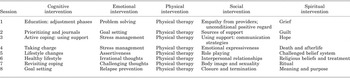
The structured multidisciplinary QOL intervention was designed to improve the participants' five domains of quality of life (Table 1). There were eight 90-min sessions that participants in the intervention group completed within the first 4 weeks after enrollment into the study. The sessions were led by a psychiatrist or psychologist and cofacilitated by a nurse, physical therapist, chaplain, or social worker. The content of these sessions was derived from patient education materials from our cancer education center, manuals utilized in previously published randomized controlled trials for coping with cancer, and specific materials developed by each of the study specialists representing one of the QOL domains (Cunningham, 1991; Classen et al., 1993; Fawzy & Fawzy, 1994; Nezu et al., 1998). The leaders and coleaders received training in using the structured, manualized materials and audiovisual teaching materials. Back-up group leaders or coleaders also received the same training and in addition observed the interventions prior to participation. This ensured fidelity and reproducibility of the interventions throughout the course of the study (Bellg et al., 2004).
Structured multidisciplinary intervention sessions

Each session started with 20-min conditioning exercises led by a physical therapist, followed by educational instruction on symptom management, spiritual guidance, information on financial resources and advanced directives, cognitive behavioral training for coping with cancer, and open discussion and support. The sessions concluded with 20 min of relaxation exercises. Participants received a 200-page written manual of materials covered in each of the eight sessions. At the end of each session, participants were asked to rate the value of the content of the session. On a 0–10 scale, with 10 being the highest, the range was 7–10 and the mean for each session was 9.
The standard of care condition involved the participant receiving the usual level of care that consisted of regular outpatient visits with their primary oncologist, radiation oncologist, and other allied health care providers. If clinically indicated, they were referred to other specialists by their oncologist, and all were also referred to the American Cancer Society for information about coping with cancer. Patients could also attend any non-research-based support group or other educational classes or use any other available resources as they wished. This was designed to reflect actual clinical standard practice.
OUTCOME MEASURES
The primary outcome measure for the overall study was the participants' rating of their overall QOL as measured on the Spitzer QOL Uniscale and the multiple domains of QOL as measured by the Linear Analogue Scales of Assessment (LASA) of QOL, both of which have been used in a number of oncology trials (Grunberg et al., 1996; Gudex et al., 1996; Bretscher et al., 1999; Sloan et al., 2003; Rummans et al., 2006). The Spitzer uniscale is a single question rating of a person's overall quality of life (Spitzer et al., 1981). The LASA consists of 12 items, each rated on a scale from 0 (as bad as it can be) to 100 (as good as it can be), including ratings of cognitive, physical, emotional, social, and spiritual well-being, as well as fatigue and pain. The social domain included overall social well-being, social support, financial well-being, and legal concerns. These instruments have been shown to be effective for obtaining valid and reliable measures of QOL (Cella, 1996; Osoba, 2002; Brown et al., 2006; Clark et al., 2006).
The primary outcome measures for this project involved a comparison of scores among the geriatric and nongeriatric population, using age 65 years as a cutoff. Within the geriatric group, those who were randomized to the intervention were compared to those who were randomized to standard care. Within the intervention groups, QOL scores were compared between the geriatric and the nongeriatric age groups.
The overall study sample of 50 patients per group provided 80% power to detect a clinically significant difference of a half standard deviation in overall QOL among treatment groups at week 4. Due to the unbalanced nature of the geriatric and nongeriatric populations (33 patients vs. 70 patients, respectively), there is 80% power to detect a difference of 0.6 standard deviations between these groups.
For all analyses, assessment scores were converted to a 0–100 scale where 100 is the best possible response regardless of the orientation in which the question was phrased. A difference from baseline of more than 10 points is considered a “clinically significant” finding (Sloan et al., 2003). Summary statistics including mean, median, standard deviation, and range were calculated by group across time. Two sample t tests were performed to compare differences in QOL between treatment groups and Kruskal–Wallis tests were used to assess the difference between the age groups. Linear modeling was utilized to determine the relationship between baseline characteristics and QOL.
RESULTS
Results from the primary study showed that overall QOL, as measured by the Spitzer uniscale of QOL, was maintained during radiation therapy in those receiving the structured intervention, whereas QOL was significantly reduced in the control group (Rummans et al., 2006).
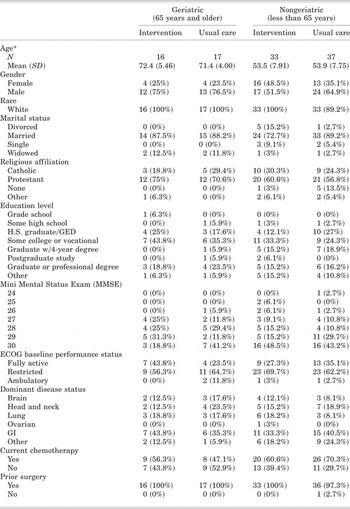
This study shows baseline participant characteristics divided into four subgroups based on age (geriatric, age 65 years and older, vs. nongeriatric, younger than age 65) and arm of intervention (structured intervention vs. standard of care; Table 2). All four subgroups were fairly well educated, and all four groups demonstrated high scores on the baseline MMSE. The majority of the participants had restricted functional status at baseline, concurrent chemotherapy, and prior surgery. Gastrointestinal cancer was the most common type of cancer in all of the four subgroups. Among the purely geriatric population (Table 1), both arms of intervention showed a similar proportion of gender, race, marital status, education level, and employment. They also had similar baseline scores on cognitive and functional testing.
Demographical information by age and arm of intervention

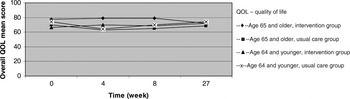
In comparing overall QOL scores in all ages, results show that the geriatric age group who received the structured multidisciplinary intervention consistently showed the highest overall QOL scores at baseline, at week 4, and at week 8 as measured by the Spitzer unsicale (Fig. 1). This overall maintenance of QOL during radiation treatment mirrors the intervention effects shown in the nongeriatric participants. The particular domains of QOL on which the geriatric intervention group scored significantly higher compared to other groups included spiritual well-being at week 4 and emotional well-being at week 8.

Overall quality of life (QOL) based on age and arm of intervention.
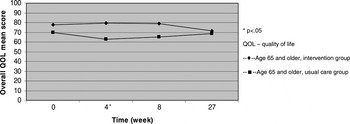
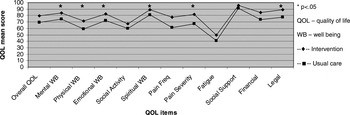
Compared to those who received standard care in the geriatric group, those who received the QOL intervention had consistently higher overall QOL scores throughout the study and significantly higher scores at week 4 (79.3 vs. 62.9, p = .0461; Fig. 2). Furthermore, the geriatric intervention group demonstrated clinically significant improvement in QOL scores at weeks 4 and 8 compared to their elderly counterparts who did not receive the intervention. The geriatric intervention group also consistently scored higher on the individual QOL domain items; however, these differences were not statistically significant.

Overall quality of life (QOL) in the geriatric participants.
In examining baseline differences between the geriatric and nongeriatric patients on the individual QOL domains, at baseline the geriatric group across the board scored 6–20 points higher on all except one (social support). The geriatric participants also demonstrated significant differences, both statistically and clinically significant, on the domains of physical well-being, pain frequency, fatigue, and financial concerns. The trend continued at week 4 (Fig. 3), and the geriatric subjects scored significantly higher on mental well-being, physical well-being, emotional well-being, spiritual well-being, pain severity, and legal concerns. At week 8, the geriatric group scores remained higher on domains of mental well-being, emotional well-being, and spiritual well-being. At week 27, the geriatric group scored lower than the nongeriatric group, but the difference was not statistically significant or clinically meaningful.

Individual quality of life (QOL) scores at week 4 in intervention participants by age.
DISCUSSION
The purpose of this study was to examine the potential impact of age on receiving benefit from participating in a structured multidisciplinary intervention designed to maintain the quality of life of cancer patients undergoing cancer treatment. The results demonstrate that the QOL of geriatric patients with advanced cancer undergoing radiation therapy can be positively affected by participating in a structured multidisciplinary QOL intervention. Other researchers should investigate these findings, but it appears that older age alone should not be used to exclude an individual from participating in a cancer QOL intervention.
It is also interesting to note that the elderly subjects in the study who received the multidisciplinary structured intervention demonstrated maintenance of their quality of life across a range of domains of QOL. This finding was consistent across the board when compared according to age or arm of intervention. Unfortunately, the clinically and statistically significant between-group difference of overall QOL of the geriatric intervention participants and nonparticipants, demonstrated at week 4, was not sustained beyond that time point. Those who did not participate in this intervention showed slow improvement in their QOL scores, which approached baseline by week 27. This is a finding consistent with the results of our primary study. The fact that QOL was significantly improved at week 4 could be due to due to the intervention being designed to address and improve the QOL of patients during the critical time when they are receiving radiation therapy, and it is not too surprising that the difference was only found at the end of radiation treatment. Future interventions need to provide coping skills for the postmedical treatment time period.
A third finding was that the geriatric patients, whether they were in the usual care or intervention arm, reported higher overall QOL compared to the nongeriatric patients at baseline. This higher level of QOL at baseline positioned the elderly individuals to more likely maintain a higher QOL compared to the younger participants. This is consistent with widely recognized research observations that entry scores are very predictive of follow-up scores.
Given that the geriatric patients would be more likely to have other medical problems at baseline, this is an unexpected finding. Perhaps they have learned to cope and adapt to other health problems over time and the impact of a cancer diagnosis and treatment is less profound on many components of QOL. It could also be that the geriatric patients had fewer work or family responsibilities, so that their cancer had less of an impact on their QOL. A different explanation for these findings would be that, rather than an impact of age, the difference may potentially be due to a generational impact. Many of the elderly patients grew up during the Depression era followed by World War II and were exposed to hardships that younger individuals were not. In support of this premise, surveys have shown that all subsequent generations (baby boomers, generation X) after the WWII generation have had few statistical differences between them in social issues such divorce and drug use, whereas there are big differences when comparing within the WWII generation.
Despite our significant findings, our study had limitations. Participants had a variety of different forms of advanced cancer, and some also received chemotherapy in addition to radiation, which could affect the results of the study. Data from this study that investigated fatigue from the entire patient data set found that chemotherapy use was well balanced between both groups and did not have a significant impact on the study results (Brown et al., 2006). Most of our study participants were white, Christian, and Midwesterners. The availability of a multidisciplinary team in a tertiary care center may limit the application of this approach in many cancer treatment centers. Finally, because this involved a subanalysis of a larger study, our sample size was small. Larger sample sizes may identify even larger differences than we observed in this study.
Our findings have important clinical implications on directing the care of geriatric patients with advanced cancer. With a comprehensive, structured multidisciplinary approach to address QOL issues, older patients can maintain or even improve their quality of life at a critical time when QOL issues are paramount. Finally, it is possible that further evaluation of interventions designed to maintain quality of life in patients with advanced cancer may result in reduced caregiver stress, which warrants further investigation.
ACKNOWLEDGMENTS
This research was funded by the Linse Bock Foundation and the Saint Marys Hospital Sponsorship Board. The research was presented as a Presidential Poster Session at the 2006 Annual Scientific Meeting of the American Geriatrics Society.