CORAL DISEASES—'WILD TYPES'
The study of coral diseases encompasses many different disciplines as it involves several aspects of complex host–pathogen interactions within the environment. Diseases and syndromes in corals have increased in number over recent years (Harvell Reference Harvell2007), however since the first observations of diseases affecting reef corals in the late 1970s and early 1980s (Ducklow & Mitchell, Reference Ducklow and Mitchell1979; Peters et al., Reference Peters, Oprandy and Yevich1983; Rutzler & Santavy, Reference Rutzler and Santavy1983; Antonius, Reference Antonius1985), the research priorities have changed substantially; from simple and general descriptions of disease signs in the field (Rutzler & Santavy, Reference Rutzler and Santavy1983) to microbial studies based on culture and/or non-culturable methods (Lesser et al., Reference Lesser, Bythell, Gates, Johnstone and Hoegh-Guldberg2007; Garren et al., Reference Garren, Raymundo, Guest, Harvell and Azam2009; Kvennefors et al., Reference Kvennefors, Sampayo, Ridgway, Barnes and Hoegh-Guldberg2010). Since the early 1990s there has been increasing effort to characterize coral disease, including the application of novel molecular tools to confirm the identities of pathogens and apply Koch's postulates, thereby aiding in the understanding of the mechanisms of the host responses and resistance to particular diseases and pathogenic causal agents (Fredericks & Relman, Reference Fredericks and Relman1996). Currently 18 coral diseases have been identified (Bourne et al., Reference Bourne, Garren, Work, Rosenberg, Smith and Harvell2009), yet only a few of these have been attributed to any particular causal agent (Kushmaro et al., Reference Kushmaro, Banin, Loya, Stackebradt and Rosenberg2001; Ben-Haim & Rosenberg, Reference Ben-Haim and Rosenberg2002; Cooney et al., Reference Cooney, Pantos, Le Tissier, Barer, O'Donnell and Bythell2002; Ben-Haim et al., Reference Ben-Haim, Thompson, Thompson, Cnockaert, Hoste, Swings and Rosenberg2003a; Luna et al., Reference Luna, Biavasco and Danovaro2007; Sussman et al., Reference Sussman, Willis, Victor and Bourne2008), and in some cases the literature is confused with different authors ascribing different causal agents to the same disease (Luna et al., Reference Luna, Biavasco and Danovaro2007, Reference Luna, Bongiorni, Gili, Biavasco and Danovaro2010; Sussman et al., Reference Sussman, Willis, Victor and Bourne2008).
White band type ІІ (Denner et al., Reference Denner, Smith, Busse, Schumann, Narzt, Polson, Lubitz and Richardson2003), white pox (Patterson et al., Reference Patterson, Porter, Ritchie, Polson, Mueller, Peters, Santavy and Smiths2002; Lyndon, Reference Lyndon2003; Sutherland & Ritchie, Reference Sutherland and Ritchie2004), aspergillosis (Kirkwood et al., Reference Kirkwood, Todd, Rypien and Johnston2010) and white plague type ІІ (Richardson et al., Reference Richardson, Goldberg, Kuta, Aronson, Smith, Ritchie, Halas, Feingold and Miller1998; Denner et al., Reference Denner, Smith, Busse, Schumann, Narzt, Polson, Lubitz and Richardson2003) are believed to be caused by known bacterial pathogens (Richardson et al., Reference Richardson, Goldberg, Kuta, Aronson, Smith, Ritchie, Halas, Feingold and Miller1998; Rosenberg & Ben-Haim, Reference Rosenberg and Ben-Haim2002; Weil et al., Reference Weil, Smith and Gil-Agudelo2006), and the seasonal bleaching of Oculina patagonica and Pocillopora damicornis has been proposed to be caused by Vibrio shiloi and V. coralliilyticus respectively (Rosenberg & Ben-Haim, Reference Rosenberg and Ben-Haim2002; Bourne & Munn, Reference Bourne and Munn2005), although this is disputed (Ainsworth et al., Reference Ainsworth, Fine, Roff and Hoegh-Guldberg2008). Some diseases may be caused by a single agent, which can be amenable to investigation via Koch's postulates (Sussman et al., Reference Sussman, Willis, Victor and Bourne2008). However, others appear to be caused by a complex association of microbes. For example, black band disease, found throughout the Caribbean and the Indo-Pacific, appears to contain at least 50 different bacterial types within the disease lesion (Sekar et al., Reference Sekar, Mills, Remily, Voss and Richardson2006). The current lack of baseline data on coral–microbial associations of healthy corals (Sweet et al., Reference Sweet, Croquer and Bythell2011a), coupled with the highly diverse microbial communities often associated with many coral diseases, makes a definitive comparison between coral diseases, often with similar disease signs, very difficult. Historically, the focus of coral disease research has primarily been on bacterial and fungal infections, whereas only recently have other microorganisms been studied. These include the infection of trematodes on Porites sp. (Aeby, Reference Aeby2002, Reference Aeby2003, Reference Aeby2007; Palmer et al., Reference Palmer, Roth and Gates2009) and more frequently the numerous reports of ciliate-associated diseases both in the Indo-Pacific and the Caribbean (Croquer et al., Reference Croquer, Bastidas and Lipscomb2006a, Reference Croquer, Bastidas, Lipscomp, Rodriguez-Martinez, Jordan-Dahlgren and Guzmanb; Cooper et al., Reference Cooper, Lirman and Schmale2007; Bourne et al., Reference Bourne, Boyett, Henderson, Muirhead and Willis2008; Page & Willis, Reference Page and Willis2008; Qiu et al., Reference Qiu, Huang, Huang, Yang and Lin2010).
With such a diversity of potential causal agents, and very little research that has located these potential agents to the specific sites and mechanisms of pathogenesis, it is extremely difficult to follow these pathogens through the environment to determine their reservoirs and modes of transmission. Several studies have detected proposed coral pathogens in healthy corals (Ritchie & Smith, Reference Ritchie, Smith, Rosenburg and Loya2004; Bourne & Munn, Reference Bourne and Munn2005; Klaus et al., Reference Klaus, Frias-Lopez, Bonheyo, Heikoop and Fouke2005; Ritchie, Reference Ritchie2006; Sweet et al., Reference Sweet, Croquer and Bythell2011b), suggesting that multiple factors in addition to pathogen exposure may be important to disease onset. Further complication arises since diseases are often identified by their symptoms alone leading to confusion over field identification of different disease lesions (Lindop et al., Reference Lindop, Hind and Bythell2008), making comparisons between studies difficult.
Ciliates and other protozoans have only recently been associated with diseases of corals. Skeleton-eroding band (SEB) was not only the first coral disease to be shown to be caused by a protozoan, but the first to be identified as being caused by a eukaryote (Antonius & Lipscomb, Reference Antonius and Lipscomb2001). SEB is a progressive disease, widespread throughout the Indo-Pacific with high local prevalence (Page & Willis, Reference Page and Willis2008). The disease is characterized by a skeletal-eroding lesion with a speckled black band composed of the empty loricae (shell-like housings) of the folliculinid ciliate, Halofolliculina corallasia (Winkler et al., Reference Winkler, Antonius and Renegar2004). More recently, another ciliate infection in the Indo-Pacific, brown band syndrome (BrB), has been described. BrB is widespread in parts of the Great Barrier Reef and known to effect three major coral families: Acroporidae, Pocilloporidae and Faviidae (Bourne et al., Reference Bourne, Boyett, Henderson, Muirhead and Willis2008). This ciliate, identified as a member of the subclass Scuticociliatia (Bourne et al., Reference Bourne, Boyett, Henderson, Muirhead and Willis2008) and only recently described as a novel species Porpostoma guamensis (Lobban et al., Reference Lobban, Raymundo and Montagnes2011), has been shown to ingest intact symbiotic algae of the coral and is responsible for the visible symptoms of this disease (a variable brown band). Ciliates have also been shown to invade the tissues of corals after damage by predators, such as the feeding scars left by the crown-of-thorn's star fish Acanthastar planci (Nugues & Bak, Reference Nugues and Bak2009) and devour the tissues of coral spats (Cooper et al., Reference Cooper, Lirman and Schmale2007). These findings further suggest that these organisms have an overall negative effect on coral population dynamics, by increasing post-settlement mortality. In contrast, other protozoans, identified as stramenopile protists, have been shown to be natural associates of corals, found both on the coral surface and within the tissues (Kramarsky-Winter et al., Reference Kramarsky-Winter, Harel, Siboni, Ben Dov, Brickner, Loya and Kushmaro2006).
The first evidence of a coral–protozoan association in the Caribbean was reported in 2002, when a sequence matching with the phylum Apicomplexa was found in tissues of Montastraea annularis (Toller et al., Reference Toller, Rowan and Knowlton2002). Despite this protozoan being related to coccidians, which are known to be highly virulent parasites, the nature of its interaction with corals remains largely unknown. In 2006, new evidence arose to show that ciliate infections were not exclusive to the Indo-Pacific. Folliculinid ciliates in the genus Halofolliculina were reported for the first time affecting over 26 Caribbean reef-building coral species (Croquer et al., Reference Croquer, Bastidas, Lipscomp, Rodriguez-Martinez, Jordan-Dahlgren and Guzman2006b). Although it is still to be determined whether this Caribbean ciliate infection (CCI) is the same as SEB in the Indo-Pacific, their morphology, life cycle and patterns of infection are similar. In terms of pathology, both SEB and CCI have been shown to produce tissue mortality and in the particular case of CCI a negative effect on tissue regeneration (Page & Willis, Reference Page and Willis2008; Rodriguez et al., Reference Rodriguez, Croquer, Guzman and Bastidas2009). Both diseases have been shown to transmit directly from infected to susceptible hosts (Page et al., unpublished results) with injuries (Page & Willis, Reference Page and Willis2008; Rodriguez et al., Reference Rodriguez, Croquer, Guzman and Bastidas2009) and temperature (Rodriguez et al., Reference Rodriguez, Croquer, Guzman and Bastidas2009) enhancing transmission rates. Both SEB and CCI are widespread and occur across bioregions (Willis et al., Reference Willis, Page, Dinsdale, Rosenberg and Loya2004; Winkler et al., Reference Winkler, Antonius and Renegar2004; Croquer & Weil, Reference Croquer and Weil2009), affecting a wide range of coral hosts which is comparable to the most virulent of the bacterial diseases (Weil, Reference Weil, Rosenberg and Loya2004). Thus, increasing evidence indicates that ciliate infections are a significant problem for coral reef health, yet Koch's postulates have not been fulfilled for any of the ciliates associated with coral lesions, further complicating the problem because mixed ciliate communities have been reported thriving upon and/or underneath infected tissues.
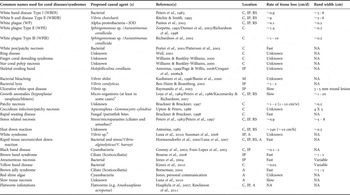
A suite of coral pathologies, termed white syndrome (WS) in the Indo-Pacific and ‘white’ diseases (commonly, white plague and white band disease) are ecologically important and have caused widespread coral mortality. The white syndromes have been correlated with elevated temperature anomalies; however, there is conflicting evidence over the causal agents of these syndromes (Table 1). Despite the prevalence of these diseases/syndromes few types have been satisfactorily characterized (Bythell & Pantos, Reference Bythell and Pantos2004; Lesser et al., Reference Lesser, Bythell, Gates, Johnstone and Hoegh-Guldberg2007). Despite this classification problem, many attempts have been made to link these diseases with a particular bacterial pathogen (Peters et al., Reference Peters, Oprandy and Yevich1983; Barash et al., Reference Barash, Sulam, Loya and Rosenberg2005; Thompson et al., Reference Thompson, Barash, Sawabe, Sharon, Swings and Rosenberg2006; Efrony et al., Reference Efrony, Loya, Bacharach and Rosenberg2007, Reference Efrony, Atad and Rosenberg2009; Sussman et al., Reference Sussman, Willis, Victor and Bourne2008). For example, Aurantimonas coralicida has been reported to cause white plague Type II disease in the elliptical star coral Dichocoenia stokesii (Denner et al., Reference Denner, Smith, Busse, Schumann, Narzt, Polson, Lubitz and Richardson2003). Another α-proteobacterium, thought to be the causative agent in juvenile oyster disease has been shown to be unique to colonies of the Caribbean coral Montastrea annularis exhibiting tissue lesions indicative of a white plague-like disease (Pantos et al., Reference Pantos, Cooney, Le Tissier, Barer, O'Donnell and Bythell2003). Many of the most commonly cited bacterial pathogens associated with coral diseases belong to the genus Vibrio. Numerous Vibrio pathogens have also been associated with WS (Sussman et al., Reference Sussman, Willis, Victor and Bourne2008), with Vibrio harveyi being the most recent (Luna et al., Reference Luna, Bongiorni, Gili, Biavasco and Danovaro2010). Despite the great effort, time and money spent trying to isolate specific pathogens and prove Koch's postulates discrepancies in the final disease outcome are common. Progressive tissue sloughing (tissue detaching from the coral skeleton) such as that described as the main disease sign in these white syndromes for example, has also been ascribed to similar diseases such as shut down reaction, rapid tissue necrosis and stress related necrosis (Borneman & Lowrie, Reference Borneman and Lowrie2001; Luna et al., Reference Luna, Biavasco and Danovaro2007, Reference Luna, Bongiorni, Gili, Biavasco and Danovaro2010; Efrony et al., Reference Efrony, Atad and Rosenberg2009). The main distinctions between these diseases/symptoms (Table 1) appear to be the rates of progression of the lesion, the species affected and regional separation (most notably those from the Caribbean and the Indo-Pacific). Currently, it is not known how these diseases are related and to date no specific pathogens have been found for these latter diseases.
Showing the diverse array of coral diseases occurring throughout the world (C, Caribbean; IP, Indo-Pacific; M, Mediterranean; RS, Red Sea) and within aquarium (A), their various attributed names, proposed causal agents, rate of recorded tissue loss and band width (if any):† Kaczmarsky & Richardson (Reference Kaczmarsky and Richardson2007) show GA to be transferable and suggest microorganisms as potential causal agent do not always appear as ‘white’ patterning; * E. Peters (Reference Peters, Oprandy and Yevich1983) noted the importance of these microorganisms but did not link them directly with the specific disease causation;$ Luna et al. (Reference Luna, Biavasco and Danovaro2007, Reference Luna, Bongiorni, Gili, Biavasco and Danovaro2010) noted that Vibrio sp. failed to cause white syndromes (WS) in all cases, suggesting WS have multifactorial aetiology and/or a group of diseases caused by more than one pathogen.

CAUSATION AND CURE IN THE WILD
A few attempts have been made to cure coral diseases in the wild, notably the use of antibiotics, removal of the microbial mat associated with the lesion and shading of the infected area (Peters et al., Reference Peters, Gassman, Firman, Richmond and Power1997; Griffin, Reference Griffin1998). Both yellow band disease (YBD) and white plague (Miller et al., Reference Miller, Rogers and Waara2003) have been reported to be treatable in the field, involving an application of putty and clay over infected tissue (Riegl et al., Reference Riegl, Bruckner, Coles, Renaud and Dodge2009). As an alternative to direct treatment of diseased corals, novel biological restoration approaches applied in Florida have been used to enhance recruitment of corals, reduce coral mortality and improve habitat quality. The most notable of these is the biological control and/or mitigation of spread of certain diseases by utilizing the reintroduction of Diadema antillarum as a tool to reduce macroalgal cover and induce increased settlement of coral larvae (Miller, personal communication). In response to BBD, Bruckner (Reference Bruckner1999) tried a variety of different techniques including: (1) the complete removal of the BBD lesion using a syringe, then covering with modelling clay or underwater putty; (2) shading of the BBD lesion using sun screens; and (3) addition of D. antillarum to cages containing the diseased corals. Brucker (Reference Bruckner1999), reported all treatments were successful but to varying degrees, with the highest success rate (>95%) being the use of underwater putty following removal of the microbial mat. This technique along with shading of infected colonies (Griffin, Reference Griffin1998) may be suitable when applied to small scale recovery programmes but remains impractical to treat large numbers of corals over large areas. Added to this, because BBD is believed to be transmitted in water, the removal of the band may liberate potential pathogens and aid in transmission to downstream corals. A recent review by Teplitski & Ritchie (Reference Teplitski and Ritchie2009), highlighted potential tools for coral disease management, the newest proposed method for curing coral disease in situ is the use of phage therapy. Bacterial viruses (bacteriophages or phages for short) have been used for treatment of human diseases with varied success and more recently within aquaculture for treating farmed fish diseases. The main advantages of phage therapy, particularly with corals, are potential host specificity and the fact that viruses self-replicate so any treatment would continue over large time scales with only minimal initial treatment doses, alongside the overall environmental safety of this particular type of treatment. The phage only attacks and destroys specific pathogens, leaving the beneficial bacteria within the coral holobiont unharmed. To date, phage therapy has only been considered for two main types of coral disease: tissue lysis of Pocillopora damicornis by Vibrio coralliilyticus (Ben-Haim & Rosenberg, Reference Ben-Haim and Rosenberg2002; Ben-Haim et al., Reference Ben-Haim, Zicherman-Keren and Rosenberg2003b); and white plague-like disease affecting several large coral species including Favia favus, Platygyra sp. and Goniastrea sp. thought to be caused by Thalosomonas loyaeana (Barash et al., Reference Barash, Sulam, Loya and Rosenberg2005; Thompson et al., Reference Thompson, Barash, Sawabe, Sharon, Swings and Rosenberg2006). Yet for phage therapy to work in the first place the causal agent must be known to be the sole causal agent and as this is in some debate for all coral diseases (Ainsworth et al., Reference Ainsworth, Fine, Roff and Hoegh-Guldberg2008; Lesser et al., Reference Lesser, Bythell, Gates, Johnstone and Hoegh-Guldberg2007), these forms of treatment remain highly controversial. Despite this, Efrony et al. (Reference Efrony, Loya, Bacharach and Rosenberg2007) demonstrated that inoculation of specific phages at the same time as the proposed bacterial pathogens did inhibit infection in colonies within the aquarium environment. It was concluded that phage therapy may be a more valuable tool in preventing the spread of diseases, rather than curing infected corals. This was supported by the fact that phage therapy used in a control environment prevented the transmission of a disease from diseased corals to apparently healthy specimens (Efrony et al., Reference Efrony, Atad and Rosenberg2009). However as with antibiotic treatments, exposure to phages can often select for resistant bacterial mutants. A latter proposal which stemmed from phage therapy was suggested by Teplitski & Ritchie (Reference Teplitski and Ritchie2009), whereby coral transplants could be inoculated to give them resistance from at least some strains of bacterial pathogens. Seeding them with beneficial bacteria or phages may offer a degree of protection to these young recruits from potential pathogens and stressors (Teplitski & Ritchie, Reference Teplitski and Ritchie2009).
In summary, despite the great research effort on wild coral diseases, the definitive causative agents, the (microscopic) co-location of suspected pathogens with sites of pathogenesis, factors contributing to their occurrence and transmission, and consequences on coral populations remain largely unknown or at least incomplete for most if not all coral diseases. As with all animals, diseases of corals are the result of an interaction between host, pathogenic agents and environment, each of which poses its own set of challenges and specific research needs. In addition, specific to coral diseases is the limitation that the pathological signs are limited, so that even experts in their field cannot reliably differentiate between diseases within the field (Lindop et al., Reference Lindop, Hind and Bythell2008), and comparisons between studies are therefore extremely difficult.
CORAL DISEASES—'AQUARIUM TYPES'
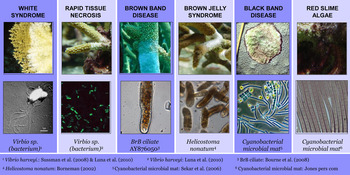
Although there is little work reported in the scientific literature on coral diseases in aquaria, a vast amount of ‘grey literature’ is available on the internet (Table 2). This undervalued information can be used to compile current knowledge of the most common diseases occurring within aquaria. A survey by Coral Zoo (Danovaro & Luna, Reference Danovaro and Luna2008), reported that the two coral disease types occurring most frequently in aquaria were white syndromes (which comprise nearly 70% of the aquarium diseases on record) and brown jelly syndrome (BJS) (Figure 1). White syndromes (WS) are defined as severe tissue loss from the coral with a sharp demarcation between the apparently healthy tissue and the disease lesion and these signs appear to be equivalent to those reported for WS in the wild. BJS has currently not been reported in the wild and is characterized by tissue death associated with widespread visible swelling and necrosis of tissues and mucus production (Borneman & Lowrie, Reference Borneman and Lowrie2001; Danovaro & Luna, Reference Danovaro and Luna2008). WS in the aquarium, like those described in the field, characteristically display extremely variable rates of lesion progression, as well as patterns of tissue loss; which has led to numerous alternative descriptions and definitions, including rapid tissue necrosis (RTN) and shut down reaction (SDR). Coral death occurring within hours is usually referred to as SDR and is thought to be due to stress brought on by any number of factors (handling, temperature, salinity, pH, extreme changes in light or other water quality issues). The slightly slower process of tissue loss, occurring within days or weeks is often referred to as RTN and appears more similar to the wild WS. As a result, RTN is the term more commonly used, specifically for the occurrence of any tissue sloughing in captive corals within aquaria. Borneman (Reference Borneman2002) suggested two main potential causes for RTN: (1) a specific pathological agent; and (2) a response to an external stress, such as physical damage, nutrient deficiencies, or temperature fluctuations, both resulting in autolysis and a general breakdown of the immune system. A more likely hypothesis is the combination of both, where the pathogenic agent, often found within healthy corals as well (e.g. within the surface mucus layer) may opportunistically become pathogenic during periods of stress when the coral's immune defences are impaired and therefore causes the disease symptoms such as that of RTN (Kushmaro et al., Reference Kushmaro, Loya, Fine and Rosenberg1996, Reference Kushmaro, Rosenberg, Fine, Ben-Haim and Loya1998; Toren et al., Reference Toren, Lanndau, Kushmaro, Loya and Rosenberg1998; Ben-Haim et al., Reference Ben-Haim, Zicherman-Keren and Rosenberg2003b). Despite the large number of cases documented in the grey literature only one study of aquarium diseases has been published in the scientific literature to date (Luna et al., Reference Luna, Biavasco and Danovaro2007). Luna et al. (Reference Luna, Biavasco and Danovaro2007) reported that RTN is readily transmissible from diseased corals to healthy specimens, which supports the hypothesis that pathogenic microorganisms are involved. Luna et al. (Reference Luna, Biavasco and Danovaro2007), demonstrate an increase in total Vibrio abundance (Figure 1; Table 1) within diseased specimens compared to those of healthy ones. In particular, one known bacterial pathogen, V. harveyi, was ascribed as being the main causative agent for RTN in their study (Luna et al., Reference Luna, Biavasco and Danovaro2007).
Showing a selection of diseases affecting corals in the wild (dark blue panels) and within aquaria (light blue panels). Disease morphology is depicted in the top picture and the proposed causal agent is depicted below.

Common diseases and syndromes found within aquarium corals and some of the suggested treatments.

Within the aquarium trade, the second most common disease type, BJS, has been associated with a suspected ciliate pathogen, Helicostoma nonatum (Figure 1) (Borneman & Lowrie, Reference Borneman and Lowrie2001). Willis et al. (Reference Willis, Page, Dinsdale, Rosenberg and Loya2004) first speculated that the ciliate associated with BrB disease was similar to this species or at least a close relative, however they later identified the protozoan associated with BrB as being more closely related to a different species of the class Oligohymenophora, subclass Scuticociliatia (Bourne et al., Reference Bourne, Boyett, Henderson, Muirhead and Willis2008). There are only a few descriptions of ciliates from the genus Helicostoma (Rama Mohan Rao et al., Reference Rama Mohan Rao, Hanumantha Rao and Shyamasundri1980, Reference Rama Mohan Rao, Hanumantha Rao and Shyamasundari1981), and very few refer to the species H. nonatum (Kahl, Reference Kahl1931; Purdom & Howard, Reference Purdom and Howard1971); although, it is sometimes referred to as ‘H. notatum’ (Carey & Carey, Reference Carey and Carey1992). However, there are no gene sequences related to this species on GenBank, so it is impossible to reconcile this ciliate with the one described in BrB by Bourne et al. (Reference Bourne, Boyett, Henderson, Muirhead and Willis2008). Other Helicostomas such as H. brudderbucki and H. oblongum are sometimes referred to in the grey literature as the BJS ciliate, but neither fit into the morphological characterization of the BJS ciliate. Further confusion occurs as the taxonomy of this species relates to that of Porpostoma natatum (Kahan et al., Reference Kahan, Wilbert, Vit and Barel1982; Kuhlmann et al., Reference Kuhlmann, Braeucker and Schepers1996; Song, Reference Song2000), recorded in the Australian Antarctica data centre as synonymous with H. nonatum. Paraturbanella stradbroki (Hochberg, Reference Hochberg2002) has also been cited as being the proper epithet for Helicostoma nonatum (Hummon, Reference Hummon2008), having been renamed in 1927, and which has assigned gene sequences in GenBank. This species also appears in databases such as the UNESCO–IOC Register of Marine Organisms, Integrated Taxonomic Information System (ITIS) and World Register of Marine Species (WORMS). To further complicate this issue, recent molecular (sequences submitted to GenBank) and taxonomic research has highlighted the need for restructuring of this particular subclass of ciliates (Scuticociliatia), due to the improvement of molecular characterization and the ability to acquire complete 18S rRNA gene sequences of single cell isolates. Based on a newly submitted sequence to GenBank and the subsequent paper by Zhang et al. (Reference Zhang, Miao, Struder-Kypke, Al-Rasheid, Al-Farraj and Song2011) we suggest the proper name for the BJS ciliate is a Philaster sp. closely related to the newly described species P. digitiformis (Zhang et al., Reference Zhang, Miao, Struder-Kypke, Al-Rasheid, Al-Farraj and Song2011). However, further research is necessary to fully understand this.
Despite the confusion in nomenclature, while ciliates are undisputedly present in the brown jelly material associated with BJS; it remains unclear as to what exact role they play in the disease pathology (i.e. are they the primary or secondary causal agents?), this remains also the case for the wild type disease, BrB. It is feasible they are only present because they are feeding on dead tissue arising from another pathogen or non-pathogenic disease (Borneman & Lowrie, Reference Borneman and Lowrie2001). In support of this, the Zoological Society of London (ZSL) has often but not always isolated Vibrio spp. particularly V. vulnificus from corals such as Goniopora and Euphyllia exhibiting disease signs similar to BJS (authors, personal observations), however further work needs to be conducted. Nevertheless, although, the disease signs of BrB and BJS are distinct and ciliates with similar morphologies appear to be involved in both diseases, at least at some level, it remains difficult to conclude if these are two separate syndromes or different visual pathological signs of the same disease caused by the same agent or agents.
Although WS and BJS are the more common diseases in aquaria, many other types of syndromes are often reported, for example, infestations from organisms such as the red bug Tegastes acroporanus is often referred to as a disease/syndrome in most of the grey literature. Tegastes acroporanus is a predatory micro-crustacean which is specific to acroporids, they are small, ~0.5 mm in length and yellow in colour with a distinctive red dot which gives this species its common name. Poor polyp extension, loss of coloration and overall decline in health have been reported as signs of a red bug infection. Infestations of T. acroporanus have not been recorded in the wild to date, although they would be easily overlooked due to their size. Another common infestation of aquarium corals is numerous flatworm species. The reported ‘brown rust disease’ is attributed to flatworms such as Convolutriloba sp. and Waminoa sp. (Shannon & Achatz, Reference Shannon and Achatz2007). Waminoa sp. tend to be commensal organisms that live only on corals, while Convolutriloba sp. will usually live and grow on any available surface. Despite not being known to cause damage to the corals directly, heavy infestations are reported that can cause disruption to photosynthesis and therefore degrade overall health, particularly in corals such as Euphyllia sp. (authors, personal observations). The heavy infestations associated with brown rust have again not been reported in the wild to date. The Acropora-eating flatworms (AEF), recently named as Amakusaplana acroporae (Rawlinson et al., Reference Rawlinson, Gillis, Billings and Borneman2011), however, are a common pathogen of aquarium Acropora and have also been described in the wild (Barneah et al., Reference Barneah, Ben-Dov, Kramarsky-Winter and Kushmaro2007; Haapkylä et al., Reference Haapkylä, Seymour, Trebilco and Smith2007, Reference Haapkylä, Unsworth, Seymour, Melbourne-Thomas, Flovell, Willis and Smith2009). They are usually extremely well-camouflaged and often the only visible signs would be the feeding scars left behind, exposing the coral skeleton, so the extent of this disease may have been under-reported in the wild and disease lesions reported as other syndromes (potentially classed in the WS group). Another common disease within aquaria is known as ‘red slime algae’. This disease is most commonly associated with high levels of organic nutrients within the aquarium, which in turn may be influenced by changes in light levels. Despite the common name of this disease, the causal agent is not actually an alga at all, but a consortium of cyanobacteria. Varying from red, black to blue-green, the specific causal agent or agents remain unknown, however there are strong similarities between this disease morphology and that of the cyanobacterial mat of BBD within wild coral populations, and cyanobacterial overgrowth is also commonly reported in the wild, particularly in the Caribbean (Weil, Reference Weil, Rosenberg and Loya2004; Weil & Croquer, Reference Weil and Croquer2009).
CAUSATION AND CURE IN AQUARIA
Since the main driver to identifying coral diseases in aquaria is the selection of an effective treatment, the lessons learnt by aquarists over what treatments are effective against particular syndromes can provide invaluable evidence for determining the causal agents of these diseases (Table 2). Such treatments are generally not sought by scientists working in the natural environment, due to the cost and potential environmental impacts of the treatments, however the potential to develop, adapt and treat corals in the wild is an important objective. With slight modifications of these proposed cures, coral disease in the wild could potentially even be managed, maintained and/or localized. If a disease can be effectively treated, this can be used as further proof of the causal agent or agents. When corals are transported to aquaria from the wild (about 2 million coral pieces are currently transported legally per year for such uses; Green & Hendry, Reference Green and Hendry1999; Wabnitz et al., Reference Wabnitz, Taylor, Green, Razak, Wabnitz, Taylor, Green and Razak2003), a significant change in the environmental conditions occurs. Thus considerable physiological stress is placed on the corals, from collection, transportation (e.g. transit times from Indonesia are long, with many stages and high potential for delays) and resettlement within aquaria, and it is therefore understandable that large percentages of those collected never reach their destinations and when they do, disease and death is common. In species such as Catalyphyllia jardinei and Goniopora stokesi mortality rates often approach >80%. In general the most popular species, those of the large single polyp varieties, are vulnerable to physical damage during transport and the onset of rapidly progressing diseases/infections are often seen in these corals. Effective treatments of known diseases and syndromes are therefore important to promote better survival and ultimately minimize the necessity to collect more from natural reefs.
Numerous suggestions have been presented by hobbyists for the cure of common aquarium diseases (Table 2), for example, the use of a broad-spectrum antibiotic, chloramphenicol (Tifomycine:flexyx.com, only available in USA) appears the most common to treat corals suffering from BJS. Chloramphenicol is a bacteriostatic antimicrobial, active against both Gram-positive and Gram-negative bacteria and is extremely lipid-soluble for fast effective treatment (Reefdreams, 2010). Doxycycline, oxytetracycline, iodine and freshwater dips (15 ppt) have also been reportedly used to treat BJS with varying levels of success (authors, personal observations). Yet treatment with antibiotics has a variety of significant limitations: (1) they are difficult to administer to the infected individual; (2) antibiotics are often light sensitive and have a short half life therefore requiring a number of repeat treatments; (3) a requirement of no filtration during treatment which in turn causes other water quality issues and the potential for other diseases to occur; (4) they will undoubtedly be harmful to beneficial bacteria within the coral holobiont and the surrounding water; and more often than not (5) by the time the decision is made to treat the disease the progression is so fast that it is too late to be useful. Treatments for diseases such as RTN which encompasses the ‘white syndromes’ discussed earlier are in much greater debate, primarily due to the causal agent being largely unknown. Fragmentation, isolation, sealing the lesion with epoxy resin and the use of a variety of antibiotics such as doxycycline have all been prescribed as possible treatments (Borneman & Lowrie, Reference Borneman and Lowrie2001; Advancedaquarist, 2002; Borneman, Reference Borneman2002; Leewis et al., Reference Leewis, Wijgerde, Laterveer and Osinga2009), although no systematic assessment of their effectiveness has been conducted.
A treatment of red bug disease caused by T. acroporanus, first developed by Dorton (Reference Dorton2010), is the use of Milbemycin oxime, an active ingredient in heart worm medication for dogs called Interceptor® within the USA or in a product called Milbemax® in the UK (where M. oxime is mixed with praziquantal). This is an indiscriminate drug which kills all crustaceans as well as T. acroporanus, so would not be a feasible treatment of wild diseases. An attractive option to this treatment is the introduction of a biological control, the dragonface pipefish, Corythoichthys haematopterus for example. These fish are known to anchor themselves to acroporids and feed on crustaceans including T. acroporanus. It is also common that secondary infections often follow, initiating from the feeding scars caused by T. acroporanus, along with the scars left by nudibranchs, Drupella and/or other corallivorous snails.
For the treatment of flatworm infections including AEF, Salifert's flatworm exit, levamisole hydrochloride, freshwater dips (15 ppt for 3 m maximum) and iodine-based dips like Lugol's iodine, Fluke-Tabs™ (Aquarium Products), and Trichlorfon™ (Dylox 80, Bayer A.G.) have all been reported for treatment of infected corals (Carl Reference Carl, Leewis and Janse2008; Nosratpour, Reference Nosratpour, Leewis and Janse2008). However, it is important to note that smaller polyp species such as the acroporids can rarely tolerate the use of freshwater dips and often mortality occurs soon after treatment.
Red slime algae is reported to be treatable by commercial products such as Ultralife Red Slime Remover™, Boyd Chemi-Clean™, and Blue Life Red Slime Control™ (Brang, Reference Brang2010). However, many of these diseases are reported as a sign of poor water quality, so most aquarists propose reassessment and improvement of aquarium water quality (reducing levels of nitrate and phosphate and monitoring light levels and improving flow) as the most effective treatment. There is also a syndrome known in the aquarium trade as ‘new tank syndrome’, which often manifests itself as blooms of algae/cyanobacteria (e.g. red slime algae). This is thought to be caused by the new silicone within the tank setup increasing nutrient levels which promotes the growth of the algae.
SIMILARITIES BETWEEN WILD TYPES AND THOSE WITHIN THE AQUARIUM
The differences between the natural reef environment and that within the aquarium are obviously great. Despite this, certain similarities can be seen between the diseases found in both cases. Most notable would be the ‘white syndromes’. As these diseases include many forms of tissue necrosis exposing the skeleton, it is impossible to confirm whether the same diseases occur without any reasonable doubt, however the visible signs are clearly very similar (Figure 1). Only the progression rate of the lesion is thought to distinguish these particular syndromes from each other (Table 1). In addition, there are significant similarities between the proposed causal agent of one form of white syndrome (ciliated white syndrome; authors, personal observations), and that thought to be the causal agent of BJS (Figure 1), the ciliate in question also being from the same genus as the proposed causal agent in BrB (Figure 1). The differences between these diseases may potentially be explained by the conditions in aquaria compared to the reef. In the natural environment wave action is likely to remove the ‘brown jelly like’ necrotic tissue associated with BJS in aquaria, revealing a ‘white syndrome’ type disease lesion. Similarly, black band disease (Figure 1) in the wild is caused by a similar association of cyanobacteria to that of red slime algae (Figure 1); however, the visible disease lesion is also dramatically different. Whilst infestations by other microorganisms like T. acroporanus and certain flatworm species appear to be unique to aquaria with no apparent cases in the wild, this may be due to at least in part that these diseases are currently being overlooked within the wild.
CONCLUSIONS AND MAJOR KNOWLEDGE GAPS
In general, many important aquarium diseases cannot be reconciled to those in the wild. In certain cases however, strong similarities can be seen. For example, the ciliate Helicostoma sp. as a causal agent of BJS in aquarium corals shows strong similarities with the ciliates associated with BrB in the wild. It is proposed that Helicostoma may be a misnomer and this ciliate may be the same as that identified in BrB. Improved understanding of this pathogen and other pathogens of these common aquarium diseases could benefit both fields. Improved practices in aquarium maintenance and husbandry would also benefit natural environments by reducing the scale of wild harvest and improving the potential for coral culture, both for the aquarium industry and for rehabilitation programmes. It is noted that in general, management of diseases within the marine environment and corals in particular is challenging due to the difficulties in controlling habitat and population dynamics and the potentially rapid rates of spread (Bourne et al., Reference Bourne, Garren, Work, Rosenberg, Smith and Harvell2009). However, without understanding the interactions between causative agents, corals and their environments, management of these diseases in the field will be near impossible. One potential step forward would be trials and adaptations of the cures used within the aquarium trade to those diseases which may be similar in the wild.
FURTHER WORK
(1) A complete study on aquarium diseases and their causal agents needs to be carried out using microbiological techniques, with attempts made to prove Koch's postulates for the proposed causal agents; and
(2) treatment trials to systematically test all treatments proposed for specific diseases (particularly RTN and BJS), within the grey literature and attempts to improve those which work.