Women are less likely than men to follow the news. This sex difference in news consumption appears to be “an acknowledged fact” (Benesch Reference Benesch2012, 150), and yet there has been surprisingly little systematic investigation of its root causes (see Lemish and Alony Reference Lemish and Alony2014). This neglect on the part of communications scholars and political scientists alike is surprising, given the link between news consumption and political knowledge (Eveland and Scheufele Reference Eveland and Scheufele2000). After all, political scientists have devoted a good deal of effort to understanding why women appear to be less informed than men about politics (see below). These studies have been motivated by an understanding that “knowledge inequalities … may lead to serious power differentials” (Viswanath and Finnegan Reference Viswanath, Finnegan and Burleson1996, 189). When women know less about politics than men do, collective preferences are likely to be biased in favor of the male majority (Althaus Reference Althaus2003). Given the importance of the media as a source of information about politics, it is therefore imperative that we understand why women consume less news than men do—and this is especially true in light of emerging evidence that the gender gapFootnote 1 in political knowledge is related to differences in the amount of attention that women and men pay to the news (Economic and Social Research Council 2013).
One distinct possibility—and one that has thus far received very little attention in the literatures on sex differences in political knowledge and/or new consumption—is that the pervasive negativity of news content is behind the tendency for women to pay less attention than men to news about politics. This suspicion is based on two findings. First, negative content dominates the news (for a recent review of the literature, see Soroka Reference Soroka2014; also see, e.g., Just, Crigler and Neuman Reference Just, Crigler, Neuman and Crigler1996; Patterson Reference Patterson1994; Sabato 1991). As Newhagen (Reference Newhagen1998) has observed, viewers of the typical television news broadcast are exposed to “more images of violence, suffering, and death in a half hour than most people would normally view in a lifetime” (267). Second, women appear to have different reactions to negative content than men. Surveys report that women are much more likely than men to cite an undue focus on war and violence as a reason for not following international news (Pew 2002), and many more women than men say that they often find the news depressing (Pew 2004). Women are also less likely than men to say that they find news content entertaining or enjoyable; more likely to agree that there is “too much violence, disaster and tragedy” in television news shows; more likely to say that television news makes them worry and that violent story or picture content causes them to turn the news off; and more likely to say that they would be happy to see more good news (Klein Reference Klein2003). Even among children as young as eight years old, girls are more likely than boys to report that the news makes them anxious and fearful (Lemish and Alony Reference Lemish and Alony2014).
There are, to date, just a few studies looking for links between negativity and sex differences in attention to the news; and they have thus far produced mixed results. These studies have also relied on self-reports, raising concerns about possible social desirability bias as well as the potential unreliability of reports of internal states (Kleemans et al. Reference Kleemans, Vettehen, Beentjes and Eisinga2012). Our goal is thus to further explore the possibility that women react to negative news content differently than men, with an eye toward the possibility that differential reactions to negative content can help explain why women consume less news than men and thus appear to be systematically less informed about politics. We report the results of an experiment that uses physiological measurements of skin conductance and heart rate to test for sex differences in responses to negative news stories. We expect, given past work in psychology and neurophysiology, that women will show heightened reactions to negative news content; as we shall see, results confirm this expectation. In a concluding section, we interpret these results in light of existing work on sex differences in news consumption and reactions to negativity in news content. We begin by reviewing the existing literatures below.Footnote 2
SEX DIFFERENCES IN NEWS CONSUMPTION
There is abundant evidence of sex differences in news consumption. Women in the United States have been found to spend less time consuming news than men across most, if not all, media (e.g., Benesch Reference Benesch2012; Bimber Reference Bimber1999). The same is true elsewhere: acccording to the fourth wave of the European Social Survey, women spend less time than men listening to news on the radio, watching the news on television, and reading about the news in the newspaper in all but two of the 28 countries surveyed; and the World Values Survey reveals a significant gender gap in news consumption in 45 of 63 countries (Benesch Reference Benesch2012).
While the existence of sex differences in news consumption is well documented, the reasons for these differences are not well understood. There has been a good deal of speculation, to be sure, but little in the way of systematic analysis. Factors such as the underrepresentation of women as news sources and the lack of mentions of women in news stories about politics have been cited, as well as the dominance of men in the newsroom and especially in managerial positions (Harp Reference Harp, Poindexter, Meraz and Weiss2008; Lemesh and Alony Reference Lemish and Alony2014). The fact that politics remains a male-dominated sphere may explain why political news remains very much a “masculine narrative” (Rakow and Kranich Reference Rakow and Kranich1991, 8). This explanation gains plausibility from findings that sex differences in political engagement (Atkeson Reference Atkeson2003) and political knowledge (Burns, Verba, and Schlozman Reference Burns, Verba and Schlozman1997) diminish when there are visible and competitive female candidates. Other explanations point to the role of socialization, suggesting that boys may be socialized differently than girls about the importance of keeping abreast of the news (Pointdexter, Meraz, and Weiss Reference Poindexter, Meraz and Weiss2008).
The most systematic analysis of sex differences in news consumption focuses on four possible explanations (Benesch Reference Benesch2012): (1) preferences—that is, differences in women's and men's taste for politics (see also, e.g., Dow Reference Dow2009; Verba, Burns, and Schlozman 1997); (2) the possibility that the private benefits of news consumption might be lower for women because their jobs are less likely to require “political literacy”; (3) differences in the perceived political benefits of keeping up with the news; and (4) higher cognitive and/or opportunity costs for women in keeping up with the news. Benesch finds little evidence to support most of these explanations, although it is notable both that the size of the male-female difference in news consumption is related to gender inequality in politics cross-nationally (related to explanation 3), and that the sex difference in news consumption is greatest among working people with children, suggesting that the “double day” of paid employment and household responsibilities limits women's opportunities to keep up with the news (explanation 4). Women are also more likely to say that they are often too busy to follow the news; but lack of time may simply be a socially acceptable way of explaining lack of attention to the news (see, e.g., Pointdexter, Meraz, and Weiss Reference Poindexter, Meraz and Weiss2008).
Like the gender gap in political knowledge (see, e.g., Delli Carpini and Keeter Reference Delli Carpini, Keeter, Tolleson-Rinehart and Josephson2000; Dolan Reference Dolan2011; Dow Reference Dow2009; Frazer and Macdonald Reference Frazer and Macdonald2003; Gidengil et al. Reference Gidengil, Blais, Nevitte and Nadeau2004), the male-female difference in news consumption has so far eluded a satisfactory explanation. Neither gap can be easily explained by socioeconomic or other sociodemographic differences. Both gaps hold regardless of income, education, labor market status, marital status, race, and age. “One can control for everything including the kitchen sink and the political knowledge gender gap remains” (Dow Reference Dow2009, 119). The same may well be true of the gap in news consumption.Footnote 3
A recent study takes a novel approach to accounting for the gender gap in political knowledge. Using a twin study design, Hannagan and her colleagues (2014) advance a behavioral genetic explanation for the portion of the gender gap that cannot be explained by environmental factors like education. They find that political knowledge questions elicit greater variation among women than among men and that this variation is heritable, driven by additive genetic effects. They suggest that “there may be adaptation involved—or something in the psychological or behavioral trait that is relevant for survival and reproduction to one sex but not the other” (107). As a result, women and men tend to pay attention to different aspects of social and political life.
One implication is that women fare poorly on conventional tests of political knowledge because the type of knowledge measured does not offer practical benefits. Ask about aspects of knowledge that are more relevant to women's daily lives—like accessing government services and benefits—and the knowledge gaps disappear or even reverse (Stolle and Gidengil Reference Stolle and Gidengil2010). And like most tests of political knowledge, political news tends to be “all about the contest, hierarchy, and power” (Hannagan, Littvay, and Popa Reference Hannagan, Litvay and Popa2014, 108). We cannot explore whether heritability plays a role in explaining sex differences in news consumption here. But we do share the belief of Hannagan and her colleagues that we need to look beyond disciplinary boundaries to explain these differences. Accordingly, we turn to psychology, evolutionary biology, and neuroscience to develop hypotheses regarding sex differences in reactions to negative news content.
SEX AND REACTIONS TO NEGATIVE NEWS CONTENT
We are not the first to suggest that sex differences in news consumption may be linked to the way that women and men react to negative news content. Underpinning these studies (and ours as well) is “the media-equal-real-life idea” (Grabe Reference Grabe and Roberts2011): “There is no switch in the brain that can be thrown to distinguish the real and mediated worlds” (Reeves and Nass Reference Reeves and Nass1996, 12). As a result, viewers are apt to respond automatically to threatening media messages as if they represent present and immediate threats (see Grabe and Kamhawi Reference Grabe and Kamhawi2006; Kamhawi and Grabe Reference Kamhawi and Grabe2008). Indeed, according to Shoemaker (Reference Shoemaker1996), the media fulfill a critical surveillance function in alerting audiences to potential threats, and human beings, in turn, are “hardwired” to prefer such negative news.
Evolutionary psychology suggests that humans have been biologically programmed to respond to potential threats to their survival. These threats can induce either approach or avoidance, depending on the seriousness of the threat; but the response also depends on the sex of the person who is experiencing the threat. Research in neuroscience, psychology, and related fields has found that women appear to exhibit a stronger avoidance response in the face of threat than men do. In evolutionary terms, this is attributed to the importance of the mother's survival to the survival of her offspring. Men's propensity to approach potential dangers, on the other hand, is linked to the need to protect offspring. Neither we nor previous researchers suggest that biological hardwiring is all-powerful, of course—biology invariably interacts with a wide range of sociological and environmental factors. But the evolutionary account does point toward the possibility that negative stimuli produce a different reaction for women than for men.
Indeed, there is evidence that unpleasant visual images elicit different patterns of brain activation in women and men. Sex differences in brain activation have been observed for a variety of negative emotional stimuli including threatening images, images that elicit disgust or fear, and images of sadness. Work using functional magnetic resonance imaging (fMRI) has revealed that women activate the anterior cingulate, which is known to integrate attention and emotion, when presented with affectively negative visual stimuli; there is no comparable activation for men (Wrase et al. Reference Wrase, Klein, Gruesser, Hermann, Flor, Mann, Braus and Heinz2003; see also Klein et al. Reference Klein, Smolka, Wrase, Gruesser, Mann, Braus and Heinz2003). Research based on the use of steady-state probe topography (SSPT) similarly finds that the processing of unpleasant images (relative to neutral images) is associated with latency reductions within the right frontal and temporal regions in women but not in men (Kemp et al. Reference Kemp, Silberstein, Armstrong and Nathan2004).Footnote 4 Kemp et al. suggest that the frontal latency reductions observed in women may reflect “an inability to successfully suppress activation associated with the presentation of unpleasant stimuli” (2004, 641). And according to a recent quantitative meta-analysis of fMRI and positron emission tomography neuroimaging studies of brain activation during emotional processing, the most consistent pattern is greater activation in women than men in the left amygdala when processing negative emotional stimuli (Stevens and Hamann Reference Stevens and Hamann2012; see, e.g., Canli et al. Reference Canli, Desmond, Zhao and Gabrieli2002; McClure et al. Reference McClure, Monk, Nelson, Zarahn, Leibenluft, Bilder, Charney, Ernst and Pine2004; Williams et al. Reference Williams, Barton, Kemp, Liddell, Peduto, Gordon and Bryant2005).
The finding that the amygdala is differentially activated in women and men is consistent with explanations derived from evolutionary biology. This brain region plays a key role in the flight-or-fight response: it regulates arousal and attentiveness to signs of potential danger. Williams et al. (Reference Williams, Barton, Kemp, Liddell, Peduto, Gordon and Bryant2005) suggest that evolutionary pressures may have resulted in women being more sensitive to threat-related signals given both their smaller physique and their importance to the survival of their infants. Bradley et al. (Reference Bradley, Codispoti, Sabatinelli and Lang2001) use psychophysiological measurements (similar to the ones we use below) to test whether women show a stronger defensive activation in response to unpleasant images. They predict, compared with men, that women will exhibit a heightened electrodermal response and greater cardiac deceleration when viewing unpleasant images. They find that while women do indeed exhibit a greater slowing of their heart rate in response to aversive images, they do not consistently show more heightened electrodermal responses than men. (This difference across physiological measures will be of some significance in our own findings, below.)
Research on impression formation has also found evidence of a stronger negativity bias for women, which has been linked in evolutionary terms to the importance of recognizing potential threats to survival (Ito and Cacioppo Reference Ito and Cacioppo2005, though see Huma Reference Huma2010 for a related discussion). This finding is mirrored in work in political behavior: drawing on models of impression formation, Soroka (Reference Soroka2014) finds that negative trait ratings have a stronger effect on women's assessments of U.S. presidents than men's. He suggests that this may reflect a sex difference in risk-aversion: from an evolutionary perspective, being risk-averse was more important to women's survival, though socialization likely plays a role as well. Research in economics also finds sex differences in risk aversion: in a meta-analysis of experimental studies, Croson and Gneezy (Reference Croson and Gneezy2009) find that women are more risk-averse than men, which may reflect women's tendency to “interpret risky situations as threats that encourage avoidance” (453).
There has been surprisingly little study, though, of whether women and men respond differently to negative news content. Grabe and Kamhawi's work (2006; Kamhawi and Grabe Reference Kamhawi and Grabe2008) is critical. In their laboratory experiments, participants are presented with stories that vary in tone. Men report enjoying the negatively framed stories more than women do (Kamhawi and Grabe Reference Kamhawi and Grabe2008); they also report more appreciation of the quality of the journalism and greater identification with the people featured in the negatively framed stories. These patterns are reversed for the positively framed stories. Grabe and Kamhawi (Reference Grabe and Kamhawi2006) also find sex differences in “approach-avoidance,” as manifested in the allocation of processing resources: men score significantly higher than women on both recognition memory and comprehension for negatively framed stories, while the pattern is reversed for positively framed stories. Results for arousal are more mixed: there are no significant sex differences in self-reported arousal for the negatively framed stories.
A recent Dutch experiment by Kleemens et al. (Reference Kleemans, Vettehen, Beentjes and Eisinga2012) reports null findings. In this study, participants are shown negative or neutral news stories; after watching each story, participants are asked how likely they would be to change channels if they had the opportunity. Once they have viewed four stories, they are shown the introductory frames of pairs of the stories and asked which of each pair they would choose to watch again. Neither “staying tuned” nor “choosing” measures reveal significant differences between women and men. Kleemans et al. (Reference Kleemans, Vettehen, Beentjes and Eisinga2012) suggest that the null findings may be explained by the European practice of including eyewitnesses and victims in news reports. They suggest that this practice serves to “feminize” the news by emphasizing the human-interest aspect and encouraging emotional involvement in the news story through a less detached form of reporting (see van Zoonen Reference van Zoonen, Carter, Branston and Allan1998). The effect, they argue, may be to inhibit women's avoidance response to negative content.
This is the extent of the existing literature on sex differences in responses to negative news content. Mixed results may partly be a function of the use of rather different dependent variables: self-reported arousal, “staying tuned,” comprehension and memory, and so on. Our study offers a new approach by focusing on variables that more directly capture the variables of interest—arousal and attention. We do so using physiological measurements of skin conductance and heart rate. To the extent that arguments for sex-differentiated responses to negative news content invoke biological predispositions, or “hard wiring,” it seems appropriate to test them by measuring their physiological implications directly.
There are at least three reasons why physiological reactions may not correspond with experimentally revealed behaviors and self-reports. First, psychophysiological measures may be better at capturing emotional responses (see discussion in Ravaja Reference Ravaja2004). People may not be consciously aware of their own responses or may not be able to recall them accurately, making their self-reports unreliable (Reeves et al. Reference Reeves, Lang, Kim and Tatar1999). Second, discrepanices between physiological measures and self-reports may be a function of the fact that self-reports can only be elicited after exposure to a stimulus whereas physiological responses are measured continuously during actual exposure to the stimulus (Lang Reference Lang and Lang1994). This means that physiological measures are capturing reactions in real time. They also yield a large number of data points for analysis without interfering with message processing (Ravaja Reference Ravaja2004). Third, and perhaps most importantly, social desirability bias may inhibit accurate reporting of participants’ internal states. Viewers may be reluctant to admit to being aroused by watching portrayals of violent behavior, for instance. As a result, the conclusions drawn from self-reports of arousal or attention may be at odds with those based on physiological responses. Indeed, faced with such discrepant findings, Balzer and Jacobs (Reference Balzer and Jacobs2011) suggest that comparing self-reported states with physiological responses can provide insight into the role of socialization. Moreover, even when physiological responses and self-reports prove to be equally strong predictors of behavior, each type of measure can provide independent information.
Note that social desirability biases point toward the possibility that the gap between physiological responses and self-reports is different for women than for men. For instance, a tendency to underreport arousal (or overreport disgust) after viewing violent images may be more prevalent for women, who are likely to have been socialized to be less aggressive than men. We draw here in particular on Smith et al. (Reference Smith, Oxley, Hibbing, Alford and Hibbing2011), whose examination of disgust sensitivity and left-right political orientations finds a gender difference in self-reports but not in physiological responses (see similar findings in Rohrmann, Hopp, and Quirin Reference Rohrmann Sonja and Quirin2008; Schienle et al. Reference Schienle Anne, Stark, Walter and Vaitl2005). The authors note, “One possible explanation of these results is that females claim to be more disgust sensitive because they feel societal pressure to project sensitivity just as males report being less disgust sensitive because they feel societal pressure to project toughness” (5). The end result is that male-female comparisons using self-reports may well reveal interesting consequences of socialization and gender norms, but might also misstate actual gender differences in reactions to news content.
We thus expect our findings to match most closely work in experimental psychological and neurophysiological studies. We expect that women will exhibit heightened attentiveness to negative news content. Connecting these findings to actual behavior (i.e., news consumption) is another matter, of course; we turn to this issue in the concluding section. For the time being, we describe our lab experiment.
METHODOLOGY
Experimental Design
Our results are based on data gathered for research focused on the impact of negative versus positive television news content (Soroka, Nir, and Fournier Reference Soroka, Nir and Fournier2013).Footnote 5 Participants were recruited at a large Canadian university. There were 38 females and 24 males.Footnote 6 This is a relatively large sample for this type of physiological response study.Footnote 7 The imbalance between males and females is a less-than-ideal outcome of an open recruitment strategy, but, given the sample size, we do not regard the 60–40 split as deeply problematic. Participants were told that they were taking part in an experiment about the news and that their physiological responses would be monitored as they viewed a news program. They watched the news program on their own, on a large computer monitor in a quiet room, wearing noise-canceling headphones. Biosensors were placed on one hand, on their face, and around their torso. These sensors captured their heart rate, skin conductance, respiration amplitude, and activation of the corrugator and zygomaticus facial muscles. A ProComp Infiniti encoder from Thought Technology Ltd. was used to capture physiological responses. The experiments were run using custom-designed software (see Soroka and McAdams Reference Soroka and McAdams2015).
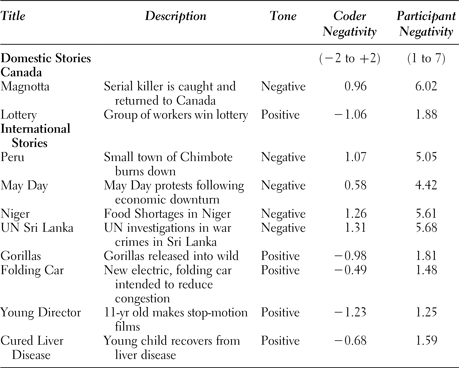
The experiment lasted roughly 25 minutes, during which participants viewed seven news stories on a variety of topics, including both political and general news. The stories were a carefully selected (nonrandom) sample of real news stories from BBC World News. The use of BBC World News is based on the long-term objective of fielding the same experiment in multiple countries.Footnote 8 Two of the seven stories were domestic. One domestic news story was negative and the other was positive. The remaining five stories were all international stories drawn from a sample of four positive and four negative stories. The stories ranged in tone from very positive to very negative. Tone was measured in two ways. First, we use second-by-second coding conducted by three expert coders using a scale ranging from −2 (very positive) to +2 (very negative). We take the average across all three coders for every second of the story; results in Table 1 show only the overall mean (but we turn to second-by-second results in Figure 2, below). Second, we use participants’ coding of the stories they viewed on a scale ranging from 1 (very positive) to 7 (very negative). These codes are captured in the survey that follows the viewing session; participants are asked to “Please rank this story on the following dimensions:…” (More information on coding is available in Soroka and McAdams Reference Soroka and McAdams2015.) The stories are listed in Table 1, along with short descriptions and the average ratings of tone provided by the expert coders and the study participants.Footnote 9
Experimental stimuli

All participants viewed the two domestic stories plus five stories that were randomly selected from the pool of eight international stories. The stories were presented in random order, and separated by 40 seconds of gray screen. Note that the random selection of international stories means that respondents saw varying numbers of positive and negative stories—from two negative and five positive to five negative and two positive. The truly “experimental” component of our study involves this variation across mainly positive to mainly negative treatments—taking the newscast as a whole, respondents receive newscasts with different combinations of positive and negative news (where the control group is effectively the group with a perfectly balanced newscast); and we expect that the different combinations of stimuli will result in different attitudes about the newcast. That said, our focus here is not on postnewscast attitudes, but rather on the analysis of physiological measures across the range of very positive to very negative intervals across all news stories.
Physiological Measures
Our analyses focus on two key physiological indicators: skin conductance and heart rate.Variations in skin conductance (SC) can be used as an indicator of physiological arousal (Dawson, Schell, and Filion Reference Dawson, Schell, Filion, Cacioppo, Tassinary and Berntson2007); indeed, Ravaja (Reference Ravaja2004, 212) characterizes electrodermal activity as “an excellent operational definition of arousal,” and its usefulness has been demonstrated in a number of studies of media effects (Bolls, Lang, and Potter Reference Bolls, Lang and Potter1999; Daignault, Soroka, and Giasson Reference Daignault, Soroka and Giasson2013; Lang et al. Reference Lang, Bolls, Potter and Kawahara1999, Reference Lang, Zhou, Schwartz, Bolls and Potter2000; Simons et al. Reference Simons, Detenber, Roedema and Reiss1999). SC reflects the level of moisture exuded by the ecrine sweat glands. When we sweat, the skin conducts electricity better. Changes in the level of sweat are related to activity in the sympathetic branch of the autonomic nervous system. It is important to note that arousal does not indicate anything about the direction of the response; it simply indicates the degree of activation elicited by a stimulus (Larsen and Diener Reference Larsen, Diener and Clark1992; Russell Reference Russell1980). In other words, arousal is not the same as valence. However, it serves our purpose by enabling us to measure whether positive or negative stories elicit stronger reactions and whether these reactions are different for women and men.
Heart rate serves as a measure of attentiveness. Attention is defined as “the allocation of limited mental resources to a specific stimulus” (Ravaja Reference Ravaja2004, 197). A decreasing heart rate is often viewed as an indication of increasing attentiveness (Grabe et al. Reference Grabe, Zhou, Lang and Bolls2000; Lang Reference Lang1990, 1994; Mulder and Mulder Reference Mulder and Mulder1981; Reeves et al. Reference Reeves, Lang, Kim and Tatar1999), and that is how we use it below. As Lang (Reference Lang and Lang1994) observes, it is “difficult, for most of us, to conceive of how the speed with which our hearts beat has any relationship to what we are thinking about … but it can … tell us about attention and cognitive effort” (100). Parasympathetic arousal is associated with increased attentiveness and causes the heart to decelerate. That said, we note that heart rate is under the control of the sympathetic branch of the autonomic nervous system as well as the parasympathetic branch and therefore likely reflects emotional arousal as well as attentiveness. Where attentiveness leads to deceleration, emotional arousal leads to acceleration. Our interpretation of heart rate (in line with Lang and others) hinges on the assumption that whatever acceleration comes from arousal will be overwhelmed by the deceleration that comes with attentiveness (see Potter and Bolls Reference Potter and Bolls2012 for a useful discussion). Heart rate is measured using a blood volume pulse sensor that detects variations in the volume of blood in the distal phalanx of the middle finger as reflected in the amount of light transmitted through the finger tissue.
Both SC and heart rate are recorded at a rate of 256 times per second. Given our relatively large sample size and the length of exposure to the individual stimuli, this makes for a wealth of data on which to base our inferences. The raw data are noisy, of course. For skin conductance (SC) analyses, data are down-sampled for analysis by taking averages over 125-millisecond (ms) intervals. The SC signal is smoothed slightly for analysis, using Lowess smoothing with a bandwidth of .02. Skin conductance measures can tend to decrease over the experiment (a consequence of measurement issues with the electrodes). One option is to detrend the SC measure (see, for example, Soroka and McAdams Reference Soroka and McAdams2015.); here, we simply include the impact of time in our model. Heart rate is also down-sampled to 125-ms intervals and Lowess smoothed.
Past work using very similar data has included respondent dummy variables in the analysis. These within-respondent analyses of variance (ANOVAs) have the advantage of filtering out the differences in skin temperatures and heart rates across respondents. Of course, the respondent dummies also capture other respondent characteristics, which is problematic for our analyses. We do not use respondent dummies here because we care about one of these respondent-level characteristics—namely, the sex of the respondent. However, we need some way of removing the confounding effects of natural differences in respondents’ skin conductance and heart rates. Some people have faster heart rates than others or are more prone to exude moisture. Accordingly, we use normalized measures of skin conductance and heart rate. Normalized measures for each participant (1) take the raw measure, (2) subtract that participant's mean over the course of the experiment, and (3) divide the results by the standard deviation over the course of the experiment. Results are in standard units, then, and account not just for the fact that different respondents will have different baseline levels of skin conductance and different baseline heart rates, but also different variances.
RESULTS
We take two approaches to analyzing our results. First, we use relatively simple analyses of SC, averaged over entire stories. Each respondent-story combination is a case, and we are interested in the possibility that negative stories lead to different levels of activation and attentiveness on the part of women and men than positive stories do. Second, we analyze our data in five-second intervals. There is, as we shall see, real variation in the tone of stories. We can (and do) capitalize on this variation by analyzing the data in smaller intervals.
Story-Level Analysis
Our story-level analysis is relatively simple. We model average SC as a function of the following variables:
-
(1) an ordinal variable representing the order of presentation of the stories, to capture the possibility that respondents’ reactions change based on the number of stories they have seen thus far (1 to 7);
-
(2) a local dummy (local = 1), to capture the possibility that domestic stories elicit stronger reactions than international stories;
-
(3) an interval-level measure of negativity, based on the average of by-second tone of stories (see the penultimate column of Table 1);
-
(4) a dummy variable (female = 1) for participant sex; and
-
(5) a series of interactions allowing for variations in the impact of negativity across variables 1 through 4.
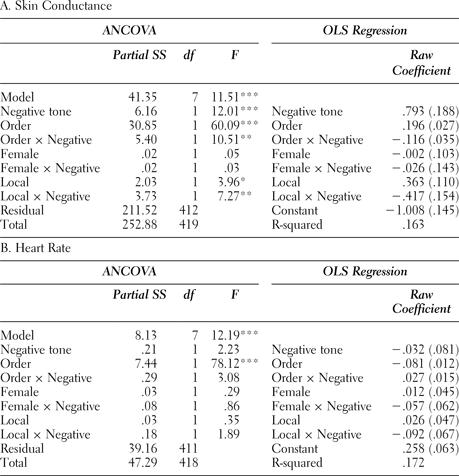
The results are shown in Table 2. The left panel in the table presents the ANCOVA results, while the right panel shows the corresponding OLS regression coefficients.
Story-level analyses

N = 420; * p < .05, ** p < .01, *** p < .001
As found in past research on responses to negative visual stimuli (see, for example, Soroka Reference Soroka2014; Soroka and McAdams Reference Soroka and McAdams2015; Soroka, Nir, and Fournier Reference Soroka, Nir and Fournier2013), negative stories lead to higher average skin conductance levels. This is the case for women and men alike. These results are clear: women and men are equally aroused by negative stories. We find no difference in activation between the sexes. (This is indicated by the insignificant coefficient for Female × Negative.)
The story for heart rate is not very different. Table 2B reveals no significant sex differences. There are hints there that women are more attentive to negative news stories: the coefficient for the Female × Negative interaction is negative, but the F-test is an insignificant .86. There is thus little evidence in these story-level data of sex differences in reactions to positive and negative news. That said, story-level data offer only a very broad (noisy) view of physiological reactivity. We therefore pursue this possibility further in more finely grained, higher-frequency data below.
Five-Second Analysis
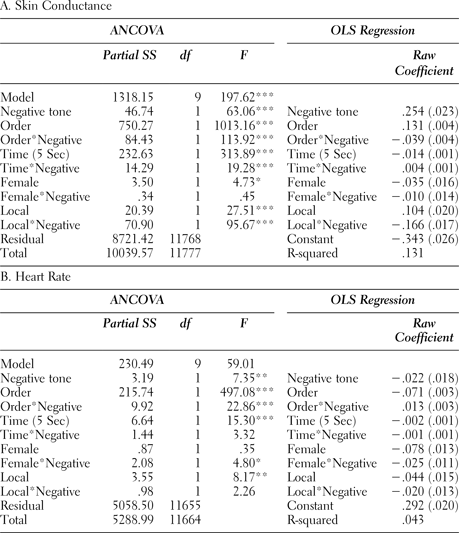
Story-level analyses have the advantage of being relatively simple to estimate, but they mask the fact that there is variation in tone within stories as well.Footnote 10 In line with Lang's (Reference Lang and Lang1994) suggestion that it is preferable to break such stories into shorter periods for analysis, we analyze our data in five-second intervals. (Five-second intervals are relatively common in the existing literature, since they tend to capture physiological changes that may not be immediate. See, e.g., Soroka and McAdams Reference Soroka and McAdams2015). Table 3 shows a re-estimation of our models using these five-second data. The structure of five-second data requires a slightly different specification. We move to a more dynamic measure of negativity—here, changes in the average by-second negativity in the current and preceding five-second periods. The negativity variable thus captures changes in a ten-second rolling average. We also add a variable capturing within-story time (in five-second intervals).
5-second interval-level analyses

N = 420; * p < .05, ** p < .01, *** p < .001
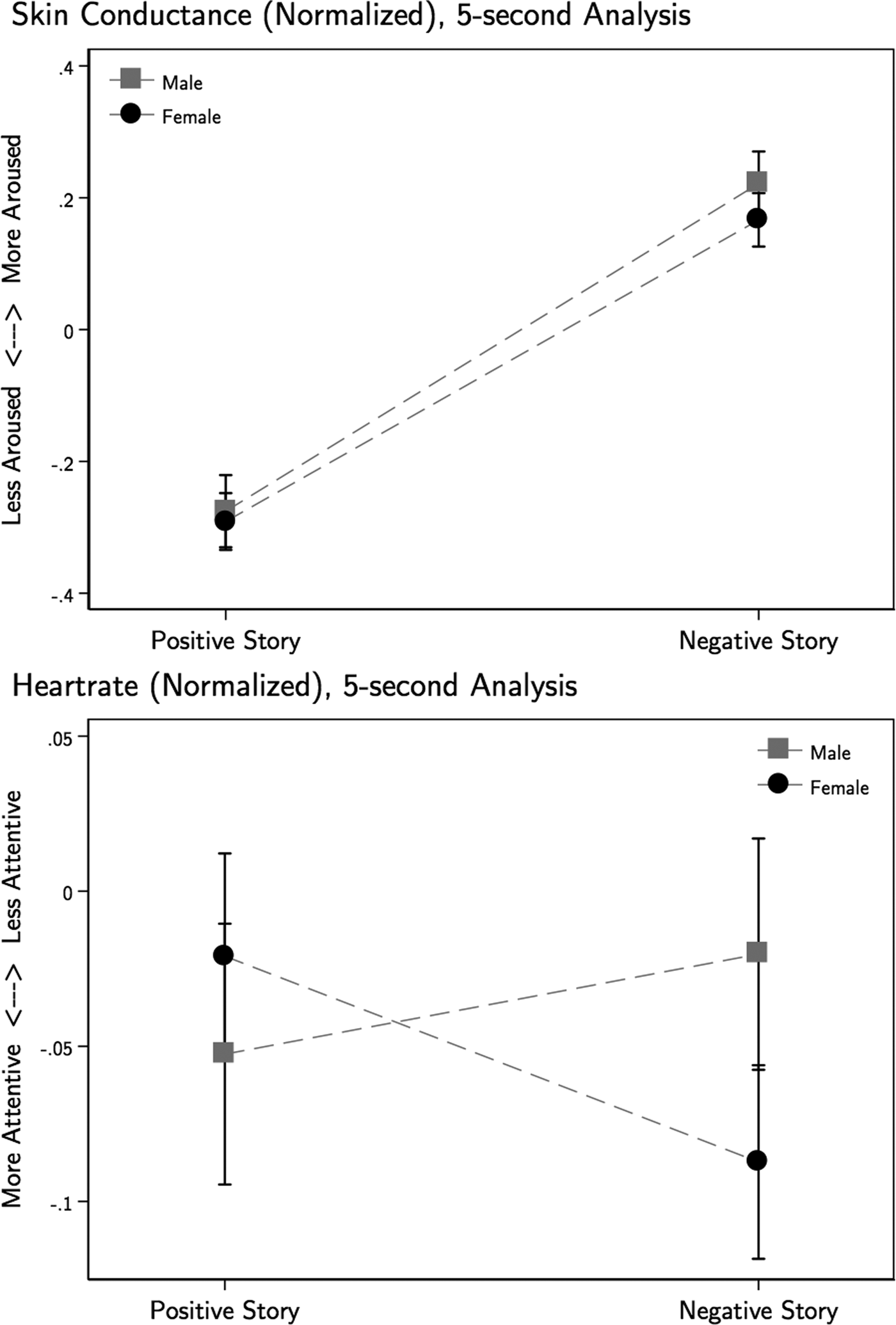
The five-second data produce more robust results. The most pertinent effects are illustrated in Figure 1. The full ANCOVA and OLS results are presented in Table 3.
5-second analyses: The impact of tone on skin conductance and heart rate

The results make clear the impact of negativity on skin conductance: all respondents are more aroused when news content in negative. This is clear in the coefficient for negativity in Table 3 and is readily apparent in the top panel of Figure 1. Equally evident is the fact that there is no apparent sex effect. Both men and women are equally (and powerfully) affected by the negative content in our news stimuli.
The story is different where heart rate—our measure of attentiveness—is concerned: our results suggest that women pay more attention to negative news stories than men do. The heart rate results thus confirm what was hinted at in the story-level analyses.This is evident in the significant interaction between gender and negativity in the bottom panel of Table 3. It is also clear in the bottom panel of Figure 1, where women's heart rate clearly drops for negative stories whereas the change in heart rate for men is insignificant.
DISCUSSION AND CONCLUSIONS
Our aim has been to explore whether women and men respond differently to negative news content, using real-time physiological responses as opposed to postexposure self-reports. Our results suggest that women may be more attentive than men to negative news content.
This heightened attentiveness on the part of women is at odds with research using self-reports (Grabe and Kamhawi Reference Grabe and Kamhawi2006; Kamhawi and Grabe Reference Kamhawi and Grabe2008; Kleemans et al. Reference Kleemans, Vettehen, Beentjes and Eisinga2012), but as we have noted above, there are several reasons to expect psychophysiological results to differ from self-reported ones.Footnote 11 Foremost among these is the difference between our physiological measures of attentiveness, which capture viewers’ variations in heartrate in response to positive and negative news stories, in contrast to Grabe and Kamhawi's focus on self-reported memory and comprehension of news after the viewing is completed. Variations in heart rate reflect the allocation of information-processing resources; they do not tell us anything about the application of those resources to encoding (recognition memory) and retrieving (comprehension) information. One possibility is that negative stories tend to elicit different emotions from women and men (see below) and that these emotions influence how story content is encoded and retrieved. This is purely speculative, of course. All we can say at this stage is that existing research captures quite different quantities. Understanding why sex appears to condition the various measures in different—indeed, apparently opposite—ways may require experiments that incorporate all three types of measurement.
The sources of the sex differences observed above are only one area ripe for further research—an equally important step is to question further how physiological measures of arousal and attentiveness translate into actual behavior. It is the sex difference in news consumption that motivated our psychophysiological study, after all. There is abundant evidence that women consume less news than men do, and it is plausible that the dominance of negative news content may help to explain this difference between women and men. In the lab setting, in real time, women pay more attention than men when exposed to negative news stories. What is the relationship between these lab-setting and real-world findings? Our experiment puts women in a situation where they get to watch negative news stories, whether they enjoy them or not;Footnote 12 and in this situation, they appear to be more attentive to the stories than men are. Outside the lab, where they have the choice to watch or not, women may simply choose not to watch the news (see, e.g., Stroud Reference Stroud2008).
We cannot easily make the leap from physiology to behavior, but we can certainly use physiological research to begin to understand what drives this behavior. One possibility is that, because they are greatly affected by (but dislike) negative information, and because they know that news content is predominantly negative, women avoid the news. Hyperreaction to negativity thus produces a withdrawal. Women's behavior may also reflect their socialization. In avoiding negative news when they have the option, women may be acting in accord with deeply socialized gender role expectations. As noted above, using physiological responses in tandem with self-reports can provide new insights into the interplay between biological predispositions and learned ones.
At the same time we need to recognize an important limitation of relying on measurements of psychophysiological responses: they do not permit us to identify the emotion that has triggered an increase in skin conductance or a slowing down of the heart rate (see Dawson, Schell and Filion Reference Dawson, Schell, Filion, Cacioppo, Tassinary and Berntson2007). Physiological responses to negative news could reflect fear, anger, anxiety, or disgust. Differentiating these emotional responses requires experiments that systematically manipulate the news coverage to elicit specific emotions. Women and men appear to be equally aroused by watching negative news stories, whether arousal is measured by self-reports as in Grabe and Kamhawi's (Reference Grabe and Kamhawi2006) experiment or by changes in skin conductance levels as in our experiment. It is quite possible, though, that viewing negative news content is exciting for men but induces anxiety in women. In other words, the emotions are different even though the level of arousal is similar.
This study represents the first—that we are aware of—to use physiological measures to examine whether women and men respond differently to television news content. As with any experimental design, there is necessarily a concern with the generalizability of our results. As McDermott (Reference McDermott2002) has argued, replication is required to establish external validity. This is especially the case for laboratory-based studies. External validity is achieved through the cumulation of results. In this spirit, we intend our study to serve as a stimulus to future studies with different populations and in different settings.
There is clearly a great deal more work that needs to be done if we are to come up with a compelling explanation of why women typically consume less news than men. Uncovering answers is important given the enduring gender gap in political knowledge. Being uninformed or, worse, misinformed about politics impairs women's ability to voice their needs and wants effectively. One reason women know less about politics than men do is that they consume less news. Finding ways of countering the gender gap in news consumption could therefore help to close the knowledge gap. Of course, this can only happen if we first understand why women consume less news.