Introduction
Tetralogy of Fallot is the most common cyanotic CHD, accounting for approximately 7–10% of cyanotic CHDs. Reference Talwar, George, Bhende and Airan1 Contemporary management favours complete surgical repair during infancy, often around 3–6 months of age, with excellent early and long-term outcomes. Reference Hribernik, Boardman and Crossland2 Consequently, presentation with unrepaired tetralogy of Fallot during adolescence or adulthood has become uncommon in developed healthcare systems. However, late presentation continues to be encountered in low- and middle-income countries, including India, because of delayed diagnosis or referral, socio-economic constraints, geographical barriers, and limited access to specialised congenital cardiac services. Reference Talwar, George, Bhende and Airan1,Reference Bhushan, Chugh and Loona3
Patients surviving with unrepaired tetralogy of Fallot into adolescence and adulthood constitute a distinct clinical and surgical population. Prolonged cyanosis and chronic pressure loading of the right ventricle may result in marked right ventricular hypertrophy, myocardial fibrosis, and impaired ventricular function. Secondary erythrocytosis, arrhythmias, infective endocarditis, cerebrovascular events, cerebral abscess, and progressive functional limitation may further complicate the natural history. Reference Talwar, George, Bhende and Airan1 More contemporary series have similarly demonstrated that complete correction can be undertaken with acceptable early mortality even in adulthood. Reference Bhushan, Chugh and Loona3–Reference Ramanan, Sasikumar and Manohar5
Surgical management of the late presenter nevertheless has several distinctive considerations. Long-standing right ventricular hypertrophy, variable pulmonary annular and branch pulmonary artery anatomy, and the presence of significant aortopulmonary collaterals may influence pre-operative preparation and operative strategy. Reference Talwar, George, Bhende and Airan1 Importantly, preservation of pulmonary valve competence must be balanced against adequate relief of right ventricular outflow tract obstruction. Previous Indian series have demonstrated considerable variation in the requirement for transannular patching, highlighting the importance of an individualised surgical approach. Reference Bhushan, Chugh and Loona3,Reference Bisoi, Murala and Airan4
Contemporary data on primary repair of tetralogy of Fallot in adolescents and adults remain relatively limited. We therefore evaluated the early surgical outcomes of patients aged ≥ 13 years undergoing primary tetralogy of Fallot repair, with particular emphasis on perioperative morbidity, mortality, reintervention, and comparison of outcomes between transannular patch and pulmonary valve-preserving strategies.
Patients and methods
A retrospective cohort study included patients aged ≥ 13 years who underwent surgical repair of tetralogy of Fallot between June 2016 and June 2025. Data collected included demographics, operative details, cardiopulmonary bypass and aortic cross-clamp times, post-operative ventilation duration, ICU stay, hospital stay, early mortality, and need for reintervention.
Between June 2016 and June 2025, 94 patients aged ≥ 13 years underwent surgery for tetralogy of Fallot in our institute. Retrospective data was collected from hospital medical records. The Institutional Ethics Committee granted an exemption from review due to the retrospective nature of the study (NSH-EC/AP/2025/031; dated 22 September 2025) . Data collected included demographics, operative details, cardiopulmonary bypass and aortic cross-clamp times, post-operative ventilation duration, ICU stay, hospital stay, early mortality, and need for reintervention.
The aim of the study was to analyse the early surgical outcomes of patients with tetralogy of Fallot, aged ≥ 13 years who underwent corrective surgery. The primary objective was to assess pos-toperative complications, including in-hospital morbidity and mortality. The secondary objective of this study was to evaluate the various surgical options exercised in these 94 patients and the outcomes. Early follow-up parameters with need for reintervention was also included.
Inclusion–exclusion criteria:
All patients aged ≥ 13 years undergoing corrective surgery for tetralogy of Fallot during the study period were included.
Patients undergoing re-do intracardiac repairs, tetralogy of Fallot–pulmonary atresia subset, or incomplete surgical records were excluded.
Pre-operative assessment
The pre-operative assessment included clinical examination, routine bloodwork, chest X-ray, echocardiography, and cardiac catheterisation with or without coiling of significant aortopulmonary collaterals.
Surgical techniques
Myocardial preservation was done with del Nido cardioplegia (20 ml/kg body weight) in all cases. A second dose was used in cases exceeding cross-clamp time of 90 minutes. Surgical techniques included transannular patch across the right ventricular outflow tract, exclusive trans-atrial repair with no intervention to the pulmonary valve or pulmonary artery and valve preserving tetralogy repair with pulmonary valvotomy and augmentation of the pulmonary artery. The patch material used for augmentation of right ventricular outflow tract or pulmonary artery was untreated autologous pericardium in all cases. The surgical outcomes of these subgroups were also compared. Any intervention on the branch pulmonary arteries was recorded.
Post-operative protocol
All patients were admitted to ICU after the operation. The elective inotropic support consisted of milrinone (0.5μg/kg/min) and norepinephrine (0.05 μg/kg/min). Inotropes were gradually tapered off over a duration of 24–48 hours.
All patients were weaned off ventilatory support as soon as possible if they were haemodynamically stable and there was no bleeding.
Statistical methods
All continuous variables were expressed as mean ± standard deviation, as well as median and interquartile range. Qualitative variables were expressed as numbers and percentages. The continuous variables were tested for normal distribution.
Results
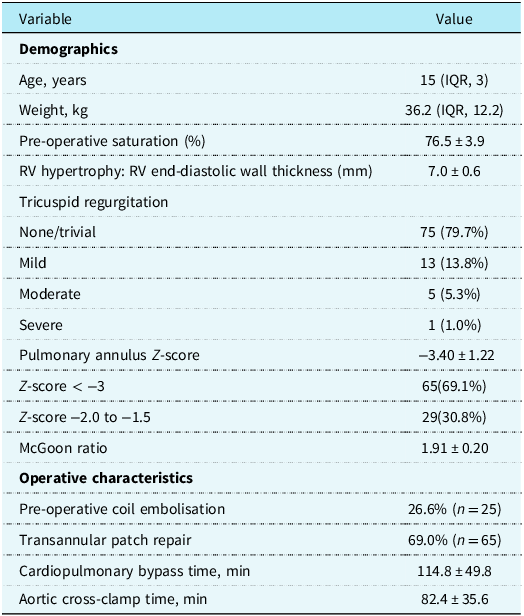
Ninety-four patients aged ≥ 13 years underwent tetralogy of Fallot repair. The median age was 15 years (interquartile range: 3), and median weight was 36.5 kg (interquartile range: 12.2). Pre-operative coil embolisation of aortopulmonary collaterals was required in 26.6% (n = 25) of patients. The average pre-operative oxygen saturation was 76.5 ± 3.9%. Significant right ventricular hypertrophy was evident in most patients, with a mean right ventricle end-diastolic wall thickness of 7.0 ± 0.6 mm. Tricuspid regurgitation was none or trivial in 75 patients (79.7%), mild in 13 (13.8%), moderate in 5 (5.3%), and severe in 1 (1.0%). The mean pulmonary valve annulus Z-score was −3.40 ± 1.22; 65 patients (69.1%) had a Z-score <−3, while 29 (30.8%) had a Z-score between −2.0 and −1.5. The mean McGoon ratio was 1.91 ± 0.20, indicating generally well-developed branch pulmonary arteries in the study cohort. Mean cardiopulmonary bypass and aortic cross-clamp times were 114.8 ± 49.8 minutes and 82.4 ± 35.6 minutes, respectively. Mean post-operative ventilation duration was 7.7 ± 7.1 hours. Mean ICU stay was 3.9 ± 1 days, and total post-operative hospital stay was 4.6 ± 1.3 days (Table 1).
Baseline demographic and operative characteristics

Table 1. Long description
A table with two columns: Variable and Value. The table has 16 rows, including headers. The first row is a header row with the columns labeled ‘Variable’ and ‘Value’. The table is divided into two sections: Demographics and Operative characteristics. Under Demographics, the variables include Age, Weight, Pre-operative saturation, RV hypertrophy, Tricuspid regurgitation, Pulmonary annulus Z-score, and McGoon ratio. Under Operative characteristics, the variables include Pre-operative coil embolisation, Transannular patch repair, Cardiopulmonary bypass time, and Aortic cross-clamp time. Each row provides specific values or percentages related to the variables listed.
RV = right ventricle; IQR = interquartile range.
Values are presented as median (IQR), mean ± standard deviation (SD), or number (%), as appropriate.
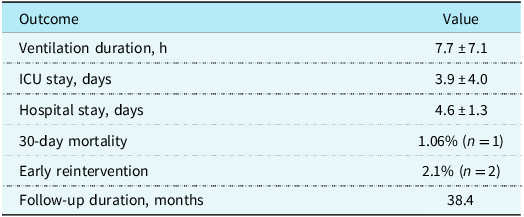
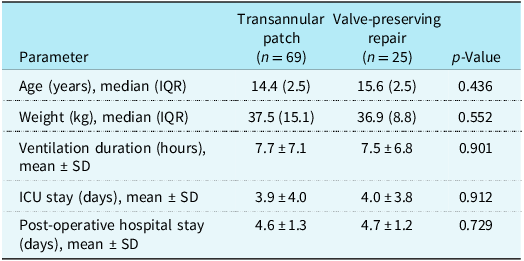
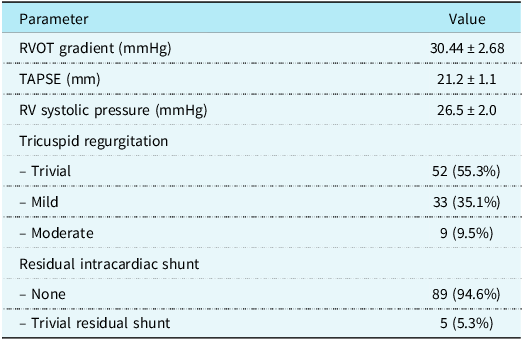
Early post-operative outcomes were analysed (Table 2). Most of the patients (65/94,69%) in this study underwent transannular patch across the right ventricular outflow tract. Nine patients (9/94, 9.5%) underwent exclusive trans-atrial repair with no intervention to the pulmonary valve or pulmonary artery. Twenty-one (29/94, 31%) patients underwent vale preserving tetralogy repair with pulmonary valvotomy and augmentation of the pulmonary artery. The surgical outcomes of these two subgroups revealed no difference in ventilation duration, ICU stay, or post-operative hospital stay (Table 3). Sixteen (16/94, 17%) patients required intervention on the branch pulmonary arteries. At discharge, the mean right ventricular outflow tract gradient was 30.44 ± 2.68 mmHg, with preserved right ventricular longitudinal systolic function as reflected by a mean tricuspid annular plane systolic excursion of 21.2 ± 1.1 mm. The mean right ventricle systolic pressure was 26.5 ± 2.0 mmHg. Tricuspid regurgitation was trivial in 52 patients (55.3%), mild in 33 (35.1%), and moderate in 9 (9.5%), with no patient having severe tricuspid regurgitation. Complete closure of the intracardiac defect was demonstrated in 89 patients (94.6%), while a trivial residual shunt was present in 5 (5.3%) (Table 4).
Early post-operative outcomes

Table 2. Long description
A table summarizing early post-operative outcomes with two columns and six rows. The columns are labeled Outcome and Value. Row 1: Outcome, Ventilation duration, h; Value, 7.7 ± 7.1. Row 2: Outcome, ICU stay, days; Value, 3.9 ± 4.0. Row 3: Outcome, Hospital stay, days; Value, 4.6 ± 1.3. Row 4: Outcome, 30-day mortality; Value, 1.06% (n = 1). Row 5: Outcome, Early reintervention; Value, 2.1% (n = 2). Row 6: Outcome, Follow-up duration, months; Value, 38.4.
Values are presented as mean ± standard deviation (SD), or number (%), as appropriate.
Surgical subgroup comparison: transannular patch versus valve-preserving repair

Table 3. Long description
A table comparing surgical outcomes between transannular patch and valve-preserving repair. The table has 6 rows and 4 columns. The columns are labeled Parameter, Transannular patch (n=69), Valve-preserving repair (n=25), and p-Value. The rows are labeled Age (years), median (IQR), Weight (kg), median (IQR), Ventilation duration (hours), mean ± SD, ICU stay (days), mean ± SD, and Post-operative hospital stay (days), mean ± SD. The values in the table are as follows: Row 1: Age (years), median (IQR), 14.4 (2.5), 15.6 (2.5), 0.436. Row 2: Weight (kg), median (IQR), 37.5 (15.1), 36.9 (8.8), 0.552. Row 3: Ventilation duration (hours), mean ± SD, 7.7 ± 7.1, 7.5 ± 6.8, 0.901. Row 4: ICU stay (days), mean ± SD, 3.9 ± 4.0, 4.0 ± 3.8, 0.912. Row 5: Post-operative hospital stay (days), mean ± SD, 4.6 ± 1.3, 4.7 ± 1.2, 0.729.
IQR = interquartile range.
Values are presented as median (IQR), mean ± standard deviation (SD), or number (%), as appropriate.
Post-operative echocardiography data

Table 4. Long description
A table with 7 rows and 2 columns. The columns are labeled Parameter and Value. The table presents post-operative echocardiography data. Row 1: RVOT gradient, 30.44 ± 2.68 mmHg. Row 2: TAPSE, 21.2 ± 1.1 mm. Row 3: RV systolic pressure, 26.5 ± 2.0 mmHg. Row 4: Tricuspid regurgitation - Trivial, 52 (55.3 percent). Row 5: Tricuspid regurgitation - Mild, 33 (35.1 percent). Row 6: Tricuspid regurgitation - Moderate, 9 (9.5 percent). Row 7: Residual intracardiac shunt - None, 89 (94.6 percent). Row 8: Residual intracardiac shunt - Trivial residual shunt, 5 (5.3 percent).
RVOT = right ventricular outflow tract; TAPSE = tricuspid annular plane systolic excursion; RV = right ventricle.
Values are presented as mean ± standard deviation (SD), or number (%), as appropriate.
Overall in-hospital mortality was recorded in one patient (1/96, 1.06%) due to severe right ventricular dysfunction. Thirty-day mortality was 1.06%. In the mean follow-up duration of 38.4 months, early reintervention occurred in two patients (2.1%), with both needing stenting of the left pulmonary artery due to stenosis.
Discussion
Late presentation of CHD remains an important reality in low- and middle-income countries. Unlike high-income settings, where most patients with tetralogy of Fallot undergo complete repair during infancy, delayed diagnosis, referral pathways, financial constraints, geographical barriers, and limited availability of specialist services continue to postpone definitive treatment. Reference Das, Dutta, Das, Ghosh and Chowdhuri6 Cheng et al., in a systematic review of 67 studies, identified delayed diagnosis, financial limitations, difficulty reaching treatment centres, and inadequate caregiver education among the major pre-operative barriers, together with limitations in specialised workforce and surgical resources. Reference Cheng, Heo, Joos, Vervoort and Joharifard7 Thus, late-presenting tetralogy of Fallot in India should not simply be regarded as an unusual manifestation of the natural history of the disease but also as a reflection of continuing disparities in access to congenital cardiac care.
Importantly, increasing age at repair does not necessarily translate into prohibitive operative risk. Earlier Indian experience has demonstrated that despite these challenges, complete repair can provide meaningful long-term survival and functional improvement. In a large series of 284 patients aged 14–50 years, Bisoi et al. reported that 94% of survivors were in NYHA functional class I, with 10-year freedom from reoperation exceeding 90%. Reference Bisoi, Murala and Airan4 The International Quality Improvement Collaborative (IQIC) analysed 2,164 tetralogy of Fallot operations from 32 centres in 20 low- and middle-income countries. More than half (54%) of primary repairs were performed beyond 1 year of age, 755 (34.9%) of them being in the age range of 2 to 27 years. In this study, older age was not independently associated with mortality. Reference Sandoval, Carreño and Novick8 Our results extend this observation into a substantially older population. The mortality of 1.06% in the present cohort compares favourably with previously reported adult series. Bhushan et al. reported 2% early mortality among 45 patients with a median age of 21 years, while Erdoğan et al. reported 3.1% hospital mortality among 64 patients aged ≥ 14 years. Reference Bhushan, Chugh and Loona3,Reference Erdoğan, Bozbuğa and Kayalar9 Even patients presenting considerably later can undergo successful correction. Talwar et al. reported acceptable outcomes in 41 patients aged 30–52 years, with two early deaths. Reference Talwar, Meena and Choudhary10 At extremes, the oldest reported cases of tetralogy of Fallot undergoing surgical repair or correction for the first time at an advanced age involve patients in their 78th and 83rd years of life. Reference Katayama, Isobe, Ozawa and Fujii11
Our study demonstrates that primary complete repair of tetralogy of Fallot in late-presenting adolescents and adults can be performed with low early mortality and acceptable perioperative morbidity. In this cohort of 94 patients aged ≥ 13 years, the median age was 15 years, and despite the prolonged period of exposure to cyanosis and right ventricular pressure overload, 30-day mortality was only 1.06%. Post-operative recovery was also relatively rapid, with a mean ventilation duration of 7.7 ± 7.1 hours, ICU stay of 3.9 ± 1 days, and post-operative hospital stay of 4.6 ± 1.3 days. Early reintervention was required in only two patients during a mean follow-up of 38.4 months. These findings reinforce the concept that chronological age alone should not preclude definitive repair in appropriately selected patients presenting late (Figure 1).
Surgical and clinical outcomes after late TOF repair. TOF = tetralogy of Fallot.

Late presenters nevertheless represent a physiologically distinct population. Long-standing cyanosis may result in secondary erythrocytosis and coagulation abnormalities, while chronic right ventricle pressure overload produces substantial hypertrophy and may eventually impair ventricular function. Aortopulmonary collaterals are another important feature. The contemporary review of late-presenting CHD emphasises the need to evaluate polycythaemia, coagulation abnormalities, brain abscesses, and aortopulmonary collaterals specifically in late tetralogy of Fallot. Reference Das, Dutta, Das, Ghosh and Chowdhuri6,Reference Khan, Tufail, Afridi, Iqbal, Khan and Waheed12,Reference Khajali, Mohammadi and Toloueitabar13 Surgical repair of tetralogy of Fallot can be performed in both adult and paediatric populations with acceptable outcomes. Khan et al. showed that the mortality rate was found to be slightly greater in the paediatric population compared to the adults. However, it can be seen that the number of post-operative complications is greater in adults. Reference Khan, Tufail, Afridi, Iqbal, Khan and Waheed12 In our series, 11 patients underwent pre-operative coil embolisation of significant aortopulmonary collaterals. This strategy is supported by the experience of Talwar et al., in which 28 of 41 (68.2%) patients had significant collaterals that were occluded before repair. Their study further demonstrated that lower pre-operative oxygen saturation correlated with greater inotropic requirements and longer ventilation, ICU, and hospital stay, while aortopulmonary collaterals, high haematocrit, and right ventricle dysfunction were associated with greater post-operative support. Reference Talwar, Meena and Choudhary10 Khan et al. reported a 30-day mortality of 8% in a series of 80 adult tetralogy patients from Pakistan. Reference Khan, Tufail, Afridi, Iqbal, Khan and Waheed12 Khajali et al. from Iran reported an in-hospital mortality of 5.1% in a series of 94 adult tetralogy repair. Reference Khajali, Mohammadi and Toloueitabar13 These observations underline the importance of meticulous pre-operative optimisation rather than considering late repair itself inherently high risk.
The surgical strategy for the right ventricular outflow tract is particularly relevant in this population. In the present series, 69 patients underwent transannular patch repair and 25 underwent a pulmonary valve-preserving strategy. Despite the different right ventricular outflow tract approaches, there were no significant differences in ventilation duration, ICU stay, or post-operative hospital stay between the groups (Table 3). This suggests that, at least with respect to early post-operative recovery, an appropriately selected transannular patch does not impose an additional immediate penalty in late presenters (Figure 2). Historical adult series similarly demonstrate frequent use of transannular patch; Erdoğan et al. required transannular reconstruction in 68.7% of patients, similar to our cohort. Reference Erdoğan, Bozbuğa and Kayalar9
Early post-operative outcomes by RVOT repair strategy. RVOT = right ventricular outflow tract.

However, equivalence in early outcomes should not be interpreted as equivalence in long-term consequences. Chronic pulmonary regurgitation following transannular patch may lead to progressive right ventricle dilatation, ventricular dysfunction, arrhythmia, and eventual pulmonary valve replacement in few patients in their follow-up of 62.3 months. Reference Erdoğan, Bozbuğa and Kayalar9 This emphasises continued echocardiographic surveillance, particularly for right ventricle dilatation, arrhythmias, residual right ventricular outflow tract obstruction, and significant pulmonary or tricuspid regurgitation. In an earlier report from Brazil, Atik et al. reported an early mortality of 5.1% and late mortality of 7.7% over a mean follow-up of 45.1 months. Reference Atik, Atik and da Cunha14 Ducas et al. analysed 230 adults with repaired tetralogy of Fallot and showed that the need for pulmonary valve replacement was six times higher patients with transannular patch over a median follow-up duration of 7.9 years. Reference Ducas, Harris and Labos15 Contemporary literature therefore increasingly favours preservation of the pulmonary annulus and valve whenever this can be achieved without leaving clinically important right ventricular outflow tract obstruction. Various strategies including intraoperative balloon pulmonary valvuloplasty, pulmonary valve reconstruction, and commissurotomy have been described during the surgical procedure based on the developmental status and anatomical characteristics of the right right ventricular outflow tract, pulmonary valve, and pulmonary artery. Reference Yi, Wang and Xu16 However, it remains clear that optimal outcome after surgical correction of tetralogy of Fallot depends adequate relief of right ventricular outflow tract obstruction and secure closure of the ventricular septal defect. Kaushal et al. demonstrated the importance of distinguishing between dynamic gradients after repair from important mechanical obstruction as a strategy for revision due high post-operative right ventricle–pulmonary artery gradient. Reference Kaushal, Radhakrishanan and Dagar17
Our finding of comparable early outcomes between transannular patch and valve-preserving repair is reassuring but cannot address this important long-term trade-off. We do not prefer primary implantation of pulmonary valve during routine tetralogy repair in adolescents and adults in tetralogy of Fallot –pulmonary subset to avoid reoperation due to prosthesis degeneration in future. Although there are reports in literature about good results with primary pulmonary valve replacement during tetralogy of Fallot repair in adults, routine pulmonary valve replacement during primary tetralogy of Fallot repair in adults is not standard practice. Reference Liu, Liu and Zaki18,Reference Jain, Rajan and Patel19 We reserve this strategy in selected cases to manage severe right ventricular volume overload and reduce long-term morbidity.
Longer follow-up incorporating right ventricle dimensions and function, pulmonary regurgitant fraction, exercise capacity, rhythm disturbances, and freedom from pulmonary valve replacement will be necessary to determine whether valve preservation confers a meaningful late advantage in this specific population.
Branch pulmonary artery intervention at primary surgery was required in 16 patients in our cohort, while only 2 patients subsequently required early reintervention, both for left pulmonary artery stenosis requiring stenting. The low early reintervention rate is encouraging. Nevertheless, late tetralogy of Fallot repair should be regarded as the beginning of lifelong congenital cardiac surveillance rather than a definitive endpoint. Historical data demonstrate excellent functional improvement following adult repair, but residual right ventricular outflow tract lesions, pulmonary regurgitation and arrhythmias remain important late concerns. In the Erdoğan series, 16-year actuarial survival was 89.2% ± 4.9%, with 6.2% requiring reoperation. Reference Erdoğan, Bozbuğa and Kayalar9 This distinction between excellent early surgical rescue and the continuing burden of repaired tetralogy of Fallot is particularly relevant when counselling late presenters.
The favourable outcomes in this study also have implications beyond operative technique. Late presentation is ultimately a marker of gaps in access to congenital cardiac care. The systematic review by Cheng et al. highlights that barriers continue even after surgery through inadequate counselling, fragmented follow-up, and shortages of critical-care and adult congenital services. Reference Das, Dutta, Das, Ghosh and Chowdhuri6 Therefore, demonstrating that late repair can be performed safely should not normalise delayed treatment. Complete repair in infancy remains the preferred strategy. Reference Hribernik, Boardman and Crossland2 Rather, these results provide reassurance that adolescents and adults who have missed the optimal window should not be denied definitive treatment solely because of age.
Nevertheless, the present experience supports a pragmatic message relevant to contemporary congenital cardiac practice in low- and middle-income countries: with careful anatomical assessment, management of aortopulmonary collaterals, appropriate right ventricular outflow tract strategy, and meticulous perioperative care, primary repair of late-presenting tetralogy of Fallot can achieve reasonable early outcomes. This is consistent with contemporary evidence that appropriately selected and managed late-presenting CHD can be treated with acceptable results despite delayed presentation.
Limitations
This study has limitations inherent to its retrospective, single-centre design and relatively modest sample size. Selection bias is unavoidable, as patients surviving unrepaired tetralogy of Fallot into adolescence represent a biologically selected group with anatomy and physiology compatible with prolonged survival. The follow-up duration is insufficient to evaluate important late endpoints, particularly pulmonary regurgitation, right ventricle remodelling, arrhythmia, exercise capacity, and pulmonary valve replacement. The study was not designed or adequately powered to evaluate associations between individual pre-operative risk factors and post-operative resource utilisation. In particular, the relationship of pre-operative oxygen saturation, haematocrit, aortopulmonary collateral burden, and right ventricle dysfunction with post-operative inotropic requirements, duration of mechanical ventilation, ICU stay, and hospital stay could not be reliably assessed because some of these variables were not consistently quantified or recorded in a standardised manner. Future prospective studies incorporating standardised assessment of these parameters are warranted to better define their influence on post-operative recovery. Additionally, the study focuses only on in-hospital outcomes and 30-day outcomes, with limited follow-up data. The retrospective and single-centre nature of the study limits the ability to establish causality and draw strong conclusions. Larger, multicentre studies with extended follow-up are needed to comprehensively evaluate the long-term results of this subset of late-presenting tetralogy of Fallot.
Conclusions
Surgical repair of tetralogy of Fallot in adolescent and adult patients presenting late is safe and effective, with low early mortality and acceptable morbidity, supporting delayed primary repair in these late presenters after careful pre-operative planning. Transannular patch and valve preserving repair did not have any difference in outcomes in this study.
Author contribution
All authors whose names appear on the submission have made substantial contributions to the conception or design of the work, or the acquisition, analysis, or interpretation of data.
Financial support
Nil.
Competing interests
There are no conflicts of interest.
Ethical standard
The Institutional Ethics Committee gave an approval for this study after due diligence (NSH-EC/AP/2025/031; dated 22 September 2025).
Informed consent
Informed consent was duly taken from parents for participation in the study.