

American social justice movements are often considered big losers on a home front that emphasized national defense over civil rights and individual liberties. The traditional American narrative offers a fairly stark assessment of the dire impact of the war on all but the female suffrage movement. Government harassment and persecution effectually destroyed the prewar momentum of socialist, anarchist, and radical movements. W. E. B. Du Bois's advice to “close ranks” with white Americans revealed the hopes of many African Americans that evidence of their patriotism would strengthen the case for granting black Americans civil rights. The Red Summer of 1919, so named because of the historically high number of race riots and lynchings that rocked the nation, dashed these hopes. The peace movement failed to prevent American entry into the war, and found itself under attack and vilified once the nation declared war on Germany. Men seeking conscientious objector status faced verbal, and often physical, torment. Pacifism was now akin to socialism: vaguely foreign and certainly un-American. The lone bright spot for social justice movements was the success of the female suffrage movement with the ratification of the Nineteenth Amendment in 1920, but only after activists endured arrests and beatings for refusing to give up the call during the war.
Aggressive government officials used the war as an excuse to crush radical movements long considered an anathema to the American way of life, a fate that historians have documented extensively. This essay focuses instead on the wartime experiences of three movements rarely discussed together—the campaigns to advance African American civil rights, female suffrage, and civil liberties. Considering these movements collectively reveals some striking similarities in how “reformist” rather than “radical” or “revolutionary” movements adapted and innovated in response to the new challenges that the war presented. These three key social justice movements ultimately redefined the meaning of citizenship in the twentieth century, and only succeeded after decades of struggle, innovation, and experimentation with different strategies for reaching their desired ends. World War I represented an important moment in the histories of all three movements. The wartime cultural environment emphasized a single-minded unity of purpose, a moment characterized by repression rather than tolerance for any cause that threatened to distract the nation from the task of winning the war. In this decidedly inhospitable environment, activists within civil rights, female suffrage moment, and civil liberties responded by developing new techniques to advance their respective causes.
The impetus to experiment with new protest tactics and techniques reflected debates over the meaning of citizenship that war mobilization generated within America at large. Wartime political rhetoric emphasized the responsibilities of citizenship and public performances of patriotism. In response, social justice activists entered the public sphere to defend individual rights as the other essential aspect of national citizenship. African Americans, female suffragists, and civil libertarians questioned the government's ability to demand that in wartime citizens fulfill their duties without receiving a corresponding recognition of their rights.
The First World War thus unintentionally provided fresh opportunities for movement building, a process that included recruiting members, refining ideological messaging, devising innovative media strategies, negotiating with the government, and participating in nonviolent street demonstrations. The constructive, rather than destructive, impact of the war on social justice movements proved significant in the short term (for the suffragist movement) and the long term (for the civil rights and civil liberties movements). Surviving in a hostile war environment required adaption and could rightly be seen as a form of success even if a movement's long-term goals remained unfulfilled by war's end.
AMERICAN WAR CULTURE
As Wilson led a divided people into war in April 1917, organized efforts from above and below immediately emerged to silence dissent and ensure the active participation of all. The range of federal government activities included a vast propaganda campaign and enforcement of anti-sedition legislation that in 1917 prohibited interfering with the draft, and by 1918 outlawed criticism of the war effort or the government. For many citizens, however, the coercive pressure to conform came, not from newly empowered federal government surveillance agencies, but from their own friends and neighbors. Across the nation community leaders, newspapers, and employers continuously informed Americans of their obligation to volunteer their labor, time, and political support to the war effort. Conformity was considered essential to national security, and local vigilantes throughout the nation were willing to use force, if necessary, to silence those who offered any criticism or misgivings about the war. The most obvious targets were groups on the political left, including populists, radicals, socialists, anarchists, international trade unionists, and, of course, German Americans. Challenging the status quo became tantamount to treason, and for those groups who openly called the nation to account, the repercussions could be severe.Footnote 1
Military Intelligence operatives put civil rights groups under surveillance and the Postmaster General banned their publications from the mails, justifying these actions with claims that German spies were trying to stir up racial trouble to undermine America's war-making capacity.Footnote 2 The war had cut off the flow of immigrant labor from Europe, creating new economic opportunities for half a million African Americans who headed north to take previously inaccessible jobs in northern factories. The Great Migration helped black migrants escape legalized segregation and disenfranchisement, but not racial violence. The war's most deadly racial clash occurred in East St. Louis, Illinois, in July 1917. Carlos F. Hurd's eyewitness account and Ida Wells-Barnett's interviews with African American survivors offered chilling accounts of black men exiting homes with their hands in the air, only to have white mobs stone them to death. Snipers picked off African Americans walking down the streets. After witnessing mobs boarding up homes and setting them ablaze, many residents fled and hid in nearby fields or fashioned makeshift rafts to get across the Mississippi River. “It was just like war,” one survivor recalled.Footnote 3
The female suffrage movement encountered violence as well. Differences within the suffrage movement had caused Alice Paul to break away from the National American Woman Suffrage Association (NAWSA) in 1914, and she founded the National Woman's Party (NWP) two years later. The NWP, the radical arm of the suffrage movement, turned Wilson's democratic rhetoric against him by pioneering a new protest technique—picketing outside the White House. The “Silent Sentinels” began their vigil in January 1917 and continued their protests after the United States entered the war. Wilson argued female suffrage was a matter for individual states to decide, but Paul was resolved to fight for a federal amendment.Footnote 4 Chipping away at the state level, Paul knew, could take years. Rapid change required a sense of urgency and the war offered Paul an opportunity to press forward rather than fall silent.
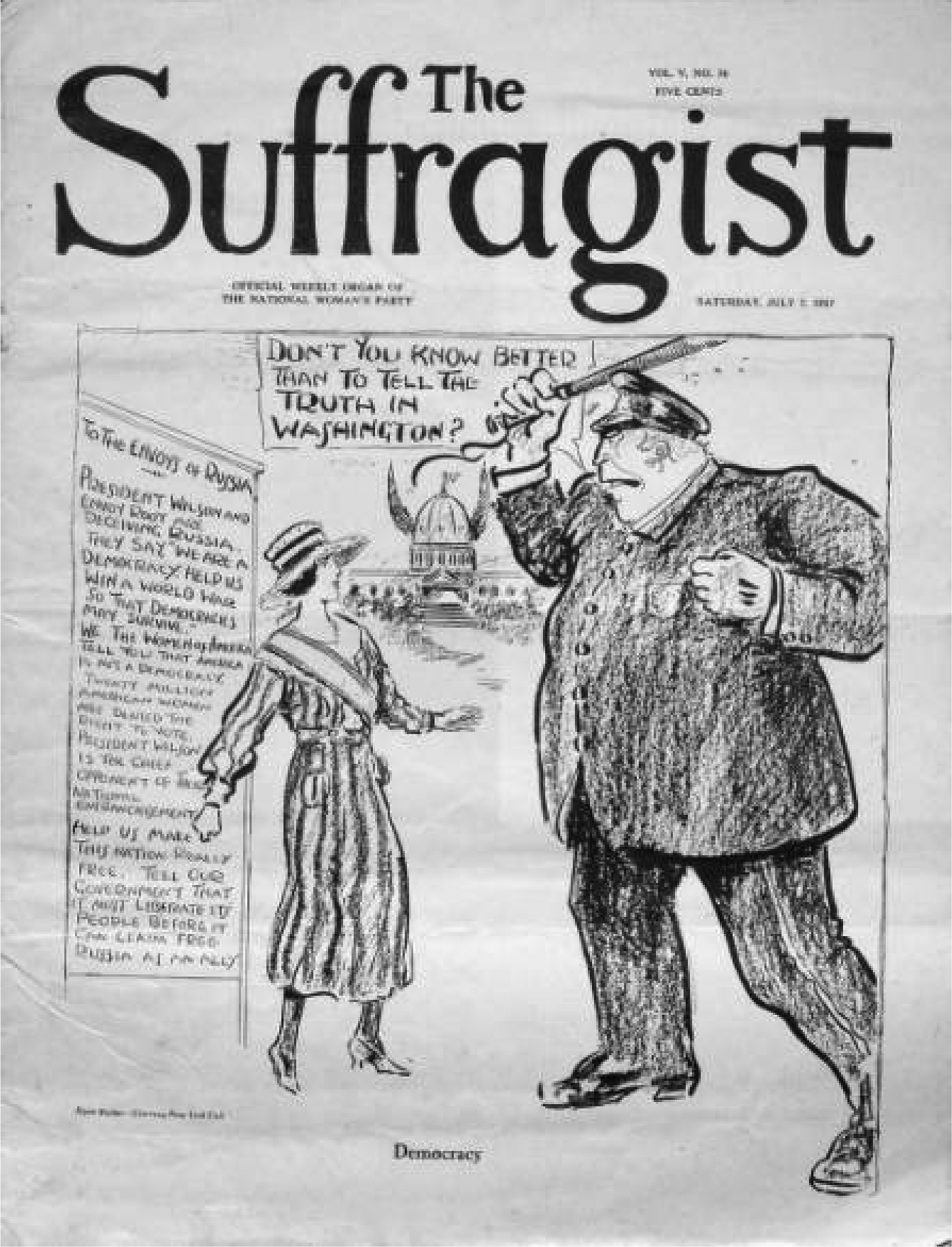
Holding signs that read “how long must women wait for liberty,” the pickets endured daily harassment and assaults from passersby. The protesters escalated their confrontation with Wilson when a delegation from the newly established Russian parliamentary government visited the White House on June 20, 1917. They held a sign that read, in part, “we, the Women of America, tell you that America is not a democracy,” pointing out that revolutionary Russia had just given women the vote.Footnote 5 An angry crowd soon formed, shouting and threatening the protesters. “After a suffragette had remarked that you are a hypocrite and opposed to their enfranchisement, I expressed my extreme indignation and with the assistance of a little group of ‘real men,” tore down all the banners which had been placed in front of the White House,” bragged one of the assailants in a letter to Wilson.Footnote 6 This man's admission of committing assault did not result in detectives tracking him down. Instead, the police warned the female activists that any more picketing would result in arrests.
In the fall of 1917, Roger Baldwin created the National Civil Liberties Bureau (NCLB). The group had begun as a committee within the American Union Against Militarism to help conscientious objectors, but the parent organization soon grew concerned over alienating the Wilson administration. Baldwin offered hesitant draftees free legal advice, arguing that anti-war political convictions, not just religious beliefs, should entitle men to conscientious objector status.Footnote 7
The Suffragist, the main publication of the National Woman's Party, satirized the disproportionate violence directed at picketers for their Russian envoy banner. The Suffragist, July 7, 1918. http://arstudies.contentdm.oclc.org/cdm/compoundobject/collection/p15728coll3/id/23517/show/23505/rec/19
In September 1918, Justice Department Bureau of Investigation agents raided and ransacked the offices of the National Civil Liberties Bureau. Even more significantly, the draft-eligible age was expanding from 21–30 to 18–45. Baldwin, age 36, had received his draft notice and since he had no intention of complying, he knew that he was likely headed for jail. Indeed, on October 30, 1918, he was sentenced to one year in prison, the maximum penalty for refusing to take his physical exam.
Violence, intimidation, arrests, loss of mailing privileges, beatings, jailings—these were an integral part of American wartime culture. Yet attempts to stop demands for civil rights, female suffrage, and conscientious objection backfired. Instead, activists’ responses resulted in new protest strategies that brought even greater attention and momentum to their respective causes.
THE SILENT PARADE
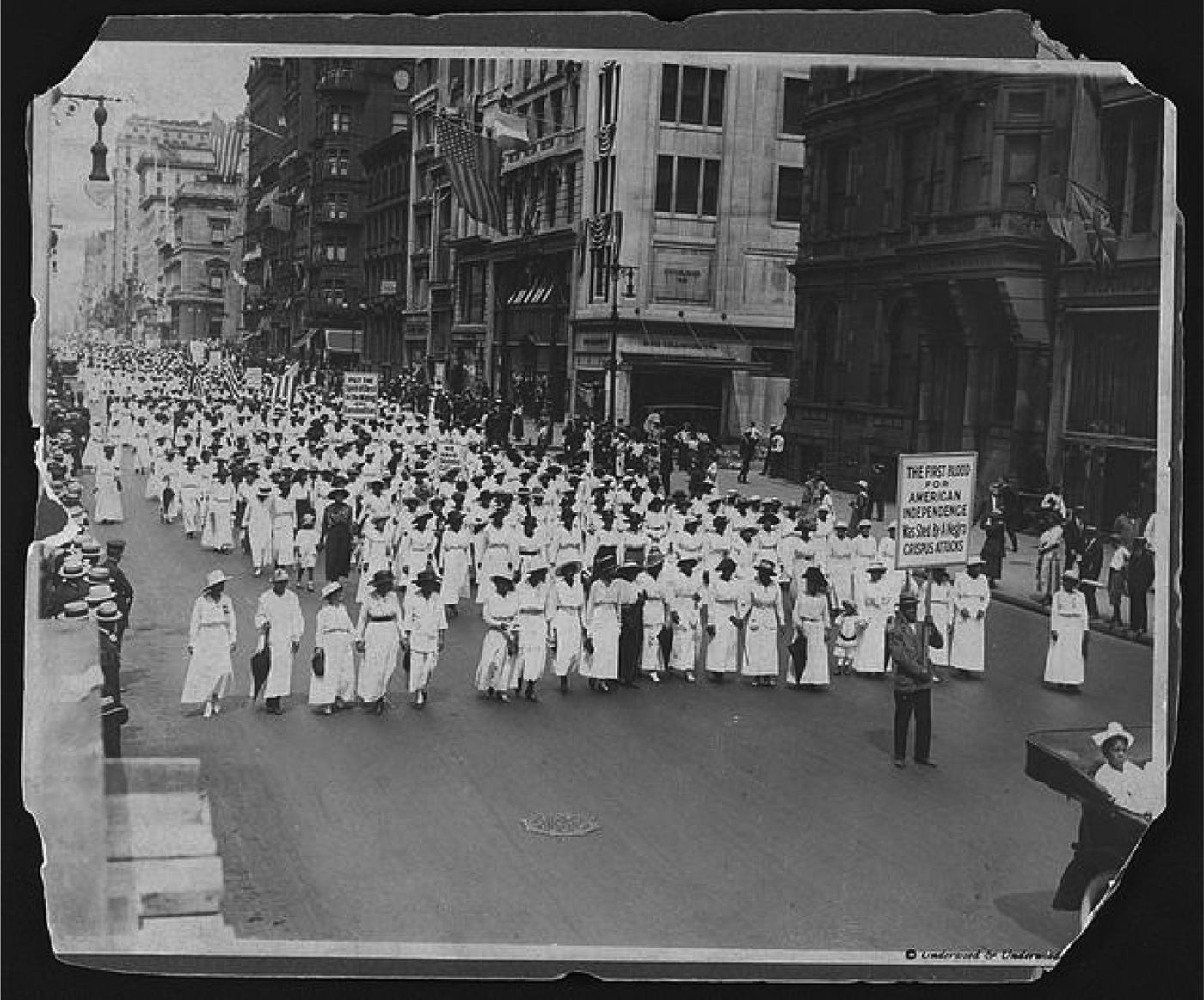
“Be in line on Saturday and show that you have not become callous to the sorrows of your race,” urged Reverend Chase Martin, writing on behalf of the Negro Silent Protest Parade committee.Footnote 8 To protest the racial pogrom in East St. Louis, approximately 10,000 African Americans marched down the commercial heart of Fifth Avenue in New York City on July 28, 1917. The marchers were silent; the only sound was a steady, muffled drumbeat from a boys’ drum corps. Hundreds of children holding hands came next, followed by women dressed in white. “Then came the men, erect, dignified and manly. … The personification of self-reliance,” reported the New York Call.Footnote 9 Taking their cue from the marchers, the police and the crowd of mostly black spectators (estimated by the New York Times at 20,000) remained silent as well. Protesting the riot, lynching, and Wilson's apparent indifference to both, the marchers carried banners with slogans that included, “Bring Democracy to America before You Carry It to Europe.”
The Silent Parade was the first large-scale civil rights demonstration to garner national attention, intended, in the words of the Washington Bee, to foster a public opinion that “will insist upon even handed justice for all.”Footnote 10 The plan took shape in a series of meetings held in New York City churches where leaders were identified, fundraising campaigns devised, slogans for banners approved, and alliances crafted with secular organizations including a relatively new civil rights organization, the National Association for the Advancement of Colored People (NAACP).Footnote 11 The organizers implemented a dress code and appointed a former army captain as parade marshal to ensure march discipline. The organizing committee also recruited doctors and nurses to ride along in automobiles to help those who succumbed to the summer heat (the possibility of white vigilantes attacking the marchers perhaps also crossed the organizers’ minds).Footnote 12
Calling the parade “the first of its kind in the history of country,” the Chicago Defender downplayed expectations that the demonstration would result in much short-term change. Its real value, the paper's editorial staff asserted, “was that the Race is waking up, are together as a unit, and are doing things.”Footnote 13 Had the march sowed the seeds of resistance to counter an attitude of resigned acceptance within the African American community? March organizers certainly hoped so. “Men and women who never marched in public before marched to register their protest,” the New York Age proclaimed.Footnote 14 It is difficult to say for certain what compelled participants to make the decision to join the protest. The viciousness of the East St. Louis attack and the organizers’ effective recruitment strategies were certainly factors. The Silent March, however, also occurred just as American society was beginning to organize for war, with daily life suddenly infused with nonstop entreaties for citizens to register for the draft, buy war bonds, and conserve food. Indeed, the African American newspapers covering the march were also full of announcements listing the names of men serving in the military, members of civilian war work committees, and details of how to buy liberty loans. A delegation from the National Association of Colored Women and Empire State Federation of Women's Clubs made this connection in a letter to Wilson. “At the first call for loyalty we immediately urged our entire people to hold your hands to buy Liberty bonds, to help freely the Red Cross, to enlist the soldiers to till the soil and help the fighting armies.” These two groups “have long been silent” about racial atrocities, they admitted. But speaking out on behalf of the mobilization effort unexpectedly led to a newfound desire to speak out against “this carnage of blood now raging in East St. Louis, Illinois, and to collect petitions from their clubs demanding a federal investigation.Footnote 15 Indifference or apathy became increasingly intolerable when the wartime climate emphasized action and commitment. In this cultural environment, is it any wonder that the Silent Parade organizers found it easier rather than harder to convince black New Yorkers to march to support racial justice?”
Female protesters dressed in white marching behind rhetorically powerful signs and the nurse riding along in a car (seen in the right-hand bottom corner) attest to the careful thought put into organizing the Silent Parade. Source: Library of Congress. http://www.loc.gov/pictures/resource/ds.00894/
After the march, a delegation headed to Washington, DC, to present a petition to Wilson, who claimed to be too busy to receive them.Footnote 16 They had better luck on Capitol Hill, where some sympathetic congressmen, including L. C. Dyer from St. Louis, Missouri, agreed to launch an investigation.Footnote 17 In 1918, Dyer introduced the Dyer Bill that would make lynching a federal crime. Fighting to enact a strong federal anti-lynching law henceforth became central to the political agenda of the NAACP.Footnote 18 It was an issue that garnered publicity and motivated members, helping to solidify the NAACP's role as the leading civil rights organization.
The Silent Parade was a crucial event at the dawn of the modern civil rights movement.Footnote 19 It set a tone of defiance while pioneering a new technique of collective nonviolence. African American marchers ended the day peacefully, with no arrests and their heads high. Female activists picketing the White House were not as fortunate.
PICKETING THE WHITE HOUSE
The Silent Parade was the second, not first, major parade for social justice that captured the national imagination. The first had been the 1913 Suffrage Parade in Washington, DC, the brainchild of Alice Paul, who was then still a member of the NASWA. Like the organizers of the Silent Parade, Paul appreciated the importance of visual symbolism. The Suffrage Parade occurred on the eve of Woodrow Wilson's presidential inauguration, provoking the ire of some onlookers who attacked the marchers. Paul leveraged the attacks to gain maximum exposure for the suffragist cause through newspaper coverage and subsequent congressional investigations. Negative publicity did not frighten Paul, who was confident that she could regain control of the narrative.
Upon hearing that arrests for picketing the White House were likely, the NWP embarked on a new strategy of resistance. Following the example set by British suffragists, they would embrace arrests as a way to garner even more publicity for the movement.Footnote 20 “[It] was a really big turning point. That's when our militancy really began,” Alice Paul later recalled. “‘If you come now, you will have to be prepared for arrest,’” Paul told suffragists volunteering to picket.Footnote 21
Paul's militant tactics had a long incubation period, but the war made them even more effective. As one citizen wrote to Wilson at the height of the crisis, “I am not in sympathy with the picketing plan, at this time, when we are overwhelmed with the business of war, but one is compelled to admire the courage of these delicate women, who will suffer criticism, privation and physical pain in the pursuit of an ideal.”Footnote 22 In a wartime environment that emphasized physical sacrifice for the cause of democracy, the willingness of suffragists to exhibit steely resolve and suffer physical pain, the exact attributes expected of male soldiers on the battlefield, eventually aroused the admiration and sympathy of many Americans. The administration's over-the-top response also helped to transform these women into democratic heroes whose actions pricked the nation's conscience.
Attacks by unruly mobs; arrests; months-long sentences in a filthy, dismal workhouse; solitary confinement; hunger strikes; force-feeding; and occasionally even guard beatings—this was the pattern throughout the summer and fall of 1917 as the picketing and arrests continued unabated.Footnote 23 The NWP recognized the propaganda value of middle-class and upper-class white women being subjected to prison conditions normally reserved for the black, working-class prostitutes with whom they sometimes shared cells.Footnote 24 Almost immediately, Wilson fretted that the arrests had been “a fearful blunder” that would turn the women into martyrs.Footnote 25
The suffragists endured a tremendous amount of physical and mental torture to win public sympathy. When Alice Paul was arrested in October, she began a hunger strike with fellow activist Rose Winslow, demanding that authorities treat jailed suffragists as political prisoners with the rights to wear their own clothes, see visitors, buy outside food to keep themselves “well and strong,” and receive and send mail.Footnote 26 Rejecting these claims, prison officials began the horrific process of force-feeding. This is how “[t]he Administration is dealing with its political opponents,” NSW official Lucy Burns told supporters in a fundraising letter.Footnote 27
Outraged comments poured into the White House mailroom. “It is absolutely essential that the American people be united at this time. But unity is not to be obtained by dragging gray-haired women to filthy jails for the crime of bearing banners upon which are inscribed the words from the President's lips!” pointed out one letter writer.Footnote 28
Sent to investigate conditions, a District Commissioner reported that “there was no evidence of nervousness on the part of either of them; both seemed perfectly calm, but very determined.”Footnote 29 Nonetheless, when Paul persisted in her hunger strike, she was secretly transferred to a psychiatric ward and denied any outside contact. Guards woke her every hour to prevent her from sleeping while a doctor visited her several times a day trying to goad her into making threats against the president so she could be declared insane.Footnote 30 Finally located by her lawyer, news of Paul's mistreatment leaked out. The Wilson administration now changed course, and the suffragists were released from jail.
The NWP presented “jailed for freedom” pins with heart-shaped locks to honor activists upon their release from prison in December 1917. National Museum of American History, Item # NMAH-RWS2012-05633.

Once freed Paul began circulating an amazing story. Just before her release, she received a late-night visit from David Lawrence, a journalist known for his friendly relationship with the Wilson White House. Paul claimed that he offered her a deal: if she agreed to stop picketing, Wilson would work behind the scenes to ensure that Congress passed a federal suffrage amendment.Footnote 31 Paul's supporters viewed this conversation as vindication for her tactics and the NWP's earlier decision to fight full throttle for a constitutional amendment rather than incremental change at the state level. The desired end of a constitutional amendment required new means, namely a national campaign strategy. With the wartime nation focused on the Wilson, picketing the White House offered Paul the perfect stage to win public attention, and apparently, leverage over the president.
Two months after Paul's release from prison, Wilson openly announced his support for a federal female suffrage amendment. With Wilson holding up his end of the bargain, the NWP followed suit and halted (only temporarily it turned out) their picketing. In the spring of 1918 the picketing resumed. The Senate had failed to follow the lead of the House in holding a vote on a female suffrage amendment and Paul blamed Wilson. Recognizing the importance of connecting suffrage to women's loyal participation in the wartime economy, Paul recruited working-class female factory workers to picket alongside upper-class society women. The activists also became more theatrical, giving speeches in Lafayette Square (where they had relocated their headquarters) opposite the White House and then burning copies of Wilson's speeches in bonfires called “Watch-fires for Freedom.” In September, Wilson went before the Senate to urge action, and behind the scenes he lobbied fellow Democrats more vigorously. “Although he insisted he was not influenced by ‘intemperate agitators’ it is hard to imagine the circumstances that would have led Wilson to the floor of the Senate if Alice Paul had not continued her campaign after the war began in the spring of 1917,” concludes legal scholar Lynda G. Dodd.Footnote 32
Yet women did not receive the vote in 1918. Keeping the pressure on Wilson and the Democrats, the suffragists kicked it up a notch after the Armistice ended hostilities along the Western Front on November 11, 1918. Their postwar protests in Lafayette Square now included burning, not just Wilson's words, but his effigy.Footnote 33
WORKING WITHIN THE WARTIME STATE
The suffragists were not alone in using arrests to gain publicity for their cause. When Roger Baldwin refused to take his army physical exam and then pled guilty in federal court to violating the Selective Service Act, he used his sentencing as an opportunity to lay out his objections, not just to war, but to conscription as an infringement on his right to act in accordance with his conscience. He knew that he could have potentially avoided a showdown with the government by waiting until he learned the results of his physical exam. He openly acknowledged that he was using this act of civil disobedience to draw attention to the plight of conscientious objectors who had received prison sentences ranging between 15–30 years from military courts.Footnote 34
Released from prison in July 1919, Baldwin began formulating plans for a permanent organization dedicated to protecting civil liberties, which for him meant championing primarily the rights of workers, pacifists, radicals, and civil rights activists to protest, organize, and demonstrate. In January 1920, under Baldwin's guidance, the NCLB was reconstituted as the American Civil Liberties Union (ACLU). A hastily organized response to wartime exigencies had evolved into a permanent and influential voice in future legal disputes concerning civil liberties.
But challenging from without was only one way to fight for social justice during the war. Working from within also mattered. Baldwin took nearly a year to embrace the tactic of civil disobedience. Initially, he worked hard to maintain good relationships with sympathetic governmental officials. In the early days of the war, civil liberties advocates believed that their personal relationships with progressive-oriented administration officials offered a backdoor channel for influencing official policies toward conscientious objectors. Rather than adopting an openly confrontational stance, both sides embraced the philosophy that negotiations worked best. Baldwin's early correspondence was peppered with phrases such as “we don't want to make a move without consulting you” and the NCLB was “entirely at the service of the War Department in rendering any assistance.”Footnote 35 Secretary of War Newton B. Baker had a deep commitment to treating conscientious objectors humanely, and he enlisted the NCLB to keep the most egregious cases out of the press while he worked behind the scenes to redress abuses and establish workable guidelines.Footnote 36
Believing that the War Department would welcome its advice, the NCLB crafted a January 1918 memorandum with other pacifist groups to draw attention to the abusive treatment meted out to conscientious objectors in the training camps. These abuses included solitary confinement, spraying men regularly with cold water, handcuffing them so they stood on tiptoes for hours, beatings, and withholding food. Until May 1918, this collaborative spirit allowed Baldwin to communicate directly with conscientious objectors in the camps and to work toward improving their treatment. These channels of direct communication, however, eventually closed.
Military Intelligence and Justice Department officials, angry that the NCLB was sending its pamphlet literature through the mails and soliciting attorneys nationwide to offer free legal advice, put the group under surveillance. In response, Baldwin (somewhat naively) tried to assure intelligence officials that he was trustworthy by offering to share the names of contributors and men inquiring about how to seek conscientious objector status.Footnote 37 The MID campaign to discredit the NCLB, however, eventually convinced Baldwin's key contacts in the War Department, including Baker, to end all cooperation with the NCLB.Footnote 38
Baldwin did not take the break well. He continued writing to administration officials and even voluntarily submitted to interviews with hostile MID officials to demonstrate his willingness operate openly.Footnote 39 When the Justice Department raided the NCLB offices and seized the records that Baldwin had offered to share months earlier, he became more combative. Baldwin's loss of insider access prompted him to devise a new approach. Beginning with his own arrest, Baldwin (and the future ACLU) would turn to the courts to protect Americans’ civil liberties.
The NAWSA, the moderate wing of the suffrage movement, never abandoned insider tactics while campaigning for a constitutional amendment. By 1917, the NAWSA had established a formidable presence in Washington, DC, dubbed the “Front Door Lobby” that recruited prominent society women, including the wives of congressmen, to the cause.Footnote 40 The suffragists made daily rounds trying to talk to lawmakers and organized local and state committees to put pressure on congressmen from their constituents. NAWSA president Carrie Chapman Catt firmly believed that the NWP pickets hurt NASWA lobbying efforts by antagonizing both the president and Congress. She asked Paul to end the picketing and when this failed, NASWA officials advised the Wilson administration to orchestrate a news blackout by persuading reporters to stop covering the protests.Footnote 41
Catt and her colleagues endeavored throughout the war to maintain cordial relations with Wilson. At the very moment that Paul languished in jail enduring rounds of force-feeding, Catt was visiting the White House with other NASWA colleagues to thank the president for his support during the recently successful New York state referendum campaign. “We believe that he is going to do everything he can to help us” gain a federal suffrage amendment, declared Catt in a NAWSA press release.Footnote 42
Beyond distancing their organization from the Silent Sentinels and courting the president, NAWSA had to decide on its response to the war. Even before the official declaration of war, the NAWSA made plans for its members to volunteer en masse for war work.Footnote 43 Catt and other high-ranking NAWSA officials, for instance, immediately agreed to serve on the Woman's Committee of the U.S. Council of National Defense. This was a controversial decision, especially since many suffragists were also active in the peace movement.
From the opening days of the war, NAWSA linked the vote to the nation's wartime dependence on voluntary female labor. “[W]e feel that it would add to our enthusiasm and usefulness during the war to be equipped with the ballot before we are placed on the firing line,” Catt told Wilson in May 1917.Footnote 44 As historian Kimberly Jensen notes, for suffragists “loyalty became currency—the medium by which individuals and groups pledged their service in exchange for civic and social recognition.”Footnote 45
Across the country self-identified suffragists were visible participants in every voluntary endeavor connected to the war. They rolled bandages for the Red Cross, conducted cooking demonstrations for the Food Administration, organized suffrage contingents to march in patriotic parades, and manned booths at state fairs selling liberty bonds (where suffrage literature was also readily available).Footnote 46 By securing prominent positions in home-front committees, suffragists won tacit official endorsement that their cause was legitimate and within the boundaries of acceptable wartime political discourse. These patriotic endeavors also keep members from drifting away as the call to engage in wartime committee work intensified. Local chapters of the NAWSA, for instance, continued to hold suffrage meetings, albeit ones where everyone was knitting socks for the troops. When Wilson decided to publicly endorse female suffrage, he found it more palatable to present his support as a reward for the NAWSA's good behavior.
African American civil rights activists also understood the importance of working from within the war effort. Emmett J. Scott became the movement's ultimate “insider” during the war. The former private secretary to Booker T. Washington (who died in 1915), served as a special assistant to the secretary of war to help the War Department “manage” race relations. Scott's office was inundated with letters and petitions detailing racial injustices within the wartime army. Scott usually just forwarded these documents to MID officials for often pointless investigations. Yet the very fact that Scott's office existed encouraged African American soldiers to speak up during the war rather than remaining silent.Footnote 47
His obvious lack of power frustrated militants, and Scott was criticized for not protesting more strenuously when confronted with flagrant examples of institutional racism. A disciple of Washington, Scott believed that building a record of patriotic devotion and accomplishment would arouse white Americans’ respect and sense of “fair play.” At the end of the war, Scott used his unique access to official documents to publish a comprehensive inventory of African Americans’ contributions to the war effort. Scott's Official History of the American Negro in the World War ended by noting that African Americans “did their full share in the great struggle to make the world safe for democracy” and each man who served entered the postwar era with a “more sharply defined consciousness, not only of his duties as a citizen, but of his rights and privileges as a citizen of the United States.”Footnote 48
Efforts to turn this rhetoric into reality immediately materialized among other activists who had pursued an insider strategy to advance civil rights during the war. African American communities had formed numerous local committees to encourage compliance with food conservation and liberty loan drives. These campaigns required recognized leaders and vehicles for communicating effectively—organizational networks that could immediately be used to protest against racial discrimination once the war ended. Some committees created to organize war bond campaigns within the black community, for instance, became incubators for new chapters of the NAACP or other locally based civil rights groups in areas traditionally hostile to any overt political organizing by African Americans.
The case of Sergeant Edgar Caldwell provides a useful illustration of this process.Footnote 49 In December 1918, Caldwell was accused of killing a white conductor who threw him off a streetcar in Anniston, Alabama. In response, Reverend Roland Williams (also a member of Anniston's Liberty Loan committee and local branch of the NAACP) called upon the same church leaders and small businessmen who had helped organize the United War Work Campaign to join Caldwell's legal defense team. Seeking national exposure for the case, Williams enlisted the NAACP's national headquarters to help fund and publicize the legal fight to overturn Caldwell's first-degree murder conviction and sentence of execution. The NAACP turned to Scott, who secured meetings with officials in the Justice Department, War Department, and White House. The case eventually went before the Supreme Court, which rejected the defense claim that a state could not to try a soldier in uniform.
Though activists failed to save Caldwell's life, the campaign was significant on many levels. Making use of networks originally created to further the war effort, activists successfully organized an appeal. Like the Silent Parade, the Caldwell case illustrated the importance of movement building from the grassroots. Charismatic national spokesmen were not enough to create a sustained social justice movement. Willing and motivated ground troops were essential to successfully challenge racial injustice and discrimination.
CONCLUSION
Social justice movements were not monolithic, but for their component parts wartime proved an apt time for recruitment, innovation, and activism. By participating in home-front mobilization efforts, civil rights and suffrage activists mitigated the charge of disloyalty and strengthened their movements internally. For a time, civil liberties activists negotiated with officials to determine the boundaries of acceptable dissent. More radical activists within the civil rights and suffrage movement also engaged in novel, nonviolent street protests that drew widespread press attention and demanded a new level of commitment from adherents. The Silent Parade and Silent Sentinels were visual, rhetorically powerful protests that could not be ignored, forcing the nation to pay attention to civil rights and female suffrage. The Espionage Act intended to silence and marginalize radicals and dissenters. These activists turned silence into a powerful weapon that forced the nation to listen. Suffragists ultimately proved more successful in getting the nation to hear. On August 26, 1920, the Nineteenth Amendment was added to the Constitution.
Female suffragists’ hard-won victory came two years after the war ended, in a nation that was trying to forget the war as quickly as possible. Wilson's 1918 endorsement was certainly a response to the pressures of wartime, but it is difficult to interpret the eventual ratification of the Nineteenth Amendment as the result of a grateful nation rewarding women for their wartime service. Instead, the amendment reflected the final, successful implementation of tactical innovations that suffragists developed in response to the war, the melding of street theater, community involvement, public sympathy, presidential support, and backdoor maneuvering.
As one movement ended, two others were just beginning. Thanks to wartime experimentation and innovation, the civil rights and civil liberties movements survived the war and entered the postwar era with new ideas about how to further their respective causes. It is worth remembering that the NACCP was only founded in 1909, with no guarantee that it would become the key civil rights organization that transformed the direction and intent of the civil rights movement. Yet the war proved transformative, bringing in new recruits (including returning soldiers) and opportunities for making the movement visible on the national stage. The war also gave birth to a brand-new social justice movement concerned with protecting civil liberties. Peacetime offered an opportunity to expand, rather than disband. In the wake of war, energized civil liberties and civil rights movements became permanent parts of American political culture.


