Making Our Collections Visible was a one year project undertaken by the University of Stirling to provide online access to our museum and archive collections.
The University of Stirling was founded in 1967 and the University's current passion and commitment to arts and culture builds on the legacy of the University's first Principal, Dr Tom Cottrell (1967–1973) who believed that art and culture should be part of the everyday experience at the University. The University still operates under the founding principle that our collections should be accessible to all, and those of us who work, study or visit should be surrounded by a substantial collection of uplifting and beautiful works of art and archives.
The cultural bodies at the University of Stirling, which include the Art Collection, University Archives, Macrobert Arts Centre and Gardens & Grounds share a common goal to promote Culture on Campus (https://www.stir.ac.uk/student-life/campus-facilities/culture-on-campus), which provides an umbrella, linking our cultural and heritage resources throughout the historic University landscape. Prior to the Making Our Collections Visible project there was no mechanism to highlight the extent of our collections and the wide variety and depth of information available in these collections which detail the history of the University and effectively promote culture on campus.
The project was funded by Museums Galleries Scotland through their Museum Development Fund, which enabled us to work with an external firm Orangeleaf to develop what would be a suitable online provision to highlight our collections. The aim of the project was to locate the University's cultural treasures together online to highlight Culture on Campus and to encourage exchanges between art, archives, research and teaching.
The University holds unique research resources which include:
• The University of Stirling Archives which hold the institutional memory of the University, including a detailed record of 50 years of cultural activity on campus in the Macrobert Archive
• The University's Art Collection (www.artcol.stir.ac.uk), which makes art and culture part of everyday life for staff, students and visitors to the university. The Art Collection is an MLA accredited Museum of Scottish Contemporary Art, located on campus in the Pathfoot Building
• The Scottish Political Archive (www.scottishpoliticalarchive.org.uk), which records the history of the campaign for a Scottish Parliament, the 1979 and 1997 devolution referendums, and the 2014 independence referendum. The collection also includes the personal papers of Lord McConnell of Glenscorrodale, Chancellor of the University of Stirling
• The Pathfoot Press (https://www.stir.ac.uk/about/art-collection/art-and-artists/the-pathfoot-press/). This undertakes workshops with staff, students and visitors to the University using the working Columbian press
• The NHS Forth Valley Archive, which contains collections of national importance, recognised by UNESCO (and added to their UK Memory of the World Register in 2013)
• The Commonwealth Games Scotland Archive, the largest multi-sport archive in Scotland
• Our cultural archives include the papers of the writers Iain Banks and Patrick McGrath, filmmakers John Grierson, Norman McLaren and Lindsay Anderson, and the archives of the Musicians’ Union
Previously, at any given time, only a small percentage of our collections were available online or physically on display in the gallery or archives reading room. There was little understanding, even internally, of the scope of our collections. Scoping studies undertaken highlighted a need for the Art Collection and Archives to reach out to its existing and potential audiences and provide them with the fullest possible information about our collections.
Although the University is located primarily on one campus, the collections are not held together within one central location. In addition, structurally, Art and Archives sit in completely different departments in the University. The Art Collection sits under Internationalisation and Partnerships, the Scottish Political Archive sits within the Faculty of Arts and Humanities and the Archives services falls under Information Services. Although we are each in small teams, and work well together, we wanted to make the cultural offer on campus easily accessible and seamless so that visitors to the University can understand the breadth of the cultural offer and how to access this. We had already worked together to promote Culture on Campus through joint projects such as our University Treasures catalogue and in the 50th anniversary year of the University in 2017 we created a 50th blog (https://realisingthevision.stir.ac.uk/) which over the course of a year advertised key items from across the collections.
Online provision was something that we were very conscious that we were lacking, in particular for the Art Collection holdings. We have almost 700 works in the Collection which are catalogued through Adlib, but this catalogue was only available internally to curatorial staff. As there was no access externally, and researchers could only see a fraction of the collection on our website, we wanted to provide our catalogue online. We also wanted, if possible, to integrate it with the CALM for Archives catalogue so that all cultural resources could be easily searched across repositories to find items in the collections which relate to the same individual or theme. The University Archives were available online through CALMview but this did not allow us the facility to cross search with museum collections.
The new Art Collection and Archives online presence sits within the University of Stirling website, and as such adheres to University branding guidelines. We can export data from Adlib for the Art Collection and also from CALM for archives to a server, and then the server aggregates the data and presents it within a Wordpress platform. The catalogue is then integrated into the main University site so that users will not notice that they have left the University site.
Funding from Museums Galleries Scotland allowed us to employ a Documentation Officer, for one day per week for nine months, who worked on checking and developing our collections information on Adlib and on testing the site. We also benefitted from a Skills for Success trainee who worked full time for a year on the project. The Skills for Success programme, funded by The National Lottery and coordinated by Museums Galleries Scotland, addressed the lack of accessible entry routes into museum jobs by offering opportunities for non-graduates from diverse backgrounds. The Art Collection's Skills for Success trainee was employed as a Documentation assistant, whose job it was to research the University Archives for reference to the Art Collection and then to cross reference these from CALM to Adlib. This is particularly interesting for artists who feature in both the collections of the Art Collection and the Archives. Filmmaker Norman McLaren is one such individual.
Norman McLaren was born in Stirling in April 1914. The son of a painter and decorator he was educated at Stirling High School. He studied art and interior design at the Glasgow School of Art from 1933–36. While there he began making short experimental films. His work came to the attention of John Grierson who offered him a job with the GPO film unit in London. In 1939 McLaren left Britain and moved to New York. In 1941 he took up an invitation from John Grierson to work at the National Film Board of Canada, which Grierson had established in 1939. In Canada, Grierson gave McLaren the freedom to experiment. He examined the various ways sound and movement could be presented on film and developed a variety of different techniques of animation. McLaren's genius was recognised worldwide with a string of awards for his work including an Oscar in 1953 for his short film Neighbours.
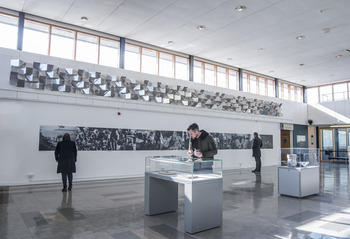
Crush Hall exhibition space in the University's Pathfoot Building

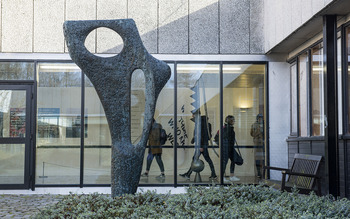
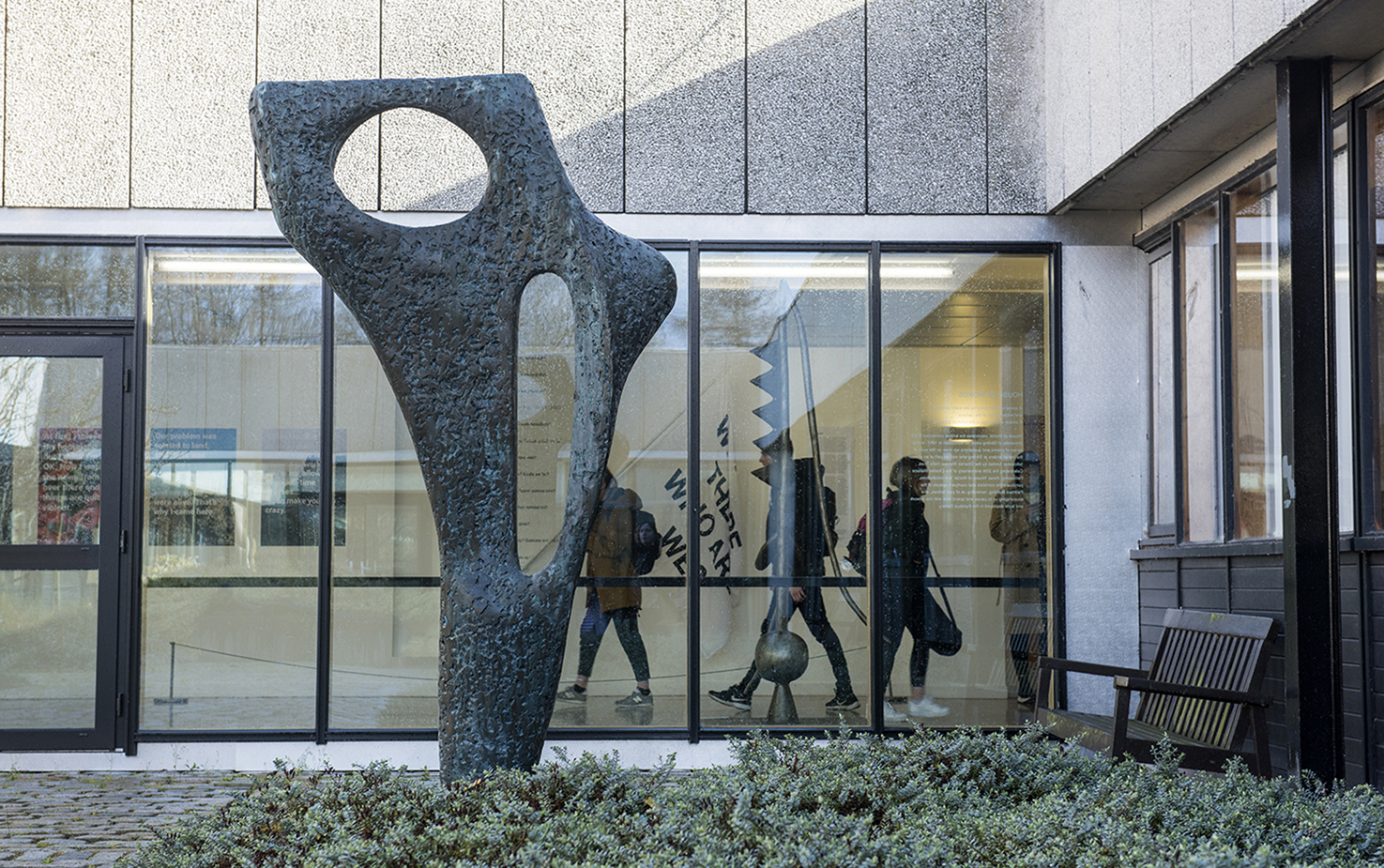
Courtyard in the Pathfoot Building with Barbara Hepworth's Archaean on display
The University holds 440 archive records in the Norman McLaren collection in the Archive and 67 artworks in the Art Collection. We can now search the artworks and are beginning to populate the collections site to provide cross links from archive records discussing particular artworks. This unlocks the depth of the collection and will allow potential researchers to discover more about the work of Norman McLaren and the resources available at Stirling to explore. This type of overlap with art and archives is common across all the collections and new links and synergies between the collections are emerging all the time as collections documentation improves.
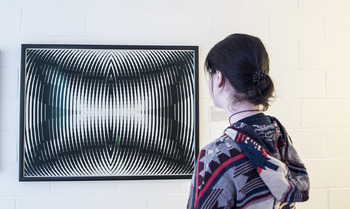
Visitor admiring Peziza by Jeffrey Steele

Functionality of the new website
Making Our Collections Visible is ongoing and we have plans to develop our collections information to fully utilise its potential. We are currently using a fraction of the functionality of the site capability. We are still in the soft launch stage of the catalogue and hope to add to the collection information online and in particular to increase the cross references from the University Archives to the Art Collection.
Each of the artworks are shown as IIIF images (International Image Interoperability Framework). This technology is increasingly being utilised by a growing community of the world's leading research libraries and image repositories. Participating members include Harvard Art Museums, J. Paul Getty Trust, Library of Congress and the National Gallery of Art (a full list is available on https://iiif.io/).
IIIF aims:
• To give scholars an unprecedented level of uniform and rich access to image-based resources hosted around the world.
• To define a set of common application programming interfaces that support interoperability between image repositories.
• To develop, cultivate and document shared technologies, such as image servers and web clients, that provide a world-class user experience in viewing, comparing, manipulating and annotating images.
The framework is based on the fundamental principle that access to image-based resources is essential to research, scholarship and the transmission of cultural knowledge. IIIF makes images accessible and searchable.
This principle facilitates access to document sharing facilities like Project Mirador. (https://projectmirador.org/). This allows comparison of images and artworks from institutions across the world. Researchers could, for example look at a high resolution image of one of the Fergusson paintings held in the University of Stirling Art Collection and compare it to an early sketch of the same painting held in an institution in Australia. Facilities like Mirador provide a tiling windowed environment for comparing multiple image-based resources with deep zoom functionality; this means that brush and pencil strokes which are sometimes not visible when viewing a painting / drawing in person can be viewed by zooming in, using the document sharing platform.
The collections site includes a map feature which allows us to geolocate our objects and create an online sculpture trail of artworks on campus. The map functionality allows us to layer different maps to suit our collections so that we can go back in time and see what the campus landscape would look like at different periods and add objects from our collections to these maps. We plan to utilise historic maps from our collection to illustrate the development and growth of the campus. In time this will integrate with oral history interviews detailing experiences of people who have lived and worked on the University campus. A recent project digitising the Brig Collection of student newspapers is planned to be added to the online collections soon. This gives a detailed description of what student life was like in each year since the University was established and will be of great interest to former students who are now all around the world and not necessarily able to visit our institutional archive.
The Art Collection is working with academic colleagues in History, Heritage and Politics to develop 3D images for our collections, in particular our sculpture collections, using programmes such as Photoscan and Sketchfab. These 3D sculpture images will be plotted onto the online map of the campus, so that they can be enjoyed by all, even those who cannot physically visit the campus. In addition, we are developing chatbots to highlight our collections. A chatbot is a piece of software that conducts a conversation via audio or text. These programmes are often designed to convincingly simulate how a human would behave as a conversational partner. An innovative example of this is Filla — Fulla: Fate of the Artist (https://fillafulla.sng.sk/?lang=en). This chatbot is based on an exhibition which is part of a joint project with the Moravian Gallery in Brno, Made in Czechoslovakia, dedicated to the centennial anniversary of the founding of Czechoslovakia. Planned chatbots from the Art Collection here at Stirling include the artists J D Fergusson and Barbara Hepworth, amongst others.
In conclusion, the provision of a new online catalogue has indeed ‘made our collections visible’. We see the new catalogue as an online showcase to allow current and potential visitors to engage with our collections, learn more about what we do and hopefully visit our beautiful campus to see our collections in person. To learn more about our collections please visit our website (https://www.stir.ac.uk/student-life/campus-facilities/culture-on-campus). The new online catalogue is now available online at: https://collections.stir.ac.uk