China's search for national salvation
The return of Hong Kong to China was naturally a moment rich with symbolism. But whereas for British elites it simply served as yet another reminder of their lost empire, for the Chinese it had an altogether more significant historical meaning. The country's common sense of identity had been forged in its bitter experience of Western colonialism, and the final end of colonial rule on lands long considered Chinese marked the realisation of a central nationalist aspiration. Indeed, the imagery Jiang Zemin invoked at the handover ceremony spoke directly to this nationalist sentiment:
July 1st 1997 will go down in the annals of history as a day that merits eternal memory. The return of Hong Kong to the motherland after going through a century of vicissitudes indicates that from now on Hong Kong compatriots have become true masters of this Chinese land, and that Hong Kong has now entered a new era of development … Hong Kong compatriots have a glorious patriotic tradition … It is inseparable from … the mainland.Footnote 1
Themes present in these remarks typify more general facets of modern nationalism. For it nearly always exhibits a tension between an imagined sense of the eternal and primordial basis for the nation, with a promise of its future historical destiny. The latter, as Jiang's remarks testify, is often seen as the flowering of an already present national essence that resolves a past sense of loss and makes a new future possible. Seemingly undermining these narratives is the fact that national identities are relatively recent historical phenomena. Indeed, scholars have long argued that the basic contradiction of nations per se lies in their ‘objective modernity … vs. their subjective antiquity’.Footnote 2 Far from being a source of instability that might foreshadow its transcendence by a new form of political association, this subjectivity has allowed nations to create a sense they can endure even the most rapid political and economic change. In the case of China, the shifts in the political form of state from dynastic empire, through to the republic, Maoist, and post-Maoist eras have all been imagined to be mere moments in the sequential development of a Chinese political subject.
This perception, however, exists in tension to the polity's real history. The state power the British defeated in the First Opium War (1841–2) to win the cessation of Hong Kong lacked the cohesiveness of identity that the term ‘motherland’, so essential to the discourse of modern nationhood, implies. The ethnically Manchu elite, who stood at the top of the Imperial Empire, considered their identity to be quite separate from the subjects over whom they ruled, and certainly not ‘Chinese’. Hong Kong itself was a tiny fishing community, largely unimportant to the wider empire. Under British rule, Hong Kong experienced a social transformation that dramatically expanded native subjects’ awareness of a territorialised world of many competing national communities, and its population mushroomed from c. 5,000 to 7,000 in 1840 to some 124,198 in 1870.Footnote 3 British colonial control in Hong Kong was particularly long lasting and took the form of direct territorial jurisdiction. However, in the nineteenth century, several ‘Treaty Ports’ were established, in which foreign powers won substantial commercial, territorial, and military rights that, while not making these cities outright colonies, significantly undermined Chinese sovereignty. It was through this interaction with the wider world that the seeds of a new kind of collective subjectivity were established in the polity: a sense of national identity that emerged out of the colonial experience, but also sought salvation from its injustices.
China was hardly alone in experiencing this transformation. Benedict Anderson long ago highlighted what he called the ‘modular’ character of national identity. Modularity referred to how, once this form of identity and political association had emerged, it was ‘capable of being transplanted with varying degrees of self-consciousness to a great variety of social terrains, to merge and to be merged with a correspondingly wide variety of political and ideological constellations’.Footnote 4 China's experience appears to offers a striking confirmation of this claim. Indeed, without for a moment accepting the eurocentric mythFootnote 5 that the Imperial polity was unchanging and static, that is, lacked any tendency to dynamism and creative renewal, it is nonetheless the case that the stratified identities of the system were rooted in cultural norms and structures which had proven to have remarkable durability – a fact that comforted conservative Qing rulers during the crises of the nineteenth century. Yet, even in Imperial China a perfect storm of social, cultural, and economic change impelled a search for a different way of thinking about time, space, identity, and society, one which would lead to the adoption of the national community by new elite social classes, and, thus, to the invention, so to speak, of ‘the Chinese’ as such.
Anderson's Imagined Communities; Reflections on the Origins and Spread of Nationalism Footnote 6 is widely recognised as a path-breaking, albeit also highly controversial, text in the theories of nationalism literature, with the concept of modularity, in particular, being one of most contested aspects of his theory. This article offers a critical engagement with Anderson's core theoretical framework, reflecting on the extent to which it provides a plausible account of the pressures and forces that led subjects of the Qing emperor to reimagine their identity as aspiring citizens of a Chinese nation. It does so by applying Leon Trotsky's ‘theory of uneven and combined development’ in order to provide a deeper analytical framework for the modularity of national identity. International relations – the pressures and influences arising from a world of many societies – constituted the missing element in Anderson's original elaboration and it is a lacuna that can be fruitfully addressed in the terms of Trotsky's theory. I therefore argue for the reconceptualisation of modularity as a product of ‘combined development’ and elaborate how the emergence of a Chinese nationality is best understood as an outcome of an intersocietal process.
Conceptualising the national community
Despite the obvious affinity of the study of nations to the intuitive concerns of the discipline, International Relations (IR) scholarship has traditionally had an ambivalent relationship to this field. In the discipline's mainstream, nationalism has tended to be considered ‘a baseline fact of international politics, as an immutable outcome of an irreversible process’.Footnote 7 National identity and political nationalism were thus subject to a timeless naturalisation, closing off enquiry into their substantive historical origins. The manner in which this was done mirrored how national myths have always tended to deny their own modernity by tracing imagined ‘origins’ into time immemorial. For IR, this ‘taking the nation for granted’ has served to underpin the intellectual preoccupation of the discipline's mainstream with the external relations between nation-states. As a result, national identity, and the nation as a specific form of community, has simply been equated with, and subordinated to, the state as the primary empirical and theoretical horizon.Footnote 8 Against the mainstream, critical scholars have, however, challenged the exclusion of ‘political identifications, collective identities and culture’Footnote 9 from the subject matter of IR. This has formed part of a wider rethinking of the discipline's theoretical assumptions in light of the challenges the end of the Cold War posed to traditional IR theory.Footnote 10
This was arguably IR's belated engagement with the ‘cultural turn’ in the social sciences that took shape in the 1970s. Perhaps unsurprisingly given its subject matter, the literature on the origins of nationalities can be largely situated within this cultural orientation. For in the study of nations and nationalism the intellectual rewards of the cultural turn were considerable. ‘The number of works genuinely illuminating the question of what nations and national movements are and what role in historical development they play’, wrote Eric Hobsbawm reflecting on this achievement, ‘is larger in the period 1968–88 than for any earlier period of twice that length.’Footnote 11 Indeed, one might reflect upon how Hayden White's Metahistory; The Historical Imagination of Nineteenth-Century Europe, a landmark text of the cultural turn, engaged directly with the nature of nationality.Footnote 12 His historical mode of enquiry led him to depart from those that held ‘the reality’ of their ‘own time’ to be ‘the ideal for all time’.Footnote 13 The ‘idea of the nation’ should, he argued, be treated as ‘what, in fact, it is, a concept of association which took shape during a particular period of world history, in a particular time and place; which assumed a specific institutional and cultural form between the sixteenth and nineteenth centuries; and which, therefore, might conceivably give place to some other concept of human association’.Footnote 14 In this way, cultural studies achieved the reinstatement of ‘the centrality of culture in nation-forming without reattaching it to a misplaced notion of the primordial’.Footnote 15 It was this ‘invention of tradition’ that saw the reimagination of archaic facts in contemporary circumstances to construct meaningful modern identities and ‘historical’ cultures.Footnote 16
Anderson built upon these insights and the work's abstraction of choice, ‘the imagined community’, attained a totemic influence in the scholarship. But as the concept gained hegemony over the literature his original position, which stressed sociological changes characteristic of modernity, was often lost, as the ‘imagined community’ became a scholarly passé partout. Footnote 17 The nature of Anderson's contribution has also been contested, and the form this has taken reflects a wider concern that the nationalism literature neglected socioeconomic analysis. Radhika Desai has complained of how a ‘division of scholarly labour – between a study of nations and nationalisms largely focused on culture and a political economy of national (and international) capitalist development – emerged’.Footnote 18 As such, Desai appealed for scholars to recognise that ‘nations were … material realities as much as classes were’.Footnote 19 Her inspiration for this position lay in Tom Nairn's The Break Up of Britain,Footnote 20 and she held Anderson's overly cultural lens to form part of the problem.
Nairn's contribution, as I will show below, certainly lay in how he visualised the uneven and combined development of the international system as a nexus of influences and forces that materially shaped nations. However, Desai's argument that Anderson attempted ‘to carve out a specific explanatory space for culture’, which ignored the ‘explanatory weights of political and economic factors’Footnote 21 is highly debateable. Consider how, when reflecting on the way that the printing press created a new apprehension of time and space, which could potentially cohere any number of forms of community, Anderson asked, why, given the existence of other possibilities, ‘did the nation become so popular?’Footnote 22 He answered cautiously but no less categorically, ‘the factors involved are complex and various. But a strong case can be made for the primacy of capitalism’.Footnote 23 Neither does Anderson suggest that culture is a non-material dimension of human existence, and thus Desai's emphasis on its ‘materiality’ need not trouble his theory.Footnote 24 In this respect, Anderson and Desai might both be read as advocates of a nondeterministic treatment of capitalism, which sees it as a system that is at once cultural and economic, and capable of disrupting archaic identities and providing the means to reshape them around territorially bounded forms of consciousness. By emphasising the contingent, cultural dimension Anderson only departed from Marxist analyses that deduced the rise of nations from capitalism.Footnote 25
If Desai's assessment of Imagined Communities stands on weak ground, the same cannot be said of the challenge postcolonial scholars have made to Anderson's theory. Their critique concerns the modular dimension and, specifically, the extent to which it involves a denial of the imaginative capacities of postcolonial subjects. ‘If nationalists in the rest of the world have to choose their imagined community from certain “modular forms” already made available to them by Europe and the Americas’, wrote Partha Chatterjee, ‘what do they have left to imagine?’Footnote 26 There is much at stake in how we choose to answer this question for it entreats us to investigate the combination of structural pressures and political choices that led to the universalisation of the nation-state form. As a critique of Anderson it hinges, perhaps, on the ambiguity of his remark that once created the nation-state is ‘there, so to speak, for the pirating’.Footnote 27 Here, then, the question one needs to reflect upon is whether this ‘pirating’ denotes a process of simple or differential repetition. For if it is the former, Chatterjee's critique would surely hold; the postcolonial subject is theorised as having little choice. Yet, if it is the latter, then any number of agent-led mutations, adaptations, and, indeed, reimaginations, are possible – a position that would accord with the role that the formation of the postcolonial state played in the overall consolidation of the system of nationality. In what follows, I argue it was such a ‘combination’ of domestic influences and global pressures that led to the differential spread of nation-ness, and gave rise to many peculiar forms, such as the Chinese case.
China's bitter experience of colonialism created the ‘whip of necessity’, sociological foundations, and cultural influences, crucial to the rise of a national subjectivity. Recent scholarship in IR on the theory of uneven and combined development can help us incorporate these processes, and develop a synergy with Anderson's theory of the imagined community.Footnote 28 In the next two sections, I outline this conceptual critique, before going on to investigate the Chinese case. Chinese identity was, I argue, a unique product of the polity's combined development with nineteenth-century colonial capitalism. Its dominant political psyche reflected this interchange profoundly, for it was imbued with the ideal of emulating, in an Asian form, European colonialism, and readily adopted its racialised repertoires of thought.
Contours of the ‘imagined community’ revisited
Anderson's investigation into the origins and nature of ‘the nation’ began with a novel theoretical presupposition, which fed into a carefully constructed historical treatment of the problem. He presupposed, ‘in an anthropological spirit’, the imagined nature of all communities that go beyond mere face-to-face contact; for they inspire a shared sense of belonging and identity among individuals who could never possibly all meet one another.Footnote 29 In short, at a certain stage of development humans create imagined boundaries that apportion an impersonal collective identity to a society. Applied to the modern nation, this transhistorical abstraction, the imagined community, helped to demystify its specific historical expression in the national form.Footnote 30 Denied the primordial status so many claimed for it, nationality was thus revealed as ‘a cultural artefact of a particular age’.Footnote 31 The movement from prenational forms of the imagined community to a distinctively national identity emerges through the process of modernisation. Specifically, Anderson argued that print-capitalism – seen as a form of cultural production and a sphere of economic accumulation – played a central role, intermingling with the expansive but centrifugal power of capitalist production, and the fact of linguistic diversity, to give rise to the nation.Footnote 32
The national imagined community had a distinctiveness that contrasted with its dynastic antecedents. Premodern societies tended to make universal claims, but these were not, and could not be, rooted in a global claim of territorial jurisdiction in the modern-day sense. Instead it involved a mode of apprehension of time that imagined the community to be eternal.Footnote 33 This feature of dynastic societies was founded upon their ascription of existence to a divine providence, and meant that time was apprehended as messianic time, where no distinction is drawn between the past and the future but both are instead thought to exist within an ‘instantaneous present’.Footnote 34 In other words, as Erich Auerbach puts it, ‘the here and now is no longer a mere link in an earthly chain of events, it is simultaneously something that has always been, and which will be fulfilled in the future’.Footnote 35 A feature of this socially constructed imagination is therefore the ‘juxtaposition between the cosmic-universal and the mundane-particular’, as the dream of eternity exists alongside the harsh daily grind of agrarian villages for survival, and the divine authority claimed by fallible human elites.Footnote 36 These mythologies gave ‘certain meanings to the everyday fatalities of existence (above all death, loss and servitude)’ and offered ‘in various ways, redemption from them’.Footnote 37 As Walter Benjamin argued, modernity radically unseats these apprehensions of time and space, replacing them with what he called ‘homogenous, empty time’.Footnote 38 In this new socially constructed imagination, time is measured by ‘clock and calendar’.Footnote 39 Actors imagine the activity of others as a simultaneous movement of a shared organism through time to an uncertain future. The sense that the shared community can have agency over their destiny underlines this major disjuncture between the modern and the premodern. For Anderson it was this shift in the mode of apprehension that provides the cultural origins for the nation. New discoveries in natural science and human life, economic development, expanding global communications, and a closer apprehension of the world's geography, combined to drive ‘a sharp wedge between cosmology and history’ which required ‘a new way of linking fraternity, power, and time meaningfully together’.Footnote 40
Anderson argued that it was print-capitalism, which provided the key link in this interconnected causal chain.Footnote 41 The novel ruptured the conception of time as simultaneity by introducing a calendrical mode of apprehension in narrative form.Footnote 42 But the newspaper was specifically critical, for its ‘single most important emblem’, the date at the top of the page, symbolised the ‘steady onward clocking of homogenous empty time’.Footnote 43 ‘The very conception of the newspaper’, wrote Anderson, ‘implies the refraction of “world events” into a specific imagined world of vernacular readers’.Footnote 44 Crucially, printers were private entrepreneurs and sought to expand their markets, aligning with the protestant movement around the Reformation to break the monopoly of Latin script, which, in turn, made possible the creation of a literate public sphere that extended beyond the traditional clerisy.Footnote 45 This unity between a nascent form of mass culture and private capital was subjected to the mediation of a fragmented European geopolitics that proved crucial in determining the form of national consciousness. Latin penmanship did not correlate with a trans-European political form and, as a consequence, different states created their own administrative vernaculars.Footnote 46 These processes proceeded largely unconsciously – reflecting mutations in European life arising from the fusion of capitalism with the absolutist states.Footnote 47 The complexity of the European process, involving military conflict, centralising state tendencies, the rise of mercantile capitalism, and so on, arguably reflects a key difference to China: the absence of a relatively unitary dynastic empire with a common tributary-based class structure. This suggests that the intensification of interaction within this polycentric, competitive international system was causally significant to the rise of the national identities in Europe. As we shall now see, Anderson's neglect of this aspect poses the need for an engagement with IR theory.
Developing Anderson: Dynamics of international relations
As discussed in the foregoing, Anderson argued the universal dispersion of what he tended to call ‘nation-ness’ reflected its modular character: that the national imagined community was ‘capable of being transplanted with varying degrees of self-consciousness to a great variety of social terrains’.Footnote 48 This argument clearly begs questions regarding the causal process at work. If the national imagination spread with varying degrees of self-consciousness, then what sociological processes created the nexus of pressures and influences resulting in its sometimes-unconscious universalisation? Why, in other words, did the nation take on this modular character? Nairn offers a suggestive answer in his account of the uneven and combined development of the early modern state system.Footnote 49 While Anderson cited the following extract positively, he appeared not to recognise its theoretical significance.Footnote 50 Nairn noted how the English state, due to its success, beckoned to be imitated by its rivals:
Alone, [the English system] represented a ‘slow, conventional growth, not like the others, the product of deliberate invention, resulting from a theory’ … Because they came second, into a world where the English Revolution had already succeeded and expanded, later bourgeois societies could not repeat this early development. Their study and imitation engendered something substantially different: the truly modern doctrine of the abstract or ‘impersonal’ state which, because of its abstract nature, could be imitated in subsequent history. This may of course be seen as the ordinary logic of developmental processes. It was an early specimen of what was later dignified with such titles as ‘the law of uneven and combined development’. Actual repetition and imitation are scarcely ever possible, whether politically, economically, socially, or technologically, because the universe is already too much altered by the first cause one is copying.Footnote 51
Nairn captured how leading states within a competitive geopolitical system will establish ideological, economic, and cultural precedents that shape how aspiring powers undertake their own development. These aspiring states mimic the trajectories of their predecessors in their own terms and do not, therefore, repeat the same journey afresh. This undermines the idea that nationalism responds to the ‘internal needs’ of a single society, rooted in an endogenous ‘tradition’, for it treats the uneven and combined development of many societies as a constitutive quality of specific nations and nationalisms.Footnote 52 Nationality should thus be reimagined as a product of the uneven and combined development – politically, economically, and culturally – of the modern world system.Footnote 53 Nationalism, likewise, can be reconceived as a product of the ‘destructive mechanisms and contradictions’ of this process.Footnote 54 By locating this in the sociological properties of a differentiated global order, Nairn suggested intersocietal relations were central to the emergence, and expansion over time, of national identity.
Anderson appeared to endorse Nairn's argument. He recognised how concepts that are utilised for modernisation undergo a process of ‘modulation and adaptation, according to different eras, political regimes, economies, and social structures’ as competing polities apply them for their own needs and ends. Recognising the cumulative character of historical change and the manner in which the different ‘plans and programmes’ of modernity have been utilised, Anderson nonetheless augmented this conception by stressing how ‘print capitalism’ meant that these events were ‘not merely ineradicable from human memory, it was also learnable from’ on a mass scale, and thus subject to ‘almost a century of modular theorizing and practical experimentation’.Footnote 55 However, despite acknowledging the importance of this process, Anderson eschewed theorisation of the specific properties of intersocietal interaction significant to the spread of nations. Anderson's endorsement of the theory of uneven and combined development was partial, for he cited it only to then reassert the absolute primacy of print-capitalism above all else. As a result, he does not incorporate an account of the inter-relations of dispersed polities into his approach. Nairn, in contrast, registered the centrality of uneven and combined development, but does not delineate the significance of each aspect of this theoretical paradigm.Footnote 56
Developing Nairn's argument via an engagement with the contemporary literature on uneven and combined development, I want to focus on the three different types of ‘combination’, which, as we shall see, were all significant to the formation of Chinese national identity. Firstly, as a sociological presupposition combined development can identify the combination of events and processes arising from the interaction among locales each with their own temporality, that is, their own cultures, institutions, and historical experiences. This compels the researcher to ask questions about the causally significant processes arising from the coexistence of societies. Into this aspect of the theory one can locate the whip of external necessity: the compulsion that exists on individual polities to ‘catch up’ with the more advanced in a fractured and competitive world order. Secondly, combined development can also refer to the rapid but differential ‘catch up’ of one society with the more advanced states. The way that aspiring states borrow from the technical achievements of the more advanced and apply these to their own circumstances is often seen as typifying this. But, no less importantly, the same dynamic can also be seen in how they, consciously or unconsciously, mimic the cultural and political values of leading actors. Thirdly, as a result of this ‘borrowing’ from the outside world the state in question undergoes a process of internal change. New industrial techniques or cultural conceptions become fused with existing qualities of the polity to create peculiar developmental outcomes for the society concerned.Footnote 57 Often referred to as the ‘amalgam of archaic with more contemporary forms’,Footnote 58 this is the transformational aspect of combined development.
Anderson's work can be integrated into this theoretical framework. He recognised that ‘nationality, nationalism, nation-ness, however one chooses to put it’ consolidated itself as a conscious political project ‘towards the end of the eighteenth century’ as a result of ‘the spontaneous distillation of a complex crossing of discrete historical forces’.Footnote 59 Capitalist modernisation confronted a politically and socially fragmented world of many societies, each with their own sense of identity. This historical context of uneven geopolitical development, coupled with the centrifugal pressures of capitalist production itself, does impart a certain fatality to the origins of nation-ness.Footnote 60 The unconsciously created national imagined community with a bourgeois state form in England established the basis for conscious emulation, modification and refinement by the civic, republican nationalisms of the New World.Footnote 61 This, in turn, fed back into Europe to provide a cultural inspiration for the French Revolution, with all the repercussions that entailed. The imposition of a colonial form of bourgeois rule on the south and east differed radically from the sovereign self-emancipation of New World civic republicanism. Nonetheless, as we will see below, the anticolonial nationalism that emerged as a challenge to the colonial order was plainly influenced by European intellectual and political concepts.
Insofar as Anderson highlights these interconnections, it might be argued that inter-state competition and the dispersion of ideas and values across societies, are only implicit in his analysis. This can then be rendered explicit if cast more fully in the terms of combined social development. However, seeing the rise of the national imagination as a process of combined development also leads us to ask questions about the resulting pattern of sociological and cultural amalgams that emerge within societies. National identities can consequently be seen as ideological amalgams that fuse local, traditional imageries with modern concepts and cultural influences to create a veritable constellation of unique territorialised identities on the world stage.
In the final third of this article, I explore these processes of combined social development in the formation of Chinese national identity at the end of the nineteenth century. Before elaborating this, in the next section I argue that the apprehension of time as messianic time remained strong in the mid to late Qing context, so much so that it continually underpinned the actions of both ruling and subaltern actors.
The strength of the dynastic imagination in Huaxia
Anderson argues there were three imagined ‘certainties’ of dynastic communities, that: (i) a script language offered special access to ontological truth; that (ii) society was naturally organised around ‘high centres’ (monarchs, etc.) whose governance drew legitimacy from celestial sources; and that (iii) there was a fundamental unity between religious cosmology and real life.Footnote 62 Each of these played a special role in the class structure of Imperial China. According to ‘the mandate of heaven’ it was believed that the divine only blessed rulers that upheld social order, denoting a conditional relationship between the dynasty and its subjects.Footnote 63 This fostered the appearance of structural permanence to the ‘high centre’, because when ruling dynasties were overthrown the core institutions of the old order remained in tack, albeit invariably modified. Moreover, entry into the ruling bureaucracy was via an examination in Confucian scripture whose teachings were considered timeless and truth absolute in the spirit of Anderson's point (i). Unlike in European Christendom, where the nobility ruled on the basis of landed title, in Imperial China the ruling class took the form of a state bureaucracy. In the absence of primogeniture in property, private land holdings easily diminished within a few generations unless offspring could win a place in the rentier bureaucracy.Footnote 64
Consciousness within the Imperial Empire thus took on a dynastic form, but one given further shape and meaning by the specificities of the bureaucratic class structure. Central to understanding the Confucian concept of identity and its depiction of the wider world are notions of hua and huaxia, which are often mistakenly translated as premodern variants of the term, ‘China’.Footnote 65 As Arif Dirlik notes, this reflects the nineteenth-century development of Chinese national identity that imagined its roots as lying in a primordial Confucian conception of International Relations.Footnote 66 Huaxia originally referred to the tribal regions of the Yellow River, but, overtime, it came to define the ‘illustrious’ (hua) and ‘grand’ (xia) imperial order at the centre of the world. The term ‘all under heaven’ (tianxia) referred not to the entire world but the world ‘that counted’, that is, those Asian societies for whom huaxia was the centre.Footnote 67 A notion of ‘open sovereignty’ is implicit in tianxia, but in the modern nationalist revision of huaxia this has been reduced to a territorially bounded conception that is then used to justify the claims of the Chinese nation state to former imperial lands.Footnote 68 Since the Han Dynasty, Chinese elites were aware of the existence of far away societies, but they did not consider themselves to be ‘one of many’ territorial polities a la modern nations.Footnote 69 By considering the Confucian realm the centre of the world there was an implied claim to ‘universal overlordship’ justified on divine grounds.Footnote 70
Analysing mid to late Qing history ‘from below’ one can see visibly how the subjects of Huaxia remained locked in a social imagination rooted in messianic time. Importantly, this apprehension of time endured despite a long period of interaction with the West. The latter had seen economic and political intercourse with non-tribute paying states from the West and the arrival of missionaries in the polity, both of which challenged cultural norms. The need for a new form of territorialised identity was posited by these developments, but did not emerge as an initial response to them. By way of an example consider how the Taiping Rebellion of the mid-nineteenth century saw rebels appropriate Western Christian scripture in a decidedly premodern form. Their leader, Hong Xiuquan, who obtained his copy of the bible from missionaries in Guangzhou, ‘claimed to be the reincarnation of a son of Jehovah and that in a dream Jehovah had given him a sacred sword and told him to cleanse the world of corruption and suffering’.Footnote 71 Despite this biblical appropriation, the narrative was similar to other uprisings of the Qing period. By invoking the Mandate of Heaven against the Qing, they encapsulated simultaneity in the apprehension of time (where past, present, and future are united in an instantaneous divinity). They did not pray to find courage for their earthly actions, but comprehended their actions in celestial terms. Once in power they attempted to establish a new religious order, with its own high centre and sacred texts, and asserted the total unity of cosmology with real life. As such, one does not find in these mental-conceptions a Chinese identity, but a consciousness rooted in messianic time. The Taiping arguably lacked the means to develop a national identity due to the still immature development of a public society.
If Anderson's theory is correct, then this will express the absence of print-capitalism. His specific focus on the latter's role has been criticised by scholars that identify the early modern creation of an internal market in European statelets as crucial to the creation of a national imagination. Davidson highlights how it was with ‘the creation of trade networks that merchant capital began to link up dispersed rural communities both with each other and with the urban centres to form an extensive home market’.Footnote 72 This proliferation of exchange within a territorially unitary polity fostered, he argues, a nascent national consciousness.Footnote 73 Problematically, however, this description of a growing internal market could easily apply to mid-Qing China. Yet, under the Qing dynasty, the expansion of inter-regional trade and a division of labour with a special role for merchants (and accordingly a thriving urban life) did not give rise to national consciousness.Footnote 74 On the contrary, this generated new archaic identities, albeit ones that deviated from cultural norms. Far from acting as a vanguard for national identity, the merchant diaspora promoted plague god cults,Footnote 75 that is, an imagination firmly rooted in messianic time. Like the Taiping rebels this layer had no inclination, or material ability, to develop the forms of cultural and communicative industries capable of laying the basis for a national identity. As we shall now see, the sociology of Imperial China gave cohesion to the Confucian imagination, which was only uprooted with the acceleration of the polity's interaction with the outside world.
Uneven and combined development in late Qing China (i): The juxtaposition of the dynastic imagination with the new social classes of colonial modernity
It was the period of Pax Britannica – the integration of a genuinely global economy under British hegemony after the Napoleonic Wars – that saw China incorporated into a radically new capitalist world order.Footnote 76 Britain crucially leapfrogged the hitherto more advanced Chinese and Indian polities,Footnote 77 drawing on their existing achievements, but also developing a novel model of export-orientated industrial capitalist growth, which was, in turn, underpinned by an aggressive colonial policy towards its Asian rivals. China's military defeat at the hands of Britain in the First Opium War was not therefore merely geopolitical, but paved the way for the transformation of its internal class structure. Not only was a free trade regime imposed, but so-called ‘extraterritorial rights’ were granted to Western traders, a system that gave them immunity from the legal sanctions of native institutional structures and placed their commercial activity under the jurisdiction of the ‘home nation’ alone.Footnote 78 In China, this had to be imposed by force, for it was entirely antithetical to the Confucian conception of legal authority. Indeed, the latter, due to the Confucian claim of universal overlordship, was not considered limited to one ethnic or religious denomination in the manner of the Ottoman Caliphate – which allowed for the existence of non-Muslim subjects of an Islamic state (dhimmī) with their own legal systems. Previous invaders of the Confucian realm had been forced to assimilate to its ‘higher’ institutional code. The novelty of Western colonialism lay in how its territorial incursion was combined with a revolutionary impact on the existing social structure.Footnote 79 Qing China's combined development with British industrial capitalism created a post-tributary economy that was subject to an unequal integration into the cyclical rhythms of the world economy. Internally, the Treaty Ports gave rise to a new social structure whose racialised power relations left natives firmly subordinated.
Qing officials did become alert to the threat that colonialism posed as they suffered successive defeats in war, but their conclusion was to retrench into and emphasise dynastic fundamentals. The officers that had repressed the revolts of the mid-century initiated the ‘Self-Strengthening’ movement and won official backing from the Court in the Qing Restoration. But its support for modernisation was limited to military and technical improvements (armaments, steamships, etc.) and this was combined with seeking to strengthen Confucian institutional and kinship norms.Footnote 80 Military spending, however, required expanded capital production if the policy was not to bankrupt the state and render it dependent on foreign credit – an outcome that ineluctably transpired.Footnote 81 The wealth of the gentry-bureaucracy was rooted in agriculture, and they were generally either hostile or parasitic towards industry and commerce.Footnote 82 Indeed, large-scale capital investment projects were often vulnerable to corrupt rentier practices.Footnote 83 But once Imperial China was forcibly ‘opened’ its domestic capital enjoyed no protections from foreign competition, thus attenuating underdevelopment. These processes underline how there was an absence of sovereign capitalist power in conditions of capitalist penetration of the polity. Capitalist sovereignty implies that the state constitutes itself in an external relation to production and civil society as an autonomous political sphere. Once in place, this domain upholds the private property rights of the capitalist class.Footnote 84 Confucian power, in contrast, firmly upheld the primacy of bureaucratic tutelage in relation to production. As such, an amalgam of capitalist and pre-capitalist structures emerged in which the latter subverted China's ability to compete economically as a sovereign state power.
These class conditions intersected with elite deference for the cultural status quo and meant that the formation of Chinese national identity would be dissonant from the Qing state. Ideologically, China's rulers did not adopt the principles of the Meiji slogan, ‘strong country, strong defence’ that sought to generate a patriotic public mood to resist foreign domination. In Qing China, this would have involved the unacceptable concession to the idea that the ethnically Manchu rulers shared a Chinese identity with those below them. This situation makes for quite a contrast with Europe where ruling elites had naturalised into nations. Romanovs became Russians, Hanoverians discovered they were English, Hohenzollerns that they were Germans, and in each case the elite conceded that they were first among a community with a shared, common identity.Footnote 85 The Qing dynasty had woven their Manchu ethnicity into the cultural and institutional life of the state and, until the mid nineteenth century, had also maintained an ethnic majority in their Manchurian homeland by force.Footnote 86 Only reimagining their identity on national lines could make possible a shared struggle for survival in the spirit of social patriotism. In the First Sino-Japanese War, a ‘modern state in which nationalism bound the government and people together in a common purpose’ was therefore pitted against one for whom ‘government and people by and large formed separate entities’ – a reality that directly undermined the war effort.Footnote 87
It fell to actors outside the Qing state to pursue the national cause. These layers were certainly bourgeois in the broad conception of the term, that is, encompassing administrative elites, middle-class professionals, as well as capitalist property owners.Footnote 88 By the 1890s, the Treaty Ports had undergone a considerable transformation, and their regional economies exhibited an explicitly capitalist dynamic of expansive development. To the fore came China's new social groups: comprador-businessman, whose interests straddled the new service economies as well as the traditional pastimes of foreign trade; salaried professional workers, such as teachers, journalists, accountants, lawyers, and doctors; not to mention a small but nonetheless visible urban proletariat.Footnote 89 Spatial surroundings underwent a connected transformation in the spirit of modern urban life: ‘Western-style buildings, street patterns, and city services of gas lighting and water supply, plus steamship transportation and foreign trade, were all connected with (or extensions of) the world outside China.’Footnote 90 These coastal cities now developed a ‘modern mass media – Chinese journalists, newspapers, and magazines – and a new intelligentsia of writers and artists not oriented toward careers as government officials’.Footnote 91 These processes took place over several decades and gave rise to new modes of apprehension, but it was only in the 1890s where a national consciousness really started to take shape.
To account for this delay one needs to understand the blockage the Qing state represented to what Anderson called ‘the Lexicographic Revolution’ in the European context: the rupture that saw local administrative script-vernaculars adopted by absolutist states to meet practical needs of governance, which broke the Latin script language monopoly.Footnote 92 In contrast, Confucian scripture was the only language of state administration, but it was not a spoken vernacular and was only learnt by those seeking a place in the officialdom.Footnote 93 This reflected how in Imperial China the ability to read Confucian script expressed ruling class power, not just a scholarly privilege. The examination-system was the means of entry into the ruling class and as such the purely lexicographic character served to sustain elite status. The Chinese literati were not simply steeped in Confucian teachings and ritual that preached a superior insularity; the lexicographic status quo was also organically connected to their economic power. Their jealous defence of it consequently fed cultural hostility to all things Western. The Kiangnan Arsenal, which was established in the 1860s to translate Western literature, could only carve out a small market.Footnote 94 Neither could the schools established at this time to offer training in Western languages, sciences, and technology, gain significant numbers of recruits among the youth of the elite.Footnote 95
A national consciousness did, however, emerge among cosmopolitan social groups at the end of the nineteenth century and, importantly, its development was for many a conscious project. Intellectuals like Lu Zhuangzhang connected lexicographic revolution to the development of the broad literacy needed for national cohesion.Footnote 96 Lu ‘described the people as the vital organs of the state connected to its head (the ruler) and limbs (the officials) by virtue of their aptitude’ and so ‘only a literate people could make China stronger because it allowed the organism to function in a perfect way from top to bottom’.Footnote 97 Such remarks represent archetypical elements of conservative ideology, but they were revolutionary in the Confucian context. Lu had naturalised ruling elites into a single imagined organism, ‘China’, and the literary revolution he pushed for was thus intended to end the system where rulers and ruled were separate entities. Chatterjee usefully refers to this reimagination of the community's identity by the anticolonial subject as the taking of ‘spiritual sovereignty’, the construction of a cultural space whose terms were not determined by the colonial power.Footnote 98 In China's case the effect of this was to construct a new community outside of the cultural control of both the Qing and the colonial powers, as ‘a secularized realm of politics, increasingly dissociated from both the dynastic state and ritual knowledge’.Footnote 99 Indeed, a new autonomous institutional networkFootnote 100 – with its own printing presses, newspapers, publishers, literary societies, and so on – was formed whose agents represented a profound cultural-political threat to the status quo.
These endeavours to form a new sense of ‘China’ did not, however, merely arise out of long-maturing social changes. China's colonial encirclement compelled this institutional network to speed up its efforts to create a new anticolonial subject.
Uneven and combined development in late Qing China (ii): Competitive compulsions of the global system inspire a reimagination of the community
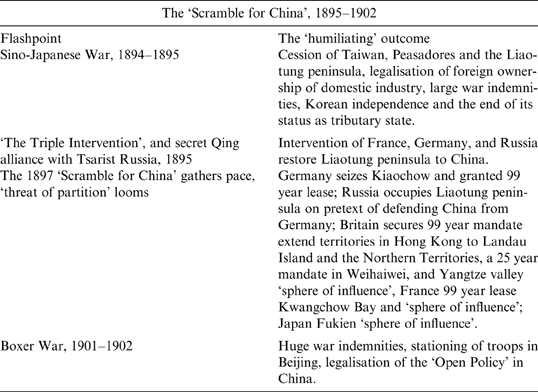
China stood at the centre of the cumulative global contradictions pushing towards world war in the early twentieth century. It formed the main site of geostrategic conflict in the decades prior to the First World WarFootnote 101 – creating a ‘scramble for China’ in the late nineteenth century that followed the better-known dash for colonial possessions in Africa (see Table 1). The intensity of this colonial encroachment and the powerlessness of the Qing in the face of such a threat, created a powerful impetus for Chinese subjects to push for revolutionary change. A series of periodicals consciously concerned to ‘create a public opinion’ and generate pressure for reform were launched in the 1890s.Footnote 102 Modernisation was increasingly recognised as the only means by which China might be able to retain its territorial integrity. The Hundred Day Reform of 1898 was a response to defeat at the hands of Japan and the 1897 dash for colonial rights that followed, both of which pushed the balance of power in the Court in favour of reformists.Footnote 103 The Confucian examination was finally reformed, along with other measures designed to create an efficient state. Yet the scale of the colonial encirclement provided no space for these efforts to take shape and bear fruit.
The ‘Scramble for China’, 1895–1902*

German activity in the Shandong peninsula exemplified how the inter-section of religious, class, and colonial cleavages were reshaping the Chinese polity. In Shandong, German Christian missionaries, employing typical ‘divide and rule’ tactics, had won influence by supporting the property claims of converts against non-Christian subjects.Footnote 104 The resulting peasant backlash spiralled into the Boxer Rebellion, which interwove two ancient traditions, of martial arts and shamanism, in yet another millenarian uprising.Footnote 105 This time, however, the ‘foreign devils’ that were targeted were the European imperialists and not the Qing – who the rebels saw as the rightful leaders of the Confucian realm, despite their Manchu ethnicity.Footnote 106 Belief in their own supernatural powers placed them within the framework of messianic time, but their hatred of the colonial foe ‘spoke directly to China's ills’.Footnote 107 Their appeal to traditional cultural and religious norms had, however, now become divisive within the polity. The Boxers not only supported the subjectively ‘non-Chinese’ Manchu rulers, but also targeted Chinese Christians – an orientation that, while triggered by colonial practices, also introduced an element of religious sectarianism that was plainly in contradiction to uniting the nation in a common struggle for territorial sovereignty.
The Boxer Rebellion illustrates how, even as late as the 1890s and early 1900s, the form the anticolonial backlash took among many subjects was still rooted in a dynastic consciousness. Indeed, a schism developed between the modernist ‘public society’ – that is, those that imagined ‘China’ to be a shared agency and therefore firmly framed their consciousness within ‘homogenous empty time’ – and those who aggressively struck back against colonialism but with little comprehension of the nature of their foe or realisable aims and goals. The ‘new Chinese’ of the urban centres developed a national orientation more closely attuned to the tasks the modern world posed to aspiring nation-states builders. These layers actively saw the need to generate a public opinion with new means of cultural production.Footnote 108 This term, ‘public opinion’, is so familiar in the contemporary context that it is easy to forget the anterior assumptions it contains. It assumes the existence of a collective agency, the public, who might then speak – and potentially act – with a coherent voice. Furthermore, the apprehension of time and place presupposes the possibility of concrete social change and that the views of the public matter for the future of the community. For the Chinese looking to create this sensibility print-capitalism provided the means to forge the body politic that could ‘save the nation’.
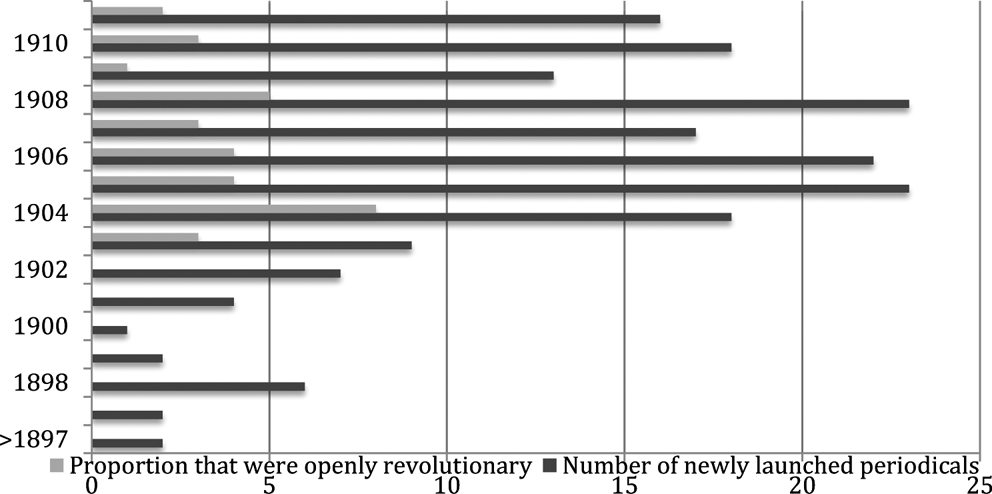
The turn to create periodicals that could express a Chinese opinion and identity correlated very closely with major geopolitical events, in 1895, 1897, and 1904–5 (see Graph 1). Numerous newspapers emerged with the sole purpose of covering the Russo-Japanese war (1904–5), a conflict of great interest to the new Chinese for it pitted a modernising Asian nation against a foe perceived to be one of Europe's most powerful autocracies.Footnote 109 As Graph 1 shows, many of the journals emerging in 1904 were explicitly revolutionary and fervently sought a Chinese state to defend the new sensibility of raison d'état. This underlines how the ‘whip of external necessity’ triggered the radicalisation that led to the fall of the Qing in 1911. These new layers attacked the foreign nature of the Qing in a manner not dissimilar to previous movements for the restoration of the Ming. Distinctively, however, they looked forward, not back, advocating a new, national state. This was seen as the first step in the project of jiuguo (national salvation) – a term that would come to capture the desire to ‘restore’ a seemingly ‘lost’ sense of Chinese prestige in global affairs.
Number of newly launched periodicals, 1897–1911
* Kaske also gives a reliability breakdown on the figures that I have not included in this version of the graph.

Such was the pressure felt from the ‘external necessity’ of colonialism that the emerging national identity was riven with what has been usefully termed, albeit in the Japanese context, ‘desymbolisation anxiety’.Footnote 110 The real and tangible threat of the polity's colonial annexation at the turn of the twentieth century created the fear that the newly symbolised imagination of ‘China’ would be carved up by foreign powers and replaced with a myriad of weaker national communities. A key problem lay in how to reconcile an intricate and sophisticated cultural tradition with modernisation in a period where the polity had been humbled by colonialism. If China had such a rich tradition and deserved a proper place in the colonial world order, then the question had to be confronted of why it had suffered such humiliating defeats. This distinctive feature of uneven and combined development – where the past meets the present in a ‘mix’ of cultural and economic elements – thus expressed an existential tension for the Chinese nationalists; of what is and was the ‘new China’ being born or rediscovered.Footnote 111 For those wishing to make the country strong and coherent, a national myth and dream had to be expressed at a time China appeared ‘futureless’. In the longer-term, this became reflected in schisms in the Chinese national movement, between those who advocated a radical break with the past,Footnote 112 and those who sought to incorporate more traditional elements – with the latter gaining the upper hand over the course of the twentieth century. At its most overt, this took the form of Confucian revivalism in the 1930s,Footnote 113 but even the emphasis on kinship and paternalismFootnote 114 by the communists involved an implicit nod in the direction of Chinese traditionalism.
Uneven and combined development in late Qing China (iii): The new nationalism as an amalgam of endogenous and exogenous ideological forms
If the sociological transformations of modernity, along with the geopolitical ferment of the early twentieth century, were crucial to kindling a new sense of time and space in the Chinese polity, the remaining question to ask is whether the outside world helped to shape the type and form of national imagination that arose. The answer might simply be stated with an emphatic ‘yes’. Inevitably, the dramatic acceleration of global interconnectedness the world witnessed in the late nineteenth century led to a considerable cross-fertilisation of cultural outlooks. Whether conceptual, ideological, or technological, the many ‘inventions’ of the modern epoch were harnessed by different communities in diverse ways, and in a manner that on every occasion reflected their distinctive histories, geographies, and cultural traditions. Indeed, in this maelstrom of uneven and combined development, not only technical and economic innovations of the most advanced states,Footnote 115 but ideas from ‘the outside’ too could be readily appropriated and adapted to domestic conditions in a manner that had the net effect of creating a world characterised by differential interactivity.
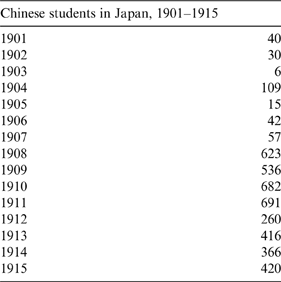
Newspapers were a crucial transition belt of influences, distilling into the minds of the reading public an awareness of the approaching clash of imperialisms and ideologies. But, no less important, were the social groups that had a direct, lived experience of the outside world, from the armies of migrant labourers flocking to the Americas, to the small but influential groups of students studying overseas. For the Chinese that took these steps, the experience provided considerable impetus and inspiration for the national imagination. Experiencing this world of nationalities, they came to reimagine China as a single flag within a veritable patchwork of nations. Indeed, this territorialised sense of identity was reinforced by the otherisation they experienced as ‘aliens’ in foreign climes. The most far-sighted among the migrant community also became acutely aware of how far their home country had fallen behind – and not only with the West. Indeed, the Chinese diaspora in East and South East Asia played a central role in the development of the country's political nationalism; both as a ‘creolised’ ethnic group and as a transition belt for modern ideas.Footnote 116 The early twentieth century had seen the number of students studying in Japan grow steadily (see Table 2) and the country's successful modernisation provided a source of inspiration for the Chinese. Initially, the form this took was the advocacy of pan-Asian solidarity against Western imperialism.Footnote 117 In 1904, students studying in Tokyo formed the ‘Resist Russia’ movement, even attempting to establish a volunteer corps to support the war effort. Their dark warning that ‘once Manchuria was lost foreign flags would soon be raised over the eighteen provinces of China proper’Footnote 118 reflected the angst-ridden nature of the new national imagination.
Chinese students in Japan, 1901–15

These themes and concerns are found in the work of the most famous cosmopolitan radical of this period, Sun Yat-Sen. Like many of his other peers who had experienced the tumultuous energy and rapid change of the colonial nations first hand, Sun found the timeless bureaucratism of Imperial China, ‘deficient in government organization, scientific and education progress and material standards of living’.Footnote 119 Meanwhile, Japan's ascent appeared to provide a model for the aspiring Chinese nationalists. It gave a practical illustration of how political and economic modernisation might be rendered compatible with existing Asian cultural values. Indeed it was the indifference the Qing authorities showed to Sun's petition urging them to adopt the Meiji slogan, Fukoku kyōhei, ‘strong country, strong defence’ (the overall significance of which we noted earlier) and pursue fiscal and economic reform, that pushed him to draw revolutionary nationalist conclusions.Footnote 120
China's eminent national leader would live to embody all of the contradictions of the anticolonial subjectivity that became manifest within the imagined communities formed in polities that fell afoul of colonialism. To explain the failure of the polity's Manchu rulers to confront the West, Sun appropriated racist terminologies of Western provenance. This laced his nationalism with a racial element that would come to characterise Chinese nationalist discourse per se.Footnote 121 While the latter reflected the influence of Western concepts of race on the political discourse of the time, it also grew out of the diasporic nature of the Chinese national movement. For overseas Chinese derived their sense of nationality ‘mainly from their race and culture, the special attachment to their birthplace, and the desire to retain racial and cultural identity’.Footnote 122 Sun also looked to Japan as a potential friend, even though their ‘pan-Asianism’ served as a thin disguise for the colonial ambitions they harboured for the Asia-Pacific. Despite this being clearly manifested by the late 1890s, Sun's hopes of a pan-Asian alliance persisted through to the 1920s. As late as November 1924, he anticipated the rise of a Sino-Japanese ‘Great Asia’, stressing the superiority of Asian culture and virtues.Footnote 123 In The International Development of China, Sun openly advocated Han-Chinese settler colonialism in Tibet, Mongolia, Manchuria, and Xinjiang, and asserted this would allow the people of these polities to come to terms with their common racial identity.Footnote 124 Both in its appeal to the imagined existence of racial hierarchies for political legitimacy and its expansive, colonial ambitions, Sun's outlook symbolised the strategic, historical problems of Chinese nationalism as an anticolonial force: its desire to emulate, in an Asian form, the Western colonialism it contested. It underlines, in this sense, how, in conditions of uneven and combined development, aspiring states set out to not only mimic the economic prowess of the leading states, but also, no less significantly, assimilate many of their cultural values.
Anti-Manchu sentiment in the national movement meant that it became beset with uncomfortable juxtapositions between emancipatory discourses and racist repertoires of thought imported into China from the West. Moreover, because ‘nation-ness’ emerged externally to the Qing-Manchu state there was a resulting tendency to identify ‘China’ with the Han-Chinese race alone. In other words, national identity itself increasingly became racially exclusive. As Rana Mitter explains:
The introduction of ‘nation’ as a form of political identity in China in the late nineteenth century was highly problematic. The neologism minzu, the term finally widely accepted as a translation of ‘nation’, was infused with a racial element which has led to its becoming a taboo term in contemporary Chinese political discussion. Yet that racial overtone, used by thinkers including Sun Yat-sen, separated it from pre-existing terms such as guo or guojia, which encompassed a more territorially bounded, racially uninflected concept of ‘country’ or ‘state’.Footnote 125
Minzu Footnote 126 was attractive precisely because the Qing dynasty, as we have already outlined, insisted they were not Chinese. In this context it was deemed logical for nationalists to define the nation on Han-Chinese ethnic lines. Feng Tzu-yu, a writer of the new culture, perfectly expressed this widely held view after the Boxer War when he bemoaned the support the Boxer Rebellion had given to the Manchu regime.Footnote 127 Such was the allure of racialised nationalism it crossed the immature but real boundaries between left and right forming at this time. For instance, in 1903, in a quite shocking passage, Tsou Jang, a ‘leftist’ and radical author of the bombastic tome, The Revolutionary Army, declared himself in favour of the genocidal extermination of five million Manchus in China.Footnote 128 This Chinese inflection of race with nationhood consciously mirrored the growing popularity of Social Darwinist discourse across international society.Footnote 129 The writer Yan Fu imported Social Darwinism into China in the nineteenth century and it had an enduring impact on the nationalist movement.Footnote 130 The pseudo-scientific ideology held a particular attraction for the polity's nationalists, because of its superficially radical break with Confucian notions of social harmony. With world politics now conceived as a raw struggle for survival, China's humiliation was seen as lying in the ‘un-Chinese’ character of the Qing. Some writers even engaged in pseudospeciation – treating the Manchus and other nomadic peoples as ‘subhuman’ – and argued the ability to colonise, or withstand attempted annexation, indicated the superiority or inferiority of the race.Footnote 131
Like all mythologies, these racialised elements of the national movement were deeply incoherent. They combined a ‘totalistic antitraditionalism’, which was rooted in political and racial hostility to the Qing dynasty,Footnote 132 with the elaboration of a timeless mythology of the Han-Chinese people. By grounding the anticolonial subject in the idea that the Han-Chinese race had suffered a loss of power and prestige, national liberation became judged according to the restoration (or not) of that ‘ethnic power’ within China and the international order. The concept of ‘racial revolution’ used by Wang Jingwei, for example, explicitly equated concepts of sovereign democracy with Han-Chinese racial empowerment.Footnote 133 This amalgam of discourses emerged out of the complex conditions of compulsions and emulation characteristic of uneven and combined development. In China, the desire to emulate the more advanced led to the mimicking and adaptation of racist narratives to legitimise the ascendance of the nation as a great power. Cultural ideas and values from the outside were thus ‘pirated’ and rendered meaningful to the domestic setting.
The social construction of China in the twentieth century
Peter Zarrow usefully summarises the Chinese national movement as having three characteristics: ‘a sense of time as linear and progressive; a sense of national identity (as minzu) based on racial-cultural consciousness; and a cluster of notions about the good society’.Footnote 134 As the foregoing elaborates, each of these elements of the new imagined community reflected the polity's interaction with the outside world: the emergence of a modern sense of collective agency in global time and space, the amalgam of traditional notions of ethnicity with Western typographies of race, and the development of forward-looking discourses influenced culturally by rival states. Chinese nationalists imported a European conception of territorialised state sovereignty,Footnote 135 forcing a break with dynastic conceptions of identity, time, and space, and often aspired to emulate the colonial empires in order to compete with them.
This reflected the transition from dynastic empire to nation, for the latter stood in a paradoxical relation with the former. ‘China’ emerged externally to the Qing state, but the new Chinese also identified with the polity over whom the latter had ruled, made a claim on its territory, and accused the dynasty of being un-Chinese. After 1911, the new Chinese imagination therefore had to establish a unitary identity in contrast to the stratified identities of the Qing era, and faced with this problem found the anti-Manchusim that ‘had been useful for nation-building proved useless to state-building’.Footnote 136 As such, the question tended to become posed in terms of whether ‘China’ could encompass a plurality of races – symbolised in the initial ‘five colour flag’Footnote 137 – or whether instead it should be seen as a more monolithic racial entity in its own right.Footnote 138 This ‘racial cultural consciousness’Footnote 139 encapsulated the complexity of the relationship between the archaic and the modern in Chinese nationalism per se.
Chinese nation-state builders would ultimately settle on a party-state form, beginning with the Nanjing decade and continuing under the communists in a quite different manner. This arose in large part out of the structural challenges of the polity's severe underdevelopment and lack of political cohesion after 1911. However, it also reflected the particular cluster of assumptions about the ‘good society’,Footnote 140 that is, the melange of local and global ideologies, characteristic of Chinese nationalism. It was arguably the tendency to assert unity and coherence at all costsFootnote 141 – in the face of the danger of China's dismemberment by the colonial outside – that made the party-state model politically attractive. The search for a pristine national form – in response to the ‘desymbolisation anxiety’Footnote 142 colonialism had triggered – also helps to explain why Chinese ‘revolutionaries tended to put race at the core of their vision of the nation, and to derive the state from the nation’.Footnote 143 The monolithic character that Chinese nationalism took on in the twentieth century, and the particular appropriateness of a party-state form of governance to it, should therefore be seen as an historical outcome of its combined social development with Western colonialism.
What emerges from this account of the development of ‘China’ within the social imagination of an East Asia confronted with Western power and hubris, is thus an interplay between geopolitical and economic conflict, on the one hand, and ideological and cultural influences, on the other. Print-capitalism, and the shift in the nature of political imagination it made possible, intersected dynamically with these intersocietal processes. Sun's own life illustrates the playing out of this dynamic sociological process. He shot to prominence on the national scene in 1896 when he was captured by the Chinese Legation in London ‘and almost smuggled back to China for certain torture and death’, only escaping this fate thanks to the British authorities.Footnote 144 The fact the incident won him fame in China tells us something about how the polity was changing. For if it had occurred two decades earlier there would neither have been as much awareness of it inside the country nor as much resonance for the nationalist views Sun now espoused. Only with the mass paper could the news be distilled into a community of vernacular readers. The social contradictions of combined development – with war and revolution its highest epitome – were thus refracted into the minds of this newly conceived society by way of print-capitalism. The result of these investigations into the Chinese case thus suggests that a modified, rather than wholly uprooted, conception of Anderson's theory is required, which locates the development of the national imagined community in the modalities of modern international, that is, intersocietal, relations. The latter not only helps us to make sense of the modular expansion of national identity Anderson rightly identified, but it also explicitly avoids any implication that this was a process of simple repetition. Societies, like China, that were reimagining their forms of association and identity in national terms did not, and indeed could not, simply repeat the European process. But, on the contrary, they introduced new modifications to the imagined community and its political form that, in turn, would influence others as the nation-state universalised.