Introduction
Aphasia, an acquired language disorder, is a common consequence of stroke. It has been estimated that as many as 38% of individuals who have experienced a stroke will present with aphasia (Pedersen, Jorgensen, Nakayama, Raaschou, & Olsen, Reference Pedersen, Jørgensen, Nakayama, Raaschou and Olsen1995). The communication difficulties associated with aphasia can have severe and wide-reaching consequences, including social isolation, exclusion from decisions about daily life and health care, and reduced psychosocial wellbeing and quality of life (Kagan, Reference Kagan1998; McVicker, Parr, Pound, & Duchan, Reference McVicker, Parr, Pound and Duchan2009; O'Halloran, Hickson, & Worrall, Reference O'Halloran, Hickson and Worrall2007; Parr, 2007; Ross, Winslow, Marchant, & Brumfitt, Reference Ross, Winslow, Marchant and Brumfitt2006; Simmons-Mackie, Reference Simmons-Mackie2009; Simmons-Mackie & Damico, Reference Simmons-Mackie and Damico2007). Traditionally, speech–language pathology (SLP) services for people with aphasia have involved face-to-face individual or group sessions using paper-based worksheets and/or items in the surrounding environment. However, with the increasing permeation of technology into aspects of daily life (including work, shopping, finance and social contact), computers are also becoming increasingly encountered in the clinical setting, including during aphasia rehabilitation. In the United States, Davis and Copeland (Reference Davis and Copeland2006) found that 51.4% of SLPs surveyed reported using computers in aphasia rehabilitation. This recent, rapid development and uptake of technology in aphasia rehabilitation is also reflected in the wide variety of therapy apps and software, and in the dedication of special issues of professional journals to the area (e.g., Kurland, Reference Kurland2014).
Beyond the administrative advantages (Davis & Copeland, Reference Davis and Copeland2006), the potential benefits of computers (and other electronic devices) in aphasia rehabilitation include the ability to: (1) increase therapy intensity (Finch, Clark, & Hill, Reference Finch, Clark and Hill2013; Palmer, Enderby, & Paterson, Reference Palmer, Enderby and Paterson2013; Wade, Mortley, & Enderby, Reference Wade, Mortley and Enderby2003); (2) maximise the number of items and tasks (Adrian, Gonzales, & Buiza, Reference Adrian, Gonzalez and Buiza2003; Adrian, Gonzalez, Buiza, & Sage, Reference Adrian, Gonzalez, Buiza and Sage2011; Wade et al., Reference Wade, Mortley and Enderby2003); (3) extend the duration of rehabilitation (Fink, Brecher, Sobel, & Schwartz, Reference Fink, Brecher, Sobel and Schwartz2005); and (4) enable rural and remote patients to receive a speech pathology service without a clinician being physically present. This latter point is particularly pertinent for countries such as Australia, which are vast in size with a large rural population.
Over recent years, there has been a move towards consumer-focused health care (Ford & Fottler, Reference Ford and Fottler2000). This paradigm shift has involved transitioning from the traditional patient–doctor hierarchical model towards a model that encourages increased involvement of the patient in the decision-making process (Ford & Fottler, Reference Ford and Fottler2000). However, the communication difficulties associated with aphasia can impede the uptake of a more consumer-focused approach. A recent qualitative study by Tomkins, Siyambalapitiya and Worrall (2013) revealed that, despite a variety of positive and negative experiences, some people with aphasia were dissatisfied with their level of involvement in their own health-care decisions. Given the rapid uptake of technology in the clinical setting, it is vital that we determine whether people with aphasia actually want computers as a component of their aphasia therapy.
Most research to date into computer-based aphasia therapy has focused on the effectiveness of the computer programs and people with aphasia's experiences of specific programs, rather than their perspectives of computers and computer therapy in general. This body of research has demonstrated that computer-based therapy may be an effective rehabilitation approach for people with naming difficulties associated with aphasia (Adrian et al., Reference Adrian, Gonzalez, Buiza and Sage2011; Archibald, Orange, & Jamieson, Reference Archibald, Orange and Jamieson2009; Mortley, Wade, Enderby, & Hughes, Reference Mortley, Wade, Enderby and Hughes2004; Wade et al., Reference Wade, Mortley and Enderby2003). However, most of this research has focused on individuals with chronic aphasia (e.g., Adrian et al., Reference Adrian, Gonzalez, Buiza and Sage2011; Archibald et al., Reference Archibald, Orange and Jamieson2009; Mortley et al., Reference Mortley, Wade, Enderby and Hughes2004; Wade et al., Reference Wade, Mortley and Enderby2003). Furthermore, a review of computer-based aphasia therapy by Van De Sandt-Koenderman (Reference Van De Sandt-Koenderman2011) concluded that the majority of programs delivered therapy that targeted the impairment level of the International Classification of Functioning, Disability and Health (ICF), with far fewer focusing on the functional and participation levels.
In terms of research into the perceptions of people with aphasia towards computer-based aphasia therapy, Wade and colleagues (Reference Wade, Mortley and Enderby2003) interviewed six people with aphasia and their partners about their views and experiences of using the computer-based language therapy program, StepByStep©, with remote monitoring from SLP services. Participants reported favourable views about the program and believed that computer-based therapy presented a broad range of benefits. Four participants reported that they preferred the computer therapy program with remote SLP monitoring to traditional, face-to-face therapy (Wade et al., Reference Wade, Mortley and Enderby2003). A more recent study by Palmer et al. (Reference Palmer, Enderby and Paterson2013) of 14 people with aphasia and 10 carers revealed that while participants viewed computer-based aphasia therapy as an acceptable treatment option, some participants (n = 3) expressed a preference for face-to-face therapy. It must be noted that both of these studies were focused on the use of a specific computer program called StepByStep©, rather than investigating computer use in general.
The practical application of computers to aphasia rehabilitation is not restricted solely to therapy, as a recent study by Newton, Acres and Bruce (2013) revealed that computerised versions of traditional paper-based assessment tasks could be a viable alternative. That said, however, the researchers found that when participants expressed a preference for an assessment method, most tended to prefer the traditional paper-based assessments (Newton et al., Reference Newton, Acres and Bruce2013). This finding suggests that the preference of people with aphasia is an important consideration when deciding whether to introduce technology into the clinical setting.
Currently we do not know what people with aphasia think about using computers in therapy and daily life, and to what extent people with aphasia use computers in their everyday life. This has implications for speech–language therapy provision to people with aphasia, as we currently do not know whether people with aphasia are actually familiar with computers (and other electronic devices) and whether they like using computers in therapy. As a result, the aim of this preliminary study was to investigate: (1) the use of computers by people with aphasia; and (2) the perceptions of people with aphasia towards computers and computer-based therapy.
Methods
Ethical approval was obtained from the University of Queensland Medical Research Ethics Committee.
Participants
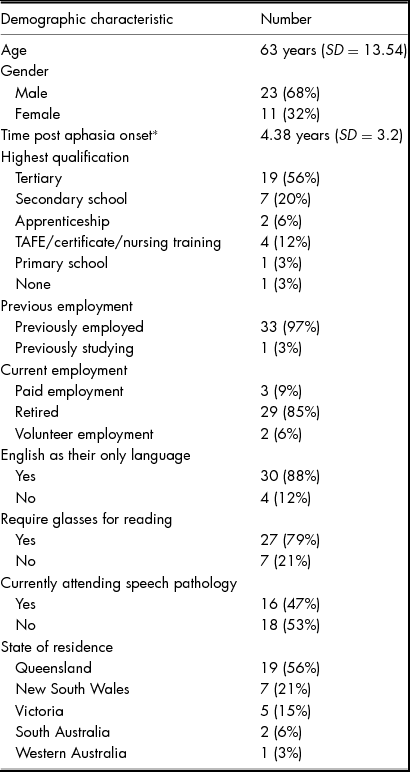
Participants were recruited through the University of Queensland Aphasia Registry and the Australian Aphasia Association. All members of the Registry and Australian Aphasia Association were invited to participate in the study. At the time of the survey there were approximately 110 members in the Aphasia Registry and 225 active members in the Australian Aphasia Association. However, due to potential overlap in membership between the two organisations it was not possible to determine the exact number of individuals who were invited to participate. It was therefore, not possible to calculate a response rate for the survey. The participants were adults, over the age of 18 years, with a diagnosed aphasia. There were no other inclusion or exclusion criteria for the study. Thirty-nine individuals responded to the invitation and were posted the paper-based survey. Of these, 34 people returned the completed survey and were included in the data analysis. Table 1 provides detailed demographic information.
Participant Demographic Information

Percentages are rounded to the nearest whole number; SD, standard deviation; *, two participants did not answer this question.
Procedure
Recruitment through the Aphasia Registry involved the Registry posting the Study Participant Information Sheet with an attached cover letter to all Registry members. Recruitment through the Australian Aphasia Association involved an advertisement describing the study being placed in the Association's newsletter, inviting potential participants to contact the study researchers. Individuals interested in the study then contacted the researchers directly to confirm their willingness to participate in the study and provide their contact details. The researchers sent out the consent form and questionnaire to the individual participants with an enclosed return-postage-paid envelope.
Questionnaire
A customised aphasia-friendly questionnaire was developed for the study (see Appendix A). All participants were given the option of completing the questionnaire with a family member or friend. The questionnaire consisted of three main sections. Section 1 consisted of demographic questions (e.g., age, gender, occupation, languages spoken, previous and current speech pathology intervention) in multiple choice and open-ended format. Section 2 consisted of a series of tick box questions about participants’ previous and current computer use, including what tasks they undertook with the computer (e.g., work, banking, E-mail, photos, shopping, entertainment) and how often they completed these tasks (daily, weekly, fortnightly, monthly, rarely). Section 3 consisted of general questions in multiple choice and open-ended format, including what type of computer participants used (e.g., desktop, laptop, tablet), whether participants needed assistance to use a computer, whether participants had used a computer for SLP therapy (if yes – the names of programs and types of tasks), whether participants liked using a computer in general (why/why not), and whether participants liked using a computer for SLP therapy (why/why not).
Data Analysis
Demographic and computer usage data were analysed descriptively according to frequencies and percentages. Open-ended questions were analysed by thematic analysis involving the identification of key themes across participants (Braum & Clark, Reference Braum and Clark2006; Marks & Yardley, Reference Marks and Yardley2004; Patton, 2022). Thematic analysis involved the one member of the research team (E.F.) independently grouping participants’ responses under emerging categories (e.g., ‘learn more’ and ‘helping to gain more knowledge’ were coded as ‘improved knowledge’). These categories were then aligned under higher-order categories (e.g., ‘benefits of computers’). The coding was checked by A.H. Any discrepancies were discussed until consensus was reached.
Results
Computer Use
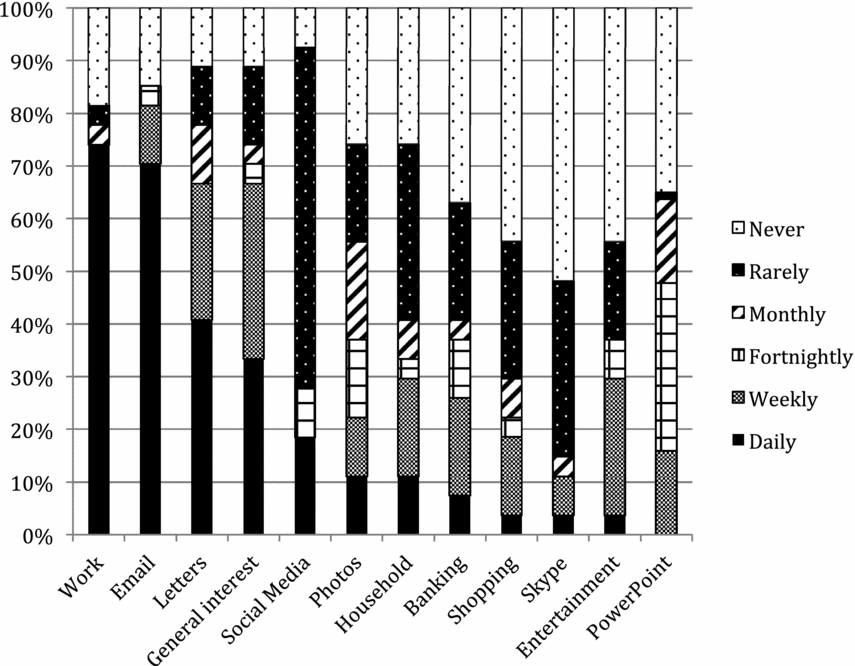
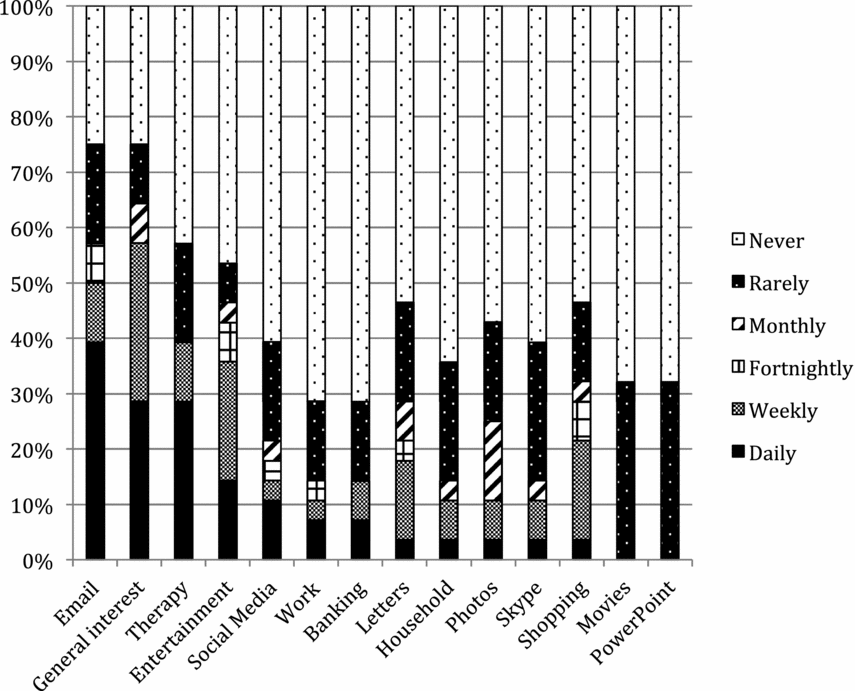
In total, 82.4% (n = 28) of participants reported using computers before the onset of their aphasia. This was most often for work and E-mail, with 74.1% (n = 20/27) and 70.4% (n = 19/27) reporting daily use of computers for these tasks, respectively. The least common uses were watching movies, SkypeTM and Microsoft© PowerPoint, with no participants reporting daily usage of movies or Microsoft© Powerpoint, and approximately 85% of respondents using SkypeTM monthly or less (see Figure 1). There was a slight increase in the percentage of participants who used a computer following the onset of their aphasia, at 85.3% (n = 29); however, the computer usage pattern changed. In general, participants shifted from daily usage of the computer for a variety of tasks to less frequent usage. The nature of the computer tasks also changed following aphasia onset. While E-mail was still used frequently following the onset of aphasia (n = 11/28, 39.3%), general interest (n = 8/28, 28.6%) and therapy (n = 8/28, 28.6%) were also common uses (see Figure 2). The use of a computer for entertainment purposes also moved up in terms of frequency of use. Of the six participants who reported never using a computer before the onset of their aphasia, half of these participants started using a computer post aphasia, while the remaining half continued to never use a computer. Only two participants who reported using a computer before the onset of their aphasia ceased computer use after the onset of aphasia.
Frequency of computer-based tasks before the onset of aphasia.
Frequency of computer-based tasks following the onset of aphasia.
Questions regarding the types of computer hardware used revealed that following the onset of aphasia, half of participants reported that they used a desktop computer (n = 17/31, 54.8%), with decreasing numbers of respondents reporting the use of laptops (n = 13/31, 41.9%), tablet computers (n = 9/31, 29.0%) and smart phones (n = 5/31, 16.1%). Many participants (n = 25/33, 75.8%) reported that they required assistance using the computer. This help typically involved assistance with setting up the computer (36.4%, n = 12/23), opening a specific computer program (60.9%, n = 14/23), using a specific program (56.5%, n = 13/23) and/or turning off the computer (17.4%, n = 4/23).
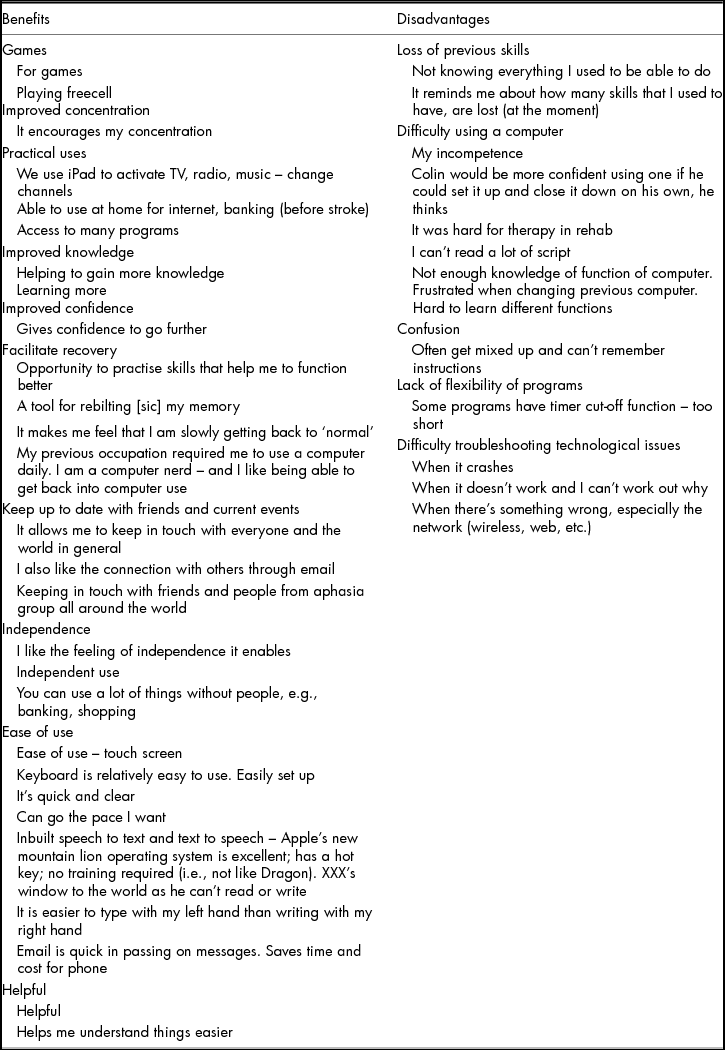
Participants reported that computers offered a range of benefits, including: the ability to facilitate their recovery, maintain contact with friends and develop a sense of independence. While less common, computers were also perceived to present a number of challenges, including: being difficult to use, lack of flexibility of programs and highlighting a loss of previous skills (see Table 2).
Perceived Benefits and Challenges of Computers from the Perspective of People Living with Aphasia
Computer-based Aphasia Therapy – Usage and Perspectives
In total, 72.7% (n = 24/33) of participants reported using computer-based aphasia therapy programs. Of these participants, 75% (n = 18/24) had used the computer-based aphasia therapy programs at home, 62.5% (n = 15/24) used computer-based aphasia therapy program as part of a formal speech pathology session, while 20.8% (n = 5/24) used the program independently at a speech pathology facility. The computer-based therapy programs most commonly used by participants included Speech Sounds on Cue (62.5%, 15/24), React2 (29.2%, 7/24), StepByStep© (20.8%, 5/24), Aphasia Tutor (20.8%, 5/24), Issues in English (4.2%, 1/24), and Extra Language Resources (ELR) (4.2%, n = 1/24). Additional, less commonly used, web-based resources included Proloque2go, BBC skillswise, PPP flashcards, free text to speech programs and websites (including www.dictionary.com, www.manythings.com and www.luminosity.com). While participants who reported using computer-based aphasia therapy at home but not during formal speech pathology sessions used the widely known commercially available software programs (such as Speech Sounds on Cue, StepByStep© and React2), they were also more likely to use the web-based resources listed above.
Participants reported undertaking a variety of therapy tasks on the computer. The therapy tasks most commonly used on the computer by participants included naming (79.2%, 19/24), word matching (70.8%, 17/24), repetition (66.7%, 16/24), sentence completion (62.5%, 15/24), reading comprehension (48.0%, 12/25) and typing/writing (36.0%, 9/25). Other, less frequently used tasks included following instructions, moving objects, sequential thought processes, and listening to words and then understanding or copying the word.
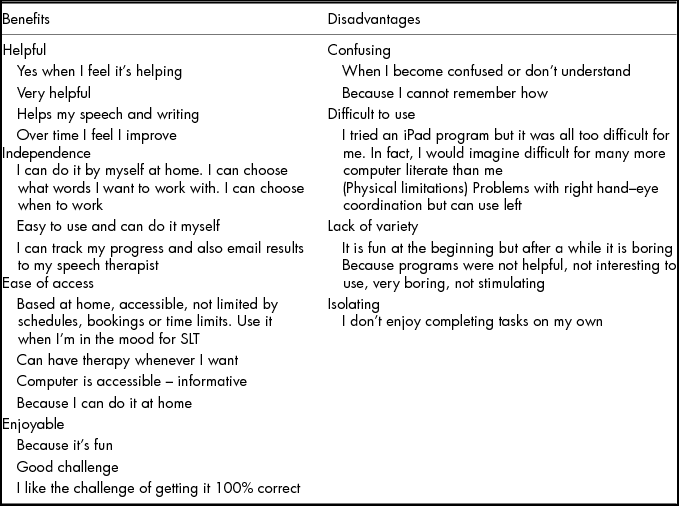
In terms of attitudes towards computer-based aphasia therapy, 76.9% (n = 20/26) indicated that they liked using computers as part of their aphasia therapy. Reasons for these favourable attitudes were often based around ideas of independence, enjoyment, perceived benefits to recovery and ease of access to therapy (see Table 3). Less commonly encountered were negative attitudes towards computer-based aphasia therapy (23.1%, n = 6/26, indicated that they did not like using computers as part of their aphasia therapy). These negative attitudes were typically associated with isolation or a mismatch between the program and the participant's expectations or abilities (including the level of difficulty and a lack of variety; see Table 3).
Perceived Benefits and Challenges of Computer-based Aphasia Therapy
The survey revealed that 27.3% (n = 9/33) of participants had not used computer-based aphasia therapy programs. The reasons cited by participants for this included lack of familiarity with the technology, hemiplegia, absence of assistance with using computers, memory issues and lack of access to a computer. Of the participants who had not used computer-based aphasia therapy programs, 87.5% (n = 8/9) indicated that they would like to try computer-based aphasia therapy. Reasons for wishing to try computer-based aphasia therapy were largely based around a desire to further improve their language skills (‘To extend my language skills and be able to write my own letters’) or knowledge (‘To get more information to assist in recovery’). These participants reported that in order to use a computer for therapy they required further education about how to use a computer and specific programs, assistance and supervision when using a computer, simplification of tasks, and more frequent access to the technology.
Discussion
The present study aimed to explore the use of computers by people with aphasia, and the perceptions of people with aphasia towards computers and computer-based therapy. Overall, the study revealed that the majority of participants used computers, both before and after the onset of their aphasia. Interestingly, there was a slight increase in the usage of computers post onset of aphasia; however, the nature of the computer use changed following the onset of aphasia. The predominant pattern was a shift from daily work-based computer usage to less frequent, more general usage and entertainment. Specifically, the most common uses for the computer reported by participants in the present study were work and E-mail. Following the onset of aphasia, E-mail was still popular; however, work uses were superseded by general interest, entertainment and therapy. This change in usage most likely reflected a change in participants’ social and life roles following the onset of aphasia. An explanation for this finding may lie in previous literature, which has reported that the onset of aphasia is often associated with a reduction in employment (Dalemans, De Witte, Wade, & Van den Heuvel, Reference Dalemans, De Witte, Wade and Van den Heuvel2008; Graham, Pereira, & Teasell, Reference Graham, Pereira and Teasell2011).
In terms of computer hardware, the survey revealed that following the onset of aphasia, half of participants reported that they used a desktop computer, with decreasing numbers of respondents using laptops, tablet computers and smart phones. It is possible that the pattern of results observed may have reflected historical factors. For example, desktop computers and laptops have been available for a much longer period of time and may therefore be more established in terms of daily usage than tablet computers or smart phones. The inclusion of a matched control group may have assisted to address this issue.
The present study expanded previous research into attitudes of people with aphasia and their experiences of a single program (Palmer et al., Reference Palmer, Enderby and Paterson2013; Wade et al., Reference Wade, Mortley and Enderby2003) by revealing that the majority of participants used and enjoyed using computer-based aphasia therapy programs. It was revealed that many of the participants used the computer programs at home, with the ability to access the programs at home cited as a leading reason why participants enjoyed using computer-based therapy programs. Despite this, in the present study, many participants reported that they required assistance to use a computer, with a lack of assistance presenting a key barrier for some participants who had not used computer therapy programs. These observations suggest that there is a need for clinicians to guide people with aphasia in their computer-based aphasia therapy at home, by determining the balance between each client's desire for independent computer use at home and the need for assistance. Achieving the unique balance between these two competing factors for each individual client may maximise the likelihood of successful computer-based aphasia therapy outcomes and increase client satisfaction.
In the present study, a small number of respondents reported negative attitudes towards computer-based aphasia therapy. Analysis revealed that these negative perspectives were often founded in a mismatch between a software program and the participant's expectations, either in terms of task difficulty, variety or overall effectiveness of the program. Given the wide range of computer programs available, with many programs and websites being free or able to be purchased directly by the public, it is possible that people with aphasia and their carers may be using programs independent of a SLP that are not at a suitable level for the person with aphasia or lack instructions at a suitable level for the individual's language skills. This highlights the need for clinicians to guide and support people with aphasia undertaking computer-based aphasia therapy, ideally from both the initial selection of programs and tasks based on the client's language and motor skills, through to the ongoing monitoring of program suitability, variety and effectiveness. As noted by Van De Sandt-Koenderman (Reference Van De Sandt-Koenderman2011), there is a need for more computer-based aphasia therapy programs that address the functional and participation needs of people with aphasia.
It is also worth noting that, in the present study, just over one-quarter of participants had not used computers in their aphasia therapy; however, the majority of these participants were keen to try computer-based aphasia therapy programs. In light of the move towards consumer-driven health care and the desire of people with aphasia to be involved in their own health-care decisions (Ford & Fottler, Reference Ford and Fottler2000; Tomkins et al., Reference Tomkins, Siyambalapitiya and Worrall2013), it is important that clinicians consider how to expose and support interested people with aphasia to access computer-based aphasia therapy. One way to achieve this could be to familiarise people with aphasia with specific computer-based aphasia therapy programs or functional tasks in the supported clinical environment, with the goal of requiring the people with aphasia to repeat the tasks as subsequent home practice. Future research could explore clinicians’ views around the barriers and facilitators to the use of computers in aphasia rehabilitation, in order to determine whether this is a feasible option.
Limitations
Given the low response rate, the present study may not reflect accurately the views of all people with aphasia. Although the recruitment process involved wide dissemination of the invitation to participate, the majority of respondents resided in Queensland, which may indicate a bias within the sample. Another limitation of the survey is that participants who used computer-based therapy programs at home were not asked who suggested the program (i.e., speech pathologist, family member). It must also be noted that while the majority of participants reported positive experiences with using computers, it does not mean that the therapy software used with computers is necessarily an effective treatment for aphasia. Finally, the anonymous nature of the survey meant that the researchers were unable to obtain information about missed responses.
Conclusions
The present study revealed that there was a high level of computer usage by people with aphasia, both before and after the onset of their aphasia. However, the nature of the computer use changed following aphasia onset. The majority of respondents used and liked using a computer for aphasia therapy, providing that the therapy was perceived as appropriate for their individual needs. Given the rapid uptake of technology in everyday life and the participants’ generally positive attitudes towards computers and computer-based aphasia therapy, the key for clinicians may lie in exposing interested clients to computer-based aphasia therapy in a supported clinical environment to determine which computer-based therapy programs and tasks are most suitable for each individual client. Equally as critical is the need for ongoing monitoring of each client's progress with the program and the client's overall satisfaction. Following this process may help maximise client outcomes and satisfaction with computers in therapy.
Acknowledgements
The authors would like to thank Stacie Park for assistance with data entry. We would also like to thank the Aphasia Registry and Australian Aphasia Association for their support of the study, and all of the people with aphasia and their families who participated in the study.
Declaration of Interest
The authors have no conflict of interest.
Appendix A: Computer use survey
You can complete this survey with a friend or family member
Demographics
Date of Birth: _________________
Gender: Male □ Female □
Date of Injury/Stroke: _____________________
What was your highest level of education?
□ Primary school
□ High school
□ TAFE
□ Apprenticeship
□ Tertiary education
□ Other ____________________________________________
What was your previous occupation? ______________________________________________
What is your current occupation? ___________________________________________________
Is English the only language you speak? YES □ NO □
If no, what other language/s do you speak at home? _____________________________________
Have you previously had any speech-language therapy? YES □ NO □
Are you currently having speech-language therapy? YES □ NO □
Do you wear glasses? YES □ NO □
Do you see well enough to read? YES □ NO □
Do you have other visual problems? YES □ NO □
(e.g. right or left visual field cut, cataracts, etc.) _____________________________________
Questions about computer use
1. Did you use a computer before you had aphasia? YES □ NO □
If yes please tick as many as needed and then tick how often you used the computer for this task.
2. Do you currently use a computer? YES □ NO □ (go to question 4)
If yes please tick as many uses as needed and how often you use the computer for the task.
3. What type of computer do you usually use?
□ Desktop
□ Laptop
□ Tablet (e.g iPad)
□ Smartphone (e.g. iPhone)
□ Other __________________________________________________________
4. Do you need help to use the computer? YES □ NO □
a. What type of help do you need?
□ Setting up
□ Getting into programs
□ Using the program
□ Turing off the computer
□ Other__________________________________________________
5. Have you used a computer for speech therapy? YES □ NO □
a. If yes, where?
□ Home
□ During therapy session with therapist or assistant
□ Extra independent therapy session at rehab facility
□ Other_____________________________________________________
b. What names of programs?
□ StepbyStep
□ React
□ Aphasia Tutor
□ Issues in English
□ ELR
□ Speech sounds on cue
□ Other ________________________________________________
c. What types of activities?
□ Naming
□ Sentence completion
□ Word matching
□ Repetition of words
□ Reading comprehension
□ Typing/writing
□ Other______________________________________________________
6. Do you like using the computer for speech therapy? YES □ NO □
a. Why?
_____________________________________________________________________
_____________________________________________________________________
_______________________________________________________
7. If you haven’t used a computer for therapy, would you like to? YES □ NO □
a. Why?________________________________________________________________
_____________________________________________________________________
_____________________________________________________________________
b. What are the barriers to you using a computer?
_____________________________________________________________________
_____________________________________________________________________
_____________________________________________________________________
c. What would help you to use a computer?
_____________________________________________________________________
_________________________________________________________
_________________________________________________________
8. What do you like about using a computer?
___________________________________________________________________________
___________________________________________________________________________
9. What do you dislike about using a computer?
___________________________________________________________________________
___________________________________________________________________________
___________________________________________________________________________
10. Comments
___________________________________________________________________________
___________________________________________________________________________
___________________________________________________________________________