





Introduction
The number of studies regarding integration of resilient and non-traditional crops into agricultural systems, aiming to ensure sustainable food production under changing climate and environmental conditions, are increasing rapidly. According to a life cycle assessment research conducted by Duca et al. (Reference Duca, Boakye-Yiadom, Ilari, Aquilanti and Pedretti2024), sea fennel cultivation in open fields has great potential for sustainable production considering its low input and water requirements. Sea fennel (Crithmum maritimum L.) has emerged as a promising alternative because of its adaptability to coastal, dry, and semi-dry environments where climate change-related soil salinity is progressively limiting conventional production (Colak Esetlili et al., Reference Colak Esetlili, Yildiz Aktas, Esetlili, Oztekin, Kılıc and Kurucu2024; Renna, Reference Renna2018; Shahid et al., Reference Shahid, Zaman, Heng, Zaman, Shahid and Heng2018). Sea fennel, a perennial halophyte, can preserve tissue hydration and physiological activities even under extreme salt stress (Atia et al., Reference Atia, Barhoumi, Mokded, Abdelly and Smaoui2011; Colak Esetlili et al., Reference Colak Esetlili, Yildiz Aktas, Esetlili, Oztekin, Kılıc and Kurucu2024; Hamed et al., Reference Hamed, Youssef, Ranieri, Zarrouk and Abdelly2007). Cultivating sea fennel, which grows naturally throughout the Atlantic and Mediterranean coasts, provides a strategic opportunity for using saline lands while lowering the sustainability concerns associated with wild-harvested traditional medicinal plants (Papageorgiou et al., Reference Papageorgiou, Bebeli, Panitsa and Schunko2020; Renna, Reference Renna2018).
Sea fennel grows naturally in Turkey’s Aegean and Mediterranean regions and has long been consumed locally (Eren and Sarper, Reference Eren and Sarper2023). Fresh leaves and young shoots are used to add flavour to food and produce pickles. The consumption of this crop is primarily restricted to its native habitat (Eren and Sarper, Reference Eren and Sarper2023; Özcan et al., Reference Özcan, Pedro, Figueiredo and Barroso2006). This situation demonstrates the possibility for cultivating the species in Turkey. Essential oil (EO) content varies significantly across plant materials collected from different locations in Turkey, highlighting the necessity for careful evaluation of cultivation and final use quality (Özcan et al., Reference Özcan, Akgül, Başer, Özek and Tabanca2001, Reference Özcan, Pedro, Figueiredo and Barroso2006).
Variation between ecotypes plays a crucial role in transforming sea fennel into a commercial crop. Physiological growth and chemotypic distinctions across various ecotypes are crucial variables for the cultivation of the crop. Therefore, identifying superior ecotypes is important for stabilizing agronomic yield and ensuring the consistency of secondary metabolites required for industrial applications (Karkanis et al., Reference Karkanis, Polyzos, Kompocholi and Petropoulos2022).
Sea fennel has a traditional use in Mediterranean cuisines. Its young shoots are consumed fresh or processed into brined and pickled products (Kraouia et al., Reference Kraouia, Nartea, Maoloni, Osimani, Garofalo, Fanesi, Ismaiel, Aquilanti and Pacetti2023). Its salty and aromatic taste profile is one of the main characteristics supporting its potential use as a food crop (Politeo et al., Reference Politeo, Popović, Veršić Bratinčević, Kovačević, Urlić and Generalić Mekinić2023). Different organs, including leaves, flowers and seeds, contain EOs, phenolic compounds, vitamins and minerals (Generalić Mekinić et al., Reference Generalić Mekinić, Blažević, Mudnić, Burčul, Grga, Skroza, Jerčić, Ljubenkov, Boban, Miloš and Katalinić2016; Kraouia et al., Reference Kraouia, Nartea, Maoloni, Osimani, Garofalo, Fanesi, Ismaiel, Aquilanti and Pacetti2023). The EO is commonly rich in monoterpenes such as sabinene and γ-terpinene and previous studies have reported antimicrobial and anti-inflammatory activities for sea fennel extracts and oils (Houta et al., Reference Houta, Akrout, Najja, Neffati and Amri2015; Karkanis et al., Reference Karkanis, Polyzos, Kompocholi and Petropoulos2022). The species has also been recognized for its vitamin C content (Franke, Reference Franke1982), supporting its possible use in food and other value-added products (Dzhoglova et al., Reference Dzhoglova, Ivanova, Shishmanova-Doseva and Saracheva2025; Kraouia et al., Reference Kraouia, Nartea, Maoloni, Osimani, Garofalo, Fanesi, Ismaiel, Aquilanti and Pacetti2023).
Sea fennel is still an underutilized crop, and field information on its cultivation remains limited. Comparative data on ecotype performance, organic fertilization and longer-term development under Mediterranean open-field conditions are particularly scarce (Martins-Noguerol et al., Reference Martins-Noguerol, Matías, Pérez-Ramos, Moreira, Muñoz-Vallés, Mancilla-Leytón, Francisco, García-Gonzalez, DeAndres-Gil, Martínez-Force, del Millan-Linares, Pedroche, Figueroa, Moreno-Perez and Cambrollé2022; Renna, Reference Renna2018; Zenobi et al., Reference Zenobi, Fiorentini, Ledda, Deligios, Aquilanti and Orsini2022). Therefore, the goal of the current study was to evaluate the domestication potential of sea fennel under Mediterranean open-field conditions and to identify ecotypes and management practices that could support stable yield, marketable biomass production and phytochemical quality. The specific objectives were to compare the agronomic performance, biomass partitioning and yield stability of three sea fennel ecotypes over two consecutive growing seasons; to determine whether bio-fertilizer application improves canopy development, edible biomass and total fresh yield; and to characterize organ- and ecotype-dependent variation in antioxidant capacity, phenolic compounds, carotenoids, vitamin C and essential-oil composition. It was hypothesized that the tested ecotypes would differ in both agronomic performance and phytochemical composition, and that bio-fertilizer application would increase biomass production without reducing the proportion of edible plant material.
Materials and methods
Experimental site and plant material
The trial was conducted in Bornova, İzmir, Türkiye (38°27′ N, 27°14′ E, 10 m a.s.l.) during the 2023 and 2024 growing seasons. The site has a Mediterranean climate, with hot and dry summers and mild, rainy winters. Air temperature and relative humidity were recorded hourly. Mean air temperature was 16.5°C in 2023 and 17.7°C in 2024. Total rainfall was 780 mm in 2023 and 468 mm in 2024 (Figure 1).
Hourly average air temperature and precipitation at the experimental site (İzmir-Bornova) during 2023 and 2024. In the temperature heat maps, the colour scale represents air temperature (°C), with green colours indicating lower temperatures and warmer colours indicating higher temperatures. In the precipitation panels, coloured markers denote the occurrence and relative magnitude of rainfall events, where denser/more intense colour tones indicate higher precipitation amounts (mm) and absence of markers indicates dry hours.

Figure 1. Long description
Panel A: The first heat map shows the hourly average air temperature in Izmir for 2023. The x-axis represents the months from January to December, and the y-axis represents the hours of the day from 00 to 21. The color scale ranges from green, indicating lower temperatures, to red, indicating higher temperatures. Panel B: The second heat map shows the hourly average air temperature in Izmir for 2024, with the same axes and color scale as Panel A. Panel C: The first scatter plot shows precipitation in Izmir for 2023. The x-axis represents the months from January to December, and the y-axis represents the hours of the day from 00 to 21. Colored markers denote the occurrence and relative magnitude of rainfall events, with denser and more intense color tones indicating higher precipitation amounts in millimeters. Absence of markers indicates dry hours. Panel D: The second scatter plot shows precipitation in Izmir for 2024, with the same axes and marker scheme as Panel C.
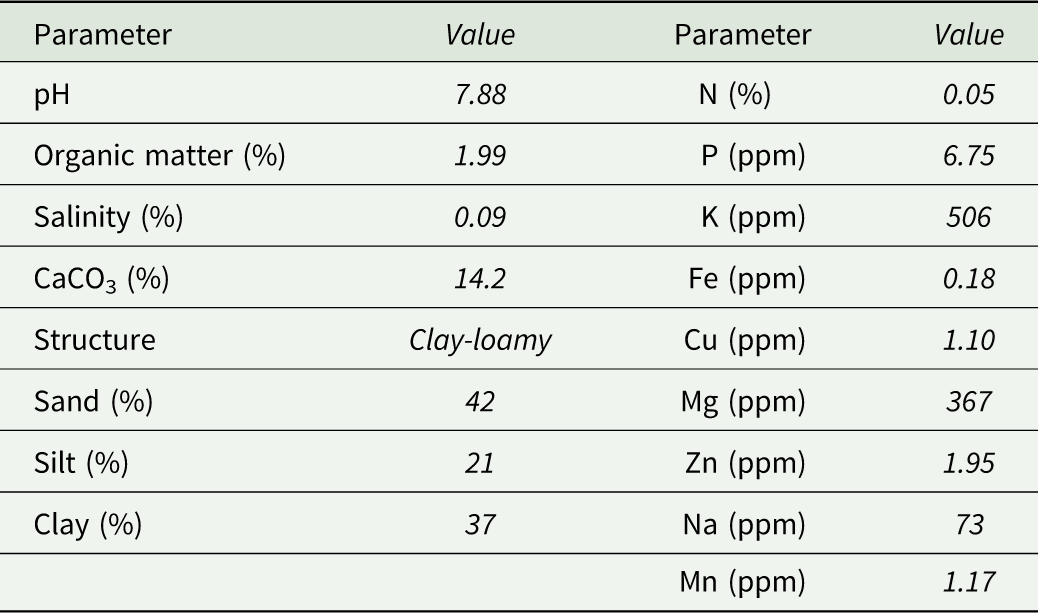
Soil samples were collected from the 0–30 cm layer before transplanting. The soil was clay-loam, moderately alkaline (pH 7.88), low in salinity (EC 0.09 ds/m) and calcareous (14.2 % CaCO3). Organic matter was 1.99 %, and total N was 0.05 %. Available P and K were 6.75 and 506 mg/kg, respectively. Exchangeable Ca, Mg and Na were 975, 367 and 73 mg/kg. Fe, Cu, Zn and Mn values were within agronomically adequate ranges (Table 1).
Physicochemical properties of the soil sampled from the experimental site in İzmir before transplanting sea fennel seedlings

Table 1. Long description
The image displays a structured table detailing various chemical and physical soil parameters alongside their respective values. On the left side of the table, general soil properties are listed. The soil has a pH of 7.88, an organic matter content of 1.99 percent, a salinity of 0.09 percent, and a calcium carbonate content of 14.2 percent. The soil structure is categorized as clay-loamy, with a particle composition consisting of 42 percent sand, 21 percent silt, and 37 percent clay. On the right side of the table, specific nutrient levels are provided. Nitrogen is measured at 0.05 percent, while phosphorus is present at 6.75 ppm and potassium at 506 ppm. Micro-elements and other minerals include iron at 0.18 ppm, copper at 1.10 ppm, magnesium at 367 ppm, zinc at 1.95 ppm, sodium at 73 ppm, and manganese at 1.17 ppm.
Three sea fennel (C. maritimum L.) ecotypes were used: Atlantic (ATL), Çandarlı (CAN) and Urla (URL). ATL was used as a French Atlantic reference ecotype and corresponds to material reported from the Brittany coast near Brest, France (Politeo et al., Reference Politeo, Ćurlin, Brzović, Auzende, Magné and Generalić Mekinić2024). The local ecotypes, CAN and URL, were collected from the coastal areas of Çandarlı and Urla in İzmir Province, Türkiye.
Approximately 2000 seeds per ecotype, 6000 seeds in total, were sown on 20 March 2023 in plastic seedling trays filled with sterilized organic peat. During seedling production, greenhouse temperature ranged between 20 and 25°C. The trays were irrigated every day between 09:00 and 10:00 with a sprinkler system, keeping the peat moist without waterlogging the seeds. No dormancy-breaking treatment was applied before sowing. Final emergence rates were 57 % for ATL, 66 % for CAN and 64 % for URL. Seedlings were grown until they reached the 2–4 true-leaf stage and were then transplanted to the field between 8 and 12 May 2023 (Figure 2).
Germinated seedlings of sea fennel (Crithmum maritimum L.) in vials filled with organic peat. The photographs were taken on 25 April 2023 (right photograph) and 5 October 2023 (left photograph).

Experimental design and treatments
The experiment was established using a split-plot design within a randomized complete block framework with three biological replicates. Fertilization treatment was assigned to the main plots, whereas ecotype was assigned to the subplots within each main plot. The main plots consisted of two fertilization levels: fertilized and unfertilized control. Within each main plot, the three sea fennel ecotypes [ATL, CAN and URL] were arranged as subplots. Each experimental plot measured 1.8 × 5.0 m (9.0 m2), with plants spaced 45 cm between rows and 22.5 cm within rows, resulting in a planting density of 9.9 plants/m2. The total experimental area encompassed 390 m2, with a net planted area of 324 m2.
Given the moderately alkaline and calcareous soil conditions, together with the low organic matter and total N contents and the potentially constrained P availability under alkaline-calcareous conditions (Bot and Benites, Reference Bot and Benites2005; Hopkins and Ellsworth, Reference Hopkins and Ellsworth2005), a balanced 12-12-12 organomineral fertilizer was applied at 330 kg/ha(39.6 kg N, 39.6 kg P2O5 and 39.6 kg K2O per ha) as a moderate establishment input. This fertilization strategy was intended to support early crop establishment under field conditions, rather than to follow a species-specific standard recommendation; in sea fennel, fertilization studies remain limited, although Zenobi et al. (Reference Zenobi, Fiorentini, Zitti, Aquilanti, Foligni, Mannozzi, Mozzon and Orsini2021) reported positive responses under low-input fertigation. The fertilizer was applied once as a basal soil application to the designated fertilized plots before flowering. Control plots received no supplemental nutrients. Supplemental irrigation was provided uniformly to all experimental plots through a drip irrigation system and was not included as an experimental treatment. Thus, fertilized and unfertilized plots, as well as all ecotypes, received the same irrigation regime. The emitter discharge rate of the drip irrigation system was 2 l/h. Approximately 100 mm of supplemental irrigation was applied during the critical summer growth period, divided into two equal applications of 50 mm in June and July. Natural rainfall was common to all plots because the experiment was conducted within the same field. Therefore, treatment comparisons were interpreted under a common water-management regime. Weed management was conducted manually without the use of herbicides. No significant pest or disease outbreaks occurred during the two-year study; consequently, no synthetic pesticides or fungicides were applied, maintaining the trial under organic management principles.
Measurements and analysis
Growth, yield and biomass partitioning
The final harvests were performed on 5 October 2023 and 7 October 2024. In each plot, ten representative plants were selected from the inner rows and harvested destructively in order to minimize possible edge effects. After harvest, plant material was divided into edible and refused fractions. Succulent sprouts, tender leaves and young stems were included in the edible fraction, whereas senescent leaves and lignified or fibrous stems were recorded as refused biomass.
Fresh weights (FWs) of total biomass and edible parts were measured in the field at harvest. Representative leaf samples were taken for relative water content (RWC) and dry matter (DM) analysis. For RWC, FW was recorded immediately after sampling. The samples were then rehydrated to full turgidity, and turgid weight (TW) was measured. They were then oven-dried at 105°C to constant weight to obtain dry weight (DW). RWC was calculated as follows:
 ${\rm RWC\ }({\rm \%\ })=[({\rm FW}-{\rm DW})/({\rm TW}-{\rm DW})]\times 100$
DM content was calculated from the same oven-dried subsamples and expressed as g/100 g FW. The field-recorded FW and corresponding DM values were then used to calculate total and edible yield on both a per-plant and per-hectare basis.
In addition to biomass, morphological and quality parameters were assessed. Leaf area measurements were conducted at the final harvest in each growing season using representative plants sampled at the same harvest stage. Leaf colour measurements were performed on fully developed, healthy leaves from the same representative plant material; however, CIE L∗a∗b∗ colour data were recorded only in the 2023 season and were therefore not used for interannual comparison. Total leaf area per plant was determined using a standardized digital image-analysis procedure. Fully developed leaves collected from representative plants at harvest were placed flat on a contrasting background together with a metric ruler for scale calibration. Images were captured from a fixed vertical position under uniform light conditions using a Samsung Galaxy A34 smartphone camera (Samsung Electronics, Seoul, South Korea). The images were then imported into ImageJ software (version 1.54m; National Institutes of Health, Bethesda, MD, USA), calibrated using the ruler included in each image and the projected leaf area was calculated as cm2 per plant. Leaf colour was determined from the same digital images using ImageJ-based colour analysis in the CIE L*a*b* colour space. Mean L*, a* and b* values were extracted from the selected leaf regions, corresponding to lightness, greenness/redness and blueness/yellowness, respectively (McGuire, Reference McGuire1992).
Phytochemical analysis and antioxidant capacity
For the determination of phytochemical constituents, 0.5 g of dried plant tissue (partitioned by organ) was extracted in 20 ml of 80 % (v/v) ethanol. The extract was centrifuged at 10 000 × g for 20 min at 4°C, and the supernatant was used for the biochemical analyses.
Ferric reducing antioxidant power (FRAP) was measured by the FRAP assay, following Benzie and Strain (Reference Benzie and Strain1996). For this analysis, 0.05 ml of supernatant was mixed with 1.50 ml of freshly prepared FRAP reagent and 0.15 ml of distilled water. After the reaction, absorbance was read at 593 nm, and the results were given as μmol FRAP/g DW.
Radical-scavenging activity was assessed by the 2,2-diphenyl-1-picrylhydrazyl (DPPH) method of Brand-Williams et al. (Reference Brand-Williams, Cuvelier and Berset1995). Briefly, 0.1 ml of extract was added to 3.9 ml of DPPH solution, and absorbance was monitored at 515 nm for 10 min. Activity was expressed as IC50, defined as the extract concentration required to reduce the initial DPPH concentration by 50 %.
Total flavonoid content (TFC) was determined using the aluminium chloride method described by Zhishen et al. (Reference Zhishen, Mengcheng and Jianming1999). Extracts were mixed with NaNO2, AlCl3 and NaOH solutions and incubated in the dark for 30 min. Absorbance was then recorded at 510 nm, and TFC was expressed as mg rutin equivalents (RE)/g DW.
Total phenolic content was measured with the Folin-Ciocalteu method according to Singleton and Rossi (Reference Singleton and Rossi1965). In brief, 0.5 ml of ethanol extract was mixed with 2.5 ml of 10 % Folin–Ciocalteu reagent. After 5 min, 2.0 ml of 7.5 % sodium carbonate was added, and the mixture was kept in the dark at room temperature for 2 h. Absorbance was recorded at 765 nm, and total phenolics were expressed as mg gallic acid equivalents (GAE)/g DW.
Total carotenoid content was determined in the leaf tissues through solvent extraction followed by UV-Vis spectrophotometric detection according to the procedures described by Biswas et al. (Reference Biswas, Sahoo and Chatli2011).
Essential oil extraction and compositional analysis
EO content and composition were determined only for plant material collected at the final harvest of the second growing season (2024). Therefore, EO data were used to compare the three ecotypes at a single harvest time and were not included in the two-year agronomic analysis. EOs were isolated from 10 g of air-dried plant material (dried at 35°C to preserve volatile constituents) via hydro distillation using a Clevenger-type apparatus. The extraction was performed with 100 ml of distilled water for a duration of 3 hours. The obtained EOs were dried over anhydrous sodium sulphate and stored in airtight amber vials at 4°C until analysis. EO yield was expressed as ml oil/100 g DW.
The EO composition was analysed using an HP 6890 Series GC system coupled with an HP MSD 5973 detector (Hewlett-Packard/Agilent Technologies, Wilmington, USA). Separation was performed on an INNOWAX capillary column (Hewlett Packard No. 19091N-116; 60 m length, 0.32 mm internal diameter and 0.25 µm film thickness). Helium was used as the carrier gas at a flow rate of 0.7 ml/min. The injector block temperature was set at 150°C, and the split ratio was 1:50. The GC oven temperature programme was as follows: the initial temperature was 60°C, increased to 210°C at a rate of 4°C/min and held for 3 min, then increased to 230°C at a rate of 20°C/min and held for 5 min. The system was operated in SCAN mode. Individual constituents were identified based on a dual-criteria approach: (i) comparison of their calculated retention indices relative to a homologous series of n-alkanes (C8–C24) with those reported in the literature and (ii) matching their mass spectra with the Wiley 7nL and NIST library databases. Results were expressed as the relative percentage area of the total integrated peak area.
Statistical analyses
All experimental data were analysed using a split-plot analysis of variance (ANOVA) across two consecutive growing seasons. Year (2023 and 2024), fertilization (main-plot factor) and ecotype (sub-plot factor) were treated as fixed effects, whereas blocks were considered random and nested within year. Year was included as a fixed factor because the objective was to compare the two specific experimental seasons included in the study, rather than to draw inference to a broader random ecotype of years. In the split-plot structure, fertilization was assigned to the main plots and ecotype to the subplots. Accordingly, the effect of year was tested against the block-within-year term [block(year)], whereas fertilization and the year × fertilization interaction was tested against the main-plot error term [block(year) × fertilization]. Ecotype and all interactions involving ecotype were tested against the subplot residual error.
Prior to analysis, the assumptions of normality and homogeneity of variance were verified using the Shapiro–Wilk and Levene’s tests, respectively. When significant F-values were detected, mean separations were performed using Tukey’s honestly significant difference (HSD) test at a probability level of P < 0.05. Relationships among yield, biomass fractions and phytochemical traits were assessed using Pearson’s correlation coefficients (r). All analyses and data visualizations were performed in R version 4.4.2 using RStudio.
Results
Growth, yield and biomass accumulation
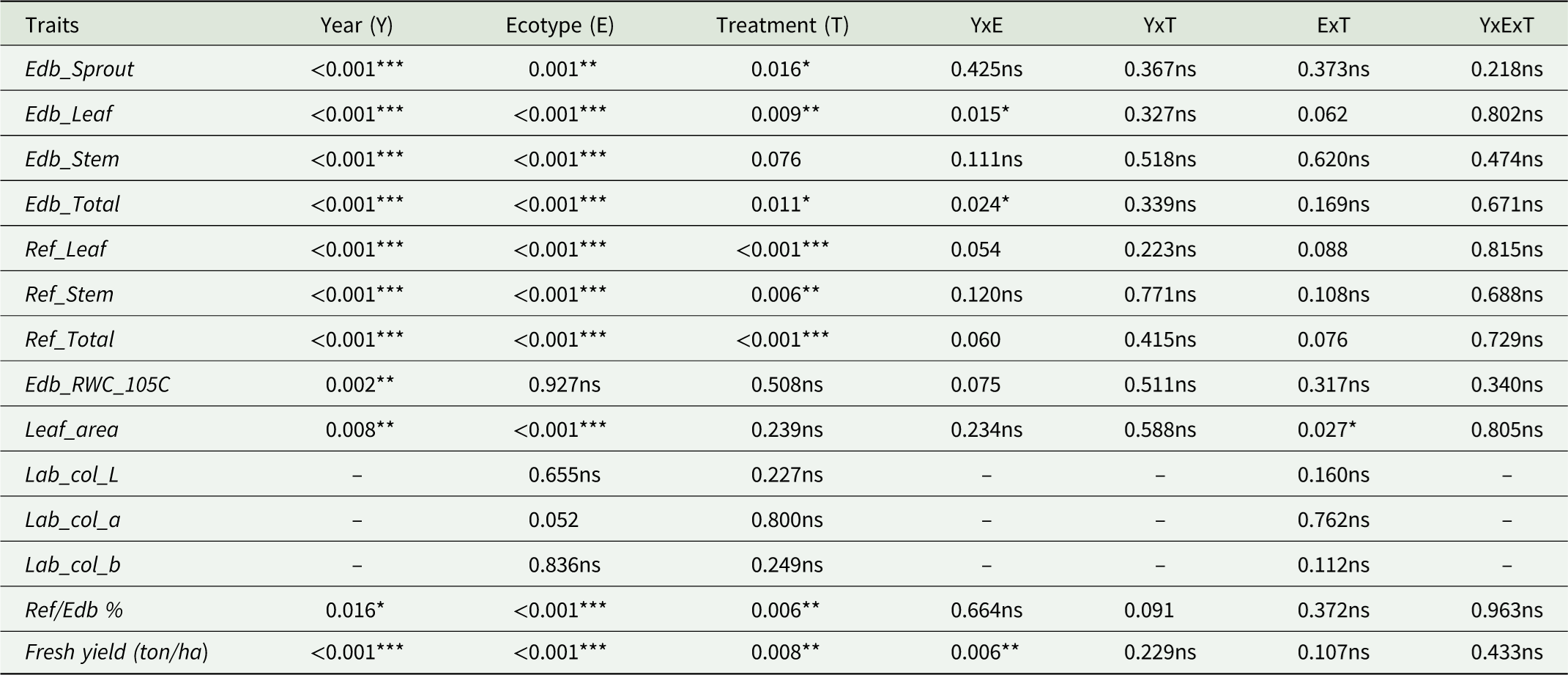
Growing season, ecotype and organic fertilization affected sea fennel performance (Table 2). Mean fresh yield rose from 0.58 t/ha in 2023 to 1.02 t/ha in 2024, corresponding to a 76 % increase. This suggests that the crop established well in the first season and produced more biomass in the second year. Year had a significant effect on the main agronomic traits, including biomass fractions, leaf area and fresh yield (P < 0.01).
P-values and significance levels of the effects of year (Y), ecotype (E), fertilizer (F), and their interactions on agronomic traits [Edible parts (sprout, leaf, stem and total), refused parts (leaf, stem and total), relative water content of edible parts, leaf area, lab colour (L-a-b), refuse:edible ratio and yield] in sea fennel. Significance levels are indicated as follows: *P < 0.05, **P < 0.01, ***P < 0.001, ns: not significant and ‘-’: not applicable)

Table 2. Long description
The table presents P-values and significance levels of the effects of year (Y), ecotype (E), fertilizer (F), and their interactions on agronomic traits in sea fennel. The table has 14 rows and 9 columns. The columns are labeled as Traits, Year (Y), Ecotype (E), Treatment (T), YxE, YxT, ExT, and YxExT. The rows are labeled with different traits such as Edb_Sprout, Edb_Leaf, Edb_Stem, Edb_Total, Ref_Leaf, Ref_Stem, Ref_Total, Edb_RWC_105C, Leaf_area, Lab_col_L, Lab_col_a, Lab_col_b, Ref/Edb %, and Fresh yield (ton/ha). Each cell contains a P-value indicating the significance level of the effect. Significance levels are indicated as follows: *P < 0.05, **P < 0.01, ***P < 0.001, ns: not significant, and -: not applicable.
The edible fraction, which included sprouts, tender leaves and young stems, varied between years and among ecotypes (Figure 3). Edible biomass per plant increased in the second growing season for all three ecotypes, largely due to the greater contribution of leaf tissues. In 2023, ATL and CAN had very similar edible biomass values, 206 and 204 g/plant, respectively, while URL produced a lower value of about 130 g/plant. By 2024, ATL had reached the highest edible biomass, with 410 g/plant. CAN and URL followed with 265 and 234 g/plant, respectively.
Effect of growing season (2023 and 2024) on the partitioning of edible biomass (sprout, stem, leaf, and total) in three sea fennel (Crithmum maritimum L.) ecotypes (ATL: Atlantic, CAN: Çandarlı, and URL: Urla). Bars represent mean edible biomass per plant (g/plant), and error bars indicate standard errors (SE). Different lowercase letters above the bars show significant differences among Ecotype × Year combinations within each biomass component according to Tukey’s HSD test (P < 0.05). (Fertilization treatments are not shown separately because fertilization-related interactions were not significant for total edible biomass; the significant main effect of fertilization is reported in Table 2 and described in the results text.).

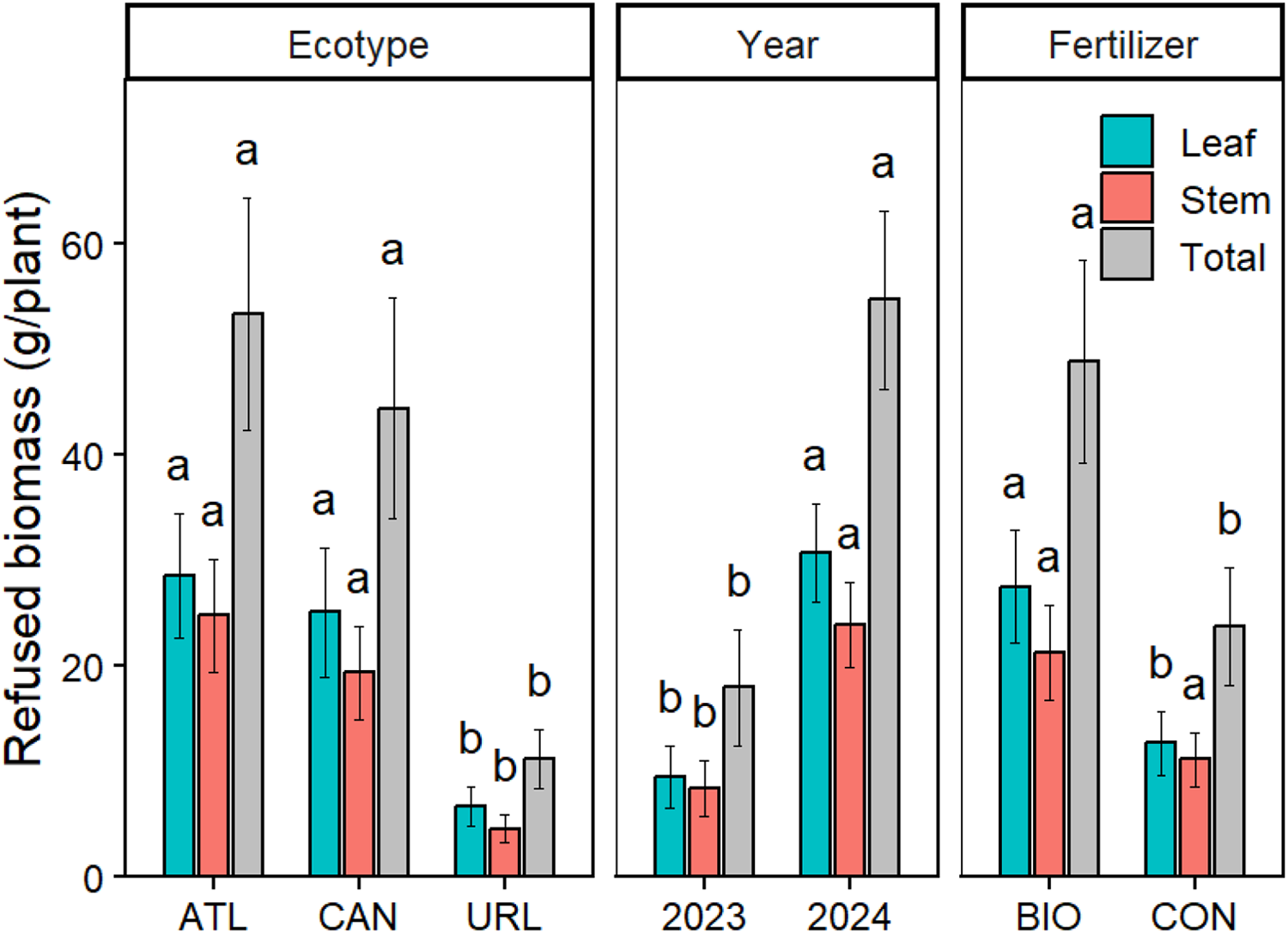
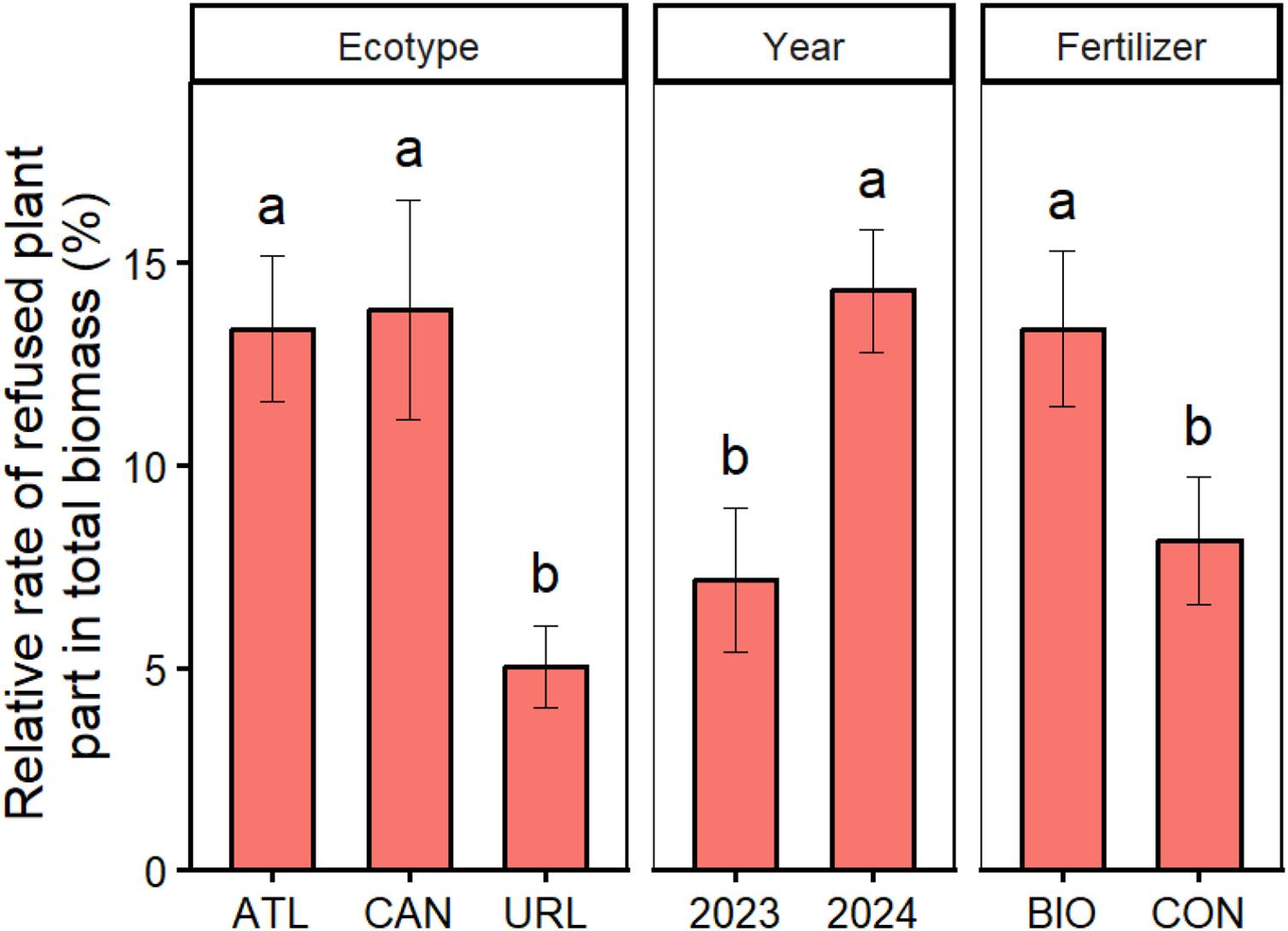
The refused fraction, consisting of senescent leaves and fibrous stems, showed a similar pattern of increase and was affected by fertilization (Figure 4). Although refused biomass remained much lower than the edible fraction, bio-fertilizer application increased this fraction in both growing seasons. In 2023, refused biomass was 28 g/plant in bio-fertilized plants, compared with 8 g/plant in the control. In 2024, the corresponding values were 70 g/plant under fertilization and 40 g/plant in the control plots. Even with these increases, refused biomass accounted for less than 15 % of total biomass across all treatments, indicating that most of the harvested biomass was composed of marketable edible material (Figure 5).
Refused biomass of sea fennel (Crithmum maritimum L.) leaves, stems and total aboveground biomass (g/plant) as affected by (a) ecotype (ATL: Atlantic, CAN: Çandarlı, URL: Urla), (b) growing season (2023 and 2024), and (c) fertilization treatment (BIO: bio-fertilizer, CON: unfertilized control). Bars represent means with standard errors (SE). Within each panel, different lowercase letters above the bars indicate significant differences among factor levels according to Tukey’s HSD test (P < 0.05). The panels display the significant main effects identified by the split-plot ANOVA. Where interaction effects were not significant, means were pooled across the non-displayed factors to simplify graphical interpretation.

Figure 4. Long description
Panel A: A bar graph comparing the refused biomass of sea fennel leaves, stems, and total aboveground biomass across three ecotypes: ATL, CAN, and URL. The horizontal axis represents the ecotypes, and the vertical axis represents the refused biomass in grams per plant. The bars are grouped by ecotype and color-coded: teal for leaf, red for stem, and gray for total biomass. The ATL and CAN ecotypes show higher biomass compared to the URL ecotype. Panel B: A bar graph comparing the refused biomass of sea fennel leaves, stems, and total aboveground biomass across two growing seasons: 2023 and 2024. The horizontal axis represents the years, and the vertical axis represents the refused biomass in grams per plant. The bars are grouped by year and color-coded: teal for leaf, red for stem, and gray for total biomass. The year 2024 shows higher biomass compared to 2023. Panel C: A bar graph comparing the refused biomass of sea fennel leaves, stems, and total aboveground biomass across two fertilization treatments: BIO and CON. The horizontal axis represents the fertilization treatments, and the vertical axis represents the refused biomass in grams per plant. The bars are grouped by treatment and color-coded: teal for leaf, red for stem, and gray for total biomass. The BIO treatment shows higher biomass compared to the CON treatment.
Relative proportion of refused plant parts in total aboveground biomass (%) of sea fennel (Crithmum maritimum L.) as affected by (a) ecotype (ATL: Atlantic, CAN: Çandarlı and URL: Urla), (b) growing season (2023 and 2024), and (c) fertilization treatment (BIO: bio-fertilizer, CON: unfertilized control). Bars represent means with standard errors (SEs). Within each panel, different lowercase letters above the bars indicate significant differences among factor levels according to Tukey’s HSD test (P < 0.05).

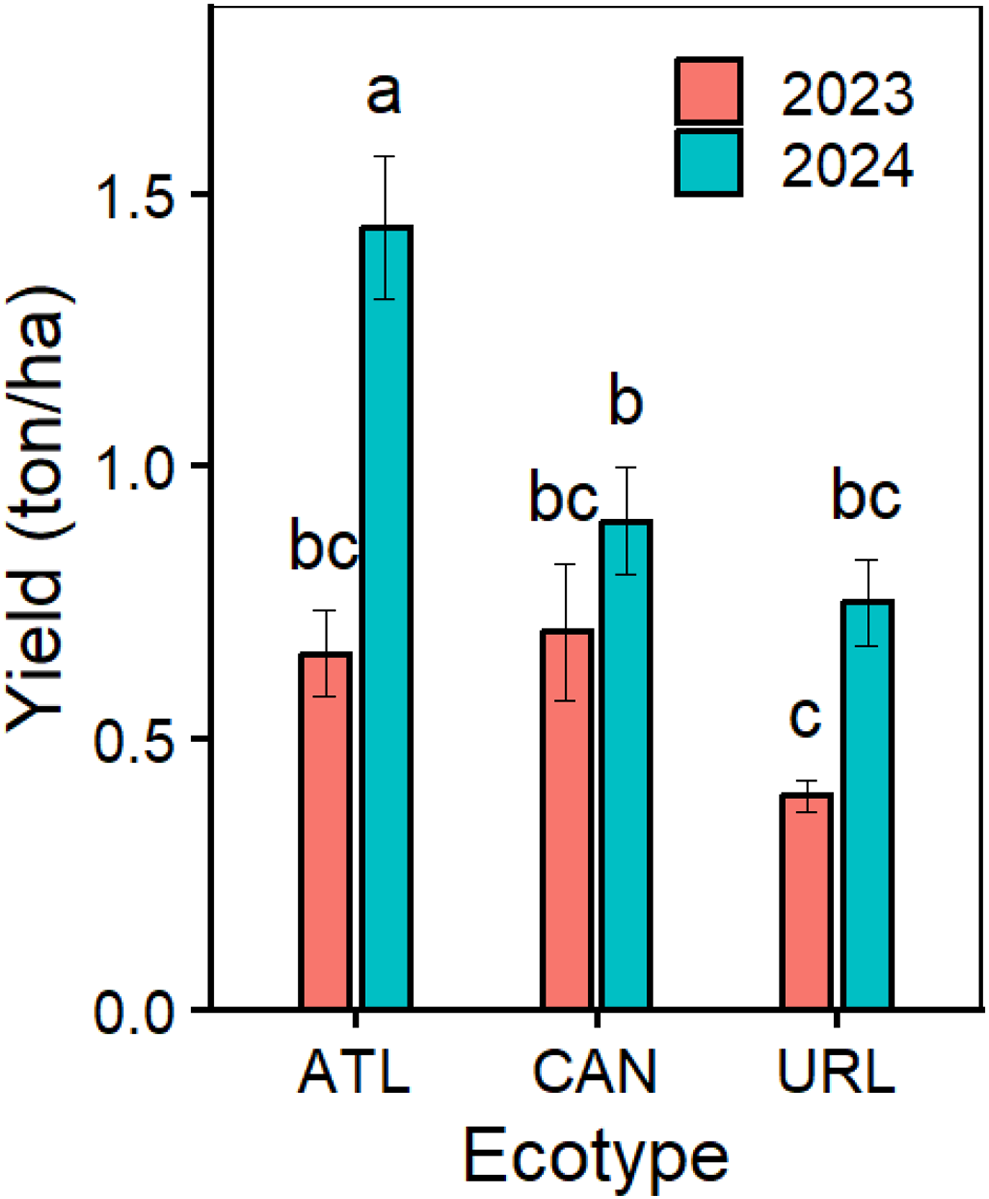
Fresh yield per hectare differed according to ecotype and growing season, with a smaller but significant effect of BIO (Figure 6). Across the two growing seasons, ATL had the highest mean yield (1.05 t/ha), followed by CAN (0.80 t/ha) and URL (0.57 t/ha).
Fresh yield of three sea fennel (Crithmum maritimum L.) ecotypes (ATL: Atlantic, CAN: Çandarlı and URL: Urla) during the 2023 and 2024 growing seasons. Bars represent mean fresh yield (ton/ha) with standard errors (SEs). Different lowercase letters above the bars indicate significant differences among Ecotype × Year combinations according to Tukey’s HSD test (P < 0.05).

RWC remained above 80 % in both years (Figure 7). Mean RWC was 87 % in 2023 and 84 % in 2024, and no significant differences were found among the three ecotypes. Leaf area varied more clearly among ecotypes and treatments. In 2023, mean leaf area was higher in ATL (226 cm2) and CAN (232 cm2) than in URL (125 cm2). In CAN, bio-fertilizer application increased leaf area by 83 % compared with the unfertilized control.
Relative water content of sea fennel (Crithmum maritimum L.) plants during the 2023 and 2024 growing seasons and the effect of bio-fertilizer application (BIO) versus unfertilized control (CON) on leaf area of three sea fennel ecotypes (ATL: Atlantic, CAN: Çandarlı and URL: Urla). Bars represent means with standard errors (SEs). Different lowercase letters indicate significant differences between years or among ecotype × treatment combinations according to Tukey’s HSD test (P < 0.05).

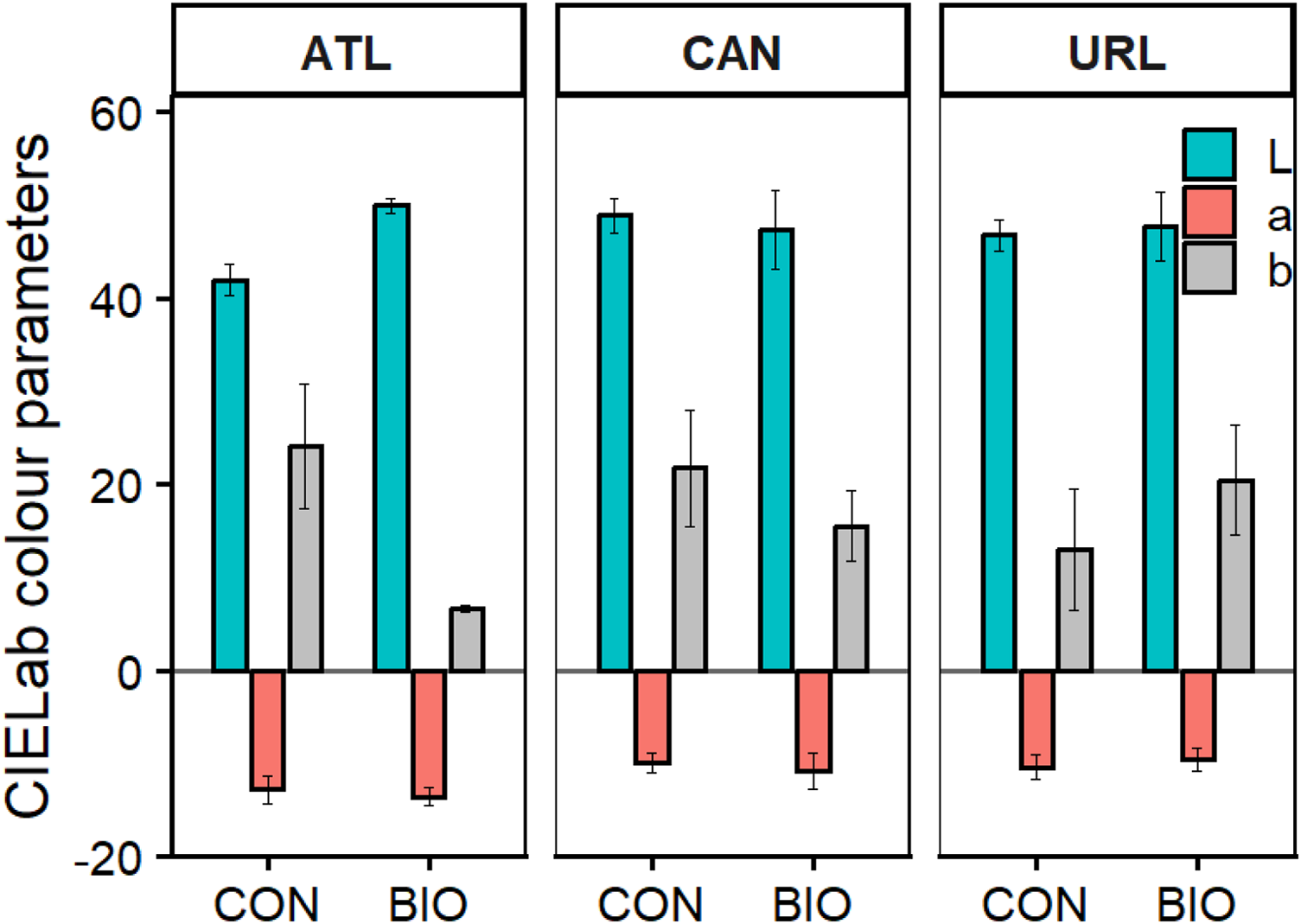
CIE L*a*b* colour values showed some variation among treatments (Figure 8). Mean lightness (L*) was 47.1, with values ranging from 41.9 in ATL-CON to 49.9 in ATL-BIO. For the a* coordinate, ATL-BIO had the most negative value (−13.5), indicating a greener leaf colour, whereas URL-BIO had the least negative value (−9.5). The b* value ranged from 6.7 in ATL-BIO to 24.1 in ATL-CON. Generally, fertilization affected biomass and leaf area, but it did not cause a consistent change in leaf colour.
CIE L*a*b* leaf colour parameters of three sea fennel (Crithmum maritimum L.) ecotypes (ATL: Atlantic; CAN: Çandarlı URL: Urla) under control (CON) and bio-fertilizer (BIO) treatments in 2023. L* indicates lightness, a* the green (negative) to red (positive) axis, and b* the blue (negative) to yellow (positive) axis. Bars represent means ± SE.

Phytochemical analysis and antioxidant capacity
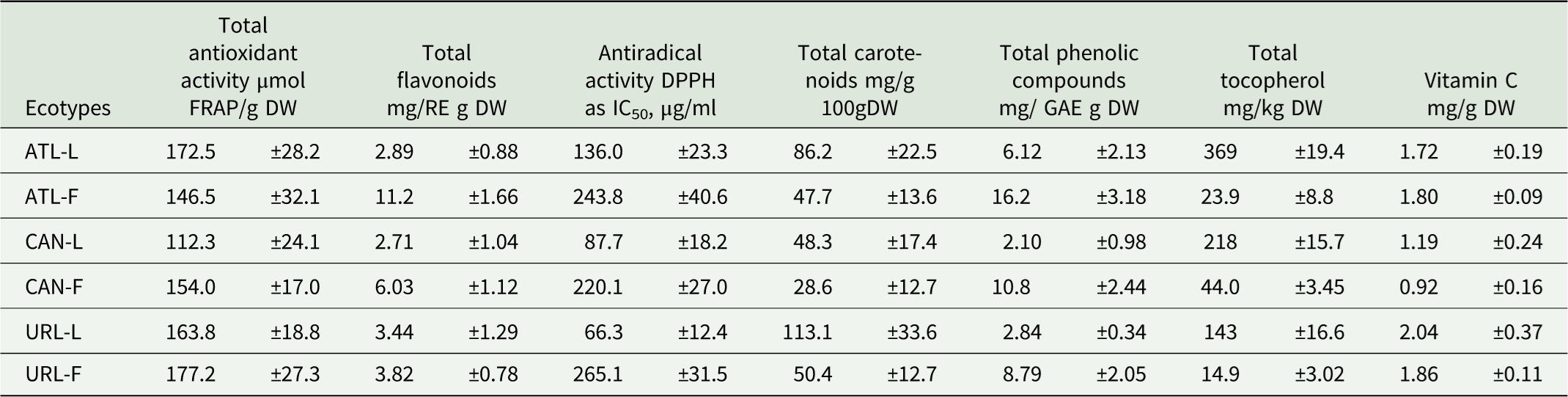
Phytochemical composition and antioxidant capacity differed among ecotypes and between plant organs (Table 3). In general, flowers had higher total phenolic content and reducing power, whereas leaves contained higher levels of some vitamins and showed stronger radical-scavenging activity.
Total antioxidant activity, total flavonoid content, antiradical activity, total carotenoid content, total phenolic content, total tocopherol content and vitamin C content in leaves (L) and flowers (F) of three sea fennel (Crithmum maritimum L.) ecotypes

Table 3. Long description
This table details antioxidant and chemical properties across six plant ecotypes: ATL-L, ATL-F, CAN-L, CAN-F, URL-L, and URL-F. Key parameters include total antioxidant activity (112.3 to 177.2 micromoles FRAP/g DW) and flavonoids (2.71 to 11.2 mg/RE g DW). Antiradical activity ranges from 66.3 to 265.1 IC50, while carotenoids reach up to 113.1 mg/g 100gDW. Total phenolics span 2.10 to 16.2 mg/GAE g DW, tocopherols up to 369 mg/kg DW, and Vitamin C content stays between 0.92 and 2.04 mg/g DW.
FRAP values ranged from 112 to 177 μmol FRAP/g DW. The highest value was measured in URL flowers, while the lowest was recorded in CAN leaves. DPPH activity, expressed as IC50, also varied considerably among samples, from 66 to 265 μg/ml. Since lower IC50 values indicate stronger antiradical activity, URL leaves showed the highest activity, with an IC50 of 66 μg/ml, whereas URL flowers showed the weakest response, with an IC50 of 265 μg/ml.
Total phenolic content ranged from 2.10 to 16.2 mg GAE/g DW. ATL flowers had the highest TPC, while CAN leaves had the lowest. TFC also differed among samples. ATL leaves contained 6.12 mg RE/g DW, which was more than twice the value recorded in CAN leaves, 2.71 mg RE/g DW.
URL leaves had the highest total carotenoid content (113.1 mg/100 g DW), while CAN flowers had the lowest value (28.6 mg/100 g DW). Vitamin C content was between 0.92 and 2.04 mg/g DW, with the highest value in URL leaves. Tocopherol content was 369 mg/kg DW in ATL leaves and 14.9 mg/kg DW in URL flowers. These results show that phenolic compounds were higher in flowers, whereas vitamin C, carotenoids and tocopherols were generally higher in leaves.
Essential oil content and compositional profiles
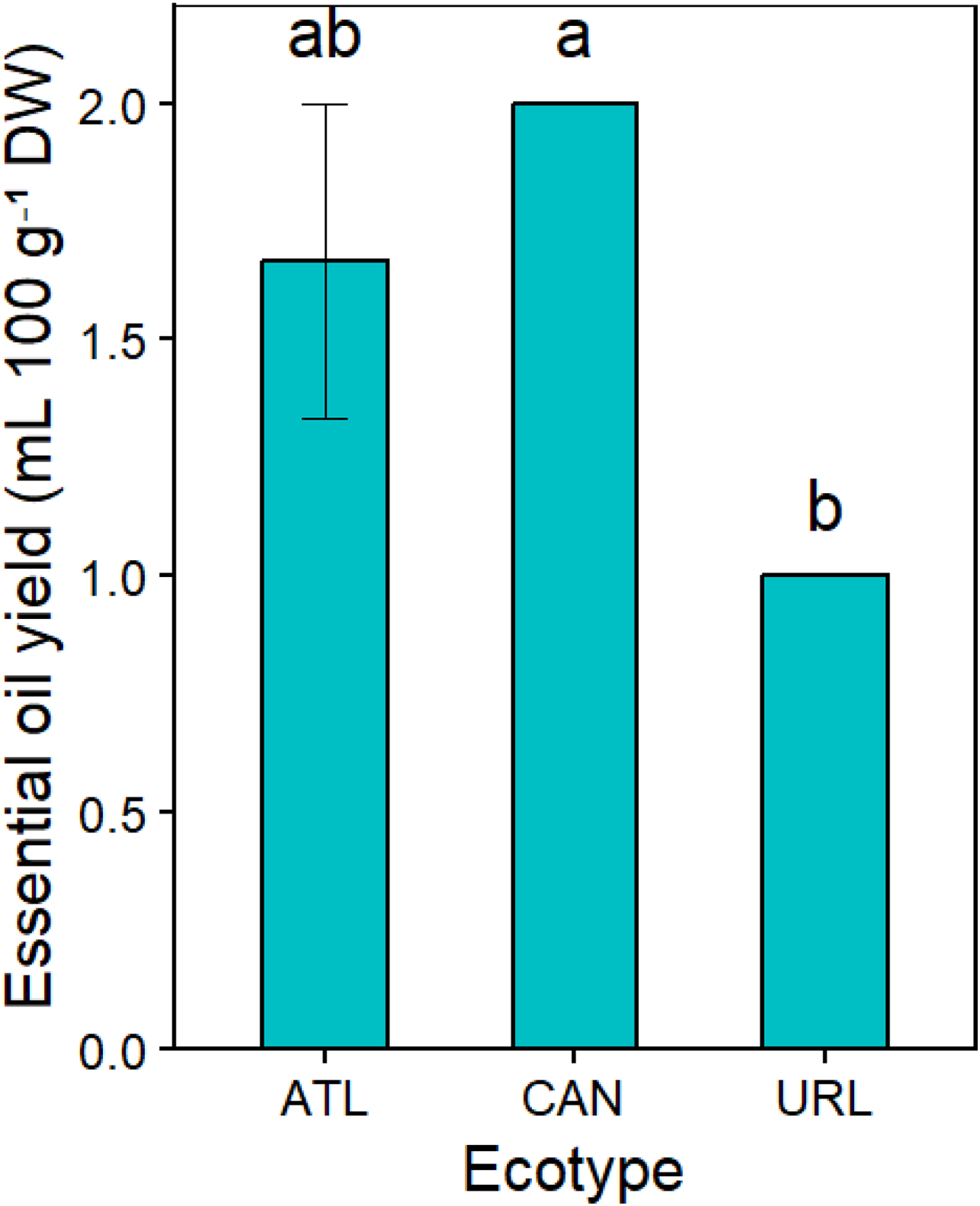
EO yield differed among ecotypes (Figure 9). The mean yield obtained from aerial biomass was 1.6 ml/100 g DW. CAN gave the highest EO yield with 2.0 ml/100 g DW, while ATL and URL had 1.7 and 1.0 ml/100 g DW, respectively.
Essential oil rate of three sea fennel (Crithmum maritimum L.) ecotypes (ATL: Atlantic, CAN: Çandarlı and URL: Urla). Bars represent mean essential oil rate yield (ml/100 g DW) with standard errors (SEs). Different lowercase letters above the bars indicate significant differences among ecotypes according to Tukey’s HSD test (P < 0.05).

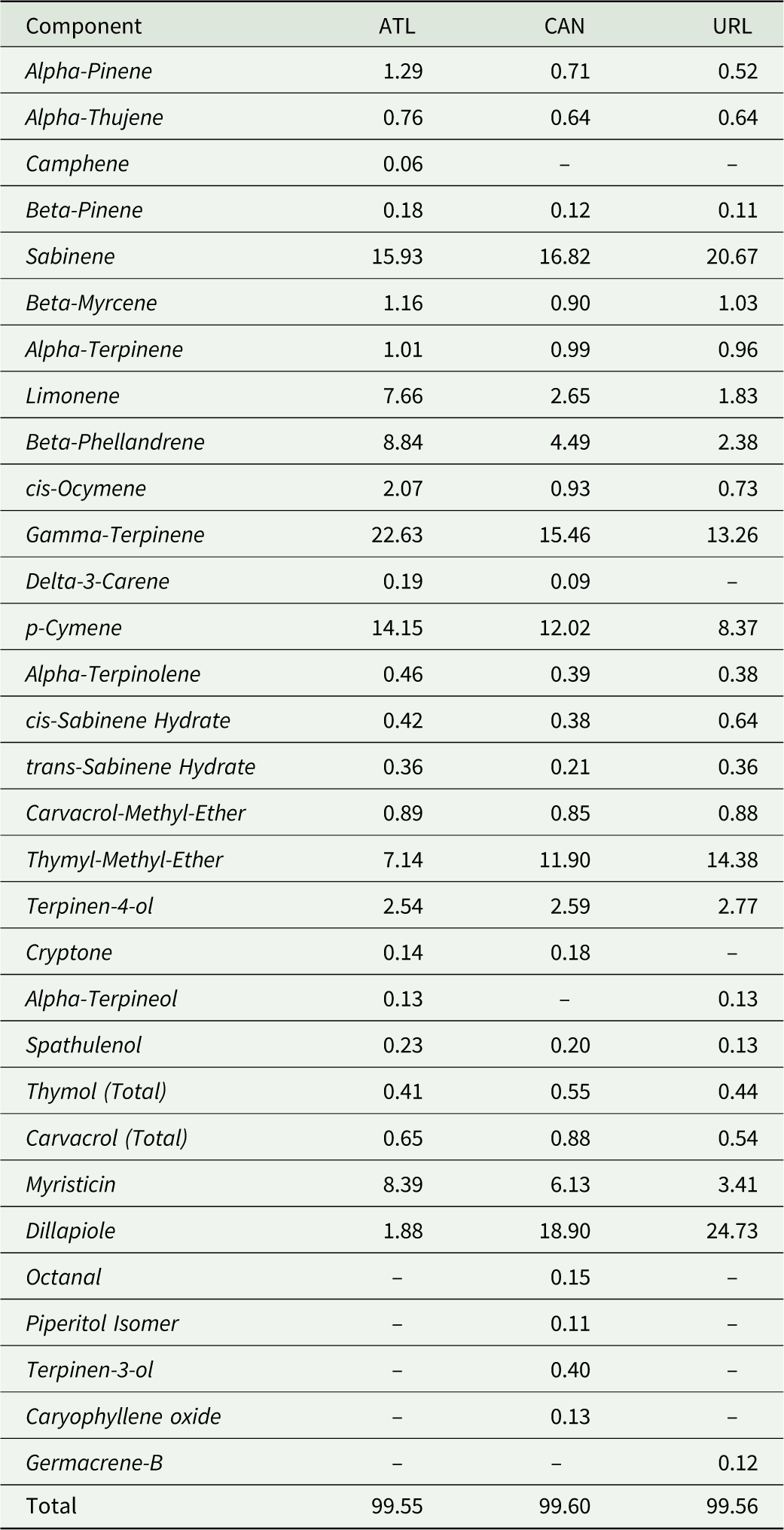
EO composition showed both similarities and differences among the three ecotypes (Table 4). Monoterpene hydrocarbons were the dominant group in all samples. The main compounds were sabinene (15.9–20.7 %), γ-terpinene (13.3–22.6 %) and p-cymene (8.4–14.2 %). Limonene (1.8–7.7 %) and β-phellandrene (2.4–8.8 %) were also detected at notable levels.
The results essential oil composition analysis of three sea fennel (Crithmum maritimum L.) ecotypes (ATL: Atlantic, CAN: Çandarlı and URL: Urla). The values are expressed as percentage area (% area) based on GC–MS analysis

Table 4. Long description
This table lists the chemical composition percentages of essential oil components across three plant sample groups: ATL, CAN, and URL. Major components include Gamma-Terpinene (22.63% in ATL, 15.46% in CAN, 13.26% in URL), Sabinene (15.93% in ATL, 16.82% in CAN, 20.67% in URL), and Dillapiole (1.88% in ATL, 18.90% in CAN, 24.73% in URL). Additional primary compounds present are p-Cymene, Thymyl-Methyl-Ether, Myristicin, and Limonene. Trace components like Camphene, Octanal, and Germacrene-B occur in specific ecotypes. Total accounted compositions range between 99.55% and 99.60%.
Among the oxygenated compounds, thymol methyl ether ranged from 7.1 to 14.4 %, and myristicin from 3.4 to 8.4 %. Terpinen-4-ol, carvacrol methyl ether, thymol and carvacrol were present at lower levels, generally below 3 %.
The clearest difference among ecotypes was found in dillapiol content. Dillapiol was high in the native Turkish ecotypes, CAN and URL, with values of 18.9 and 24.7 %, respectively, whereas ATL contained only 1.9 %. In contrast, ATL had higher proportions of γ-terpinene, p-cymene and β-phellandrene. Minor constituents, including α-pinene, α-thujene and β-pinene, were below 2 % of the total peak area. These results indicate that the native Turkish ecotypes had a dillapiol-rich essential-oil profile, while the ATL reference ecotype showed a low-dillapiol profile.
Discussion
Yield performance and biomass partitioning
Under field cultivation, fresh biomass yield of C. maritimum L. may vary with season, ecotype and nutrient availability, as reported for sea fennel and other halophyte crops (Karkanis et al., Reference Karkanis, Polyzos, Kompocholi and Petropoulos2022; Martins-Noguerol et al., Reference Martins-Noguerol, Matías, Pérez-Ramos, Moreira, Muñoz-Vallés, Mancilla-Leytón, Francisco, García-Gonzalez, DeAndres-Gil, Martínez-Force, del Millan-Linares, Pedroche, Figueroa, Moreno-Perez and Cambrollé2022; Zenobi et al., Reference Zenobi, Fiorentini, Ledda, Deligios, Aquilanti and Orsini2022). In the current study, fresh yield increased in the second year, indicating stronger vegetative growth after the establishment season. Since the trial covered only two growing seasons, this result should be interpreted as short-term evidence of continued field performance, not as proof of long-term perennial productivity. The increase may partly reflect the development of a larger root system after establishment, which can support water and nutrient uptake in perennial halophytes (Zenobi et al., Reference Zenobi, Fiorentini, Ledda, Deligios, Aquilanti and Orsini2022). A similar pattern was reported for Sarcocornia, where yield peaked during the second summer after the first winter dormancy period (Muñoz-Araya et al., Reference Muñoz-Araya, Alonso and Flórez-Méndez2021).
Earlier studies suggest that C. maritimum can be grown from seed outside its natural coastal habitat. Accogli et al. (Reference Accogli, Nutricati, De Bellis, Renna, Luvisi and Negro2024) reported high germination percentages in seeds collected from several coastal accessions and found no clear evidence of dormancy limitation. Nimac et al. (Reference Nimac, Lazarević, Petek, Vidak, Šatović and Carović-Stanko2018) also studied germination and early seedling growth in relation to salinity and priming treatments. Similarly, in the present study, ATL, CAN and URL emerged under nursery conditions and established after transplanting. Still, detailed information on propagation performance at the ecotype level is limited, particularly for Turkish ecotypes.
The increase in edible biomass was particularly clear in ATL, which nearly doubled its edible yield in the second season. This may suggest a good adjustment of the Atlantic material to the clay-loam and moderately alkaline soil conditions of the İzmir site. Differences among sea fennel ecotypes have also been reported in previous studies, where material from different geographical origins, including France, Portugal and Israel, showed variation in salinity response, nutrient acquisition and yield-related traits (Karkanis et al., Reference Karkanis, Polyzos, Kompocholi and Petropoulos2022). Although C. maritimum is adapted to different ecological conditions, germplasm selection remains important for cultivation and domestication studies (Naui, Reference Naui2025).
BIO improved shoot yield and canopy growth, particularly during early vegetative development. This response was probably associated with the added N, P and K and with the contribution of organic matter to soil fertility (Shi et al., Reference Shi, Collins, Yu, Peñuelas, Sardans, Li and Ye2024). The larger canopy observed in fertilized plots may also be explained by better nitrogen and phosphorus availability, which supports leaf area development and shoot formation (Diacono and Montemurro, Reference Diacono and Montemurro2010).
Organic fertilization clearly improved biomass production, but the fertilizer response may not necessarily be identical among sea fennel ecotypes. Differences in nutrient requirement or nutrient-use efficiency may occur, particularly because population-level variability has been reported in this species and growing conditions can affect both yield and compositional traits (Karkanis et al., Reference Karkanis, Polyzos, Kompocholi and Petropoulos2022; Martins-Noguerol et al., Reference Martins-Noguerol, Matías, Pérez-Ramos, Moreira, Muñoz-Vallés, Mancilla-Leytón, Francisco, García-Gonzalez, DeAndres-Gil, Martínez-Force, del Millan-Linares, Pedroche, Figueroa, Moreno-Perez and Cambrollé2022). In the current study, the ecotype × fertilization interaction was not significant for most agronomic traits (Table 2), indicating that the three ecotypes generally followed a similar response pattern under the fertilizer regime used. However, the significant interaction observed for leaf area shows that some growth traits may still respond in an ecotype-dependent manner. For this reason, the effects of different fertilizer types or application rates should be tested in future dose–response studies, particularly if the aim is to optimize both yield and phytochemical composition.
The partitioning of biomass into edible and refused fractions is also relevant for the commercial use of sea fennel. Organic fertilization increased refused biomass, but this was not accompanied by a reduction in edible biomass. Edible biomass also increased with fertilization, suggesting that the treatment enhanced overall vegetative growth rather than promoting a shift from edible to non-edible tissues. The larger relative increase in refused biomass was probably associated with greater canopy development and the formation of older leaves and fibrous stems in larger plants. Even so, the refused fraction remained below 15 % in all treatments. This is lower than the value reported by Montesano et al. (Reference Montesano, Gattullo, Parente, Terzano and Renna2018), who found refused biomass up to 41 % in pot-grown sea fennel. Therefore, under the conditions of the present field trial, the increase in non-edible material was limited and did not markedly reduce marketable yield. This is a useful result for production, since a lower refused fraction can reduce trimming losses and improve post-harvest handling efficiency (Hulkko et al., Reference Hulkko, Chaturvedi, Custódio and Thomsen2023; Renna, Reference Renna2018).
RWC values remained above 80 % in all ecotypes and treatments, indicating that the plants maintained a high tissue water status during the summer growing period. This result is compatible with the halophytic character of C. maritimum, which can maintain hydration and physiological activity under saline or water-limited conditions through traits such as succulence, ion regulation and osmotic adjustment (Atia et al., Reference Atia, Barhoumi, Mokded, Abdelly and Smaoui2011; Hamed et al., Reference Hamed, Youssef, Ranieri, Zarrouk and Abdelly2007; Rahman et al., Reference Rahman, Mostofa, Keya, Siddiqui, Ansary, Das, Rahman and Tran2021). However, the present experiment should not be interpreted as a drought-stress trial, because all plots received the same drip-irrigation regime. The RWC results therefore show that sea fennel was able to maintain tissue hydration under hot Mediterranean field conditions when limited supplemental irrigation was provided. In leafy vegetables, the maintenance of tissue water status is closely related to turgor, photosynthetic activity and visual freshness under stressful field conditions (Parkash and Singh, Reference Parkash and Singh2020).
Finally, the aesthetic quality of sea fennel, particularly its foliar colour, is a primary determinant of consumer acceptability (Radman et al., Reference Radman, Brzović, Radunić, Rako, Šarolić, Ninčević Runjić, Urlić and Generalić Mekinić2023). While CIELab colorimetry revealed that fertilization and ecotype did not cause drastic shifts in visual appearance, the slight tonal variations were statistically significant. Fertilization did not cause a consistent change in leaf colour. This suggests that the measured visual colour traits were largely maintained under the tested fertilization regime, although leaf optical properties in halophytes can be affected by salt accumulation on the leaf surface under saline conditions (Grašič et al., Reference Grašič, Budak, Klančnik and Gaberščik2017).
Phytochemical diversity and antioxidant potential
Sea fennel is well-recognized for its capacity to accumulate large quantities of carotenoids, flavonoids and vitamin C, particularly inside its succulent leaves (Renna, Reference Renna2018). The findings indicate that, in addition to differences in antioxidant profiles between ecotypes, there is also a significant differentiation within the plant itself, such as in its parts like leaves and flowers.
The highest FRAP value was recorded in the flowers of the URL ecotype. This result shows that flower tissues had a strong antioxidant potential in terms of total reducing capacity. This may be related to the accumulation of antioxidant secondary metabolites, such as phenolic compounds and flavonoids, in the flowers. These compounds have been reported to play a role in protecting reproductive tissues against oxidative stress and UV radiation (Radman et al., Reference Radman, Mastelić, Ljubenkov, Lazarevski, Politeo, Podrug, Prga, Čorić, Popović, Veršić Bratinčević, Skroza, Brzović, Runjić, Urlić and Generalić Mekinić2024). In contrast, a different trend was observed in the DPPH assay, which evaluates the capacity to scavenge stable free radicals. In this assay, the highest activity was recorded in the leaves of the URL ecotype. The difference between FRAP and DPPH results suggests that the antioxidant capacity of sea fennel cannot be explained by a single group of compounds. Instead, different metabolite groups may be more important in different plant organs. In this context, flowers may be more important for electron-transfer-based reducing capacity, while the radical-scavenging activity of leaves may be supported by vitamin C, carotenoids, and other antioxidant compounds present in vegetative tissues (Generalić Mekinić et al., Reference Generalić Mekinić, Blažević, Mudnić, Burčul, Grga, Skroza, Jerčić, Ljubenkov, Boban, Miloš and Katalinić2016).
The lower levels of carotenoids and vitamin C in flowers compared with leaves, especially in the CAN ecotype, can be explained by the different physiological roles of leaves and flowers. Leaves are photosynthetically active organs and therefore tend to contain higher levels of photosynthetic pigments and water-soluble antioxidants. In contrast, flowers are mainly associated with reproductive development, pollinator attraction and the synthesis of secondary metabolites with defensive or signalling functions, such as EOs (Šunić et al., Reference Šunić, Ilić, Stanojević, Milenković, Lalević, Stanojević, Milenković and Cvetković2024). Therefore, the lower carotenoid and vitamin C contents in flowers suggest that the plant may allocate its metabolic resources differently according to organ function.
From an ecological point of view, previous studies have also reported clear differences in chemical composition among sea fennel populations. Radman et al. (Reference Radman, Mastelić, Ljubenkov, Lazarevski, Politeo, Podrug, Prga, Čorić, Popović, Veršić Bratinčević, Skroza, Brzović, Runjić, Urlić and Generalić Mekinić2024) showed that sea fennel samples collected from different locations along the Adriatic coast had chemical differences related to their geographic origin. In that study, α-tocopherol content was higher in northern populations, while total phenolic content was higher in southern populations. These findings support the results of the present study, in which the native Turkish ecotypes CAN and URL differed from the ATL reference ecotype in some phytochemical traits. Therefore, local germplasm of sea fennel should be evaluated not only for yield-related traits, but also for chemical composition and target uses. This approach may help select plant materials with valuable metabolites under standardized organic cultivation conditions.
Essential oil and chemotypic variation
EO content was measured in one season only; therefore, year and fertilization effects could not be assessed. The mean EO yield was 1.6 ml/100 g DW, which is within the higher part of the range reported for C. maritimum. Previous studies reported EO yield ranging from 0.5 to 4.8 ml/100 g DM, with higher oil accumulation generally found in reproductive organs such as umbels and seeds than in leaves and stems (Generalić Mekinić et al., Reference Generalić Mekinić, Blažević, Mudnić, Burčul, Grga, Skroza, Jerčić, Ljubenkov, Boban, Miloš and Katalinić2016; Šunić et al., Reference Šunić, Ilić, Stanojević, Milenković, Lalević, Stanojević, Milenković and Cvetković2024). In the present study, the relatively high EO yield may be related to the use of whole aerial biomass for hydrodistillation and to the early October harvest, when flowering had ended and fruit formation had started. This developmental stage can favour volatile accumulation in aromatic halophytes (Atia et al., Reference Atia, Barhoumi, Mokded, Abdelly and Smaoui2011).
The three ecotypes showed similar main monoterpene compounds, mainly sabinene, γ-terpinene and p-cymene, but differed clearly in the proportion of some constituents. The most notable difference was observed for dillapiole. This compound was abundant in the native Turkish ecotypes, CAN and URL, whereas it occurred only at a low level in the ATL ecotype. In contrast, ATL contained higher proportions of myristicin and some monoterpene hydrocarbons. These differences indicate the presence of dillapiole-rich and dillapiole-poor chemical profiles within the tested material, in agreement with previous reports showing that sea fennel essential-oil composition can vary according to the geographic origin of the plant material (Jallali et al., Reference Jallali, Hannachi, Zaouali, Smaoui, Abdelly and Ksouri2023; Pateira et al., Reference Pateira, Nogueira, Antunes, Venâncio, Tavares and Capelo1999).
The high dillapiole content of the native ecotypes should be considered when evaluating their possible end uses. Although dillapiole is a bioactive phenylpropanoid, its occurrence in food-grade products may require attention because of reported safety concerns (Porrello et al., Reference Porrello, Vaglica, Savoca, Bruno and Sottile2024). For this reason, the ATL ecotype, which had a much lower dillapiole level under the tested conditions, may be more suitable for fresh consumption and food-oriented applications. By contrast, the CAN and URL ecotypes may require further safety evaluation before being recommended for food use, although their dillapiole-rich oil profiles could still be relevant for non-food or specialized industrial applications.
This ecotype × environment chemotypic variability is a hallmark of Mediterranean aromatic species, including Thymus vulgaris, Salvia officinalis and Origanum vulgare. Comparable variability in secondary-metabolite profiles has been reported in several Mediterranean aromatic species, such as Thymus vulgaris, Salvia officinalis and Origanum vulgare (De Mastro et al., Reference De Mastro, Tarraf, Verdini, Brunetti and Ruta2017; Gouyon et al., Reference Gouyon, Vernet, Guillerm and Valdeyron1986; Sarrou et al., Reference Sarrou, Ganopoulos, Xanthopoulou, Masuero, Martens, Madesis, Mavromatis and Chatzopoulou2017). Therefore, the domestication of sea fennel should include both agronomic evaluation and chemotypic characterization, particularly to support product quality and food-use suitability.
Among the germplasm evaluated, ATL appeared to be the most suitable ecotype for food-oriented production under the conditions of the current study. This ecotype combined stable biomass production with a comparatively favourable essential-oil profile, including lower dillapiol levels than the other tested materials. However, this recommendation should be considered specific to the present experimental conditions.
Practical cultivation implications
Based on the findings of the current study, sea fennel seedlings can be produced in early spring under greenhouse conditions using sterilized organic peat. Light daily irrigation is sufficient to keep the substrate moist during seedling development. Transplanting to the field at the 2–4 true-leaf stage was suitable for plant establishment in this trial. The spacing used in the experiment, 45 cm between rows and 22.5 cm within rows, corresponding to about 9.9 plants/m2, allowed good field establishment and biomass production under the tested conditions. A moderate basal organomineral fertilizer application, corresponding to 39.6 kg N, 39.6 kg P2O5 and 39.6 kg K2O/ha, may be used as an initial input, depending on soil fertility. During the dry summer period, especially in the first year after transplanting, supplemental drip irrigation should be provided to support plant survival and maintain shoot water status. Harvesting at the end of the vegetative growth period, when tender leaves, young stems and edible shoots are well developed, appears appropriate for obtaining marketable biomass.
The current study provides useful agronomic and phytochemical information on the field cultivation of sea fennel, but it also has some limitations. The experiment was conducted at one location and covered two growing seasons. Only one fertilizer dose was tested, and essential-oil composition was determined only at the end of the second year. For this reason, further studies are needed to test the crop over longer periods, at different locations and under different fertilization and irrigation regimes. Larger field trials would also be useful to evaluate whether the proposed cultivation approach remains practical under semi-commercial or commercial production conditions.
Conclusion
Sea fennel (C. maritimum L.) was successfully established under the tested Mediterranean field conditions, with plants surviving into the second growing season and fresh biomass increasing by 76% compared with the first year. Organic fertilization improved canopy development and total yield across ecotypes without reducing the proportion of edible biomass or causing consistent changes in leaf colour, indicating that a moderate basal organomineral input can support biomass production under these conditions. Phytochemical profiling revealed clear organ-specific differences, with flowers showing higher phenolic content and reducing power and leaves containing higher vitamin C, carotenoids and radical-scavenging activity, suggesting different end-use potential for fresh consumption, antioxidant-rich material and essential-oil production. Among the evaluated germplasm, ATL appeared to be the most suitable ecotype for food-oriented production under the present conditions, although further multi-location and longer-term studies with different fertilization and irrigation regimes are needed before broader cultivation recommendations can be made.
Author contributions
Volkan Yeşil: Writing – original draft, writing – review and editing, methodology, data curation, formal analysis, validation, investigation. Uğur Çakaloğulları: Methodology, investigation. Çiğdem Sönmez: investigation. Özgür Tatar: Writing – original draft, writing - review and editing, conceptualization, data curation, methodology, project administration, supervision, visualization.
Funding statement
This work was funded by the Scientific and Technological Research Council of Türkiye (TÜBİTAK) and was carried out within the PRIMA Programme supported by the European Union. Project title: “Innovative sustainable organic sea fennel (C. maritimum L.)-based cropping systems to boost agro biodiversity, profitability, circularity, and resilience to climate changes in Mediterranean small farms” (acronym: SEAFENNEL4MED, https://seafennel4med.com/)
Competing interests
The authors declare there are no conflicts of interest.
Ethical standards
Not applicable.





 Open access

