For more than two decades, the State Board of Education required Virginia’s high school history teachers to teach Virginia’s Attitude Toward Slavery and Secession alongside every American history textbook. From the state’s origin, author and Richmond politician Beverley Munford argued, the enslaving elite maintained a benevolent yet reluctant relationship with slavery.Footnote 1 The book, published in 1909, featured quotes from Virginians like Thomas Jefferson in support of its defense of the institution of slavery, including: “To give liberty to, or rather to abandon, persons whose habits have been formed in slavery, is like abandoning children.”Footnote 2 Munford argued that Jefferson and others could not free enslaved people because they were “trained only for the paths of dependence.”Footnote 3 Munford denied the importance of slavery to the Civil War. He portrayed the antebellum era as one defined by familial bonds between enslaved Black people and white enslavers, ruined by federal intervention during the war. In preserving this narrative about slavery and the Civil War, the text communicated underlying messages about segregation and white supremacy to young white readers. To help drive home those messages, Munford reprinted for his readers the words of Virginia governor and US congressman James McDowell: “Social, civil and political equality” would lead to a “war of colors.”Footnote 4 These messages were twisted falsehoods grounded in the Lost Cause, a set of myths about the Civil War shaped around Confederate memory of the war as a conflict over states’ rights rather than slavery.Footnote 5
White Southerners like Beverley Munford used the Lost Cause to defend and justify Jim Crow, arguing that racial coexistence depended on a racial hierarchy, that systems of white domination benefited Black people, and that federal power destroyed the relationship between white and Black Virginians.Footnote 6 In order to assert the Confederate Cause as noble and just, the Lost Cause viewed the antebellum South with nostalgia, “rewriting slavery as a benevolent institution.”Footnote 7 By celebrating antebellum slaveholding society, the Lost Cause acted as a tool for white Southerners to legitimize white supremacy, segregation, and disenfranchisement.Footnote 8 While historians have debated the origins of the Lost Cause, its key proponents, and the ways it has changed over time, many agree on the core role of textbooks and education in forwarding the ideas of the Lost Cause.Footnote 9 During the 1910s and 1920s, curricular control in history classrooms developed into a key aspect of bureaucratic racial control in Upper South states, because it gave states the power to determine that children learned a Lost Cause framing of slavery and the Civil War.Footnote 10 Munford’s textbook, with core arguments asserting that slavery did not play a role in secession, served a particularly strong role in shaping Virginian students’ understandings of the Lost Cause and subsequently in teaching them to accept white supremacy.Footnote 11 It also had particularly strong staying power on the state textbook lists. As the basal textbooks rotated through several revisions and changes between 1911 and 1932, the original edition of Virginia’s Attitude remained untouched.Footnote 12 By reaching thousands of Virginian students, Virginia’s Attitude shaped children’s racial identities and their perceptions of the Jim Crow racial order.
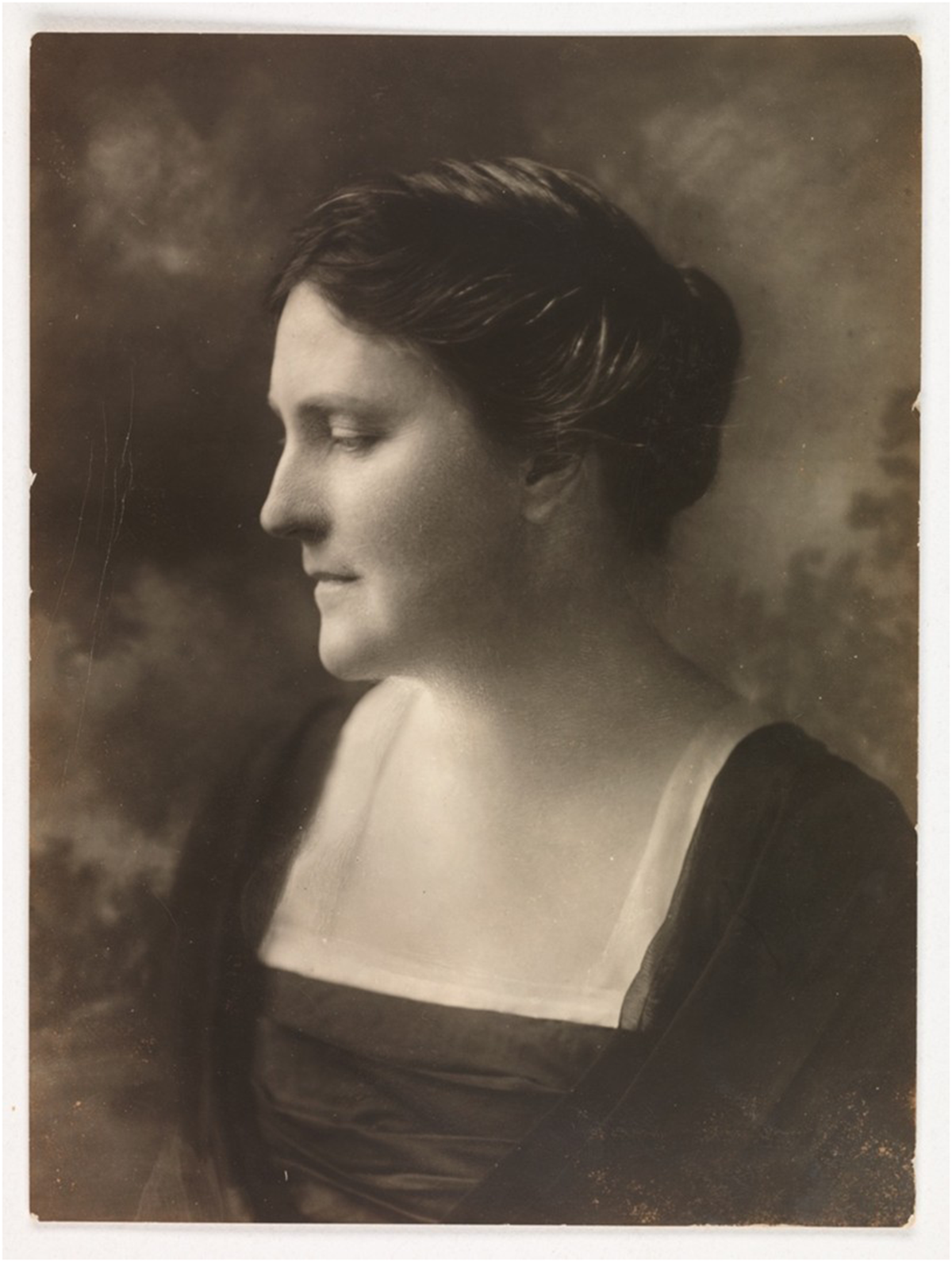
The success of Virginia’s Attitude should be attributed to the group of educators and activists—who were predominantly women—that pushed the Board of Education to continue to require the book. This effort was led by author Beverley Munford’s wife, Mary-Cooke Branch Munford (Figure 1), to whom he dedicated the book. After her husband died in 1910, Mary Munford committed herself to assuring that the book would be readopted by the Board of Education and read in full by every white high school student in the state.Footnote 13 In her mission to get the book in Virginia’s classrooms, Munford worked closely with the leading education men in the state: both local and state superintendents, members of the Board of Education, and academics at the University of Virginia and Virginia Polytechnic Institute.Footnote 14 On the surface, it appears that curricular change and textbook adoption occurred through the efforts of those superintendents, Board of Education members who approved textbooks, and leaders of curriculum reviewing committees. While these men often made the decisions that approved curricular guidelines, the ideas for new ways to teach history came largely from white women, who published about history pedagogy in widely circulating teachers’ journals, made up the majority of the history curriculum committee that suggested the book, and were the history teachers in the state who taught the book.Footnote 15 Mary Munford led these women, and they helped her develop methods to impart the messages from the text to their students.Footnote 16 Her dedication to the readoption of Virginia’s Attitude and her commitment to developing specific history standards, paired with the work of teachers to impart the history on their students, makes evident the everyday work required to uphold white supremacy and pushes back on the myth that white supremacy was maintained through a natural racial hierarchy.Footnote 17
Mary-Cooke Branch Munford, late nineteenth century. (Virginia Museum of History and Culture. Used by permission).

The work to preserve Jim Crow carried out by Munford and other white women through their curricular activism rested on a broader, and well-studied, system of racial instruction. In their efforts to control curricula and textbooks, these white women educators sought to develop white students’ senses of racial identity to reinforce and uphold the institution of segregation. Jennifer Ritterhouse, Kristina DuRocher, and LeeAnn Reynolds have written about the learned culture of segregation and shown that adults instructed children in the “racial etiquette,” to use Ritterhouse’s term, of segregation.Footnote 18 Children did not inherently understand the social rules of segregation and often played across interracial lines in early childhood, which made the boundaries and violence of segregation even more confusing as they got older. But by the time they entered school, the racial order was made abundantly clear through the design and teachings of the segregated school system, and it was difficult to question or challenge.Footnote 19
This article builds on the developing historiography of racial instruction by unveiling the committed activism that solidified these texts as mandated books. Schools were essential spaces where teachers reinforced the meaning of race through history and moral lessons that were found in state-mandated curricula and textbooks. Therefore, textbooks held the continued focus of white women activists concerned with preserving Jim Crow. Curriculum control, a key tool of racial control, occurred through the forced teaching of textbooks like Virginia’s Attitude and binding each day’s instruction to a strict document known as the Course of Study. By focusing on the role of curriculum control in Jim Crow, this article highlights the power of education in building a system of racial supremacy. While some of the women who developed the state history curriculum and supported the use of Virginia’s Attitude worked to improve Black schools, opposed the new laws for racial control, and generally saw themselves as bettering interracial relations, they remained committed to a curriculum that bolstered the existing racial hierarchy.
“Real Historical Insight”: History Instruction as Racial Instruction
Mary Munford began her campaign for Virginia’s Attitude to join the required textbook list immediately after her husband’s death, drawing from her experience in reform efforts and her social network of elite Virginians. She first drew on that network when she heard news that the Board of Education was considering Virginia’s Attitude as a supplementary rather than required textbook, meaning that it would be optional to teachers. She quickly sent the book to superintendents around the state along with impassioned appeals for their support to add the book to the list of required texts. At first, she was met with resistance not only from the administrators but also from teachers. Three superintendents explained to Munford that the teachers had a hard time using her book in the classroom, as it was different from the classic textbook with names, dates, and short descriptions of historical events.Footnote 20 One acknowledged that despite the book having “real historical insight,” it was difficult to “get the teachers of history to realize that a book like this in the high school is more important than the details or battles in a regular history.”Footnote 21 Virginia’s Attitude included carefully selected writings of prominent Virginians, which challenged teachers, as one of the superintendents, J. A. C. Chandler pointed out.
Munford shaped his textbook around his assertion that white Virginians were largely anti-slavery in sentiment, and that they could not have seceded to protect an institution they were inherently opposed to. His argument laid out a convoluted explanation for Virginia’s secession, insisting that to secede in defense of slavery would have “dishonored” Virginia’s men.Footnote 22 Munford therefore undertook a project to restore honor to Confederate Virginians through a unique manipulation of the Lost Cause. White Virginians largely opposed slavery, he argued, leading efforts to end the slave trade and advocating for a constitutional ban on the trade. Munford quoted “antislavery sentiments” from prominent white Virginians, including eighteenth century House of Burgesses member Richard Henry Lee and Virginia-born presidents James Monroe and Thomas Jefferson.Footnote 23 He provided evidence that only a small percentage of white people in Virginia were enslavers.Footnote 24 Munford also argued that enslaved labor replaced labor roles from more deserving whites, limiting the opportunity for white men to earn wages and therefore the presence of an expansive white population in the state.Footnote 25 Because Virginians held a disapproving “attitude toward slavery,” Munford insisted, the state seceded not to protect the institution, but because of its enduring commitment to the “principles of liberty and law” that the federal government supposedly violated by infringing on the rights of enslavers.Footnote 26 Despite all of his evidence for “anti-slavery” attitude in Virginia, Munford conceded that the institution of slavery maintained a prominent position in Virginia until the war.
Munford used an argument infused with white supremacy—one that forwarded the project of racial instruction—to explain the existence of slavery in Virginia despite white Virginian’s lack of support for it. Because they opposed slavery, Munford contended, white Virginians were particularly invested in creating projects to end the institution: Colonization and forced emigration to other states. Munford presented these two projects as the only viable options for the end of slavery, revealing his inability to imagine a free, integrated society without a system of racial oppression. He did not argue for a project of gradual emancipation, but presented an entirely white society, free of slavery, as the true solution to the “problems” of slavery. Munford reflected on the state’s history with the institution through quotes attributed to colonial leaders like William Byrd, members of Virginia government, and other recognizable figures like Patrick Henry. He used their writings to explain that slavery was “justified” by “the difficulties and dangers attending its abolition.”Footnote 27 According to Munford, the presence of African-descended people posed a “danger” to white Virginians. He quoted British statesman Edmund Burke to convey this message, noting that white Virginians, according to Burke, had to protect themselves against the enslaved Africans, who introduced “publick danger” of violence to the colony.Footnote 28 However, through the system of slavery, enslavers “continue[d] day by day the work of teaching these children of the Dark Continent an intelligible language, the use of tools, the necessity for labor and the rudiments of morality and religion.”Footnote 29 After arguing “insuperable difficulties” had “embarrassed every plan of emancipation” Munford concluded that a white-over-Black racial hierarchy established peace and order in the state.
By depicting slavery as inevitable, his framing absolved Virginia of fault for slavery and attempted to prove that the paternalistic relationship between enslaver and enslaved existed not out of white Virginians’ desire to own Black people but to care for them. His approach upheld the myth that the system of slavery in Virginia was based on benevolence of white enslavers towards Black enslaved people, while also perpetuating the idea that racial order could only be preserved through supremacy of white people over Black people. The release of Munford’s book coincided with the conservative Dunning School domination of histories of Reconstruction and of race science’s infiltration into the academy. An academic approach, rooted in primary sources, did not mean a less racially biased one. In Virginia’s Attitude, this approach corroborated a view of the past that positioned Black enslaved people as inherently inferior to their white enslavers. In the context of Jim Crow Virginia, Munford’s history of slavery legitimized segregation and portrayed it as a natural progression of the state’s social relations.
Munford’s approach to Virginia history committed more heavily to instilling an understanding of the racial hierarchy in his readers than other history textbooks at the time, textbooks that teachers were more familiar with. While other textbooks often framed enslaved people as inherently inferior to enslaving whites, they did not go to the same lengths to include the justifications for slavery that enslavers themselves used.Footnote 30 Mary Munford saw Beverley Munford’s use of quotes and excerpts as a strength of his work. She developed an outline for teachers to use the book in their classrooms in 1915 so that they could navigate teaching the unique style of the textbook in the way that she believed was most effective.Footnote 31 Despite some teachers’ skepticism, Mary Munford continued to pressure superintendents around the state. She convinced them, as superintendent Harris Hart noted, that “the present State adoption for high school books makes very inadequate provision for the teaching of American history.”Footnote 32 That Mary Munford was successful in pushing the Board of Education to adopt the book and later to train hundreds of teachers in how to use it in the classroom, while facing resistance from many educators, is a testament to her commitment to the book as a tool in racial instruction. Because she viewed the text as an essential part of white students’ coming of age in Virginia, she remained dedicated to its adoption and readoption, even when classroom educators and administrators pushed back. The efforts of teachers throughout the decade to impart the book’s messages to their students show that racial instruction was not just Munford’s project, but one that extended to classrooms around the state.
Mary Munford and Upper South Progressivism
As a prominent member of Richmond’s white society, Mary Munford was “motivated by the progressive creed,” which in the South tied together white paternalism with progressive reforms and can explain Munford’s dedication to Virginia’s Attitude.Footnote 33 Southern progressivism was a complex reform movement that, while advocating for modernization and bureaucratic efficiency, also codified racial hierarchies through the institutionalization of discriminatory policies like voter registration laws and literacy tests.Footnote 34 Southern progressives used the Progressive Movement’s signature pillars—health and social welfare institutions—to reinforce racial segregation and maintain white supremacy by surveilling and policing Black communities.Footnote 35 They projected ideas about efficiency and social reform onto segregation, which they believed would solve social problems like racial violence. Southern progressive ideals filtered into both educational activism and interracial activism for Black “uplift.”Footnote 36 Mary Munford, a typical Southern progressive, took part in interracial reform efforts to improve Black education and living conditions. She was a founder of the Virginia Inter-Racial League and financially supported Fisk University and various other Black educational institutions. If both Black and white children were well educated and received social support, white Southern progressives believed, interracial conflict would decrease and the South would benefit from an orderly society defined by segregation.Footnote 37
Munford’s work to assure that white children read Virginia’s Attitude—paired with her commitment to Southern progressive reforms—reveals a form of racism distinct to Upper South women’s curricular activism. While historians like William Link and J. Douglas Smith have explored the role of Southern progressives in schools and Virginia’s racial policies, exploring curricula as a focus of Southern progressivism unveils the intellectual work necessary to undergird the laws and systems of Jim Crow.Footnote 38 It also brings women activists to the forefront. Classrooms were largely the realm of women, as they made up about 90 percent of Virginia’s teachers between 1918 and 1928.Footnote 39 The classroom provided women history teachers a formal space of racial instruction, where they, increasingly guided by Munford through her influence over the Board of Education and the Virginia Society of History Teachers, taught about the Civil War and slavery. This form of racism was less overt than segregation policies and outright discrimination, as it did not rely on violence or the law, but it was no less nefarious, as it aimed to sow a vision of racial hierarchy in white children’s minds. The content of Virginia’s Attitude would have given white children a picture of the past in which inherent racial qualities made Black freedom unimaginable. By learning about slavery from the words of Jefferson and other elite white enslavers, white children learned to consider the institution as a necessary source of order in a multiracial society, and therefore to consider Jim Crow in the same way. Curricular activism to instill the Lost Cause through textbook requirements was deeply ingrained within Southern progressivism, as it rested on the idea that more control in the classroom would lead to better race relations outside it.Footnote 40
In the South, most public school systems were established in the late nineteenth century and in many cases were undeveloped and not uniform across states, making education a prime target for progressives looking to exert ideological influence.Footnote 41 Progressive activism resulted in the transformation of Virginia’s public education system through a great bureaucratic expansion. At the beginning of the century, the state education system was not standardized, and rural parts of Virginia especially suffered in terms of the quality of their schools. Teachers did not have certification requirements, and the state did not have a system for textbook distribution nor yet employ supervisors to coordinate curriculum, school attendance, or school maintenance. However, through the work of state superintendents and the progressive momentum generated among the State Board of Education, the state expanded the educational bureaucracy. By 1920, the educational bureaucracy was strong enough to monitor teacher training and examination and to require even rural teachers to obtain certificates from high schools or normal schools. The state also appointed rural school supervisors and other bureaucrats to inspect schools regularly and to ensure compliance with health and curricular standards.Footnote 42 The Board of Education introduced required compliance with the state curriculum, which increased and standardized textbook usage across the state.Footnote 43 Rather than the nineteenth-century schoolbooks and pedagogy that encouraged teachers to set their own curriculum or relied on local school leagues to handle that function, textbooks in the new education bureaucracy “embodied patterns of standardization and centralization” that were evident in education more broadly.Footnote 44 This set of ideas aligned with Munford’s activism for curricular reform and the readoption of Virginia’s Attitude, which operated as a text that reinforced segregation as a mechanism of order through its portrayals of slavery, but also standardized the way that white children would learn Virginia history.
The progressive transformation of Virginia’s schools also opened space for women to participate in curricular control at the state level, as it expanded bureaucratic positions and the standardization of education. Munford and the women that she worked with both benefited from and shaped the expansion of the education bureaucracy over curriculum, using it as a tool to shape the way that children understood their racial identity within a broader racial hierarchy. These women drew not just from Progressive Era trends, but from trends established by Confederate women to take hold of the way white children learned about the Civil War. By the early twentieth century many white women, particularly the members of Ladies’ Memorial Associations and the United Daughters of the Confederacy (UDC), were already deeply invested in instilling the Lost Cause in the minds of Southern children through a more structured education system.Footnote 45 Even during the Civil War, Confederate wives and mothers worked to revise the national narrative of the Confederate rebellion by framing the federal government as an insurmountable antagonist infringing on their rights. Through commemorations, memorial day celebrations, and the erection of memorials, these women revised the collective memory of the Civil War, insisting that slavery played no role in secession and that it was instead sparked by a dispute over the Constitution and states’ rights, that Confederate soldiers fought valiantly but faced an unbeatable enemy, and that the antebellum era was “a golden age of race relations” defined by “love and ‘familial’ duty” during the period of enslavement.Footnote 46 All of these narratives were made clear in Virginia’s Attitude.
The UDC, which represented a new generation of women that emerged to take the place of Ladies’ Memorial Associations, gained prominence at the end of the nineteenth century. By 1900, there were fifty-seven chapters of the UDC in Virginia, with more than 3,200 members.Footnote 47 The women of the UDC supported the use of Virginia’s Attitude, but it was not UDC members who had the most control over the adoption of the book.Footnote 48 A group of women teachers and educators largely unaffiliated with the UDC accomplished a similar goal without explicitly tying the memorialization of the Confederacy to their efforts. Instead, they argued that adopting Munford’s text would improve their students’ understanding of history and high school education overall. While most history of Southern women’s curricular activism concerns the work of the UDC to implement an overtly racist curricula in Southern schools, Mary Munford and the women who helped disseminate Virginia’s Attitude were part of a more covert project to instruct young people of a racial hierarchy that fit their white Southern progressive ethos.Footnote 49
Regardless of her lack of UDC ties, much of Munford’s activism was shaped by Lost Cause remembrance, which applied the same logic of paternalism to enslaved people as it did to Black people in the South in the early twentieth century. Munford and other paternalist activists in Virginia believed that the descendants of Virginia’s enslaving elite had the responsibility to reform Black communities through education and health programs. According to Clayton McClure Brooks, “she drew inspiration from Confederate commemoration, often citing the love and loyalty of her family’s ex-slave servants as the reason for her activism in African American uplift causes.”Footnote 50 Munford upheld the Lost Cause through her paternalistic interracial reform efforts, but her commitment to white supremacy and the Lost Cause played out most clearly through her efforts to assure that Virginia’s children learned the Lost Cause with her husband’s textbook. Munford’s commitment to making sure Virginia’s students were well versed in the Lost Cause was a project intertwined with her philanthropic work for Black education. She viewed herself as a caretaker for Black Richmonders, paternalistically participating in interracial reform through the Commission for Inter-Racial Cooperation and other organizations.Footnote 51 This same logic extended to her commitment to the textbook, her project for white schools.Footnote 52
The 1919 Course of Study and Virginia’s Attitude
In 1919, the Virginia State Board of Education released the Manual and Courses of Study for the High Schools of Virginia (commonly known as the 1919 Course of Study), in an attempt to institute an unprecedented level of curricular control over Virginia’s history classrooms.Footnote 53 The previous 1915 State Course of Study for High Schools had provided two pages of narrative outline of United States history to guide teachers through the year, but the new 1919 curriculum included a detailed list of subjects and topics that teachers should cover under each subject.Footnote 54 Rather than taking the 1915 overview’s approach of simply directing teachers to teach Reconstruction and the Civil War, the new curriculum specified exactly how teachers should teach it, requiring them to incorporate Lost Cause distortions.Footnote 55 The new guidelines for teachers also demanded stricter adherence to state-approved textbooks, including devoting an entire page to reminding teachers of the importance of these textbooks as teaching tools. Students were to study, answer content questions about, and memorize recitations from chapters of the textbooks each day.Footnote 56 The state distributed the Course of Study to all teachers as a guide for classroom work, and superintendents collected daily forms that asked teachers to confirm if they had taught the state curriculum, embodying the progressive reforms that had swept the state education system.Footnote 57 The development and implementation of the Course of Study, which included Virginia’s Attitude as a required text, also revealed that Munford was not alone in her efforts to teach Virginia’s young white people the Lost Cause. The women in who developed the curriculum and teachers who carried it out both supported and used Virginia’s Attitude.
While Virginia’s Attitude had been approved for use before 1919, that year marked an important shift in the way the State Board of Education mandated the teaching of the text, largely because of Mary Munford’s campaigning for its adoption within the new Course of Study. In addition to the strict history curriculum, the new Course of Study included much more specific guidelines for the ways Munford’s book should be used in the classroom than the previous Course of Study. Munford had written most of the mandate herself, meeting with members of the Board to assure that her exact wording of the guidelines would enter the new curriculum.Footnote 58 Her guidelines required teachers to assign discussions, reports, and tests on the text, to ensure “a thorough knowledge of Virginia’s part in forming and maintaining the Union” and “the anti-slavery and union-loving sentiment of Virginia’s people.”Footnote 59 To assure that Virginia’s Attitude was taught exactly as she envisioned, Munford also wrote briefs to be read at meetings of the Board, mailed the book to education leaders around the state to push them to adopt it, wrote teaching guides and submitted them to the Board’s history committee, and solicited teacher testimonies to share with Board members.Footnote 60
Although efforts to solidify the role of the text in Virginia’s classrooms were spearheaded by Munford, she collaborated with other women in developing the curricula, spreading it to teachers, and implementing it in the classroom. Her work illuminates a much larger project to use Lost Cause history to teach white children their role in the Jim Crow racial hierarchy. The six-person history committee that put together the history component of the 1919 Course of Study included two women, Bessie Randolph and Mary Peck.Footnote 61 Randolph and Peck served particularly important roles on the history committee, because they represented the classroom teachers who would be teaching the new history curriculum. They also served as a liaison between the history committee and teachers more broadly because of their roles at white women’s teaching schools.Footnote 62 Both women were also in communication with Mary Munford and advocated for the adoption of Virginia’s Attitude. Footnote 63 Randolph and Peck helped to solidify women’s role in Virginia’s mission to control curriculum. While women teachers had already been able to carry out their visions for history curriculum in the classroom or at teaching colleges, Randolph and Peck participated in a more formal, more strict form of curriculum control by implementing guidelines for history teaching. They brought forward the philosophies of many white women they worked with at Farmville State Normal School and developed a history curriculum for teachers throughout the state. They also assumed roles as leaders in history education in subsequent years: From 1919-1921 Bessie Randolph held leadership positions in the Virginia Society of History Teachers, and in 1926 Mary Peck led sessions of the annual teachers’ conference concerning materials for history classrooms.Footnote 64
Women’s participation in curriculum control was not limited to engagement with the State Board of Education, and it involved more women than just Randolph and Peck. As teachers became increasingly professionalized because of Progressive Era standards for teacher training, associations like the aforementioned Virginia Society of History Teachers gained prominence, led by and consisting largely of women. The leaders of the Virginia Society of History Teachers, including Randolph, also maintained consistent contact with Munford and could disseminate her teaching suggestions through their positions at the helm of the society.Footnote 65 The society regularly met at John Marshall High School in Richmond (Figure 2), where Virginia’s Attitude was first trialed in a classroom.Footnote 66 By 1919, the society participated in the state teachers’ conference, and, in 1920, it made calls for textbook changes through a report to the Board of Education, insisting that the textbooks at the elementary level lacked an outline of “this State’s attitude toward slavery from the inception to the finish of that institution,” and that “belated historical justice will be done to Virginia, and, in the years to come, it will take its rightful place among the makers of America.”Footnote 67 The report by the Society of History Teachers made clear the influence of Munford’s text on Virginia’s history teachers more broadly: It called for a Virginia-specific text that discussed slavery in the state in a way similar to Virginia’s Attitude.
John Marshall High School in Richmond, between 1910 and 1920. Munford’s textbook was first tested with teachers at the school. (Library of Congress Prints and Photographs Division).

Figure 2 Long description
The photograph depicts John Marshall High School in Richmond, showcasing its architectural design. The building features a prominent entrance with large columns and a pediment. It has multiple rows of windows across three floors. The surrounding area includes a street with visible utility poles and a few pedestrians walking nearby. Trees are present in the background and a streetlamp is visible in the foreground. The image captures the school between 1910 and 1920.
In addition to collaborating with the women of the state history committee and Virginia Society for History Teachers, Mary Munford kept tabs on the hundreds of high school history teachers in the state, consistently mailing them surveys to solicit feedback on the ways they used the text, their understanding of its value to the classroom, and to remind them that the teaching of the text was required, not suggested. Footnote 68 Munford’s communication with these history teachers unveils a larger project across Virginia, led by one woman yet bolstered by hundreds of others at the state and classroom level, to teach white children the Lost Cause. She kept a collection of the praise she received from Virginia’s teachers on the usefulness of the textbook in their classrooms, with women from all over the state providing her details on the ways they taught the Lost Cause and their efforts to “vindicate the good name of our state,” according to teacher Adelaide Trent.Footnote 69 The archive of teacher feedback on Virginia’s Attitude that Munford developed provides insight into the effort required of teachers like Gladis Farise, Blanch Hawkins, Virginia Harwood, Annie Newcomb, and the hundreds of others in instructing white children about their role in the racial hierarchy.Footnote 70
Despite support for her text from Peck, Randolph, and hundreds of others during the curriculum revision process in 1919, Munford faced a crisis when first soliciting teacher support. In the responses to her questionnaires, Munford was surprised to face some resistance from a few white teachers about the requirement to teach the book. “Slavery is a dead issue and question should not be agitated,” noted a teacher from Rappahannock District. Other Virginia teachers criticized the teachability of the text, commenting that the book was “too wordy,” “of little value,” and “school children do not seem at all interested in it.”Footnote 71 The responses pushed Munford toward an even more rigorous dedication to assuring that the textbook was taught in every white classroom. If the teachers and students did not value the history of Virginia’s race relations, it became even more important for Munford to teach them to understand and defend the racial hierarchy. She wrote back to every teacher that disagreed with the adoption, sending them outlines for ways to teach the textbook, her arguments for its importance, and pointed reminders that state law required them to teach it.Footnote 72 It also drove her toward a more specific argument in support of the textbook that drew from Lost Cause notions of states’ rights and racial relations.
In her push to get the book readopted in 1919, Munford drew on two arguments: one, that the book was essential in teaching Virginian students to maintain their allegiance to Virginia as nationalism and patriotism expanded in the wake of the First World War, and two, that it would shed light on the relationship between white and Black people in Virginia. She framed her book as an interracial history of sorts, which drew from the Southern progressive trends of the moment. In a letter to John E. Williams, a faculty member at Virginia Polytechnic Institute who was involved in curriculum construction, Munford explained that the book would help reconcile “the rapid development of nationalism on one hand with the necessity on the other for the preservation in the nation of local self government.”Footnote 73 After the nationwide mobilization of the First World War, a heightened sentiment of patriotism existed among many Americans who had contributed to the war effort and developed a commitment to the nation shaped around “duty, sacrifice, and obligation.”Footnote 74 Americans experienced the “government’s presence in everyday life” during the war, witnessing mass conscription, widespread coercive voluntarism, and the expansion of state surveillance of political dissent.Footnote 75 To Munford, heightened nationalism threatened a permanent expansion of federal power. The book positioned Virginia as the place where democratic government was founded by men such as Thomas Jefferson and George Mason. Mary Munford argued that by understanding Virginia as the origin of democracy, students would maintain their appreciation for democratic institutions while assuring that state power prevailed over federal power. She reiterated the sentiment in letters to other educators throughout Virginia. Munford’s point that the book would shed light on the benefits of “local self government” was related to her point that the book would explain “the relationship of Virginia to the Negro race from the time of the landing at Jamestown.”Footnote 76
The connection Mary Munford made between state government and interracial relations reflected a broader perspective of Virginia’s white elites about slavery and segregation in the state. As historians of eugenics, race relations, and segregation in Virginia have made clear, many white elites in Virginia saw their relationship with Black Virginians as unique to their state.Footnote 77 Historian J. Douglas Smith called this “managed” race relations, by which he meant that white Virginians viewed themselves as paternalistic managers of Black Virginians, who through management would experience racial uplift. This, white Virginians believed, stemmed from a less violent form of slavery than what existed in the Lower South, and from a benevolent relationship between enslaver and enslaved. White elites’ understanding of race relations in Virginia were closely related to the Lost Cause, and Beverley Munford’s book captured their belief well by arguing that the federal government forced Virginia to secede by interfering with states’ rights. Because race relations in the state were so unique, this elite group of Virginians argued, federal intervention should not interfere with managed race relations.Footnote 78 Instead, they relied on local bureaucrats to provide meager social services for Black Virginians, enforce segregation, and maintain a peaceful relationship between races that was conditional on white supremacy.Footnote 79 Virginia’s white leaders largely used the language of states’ rights and limited government to protect Jim Crow laws and racial segregation from federal intrusion. In other words, they defended local bureaucracy against federalization as a mechanism to maintain racial order.Footnote 80 Through managed race relations, many white Virginians believed that they mitigated racial violence.
This tangled logic played out in particular over the federal anti-lynching bill that was first introduced in 1918. In Virginia, where many white segregationists considered themselves morally superior to those in Deep South states, white racial violence and political control increased in reaction to rising Black political organization after the First World War.Footnote 81 Although there were no lynchings in the state between 1906 and 1916, racial violence began to rise soon after, with two lynchings occurring between 1917 and 1918, and six in the 1920s.Footnote 82 As someone who considered Virginia the cradle of democracy, Mary Munford was disgusted and embarrassed by the rise of racial violence there, writing to one state official that “there is no more important subject before this country at present than the issues of racial adjustment.”Footnote 83 Munford continued to insist on the need to reinforce the racial order, but that the solution was reinforcing it through institutional rather than extralegal methods.
Although she called on government officials to protect Black people from racial violence, she also opposed the federal anti-lynching bill. In a 1922 letter to a leader of the Young Women’s Christian Association who solicited support for the bill, Munford wrote that she and the other members of the Richmond YWCA believed that “an attempt to enforce laws of this nature by federal agents … would prove ineffective and tend to weaken rather than strengthen the feeling of local responsibility.”Footnote 84 She argued that rather than establishing an anti-lynching law, “the line of improvement must be by the slow process of education of public sentiment and the interesting of prominent local people in the improvement of the interracial conditions in the different sections of our country.”Footnote 85 Munford’s opposition to the federal law displayed her belief that federal control would impair Virginia’s system of white supremacy. She supported neither racial violence nor a federal ban of it and instead wanted to use education to prevent racial violence, “peacefully” protecting and upholding segregation.
This sentiment was held by many Virginians, who believed that their system of racial control—founded on strict segregation laws and the strengthening of racial education systems—was superior to those of the Deep South.Footnote 86 Mary Munford’s contribution to this logic concerned the role of history education, which she saw as a form of Jim Crow-based instruction that would inform white Virginians of their role and paternalistic responsibility in the racial order and therefore prevent racial violence. Munford’s argument that Virginia’s Attitude would enlighten young people on “our relationship to the Negro race” revealed that her aim for white children was that they not only see themselves as superior to Black children, but also understand slavery as an unchallenged, unproblematic system of racial control. The book would inspire a sense of paternalism toward Black people in the white students that read her husband’s work. The success that Virginia’s Attitude saw in white classrooms after World War I demonstrates the pervasiveness of Mary Munford’s case for the book as a tool for racial instruction, and one that could help preserve the racial order while lessening racial violence.
Teaching Virginia’s Attitude
The Course of Study and Virginia’s Attitude would not have been successful as tools for racial instruction without the work of the predominantly women teachers who relied on the texts in their classrooms. In 1919, Lina Sanger, a teacher at the all-white Bridgewater High School, assigned her history classes Virginia’s Attitude. Through the curriculum committee’s and Munford’s efforts, the Virginia State Board of Education had approved the 1919 Course of Study and designated Virginia’s Attitude a required textbook to be taught alongside Matthew Page Andrews’s History of the United States. Per Munford’s suggestions, the state required Sanger’s class and all high school history students in Virginia to read the book from cover to cover to supplement the teaching of History of the United States with a Virginia-focused narrative. As Sanger looked through the state-mandated course outline, she developed plans for assignments that correlated with Virginia’s Attitude. Sanger was an expert on the 1919 Course of Study, having delivered a presentation to teachers in Harrisonburg when it was first released, showing them how to use it in their day-to-day teaching.Footnote 87 Her strategies, therefore, were likely used by teachers around the state who attended her instructional presentation about the curriculum.
While Sanger’s instruction for her white students on History of the United States provided only a general overview of the period leading to the Civil War, the class discussion of Virginia’s Attitude went in deeper detail. Each class period, Sanger and her students discussed various sections of the book, including “The Adoption by the Federal Government of the Policy of Coercion Towards the Cotton States,” and “Virginia Did Not Secede in Order to Extend Slavery into the Territories, or to Prevent its Threatened Destruction Within Her Own Borders.”Footnote 88 They also discussed Beverley Munford’s assertion that “the slaves in Virginia were better off as a result of their training and experience in servitude than they would have been had their ancestors never set foot upon her soil.”Footnote 89 Further, they reviewed Munford’s insistence that the only realistic path toward emancipation was through colonization (“repatriating” enslaved Black people to Africa). This was paired with assertions in the History of the United States textbook that congressional Reconstruction was “even more ruinous than actual warfare,” as Southern governments were “almost wholly in the hands” of formerly enslaved people, while “secret societies” like the Ku Klux Klan “ultimately helped to save portions of the country from absolute anarchy and ruin.”Footnote 90 In presenting these narratives about slavery and Reconstruction, the textbooks communicated clear messages justifying segregation. After the students finished discussing a chapter of Virginia’s Attitude, Sanger would test their understanding of its arguments. She faced the most difficulty teaching her students to “prove that Virginia could not have seceded from a wish to maintain slavery,” and spent at least two days on the subject, noting that “this is the longest and hardest answer.” Benevolent enslavers, hesitant to own enslaved people but doing so because of their “care” for African-descended people, Munford showed, could not have seceded to protect slavery. Sanger was committed to teaching this lesson of the Lost Cause, one essential to understanding slavery as a system founded on the natural racial order, rather than a point of contention or conflict in the “Old South.” Sanger praised Virginia’s Attitude, and in a letter to Mary Munford, she wrote that every teacher of American history should follow a similar teaching model, as the book was “helpful in getting pupils to see the true state of affairs in Virginia” and her students “appreciate[d] the viewpoint very much.”Footnote 91
Other teachers followed this model of teaching Virginia’s Attitude. Lynchburg High School history teacher Mary S. Gish wrote to Mary Munford, thanking her for sharing Virginia’s Attitude with her. Gish’s senior class had spent weeks studying the book and welcomed the respite from textbooks that were designed for rote memorization, listing date after date. Instead, the book invited its readers to do true historical analysis of primary sources, which Gish called “the clearest statement of the facts regarding slavery of anything that has ever been published.”Footnote 92 Not only had her students “widened their interest” in American history, but, she wrote, “we feel filled with a deeper devotion to our native state and a high sense of responsibility in keeping her record bright.”Footnote 93 Another teacher, Martha Wynne, expected that the text would “dispel a vast deal of ignorance and misconception,” and Besse Cureton “found great pleasure in studying it, as it deals with questions which lie close to every Southerner’s heart.”Footnote 94 Some teachers sent Munford the results of the written exams they had administered to their students after they finished studying the book. The students, all high schoolers, clearly absorbed Munford’s arguments: Charles L. Reed reflected, “I have learned from Munford that Virginia seceded because the government tried to force the cotton states back into the union and not for slavery.” Elizabeth Timberlake wrote, “Virginia wished to emancipate her slaves, but conditions at the time did not allow her to do so, which was caused partly by the agitation brought on by the abolitionists of the north.” Another student asserted, “Slaves were forced upon her,” and another cited “the moral and political welfare of the slaves since they were too ignorant to take care of themselves” as a “difficulty of emancipation.”Footnote 95 The response from teachers across Virginia about Virginia’s Attitude—through feedback, teaching materials, and completed questionnaires regarding their use of the book—shows the pervasiveness of the text as a tool for racial instruction. Further, it sheds light on the large network of white women history teachers who shared pedagogical strategies with each other on introducing Virginia’s Attitude to their students.Footnote 96
Through teachers’ efforts to impart the Lost Cause with Virginia’s Attitude, white students learned not to question the racial order of Jim Crow. The book also encouraged white students to tie their sense of racial supremacy with their identity as Virginians. In their exams, students demonstrated that they had understood and appreciated Munford’s arguments in the book. In response to a teacher-administered survey about the book asking “What have you gotten from the study of this book?” a John Marshall high school student wrote, “I have been firmly convinced of the right of the Southern States in the matter,” and that if faced with the “arguments of any Yankee on the subject of the American War of Secession,” he could “prove to him Va’s greatness.”Footnote 97 Because of the efforts of Mary Munford, members of the 1919 history committee, and the hundreds of history teachers who used the book in their class, the text became a key source of racial instruction in white high schools in the early 1920s.
The 1925 Course of Study: Curricular Control as Bureaucratic Racial Control
In 1925, the state formalized the role of history curriculum as a form of bureaucratic racial control through the release of the strictest Course of Study it had ever created, while also establishing a new system for classroom supervision. That year, the state further increased the presence of superintendents in schools and classrooms and began to require teachers to submit extensive records on their daily classroom activities, their students, and the progress they made through the Course of Study and teachers’ reading lists. In the comprehensive project of expanding the bureaucracy of racial control, the state’s tightening curricular control operated in parallel with two new oppressive pieces of Jim Crow legislation: the Racial Integrity Act and Public Assemblages Act. This legislation was an effort by elite white Virginians to institute strict segregation in a more “enlightened” way than Lower South states, where white supremacy was shored up by overt racial violence through lynchings and chain gains. The racial violence of the Jim Crow laws has been well studied by historians including Gregory Michael Dorr, J. Douglas Smith, and Clayton McClure Brooks.Footnote 98 Highlighting the role of curricular control in history education displays an understudied aspect of the state bureaucracy that produced a more veiled form of racial control in comparison to the Jim Crow laws.
The Racial Integrity Act, which was passed in 1924, classified Black and white Virginians according to strict definitions based on lineage, prohibited interracial relationships, and banned any Virginian descended from a non-white person from entering white institutions. While the act was spearheaded by the leaders of Anglo-Saxon Clubs, it ultimately passed because of the support it received from a wide range of the white population.Footnote 99 As Black Virginians challenged white supremacy after the First World War through political, professional, and labor organizing, many white Virginians expressed anxieties over a changing racial order through support for strict segregation laws. The law did not directly affect the lived reality of many Black Virginians that did not try (or have the desire to) pass as white, but it did establish a new position for the state government and schools as sites of the expanding racial bureaucracy. The passage of the Racial Integrity Act signaled a shift away from the more covert means of managing white supremacy through progressive reform and paternalist curricula, and toward a more extreme form of racial control.Footnote 100
In practice, the law was incredibly difficult to enforce, as there was no true way to prove ancestry. It was therefore only possible through an expansion of the bureaucracy of racial control, and the state appointed agents, the large majority of whom were middle- and working- class white women, to register interracial families and verify the birth certificates of newborns. As Elizabeth McRae has argued, white women were particularly invested in maintaining segregation through the Racial Integrity Act because they “had the most access to and knowledge of the places where this racial classification would occur—the bedroom, the birthing room, and the classroom.”Footnote 101 White teachers also played a significant role as enforcers of the Racial Integrity Act: If they suspected that one of the children in their classroom was mixed race, they reported it to a state agent so the child would be removed from a white classroom. White teachers’ familiarity with racial instruction through teaching books like Virginia’s Attitude may have made them more attuned to other ways that they could contribute to a segregationist racial order, including through the enforcement of the Racial Integrity Act.
The Public Assemblages Act, also known as the Massenburg Bill, passed in 1926, also involved educational institutions. The act followed a controversy regarding a concert at Hampton Institute that did not provide strictly segregated seating, an incident that was widely publicized in eastern Virginia newspapers. After elite white Virginians, largely led by a group of eugenicist Anglo-Saxon Clubs, stoked fears of racial mixing at Hampton, State Delegate Alvin Massenburg introduced his bill, “requiring the separation of white and colored persons at public halls, theaters, opera houses, motion picture shows and places of public entertainment and public assemblages.”Footnote 102 Historian J. Douglas Smith has argued that the Massenburg Bill was a reaction to racial progress made at Hampton Institute and the school’s slow move away from solely industrial education. White Virginians that supported the bill feared that Hampton Institute was teaching its students that they were equal to whites, finding evidence for this in the Institute’s reluctance to enforce segregation. Elite Virginians’ obsession with controlling the racial order through schools—either through enforcing segregation or by surveilling children suspected of being mixed race—had also sparked this interest in what children were being taught in schools.
Despite Mary Munford’s strong feelings on race relations, she opposed the Public Assemblages Act. Munford regularly appeared in interracial spaces, speaking at conferences with mostly Black attendees and participating in various interracial reform efforts. When the state began debating the act, she discouraged legislators from passing it. One leader even called her “the mainspring of the anti-Massenburg lobby.”Footnote 103 Munford considered the act an attack on Hampton Institute, which she saw as committed to racial uplift and not a threat to Jim Crow.Footnote 104 That Munford opposed the Public Assemblages Act yet remained committed to curricular control indicates her preference for the more covert form of racial control.
While the Racial Integrity Act and Public Assemblages Act/Massenburg Bill were advocated for by members of Anglo-Saxon Clubs and passed on the premise of white racial supremacy, curriculum control was largely implemented and carried out by regular white women teachers and educators who followed the path of Mary Munford. Rather than taking a drastic approach to social change through efforts such as banning interracial events, history education in Virginia took a more nuanced and long-term approach to shaping race relations, though it still ultimately perpetuated white supremacy. Through the development of the 1925 curriculum, white women built upon the foundation of the years-long project pioneered by Munford and other women. Taking a closer look at curricular control and its implementation provides insight into the way that the Jim Crow bureaucracy did not just unfold automatically from policies for racial control but was forged on the ground level and strengthened over time.
The momentum of bureaucratic expansion that was inspired by the passage of the Racial Integrity Act and the Public Assemblages Act extended to the creation of a new curriculum and new practices in policing the classroom. As the 1925 Course of Study was rolled out, the state also developed new reporting practices for teachers and increased the number of classroom visits by local supervisors. In the Charlottesville City Schools, for example, all teachers were required to submit term reports to the local superintendent. As time went on, the term reports became more and more detailed, and a higher percentage of teachers responded to them. After the 1925 Course of Study was released, the question on every teacher’s term report changed from “Do you have a graded course of study?” to “Did you use the course of study?” This small edit represented a more significant change at the supervisory level. After 1925, there was an increase in visits from local supervisors, education officials who reported to superintendents on schools and teachers, but a decrease in visits from superintendents themselves.Footnote 105 In Richmond, principals were required to evaluate teachers with respect to their physical condition, personal characteristics, administrative and educational “efficiency,” and “general influence on school and community” before they were recommended for reappointment.Footnote 106 After the 1925 curriculum was released, many principals’ observations of their teachers became more detailed, with reports explaining a decision not to reappoint through rationale such as, “She tries to follow suggestions, but falls back into old methods,” or even that the teacher had “an unattractive personality.”Footnote 107 The stakes of a principal’s visit to the classroom were clear: If teachers did not perform to the principal’s expectations, they could lose their positions. While most teachers were reappointed, the more detailed reporting styles and recordkeeping on teachers reflected the expansion of the education bureaucracy that accompanied the development of the 1925 Course of Study.
The political work of Mary Munford and the women on the history committee to write and institute the 1925 Course of Study and to execute related forms of curricular control reveals an aspect of bureaucratic racial control largely in the purview of women. Women had a distinct role in history curriculum development because of its close association with education and the classroom as a woman’s space. As the state developed new structures to implement curricular control through more intensive supervision and increasingly detailed curriculum guidelines, white women took up the new positions in regulating state history curricula. The proportion of women on the history curriculum committee increased between 1919 and 1925, the year Lina Sanger joined the history committee established to create a new Course of Study, along with Bessie Randolph, Florence Duke, and Ellie M. Marx. This committee had only one man, Dr. R. L. Morton of William & Mary.Footnote 108 Mary Munford also maintained a significant amount of control over the way that the Civil War and slavery were taught under the new curriculum, because she successfully lobbied, again, for the inclusion of Virginia’s Attitude as a required text. Munford drew from her relationships that she had formed with the women on the committee through corresponding about Virginia’s Attitude to assure that her book was readopted. By doing so, she and the women she worked with developed explicit guidance on how to teach Virginia’s white children about Virginia, slavery, and the Civil War.
The 1925 Course of Study was the first to include a separate document for “history and social science,” providing a more extensively detailed history curriculum. This included a section titled “The Need for a Common Knowledge of American History,” in which the authors set ground rules for teaching American history, including that textbooks and teaching should improve and perpetuate “American ideals and institutions,” and therefore teachers must avoid teaching “the minor events of history” as “comparable in importance with such great historical facts as the Declaration of Independence, the Constitutional Convention.”Footnote 109 The stipulation prohibited teachers from teaching historical events and individuals outside of the prescribed corpus of “important history,” which included only white people. The new Course of Study called on teachers to insert more vitality and enthusiasm in their presentation of “the peculiar and characteristic genius of American institutions,” because the previous style of teaching did not inspire “enthusiasm over our priceless heritage.”Footnote 110 The introductory section of the Course of Study also required that all textbooks “be rewritten in the interest of presenting adequately and fairly the truth regarding all questions and issues discussed,” especially with reference to the Civil War, which “must be so presented as to represent truly and fairly the objects and motives as well as the successes and failures of both sides of the conflict.”Footnote 111 On the surface level, this seems like a neutral requirement, but the texts that the state considered “true and fair” framed the Civil War as a tragic yet heroic loss for Confederates and not as a war for emancipation.
Mary Munford took the development of the newly detailed 1925 Course of Study as an opportunity to add specific references to sections of Virginia’s Attitude to the new curriculum and likely viewed the expanded narratives related to nationalism as a call to reassert the importance of state history. When the history committee first began drafting the new curriculum, Munford prepared a fifty-page packet of suggestions for the use of Virginia’s Attitude. She sent the packet to every member of the history committee. Thanks to her suggestions in the packet, the committee included a section titled “Contribution of the War Between the States toward National Union,” under the topic “The Development of Nationalism.”Footnote 112 When they covered this section, teachers were to discuss the secession movement and the “national supremacy versus States’ rights” debate using Munford’s text. The Course of Study included the page and chapter references that Munford suggested. The new curriculum also required teachers to use three chapters of Munford’s book, and no other texts, when they covered slavery: “Slavery and the Federal Constitution—Virginia’s Position,” “The Foreign Slave Trade—Virginia’s Efforts to Abolish It,” and “Some Virginia Statutes with Respect to Slavery.”Footnote 113 As the history committee expanded the reach of the state over the content that teachers taught in their classrooms through a much more extensive Course of Study than previous versions, Munford also expanded her own reach over the curriculum. In doing so, she assured that students would be taught a Lost Cause view of Virginia’s position on slavery and that the states’ rights position was superior to the national supremacy position.
Regardless of Munford’s influence, Lina Sanger, Bessie Randolph, Florence Duke, and Ellie Marx together established an enduring trend in Virginia’s history curriculum. They were not attributed as authors of the history section of the Course of Study, but they were responsible for writing it and determining its content, including the approved texts and teaching methods. The 1925 curriculum reinforced systems of segregation with historical justifications of a white-over-Black racial order. For the instruction on “the enfranchisement of the Negro” for the tenth grade American history course, the women mandated that teachers draw from a five-page section of John Latané’s A History of the United States, which explained that the post-Civil War “Black Codes” were “intended to define the legal status of the freedmen, to regulate conditions of labor, and to check the disorder and vagrancy which were already making such alarming progress among the negro population suddenly freed from white control and unaccustomed to the exercise of self-restraint.”Footnote 114 Paired with Munford’s arguments against the emancipation of enslaved people, the history course promoted the benevolent responsibility of white people and defended systems of racial control as mechanisms for order. By closely regulating what students learned about slavery, the Civil War, and Reconstruction, the state—and white women who worked within it—could enforce racial instruction on its terms.
Conclusion
Between 1919 and 1932, curricular control in Virginia evolved from a project of racial instruction into a form of bureaucratic racial control that aligned with laws like the Racial Integrity Act and Public Assemblages Act. Work by women like Mary Munford underpinned this racial control. When Munford first began writing to members of the school board to convince them to adopt Virginia’s Attitude, she worked largely alone and faced significant resistance from education bureaucrats and teachers. When the state’s project for racial control significantly expanded in the wake of the First World War and attendant Black activism, so did openings for racial instruction through history education. Throughout the decade, predominantly white women educators understood the significance of history teaching as a form of racial control and used Virginia’s Attitude to teach their white students about race relations. This period opened opportunities to white women to participate in the everyday maintenance of segregation, and Munford led the charge.
In 1932, the Virginia State Board of Education for the first time moved Virginia’s Attitude off the required textbook list; at the same time, it inaugurated the “Curriculum Revision Program,” an overhaul of the curriculum that allowed teachers to develop their own classroom units. This was in no small part related to Munford’s failing health, which by the 1930s had caused her to step away from her activism. Despite her committed work to entrench segregation through her interracial reform efforts and activism for Virginia’s Attitude, Munford is largely remembered as a racially progressive Virginian and has been elevated in the historical record for her work for women’s suffrage and community reform.Footnote 115 A plaque erected in 2009 at Mary Munford Elementary School in Richmond commemorates her work for “equal educational opportunities.”Footnote 116 Her reputation as a progressive reformer for Black and white Virginians sheds light on the unassuming nature of the women who developed policies for curricular control. Their project of curricular control fit in well with Southern white progressivism: It advanced the expansion of the state bureaucracy, which was designated as a modern reform but actually deepened segregation. The women, like Munford, were not members of the well-recognized, overtly racist UDC, they did not participate in overt acts of racial violence, and oftentimes, the racist language in their history texts was veiled in persistent myths about the past.
However, white women’s projects for racial instruction resulted in the deep entrenchment of white supremacy in Virginia society. Their role in dictating a Lost Cause curricula did not cease with Mary Munford, nor with the implementation of the Curriculum Revision Program in the 1930s. White women carried on racial instruction through history texts into the 1970s and beyond, leaving a lasting impact on the ways Virginian students thought about race. In the 1950s, the state established a textbook commission to regain control over the way that children learned Virginia history. Commission member Natalie Blanton, who was likely instructed with Virginia’s Attitude during her time in high school between 1910 and 1913, exercised significant influence over the textbook, editing drafts to remove Black history and paint a more sympathetic picture of the system of slavery.Footnote 117 The textbook carried on themes that were found in Virginia’s Attitude, including the assertion that “it was easy for Virginians … to regard themselves as benefactors of a backward race. Indeed, in some respects they obviously were.” It also stated that “the slave enjoyed what we might call comprehensive social security… . His food was plentiful, his clothing adequate, his cabin warm, his health protected, his leisure carefree.”Footnote 118 The book was repealed in the 1970s in response to protests of Black parents and teachers.Footnote 119 Even as late as 2010, historian Carol Sheriff found in her daughter’s textbook the unfounded claim that “thousands” of Black soldiers fought for the Confederacy during the Civil War.Footnote 120 The myth was based on the premise of slavery as a source of peace that both Black and white people were invested in defending—an idea that was cemented in Virginia public schools by Mary Munford. The work of Munford and many white women who came after her entrenched the Lost Cause in Virginia’s education bureaucracy, which not only shaped the ways white children situated themselves within the Jim Crow racial hierarchy, but also made true integration much harder to imagine, much less to achieve.
Meredith Barber received her PhD in history from Boston University in 2026. This research was supported by a 2025-26 National Academy of Education/Spencer Dissertation Fellowship and the University of Virginia Library’s William A. Elwood Fellowship.