Automatic milking has the potential to substantially change pastoral farming systems. However, its success will depend largely on the ability to develop farm layouts that afford satisfactory return passage of cows from pasture to the automatic milking system (AMS) and on harvesting sufficient milk for economic viability. The behaviour of the cow is integral to the efficient utilization of the AMS and minimizing labour requirements.
Extensive pastoral grazing systems, typical in New Zealand, pose unique challenges for automatic milking. In housed dairy systems many of the variables known to be important to cow movement and AMS utilization, such as feed type, quantity, allocation schedule, layout of the barn and free v. forced cow traffic (Ketelaar-de Lauwere et al. Reference Ketelaar-de Lauwere, Hendriks, Metz and Schouten1998; Stefanowska et al. Reference Stefanowska, Ipema and Hendriks1999; Ketelaar-de Lauwere & Ipema, Reference Ketelaar-de Lauwere and Ipema2000; van't Land et al. Reference van't Land, van Lenteren, van Schooten, Bouwmans, Gravesteyn and Hink2000), are able to be maintained as constants. In contrast, grazing systems have the complication of varying feed quality and quantity, changing environmental conditions, seasonal or staggered calving patterns, varying walking distances and more complex farm geometries. Cow behaviour has also been observed to be more synchronized at pasture than in the barn (Ketelaaar-de Lauwere et al. Reference Ketelaar-de Lauwere, Ipema, Lokhorst, Metz, Noordhuizen, Schouten and Smits2000; Krohn et al. Reference Krohn, Munksgaard, van Dooren, Leonie, Heutinck, Biewenga, Spörndly, Wredle and Wiktorsson2004) adding further complexitity to developing a distributed milking system.
One important consideration when developing the farm layout for pastoral dairying systems is the placement and availability of the resources that can act as incentives for voluntary cow movement. A farm layout has been described previously that utilized remote preselection of cows for milking and incorporated a number of incentives designed to encourage voluntary cow movement to and from the AMS located away from the grazing area (Jago et al. Reference Jago, Copeman, Bright, McLean, Ohnstad and Woolford2002, Reference Jago, Bright, Copeman, Davis, Jackson, Ohnstad, Wieliczko and Woolford2004). The major incentives included: crushed barley fed in-bail during milking; water located within the remote selection unit (SU); and fresh pasture, accessible after visiting the SU or visiting the AMS. To design optimal cow movement systems it is necessary to gain a greater understanding of these key factors believed to be motivating cows to visit the AMS.
Feeding during milking is common practice on all farms using AMS (de Koning et al. Reference de Koning, van der Vorst and Meijering2002). Experimental studies have shown that the main motive for the cow to visit the AMS is the supply of concentrate (Prescott, Reference Prescott1996) and that concentrate allocation is important to achieving a steady flow of cows through the AMS. Although increasing in popularity, supplementary feeding of concentrates or meal is not routine practice on many New Zealand dairy farms. If in-bail feeding is found to be essential for successful cow-flow, this will be an additional cost when considering automated milk harvesting.
In addition to resource placement and allocation, AMS settings are able to influence milking frequency and machine utilization. Typically AMS have replaced traditional milking parlours/milk harvesting systems on farms to increase milking frequency (e.g. from 2 to at least 3 times/d) without the need for increased labour costs. Increasing milking frequency from 2 to 3 times/d can result in a yield response of 3·5–3·8 kg/d that appears to be unrelated to existing yield (Erdman & Varner, Reference Erdman and Varner1995; Stockdale, Reference Stockdale2006). Given New Zealand's predominantly pasture-based feeding system and relatively lower yielding cows (average yield per cow of 3763 l and 325 kg milk solids per cow; Livestock Improvement Corporation, 2006) an alternative approach is to increase the number of cows milked/AMS by increasing the minimum interval between milkings, thereby decreasing the daily average per cow milking frequency but maximizing the milk yield per AMS unit. Previous studies have shown that the loss in yield through milking cows once every 18 h averages 7% but with large variation between individuals indicating potential for selection (Woolford et al. Reference Woolford, Phillips and Copeman1982; Woolford et al. Reference Woolford, Copeman, Napper and Phillips1985). A more recent New Zealand study has shown that limiting milking to once every 24 h and increasing the stocking rate resulted in 16·4% less milk/ha for Holstein-Friesain cows and 6·3% less milk/ha for Jersey cows than had they been milked twice per day and at a lower stocking rate (Clark et al. Reference Clark, Phyn, Tong, Collis and Dalley2006).
The experiment reported here investigated the relationship between two minimum milking interval settings (MM) and in-bail feeding, and their effects on voluntary cow movement and milking performance in an extensive pasture-based automatic milking system.
Materials and Methods
Animals and experimental design
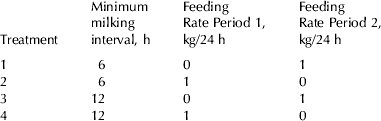
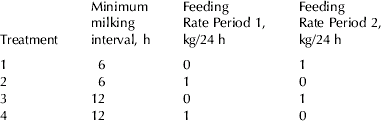
A multi-factorial cross-over (feeding level only) design was used to study the effects of in-bail feeding rate (FR=0 or 1 kg crushed barley/cow per d) and minimum milking interval (MM=6 or 12 h) on cow movement patterns and ease of milking in an automated milking system. Twenty-seven mixed-breed (Friesian, Friesian×Jersey, Jersey and Ayrshire), mixed-age, multiparous lactating dairy cows were allocated to one of the four treatments described in Table 1. The 27 experimental animals were managed as part of a larger herd of, on average, 31 cows (range: 27–41).
Description of treatment: Minimum milking interval and feeding rate of crushed barley. Each feeding rate period lasted 4 weeks
Each treatment was balanced for calving date (23 cows: 7–38 d lactation; 5 cows: 347–376 d lactation at start of data collection period) and breed. The herd had a wide calving spread (approximately 9 weeks) so, in an attempt to reduce the influence of stage of lactation on cow movement patterns, the cows were tested in three groups each starting 1 week after the previous. Cows did not start their treatments until at least 7 d post-calving to allow them to become re-established in the farm system.
A minimum milking interval of 6 h was chosen as this had previously been shown to result in a mean milking frequency of 2·1–2·4 milkings/cow per d during the equivalent stage of the lactation (Jago et al. Reference Jago, Copeman, Bright, McLean, Ohnstad and Woolford2002). The MM12 treatment was expected to result in a milking frequency between 1·0 and 1·5 milkings/cow per d. A feeding rate of 1 kg/cow per d was chosen to minimize the incidence of cows not consuming their full allowance resulting in residual barley being left in the feed bin. Any residual barley in the bin could then be eaten by the next cow to enter the crate – potentially a ‘FR0’ treatment cow.
Farm layout and animal management
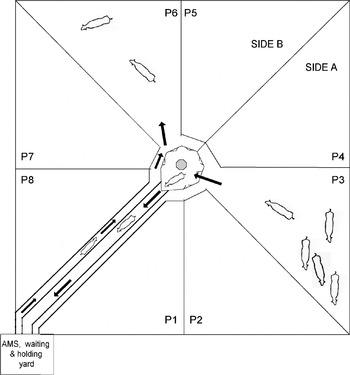
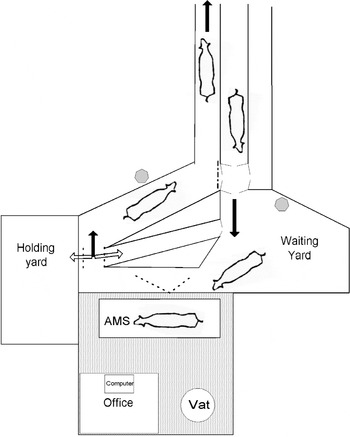
The grazing area consisted of 9·2 ha (effective milking area) and was set up similarly to that described by Jago et al. (Reference Jago, Copeman, Bright, McLean, Ohnstad and Woolford2002) and included a system for remotely selecting cows for milking from pasture (Jago et al. Reference Jago, Bright, Copeman, Davis, Jackson, Ohnstad, Wieliczko and Woolford2004). The farmlet, depicted in Fig. 1, was radially subdivided into eight paddocks, all of which led to the SU. A 200-m dual race system (one lane in, two lanes out) extended between the SU and a small waiting yard adjoining a Fullwood Merlin AMS (Fig. 2). A series of cow-operated one-way gates, positioned at the entrance to the SU and waiting yard along with AMS-controlled automatic gates at the exit from the AMS, were used to control cow traffic. Water was only available in the SU (Fig. 1), the waiting area and at the exit from the AMS (Fig. 2).
The farm layout indicating radial paddock design (paddocks 1–8 indicated by P1, P2 … P8) separated into Side A and Side B, remote selection unit (SU, centre), water placement within the SU and three-way race system (to waiting yard, from AMS to paddock).

Layout and positioning of the Automatic Milking System adjoining a waiting yard, and showing direction of cow flow via the one-way and automatic gate system.

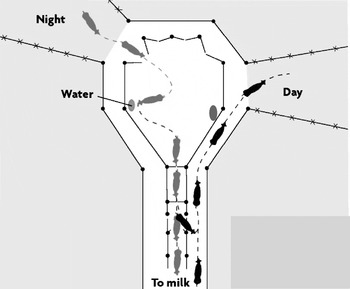
All cows were familiar with the farm layout and had at least 8 months experience using the AMS. Figure 1 shows the location of the SU and grazing areas relative to the AMS. Figure 3 shows the SU configuration. Cows alternated in direction of traffic flow from one side of the farm (night-side) to the other (day-side) twice daily (i.e. cows moved from the day-side to the night-side via the SU from 17·00, at 8·00 any cows that had not left the day-side were moved to the SU, a new section of pasture was made available and from 8·00 cows moved from the night-paddock to the day-paddock via the SU). At change-overs any cows remaining in the previously grazed paddock were manually guided to the selection unit. A rotational grazing system was used in which a fresh area of pasture was offered twice daily to the herd. Temporary electric fences were used to partition the paddocks as depicted in Fig. 1 into smaller allocations of pasture. Daily feed allocation and pasture area were based on visual assessment of pasture cover each week and the number of cows in the herd.
Configuration of remote selection unit (SU) showing entry (from Night or Day paddocks) via one-way gates and automatic diversion either to the dairy for milking or to the paddock. Key: one-way gate, ( ); water trough, (
 ).

Climatic data were obtained from the Ruakura Meterological Station, located approximately 5 km from the experimental site. Average (maximum, minimum) maximum daily temperature was 9·3°C (20·9, −1·83), radiation 15·8 MJ/m2 (30·2, 3·1), rainfall 4·1 ml (15·4, 0·2) and relative humidity was 75% (98, 53).
Implementation of feeding and milking interval treatments
Feeding rates for individual cows were set in the Crystal software (Crystal 0.44, Fullwood Fusion, Willem Alexanderweg 83, 3945 CH Cothen, The Netherlands). After calving and prior to the start of the experiment, all cows were set to a MM of 6 h and received a 1·0-kg/d allowance of crushed barley while they became established in the farm system. The MM and FR were then changed to the appropriate setting for the allocated treatment group at the start of the experiment. The first group of cows began their feeding rate treatment between 8 and 31 d post-calving (340–369 d for 5 carry-over cows) when half the herd had calved allowing herd dynamics to be established prior to the experiment commencing. They remained on this treatment for 4 weeks (1 week settling period, 3 weeks data collection). After 4 weeks the feeding rates were swapped according to Table 1, and cows previously receiving 1 kg crushed barley/cow per d received 0 and vice versa. Cows remained on the second treatment for a further 4 weeks. All lactating cows were grazed as a single herd for the entire experiment. Groups 2 and 3 commenced their feeding rates between 9 and 18 d post-calving.
The minimum milk interval was set in the Crystal software and was derived using production rate and expected yield criteria. Cows entered the SU via cow-operated one-way gates and exited via a computer-controlled pneumatically operated gate at which point they were identified and directed either to the dairy or the paddock depending on the time since their last milking (Fig. 3). The AMS server was programmed to make this decision and it was relayed to the SU with a communication cable laid above ground in alkathene which connected the SU to the AMS server in the dairy. Compressed air was used to drive the exit gates. Cows were fitted with a leg-mounted radio transponder identification device that allowed automatic identification at the SU and in the AMS.
The milking outcome was determined automatically for each milking according to actual yield relative to expected yield (failure, <20% of expected yield harvested; yield carryover, YCO, 20–80% of expected yield harvested; OK, >80% expected yield harvested). A failed milking resulted in the cow being returned to the waiting yard for another milking attempt and was generally caused by one or more cups failing to be attached to the teat (due to udder conformation, cow behaviour or machine problems) or by premature removal of cups. If the milk yield was sufficiently high to result in a YCO or OK outcome then the cow was allowed to return to the paddock on exit from the AMS crate. A YCO outcome resulted in the cow being allowed to return to the dairy earlier than her MM for another milking.
Verification of feeding treatment
The feeding system was calibrated prior to the start of the experiment. The software was set such that while the total feed allowance was 1 kg, the feed offered at a given milking was dependent upon time elapsed since last milking (e.g. a cow milked after 6 h received 250 g at that milking, whereas a cow milked after 12 h received 500 g). Cow observations were carried out over eight 24-h periods using video camera surveillance of the in-bail feeder. To determine the proportion of cows on FR1 that ate their crushed barley allowance and the proportion of FR0 cows which received some left over barley from the previous cow the barley level in the feed bin was recorded before each cow entered the AMS along with whether or not the cow ate during milking. The barley level upon entry to AMS was categorized as: nil <10 grains of barley on the bottom of feed bin; minimal, approximately 20–30 g; or moderate, approximately 75% of the bottom of feed bin covered with barley and equivalent to 200–300 g.
Milking parameters
The following measurements were collected automatically for the experimental period by Crystal (Crystal 0.44, Fullwood Fusion) and Logview, the support software for the Fullwood Merlin AMS (Fullwood Limited, Ellesmere, UK): time and date of each entry into the AMS which was then used to calculate milkings/cow per d, milking outcome (OK, YCO or failure), milk yield (kg) per milking, milk yield per 24 h, cups-on-time (time from attachment of first cup to removal of last cup), and total crate time (duration from identification of cow on entry into the AMS crate until exit following milking).
Visitation frequency to SU
The frequency and destination (returned to paddock or sent to dairy) of all visits to the SU were recorded for six 24-h periods in the second, third and fourth weeks of periods 1 and 2. The time of exit of each cow from the SU was recorded automatically by the computing system (Crystal 0.44, Fullwood Fusion, Holland); however, due to a technical problem with the electronic collection of these data, the number of visits, time of exit and destination for each cow was checked by visual observation. A camera was positioned above the SU and recorded each cow as she exited the SU.
The proportion of the herd that had not moved voluntarily from the paddock grazed previously at 8·00 and 17·00 was recorded daily. The time taken from exiting the SU (for visits resulting in traffic to dairy) to entering the AMS was recorded using a combination of visual observations from the SU video observations and recorded time stamp data when the cow entered the AMS.
Behaviour during milking
The behaviour of cows during milking was determined by observing each cow in the crate two or three times while on each feeding rate. These observations were carried out during times of minimal disturbance in the dairy. The number of leg lifts (each time the cow lifted her leg off the AMS platform) and the number of times the cow placed her leg on the arm of the AMS was recorded using continuous behaviour sampling by direct observation during milking. Recording began when the arm moved in under the cow to prepare for milking and finished when all four cups were removed.
Statistical analysis
Two cows were excluded from the analysis, one due to an injured teat requiring assisted milkings during the initial days following the injury and the second due to poor udder conformation also requiring assistance during cup attachment. All data were analysed using residual maximum likelihood (REML) in Genstat (2002, Genstat for Windows, release 6.1, 6th edition, VSN International Ltd., Oxford, UK). The model included period, group, feed rate, target milkings and interactions between feed rate and target milkings as fixed effects and cow as a random effect. The milking behaviour data were not normally distributed, therefore a square root transformation was applied prior to analysis. An angular transformation was applied to all percentage data because of heterogeneity of variance (ang(%)+arcsine(sqrt(%/100)). All data regarding milking parameters excluded milkings which resulted in a failed outcome since failed cows were automatically returned to the waiting yard for another milking (i.e. only OK and YCO data included).
Results
In-bail feeding observations
Observations of level of barley in the feed bin when cows entered the AMS revealed that there was <10 grains of barley in the hopper when cows entered the AMS for 80% of milkings, a minimal amount (20–30 g) for 15% of milkings and a moderate amount (approximately 200–300 g) for 5% of milkings. This was consistent for both FR0 and FR1 cows.
Cows on the FR1 treatment ate during 95% of their observed milkings. During the remaining 5% of milkings the cows were observed licking the bowl (2%) or not eating (3%). On all of these occasions (7 milkings, 5 cows) the feeder did not drop any barley into the feed bin because the daily allowance had already been consumed at previous milkings which had resulted in a failed attempt to milk the cow. These observations indicate that for 5% of milkings FR0 cows received (and ate) a moderate amount of feed and for a further 15% of milkings enough for a taste. In addition cows were seen to lick the feed bin on 21% of milkings, although no feed was available.
Milking parameters
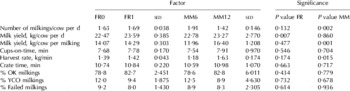
A summary of the milking performance results are presented in Table 2. Feeding rate had no effect on the average number of milkings/d. The average milking interval was 14·72 h and 14·20 h for FR0 and FR1, respectively and 12·56 h and 16·90 h for MM6 and MM12, respectively. Cows receiving a 1-kg allowance of crushed barley/d produced an extra 1·12 kg milk/cow per d (FR0=22·47, FR1=23·59, P=0·007). The higher MM treatment resulted in a decreased number of milkings/cow per d (MM6=1·91, MM12=1·42, P=0·002) and an increased average milk yield/milking (MM6=11·96, MM12=16·40 kg, P=0·001) but no difference in milk yield/cow per d (MM6=22·78, MM12=23·27, P=0·860). No differences were found between the two FR treatments or the two MM treatments for cups-on-time, crate time or the proportion of OK, YCO and failed milkings.
Milking performance as predicted means (OK, >80% expected yield; YCO, 20–80% of expected yield; failed, <20% of expected yield), for two in-bail feeding rates (FR0=0 kg crushed barley/cow per d; FR1=1 kg crushed barley/cow per d) and two minimum milking intervals (MM6 h and MM12 h)

Visitation frequency to AMS and SU
Cow traffic and visitation frequency to the AMS and SU are shown in Table 3. FR significantly affected visits to the selection unit with cows on the FR1 treatment visiting the SU more often per day than when on FR0 treatment (FR0=4·6, FR1=5·46, P=0·02). The minimum milking interval setting also affected the frequency and outcome destination of visits to the SU with cows in MM12 recording more visits to the SU (MM6=4·54, MM12=5·52, P=0·071), but being directed to the dairy less often than MM6 cows (MM6=1·96, MM12=1·47, P=0·019) consequently visits to the AMS were more frequent (MM6=1·91, MM12=1·42, P=0·002). Cows in the MM12 treatment had more visits to the remote SU resulting in being returned to the paddock (MM6=2·58, MM12=4·05, P=0·003). No difference was found between the two FR treatments or the MM treatments for the proportion of cows remaining in the ‘old’ paddock or the average time taken to travel from the SU to the AMS.
Cow traffic parameters and visitation frequency (predicted means) to automated milking system (AMS) and remote selection unit (SU) for cows on two in-bail feeding rates (FR0=0 kg crushed barley/cow per d; FR1=1 kg crushed barley/cow per d) and two minimum milking intervals (MM6 h and MM12 h)

Behaviour during milking
Neither feeding rate nor minimum milking interval influenced the number of leg lifts during milking (raw means: FR0=12·5, FR1=14·4, sed=1·450, P=0·184; MM12=13·1, MM6=13·7, sed=3·167, P=0·847). Very few occasions occurred when the cow placed her leg on the arm.
Discussion
The results show that both in-bail feeding level and machine minimum milk interval settings influenced milking performance and behaviour in extensive pastoral systems using AMS. Reducing feed offered during milking to minimal levels had no effect on daily milking frequency or on behaviour during milking but did result in a decreased daily yield and a reduced frequency of visits to the SU located at pasture away from the AMS and dairy. Restricting access to the dairy and AMS using machine milk interval reduced the daily milking frequency, increased the yield per milking and had no negative effect on daily yield, behaviour during milking or the number of cows having to be moved from the grazing area.
Observations of the level of feed in the bin prior to a cow entering the AMS indicated that the FR0 treatment was in fact low-level intermittent feeding rather than zero feeding. This was because some cows left some of their allowance in the feed bin as they exited the AMS crate. This mostly followed a failed attachment after which the cow was required to exit the AMS before all her feed allocation was consumed. Despite this, the results indicate that the feeding treatments had both a physiological (milk yield) and behavioural effect (visits to the SU) on the cows.
Interestingly, the zero feeding rate did not result in any reduction in visit frequency to the AMS (and therefore milking frequency) within the restrictions placed by the minimum milk interval settings. Nor did the zero feeding rate result in any indication of poorer milking performance (as measured by cups-on-time and crate time) or behaviour in the crate. Poorer behaviour would potentially result in more YCO or failed milkings and more leg lifts and movement during milking. Prescott (Reference Prescott1996) reported that feeding during milking caused cows to move more, making cup attachment more difficult. This was not observed in the present study. Cows on the FR0 treatment were often observed standing further back in the milking crate away from the feed bin.
These results show that it should be possible to operate a near-100% grazing system with automatic milking. The maximum distance cows were required to walk to the dairy (400 m from furthest point on farm) was small in terms of typical farm sizes in New Zealand (average effective area 118 ha, average herd size 322 cows; Livestock Improvement Corporation, 2006). Previous studies show that milking frequency, milk yield and grazing times decrease as walking distance from the grazing area to the dairy increases (Sporndly & Wredle, Reference Sporndly and Wredle2004) although other studies show no effect (Ketelaar-de Lauwere et al. Reference Ketelaar-de Lauwere, Ipema, Lokhorst, Metz, Noordhuizen, Schouten and Smits2000).
The feed level offered to the cows was low (1 kg/cow per d) compared with other studies on automatic milking and extensive grazing systems. More typically 2–7 kg/cow per d are offered during milking in addition to pasture and grass silage. Possibly a higher level of supplementation may have resulted in a stronger effect in terms of incentive to visit and enter the AMS. Pilot studies for this experiment indicated that cows were unable to consume an allocation of more than 2·5 kg during milking. The higher allowances also resulted in more residual feed that might then be consumed by the next cow.
The response rate of 1·12 kg milk to each kg crushed barley fed in this experiment is relatively high for New Zealand pastured cows where an expected response rate of 0·6–0·7 kg milk/kg concentrate is more common (Penno et al. Reference Penno, McGrath, MacDonald, Coulter and Lancaster1999). Response rates are affected by many other variables including the energy balance of the cows and pasture quality and these factors are likely to have influenced the yield response.
Feeding during milking has been shown to have advantages including a more rapid and consistent milk let-down (Svennersten et al. Reference Svennersten, Gorewit, Sjaunja and Uvnas-Moberg1995). The present study showed no change in crate occupancy time or cups on time indicating that there was no clear operational advantage of feeding 1 kg barley/d during milking. All cows received pre-milking udder preparation which consisted of a set of horizontally mounted, counter-rotating teat brushes rolling up and down each teat which served to clean the teats and stimulate milk let down. Pre-milking preparation has been shown to increase milking speed in AMS by 30 s per milking (Jago et al. Reference Jago, Davis, Copeman and Woolford2006a). Any additional effects of feeding do not appear to have been significant.
The cows visited the SU frequently enough to effect a higher milking frequency for the longer minimum milk interval treatment. Had the cows failed to visit the SU regularly the impact of milking settings would have been negated and a lower milking frequency would have been recorded. As expected, cows on the highest setting (12 h) were returned to the paddock more often following a visit than cows on the lower setting. Interestingly the lower (6 h) setting tended to result in a lower number of visits to the SU. This is possibly because the cows spent more time at the dairy or in transit to the dairy or it might reflect a reduced motivation to attend the SU if there was a higher chance that a visit would result in access to pasture being denied. This assumes that access to pasture has a higher reward value than access to the laneway to the AMS. Cows on the restricted treatment (12 h) seemed to have a quicker transit time to the dairy; however, this difference did not reach significance. The transit time reported in this study may be considered long; however, this was not necessarily due to queues of cows waiting for access to the AMS. During the study it was often observed that cows would exit the SU and then stand along the raceway to the waiting yard and ruminate. It is a common behaviour pattern for grazing cows to graze, drink and then ruminate (Kilgour & Dalton, Reference Kilgour and Dalton1984).
The increase in production per milking from cows with restricted access to the dairy was large enough to result in no reduction in daily milk production, attendance dropped almost 0·5 milkings/cow per d when MM settings were increased from 6 to 12 h. The lower milking frequency (resulting from higher MM) appeared to have neither a detrimental nor a beneficial effect on milking speed, crate time or the outcome of milking. Milk harvesting efficiency was significantly improved through a higher harvest rate (kg/min). Efficiency in AMS assumes a higher importance than conventional milk harvesting systems as low harvest rates limit potential production from an AMS when milkings must be distributed over 24 h. Data from this experiment suggests that increasing the milking interval from 12·6 (MM6) to 16·90 h (MM12) would increase the harvest rate allowing more cows to be milked per AMS, increasing overall production yield per AMS. Milk production will decline after about 18 h if milk is not removed from the udder (Woolford et al. Reference Woolford, Copeman, Napper and Phillips1985; Davis et al. Reference Davis, Farr and Stelwagen1999). This suggests that there will be an optimal milking interval for maximizing per cow and per AMS milk yield. The data presented in this study suggest that extending the milk interval 4·5 h to just over 17 h between consecutive milkings is more efficient both in terms of performance per cow and AMS harvest rate, than targeting a shorter 12-h interval.
Several potential advantages arise from targeting a longer minimum milking interval other than a higher ratio of cows to each AMS and a higher milk harvest per AMS. For example, a more consistent milking interval can be attained and therefore more even use of the AMS throughout the year. Pasture availability will vary when grazing and this has been shown to influence milking frequency (Ketelaar-de Lauwere et al. Reference Ketelaar-de Lauwere, Ipema, Lokhorst, Metz, Noordhuizen, Schouten and Smits2000). Jago et al. (Reference Jago, Copeman, Bright, McLean, Ohnstad and Woolford2002) reported that in a grazing system the number of visits to the AMS ranged from 1·5–2·7 visit/cow per d and that milking frequency decreased as the lactation increased (Jago et al. Reference Jago, Davis, Wieliczko and Woolford2006b). If cows were allowed to access the AMS less often (minimum 12-h interval between visits) they might be more willing to walk the distance to the AMS, particularly if a supplementary ration were available during milking, than if they were regularly directed to the AMS each time they passed through the SU. The data from this study provided some evidence in support of this hypothesis. Cup attachment may also be improved with a longer minimum milking interval (MM). When set at 6 h the possible range in time interval between milkings is 6–24 h. When set at 12 h the range is shorter, 12–24 h, therefore reducing the potential for large changes in udder shape from milking to milking. The outcomes of this study did not support an advantage of an extended milking interval in terms of operational milking performance.
This study has shown that automatic milking can be combined successfully within an extensive grazing dairy farm system with extremely low levels of concentrate supplementation when a milking frequency of less than twice per day is desired. Further the results demonstrate that remote selection and machine settings restricting access to the AMS and dairy are tools for maximizing milk output per AMS by increasing the ratio of cows to AMS and increasing milk harvest rate.
The results indicate that a daily allowance of concentrate in the AMS crate may not provide a large incentive for cows to report to the dairy for milking. The data showed that a low quantity intermittent feeding schedule, in an AMS under New Zealand conditions, would be a practical option when higher levels of concentrate feeding was not financially viable. This study indicates that there were no adverse effects of the low intermittent feeding level on milk ejection, speed of cup-attachment or AMS visitation frequency. It is important to note that there was a reasonable production increase from those cows fed a 1-kg/d allowance of crushed barley. The lower milking frequency resulting from the higher MM indicated a potential to maximize efficiency of the AMS units by maximizing the number of cows milked through one AMS with reduced milking frequencies and little or no reduction in milk production/cow per d.
This study was part of a programme of research funded by the New Zealand Foundation for Research, Science and Technology (Contract No. DRCX0201), the New Zealand Dairy Industry Global Programme (Contract No. B1491.2) and latterly Dairy Insight (Contract No. 10080). The authors acknowledge the support of Sensortec Ltd (New Zealand) and Fullwood Ltd (UK) who supplied the automated milking system used in this research.