Introduction
Major depressive disorder (MDD) is one of the leading causes of the global disability burden (GBD 2017 Disease and Injury Incidence and Prevalence Collaborators, 2018). Pharmacotherapy for MDD has been established, mainly including tricyclic antidepressants (TCAs), monoamine oxidase inhibitors (MAOIs), selective serotonin reuptake inhibitors (SSRIs) and serotonin and norepinephrine reuptake inhibitors (SNRIs). During acute phase treatment, these antidepressants exhibit similar levels of efficacy (Cipriani et al., Reference Cipriani, Furukawa, Salanti, Chaimani, Atkinson, Ogawa and Geddes2018; Trivedi et al., Reference Trivedi, Rush, Wisniewski, Nierenberg, Warden, Ritz and Team2006). However, because MDD has a high relapse/recurrence rate after successful acute-phase treatment, continuation and maintenance treatment is recommended to reduce relapse and recurrence rates. According to the guidelines, patients with a first episode should continue the same drug used in the acute phase for at least 6 months. For patients with recurrent depression, antidepressants should be maintained for at least 3 years or even a lifetime (Bauer, Severus, Moller, & Young, Reference Bauer, Severus, Moller and Young2017).
In clinical practice, it is critical to determine how long antidepressants should be continued and which drugs more effectively prevent relapse. Previous meta-analyses have addressed this issue. Geddes et al. (Reference Geddes, Carney, Davies, Furukawa, Kupfer, Frank and Goodwin2003) calculated the odds ratio (OR) as the effect size, indicating that an average of 18% of patients in the active arm relapsed, while 41% of patients in the placebo arm relapsed. A more recent meta-analysis using the risk ratio (RR) as the effect size also concluded that antidepressants were more effective at preventing relapse or recurrence than the placebo (Sim, Lau, Sim, Sum, & Baldessarini, Reference Sim, Lau, Sim, Sum and Baldessarini2015). Although time-to-event data can be analysed as dichotomous data (with the RR or OR as the effect size), the best method to analyse these data is to conduct a survival analysis with the hazard ratio (HR) as the effect size (Higgins & Green, Reference Higgins and Green2011).
The hazard describes an instantaneous risk that may change over time. The proportional hazards assumption, which assumes that the HR is constant over time, is the precondition for a traditional meta-analysis using the HR as the effect size. However, this assumption may often be violated, particularly when survival curves intersect (Ouwens, Philips, & Jansen, Reference Ouwens, Philips and Jansen2010). Moreover, survival distributions are generally based on scale and shape parameters, but the traditional pooled method only uses one parameter (scale parameter) to estimate the effect size. Ouwens et al. (Reference Ouwens, Philips and Jansen2010) proposed a method based on parametric survival curves, which has overcome the aforementioned limitations. This method allows researchers to more accurately estimate treatment effects based on time-to-event data. Thus, we performed this pooled analysis of parametric survival curves to study the prophylactic effect of antidepressant medicines (ADMs) on adult patients with MDD.
Methods
This study was registered with PROSPERO under number CRD42019146577.
Search strategy and selection criteria
ZL and XC searched PubMed, the Cochrane Central Register of Controlled Trials, Embase and Web of Science on 4 July 2019. No time limit was applied. The search strategy is presented in detail in online Supplementary Appendix S1. We also screened the reference lists of previous meta-analyses and all included studies. English language articles published or accepted in peer-reviewed journals were included. ZL and XC independently screened the references, abstracts and full texts obtained from the primary search, and any discrepancies were discussed with other members of the research team.
Generally, relapse refers to a return of the current depressive episode after remission; recurrence refers to the development of a new depressive episode after recovery (the patient is asymptomatic for at least 6 months). The aim of continuation treatment is to prevent relapse, while the aim of maintenance treatment is to prevent recurrence (Frank et al., Reference Frank, Prien, Jarrett, Keller, Kupfer, Lavori and Weissman1991). Randomized controlled trials (RCTs) investigating the prevention of relapse or recurrence were included. If not specified, we used the term ‘relapse’ to denote any period when a patient is symptomatic again after remission for convenience.
Adults (⩾18 years old) who were diagnosed with MDD according to acknowledged criteria and who achieved clinical remission or a response after the acute phase or recovery after the continuation phase were enrolled. Studies including patients with bipolar depression were excluded. Studies examining depression in older adults (mean age older than 60 years old), depression in children/adolescents, pre- or postpartum depression and depression secondary to physical disease or other mental disorders were excluded. Antidepressant monotherapy, including TCAs, SSRIs, SNRIs, MAOIs, noradrenaline and dopamine reuptake inhibitors (NDRIs), selective noradrenaline reuptake inhibitors (NARIs), melatonin receptor agonists or other classes of drugs, were used in the acute phase of treatment. Patients were randomized to the intervention group (continuing the same ADM) or placebo group after clinical response or remission. The trial duration should be at least 4 months. Studies in which patients switched to a different drug after the acute or continuation phase were excluded. Studies comparing different dosage regimens of antidepressants without a placebo control were excluded. The primary outcomes were the relapse-free survival rate and mean relapse-free months. Survival curves or the numbers of events at each time interval were reported or were able to be calculated from the reported information. Studies without the information needed for the analysis were excluded. Open-label, single-blind and double-blind RCTs were included.
Data extraction and quality assessment
LS and QXL independently extracted data from the eligible studies using a predefined form. The data extracted were the study characteristics (such as the surname of the first author, publication year, blinding method and sponsorship), participant characteristics (such as the sex ratio, mean age, diagnostic criteria and acute and continuation phase durations), intervention details (such as the specific drug names and dosages of antidepressants) and outcome measures (number of patients experiencing relapse in each arm, total number of patients in each arm and relapse definition). The Kaplan–Meier curves reported in the articles were digitized using GetData Graph Digitizer 2.25. The assessment of the risk of bias was performed according to the Cochrane Handbook 5.1.0 (Higgins & Green, Reference Higgins and Green2011).
Statistical analysis
The method described by Guyot, Ades, Ouwens, and Welton (Reference Guyot, Ades, Ouwens and Welton2012) was used to reconstruct individual patient data based on a digitized survival curve, which was used for the survival analysis. Bayesian analyses were conducted with WinBUGs (version 1.4.3). First, we compared four models with Weibull, Gompertz, log-logistic and log-normal distributions, both with fixed- and random-effect models. These models were adapted from the model proposed by Ouwens et al. (Reference Ouwens, Philips and Jansen2010). Flat priors were used for all parameters. The Deviance Information Criterion (DIC) was used to compare the models (Dias, Welton, Sutton, & Ades, Reference Dias, Welton, Sutton and Ades2014), and we chose the model with the lowest DIC value for the subsequent analyses. Posterior statistics of the scale and shape parameters were based on 100 000 iterations with a burn-in of 50 000. The Markov Chain Monte Carlo (MCMC) approach was used with two chains with different initial values. R software (version 3.5.3) was used to calculate the HR, hazard rate, relapse-free survival rate, mean relapse-free months and surface under the cumulative ranking curve (SUCRA). The SUCRA was calculated based on the survival proportions and mean survival over time (Cope & Jansen, Reference Cope and Jansen2013). The posterior statistics of the scale and shape parameters of ADM were added to an average parameter of the placebo to estimate the relapse-free survival rate. The method proposed by Jansen and Cope (Reference Jansen and Cope2012) was used to explore the potential heterogeneity by considering the covariate of whether a trial included a continuation phase before randomization. The ‘ggplot2’ package in R was used to visualize the results.
Results
Characteristics of included studies
Thirty-seven relevant RCTs were included in the predefined analysis (Amsterdam & Bodkin, Reference Amsterdam and Bodkin2006; Boulenger, Loft, & Florea, Reference Boulenger, Loft and Florea2012; Coppen et al., Reference Coppen, Ghose, Montgomery, Rama Rao, Bailey and Jorgensen1978; Dalery, Dagens-Lafont, & De Bodinat, Reference Dalery, Dagens-Lafont and De Bodinat2001; Davidson & Raft, Reference Davidson and Raft1984; Dobson et al., Reference Dobson, Hollon, Dimidjian, Schmaling, Kohlenberg, Gallop and Jacobson2008; Durgam, Chen, Migliore, Prakash, & Thase, Reference Durgam, Chen, Migliore, Prakash and Thase2019; Durgam et al., Reference Durgam, Gommoll, Migliore, Chen, Chang, Aguirre and Thase2018; Feiger et al., Reference Feiger, Bielski, Bremner, Heiser, Trivedi, Wilcox and Archibald1999; Gilaberte et al., Reference Gilaberte, Montejo, de la Gandara, Perez-Sola, Bernardo and Massana2001; Goodwin, Boyer, Emsley, Rouillon, & de Bodinat, Reference Goodwin, Boyer, Emsley, Rouillon and de Bodinat2013; Hochstrasser et al., Reference Hochstrasser, Isaksen, Koponen, Lauritzen, Mahnert, Rouillon and Nil2001; Kamijima, Burt, Cohen, Arano, & Hamasaki, Reference Kamijima, Burt, Cohen, Arano and Hamasaki2006; Kasper, Volz, Moller, Dienel, & Kieser, Reference Kasper, Volz, Moller, Dienel and Kieser2008; Keller et al., Reference Keller, Kocsis, Thase, Gelenberg, Rush, Koran and Harrison1998, Reference Keller, Ruwe, Janssens, Sitsen, Jokinen and Janczewski2005; Kocsis et al., Reference Kocsis, Thase, Trivedi, Shelton, Kornstein, Nemeroff and Keller2007; Liebowitz et al., Reference Liebowitz, Lam, Lepola, Datto, Sweitzer and Eriksson2010; McGrath et al., Reference McGrath, Stewart, Quitkin, Chen, Alpert, Nierenberg and Petkova2006; Montgomery & Dunbar, Reference Montgomery and Dunbar1993; Montgomery et al., Reference Montgomery, Dufour, Brion, Gailledreau, Laqueille, Ferrey and Pierredon1988; Montgomery, Entsuah, Hackett, Kunz, & Rudolph, Reference Montgomery, Entsuah, Hackett, Kunz and Rudolph2004; Montgomery, Rasmussen, & Tanghoj, Reference Montgomery, Rasmussen and Tanghoj1993; Perahia et al., Reference Perahia, Gilaberte, Wang, Wiltse, Huckins, Clemens and Detke2006, Reference Perahia, Maina, Thase, Spann, Wang, Walker and Detke2009; Rickels et al., Reference Rickels, Montgomery, Tourian, Guelfi, Pitrosky, Padmanabhan and Brisard2010; Robert & Montgomery, Reference Robert and Montgomery1995; Robinson et al., Reference Robinson, Lerfald, Bennett, Laux, Devereaux, Kayser and Albright1991; Rosenthal, Boyer, Vialet, Hwang, & Tourian, Reference Rosenthal, Boyer, Vialet, Hwang and Tourian2013; Rouillon, Warner, Pezous, & Bisserbe, Reference Rouillon, Warner, Pezous and Bisserbe2000; Shiovitz, Greenberg, Chen, Forero, & Gommoll, Reference Shiovitz, Greenberg, Chen, Forero and Gommoll2014; Simon, Aguiar, Kunz, & Lei, Reference Simon, Aguiar, Kunz and Lei2004; Terra & Montgomery, Reference Terra and Montgomery1998; Thase, Nierenberg, Keller, Panagides, & Relapse Prevention Study, Reference Thase, Nierenberg, Keller and Panagides2001; Versiani, Mehilane, Gaszner, & Arnaud-Castiglioni, Reference Versiani, Mehilane, Gaszner and Arnaud-Castiglioni1999; Weihs et al., Reference Weihs, Houser, Batey, Ascher, Bolden-Watson, Donahue and Metz2002). A flowchart of the screening process is presented in online Supplementary Appendix S2. Survival curves were reported in 32 studies. For the other five studies, event numbers at each time interval were reported or calculated from the figures presented in the original articles. Sixteen classes of ADM (24 drugs in total), including a TCA (amitriptyline), MAOIs (selegiline and phenelzine), SSRIs (citalopram, sertraline, fluoxetine, paroxetine and fluvoxamine), SNRIs (venlafaxine, desvenlafaxine, duloxetine, milnacipran and levomilnacipran), a 5-HT1A agonist (gepirone), second-generation antipsychotics (SGA and quetiapine), hypericum extract, an α2-antagonist (mirtazapine), a NARI (reboxetine), a NDRI (bupropion), a 5-HT reuptake enhancer (tianeptine), a melatonin (MT) receptor agonist (agomelatine), a multimodal drug (vortioxetine), an SSRI plus 5-HT1A agonist (vilazodone) and a serotonin receptor antagonist and reuptake inhibitor (SARI, nefazodone), were investigated. The most commonly investigated antidepressant classes were SSRIs (29.7%) and SNRIs (27.0%). Seventeen studies (45.9%) included a continuation phase before randomization, while 20 studies (54.1%) did not. The continuation period varied across studies, ranging from 4 weeks to 6 months. All included trials were double-blinded RCTs. Only four trials (10.8%) had follow-up periods lasting more than 1 year, while most studies (89.2%) had follow-up periods ⩽1 year. The characteristics of the included studies are presented in online Supplementary Appendix S3. Twelve studies (32.4%) were assessed as having a high risk of bias (online Supplementary Appendix S4).
Additionally, three RCTs that randomized patients after the long-term maintenance phase were included in the post hoc analysis (Bialos, Giller, Jatlow, Docherty, & Harkness, Reference Bialos, Giller, Jatlow, Docherty and Harkness1982; Keller et al., Reference Keller, Trivedi, Thase, Shelton, Kornstein, Nemeroff and Ninan2007; Kupfer et al., Reference Kupfer, Frank, Perel, Cornes, Mallinger, Thase and Grochocinski1992). These studies were analysed separately. The characteristics of these studies are also described in online Supplementary Appendix S3. Thus, 40 studies were included in this study.
Pooled analyses of parametric survival curves
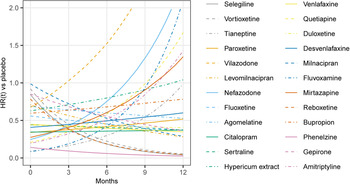
The model with the Gompertz distribution had the lowest DIC value (see online Supplementary Appendix S5 for a comparison of the models). Therefore, subsequent analyses were conducted using the Gompertz model. ADM had a higher hazard rate at the initial point, which gradually decreased over time and subsequently reached a relatively steady phase (online Supplementary Appendix S6). The HR of the ADM v. the placebo was approximately 0.5. The HR for each ADM with a 95% credibility interval is illustrated in online Supplementary Appendix S7. Compared with placebo, the HRs of several drugs (vilazodone, nefazodone, quetiapine, mirtazapine, amitriptyline, fluvoxamine, hypericum extract and tianeptine) became closer to 1 over time and crossed the invalid line (HR = 1) before 12 months. The HRs of paroxetine, desvenlafaxine and bupropion approached 1 over time, but they remained superior to the placebo within 1 year. Other antidepressants (selegiline, vortioxetine, levomilnacipran, fluoxetine, agomelatine, citalopram, sertraline, venlafaxine, duloxetine, milnacipran, reboxetine, phenelzine and gepirone) were continuously superior to placebo over time (Fig. 1).
The trajectories of HRs of antidepressants v. the placebo over time.

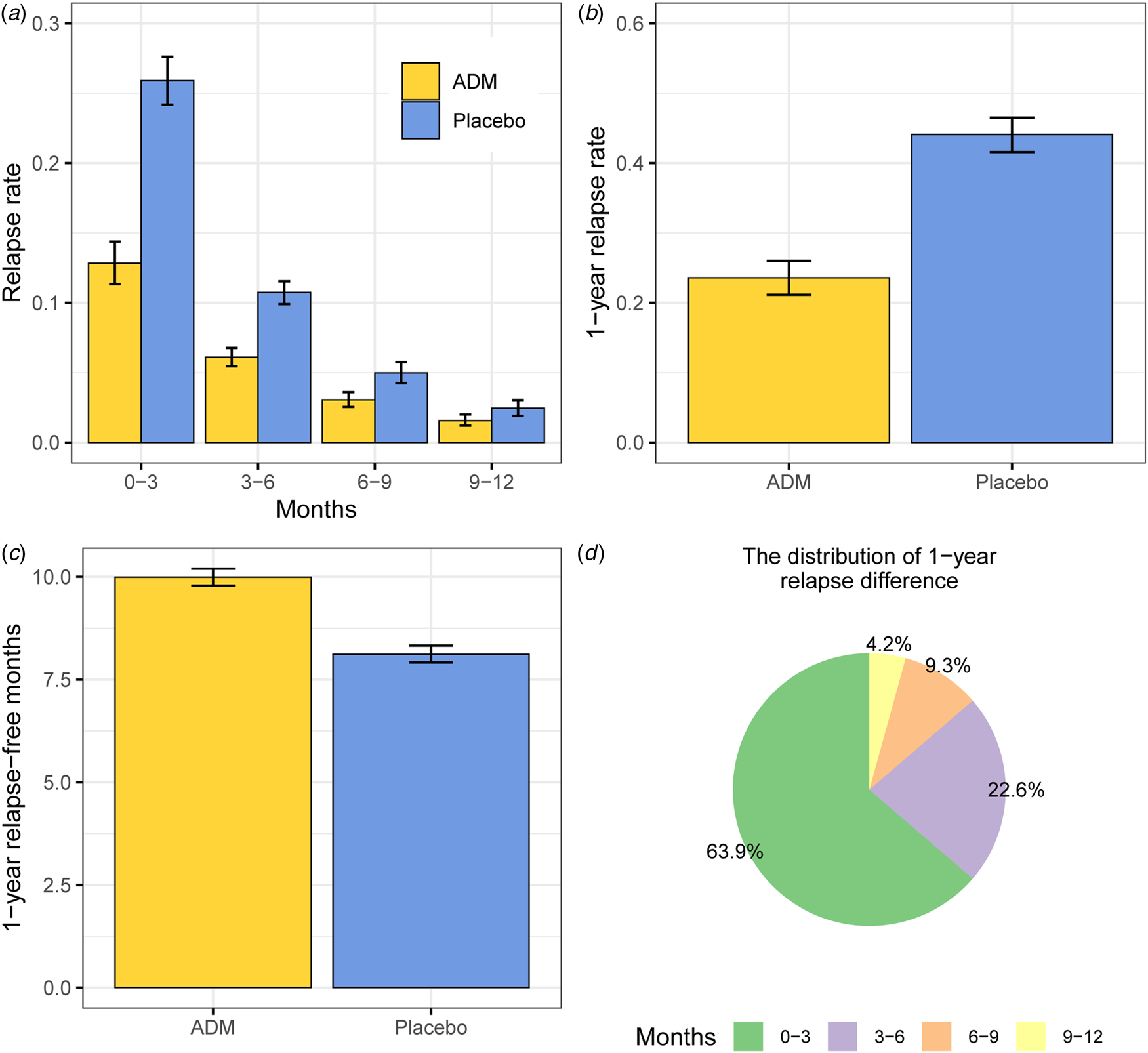
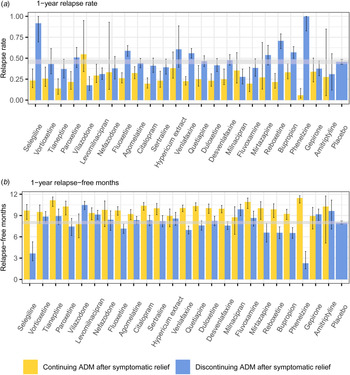
The 1-year relapse-free rate of the ADM group was approximately 76% (relapse rate 24%), while the value of the placebo group was approximately 56% (relapse rate 44%) (online Supplementary Appendix S6 and Fig. 2). The mean relapse-free months in the ADM group was 10 months, while the value of the placebo group was 8 months within a 1-year period (Fig. 2). The differences in the 1-year relapse rate and 1-year relapse-free months between the ADM and placebo groups were significant (95% credibility intervals did not overlap) (Fig. 2). However, most of the difference in the 1-year relapse rate between the ADM and placebo groups occurred early (63.9% in the first 3 months and 86.5% in the first 6 months) (Fig. 2). The 1-year relapse-free survival and mean relapse-free months for each antidepressant are presented in Fig. 3, showing that most drugs were significantly better than the placebo. The relapse-free survival curve for each ADM is presented in online Supplementary Appendix S7. The SUCRAs according to the relapse-free proportions and mean relapse-free months changed over time (online Supplementary Appendix S8). We also compared the 1-year relapse rates and mean relapse-free months in the placebo arms after patients discontinued different ADMs (Fig. 3).
Relapse rate and relapse-free months for ADM and the placebo. (a) Relapse rate every 3 months; (b) 1-year relapse rates of the ADM and placebo groups; (c) 1-year mean relapse-free months of the ADM and placebo groups; (d) the distribution of the difference in the 1-year relapse rates. Error bars represent the 95% credibility intervals. ADM, antidepressant medicine.

One-year relapse rates and relapse-free months for each ADM. (a) One-year relapse rates in the groups continuing or discontinuing ADM after symptomatic relief; the placebo indicates the mean 1-year relapse rate after the discontinuation of ADM; (b) 1-year mean relapse-free months in the groups continuing or discontinuing ADM after symptomatic relief; the placebo indicates the mean 1-year relapse-free months after the discontinuation of ADM. Error bars represent the 95% credibility intervals. ADM, antidepressant medicine.

Subgroup analysis
A subgroup analysis was conducted based on whether a trial included a continuation phase before randomization. We calculated the average scale and shape parameters of the placebo for studies with or without a continuation phase. Regarding the 1-year relapse rate and mean relapse-free months, no significant differences were observed between the two subgroups. However, discontinuing ADM after the maintenance phase resulted in a higher relapse rate and fewer relapse-free months, while continuing ADM after the maintenance phase resulted in a lower relapse rate and a greater number of relapse-free months (Fig. 4 and online Supplementary Appendix S6). A longer continuation phase did not result in a lower relapse rate after discontinuation (online Supplementary Appendix S9).
One-year relapse rates and mean relapse-free months of the ADM and placebo groups randomized after the acute phase, continuation phase and maintenance phase. Error bars represent the 95% credibility intervals. ADM, antidepressant medicine.

Sensitivity analyses
The first sensitivity analysis was conducted by only including trials with a follow-up period of at least 6 months. Two trials were excluded (Davidson & Raft, Reference Davidson and Raft1984; Kamijima et al., Reference Kamijima, Burt, Cohen, Arano and Hamasaki2006). The 1-year relapse-free rate of the ADM group was approximately 78% (relapse rate 22%), while the rate of the placebo group was approximately 56% (relapse rate 44%). Similarly, most differences in relapse rates (86.2%) occurred in the first 6 months. The results were similar to the primary analysis (online Supplementary Appendix S10). The second sensitivity was conducted by only including trials of patients with recurrent depression. Twenty-two studies were included, and the results were also similar to the primary analysis (online Supplementary Appendix S11). The third sensitivity analysis was conducted by only including trials that randomized patients after a continuation phase of at least 6 months. Only three studies were included (Gilaberte et al., Reference Gilaberte, Montejo, de la Gandara, Perez-Sola, Bernardo and Massana2001; Kocsis et al., Reference Kocsis, Thase, Trivedi, Shelton, Kornstein, Nemeroff and Keller2007; Perahia et al., Reference Perahia, Maina, Thase, Spann, Wang, Walker and Detke2009). The ADM remained significantly superior to the placebo (online Supplementary Appendix S12).
Discussion
To the best of our knowledge, this pooled analysis of parametric survival curves is the first to address this clinical issue. Obviously, most HR curves were not constant over time, violating the proportional hazards assumption. Therefore, the method based on parametric survival curves instead of the conventional method using constant HRs and dichotomous outcomes (ORs and RRs) was more appropriate. HRs, relapse-free proportions and mean relapse-free months were calculated, providing more comprehensive evidence regarding the prevention of an MDD relapse. Although ADM was significantly better than the placebo in the present study, the prophylactic efficacy of ADM was likely to be overestimated (see discussion below). Additionally, our results provided several pieces of evidence that were different from the findings of previous meta-analyses: (a) most of the difference in 1-year relapse rates between ADM and placebo occurred in the first 3 months (63.9%) and the first 6 months (86.5%); (b) HRs of several antidepressants v. the placebo showed clear increasing trends, such as vilazodone, nefazodone, quetiapine, fluvoxamine, amitriptyline, mirtazapine, hypericum extract and tianeptine. The HRs of these drugs v. placebo crossed the invalid line (HR = 1) over time; and (c) the 1-year relapse-free survival rate in the ADM arm was 75% for the subgroup of trials employing randomization after the acute phase, 78% for the subgroup of trials employing randomization after the continuation phase and 93% for the subgroup of trials employing randomization after the maintenance phase, suggesting that the relapse risk may decrease over time if patients adhere to ADM treatment. These results are worth discussing and might provide insights into this clinical issue.
Does the difference between ADM and placebo represent the true prophylactic effect of ADM?
We only included studies in which patients were randomized to discontinuing or continuing the same ADM previously used to achieve clinical remission to address the clinical issues of whether the same ADM should be continued and how long it should be continued. In these studies with enrichment designs, the placebo is not only a usual placebo condition but also contains a disadvantage factor (discontinuation from prior ADM) at randomization. Most of the differences observed between ADM and the placebo occurred in the first month after randomization (Rapaport, Bose, & Zheng, Reference Rapaport, Bose and Zheng2004). This result might be attributed to the acute withdrawal effect. The symptoms after discontinuing ADM may appear to be depressive (Warner, Bobo, Warner, Reid, & Rachal, Reference Warner, Bobo, Warner, Reid and Rachal2006). Additionally, most of the differences occurred in the first 6 months after randomization, which may be due to a protracted withdrawal effect (El-Mallakh & Briscoe, Reference El-Mallakh and Briscoe2012). Our results consistently showed that most differences in relapse occurred early, with 63.9% occurring in the first 3 months and 86.5% occurring in the first 6 months. These results supported the hypothesis that the difference between ADM and the placebo may include the withdrawal effect.
Compared with acute-phase studies, the blinding of individuals might be more difficult in relapse prevention studies. All studies used an enrichment design, and patients were more likely to realize that they were receiving the placebo because they had taken the ADM for several weeks before randomization and may have experienced adverse events due to ADM withdrawal. Although all RCTs claimed that they were double-blinded, specific descriptions of the blinding method were absent in most studies. The proportion of unblinding was positively associated with the treatment effect (Baethge, Assall, & Baldessarini, Reference Baethge, Assall and Baldessarini2013). Similarly, patients are more likely to experience a relapse if they knew that they received the inactive placebo, which may bias the true prophylactic effect of ADM. Therefore, the difference between ADM and the placebo may be the result of the true ADM prophylactic effect, the withdrawal effect (including acute and protracted effects) and the consequences of unblinding. In other words, the prophylactic effect of ADM observed in studies with enrichment designs was likely to be overestimated because of the withdrawal effect and unblinding.
Should ADM be continued after symptomatic relief?
Patients with MDD who achieve remission after the acute phase still have an unresolved and higher level of core symptoms compared with patients who achieve recovery, which might contribute to future relapse (Conradi, Ormel, & de Jonge, Reference Conradi, Ormel and de Jonge2012). Nearly all RCTs and previous meta-analyses consistently reported a significantly lower relapse rate than the placebo in patients continuing ADM therapy. According to Williams, Simpson, Simpson, and Nahas (Reference Williams, Simpson, Simpson and Nahas2009), the 1-year relapse rate was 23% for ADM and 51% for the placebo. As shown in the study by Sim et al. (Reference Sim, Lau, Sim, Sum and Baldessarini2015), the average relapse rate of patients taking ADM was 23.3%, and ADM significantly reduces the risk of relapse (RR = 1.9 or 2.03). Consistent with these findings, the 1-year relapse rate was 24% for patients taking ADM and 44% for patients taking the placebo in our study. The HR of ADM v. the placebo was approximately 0.5, similar to previous studies. Both the relapse-free survival rate and mean relapse-free months were significantly better for ADM. These results supported the continuation of ADM after symptomatic relief. However, based on our results, most of the difference in relapse occurred in the first 6 months, and the difference between ADM and the placebo became much smaller after 6 months.
Does continuous ADM treatment prevent a new episode after 6 months?
Previous studies also noted that most relapses occurred in the first 6 months after randomization (El-Mallakh & Briscoe, Reference El-Mallakh and Briscoe2012; Ghaemi & Selker, Reference Ghaemi and Selker2017). Because the natural history of MDD is approximately 6–12 months, the first 6 months after randomization was likely within the natural course of the previous episode (Ghaemi & Selker, Reference Ghaemi and Selker2017). Thus, ADM may only prevent relapse within 6 months but exerts little prophylactic effect on recurrence (a new episode after recovery). Alternatively, ADM may only prevent the withdrawal effect, and the effect on preventing a new episode is less clear (El-Mallakh & Briscoe, Reference El-Mallakh and Briscoe2012). Compared with the placebo, the HRs of vilazodone, nefazodone, quetiapine, fluvoxamine, amitriptyline, mirtazapine, hypericum extract and tianeptine showed clear increasing trends and crossed the invalid line (HR = 1) over time. Thus, these drugs may not provide invariable prophylactic effects over time. Patients may recover from the previous episode, and the effect of drug withdrawal fades after 6 months, which may explain why these drugs became ineffective over time. In other words, these drugs do not appear to prevent further recurrence. However, other drugs, of which the HRs were nearly constant or showed a decreasing trend over time, may be effective at preventing recurrence. We should remember that a few trials followed patients for more than 1 year. Thus, the trajectory of HRs was less robust after 1 year and remains undetermined for a longer time (such as for 5 or 10 years). Further studies are needed.
What is the optimal time point for ADM withdrawal?
The 1-year relapse rate in the placebo arm was comparable between the subgroups of trials randomizing patients after the acute phase and continuation phase, while the highest relapse rate in the placebo arm was observed for studies randomizing after the maintenance phase. These results appear to support the hypothesis that longer exposure to ADM may increase the relapse risk after discontinuation (El-Mallakh & Briscoe, Reference El-Mallakh and Briscoe2012). Prolonged ADM treatment may lead to plastic changes in neurons (reducing dendritic arborization), which may increase the relapse risk after discontinuation (El-Mallakh & Briscoe, Reference El-Mallakh and Briscoe2012). However, this result should be interpreted with caution because only three studies randomizing patients after the maintenance phase were included. On the other hand, for the placebo arm, ADM was discontinued abruptly or tapered over several weeks in all included trials. No significant difference was observed between gradual and abrupt discontinuation in a previous study (Viguera, Baldessarini, & Friedberg, Reference Viguera, Baldessarini and Friedberg1998). We inferred that ADM withdrawal in a short time was associated with an increased relapse risk compared with the continuation of ADM, regardless of randomization after the acute phase, continuation phase or maintenance phase. Patients with longer ADM exposure were likely to be more sensitive to ADM withdrawal in a short time. An alternative strategy for ADM withdrawal may be safer than discontinuing abruptly or tapering over several weeks. For example, ADM withdrawal supported with mindfulness-based cognitive therapy was reported to be as effective as continuing antidepressants (Kuyken et al., Reference Kuyken, Hayes, Barrett, Byng, Dalgleish, Kessler and Byford2015). Further studies are needed.
Which is the best drug for relapse prevention?
The relapse rate of continuing phenelzine was the lowest, but the highest relapse rate was observed after discontinuing phenelzine (Fig. 3). Although continuing vilazodone failed to result in better outcomes than the placebo, discontinuing vilazodone after symptomatic relief resulted in the lowest relapse rate. A potential explanation for these findings is that the effect after discontinuing an effective drug may be much greater than the effect after discontinuing an ineffective drug. SUCRAs were calculated to provide a hierarchy for relapse prevention. However, SUCRAs were not constant and intersected over time, suggesting that the prophylactic effects of ADMs may vary over time. Obviously, for the drug with an upward HR curve crossing the invalid line (HR = 1) over time, the SUCRA curves showed a decreasing trend, suggesting that this drug may only prevent earlier relapse or the withdrawal effect, but was ineffective at preventing recurrence. These drugs may not be suitable for long-term use. The drug with an upward SUCRA curve and a downward HR curve may exert less of a prophylactic effect on earlier relapse or less of a withdrawal effect, but was effective at preventing recurrence. The drug with nearly constant HR and SUCRA curves may exert comparable effects on earlier relapse and subsequent recurrence.
Limitations
The present study has some limitations. First, only a few trials included a follow-up period of longer than 1 year, resulting in wider credibility intervals after 1 year. As mentioned above, the trajectory of HRs for a longer time remains undetermined. Second, only three studies were included that randomized patients after the maintenance phase, and the estimates obtained after the long-term maintenance phase were less robust than the estimates obtained after the acute or continuation phase. Third, most trials only recruited patients with recurrent depression, although a few trials included some proportions of patients experiencing a first episode. The results of the sensitivity analysis conducted by only including trials with recurrent depression were comparable to the primary analysis, suggesting that our results were relatively robust for patients with recurrent depression. However, no trial recruited only patients experiencing a first episode. Thus, our results may not be applicable to patients experiencing a first episode. Fourth, our results should be interpreted with caution because limited numbers of studies were included.
Conclusions
Although the relapse-free survival rate and mean relapse-free months of ADM were significantly better than the placebo, most differences in relapse occurred in the first 6 months, which may be explained because almost all included trials used an enriched randomized discontinuation design. The prophylactic efficacy of ADM was not constant over time and the efficacy for preventing new episodes after 6 months was questionable. These findings might have implications for clinical practice and inspire future research.
Supplementary material
The supplementary material for this article can be found at https://doi.org/10.1017/S0033291720001610.
Financial support
This research received no specific grant from any funding agency, commercial or not-for-profit sectors.
Conflict of interest
None.