Introduction
There has been much interest in the impact of maternal mental illness on mother–infant interactions and child outcome. Maternal depression, for example, has been associated with reduced maternal sensitivity, especially in samples where there is high social adversity (Murray et al. Reference Murray, Halligan, Cooper, Bremner and Wachs2010). Goodman & Brumley (Reference Goodman and Brumley1990) found that in a high-risk community sample, women with schizophrenia showed poorer quality interactions compared with women with depression. Some studies of women admitted to psychiatric mother and baby units (MBUs) (Hipwell & Kumar, Reference Hipwell and Kumar1996; Riordan et al. Reference Riordan, Appleby and Faragher1999; Wan et al. Reference Wan, Salmon, Riordan, Appleby, Webb and Abel2007) found that women with schizophrenia showed poorer-quality interactions compared with women with affective disorders. However, Kenny et al. (Reference Kenny, Conroy, Pariante, Seneviratne and Pawlby2013) found no differences between different diagnostic groups in their sample. Snellen et al. (Reference Snellen, Mack and Traner1999) compared mother–infant interactions at admission and discharge in women with schizophrenia who had been admitted to a psychiatric MBU with their infants. At admission, poor quality interactions were associated with positive symptoms, which improved over time. At discharge, poor-quality interactions were associated with negative symptoms, which had shown less improvement. Other clear clinical correlates of mother–infant interactions in schizophrenia have been hard to establish (Wan et al. Reference Wan, Salmon, Riordan, Appleby, Webb and Abel2007), although Wan et al. (Reference Wan, Penketh, Salmon and Abel2008) did report less infant-directed speech in mothers with schizophrenia v. mothers with affective disorders.
Schizophrenia is associated with impairments in ‘theory of mind’ (ToM), the everyday ability to attribute mental states to explain and predict others’ behaviour. The clearest ToM deficits have been observed in patients who are symptomatic (Brüne, Reference Brüne2005; Harrington et al. Reference Harrington, Siegert and McClure2005; Sprong et al. Reference Sprong, Schothorst, Vos, Hox and Van Engeland2007; Bora et al. Reference Bora, Yucel and Pantelis2009b ). However, more subtle deficits have been found in patients in remission (Herold et al. Reference Herold, Tenyi, Lenard and Trixler2002; Russell et al. Reference Russell, Reynaud, Herba, Morris and Corcoran2006), unaffected relatives (Janssen et al. Reference Janssen, Krabbendam, Jolles and van Os2003), or in non-clinical groups with high schizotypal traits (Langdon & Coltheart, Reference Langdon and Coltheart1999), suggesting that ToM deficits may be a trait feature of schizophrenia. It is possible that the poor-quality mother–infant interactions observed within this population may be in part due to impaired ToM.
Good ToM may be one element contributing to appropriate mother–infant interactions and hence attachment (Ainsworth et al. Reference Ainsworth, Blehar, Waters and Wall1978). Child outcome in terms of attachment security has been associated with maternal sensitivity (Smith & Pederson, Reference Smith and Pederson1988; Isabella & Belsky, Reference Isabella and Belsky1991), maternal attachment representations (Fonagy et al. Reference Fonagy, Steele and Steele1991; Atkinson et al. Reference Atkinson, Raval, Benoit, Poulton, Gleason, Goldberg, Pederson, Moran, Myhal, Zwiers and Leung2005) and maternal ‘mind-mindedness’ or the mother's proclivity to treat her infant as an individual with a mind (Meins et al. Reference Meins, Fernyhough, Wainwright, Gupta, Fradley and Tuckey2002). Sharp & Fonagy (Reference Sharp and Fonagy2008) have argued that maternal capacity to ‘mentalize’, i.e. ToM, mediates the relationship between maternal attachment representations and infant attachment. Meins (Reference Meins2013) has highlighted that Ainsworth's original conceptualization of maternal sensitivity made explicit reference to the capacity to understand the baby's point of view.
To date, no mother–infant attachment research has used standard ToM tasks developed to study disorders of ToM in clinical populations such as schizophrenia or autism spectrum disorder. Pawlby et al. (Reference Pawlby, Fernyhough, Meins, Pariante, Seneviratne and Bentall2010) studied the related construct of maternal mind-related comments (mind-mindedness) during mother–infant interactions in mothers with severe mental illness. The mothers with schizophrenia did not differ from the control group in the frequency of appropriate mind-related comments. However, the authors noted that this was the first time the mind-mindedness coding system had been used with a clinical population, and the system may not have picked up indicators of clinical relevance.
More recently, Mehta et al. (Reference Mehta, Bhagyavathi, Kumar, Thirthalli and Gangadhar2014) studied the relationship between various indices of social cognition, including ToM, and ‘parenting role function’ (i.e. the extent to which a parent is involved in his or her child's life, and the quality of the parent–child relationship) in a sample of parents with schizophrenia. Although this study was focused on parenting in a wider sense, and the children of the participants were of all ages, the results suggested that better performance on traditional ToM tasks was predictive of better parenting role function.
The aim of the present study was to explore the relationship between ToM and mother–infant interactions in a sample of women with severe mental illness. Due to the relative lack of previous research, this was conceived of as an exploratory study. Although schizophrenia was the clinical disorder of primary interest, the present study included the whole range of psychiatric disorders presenting in an MBU. ToM deficits have been reported in several psychiatric disorders, including bipolar affective disorder (Bora et al. Reference Bora, Yucel and Pantelis2009a ) and depression (Zobel et al. Reference Zobel, Werden, Linster, Dykierek, Drieling, Berger and Schramm2010), although the evidence is more equivocal and possibly mediated by more general cognitive impairments in symptomatic patients.
It was hypothesized that ToM would predict maternal sensitivity in mother–infant interactions in the whole sample, and that, should numbers allow further analysis by diagnosis, women with schizophrenia would show lower levels of sensitivity. It was further hypothesized that women with schizophrenia would perform worst on ToM tasks and that this would account for their reduced maternal sensitivity; that is, ToM performance, rather than diagnosis, would be the best predictor of maternal sensitivity.
Method
Participants
Participants were mothers who had been admitted to a psychiatric MBU in London. Recruitment took place between November 2006 and July 2009. All mothers were invited to participate unless they had required the use of an interpreter during their admission. In line with previous research (Hipwell & Kumar, Reference Hipwell and Kumar1996; Riordan et al. Reference Riordan, Appleby and Faragher1999; Wan et al. Reference Wan, Salmon, Riordan, Appleby, Webb and Abel2007), all participants were tested at the point of discharge from hospital, when they were clinically recovered from their episode of acute mental illness and were at their optimal level of functioning, as this would reflect their sensitivity in their interactions with their infant in the longer term. Clinical recovery was operationally defined as an assessment by the multidisciplinary team that the mother no longer needed in-patient care as her mental health was stable and she had successfully spent periods of leave at home.
The study was approved by the Joint South London and Maudsley and the Institute of Psychiatry NHS Research Ethics Committee. Informed consent was obtained from each participant, including permission for videotaped play sessions (made for routine clinical purposes) to be used in this study.
A total of 41 women were recruited. One woman with a diagnosis of schizophrenia was found during the data collection to be experiencing a relapse of symptoms and her data were excluded from the analysis. Of the 40 remaining participants, a total of 31 had been admitted for treatment of their mental health in the perinatal period, and nine had been admitted in order to undertake a parenting assessment because of local authority concerns about their parenting capacity. These women had established histories of mental health difficulties but were deemed to be functioning at their optimum level during the course of the admission.
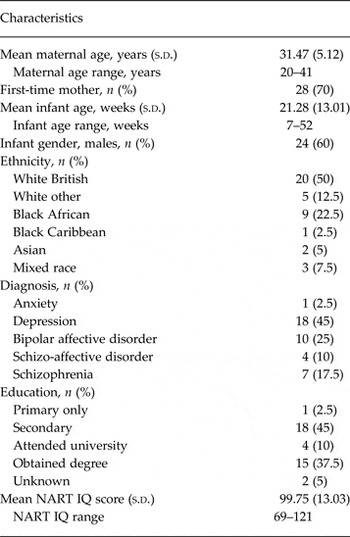
Demographic details were obtained from the patient records and are described in Table 1.
Demographic information

s.d., Standard deviation; NART IQ, National Adult Reading Test intelligence quotient.
Mental health diagnosis was determined by interview using the Structured Clinical Interview for DSM Disorders (SCID). The interviews were conducted by an experienced clinical researcher trained in the use of the SCID. For details of participant diagnoses, see Table 1.
Study tasks
Social cognition tasks
Bowler Coat Story (Bowler, Reference Bowler1992)
This is a second-order false belief task. A story is read aloud to the participant, who is required to answer questions about what one character thinks another character believes. Participants received a score of 1 if they correctly answered the test question, and a score of 0 if they did not.
Reading the Mind in the Eyes Test (Revised Version) (Baron-Cohen et al. Reference Baron-Cohen, Wheelwright, Hill, Raste and Plumb2001)
This test of attribution of psychological states requires the participant to choose one of four words (e.g. ‘concerned’) to match a photograph of the eye region of a face. Number of correct choices is recorded.
Frith–Happé Animations (Abell et al. Reference Abell, Happé and Frith2000; Castelli et al. Reference Castelli, Happé, Frith and Frith2000)
This test of ToM requires attribution of mental states to explain the interaction between two triangles in a short, silent animation. Participants are asked to watch the c. 40 s animations and then tell the experimenter what was going on in the film.
In the present study each participant was shown each clip as many times as she wished (none requested more than two viewings) before providing her commentary, which was recorded and transcribed. Responses were scored for accuracy and intentionality. Accuracy was defined as the extent to which responses conveyed the original authors’ intended meaning for each animation, scored from 0 to 3. Intentionality was scored as reflecting the degree of psychological or ‘mentalizing’/ToM language used (from 0 to 5). Scoring criteria are shown in online Supplementary Appendix S1.
Neuropsychological tests
National Adult Reading Test (NART) (Nelson, Reference Nelson1982)
The NART provides an estimate of pre-morbid intellectual ability based on reading vocabulary. In the present study, each participant was given the NART word list to read out loud. Pronunciation was assessed according to the criteria given in the NART manual. The final score for each participant was based on number of errors, converted to full-scale intelligence quotient (IQ) using the conversion table provided in the test manual.
Wechsler Adult Intelligence Scale – 3rd edition (WAIS-III)
The Similarities, Matrix Reasoning, Digit Symbol and Digit Span subtests were administered to provide an estimate of verbal and non-verbal reasoning, speed and working memory processes that might contribute to performance on the experimental tasks.
Verbal fluency (Controlled Oral Word Association; Benton & Hamsher, Reference Benton and Hamsher1989)
This test, requiring the participant to generate a list of words beginning with a designated letter, has been used in research as a measure of executive function (Costrafreda et al. Reference Costrafreda, Fu, Picchioni, Toulopoulou, McDonald, Kravariti, Walshe, Prata, Murray and McGuire2011).
Maternal sensitivity
CARE-Index (Crittenden, Reference Crittenden2004)
The CARE-Index is a method for evaluating adult–infant patterns of interaction. It was developed for research purposes, and it is specifically designed to evaluate the parent–infant relationship. The procedure consists of coding 3 to 5 min of videotaped adult–infant play interaction. The coding system is based on seven aspects of interactional behaviour: Facial Expression, Verbal Expression, Position and Body Contact, Affection, Turn-taking Contingencies, Control, and Choice of Activity.
The adult and infant are separately evaluated on each of these aspects, and the scoring of each item contributes to one of seven scales; three adult scales and four infant scales (not coded in the present study). The three adult scales are: Sensitive, Controlling, and Unresponsive.
‘Sensitivity’ is defined in play as ‘any pattern of behaviour that pleases the infant and increases the infant's comfort and attentiveness and reduces its distress and disengagement’ (Crittenden, Reference Crittenden2004, p. 3). Sensitivity is therefore a dyadic construct, since it reflects in part the unique characteristics of the infant.
Each behavioural domain is coded as either sensitive, controlling (i.e. interfering or intrusive) or unresponsive, or a mixture of these. It is a 14-point scale, and the scales are inter-correlated, i.e. the separate scores for each of the subscales must add up to 14. A score of 14 for sensitivity would mean that there were no controlling or unresponsive behaviours in evidence.
The infant version of the CARE-Index is designed for use with infants from birth to 15 months. The coding is sensitive to the developmental stage of the infant.
The CARE-Index has been used extensively in research, including research investigating the impact of mental illness on mother–infant interactions (e.g. Steadman et al. Reference Steadman, Pawlby, Mayers, Bucks, Gregoire, Miele-Norton and Hogan2007; Kenny et al. Reference Kenny, Conroy, Pariante, Seneviratne and Pawlby2013).
The CARE-Index was chosen because of its specific focus on the mother–infant dyadic relationship, and the fact that it can be used across the entire age range of interest for this study.
For the purposes of this study, the sensitivity scale only was used in the data analyses. This was because maternal sensitivity was the main variable of interest, and the maternal scores of controlling and non-responsiveness are correlated with the sensitivity scale.
Inter-rater reliability
Frith–Happé Animations
All responses were coded by the principal investigator and a subset of 15 (37.5%) was also coded by the research supervisor, one of the original authors of this task, who was blind to the clinical or demographic characteristics of the participants. A high level of inter-rater reliability was obtained (intraclass correlation coefficient: for Accuracy ratings 0.89; for Intentionality ratings 0.92).
CARE-Index
All clips were coded by an independent rater who was blind to the purpose of the study and the diagnoses of the participants. The rater had undergone formal training in the rating of the CARE-Index and had achieved research reliability. A subset of 10 (25%) clips was rated by a second rater who had also undergone formal training and achieved research reliability with this instrument.
The initial level of inter-rater agreement was deemed to be inadequate (intraclass correlation coefficient = 0.60). Scrutiny of the ratings revealed that eight out of 10 pairs of ratings (80%) were within an acceptable margin of error (i.e. within 2 points of each other). However, two pairs of ratings were considered to be significantly discrepant. Each rater was asked to review their ratings for the two discrepant clips. They then conferred in order to resolve any remaining differences. The raters were able to reach agreement on one of the ratings, but were unable to reach agreement on the other. A third rater, also trained in the use of the CARE-Index, was asked to provide a rating for the remaining discrepant case. This rater agreed with the original score of the main rater, and this score was used in the final analysis. Once these differences were resolved, the inter-rater agreement was acceptable (intraclass correlation coefficient = 0.87).
Procedure
Participants were assessed as close to the discharge date as possible. Completion of the study tasks took around 90 min. The participants were also videotaped in an unstructured play session with their infant, for routine clinical evaluation, at around the same time (usually within 1 week). Each participant was filmed sitting facing her baby who was in a baby seat. A mirror was placed in such a way that the video camera simultaneously captured the mother's and the baby's faces. The mother was given the instruction to ‘speak to and play with your baby as you would normally’. Filming lasted 3 min.
Statistical analysis
All analyses were conducted using SPSS version 19 (USA). A correlational matrix was generated for all variables with continuous properties in order to identify the most highly correlated variables. In order to reduce the number of statistical comparisons, some variables (e.g. WAIS-III subtests) were combined for some stages of the analysis.
Analysis of variance (ANOVA) and analysis of covariance (ANCOVA) were used to compare diagnostic groups and explore the effect of ToM. Post-hoc analyses were conducted to examine possible interactions or confounds.
Results
Demographic characteristics of the sample
The one participant with a diagnosis of anxiety was included in the depression group, since the treating consultant psychiatrist considered her symptomatology to be similar to that of the women in the depression group. All other diagnostic categories were treated separately in the initial stages of the analysis: depression (n = 19); bipolar affective disorder (n = 10); schizophrenia (n = 7); schizo-affective disorder (n = 4).
Given the degree of ethnic diversity within the sample, and relatively small n, the ethnicity variable was collapsed into two categories of ‘white’ and ‘non-white’ in order to increase statistical power. The ‘non-white’ group included participants who identified themselves as mixed race.
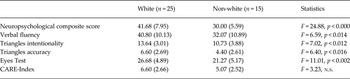
There was an over-representation of tertiary educated women in the ‘white’ group (χ2 = 4.071, p < 0.044), who also obtained higher NART IQs compared with the ‘non-white’ group (105.72 v. 89.80, t = 4.613, p < 0.000). The relationship between diagnosis and ethnicity was not significant (χ2 = 1.93, p < 0.58).
Diagnosis was not related to any of the neuropsychological variables (all p > 0.05). A neuropsychological composite score was derived by summing the scores of the WAIS-III subtests.
ToM variables
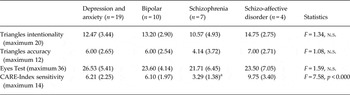
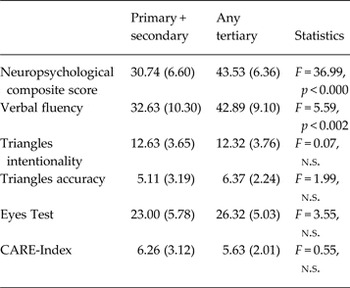
There was no significant effect of diagnosis on the ToM variables (see Table 2). Similarly, there was no effect of education (see Table 3), although there was a non-significant trend for tertiary educated participants to score more highly on the Eyes Test. There was, however, a significant effect of ethnicity on ToM, with the ‘white’ group obtaining higher scores on both measures of the Frith–Happé Animations and on the Eyes Test (see Table 4).
Theory of mind variables and maternal sensitivity by diagnosis
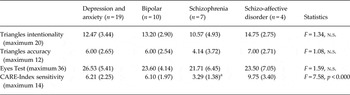
Data are given as mean (standard deviation).
n.s., Non-significant.
a Post-hoc comparisons show Depression and anxiety, Bipolar > Schizophrenia.
Neuropsychological variables, theory of mind and maternal sensitivity by education

Data are given as mean (standard deviation).
n.s., Non-significant.
Neuropsychological variables, theory of mind and maternal sensitivity by ethnicity

Data are given as mean (standard deviation).
n.s., Non-significant.
Relationships between study variables and maternal sensitivity
Maternal sensitivity was not related to mother's age (r = 0.10) or the age of the baby (r = 0.00). There was a non-significant trend for first-time mothers to be less sensitive than mothers who had had previous children (F = 3.83, p < 0.058). Maternal sensitivity was, however, significantly related to infant gender, with mothers of girls being rated as more sensitive than mothers of boys (F = 5.59, p < 0.023). Infant gender was not related to other variables, although there was an over-representation of girls in the ‘white’ group compared with the ‘non-white’ group (χ2 = 4.000, p < 0.046). A two-way ANOVA, to explore if there was an interaction between infant gender and diagnosis, was not significant.
A one-way ANOVA was carried out to investigate the effect of diagnosis on maternal sensitivity. There was a significant effect of diagnosis on maternal sensitivity (see Table 2). As the sample sizes and variances were unequal across the diagnostic categories, post-hoc comparisons were carried out using Dunnett's T3 procedure. Mothers with a diagnosis of schizophrenia were rated the least sensitive, and the post-hoc contrasts showed the difference was significant in comparison with mothers with depression and those with bipolar disorder. Despite obtaining the highest sensitivity scores, mothers with a diagnosis of schizo-affective disorder were not significantly different from any other diagnostic group, perhaps due to a small n. Maternal sensitivity was not related to ethnicity or educational background (all p < 0.05).
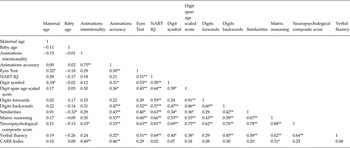
A correlational matrix (see Table 5) was constructed in order to explore the relationships between the neuropsychological variables, the ToM variables and maternal sensitivity. Maternal sensitivity was not related to IQ or any neuropsychological variable apart from Matrix Reasoning (r = 0.31, p < 0.048). The two scores derived from the Frith–Happé Animations were each found to correlate significantly with maternal sensitivity (Intentionality r = 0.49, p < 0.001; Accuracy r = 0.46, p < 0.003). The other task designed to tap ToM (the Eyes Test) did not correlate significantly with maternal sensitivity (r = 0.29, p > 0.05).
Pearson correlational matrix

NART IQ, National Adult Reading Test intelligence quotient.
Significant correlation: *p < 0.05 (two-tailed), ** p < 0.01 (two-tailed).
As ToM was not related to diagnosis, it was unlikely that it was mediating the relationship between diagnosis and maternal sensitivity. This was confirmed with an ANCOVA in which the relationship between diagnosis and maternal sensitivity was explored using ToM (Frith–Happé Animations Intentionality score) as the covariate. The results confirmed that diagnosis and ToM were independent predictors of maternal sensitivity, since each remained significant when the other variable was the covariate [diagnosis F = 5.67, degrees of freedom (df) 3,35, p < 0.003; ToM F = 6.71, df 1,35, p < 0.014].
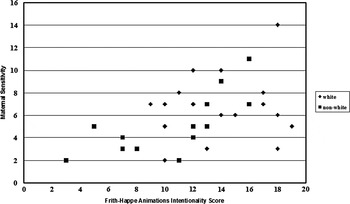
Further qualitative examination of the relationship between maternal sensitivity and ToM was made by plotting the data in a scatterplot (Fig. 1). It was apparent that the relationship between the variables was such that no participant with low ToM was rated highly for maternal sensitivity. However, there was a small group of women who obtained high scores on the ToM tasks, but were rated as low in maternal sensitivity. These women appeared to be more likely to be white and/or tertiary educated. Unfortunately, the study did not have sufficient power to confirm this post-hoc observation statistically.
Relationship between theory of mind and maternal sensitivity by ethnicity.

Discussion
This was an exploratory study investigating the relationship between ToM and maternal sensitivity in a sample of women with severe mental illness. To date, no other studies have reported using standard ToM tasks to explore maternal sensitivity in such a population. A small number of studies have looked at related constructs, such as mind-mindedness or infant-directed speech, in non-mentally disordered samples (Meins et al. Reference Meins, Fernyhough, Wainwright, Gupta, Fradley and Tuckey2002), and in mentally disordered samples (Wan et al. Reference Wan, Penketh, Salmon and Abel2008; Pawlby et al. Reference Pawlby, Fernyhough, Meins, Pariante, Seneviratne and Bentall2010). In these studies, the measures used had not been specifically designed to distinguish clinical from non-clinical populations.
The results confirmed the hypotheses that ToM would be related to maternal sensitivity and that a diagnosis of schizophrenia would be associated with lower maternal sensitivity. However, unexpectedly, there was no difference in ToM performance by diagnostic group, and ToM did not mediate the poor quality of interactions in the schizophrenia group. The results obtained by Snellen et al. (Reference Snellen, Mack and Traner1999) suggested that quality of mother–infant interactions at the point of discharge were related to the presence of negative symptoms in their sample of mothers with schizophrenia. In the present study, only one participant was identified on the SCID as meeting the criteria for negative symptomatology. However, it is possible that more subtle examples of negative symptomatology which did not reach SCID threshold could have influenced the findings.
Although there was an unexpectedly high degree of maternal sensitivity shown within the schizo-affective disorder group, this difference was not significantly different from that in the other diagnostic groups, perhaps due to the small n.
It is noteworthy that only one of the ToM tasks, the Frith–Happé Animations, was related to maternal sensitivity. It is likely that the range of ToM tasks tap into different dimensions of the construct, and depending on the context, may be more or less relevant. The Frith–Happé Animations require participants to ‘detect’ mental states in simple, non-verbal stimuli that act contingently. In the current study, participants were not ‘cued’ to expect mental states, so any attribution was made spontaneously. This task may be especially relevant to the understanding of infant mental states. Clinical experience suggests that not all parents of young babies attribute mental states until the infant begins using words. Conversely, some parents overmentalize, and attribute mental states that are developmentally inappropriate (such as thinking that the baby is ‘judging’ them). The extent to which parents spontaneously detect mental states may be important in interacting with very young infants. The other ToM tasks (Bowler Coat Story and Eyes Test) appeared to be more associated with other neuropsychological variables such as IQ, suggesting that they were more intellectually taxing for such a diverse sample (Table 4 and online Supplementary Table S1).
The non-white group was found to have lower levels of ToM, although they were not found to be lower in maternal sensitivity. It is possible that the differences in educational background may explain this difference.
It is important to note that while adequate ToM skills appeared to be necessary for adequate maternal sensitivity, as no-one with a low ToM score was rated highly on maternal sensitivity, a small number of women with high ToM scores obtained very low scores on the sensitivity scale. In other words, some women did not or were unable to use their ToM skills in the context of interacting with their babies. The possibility that this may be related to socio-economic or cultural factors is intriguing and worthy of further study.
The finding that mothers of girls were rated as more sensitive than mothers of boys was unexpected. This has not been reported in other studies focusing on mother–infant interaction within a mental health sample (e.g. Goodman & Brumley, Reference Goodman and Brumley1990; Riordan et al. Reference Riordan, Appleby and Faragher1999; Hipwell et al. Reference Hipwell, Goossens, Melhuish and Kumar2000; Albertsson-Karlgren et al. Reference Albertsson-Karlgren, Graff and Nettelbladt2001; Steadman et al. Reference Steadman, Pawlby, Mayers, Bucks, Gregoire, Miele-Norton and Hogan2007; Wan et al. Reference Wan, Salmon, Riordan, Appleby, Webb and Abel2007), although it is not always clear whether the effect of gender was examined in these papers. In a recent paper exploring the relationships between maternal depression, infant gender and maternal sensitivity, no effect of infant gender was found (Sidor et al. Reference Sidor, Kunz, Schweyer, Eickhorst and Cierpka2011). However, the depressed women in the sample were at the milder end of the spectrum, where only subtle effects of maternal depression tend to be found (Murray et al. Reference Murray, Halligan, Cooper, Bremner and Wachs2010). Similarly, there is no mention of the relevance of the gender of the baby in studies of maternal sensitivity in healthy populations (e.g. Ainsworth et al. Reference Ainsworth, Blehar, Waters and Wall1978). McElwain & Booth-LaForce (Reference McElwain and Booth-LaForce2006) did not find that infant gender was related to maternal sensitivity or attachment security. In their twin study of the genetic and environmental components of maternal sensitivity, Fearon et al. (Reference Fearon, Fonagy, Schuengel, van IJzendoorn, Bakermans-Kranenburg and Bokhorst2006) reported that infant gender did not moderate the results.
On the other hand, studies of child outcome after infant exposure to maternal depression do suggest some differential impacts on boys v. girls (Sharp et al. Reference Sharp, Hay, Pawlby, Schmucker, Allen and Kumar1995; Hay et al. Reference Hay, Pawlby, Sharp, Asten, Mills and Kumar2001; Murray et al. Reference Murray, Halligan, Cooper, Bremner and Wachs2010). Tronick & Reck (Reference Tronick and Reck2009) reported that mothers of infant sons scored more highly on a depression scale, and suggested that infant boys are less able to control their own emotions and require more regulatory ‘scaffolding’ from their mothers. This could make them more difficult interactive partners. It is therefore possible that there is a difference in mothers’ responsiveness to girls v. boys, but only where the mother has mental health problems. In the current study, no interaction was found between diagnosis and infant gender, although the numbers were small and it was difficult to make meaningful analyses.
Limitations
This was an exploratory study, and a healthy comparison group was not included in the design. Therefore, it is not known whether the finding that ToM is a significant predictor of maternal sensitivity would generalize to a non-clinical sample, or whether there are socio-economic or cultural differences which moderate this relationship. Similarly, it is not possible to conclude whether the finding for infant gender is a general feature of mothers with respect to their interactions with boys v. girls, or whether this finding is specific to the context in which the mother has significant mental health difficulties. The small n meant that there was insufficient power to undertake some post-hoc analyses, and the findings relating to the impact of diagnosis need to be interpreted with caution.
Clinical implications
The findings of this study suggest that clinical interventions targeting the mother–infant relationship should facilitate the capacity of the mother to think about her infant as a separate person with independent thoughts and feelings. The importance of this is borne out by the studies which have demonstrated that the maternal ‘mind-mindedness’ is important for the infant's emotional development (Meins et al. Reference Meins, Fernyhough, Wainwright, Gupta, Fradley and Tuckey2002). It is suggested that this is a capacity that may be taught within the context of a clinical intervention and especially where mothers have good ToM skills, but are not utilizing them to benefit their relationships with their babies.
Conclusions
This study extends previous research in underlining the importance of ToM, or mentalizing, in mother–infant interactions, and by implication, for child outcome. Although there was no direct relationship between specific mental health disorders and ToM, ToM was relevant across all disorders. In certain contexts, it is possible that ToM skills may be overridden or inhibited, and more research is needed to explore this theoretically intriguing possibility.
Supplementary material
For supplementary material accompanying this paper visit http://dx.doi.org/10.1017/S0033291716000337
Acknowledgements
This research was conducted in partial fulfilment of a post-qualification Doctor of Psychology degree at City University London. Special thanks are due Dr Rachel Mycroft for undertaking the reliability check for the CARE-Index, to Dr Gertrude Seneviratne for clarifying some issues of diagnosis, and most especially to the mothers and their babies who participated in this study.
Declaration of Interest
None.