The microbiota of dairy products consists of, apart from starter and non-starter lactic acid bacteria, yeasts and filamentous fungi that form secondary microbiota with a significant role during cheese ripening (Beresford et al., Reference Beresford, Fitzsimons, Brennan and Cogan2001). LAB used as starter cultures in cheese production are essential for the development of organoleptic characteristics. Starter and secondary bacteria modify the physical and chemical properties of cheese and largely influence its characteristics (Steele et al., Reference Steele, Broadbent and Kok2012; Gobbetti et al., Reference Gobbetti, Angelis, Cagno and Mancini2015).
Up to recent years, the study of microbial community of cheeses was performed mainly by a conventional plate counting method, which has certain drawbacks such as high time consumption and often uncertainty owing to an increasing number of species that vary in only a few characteristics (Requena and Peláez, Reference Requena, Peláez, Nollet and Toldrá2010). In the last two decades, however, molecular methods have attracted the interest of scientists as culture-independent tools, because of certain advantages such as simplicity, repeatability, specificity and relatively low cost. However, some of them especially metagenomic analysis by next-generation sequencing (NGS) are still quite costly and the identification at species level is still not very satisfactory. Nevertheless, the choice of the appropriate method is still a requisite and quite often polyphasic studies, including both culture-dependent and culture-independent approaches are applied (Alegria et al., Reference Alegría, Szczesny, Mayo, Bardowski and Kowalczyk2012).
In Greece, cheeses are usually produced from pasteurized milk with the addition of either industrial or artisan starters and most cheeses are hard. Almost every Greek region produces a unique type of cheese. In Greek islands, due to the characteristic microclimate, soil, other environmental factors and technology, very special types of cheese are produced (Litopoulou-Tzanetaki and Tzanetakis, Reference Litopoulou-Tzanetaki and Tzanetakis2011).
In our laboratory we designed new primers to be used for a novel multiplex PCR and a novel real-time PCR as culture-independent methods for the identification and quantification of the LAB present in cheese. We applied these methods for analyzing a total of thirty-six Greek cheeses in terms of qualitative determination of the four representatives LAB genera (Lactobacillus, Lactococcus, Streptococcus, Leuconostoc) most frequently found in Greek cheeses. Of these samples, all were tested with the multiplex PCR. All these cheeses have also been tested for the animal origin of the milk by a specific molecular method according to Tsirigoti et al. (Reference Tsirigoti, Katsirma, Papadopoulos, Samouris, Ekateriniadou and Boukouvala2020). Nine of these cheeses, which were fully analyzed regarding the milk origin by molecular protocols, were chosen as representatives from different Greek regions and were further analyzed by both the conventional culture plate method and the novel real-time PCR.
Materials and methods
Sampling
Thirty-six different local cheeses from dairies of the Greek mainland (10) and from different Greek islands (26) were analyzed. Eleven were produced from pure cows' milk, three from sheep's milk, six from goat's milk and the rest from a mixture of cow, goat and sheep's milk (ten), goat and sheep's milk (five) and finally cow and sheep's milk (one). Twenty-three of them were classified as hard cheese, nine as semi hard and four as soft. The nine cheeses chosen for further analysis by a combination of culture methods and real-time PCR, were of cow's milk (2), goat's milk (2), sheep's milk (1), goat and sheep's milk (2) and cow, goat, and sheep's milk (2), whereas according to cheese type, six were hard, two semi hard and one soft.
DNA extraction
DNA was extracted out of 10 g of homogenized cheese according to methods described in detail in the online Supplementary File, and using the Pure Link Genomic DNA Extraction Kit (Life Sciences-Thermo Fisher Scientific, USA) from Gram positive bacteria.
Qualitative determination of the four LAB genera by multiplex PCR
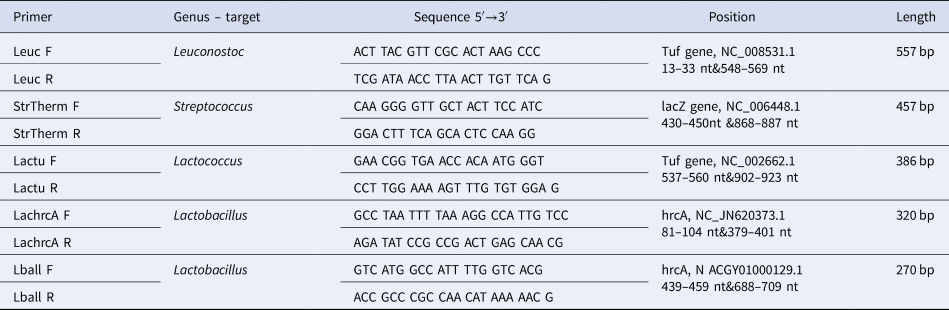
Specific fragments of tuf, hrcA and lacZ genes were chosen for the identification of the genera Lactobacillus sp., Lactococcus sp., Leuconostoc sp. and Streptococcus sp. Five primer pairs were designed, to amplify different size fragments of these genes suitable for both multiplex PCR and real-time PCR (Table 1).
Primers used in Novel multiplex and Real Time PCR Sequences of the primers designed for the four LAB genera and the size of the amplified fragment

The pair of primers LachrcA F/R detects the Lactobacillus sp (specifically Lactobacillus pentosus, Lactobacillus plantarum and Lactobacillus paraplantarum), while the pair Lball F/R detects the species Lactobacillus casei, Lactobacillus paracasei and Lactobacillus brevis.
Genomic DNA of reference bacterial strains was used to test the specificity of the multiplex PCR. Multiplex PCR reactions were performed according to the method described in the online Supplementary File.
Quantitative determination of the four LAB genera
For the quantitative determination we applied both the plate culture method (Cabezas et al., Reference Cabezas, Sánchez, Poveda, Sesena and Palop2007) and the real-time PCR as described in the online Supplementary File.
Statistics
The R programming (v 3.5.1) language was used for statistical computing and graphics. The significant statistical differences were determined by Welch t-test with significance declared as P < 0.05.
Results
Qualitative determination of lactic acid bacteria
The specificity of the multiplex PCR was tested by a number of reference bacterial strains (described in the online Supplementary File). In 35 out of 36 cheeses tested, all four genera were detected by the novel multiplex PCR (online Supplementary File, Fig. S1). In one semi-hard cheese sample, produced by cow milk originated from the mainland, the Lactobacillus sp. was poorly detected.
Quantitative determination of lactic acid bacteria
Nine out of the thirty-six analyzed cheese samples were further analyzed as representatives from different Greek regions by both the conventional culture plate method and the novel real-time PCR. These nine cheeses were all tested by the specific triplex-PCR on somatic cell DNA, described by Tsirigoti et al. (Reference Tsirigoti, Katsirma, Papadopoulos, Samouris, Ekateriniadou and Boukouvala2020) that enables the identification of the species of origin (cow, sheep, goat), and all were shown to be correct as labelled.
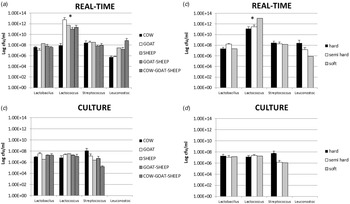
The population of the four genera of LAB counted by real-time PCR are shown in a logarithmic scale in Figure 1. In almost all the cheese samples tested, a pattern of the relative population of the LAB was repeated independently of the milk originality (ie cow, goat, sheep, or a mix of them) (Fig. 1a), the type of cheese (hard, semi hard, soft) (Fig. 1c) and the geographical location (data not shown). Lactococcus sp was dominant, at a significant level (P < 0.05), against the rest of the genera studied. No statistically significant differences among the remaining genera were noticed.
Population of the four LAB genera determined by real-time PCR (copy numbers: 1a and 1c) and Standard Plate Method (CFU/ml: 1b and 1d). Data are presented in logarithmic scale. The cheese samples were separated into five groups of cheeses, (according to the animal origin of milk: 1a, 1b, or the cheese type: 1c, 1d).

As shown in Figs. 1b and 1d the application of the standard plate culture method detected Lactobacillus, Lactococcus and Streptococcus genera in significant populations. Leuconostoc genus was not detected in any of the tested cheeses. No statistical differences were found among the three genera (Lactobacillus, Lactococcus and Streptococcus) of the cultured LAB.
Discussion
The role of the four main bacteria genera used in almost all the cheese production methods for the starter culture, (Lactobacillus, Lactococcus, Streptococcus and Leuconostoc) is extremely important (Beresford et al., Reference Beresford, Fitzsimons, Brennan and Cogan2001). According to many reports Lactobacillus dominates cheese ripening (Gurses and Erdogan, Reference Gurses and Erdogan2006), although the actual effect of the milk origin, the geographical location and the production technology of different types of cheese (hard, semi hard, soft) is not yet fully understood. Successful identification, typing and characterization of the microorganisms in cheese microbiota and enumeration of their actual populations are essential (Pogacic et al., Reference Pogacic, Kelava, Zamberlin, Dolencic–Spehar and Samarzija2010). In the present research communication, we report on an approach to the above-mentioned questions by a combination of culture plate dependent and novel culture-independent methods.
Specific primers were designed in our laboratory targeting the four essential and most common genera of LAB in Greek cheeses. They were designed to be used in both a novel multiplex PCR for the qualitative analysis and in a novel real-time PCR for quantitative analysis in cheeses. The specificity of the novel multiplex PCR was confirmed by applying the method on the reference bacterial strains. The application of multiplex PCR clearly indicated the presence of all four genera of LAB in 35 out of the 36 cheeses tested. This was expected since all the cheeses originated from pasteurized milk and their microbial community is determined mainly by the starter cultures (Gobbetti et al., Reference Gobbetti, Angelis, Cagno and Mancini2015).
The novel real-time PCR offered quantitative determination for all four LAB genera. The population of Lactococcus was consistently higher than the remaining genera with the only exception observed in cheeses produced from cow's milk. In these cheeses we also observed Streptococcus presenting a slightly increased population from the remaining genera. Domination of Streptococcus and Lactococcus species in cow's milk and Lactococcus in goat's milk cheeses has been reported by Zhu et al. (Reference Zhu, Zeng, Yang, Hou, Wang, Hu, Senoo and Wei2020) in China. According to our results it seems that the bacterial community in Greek cheeses is not affected by the geographical location of the producing place, the type of cheese and to a lesser extent the origin of milk.
Comparing the results of the culture-independent method with the standard plate count method, the former has proven to be more accurate and valuable. The culture dependent method did not exhibit statistically significant differences in the CFU among the LAB genera and failed to detect any CFU of Leuconostoc sp. in any of the analyzed samples. It also gave significantly lower counts for Lactococcus, which may be attributed to the fact that real-time PCR detects the Lactococcus DNA present in the milk used for the production and through the whole ripening process of cheeses samples, whether they are alive or not. Many research reports mention an increased population of Lactococcus sp. that does not survive up to the end of the ripening process (Dolci et al., Reference Dolci, Alessandria, Zeppa, Rantsiou and Cocolin2008; Litopoulou-Tzanetaki and Tzanetakis, Reference Litopoulou-Tzanetaki and Tzanetakis2014). Lactococcus is sensitive to low pH and high NaCl concentration (Rantsiou et al., Reference Rantsiou, Comi and Cocolin2004). Furthermore, carbohydrate starvation may force Lactococcus to a nonculturable state although they remain alive for at least another two weeks (Ganesan et al., Reference Ganesan, Stuart and Weimer2007).
As far as the genus Leuconostoc is concerned, the observed absence of living bacteria, indicated by the standard culture method, is not an unusual phenomenon. These results were in agreement with Cogan et al. (Reference Cogan, Barbosa, Beuvier, Bianchi-Salvadori, Cocconcelli, Fernandes, Gomez, Gomez, Kalantzopoulos, Ledda, Medina, Rea and Rodriguez1997), who found that five cheeses, amongst them three of Greek origin (Kasseri, Feta, fresh cheese), did not present bacteria of this genus. However, application of real-time and multiplex PCR, indicated the presence of significant levels of DNA of Leuconostoc sp. in the tested samples which is in line with many previous reports according to which Leuconostoc represents a dominant genus in the process of cheese production (Friedrich and Lenke, Reference Friedrich and Lenke2006). Leuconostoc species are known for their role in flavor and aroma of cheese, and are often found in significant populations, especially at the beginning of ripening (Gerasi et al., Reference Gerasi, Litopoulou-Tzanetaki and Tzanetakis2003) but a lot of studies have demonstrated a significant decrease or even absence at the end of ripening (Litopoulou-Tzanetaki and Tzanetakis, Reference Litopoulou-Tzanetaki and Tzanetakis2014). Also, other comparative studies of culture-independent methods such as real-time PCR and FLOW-FISH, indicated that viable bacteria are present in cheese but are not able to be cultured (Friedrich and Lenke, Reference Friedrich and Lenke2006; Ganesan et al., Reference Ganesan, Stuart and Weimer2007).
In conclusion, our results point to a relatively low cost and reliable molecular method for LAB identification and quantification in cheese samples. Inconsistencies between this method and the plate count method are probably due to the lower sensitivity of the latter. The results also showed a rather persistent pattern of the four LAB genera in all Greek cheeses with Lactococcus sp. being the most abundant and this pattern is independent of geographical location, milk-producing animal species and type of cheese.
Supplementary material
The supplementary material for this article can be found at https://doi.org/10.1017/S0022029922000760
Acknowledgements
We would like to thank Professor E. Litopoulou-Tzanetaki for providing some of the reference bacterial strains used in this study.