Sinks in healthcare facilities are an important reservoir for dissemination of multidrug-resistant gram-negative bacilli and Candida spp.Reference Kanamori, Weber and Rutala1–Reference Parkes and Hota7 It has been demonstrated that colonizing microorganisms and fluorescent markers can be dispersed as far as 0.8 to 1 m from sink drains.Reference Hota, Hirji, Stockton, Lemieux, Dedier, Wolfaardt and Gardam3, Reference Kotay, Chai, Guilford, Barry and Mathers4 Such dispersal may result in spread to patients through contamination of equipment or supplies in close proximity to the sink. In addition, patients or personnel might acquire organisms on hands or clothing after contact with contaminated countertops.
Given the potential for dispersal from sink drains, it is plausible that direct contamination of personnel or patients could occur during hand washing. However, previous reports have not investigated this mechanism of transmission. Therefore, we examined the potential for dispersal from contaminated sink drains to hands and clothing during hand washing. Because a plastic drain cover reduced dispersal from sinks to countertops,Reference Livingston, Cadnum, Gestrich, Jencson and Donskey8 we tested whether the device would reduce dispersal to hands and clothing.
Methods
The study was conducted on 7 hospital wards, including 2 intensive care units and 5 medical-surgical units, during a 2-month period. In total, 10–20 automated patient room sinks were studied on each ward during the daytime when patients were not in the room. Prior to testing, the sink bowl and adjacent countertop or other surfaces ≤15.2 cm (≤6 inches) from the bowl were disinfected with a commercial hydrogen peroxide disinfectant and surfaces were sampled with BBL culture swabs (Becton Dickinson, Franklin Lakes, NJ) premoistened with Dey-Engley neutralizing medium to confirm the absence of gram-negative bacilli.
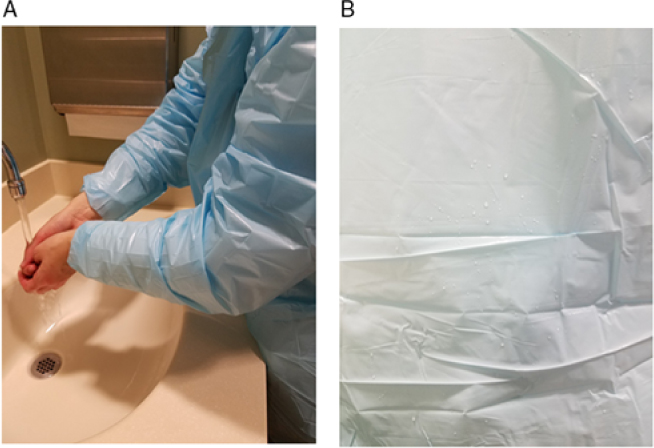
A standardized test protocol was used to examine the potential for dispersal from the sink drain to clothing and hands during hand washing. Research personnel donned a clean cover gown (Safety Plus Polyethylene Gown, TIDI Products, Neenah, WI); the gown was worn as a surrogate for clothing that would allow visualization of sites of water splattering. Multiple cultures of the clean gowns were negative for gram-negative bacilli. After donning the gown, hand hygiene was performed using alcohol-based hand sanitizer. The anterior and posterior surfaces of the hands and fingers were imprinted onto replicate organism detection and counting (RODAC) plates containing MacConkey agar (Hardy Diagnostics, Irving, TX) to confirm the absence of gram-negative bacilli. Hands were then washed for 15 seconds and patted dry with a paper towel. After hand washing, RODAC plates containing MacConkey agar were used to sample both hands and a 10 × 10-cm area on the anterior surface of the cover gown over the abdomen, including areas with visible evidence of water splattering. Figure 1 provides an illustration of personnel performing hand washing and shows visible water splattered onto the cover gown. We used BBL culture swabs premoistened with Dey-Engley neutralizer to sample the countertop or other areas <15.2 cm (<6 inches) from the sink bowl.
Pictures of personnel performing hand washing (A) and of visible water splattered onto the cover gown after hand washing (B).

Immediately after completion of the initial assessment, the bowl and adjacent surfaces of the sink were again disinfected using the hydrogen peroxide disinfectant, and a plastic drain cover (Drain Armor, Boehringer Laboratories, Phoenixville, PA) was applied.Reference Livingston, Cadnum, Gestrich, Jencson and Donskey8 The same test protocol was then followed with the drain cover in place.
After completion of the assessments of dispersal, swabs were used to sample the proximal sink drain to a depth of 2.5 cm (1 inch) below the strainer. These swabs were plated onto MacConkey agar using a 4-quadrant streak method. Sinks that did not have growth of gram-negative bacilli from the drain swab were excluded from the analysis of dispersal. All culture plates were incubated at 37°C for 24 hours. The numbers of colonies of gram-negative bacilli recovered from gowns and hands were counted. Selected colonies from gowns and hands and from sink drains of the rooms where dispersal to gowns and hands occurred were subjected to identification using standard microbiologic methods and matrix-assisted laser desorption/ionization time-of-flight (MALDI-TOF) mass spectroscopy.9 If multiple colony morphologies were present, only the predominant colony morphology was tested.
For the initial 20 sinks studied, 50 mL water from the faucet was filtered and the filter paper was cultured for gram-negative bacilli. The Fisher exact test was used to compare the proportions of contamination with and without the drain cover in place.
Results
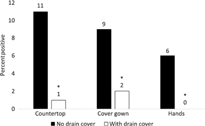
Of 112 sink drains cultured, 109 (97%) had growth of gram-negative bacilli extending to the third and/or fourth quadrants of the culture plates. All drain cultures included colonies consistent with Pseudomonas spp or other non–lactose-fermenting gram-negative bacilli, but presence of multiple colony morphologies was common. Figure 2 shows percent contamination of countertops, cover gowns, and hands after hand washing with versus without the sink drain cover for the 109 colonized sinks. Without the drain cover, there was no significant difference in the percentage of contaminated countertops and cover gowns or hands: 12 of 109 (11%) versus 10 of 109 (9%) versus 6 of 109 (6%; P ≥ .22). The median numbers of colonies recovered from countertops, gowns, and hands were 2, 5, and 4, respectively.
Percentage of sink countertops, cover gowns, and hands with positive cultures for gram-negative bacilli after washing hands for 15 seconds with versus without a plastic sink drain cap in place. *, P ≤ .03.

For 8 of 10 sinks associated with gown and/or hand contamination (80%), the organisms recovered from the gown or hands were the same species as the predominant isolate recovered from the sink drain; organisms recovered from the gown and/or hands included Pseudomonas aeruginosa (n = 7), Stenotrophomonas maltophilia (n = 1), Proteus mirabilis (n = 1), and Enterobacter agglomerans (n = 1). All control cultures of the countertop and hands and of water from the faucet were negative.
As shown in Figure 1, the sink drain cover significantly reduced the frequency of contamination. Because gram-negative bacilli were dispersed from 2 sinks despite the presence of the drain cover, we assessed potential reasons for the failure of the device. For both sinks, it was observed that water inflow from the faucet was faster than water outflow such that water backed up in the sink bowl. To examine the potential for dispersal, 1 mL fluorescent gel was inoculated just below the strainer of each sink, the drain cover was installed, and the water was run for 15 seconds. Water backed up into the sink bowls and drain covers, and a black light was used to demonstrate fluorescent gel dispersal to sink bowls and countertops and to gowns of personnel.
Discussion
Recent studies have demonstrated that gram-negative bacilli and Candida spp can be dispersed from colonized sink drains to environmental surfaces outside the sink bowl.Reference Kanamori, Weber and Rutala1–Reference Kotay, Chai, Guilford, Barry and Mathers4 In the current study, we have demonstrated that such dispersal can also result in contamination of the clothing and hands of individuals washing their hands. This mechanism of dispersal could lead to contamination of healthcare personnel and patients.
Our findings are consistent with previous evidence that sink drain covers could reduce pathogen dispersal from sinks.Reference Livingston, Cadnum, Gestrich, Jencson and Donskey8 However, the results also highlight a potential limitation of the drain covers. The devices did not prevent dispersal from 2 sinks where there was evidence of back up of water into the sink bowl and device due to more rapid inflow than outflow of water. Kotay et alReference Kotay, Chai, Guilford, Barry and Mathers4 similarly demonstrated dispersal of bacteria from below the strainer when water backed up due to a higher inflow than outflow of water. Thus, sinks with drain covers should be examined to determine whether there is the potential for water backup.
Our study has some limitations. The study was conducted in only 1 hospital. However, similar dispersal of gram-negative bacilli has been demonstrated in sinks in 4 hospitals.Reference Gestrich, Jencson, Cadnum, Livingston, Wilson and Donskey10 The sink drain cover was only tested for 1 hand-washing episode per sink. However, we previously implemented the devices for a 2-week period in an intensive care unit and demonstrated that organisms in the sink bowl can be dispersed by flowing water.Reference Kotay, Chai, Guilford, Barry and Mathers4 Thus, our results may underestimate the frequency of dispersal because the sink bowl was disinfected prior to hand washing. Finally, additional studies are needed to determine whether dispersal to clothing and hands contributes to transmission in healthcare facilities.
Acknowledgments
We thank the nursing staff of the Cleveland VA Medical Center for assistance in coordinating the timing of the study assessments.
Financial support
This work was supported by the Department of Veterans Affairs. Boehringer Laboratories provided the drain covers that were used but did not provide funding or input on study design and did not review the manuscript.
Conflicts of interest
C.J.D. has received research funding from Clorox, EcoLab, GOJO, Pfizer, Avery Dennison, and Boehringer Laboratories. All other authors report no potential conflicts relevant to this article.