


Introduction
Eating disorders, which have a significant impact on the well-being of patients (Hay et al., Reference Hay, Girosi and Mond2015), have a lifetime prevalence of about 2% (Preti et al., Reference Preti, Girolamo, Vilagut, Alonso, Graaf, Bruffaerts, Demyttenaere, Pinto-Meza, Haro and Morosini2009). As such disorders are moderately responsive to psychological interventions, to enhance recovery rates and minimise negative consequences, the effectiveness of various treatments needs to be investigated for each eating disorders (Linardon et al., Reference Linardon, Wade, de la Piedad Garcia and Brennan2017b). The National Institute for Health and Care Excellence (NICE) guidelines recommend cognitive behaviour therapy for eating disorders (National Institute for Clinical Excellence, 2017). One such evidence-based treatment is cognitive behavioural therapy-enhanced (CBT-E) (Fairburn, Reference Fairburn2008).
CBT-E is based on a transdiagnostic model which assumes that all eating disorders share common core mechanisms (Cooper and Fairburn, Reference Cooper and Fairburn2011; Fairburn et al., Reference Fairburn, Cooper and Shafran2003). CBT-E addresses these mechanisms, such as over-evaluation of shape, weight and eating (Fairburn et al., Reference Fairburn, Cooper and Shafran2003). However, data regarding over-evaluation of shape and weight among patients suffering from binge eating disorder (BED) are inconclusive (Coffino et al., Reference Coffino, Udo and Grilo2019; Linardon, Reference Linardon2017). Still, it is assumed that all eating disorder patients with a body mass index (BMI) between 17.6 and 39.9 can be treated with a similar treatment (Fairburn, Reference Fairburn2008; Fairburn et al., Reference Fairburn, Cooper and Shafran2003).
CBT-E is effective among transdiagnostic samples, for patients suffering from bulimia nervosa (BN), and other specified feeding and eating disorder with a restrictive food pattern (OSFED). However, although patients suffering from BED were included in transdiagnostic samples, no remission rates of individually offered CBT-E among adult patients suffering from BED have been reported. Remission rates based on reduction in eating disorder pathology vary between 18 and 70%. Full recovery, defined as abstinence of eating disorder behaviours and eating disorder pathology below clinical cut-off, varies between 14.3 and 50% (Table A in Supplementary material). Treatment response of CBT-E differ substantially at the end of treatment (EOT) and at follow-up (Berg et al., Reference Berg, Schlochtermeier, Koenders, Mooij, Goudriaan, Blankers, Peen and Dekker2020; de Jong et al., Reference de Jong, Schoorl and Hoek2018; Linardon et al., Reference Linardon, Wade, de la Piedad Garcia and Brennan2017b; Thompson-Brenner et al., Reference Thompson-Brenner, Shingleton, Thompson, Satir, Richards, Pratt and Barlow2016). This suggests that the effectiveness of CBT-E can be improved.
Determining treatment outcome predictors of CBT-E enables prognostic information about whom CBT-E is likely to work for. Treatment outcomes can be maximised by an understanding of its predictors because more targeted and intensive treatment can be offered, thus improving clinical decision-making, allowing for personalised medicine, so potentially enhancing treatment outcome (Kraemer, Reference Kraemer2013). Although consistent findings on predictors of CBT-E are scarce, poorer treatment outcome was predicted by a lower BMI and higher frequency of eating disorder behaviours at start, longer duration of the eating disorder, and having received eating disorder treatment in the past (Cooper et al., Reference Cooper, Allen, Bailey-Straebler, Basden, Murphy, O’Connor and Fairburn2016; Linardon et al., Reference Linardon, de la Piedad Garcia and Brennan2017a; Linardon et al., Reference Linardon, Wade, de la Piedad Garcia and Brennan2017b; Vall and Wade, Reference Vall and Wade2015).
This study involves an observational design, comparing treatment responses of BN, BED, their respective OSFED, and OSFED with a restrictive food pattern, and applying alternative categorisations of clusters of diagnosis. Comparisons were made for treatment delivered in everyday clinical practice by routine outcome monitoring at fixed time intervals (de Beurs et al., Reference de Beurs, den Hollander-Gijsman, van Rood, van der Wee, Giltay, van Noorden, van der Lem, van Fenema and Zitman2011). Effectiveness studies tend to include a more heterogeneous patient population (Knott et al., Reference Knott, Woodward, Hoefkens and Limbert2015; Waller et al., Reference Waller, Gray, Hinrichsen, Mountford, Lawson and Patient2014), including patients with complex and co-morbid disorders (Leichsenring, Reference Leichsenring2004).
Data are scarce on how adult patients classified with BED respond to CBT-E when offered it individually (Berg et al., Reference Berg, Schlochtermeier, Koenders, Mooij, Goudriaan, Blankers, Peen and Dekker2020; Byrne et al., Reference Byrne, Fursland, Allen and Watson2011; Fairburn et al., Reference Fairburn, Cooper, Doll, O’Connor, Bohn, Hawker, Wales and Palmer2009; Fairburn et al., Reference Fairburn, Bailey-Straebler, Basden, Doll, Jones, Murphy, O’Connor and Cooper2015). Examining whether the specific eating disorder diagnosis matters enables us to investigate if CBT-E works for all eating disorders. Part of the sample in this study was included in a transdiagnostic study by van den Berg et al. (Reference van den Berg, Melisse, Koenders, de Jonge, Blankers, de Beurs and Dekker2020). The present study involves a larger sample, thus increasing statistical power and allowing investigation of several outcome predictors, including eating disorder diagnosis. To our knowledge, no previous studies have compared the effectiveness of CBT-E for different eating disorders. Furthermore, with the exception of adolescents and group settings, remission rates for BED specifically have not been previously reported on (Dalle Grave et al., Reference Dalle Grave, Calugi, Sartirana and Fairburn2015; Wade et al., Reference Wade, Byrne and Allen2017).
The aim of present study is to compare effectiveness of CBT-E in various eating disorder subtypes, and to investigate the predictive value of potential prognostic variables for outcome. It is hypothesised that eating disorder pathology declines among all groups, and that poorer treatment response is predicted by greater eating disorder severity, higher frequency of eating disorder behaviours, and a lower BMI at baseline, having received an eating disorder treatment in the past, and longer duration of the eating disorder. Secondary eating disorder pathology and general psychopathology are expected to decrease at EOT and follow-up.
Method
Design
This study had a cohort design, using between-group comparisons of patients with various eating disorder subtypes. Of the patients who received treatment for eating disorders from 1 July 2015 to 31 December 2019 at a Dutch specialised centre for eating disorders and obesity, 625 were eligible for inclusion and constituted the intent-to-treat sample. Treatment outcomes of 294 participants with a BMI between 17.6 and 39.9 who received treatment between 1 July 2015 and 31 December 2017 were also included in Berg et al. (Reference Berg, Schlochtermeier, Koenders, Mooij, Goudriaan, Blankers, Peen and Dekker2020). In contrast, in the current study, therapy outcomes between three groups, namely BN and BED (including their respective OSFED), and OSFED with a restrictive food pattern were compared. Alternative categorisations of diagnosis were: comparing treatment outcomes for BN, BED, OSFED, OSFED BED, and OSFED BN, and: comparing one OSFED group with the BN and BED groups. Patients were assessed at start and EOT. A follow-up assessment took place 20 weeks after conclusion of the treatment. Patients did not receive additional treatment in the follow-up period but were put on a waitlist awaiting further treatment related to other psychopathology. Patients who did not complete CBT-E phase three (less than 18/22 treatment sessions) were considered non-completers. Completion of the final phase of the treatment (‘ending well, session 19–22’) was not required to be deemed a completer. Thus, patients who completed at least 18 of the 22 treatment sessions were considered completers. Figure 1 presents a flowchart of data collected.
Flowchart of patients in study.
EOT, end of treatment; FU, follow-up; OSFED, Other specified feeding and eating disorder.

Participants and recruitment
Patients were recruited at Novarum after referral by their general practitioners or other clinicians. Patients were diagnosed with an eating disorder after a semi-structured clinical interview by a psychiatrist or clinical psychologist, were ≥18 years old, were fluent in either Dutch or English, and had BMI (kg/m2) ≥17.5 and <40. Patients were included if they met DSM-5 criteria for an eating disorder (APA, 2013). Uncertainties about diagnosis were resolved by team discussion. Severity of eating disorder pathology and weight were both determined at the start and EOT. Patients were excluded if diagnosed with another psychiatric disorder needing immediate attention (e.g. acute psychosis, severe alcohol or drug abuse, or suicidal ideation).
Measures
Eating disorder pathology: EDE-Q 6.0
The EDE-Q (Fairburn and Beglin, Reference Fairburn and Beglin2008), a self-report questionnaire, was used to determine eating disorder behaviours as well as general eating disorder pathology over the past 4 weeks. The EDE-Q has 28 questions measured on a 6-point Likert scale. The Dutch version of the EDE-Q, which has good psychometric properties, was used (Aardoom et al., Reference Aardoom, Dingemans, Slof Op’t Landt and Van Furth2012). Cronbach’s α of the Dutch version of the EDE-Q was 0.95 and 0.86 in present study.
For remission, a cut-off score of 2.77 on the EDE-Q global score was used, because it represents the portion of patients with a global score below the international community mean plus one standard deviation. Full recovery was defined as EDE-Q global score <2.77 and no additional eating disorder behaviours (binging, purging, laxatives, exercising) during the last month and BMI≥18.5. Clinically significant change (CSC) was defined as reliable change together with an EDE-Q global score <2.77. Reliable change index (RCI) was established as 0.69 change on the EDE-Q global score (Jacobson and Truax, Reference Jacobson and Truax1991).
Clinical Impairment Assessment
The Clinical Impairment Assessment (CIA) measures secondary impairment due to eating disorder pathology, measured in personal, social and cognitive areas of life (Bohn et al., Reference Bohn, Doll, Cooper, O’Connor, Palmer and Fairburn2008). The CIA is a self-report questionnaire, and 16 items are rated on a 4-point Likert scale. The Dutch translation has good psychometric properties; Cronbach’s α was 0.91 and 0.92 in present study. CIA total score was used as measure of severity.
Psychological and social functioning: Outcome Questionnaire-45
The Outcome Questionnaire-45 (OQ-45) is a self-report questionnaire measuring psychological and social functioning, including symptom distress (25 items), interpersonal relations (11 items), social role (9 items) and anxiety and social distress (13 items) over the past week. The items are measured on a 5-point Likert scale. The Dutch version has good psychometric properties (Timman et al., Reference Timman, Jong and de Neve-Enthoven2017). The Dutch version has an α between 0.91 and 0.93 (de Jong et al., Reference de Jong, Nugter, Polak, Wagenborg, Spinhoven and Heiser2007) and was 0.70 in present study. OQ-45 total score was used as measure of severity.
The Depression Anxiety and Stress Scales
The Depression Anxiety and Stress Scales (DASS) is self-report questionnaire consisting of three subscales of 14 items to assess depression, anxiety and stress. All 42 items are rated on a 4-point (0–3) Likert scale. The Dutch translation of the DASS has good psychometric properties and an α between 0.85 and 0.94 (de Beurs et al., Reference de Beurs, Van Dyck, Marquenie, Lange and Blonk2001). Cronbach’s α was 0.84 in present study. DASS total score was used as measure of severity.
Demographics
Demographic characteristics, including age, gender, marital status, domestic situation, level of education and occupational status, were gathered by self-report before the start of treatment.
Intervention
All patients received individually delivered outpatient CBT-E treatment (focused version), as extensively described in the CBT-E manual. CBT-E consists of 21 sessions of 50 minutes, over a 20-week period. In order to discuss further progress, a review session was offered 20 weeks after EOT (Fairburn, Reference Fairburn2008).
Therapists
Therapists delivering CBT-E had various professional backgrounds (psychologists, psychiatrists, nurse practitioners, dieticians), and educational levels (bachelors degree, masters degree, post-doctoral degree). A web-based CBT-E training provided by the Centre for Research on Eating Disorders at Oxford (CREDO) was successfully completed by all therapists, and they studied the detailed CBT-E manual (Fairburn, Reference Fairburn2008). To ensure adherence and familiarise themselves with CBT-E, all therapists attended weekly 1-hour peer supervision sessions supervised by senior therapists.
Statistical analysis
SPSS version 25 was used for statistical analysis. To determine whether baseline scores and demographics (age, gender, level of education, eating disorder severity) predicted treatment completion, chi-square analyses for categorical variables and binomial logistic regression for dimensional variables were used. Significance of baseline differences between the eating disorder groups were examined with chi-square tests or ANOVA. Reduction in eating disorder pathology from start to EOT and 20 weeks follow-up was analysed with a repeated measures ANOVA. Within-group effect sizes were calculated using Cohen’s d (0.2 small, 0.5 medium, 0.8 large) (Cohen, Reference Cohen1977) and adjusted for bias (Hedges, Reference Hedges1981). Bivariate and multiple regression analyses were performed to determine treatment outcome predictors with eating disorder pathology severity as dependent variable. To enhance power, the predictors were investigated on the continuous outcome variable of eating disorder severity as measured by the EDE-Q at EOT and at 20 weeks follow-up. Post-hoc calculated power, considering an effect size of 0.26, α=0.05 (2-sided), was 100%. Outliers were removed when scores were more than three standard deviations above or below the means: at the start two EDE-Q scores between 0.52 and 0.65, a score of 118 objective binge episodes, and a score of 140 times self-induced vomiting were removed. Linear mixed model analyses with fixed effect at the individual level were performed to examine the effect of diagnostic group on EDE-Q score at start, EOT and follow-up. The groups were nested in their diagnostic group (BN, BED, OSFED), and fixed effects were age and gender. The interaction between EDE-Q scores, eating disorder classification and the fixed effects were also measured. The contrasts chosen compared BN (reference group) with the BED and OSFED group. Second, the OSFED as reference group was compared with the BED and BN group. Last, the BED (reference group) was compared with the OSFED and BN group. All contrasts were compared at start, EOT and follow-up. Analyses were primarily performed according to an intention-to-treat approach (imputed dataset with 50 imputations for each missing observation), which included all patients with 29% missing data, and additionally on completers only (complete assessments available at baseline and EOT). Imputations were performed by the multiple imputation by chained equations using predictive mean matching. Multiple imputation was used for missing outcome data, under a missing-at-random assumption: analyses were first performed on the imputed datasets separately, then the outcomes of the 50 imputations were combined using Rubin’s rules (Rubin, Reference Rubin2004).
Results
Patient flow
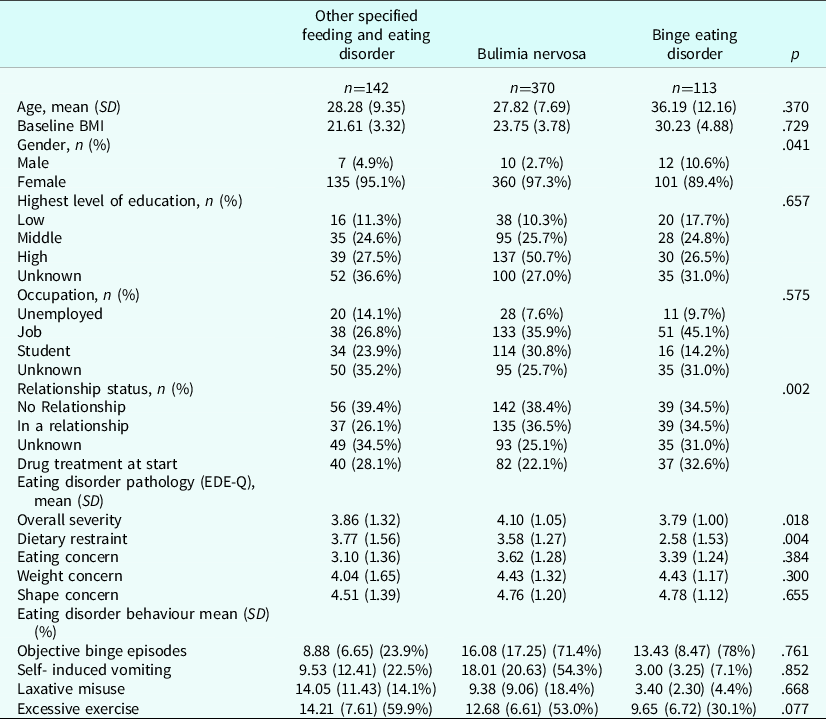
Figure 1 shows that, of the 986 patients originally considered for CBT-E, 277 were excluded because they did not meet the inclusion criteria based on BMI. A further 84 were not included in the initial sample because they did not finalise their 22 treatment sessions within the study time period. The study therefore included 625 patients, 370 of whom met criteria for BN (BN: n=259, OSFED BN: n=111), 113 for BED (BED: n=39, OSFED BED: n=74), and 142 met criteria for OSFED (n=142). Only relationship status, gender and dietary restraint differed at baseline between groups at a p=0.05 significance level. The BED group included more males and had a significantly lower dietary restraint score, and the OSFED group were less in a relationship (Table 1).
Patient characteristics at baseline

The data are shown as means (SD) unless stated otherwise. p<.05 indicates a statistical significance according to a χ2-test or ANOVA.
Treatment completion and compliance regarding the assessments
Of the 625 patients who started treatment, 391 (62.6%) completed the full course of treatment and showed compliance regarding completing the assessments (OSFED: n=101, completion rate 71.1 %; BN: n=208, 56.2 %; BED n=82, 72.6 %). Non-completers completed on average 12.4 (SD=4.10) sessions. Completion rate was significantly lower in the BN group (χ2=18.6, p=.006). Loss to therapy was not predicted by age, waiting list duration, baseline EDE-Q global score, frequency of objective and subjective binge eating, vomiting, laxative misuse, intensive exercising, and BMI. Compliance with the 20 weeks post-treatment follow-up assessments was 80.3% (BN 93.8%, BED 56.1%, OSFED 72.2%). Chi-square analyses revealed no differences between subgroups with regard to compliance at follow-up (χ2=2165.6, p=.790).
Remission
Intention-to-treat analysis
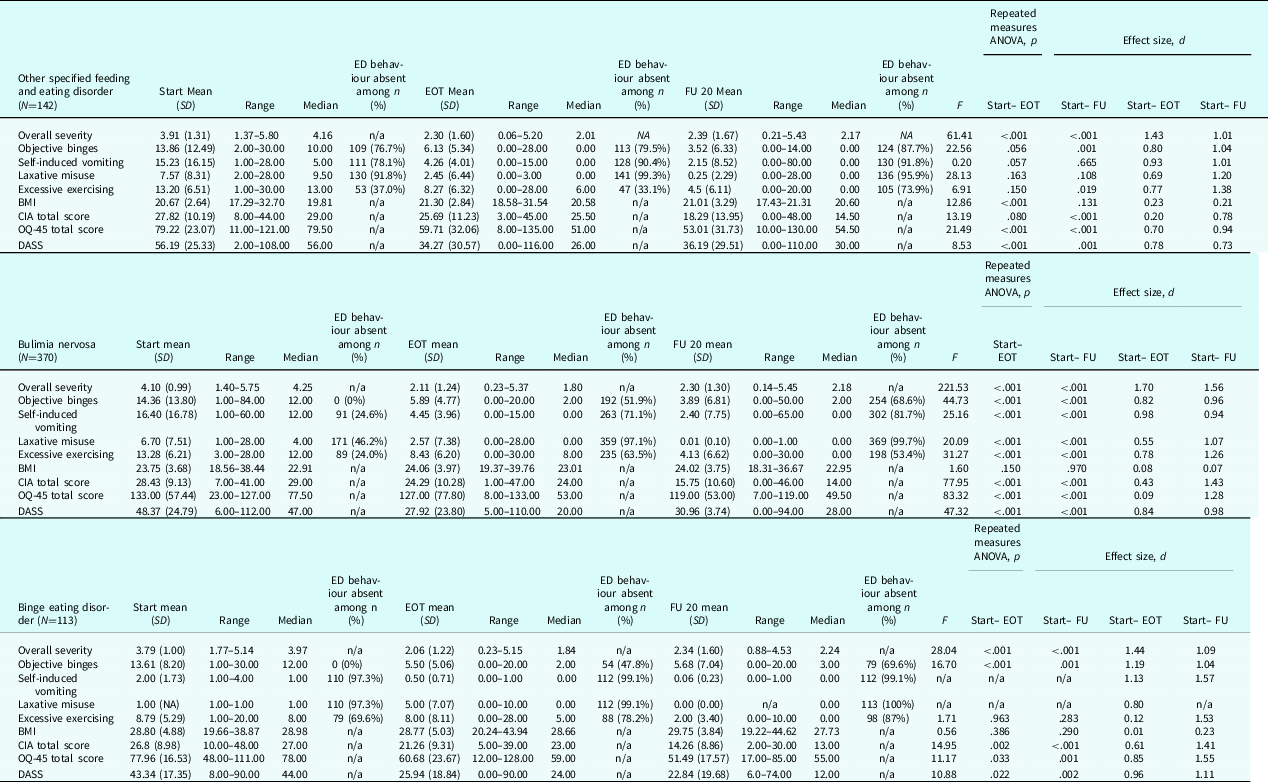
The intention-to-treat analysis was performed on the imputed dataset (N=625, BN: n=370, BED: n=113, OSFED: n=142). Table 2 shows that a repeated measures ANOVA revealed statistically significant improvements on the EDE-Q total score in all groups between start and EOT and start and follow up (Table 2). As sphericity was violated in the BN group, the degrees of freedom were corrected by Huynh-Feldt estimates (ϵ=180.90, p=.005). Effect sizes for all groups were large on the EDE-Q total score (BN: d=1.70, BED: d=1.44, OSFED: d=1.43). Eating disorder behaviours did not always decline significantly; all eating disorder behaviours diminished only significantly in the BN group. BMI only changed in the OSFED group at EOT. Secondary eating disorder pathology and general psychopathology reduced at EOT and follow-up, except for secondary pathology in the OSFED group at EOT.
Changes in EDE-Q global score, eating disorder behaviours, BMI, secondary eating disorder pathology and general psychopathology over the course of treatment and follow-up assessed using intention-to-treat analysis with multiple imputations

BMI, body mass index; CIA, clinical impairment assessment; ED, eating disorder; EOT, end of treatment; FU, follow-up; OQ-45, Outcome Questionnaire-45; n/a, not applicable,
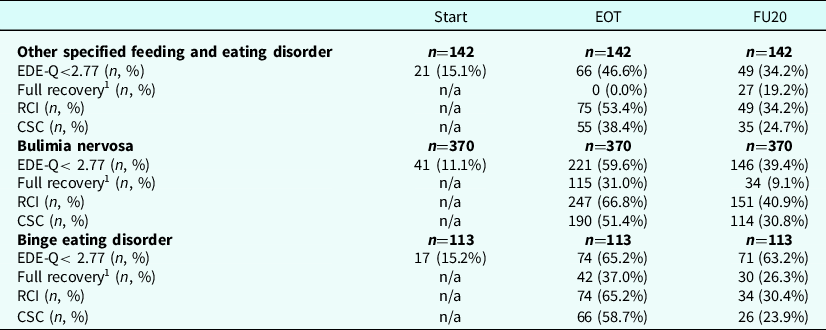
Remission varied between 34.2 and 65.2%. Full recovery was 0–37% and clinically significant change varied between 24.4 and 58.7% (Table 3).
Remission rates for the intention to treat sample

1 Full recovery: EDE-Q<2.77, BMI>18.5 and no eating disorder behaviours (binges, self-induced vomiting, laxative misuse, extensive exercising); CSC, clinical significant change; EOT, end of treatment; FU, follow-up; n/a, not applicable; RCI, reliable change index.
Linear mixed model analysis with fixed effects showed no differences in remission based on the EDE-Q between the three groups (p>.05). Alternative categorisations of diagnosis did not yield different results: additional linear mixed model analysis with fixed effects showed that there were also no differences between groups (p>.05) when all OSFED (n=327) patients were categorised in one group and the BN (n=259), and BED (n=39) group consisted only of BN and BED patients respectively, no differences were found (p>.05). There were also no differences between groups (p>.05) when patients were categorised in five groups (BN, n=259; OSFED BN, n=111; BED, n=39; OSFED BED, n=74; OSFED, n=142).
Completer analyses
All analyses were repeated on the data of the completers sample. There were no substantial differences between the results of the intention-to-treat analysis and the completers analysis. All groups showed statistically significant improvements on the EDE-Q between start and EOT and start and 20 weeks follow-up. There were no further improvements or declines between EOT and follow-up. Effect sizes for all groups were large on the EDE-Q total score (OSFED: d=1.31; BN: d=1.74, BED: d=1.46). However, among the BED group the results of the intention-to-treat analysis were favourable over the completers regarding remission based on EDE-Q<2.77 (65.2 vs 55.8%), and full recovery (37.0 vs 24.6%).
Predictors of treatment outcome
In the intention-to-treat sample, higher level of education predicted better outcomes on EDEQ total score at EOT (r=–0.14, 95% CI= –0.03 to 0.03, p=0.028) and males had better outcomes at follow-up (r=0.18, 95% CI=0.95 to 2.10, p=0.021). However, these associations were not substantial (for a full account of the findings regarding predictors, see Table B in the Supplementary material).
Clinical predictors of treatment outcome regarding EDE-Q total score were investigated in the entire sample and separately for the three subgroups (if not significant for subgroups, only results for the entire sample are reported). In the intention-to-treat sample only severity of eating disorder pathology at baseline was a predictor for eating disorder severity at EOT for the complete sample (r=0.51, 95% CI=0.56 to 0.77, p<0.001), OSFED (r=0.70, 95% CI=0.59 to 0.96, p<0.001), BN (r=0.45, 95% CI=0.51 to 0.82, p<0.001) and BED (r=0.43, 95% CI=0.20 to 0.77, p<0.001).
Baseline EDE-Q score predicted eating disorder severity at follow-up for the entire sample (r=0.55, 95% CI=0.64 to 0.82, p<0.001), for BN (r=0.47, 95% CI=0.44 to 0.89, p=0.021) and OSFED (r=0.72, 95% CI=0.59 to 1.14, p=0.021), not for BED (p>0.05). BMI and frequency of eating disorder behaviours at baseline, duration of the eating disorder, and having been treated before did not predict treatment outcome (p>0.05) in any of the groups (see Table C in Supplementary material).
Discussion
The aim was to determine and compare the effectiveness of CBT-E for non-underweight adults, differentiating between BN, BED, their respective OSFED, and OSFED outside the confines of a randomised controlled trial. Severity at start was higher in the present study compared with other studies (Byrne et al., Reference Byrne, Wade, Hay, Touyz, Fairburn, Treasure, Schmidt, McIntosh, Allen, Fursland and Crosby2017; Poulsen et al., Reference Poulsen, Lunn, Daniel, Folke, Mathiesen, Katznelson and Fairburn2014; Wonderlich et al., Reference Wonderlich, Peterson, Crosby, Smith, Klein, Mitchell and Crow2014). Eating disorder pathology declined significantly, and clinically significant change ranged between 24.4 and 58.7%.
With regard to the various types of remission, there were no differences in treatment outcomes between the completers sample and the intention-to-treat sample; therefore, patients might also recover with a less intense form of treatment (Berg et al., Reference Berg, Schlochtermeier, Koenders, Mooij, Goudriaan, Blankers, Peen and Dekker2020; Moore et al., Reference Moore, Hinde and Waller2021; Waller et al., Reference Waller, Tatham, Turner, Mountford, Bennetts, Bramwell, Dodd and Ingram2018). Only eating disorder severity at start significantly predicted outcome. Consistent with a transdiagnostic perspective on eating disorder treatment, eating disorder diagnosis did not predict treatment outcome regarding overall pathology and full recovery.
The results of the present study replicated the findings of a transdiagnostic treatment effect by van den Berg et al. (Reference van den Berg, Melisse, Koenders, de Jonge, Blankers, de Beurs and Dekker2020). Remission and full recovery rates were comparable with other effectiveness studies, while effect sizes on the EDE-Q were larger compared with other effectiveness studies (Byrne et al., Reference Byrne, Fursland, Allen and Watson2011; Dalle Grave et al., Reference Dalle Grave, Calugi, Sartirana and Fairburn2015; Knott et al., Reference Knott, Woodward, Hoefkens and Limbert2015; Wade et al., Reference Wade, Byrne and Allen2017). In addition, compared with trial studies, effectiveness was somewhat lower (Table A in Supplementary material) (Fairburn et al., Reference Fairburn, Cooper, Doll, O’Connor, Bohn, Hawker, Wales and Palmer2009; Fairburn et al., Reference Fairburn, Bailey-Straebler, Basden, Doll, Jones, Murphy, O’Connor and Cooper2015).
Contrary to expectations, a lower BMI and higher frequency of eating disorder behaviours at start, longer duration of the eating disorder, and treatment in the past did not predict treatment outcome among the complete group, or in any of the subgroups. Based on the results, it was generally not possible to identify a subgroup of patients who especially benefit from CBT-E.
Explanations why the present results regarding treatment outcome predictors differed from previous studies: first, the effect sizes of predictors, such as duration of the eating disorder, BMI (Vall and Wade, Reference Vall and Wade2015) and eating disorder severity (Linardon et al., Reference Linardon, de la Piedad Garcia and Brennan2017a) were small in other studies. Although some studies found eating disorder behaviours to predict treatment outcome, due to the large variations in the reported effects, a meta-analysis did not find their frequency predicted treatment outcome (Vall and Wade, Reference Vall and Wade2015). The use of different definitions may also have impacted research on the prediction of outcome. For instance, Cooper et al. (Reference Cooper, Allen, Bailey-Straebler, Basden, Murphy, O’Connor and Fairburn2016) investigated the prognostic effect of eating disorder duration by categorising duration as greater or less than 8 years, while this study investigated duration as a continuous variable. BMI may not have predicted treatment outcome in the present study because in the present study underweight patients were excluded. Other studies, which found that BMI predicted treatment outcome, did include underweight patients (Linardon et al., Reference Linardon, de la Piedad Garcia and Brennan2017a; Vall and Wade, Reference Vall and Wade2015). Investigation into the prognostic roles of higher levels of self-esteem (Cooper et al., Reference Cooper, Allen, Bailey-Straebler, Basden, Murphy, O’Connor and Fairburn2016), impulsivity, depression (Castellini et al., Reference Castellini, Mannucci, Lo Sauro, Benni, Lazzeretti, Ravaldi, Rotella, Faravelli and Ricca2012) and lower levels of self-control, discrepancy of actual and ideal self (Anderson et al., Reference Anderson, Smith, Schaefer, Crosby, Cao, Engel, Crow, Wonderlich and Peterson2020) when offering CBT-E is also recommended because they predicted poorer treatment outcome when offering eating disorder treatment.
Overall, treatment completion and compliance to the assessments was 62.6%, and the lowest in the BN group. Treatment completion rate was comparable to other effectiveness studies, with rates between 36.3 and 50% (Byrne et al., Reference Byrne, Fursland, Allen and Watson2011; Knott et al., Reference Knott, Woodward, Hoefkens and Limbert2015; Signorini et al., Reference Signorini, Sheffield, Rhodes, Fleming and Ward2018). In addition, the loss to therapy rate of 37% may have been affected by the fact that treatment payment was covered by the patients’ health care insurance. In addition, efforts to ensure patients complete treatment may be more limited in effectiveness studies than in efficacy studies (Byrne et al., Reference Byrne, Fursland, Allen and Watson2011). In addition, as more than 50% of all patients showed compliance regarding the assessments, the results can be generalised to other eating disorder patients (de Beurs et al., Reference de Beurs, Warmerdam and Twisk2019). Motivational sessions prior to commencing treatment might reduce drop-out and enhance treatment completion among patients suffering from BN.
The limitations of the present study are as follows: our findings do not reveal whether long-term recovery was attained, as that requires a longer period of 20 weeks. Unfortunately, compliance towards the assessments was less than 30% at 60 weeks follow-up. The response rate diminishes with a longer follow-up duration, as patients are less committed to provide these data. As response rate at follow-up was about 50%, results might be biased to patients who responded well to treatment or who relapsed. Another limitation was that outcome data were limited to patients’ self-report. There was low concordance between self-reported eating disorder behaviours in the EDE-Q at baseline and during the semi-structured interview at the intake session. An increase in awareness of eating disorder symptomatology over time may lead to a higher score on the EDE-Q, diminishing the pre- to post-test change resulting from treatment (Berg et al., Reference Berg, Swanson, Stiles-Shields, Eddy, Peterson and Le Grange2013). On the other hand, as self-report measures are most widely used, they provide data on treatment outcome in everyday clinical practice. In addition, effectiveness studies potentially deal with diminished internal study validity. One concern is confounding of outcome by extraneous factors, which is an important reason for investigating predictors of treatment outcome in effectiveness research (Leichsenring, Reference Leichsenring2004). Finally, a limitation was the lack of a control group, as confounding factors were not measured.
This study also has several strengths. Analyses were done in a clinically relevant context, with a large sample of patients referred to a specialised eating disorder clinic. As 80.3% of all participants who completed treatment complied with the request to complete the assessments, persistence of benefits of treatment could be assessed at 20 weeks follow up. These results can therefore be generalised to other specialised treatment centres. In addition, all therapists completed their web-centred CBT-E training, were intensively supervised and treatment integrity and protocol adherence was monitored. Since the recent acknowledgement of BED in the DSM-V (APA, 2013), this is, as far as we know, the first study to report CBT-E effectiveness in adult patients diagnosed with BED compared with other eating disorders. Furthermore, additional analyses were performed to assess whether OSFED classification determined group categorisation. In terms of feasibility, the present study shows that CBT-E can be delivered in everyday clinical practice in a specialised eating disorders centre.
In conclusion, CBT-E appeared to be a suitable eating disorder treatment for adults with a BMI between 17.6 and 39.9. Treatment benefits were maintained during 20 weeks follow-up. While there were no significant differences in remission between BN, BED and their respective OSFED and OSFED with a restrictive food pattern, treatment completion was significantly lower in the BN group. The findings are consistent with a transdiagnostic treatment approach. The question for whom CBT-E works best requires further study, because the present data revealed only predictive value of pre-treatment severity of the eating disorder and no other predictors were found.
Key practice points
-
(1) CBT-E is an effective treatment for patients suffering from an eating disorder with a BMI between 17.6 and 39.9.
-
(2) No subgroup of patients benefited differentially from CBT-E.
-
(3) Only severity of eating disorder pathology at start predicted treatment outcome.
-
(4) Drop-out of treatment was only predicted by the diagnosis of bulimia nervosa.
-
(5) Patients might also recover with a less intense form of treatment.
Supplementary material
To view supplementary material for this article, please visit https://doi.org/10.1017/S1754470X22000174
Data availability statement
Data are available upon reasonable request to author B.M.
Acknowledgements
We wish to express our gratitude to all respondents who participated in this study.
Author contributions
All authors contributed to the manuscript. Bernou Melisse: Investigation (lead), Methodology (lead), Writing – original draft (lead); Jack Dekker: Supervision (equal); Elske van den Berg: Writing – review & editing (supporting); Margo de Jonge: Writing – review & editing (supporting); Eric van Furth: Writing – review & editing (supporting); Jaap Peen: Data curation (supporting); Edwin de Beurs: Writing – review & editing (lead).
Financial support
None.
Conflicts of interest
There are no conflicting interests.
Ethical standards
All patients were informed about the study, assured that their data were de-identified, and all signed an informed consent form, in accordance with the World Medical Association Declaration of Helsinki (World Medical Association, 2001). According to the Dutch Central Ethical Commission on Medical Research with human subjects (Dutch abbreviation: CCMO), analysis of anonymised routine outcome monitoring data does not require additional approval from a local medical-ethical approval board.





Comments
No Comments have been published for this article.