White-brined cheese was traditionally produced from either raw or thermised milk and in both cases no starter cultures were employed. However, along with the developments in milk handling and cheese-making technologies, and increase in consumers’ demand toward safer foods, pasteurised milk has largely replaced raw or thermised milk in the production of this cheese variety. Since pasteurised milk is now widely used in the manufacture of white-brined cheese in large scale productions, the use of defined strain starter culture is of critical importance for establishing a balanced aroma/flavour and textural characteristics in the end product (Hayaloglu et al. Reference Hayaloglu, Guven, Fox, Hannon and McSweeney2004, Reference Hayaloglu, Guven, Fox and McSweeney2005). Apart from the roles of starter cultures in aroma/flavour and texture development in cheese, they also produce lactic acid at a controlled rate and hence suppress the activity of undesired microorganisms (Özer, Reference Özer, Robinson, Batt and Patel1999). The selection, maintenance and use of starter cultures are, perhaps, the most important aspects of cheese-making, particularly in the context of a modern mechanised process(es) for which predictability and consistency are essential (Hayaloglu et al. Reference Hayaloglu, Guven and Fox2002). On the other hand, white-brined cheeses produced from pasteurised milk are likely to contain non-starter lactic acid bacteria (NSLAB) originating from cheese milk and/or the environment during cheese manufacturing and ripening. In case of use of pasteurised milk in cheese-making, the most common sources of NSLAB are the post-pasteurisation contact with equipment surfaces and air (Banks & Williams, Reference Banks and Williams2004). At the later stages of ripening, NSLAB may dominate the viable bacterial population of the cheese (Banks & Williams, Reference Banks and Williams2004). Therefore, the selection of adjunct cultures (e.g. lactobacilli) from NSLAB population seems to be an effective way of controlling cheese quality and cheese microflora. Up until now, many efforts have been made to establish the best match of combination of starter and adjunct bacteria in various cheese types (El-Soda et al. Reference El-Soda, Madkor and Tong2000). Apart from the well-characterised role of adjunct cultures on ensuring the standardised quality in cheese, these microorganisms may well contribute to the formation of biologically active peptides with angiotensin converting enzyme-I (ACE-I) inhibitory or anti-hypertensive capacities as well as immunomodulatory, anti-oxidative or anti-microbial properties (Robert et al. Reference Robert, Razaname, Mutter and Juillerat2004). Lactobacilli occupy the largest stake of NSLAB population in brined-type cheeses and these microorganisms contribute to the proteolysis and, in turn, production of ACE-I peptides (Sieber et al. Reference Sieber, Bütikofer, Egger, Portmann, Walther and Wechsler2010). Ripening time and temperature are determinative factors in the growth of lactobacilli, especially in brine-ripened cheeses.
There is a close relationship between high blood pressure and cardiovascular diseases and end stage renal diseases. Angiotensin converting enzyme (ACE; dipeptidyl carboxypeptidase, EC 3.4.15.1.) plays a primary role on the regulation of blood pressure and therefore, it is of crucial importance to inhibit the activity of this enzyme to create an anti-hypertensive effect in the human body (Wang et al. Reference Wang, Cui, Chen and Zhang2011). ACE-inhibitory peptides are a class of bioactive peptides which are hidden in the original parent protein structure (Ong et al. Reference Ong, Henriksson and Shah2007) and liberated from mainly caseins by peptidases of lactic acid bacteria (Bütikofer et al. Reference Bütikofer, Meyer, Sieber and Wechsler2007). During the last two decades, efforts have been made to investigate and characterise milk-derived peptides with ACE-inhibitory activity (Otte et al. Reference Otte, Shalaby, Zakora, Pripp and Shabrawyb2007). Isoleucine-proline-proline (IPP) and valine-proline-proline (VPP) were the first tri-peptides characterised with potent ACE-inhibitory activity (Nakamura et al. Reference Nakamura, Yamamoto, Sakai and Takano1995; Bütikofer et al. Reference Bütikofer, Meyer, Sieber and Wechsler2007) and it was demonstrated that fermented milks containing these bio-peptides effectively reduced the blood pressure in humans (Seppo et al. Reference Seppo, Kerojoki, Suomalainen and Korpela2002, Reference Seppo, Jauhianene, Poussa and Korpela2003; Tuomilehto et al. Reference Tuomilehto, Lindström, Hryyrynen, Korpela, Karhunen, Mikkola, Jauhiainen, Seppo and Nissinen2004). Cheese is potentially a good source of ACE inhibitory peptides (Sieber et al. Reference Sieber, Bütikofer, Egger, Portmann, Walther and Wechsler2010). Although the mechanism of ACE-inhibitory peptide formation and their correlation with blood-pressure reducing effect in vivo have been firmly established in fermented milks, the identification and characterisation of ACE-inhibitory peptides in cheese are rather problematic due to complex matrix of cheese and continuously degradation of newly formed peptides to smaller molecular weight peptides during ripening. Some bioactive peptides may further be degraded during ripening and some newly formed peptides may exert anti-hypertensive effect (Parrot et al. Reference Parrot, Degraeve, Curia and Martial-Gros2003; Urista et al. Reference Urista, Alvarez-Fernandez, Riera-Rodriguez, Arana-Cuenca and Tellez Jurado2011). Various types of cheese have been subjected to investigation regarding formation and stability of ACE-inhibitory peptides during processing and ripening. These include Crescenza, Gorgonzola, Mozzarella, Camembert, Edam, Gouda, Cheddar, Roqueforti, Emmentaler, Parmesan, Gamalost, Norvegia, Brie, Fresco and Feta (Smacchi & Gobbetti, Reference Smacchi and Gobbetti1998; Ryhänen et al. Reference Ryhänen, Pihlanto and Pahkala2001; Bütikofer et al. Reference Bütikofer, Meyer, Sieber and Wechsler2007). The ACE-inhibiting activity of the peptides shows a time-dependent characteristic in cheese. For example, the peptides with ACE-inhibitory activity isolated from six-month old Parmesan cheese could not be found after 15 months (Addeo et al. Reference Addeo, Chianese, Salzano, Sacchi, Cappuccio, Ferranti and Malirni1992). Similarly, the physiologically-active peptide concentration of medium-aged Gouda cheese declined to almost half in long-aged Gouda cheese (Meisel et al. Reference Meisel, Goepfert and Günther1997). The levels of ACE-inhibitory peptides fluctuated in Manchego cheese during ripening, being low during the first four months of aging, reaching the maximum level at the age of eight months and then declined again through twelve months of aging (Gomez-Ruiz et al. Reference Gomez-Ruiz, Ramos and Recio2002). On contrary, Ong et al. (Reference Ong, Henriksson and Shah2007) demonstrated that ACE-inhibitory activity of water soluble extract of Cheddar cheese inoculated with Lb. casei 279 or Lb. casei LAFTI® as adjunct cultures increased continuously until 24 week of aging and then remained stable through the end of ripening.
The proteolysis profile and hence stability of bioactive peptides in brined-type cheeses shows somehow differences from pasta-filata or Cheddar-type cheeses (Fox et al. Reference Fox, Guinee, Cogan and McSweeney2000). Both high salt level and mass transfer between cheese and brine in the brined cheeses may affect the stability of bioactive peptides during ripening (Hayaloglu et al. Reference Hayaloglu, Guven and Fox2002). Although the proteolysis in brined-type cheeses have been well-documented (Hayaloglu et al. Reference Hayaloglu, Guven and Fox2002, Reference Hayaloglu, Guven, Fox and McSweeney2005), the relationship between the depth of proteloysis and ACE-inhibitory peptide activities in brined cheese variety has been subjected to a limited number of studies until now (Erkaya et al. unpublished; Sieber et al. Reference Sieber, Bütikofer, Egger, Portmann, Walther and Wechsler2010). The adjunct cultures and ripening temperature greatly affect the profile of proteolysis in white-brined cheese and these variables are also thought to interfere with the formation and stability of ACE-inhibitory peptides activity in this variety. Therefore the present work aimed to investigate the effects of addition of adjunct lactobacilli (Lb. helveticus or Lb. casei) and ripening temperature (6 or 12 °C) on proteolysis and ACE-I inhibitory capacity of white-brined cheese during 120 d ripening with 30-d intervals.
Materials and methods
Milk, starter and adjunct cultures
Raw bovine milk supplied from Harran University Dairy (Sanliurfa, Turkey) was used in the manufacture of cheese. Coagulation of cheese milk was achieved by means of calf rennet with declared coagulating power of 200 IMCU (Peyma Chr-Hansen A.S., Istanbul, Turkey). Commercial cheese starter culture was a mixture of Lactococcus lactis subsp. lactis and Lb. lactis subsp. cremoris and adjunct cultures consisted of Lb. casei and Lb. helveticus. Both starters and adjunct cultures were supplied by Peyma Chr-Hansen A.S. All chemicals used were of analytical grade (Sigma-Aldrich Chemie GmbH, Taufkirchen, Germany).
Cheese-making protocol
Three batches of bovine milk (each of 100 l) were converted to cheese at the same time as described in Hayaloglu et al. (Reference Hayaloglu, Guven and Fox2002). The milk was heat-treated at 68 °C for 10 min and cooled to coagulating temperature of 35 °C. The first vat was inoculated with commercial starter culture only (cheese A). The second and third vats were inoculated with commercial starters plus Lb. helveticus (cheese B) or Lb. casei (cheese C), respectively. The level of inoculum was 1% (v/v) [1% of liquid cheese culture for the cheese A, and 0·5% of liquid cheese culture plus 0·5% of liquid adjunct culture for the cheeses B and C]. The inoculated milk was then held for an hour to allow the development of acidity until pH 6·3 prior to addition of coagulating enzyme. The coagulation was completed within 100 min and then the curd was cut into approximately 1 cm3 cubes. After removal of whey by pressing, fresh cheese was portioned to blocks (7×7×7 cm). Cheese blocks were ripened in brine (12% NaCl, w/v) at 6 or 12 °C for 120 d. The cheeses were taken for analyses with 30-d intervals.
Gross chemical composition and proteolysis
The total solids, fat, total nitrogen and salt were determined in the cheeses according to the methods described in Ardö & Polychroniadou (Reference Ardö and Polychroniadou1999). The pH was measured by means of a combined electrode pH-meter (Thermo Orion, Asheville, NC, USA). Proteolysis was monitored by urea-polyacrylamide gel electrophoresis (urea-PAGE) and reversed-phase high performance liquid chromatography (RP-HPLC) analyses. Urea-PAGE of the water-insoluble and RP-HPLC of the water-soluble fractions of the cheese were determined by the methods described in Hayaloglu et al. (Reference Hayaloglu, Guven, Fox, Hannon and McSweeney2004). The gels scanned through HP ScanJet G4010 (Hewlett Packard, Palo Alto, CA, USA) were quantified using densitometric software (Image Master Total Lab Phonetix 1 D Pro-software, Newcastle-upon Tyne, UK). The caseins were determined quantitatively by integrating peak volumes using the densitometer. Total FAAs content of the cheeses was determined by the method described in Hayaloglu (Reference Hayaloglu2007).
Determination of individual free amino acids
One hundred milligram of freeze-dried WSE was mixed with 20 μl 40 mM methionine sulphone. The mixture was further mixed with 1 ml trichloroacetic acid (40%, w/v), and then homogenised using a vortex mixer. Afterwards, the homogenised mixture was held at 4 °C for 10 min and centrifuged at 20 000 g for 10 min. The deproteinised supernatant (25 μl) was vacuum-dried. Twenty microliters of buffer solution containing methanol, triethyleneamine and 1 M sodium acetate at ratios of 2 : 1 : 2, respectively, were added to the dried samples and the mixture was re-dried under vacuum. Twenty ml of derivatising solution (prepared by mixing methanol, water, triethyleneamine and phenylthiocyanate at ratios of 7 : 1 : 1 : 1, respectively) was added to the dried samples. The samples were incubated at room temperature for 20 min and then vacuum-dried. One ml of dilution buffer was added to the dried samples and the diluted samples were passed through a filter paper (0·20 μm, CROMAFIL Xtra PVDF-20/25, MN GmbH, Düren, Germany). The volume of the filtrate loaded into the HPLC column (Inertsil RP C18 column, GL Science Inc, Tokyo, Japan) was 20 μl. The amino acid standard was prepared by mixing acidic, neutral and basic amino acids at ratios of 1 : 1 : 1. Methionine sulphone was used as internal standard. The eluent A consisted of 70 mM sodium acetate which was adjusted to pH 6·55 with acetic acid containing acetonitrile (2·5%, v/v). The eluent B contained acetonitrile, water and methanol at ratios of 9 : 8 : 7, respectively. Na2EDTA was added to each solvent at a level of 10 mg/ml. The results were expressed as μg/g dry WSE.
Determination of the angiotensin converting enzyme (ACE) inhibition activity
The ACE-I-inhibitory activity of the WSE of the cheeses was determined according to the method developed by Cushman & Cheung (Reference Cushman and Cheung1971) which was further modified by Bütikofer et al. (Reference Bütikofer, Meyer, Sieber and Wechsler2007). Five grams of the cheese samples were mixed with 10 ml water and then homogenised for 15 s (Ultra Turrax Model T15, IKA, Werk, Germany). The homogenate was kept at 40 °C for 60 min prior to centrifugation at 10 000 g for 30 min at 4 °C. The extracts were centrifuged at room temperature for 99 min at 14 000 g and the water-soluble fractions were filtered through 3000 MWCO Microcon ym-3 (Millipore AG, Volketswil, Switzerland) filter. Five hundreds microliters of the extract was stored at −20 °C. The samples (20 μl) added with 50 μl HHL substrate (Hippuryl-Histidyl-Leucine-OH, 5 mM) were mixed with 5 μl ACE (0·5 U/ml). The mixture was kept at 37 °C for 60 min and 62·5 μl 1 M HCl was added to stop the reaction. Then 375 μl ethyl acetate was added to the mixture and the mixture was centrifuged (5000 g , 30 min, 4 °C). The liquid phase was dried at 120 °C and the same volume of water was added. Measurement was achieved at 228 nm wavelength. The percentage of inhibition was calculated as follows:
 $${\rm ACE}\,{\rm inhibitory}\,{\rm activity}\,(\% ) = \left[ {1 - \displaystyle{{\left( {A - C} \right)} \over {\left( {B - D} \right)}}} \right] \times 100$$
where A is the absorbance with ACE, HHL and ACE-inhibitory sample, B is the absorbance with ACE and HHL without ACE-inhibitory sample, C is the absorbance with HHL and ACE-inhibitory sample without ACE and D is the absorbance with HHL without ACE and ACE-inhibitory sample.
Microbiological analysis
Ten grams of the cheese samples were dissolved in 90 ml of sodium citrate buffer solution (2%, w/v) and homogenised using a Stomacher device (Seward 400 Circulator, London, UK). Serial dilutions were prepared using 0·1% (w/v) of sterile peptone water. Numbers of total starter bacteria and Lb. casei were counted on M17 agar incubated at 37 °C for 48 h and de Man Rogosa Sharpe (MRS) agar incubated anaerobically at 30 °C for 48 h, respectively (Harrigan, Reference Harrigan1998). For the counts of Lb. helveticus, the acidified-MRS agar (pH 5·4) was used at 37 °C for 48 h under anaerobic conditions (Lee et al. Reference Lee, Kilcawley, Hannon, Park, Wilkinson and Beresford2007).
Statistical analysis
Data obtained were analysed statistically using SPSS statistical package program (SPSS version 9.0, SPSS Inc., Chicago, IL, USA). Duncan's Multiple Range Test was used to determine the statistically different groups. The trial including cheese-making was repeated twice and the level of confidence was at least 95% (P<0·05).
Results and discussions
Gross chemical composition and pH of the cheeses
Chemical compositions of 1-d old white-brined cheeses ranged between 5·1±0·0–5·3±0·0 for pH, 40·3±0·3–42·8±0·6% for total solids, 25·5±0·7–27·0±0·0% for fat, 15·8±0·5–16·7±1·4% for total protein and 4·9±0·1–5·9±0·0% for salt. The use of adjunct culture significantly affected the pH, total solids, salt and fat contents of the cheeses (P<0·05). The highest and lowest pH values were determined in the cheeses C and B, respectively. The gross chemical compositions of the experimental cheeses showed similarities to those reported previously for brined-type cheeses (Hayaloglu et al. Reference Hayaloglu, Guven and Fox2002, Reference Hayaloglu, Guven, Fox and McSweeney2005; Hashemi et al. Reference Hashemi, Azar and Mazlumi2009; Wang et al. Reference Wang, Cui, Chen and Zhang2011).
Changes in the levels of total and individual free amino acids (FAAs)
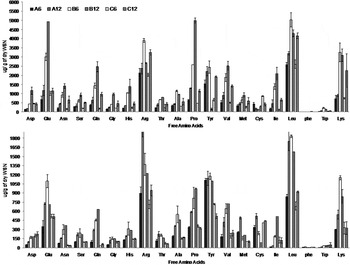
Figure 1 shows the variation in total FAA levels of the cheeses throughout ripening period. Except for the cheese B ripened at 12 °C, all samples had close total FAA concentrations to each other at each aging time. The total FAA levels of the cheeses increased slowly but continuously during ripening, as reported in previous studies (Mallatou et al. Reference Mallatou, Pappa and Boumba2004; Hayaloglu et al. Reference Hayaloglu, Guven, Fox and McSweeney2005; Pappa & Sotirakoglou, Reference Pappa and Sotirakoglou2008). Apparently, the use of Lb. helveticus as adjunct culture led to a remarkable increase in total FAA levels. The principal FAAs in all experimental cheeses were Glu, Val, Tyr, Arg, Pro, Leu and Lys (Fig. 2). Similar to total FAAs, the concentrations of individual FAAs increased during ripening. The cheeses ripened at 12 °C had about 1·5–2 times higher levels of individual FAAs than those ripened at 6 °C. The cheese B at 12 °C had relatively higher levels of individual and total FAAs than the cheeses A and C, indicating faster development of proteolysis in the former cheese than the others. Separate and combined effects of ripening temperature and adjunct culture influenced the individual FAA levels of the cheeses significantly (P<0·01). Milesi et al. (Reference Milesi, Bergamini and Hynes2011) reported that higher levels of individual FAAs were observed in the cheeses made using adjunct lactobacilli than that of the cheeses made with starter lactococci. Both total and individual FAA concentrations provided information to identify Lb. helveticus and Lb. casei according to their proteolytic capacities. Although, in the present case, the evaluation of the degree of autolysis was not made, the differences in proteolytic capabilities of the adjunct cultures used were thought to be related to the differences in their autolytic properties especially at higher ripening temperature (12 °C). High autolysis in many strains of Lb. helveticus at relatively high ripening temperatures was reported by Madkor et al. (Reference Madkor, Tong and El-Soda2000) and Hannon et al. (Reference Hannon, Kilcawley, Wilkinson, Delahunty and Beresford2007).
Mean values of total free amino acid levels of white-brined cheeses ◊: Cheese A made with only cheese starter (Lc. lactis subsp. lactis+Lc. lactis subsp. cremoris) □: Cheese B, made with cheese starter plus Lb. helveticus, △: Cheese C, made with cheese starter plus Lb. casei.

Concentrations of individual free amino acids after 30 (bottom) and 120 (top) d ripening. Letters indicate cheese samples (for cheese codes refer to Fig. 1). Numbers indicate the temperature of ripening.

Changes in water-soluble and -insoluble fractions of the cheeses
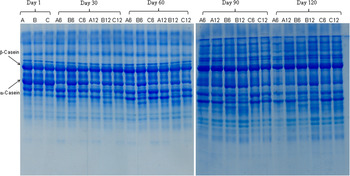
Urea-polyacrylamide gel electrophoresis (urea-PAGE) of the water-insoluble fractions of the cheeses after 1, 30, 60 or 120 d ripening are presented in Fig. 3. In all cheese groups, the intensities of the bands representing αs1-casein and β-casein decreased during the ripening period, being more pronounced in αs1-casein. It is known that β-casein shows higher resistance against hydrolysis in cheese than αs1-casein (Sarantinopoulos et al. Reference Sarantinopoulos, Kanaltzopoulos and Tsakalidou2002; Hayaloglu et al. Reference Hayaloglu, Guven, Fox, Hannon and McSweeney2004). Degradation of β-casein in brined-type cheeses with high salt level and low pH is markedly less. The initial degradation of casein in cheese is carried out mainly by residual coagulant; however, enzymes released by the starter bacteria are primarily responsible for the hydrolysis of αs1-casein degradation products [e.g. αs1-casein (f102–199), αs1-I-casein (f24–199)] and other peptides (Hayaloglu et al. Reference Hayaloglu, Guven, Fox, Hannon and McSweeney2004). Qualitative and quantitative differences between the electrophoretograms of the water-insoluble fractions of the cheeses were evident after 60 d, especially in the cheese B. The differences between electrophoretic mobilities of the cheeses could well be attributed to the differences in peptidase/aminopeptidase enzyme systems of the adjunct cultures. Ripening at 12 °C caused an increase in casein degradation in all cheeses. This finding was in agreement with those reported in Folkertsma et al. (Reference Folkertsma, Fox and McSweeney1996), Fenelon et al. (Reference Fenelon, Ryan, Rea, Guinee, Ross, Hill and Harrington1999) and Ong & Shah (Reference Ong and Shah2009). In the same line, Sihufe et al. (Reference Sihufe, Zorilla and Rubiolo2010) reported that degradation of caseins was higher in Reggianito cheeses ripened at 18 °C than those of 12 °C.
Urea-PAGE pattern of the water-insoluble fraction of white-brined cheeses during 120 d ripening. For cheese codes refer to Fig. 1

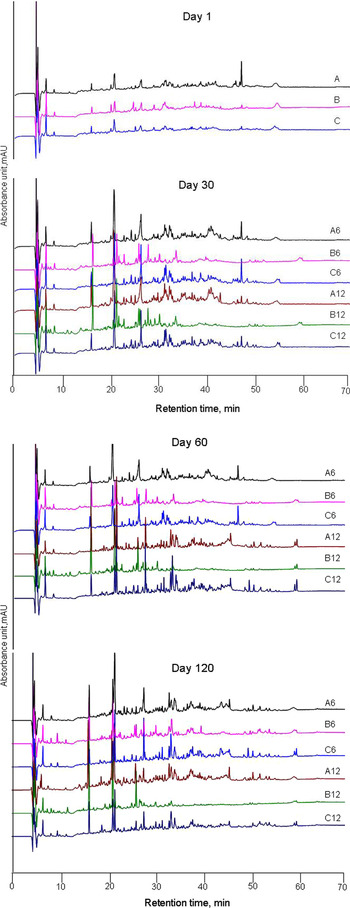
RP-HPLC chromatograms of the water-soluble fractions of the cheeses at days 1, 30, 60 or 120 are illustrated in Fig. 4. Four major peaks (with retention times of 7, 17, 21 and 27 min) and three minor peaks (with retention times of 8, 24 and 48 min) were noted in all cheese groups. The peaks representing the peptide profiles of the water-soluble fraction of the cheeses became more pronounced at day 30 onwards. It is clearly seen from the chromatograms that the peak heights in the cheese B were lower than those of the cheeses A and C regardless of ripening temperature. Since the principal starter bacteria were the same in all cheeses, it is fair to assume that the differences between the samples were due to the differences in proteolytic enzyme systems of the adjunct cultures used in the manufacture of the cheeses and/or differences in the pH values of the cheeses. Some specific peptides eluted at 47 min were only detected in cheese A at the beginning of ripening and they became visible in cheese C at 30 d onward, with lower concentrations but not in cheese B (Fig. 4). On the contrary, the peaks with retention times of 7 to 13 min were only identified in cheese B (with higher concentrations at 12 °C) after 30 d ripening (Fig. 4). In general, early eluted peptides are characterised with low molecular weight and hydrophilic nature (Hayaloglu et al. Reference Hayaloglu, Guven, Fox, Hannon and McSweeney2004). In the present case, only Lb. helveticus was able to produce such peptides (cheese B). Hydrophobic peptides (eluted at later retention times) are hydrolysed to FAAs by the bacterial enzymes (Fox et al. Reference Fox, O'Connor, McSweeney, Guinee and O'Brien1996). Indeed, the concentrations of total or individual FAAs were the highest in cheese B (Figs. 1 & 2). Similarly, it was reported that further hydrolysis of peptides by Lb. helveticus in Cheddar cheese during ripening was reported (Hannon et al. Reference Hannon, Wilkinson, Delahunty, Wallace, Morrissey and Beresford2003).
Reverse phase-HPLC peptide profiles of water-soluble fraction of white-brined cheeses after 1, 30, 60 or 120 d ripening. For cheese codes refer to Fig. 1.

Changes in ACE-I inhibitory activities
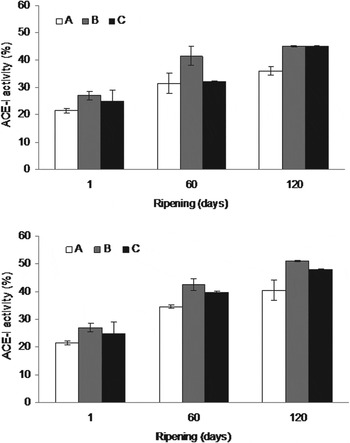
Variations in the ACE-I inhibitory activities of the experimental cheeses throughout ripening are shown in Fig. 5. Regardless to the ripening temperature, in all cheese groups, the ACE-I inhibitory activities increased with advanced ripening (P<0·05). At the end of the ripening period (day 120), the ACE-I inhibitory activities of cheeses B and C were close to each other but significantly higher than the control cheeses at both ripening temperatures (P<0·05). The cheeses ripened at higher temperature (12 °C) had slightly higher ACE-I inhibitory activities than the cheeses ripened at 6 °C. Overall, the ACE-I inhibitory capacities of the cheeses were found to be closely related to the level of proteolysis of the samples as detected by urea-PAGE of caseins and RP-HPLC of peptides or individual FAAs. Similar correlation between degree of proteolysis and release of bioactive peptides with ACE-inhibitory activity was reported by Addeo et al. (Reference Addeo, Chianese, Salzano, Sacchi, Cappuccio, Ferranti and Malirni1992), Meisel et al. (Reference Meisel, Goepfert and Günther1997) and Pripp et al. (Reference Pripp, Sorensen, Stepaniak and Sorhaug2006). The release of ACE-inhibitory peptides (i.e. IPP and VPP) is a result of the actions of peptidolytic enzymes (Ong & Shah, Reference Ong and Shah2008b). Meyer et al. (Reference Meyer, Bütikofer, Walther, Wechsler and Sieber2009) also reported the stimulating action of Lb. helveticus on the formation of IPP and VPP in Swiss cheeses. In the present case, no decline in the level of bioactive peptides was observed, indicating lower rate of hydrolysation of ACE-inhibitory peptides into smaller molecular weight peptides than the formation of new bioactive peptides. ACE prefers substrates or competitive peptides containing hydrophobic amino acid residues at C-terminus such as proline (Cheung et al. Reference Cheung, Wang, Ondetti, Sabo and Cushman1980). In the present case, lower level of hydrophobic peptides (Fig. 4) and higher levels of proline in the sample B (Fig. 2) correlate with the higher ACE-inhibitory activity in this sample (Fig. 5), which was more pronounced at higher ripening temperature (12 °C). The effect of ripening temperature on the activity of ACE-inhibitory peptides was well-demonstrated in Cheddar cheese by Ong & Shah (Reference Ong and Shah2008a). The authors showed that the concentration of the ACE-I inhibitory peptides increased in Cheddar cheese during the first six weeks of ripening, and the cheeses ripened at higher temperatures (8 or 12 °C) had higher levels of ACE-I inhibitory peptides than their counterparts ripened at lower temperature (4 °C). IC50 values of the peptides were not measured in the present study. However, Ong & Shah (Reference Ong and Shah2008b) found that ripening temperature did not affect the IC50 values of the peptides, indicating that the peptides responsible for the ACE inhibition were the same. Feta-type brined cheeses usually have lower level of ACE-inhibitory peptides than the hard and semi-hard cheeses such as Emmental, Gruyere, Gouda, Manchego and Edam (Bütikofer et al. Reference Bütikofer, Meyer, Sieber and Wechsler2007). This may be attributed to the adverse effect of NaCl on the development of proteolysis in such varieties. Similar results were reported by Meira et al. (Reference Meira, Dariot, Helfer, Correa, Segalin, Carro and Brandelli2012) who showed that water soluble extracts of Feta-type Brazilian cheese had lower ACE-inhibitory activity than Roquefort-type Brazilian cheese (46 vs. 80%, respectively).
ACE-inhibitory activity of white-brined cheeses ripened at 6 °C (top) or 12 °C (bottom). For cheese codes refer to Fig. 1.

Changes in microbial counts
The numbers of the Lb. helveticus in cheese B and Lb. casei in cheese C ripened at 6 °C were 3·24 log10 cfu/g and 5·54 log10 cfu/g, respectively, at the end of ripening period. At 12 °C, the numbers of these bacteria increased to 3·48 log10 cfu/g and 6·28 log10 cfu/g, in the same order. A slight decrease in the numbers of Lb. helveticus and Lb. casei was noted after 60 d ripening, due possible to the bacterial lysis. Similar results were reported for Feta cheese made using different starter cultures (Sarantinopoulos et al. Reference Sarantinopoulos, Kanaltzopoulos and Tsakalidou2002). The decrease in the counts of adjunct culture after 60 d coincided with the sharp increase in the level of casein degradation (Fig. 3). This may be linked to the lysis of these bacteria and release of enzymes into the cheese matrix (Crow et al. Reference Crow, Coolbear, Gopal, Martley, McKay and Riepe1995; Hannon et al. Reference Hannon, Kilcawley, Wilkinson, Delahunty and Beresford2007). At 120 d ripening, cheese B (∼7·1 log10 cfu/g) had higher number of starter bacteria at both ripening temperatures (6 or 12 °C) than cheeses A (∼6·5 and 6·4 log10 cfu/g) and C (∼6·3 and 6·7 log10 cfu/g), respectively. In general, the ripening temperature had insignificant effect on the number of lactococci in the cheeses. However, the incorporation of adjunct culture affected the counts of lactococci significantly (P<0·01).
Conclusion
Results obtained indicated that the use of adjunct culture of Lb. helveticus resulted in faster development of proteolysis in white-brined cheese. Similarly, increasing the ripening temperature from 6 °C to 12 °C led to a faster development of proteolysis as well as production of ACE-I inhibitory peptides. It is not expected that consumption of brined cheese with high ACE inhibitory peptides activity in vitro will often closely correlate with their blood-pressure reducing effect in vivo (Qureshi et al. Reference Qureshi, Vegarud, Abrahamsen and Skeie2013). Therefore, further studies should concentrate on the characterisation of ACE-I inhibitory peptides and their stability against digestive enzymes. Also technological factors affecting the stability of bioactive peptides in brined-type cheeses during the ripening period should be investigated in detail.
This research was partially financed by Inonu University (Malatya, Turkey) Scientific and Research Project Units with project number 2010/33.
Supplementary material
The supplementary material for this article can be found at http://www.journals.cambridge.org/dar