Introduction
In the Arctic region the ‘[p]ermafrost is warming, hydrological processes are changing and biological and social systems are also evolving in response to these changing conditions . . . and the Arctic is undergoing a system-wide response to an altered climatic state’ (Hinzman et al., Reference Hinzman, Bettez, Bolton, Chapin, Dyurgerov, Fastie and Yoshikawa2005, p. 251). It is stated that climate change is happening at a faster rate in the region than in most other parts of the world, and that the impacts are more severe (Columbia Climate Center, World Wildlife Fund, Woods Hole Research Center & Arctic 21, 2016; WWF, n.d.). This is considered to be a global issue, not just local or regional, as the impacts will be evident worldwide, through manifestations such as sea level rise and changing atmospheric currents (Jacob, Wahr, Pfeffor & Swenson, Reference Jacob, Wahr, Pfeffer and Swenson2012; Screen, Deser, Simmonds & Tomas, Reference Screen, Deser, Simmonds and Tomas2014; WWF, n.d.).
At the same time, melting of the ice sheets and sea ice opens up opportunities for further utilisation of natural resources, such as minerals and fossil fuels, and development of new sea routes of importance for commercial shipping and tourism. Opportunities have been identified as access to mineral resources, mining, fisheries, shipping and logistics, and tourism (Emmerson & Lahn, Reference Emmerson and Lahn2012). These opportunities are expected to attract considerable investment from around the globe, yet developments will not occur without multiple risks, as have been identified in a 2012 Lloyd's of London report. These include the geographical remoteness of the area, challenges with electronic communications, and climate change-related factors such as melting permafrost, extreme weather, icebergs and icing. In the Arctic there are environmental risks connected to industries such as oil and gas and mining, including the issue of black carbon. Equally, such environmental risks also derive from pollution occurring outside of the Arctic and, irrespective of the source, they will influence how rapidly the Arctic will warm. Economic activities may also lead to ecosystem disturbances. Additionally, in cases where environmental risks materialise, questions would inevitably arise as to who is liable and under which liability regime. This may, as a consequence, result in considerable reputational and political risk for involved parties (Emmerson & Lahn, Reference Emmerson and Lahn2012).
In no small part due to these factors, the number of stakeholders taking part in the Arctic Circle Assembly (ACA) dialogue in Reykjavík, Iceland, has been growing annually from over 1,200 participants in 2013 to over 2,000 in 2016. Here we briefly address three research questions: (1) Who are the key stakeholders taking part in plenary and breakout sessions? (2) What were the most frequently used terms in the titles of the plenary and breakout sessions? (3) Has there been a change in the themes and terms used in the titles of the plenary and breakout sessions over time?
ATLAS.is 7.5.17, trial version. [Computer software] (1999) Berlin, Scientific Software Development GmbH was used to analyse the conference programmes for 2013–2016 and Microsoft Excel (2013) Pivot tables was used to analyse stakeholders. Collectively, the responses to the three research questions provide a framework for a comprehensive discourse analysis in the future.
Framework for discourse analysis of the 2013–2016 ACA conference programmes
In the following sections three questions will be addressed focusing on stakeholders taking part in plenary and breakout sessions, terms most frequently used in the titles of plenary and breakout sessions and if there has been a change in the themes and terms used in the titles of plenary and breakout sessions over time.
Who are the key stakeholders taking part in plenary and breakout sessions?
The 2013–2016 ACA programmes included the names and working titles of speakers presenting in plenary or breakout sessions, including keynotes, speeches, presentations and panel discussions. In order to analyse the stakeholders involved, the speakers have been labelled as being from finance, government (federal/national), indigenous peoples, industry, institutions (including research institutions), intergovernmental organisations, non-governmental organisations (NGOs; namely environmental NGOs), research, universities and others (including media and artists).
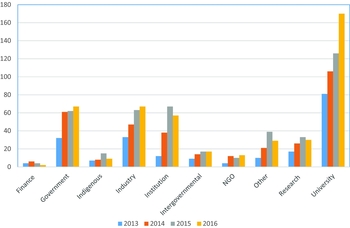
Fig. 1 shows the growing number of speakers presenting in plenary or breakout sessions over time, ranging from 209 in 2013 to 461 in 2016, and how stakeholders were represented. The presence of speakers from universities, government, industry and institutions is quite evident. Fig. 1 indicates that critical stakeholders concerned with the development of the region, such as the indigenous peoples and NGOs, seem to be under-represented at the conference.

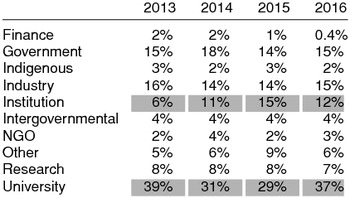
The percentage of speakers presenting in plenary and breakout sessions representing different stakeholder groups over the four years of analysis are quite stable (see Table 1), except for representatives from institutions, which grew from 6% in 2013 to between 11–15% in the following years. There was also a fluctuation in the percentage of stakeholders from universities, ranging between 29–39% of the total.

What were the most frequently used terms in the titles of the plenary and breakout sessions?
An analysis of the words used in the conference agendas, after removing speakers’ names and working titles, and function words such as ‘if’, ‘and’, ‘as’, resulted in 781 words in 2013, 1,212 in 2014, 2,257 in 2015 and 2,584 in 2016. By sorting these words according to frequency, it became apparent that some words were only used frequently at one particular conference. For example, China was used eight times in 2014, discussed in the context of a video message delivered by Wang Yi, Foreign Minister of the People's Republic of China, a country session organised by China, a photo exhibition titled China and the Arctic, and a session on Sino–Icelandic geothermal cooperation. The terms lessons (eight times) and Himalayan (eight times) were evident in the 2013 programme in the context of so-called Arctic Lessons for the Himalayan/Third Pole Region. Report was frequently used (12 times) in the 2014 programme, in particular within The Polar Risk Report on a World Economic Forum Project, The Arctic Yearbook, reports on the High Seas, the China–Nordic Arctic Cooperation and Geopolitics in the High North. Data (nine times) was discussed in the 2014 programme, for instance in the context of Arctic data and information for the benefit of science, policy, business and people, permafrost data from Svalbard, an Arctic Atlas, and challenges in data gathering and interpretation. The term law was quite evident in the 2013 programme (14 times), for instance in the context of Polar law, environmental law and the Law of the Sea. Opportunity was mentioned quite often (13 times) in the 2015 programme, such as in the cases of economic opportunities, challenges and sustainable development, barriers and opportunities for sub-contractors in the mining industry in Greenland, innovation, emerging energy technologies, research and development opportunities for northern areas, and needs and opportunities in the context of reducing harmful emissions from international shipping in the Arctic.
Has there been a change in the themes and terms used in the titles of the plenary and breakout sessions over time?
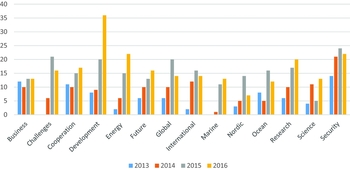
Fig. 2 presents the terms most frequently used in the 2013–2016 programmes. Words that would be expected to be used frequently given the focus of the conference were excluded, that is Arctic (used 85 times in 2013 to 246 times in 2016) and north (used eight times in 2013 to 22 times in 2016). The analysis of the most frequently used terms suggests a strong and growing emphasis on development, energy, security, research and science, challenges, cooperation and businesses. Looking more closely at the term development, as an example, it was used in the programmes in the context of environmental security and sustainable development, human development, business and economic development, development under the risk of climate change, infrastructure development, oil and gas development, Arctic offshore petroleum development, social impacts of oil development and fishery development. This discourse is polarised between human development, environmental development and business development. The discussion is further polarised in the business context, ranging from sustainable business to Arctic business interests.

The emphasis on energy, such as in the case of renewable and low carbon energy sources, energy systems, remote energy networks, interests of oil and gas, also seems to be growing. Additionally, the importance of science and research should be emphasised, as well as security issues ranging from discussions about geopolitical and military issues to effects on human, social and environmental security. The term future was also polarised between business interests, such as shipping and marine operations, and the future impact of pollution from Arctic shipping and the future mental well-being of indigenous peoples.
One should note when viewing Fig. 2 that the overall number of plenary and breakout sessions has grown from around 70 in 2013 and 2014 to 90 in 2015 and 109 in 2016.
Although it is critical to bring forth information about the most frequently used terms in the ACA 2013–2016 programmes, it is just as important to highlight terms less frequently used. A few examples include terms such as communities, hazards, emissions, environment/nature, innovation, indigenous, rights, risks, regulations and youth. There is merit to a more thorough investigation of the programmes than is possible in a short conference paper in order to study these terms and the context in which they are discussed.
Conclusions
The ACA is a network of international dialogue concerning current conditions and the future of the Arctic. The conference is open and attracts a huge number of stakeholders from around the globe, including politicians, business people, researchers, NGOs, indigenous peoples, artists and the media. It provides a democratic platform, where matters of the Arctic are discussed in plenary and breakout sessions by stakeholders from all over the world.
The first aim of the study was to analyse the stakeholders taking part in plenary and breakout sessions at the ACA. The data shown in Fig. 1 suggest a strong voice for universities and researchers at the conference, followed by government, industry and institutions. This alone does not tell the whole story, as it would be of relevance to explore in detail the audience numbers attending particular plenary and breakout sessions. The analysis might change considerably if it was undertaken according to conference room size or by using other indicators. Furthermore, the analysis suggests that the voices of critical stakeholders in the Arctic, such as indigenous peoples and NGOs, are under-represented compared to other important stakeholder groups.
The second aim of the study was to analyse terms frequently used in plenary and breakout session titles at the ACA. Interestingly, terms that appeared frequently some years, in various contexts, were rarely used in others. These include terms such as China (2014), Himalayan (2013), report (2014), lessons (2013), data (2014), law (2013) and opportunity (2015).
The third aim was to identify if there had been a change in the terms used in plenary and breakout session titles over time. There has been growing emphasis on development, energy, security, research and science, challenges, cooperation and businesses. Furthermore, the analysis suggests that the discussion are often very polarised between environmental, social and economic interests; that is, topics are not discussed from a sustainability perspective, which encompasses all three interests as well as a time dimension for future generations.
The analysis of the ACA conference programmes highlights that instead of a constructive dialogue evolving between different types of stakeholders, many of the sessions included keynotes, speeches, presentations and panel discussions among like-minded stakeholders such as government officials, industry representatives, research or academic scholars. Since climate change impacts in the Arctic region are considered to be a global issue (WWF, n.d.), it is not sufficient to unfold sustainable development solutions through public–private dialogue or partnerships projects. Instead, it is perhaps necessary for the ACA to commit to establishing dialogue in quintuple form: public–private–policy–peoples–not-for-profit (NGOs). In so doing, greater levels of discussion would take place about issues that are directly and indirectly relevant to stakeholders living in regions affected by economic development.