Multiple species of cohabitant birds, including red-winged blackbirds (Agelaius phoeniceus) and European starlings (Sturnus vulgaris), congregate in large flocks and exploit the abundant and nutritious food sources found at dairies and feedlots (Besser et al. Reference Besser, DeGrazio and Guarino1968; Dolbeer et al. Reference Dolbeer, Wornecki, Strickley and White1978). Estimates of bird damage in commercial dairies in Wisconsin, New York and Pennsylvania suggest that red-winged blackbirds were one of the most common birds species associated with depredation (Shwiff et al. Reference Shwiff, Carlson, Glass, Suckow, Lowney, Moxcey, Larson and Linz2012). Red-winged blackbirds have been previously observed to most frequently consume corn, averaging 30% of their diet (White et al. Reference White, Dolbeer and Bookhout1985). In contrast, European starlings offered individual components of total mixed rations (TMR) preferentially selected Propel® energy nugget (Nestle Purina, St. Louis, Missouri, USA), averaging 49% of their daily diet (Carlson et al. Reference Carlson, Stahl, DeLiberto, Wagner, Engle, Engeman, Olson, Ellis and Werner2018).
The purpose of this study was to investigate the nutritional depletion of TMR by red-winged blackbirds and their associated impacts to dairy production. We previously estimated the nutritional depletion of TMR by European starlings (Carlson et al. Reference Carlson, Stahl, DeLiberto, Wagner, Engle, Engeman, Olson, Ellis and Werner2018). Our estimates from the NRC (2001) production model suggested that cows fed TMR exposed to starlings would lose one body condition score (BCS) in 91 d and cows fed the reference TMR (unexposed to starling depredation) would lose one BCS in 161 d (Carlson et al. Reference Carlson, Stahl, DeLiberto, Wagner, Engle, Engeman, Olson, Ellis and Werner2018). We hypothesized that species-specific bird depredation of TMR can alter the nutritional composition of the ration and that these changes can negatively impact the performance of dairy cows. We therefore replicated our controlled feeding experiment and dairy production modeling with red-winged blackbirds offered individual TMR components and a high-energy TMR to investigate the nutritional depletion of dairy rations by red-winged blackbirds and the associated impacts on dairy cow performance.
Materials and methods
We conducted a controlled feeding experiment with red-winged blackbirds offered individual TMR components. On each of four test days, we offered blackbirds within group cages (n = 10 cages; five birds per cage) 100 g of eight individual TMR components including steamed-flaked corn, Propel® energy nugget, canola meal, cracked corn, ground corn, soybean meal, cotton seed and lactating mineral. All components were sourced from a commercial dairy located in Larimer County, Colorado 80538. Blackbird consumption of individual TMR components is reported as percent consumed throughout the 4-d test. The live-capture, animal care and use procedures were approved by the Institutional Animal Care and Use Committee of the National Wildlife Research Center (QA-2369, J.C. Carlson-Study Director).
For the purpose of estimating the nutritional offsets caused by red-winged blackbirds, we subsequently offered a high energy TMR (30–160 d in milk) to experimentally-naïve blackbirds within group cages (n = 10 cages; 5 birds per cage, 1 kg TMR per cage) for four consecutive days. Parameterization of the dairy production model (NRC, 2001) was based upon animal condition and feed formulation data provided by a commercial dairy in northern Colorado, nutrition data provided by Cumberland Valley Analytical Services (CVAS, Hagerstown, Maryland USA) and our component preference data.
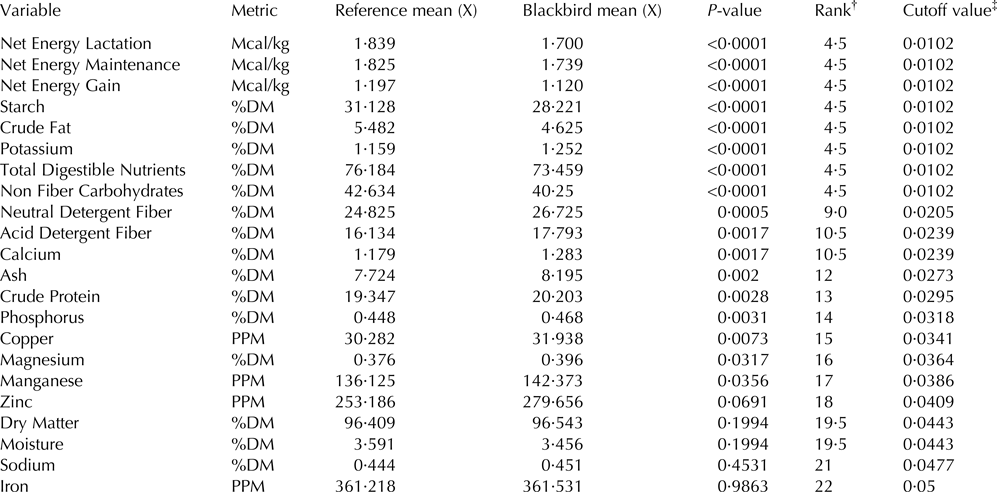
All nutritional data were analyzed using ANOVA within mixed linear models (Proc Mixed, SAS 9.2, SAS Institute Inc., Cary, North Carolina USA). Fixed effects included treatment status (i.e., reference and blackbird-consumed rations) and cage was included as a random effect. Denominator degrees of freedom were calculated using the Satterthwaite approximation. We controlled for false discoveries using the Benjamini-Hochberg procedure (Benjamini & Hochberg, Reference Benjamini and Hochberg1995). For all analyses, the false discovery rate was set at α = 0·05. Univariable analyses were ranked by P-value from smallest (1) to largest (m). Cutoff values for the rejection of null hypotheses were calculated as (rank/m) × α.
Results and discussion
Red-winged blackbirds preferred TMR components with high starch and high fat content. Among all foods consumed, various corn products (flaked, cracked and ground corn) accounted for 78% of all foods consumed by red-winged blackbirds during the preference experiment. Blackbirds primarily consumed flaked corn (42%) and the energy nugget (13%), and cracked corn and ground corn comprised 4 and 1% of blackbird consumption, respectively. Each of the other TMR components comprised <0·5% of blackbird consumption. Thus, blackbirds are likely attracted to concentrated animal feeding operations because of specific nutrients associated with expensive feed components (e.g., processed corn, fat supplements).
The preference and consumption of various TMR components by pest birds may significantly alter the cost to producers and the decision-making for bird damage management. The preference of red-winged blackbirds for steam-flaked corn (42% consumption) was greater than that observed for Propel® energy nugget, canola meal, cracked corn, ground corn, soybean meal, cotton seed and lactating mineral. In contrast, the preference of European starlings for Propel® energy nugget (49% consumption) was greater than that observed for steam-flaked corn, corn gluten, dry distillers grains, canola meal, corn silage and mineral supplement (Carlson et al. Reference Carlson, Stahl, DeLiberto, Wagner, Engle, Engeman, Olson, Ellis and Werner2018). Thus, species-specific data for offending bird species are necessary for (1) the generation of accurate estimates of bird damage and (2) the prescription and implementation of cost-effective damage management strategies.
The nutritional data illustrated that red-winged blackbird consumption significantly altered the nutritional characteristics of TMR (Table 1). Relative to the reference rations unexposed to blackbirds, blackbird-consumed rations had less net energy for lactation (P < 0·0001), maintenance (P < 0·0001) and gain (P < 0·0001). Blackbird-consumed rations also had lower concentrations of starch (P < 0·0001), crude fat (P < 0·0001) and total digestible nutrients (P < 0·0001), and greater concentrations of acid detergent fiber (P < 0·0017), neutral detergent fiber (P < 0·0005), potassium (P < 0·0001) and calcium (P < 0·0017) compared to the reference rations. Relative to reference rations, we observed a 9·5% reduction in corn silage, a 9·6% reduction in energy nugget, a 23·6% reduction in ground corn and a 24·7% reduction in steam-flaked corn in TMR exposed to red-winged blackbirds. These results enabled us to identify metabolizable energy sources that need to be excluded from depredating blackbirds.
Nutritional analysis of reference and blackbird-consumed total mixed rations

† Rank order of P-values from analyses of nutritional cattle feed samples
‡ Benjamini Hochberg cutoff values for rejection of null hypotheses
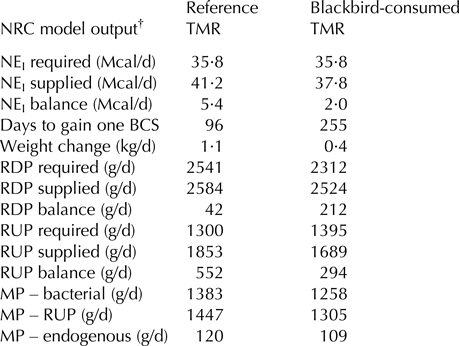
Dairy production modeling (NRC, 2001) illustrated that cow performance can be negatively impacted by blackbird consumption of TMR (Table 2). For Holsteins producing 37·1 kg of milk/d, total required net energy intake (NEI) was 35·8 Mcal/d. For the reference TMR, NEI supplied was 41·2 Mcal/d and for the blackbird-consumed TMR NEI supplied was 37·8 Mcal/d. The resulting energy balance for reference and blackbird-consumed rations was 5·4 and 2·0 Mcal/d, respectively. Thus, blackbird depredation of cattle feed can reduce dairy production through the nutritional depletion of TMR.
National Research Council, dairy production model output for reference and blackbird-consumed total mixed rations

† RDP and RUP are rumen degradable protein and rumen undegradable protein, respectively. MP is microbial protein
We also observed species-specific impacts of pest birds on dairy cow performance. Body condition scores integrate the influences of many nutritional aspects of TMR to distinguish differences in the fat reserves, or the nutritional needs among individual cows. The high-energy reference TMR used for this blackbird experiment would cause the gain of one BCS in 96 d (vs. 255 d for the blackbird-exposed TMR; Table 2) for cows producing 37·1 kg of milk per day (NEI = 35·8 Mcal/d). In contrast, the late-lactation reference TMR used for our starling feeding experiments would cause the loss of one BCS in 161 d (vs. 91 d for the starling-exposed TMR) for cows producing 31·75 kg of milk per day (NEI = 31·5 Mcal/d; Carlson et al. Reference Carlson, Stahl, DeLiberto, Wagner, Engle, Engeman, Olson, Ellis and Werner2018). These TMR-specific differences notwithstanding, the absolute difference in BCS was 159 d in this blackbird study and 70 d in the starling study (Carlson et al. Reference Carlson, Stahl, DeLiberto, Wagner, Engle, Engeman, Olson, Ellis and Werner2018). Because fat supplements are approximately $1·10 per kg (USD) and corn products are approximately $0·14 per kg, we conclude that starlings can have a greater monetary impact to dairy production than red-winged blackbirds. We have previously observed the colonization of thousands of blackbirds subsequent to the lethal control of starlings at particular dairies. Thus, the impacts of pest birds and the cost-effective management associated with these impacts are dependent on the species composition and the density of the pest-bird community at a particular dairy operation.
Because pest birds may not nutritionally deplete all TMR consumed by cows each day (Carlson et al. Reference Carlson, Stahl, DeLiberto, Wagner, Engle, Engeman, Olson, Ellis and Werner2018), our results may overestimate the nutritional depletion caused by blackbirds at commercial dairies. The density of blackbirds in our controlled feeding experiments is comparable to more than 100 blackbirds per cow under field conditions. Most commercial dairies will likely not experience 100 pest birds per cow nor the associated extent of nutritional depletion as estimated by our study. Our approach and our results, however, demonstrate that (1) we can estimate the species-specific nutritional depletion caused by pest birds and (2) dairy production models can be used to predict production losses to dairies impacted by bird depredation.
Similar to European starlings (Glahn et al. Reference Glahn, Twedt and Otis1983), red-winged blackbirds are apparently influenced by the form and size of livestock feed. For example, blackbirds strongly preferred flaked corn over ground corn in our feeding experiments. Previous research has shown that European starlings could not consume ≥1·27 cm-diameter (Depenbusch et al. Reference Depenbusch, Drouillard and Lee2011) extruded feed pellets. Altering the size of flaked corn and fat nugget, or combining highly desired components into approximately 1·27 mm-diameter pellets or finely milled particles may be a non-lethal component of integrated pest management strategies for the mitigation of the species-specific impacts of bird depredation (Twedt & Glahn, Reference Twedt and Glahn1982; Glahn et al. Reference Glahn, Twedt and Otis1983; Depenbusch et al. Reference Depenbusch, Drouillard and Lee2011; Carlson et al. Reference Carlson, Stahl, DeLiberto, Wagner, Engle, Engeman, Olson, Ellis and Werner2018).