


INTRODUCTION
The recovery of macro- and microbotanicals—plant remains visible and invisible to the naked eye, respectively—along with the study of chemical residues, allows us to shed light on several anthropological issues concerning ancient populations, such as consumption, vegetation changes, ritual practices, trade, and medicinal practices (Hastorf Reference Hastorf2017).
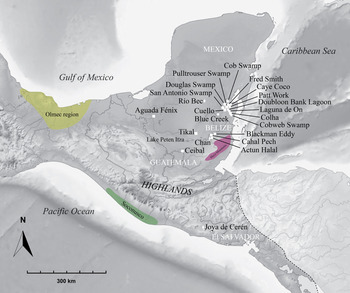
Some archaeologists working in parts of the central Maya lowlands understood very early on the significance of including archaeobotanical (also known as paleoethnobotanical) studies in their projects. The early investigations—namely, at the site of Cuello (Figure 1), where macrobotanical data were obtained through the intensive collection and analysis of flotation samples (Miksicek et al. Reference Miksicek, Wing, Scudder and Hammond1991), and at Colha and Pulltrouser Swamp, where microbotanical remains in the form of pollen and phytoliths were obtained through coring—provide some of the most significant data on ancient plant use in the region to date (Jones Reference Jones1994; Miksicek Reference Miksicek and Paul D.1983; Wiseman Reference Wiseman, Turner and Harrison1983). Chemical residue analyses and, even more recently, starch grain analysis have been applied to the study of artifacts and have offered additional information on the early diets of the inhabitants of this region (Cagnato Reference Cagnato2018b; Powis et al. Reference Powis, Valdez, Hester, Jeffrey Hurst and Tarka2002; Rosenswig et al. Reference Rosenswig, Pearsall, Masson, Culleton and Kennett2014). The aim of this article is twofold: to review the data available on the plants used and likely consumed by mobile preceramic peoples during the Archaic period (ca. 8000–2000 b.c.), and by a combination of sedentary and mobile populations during the Early to Middle Preclassic period (2000–400 b.c.) across the central Maya lowlands, and to explore their subsistence strategies during this key time of transformation.
Archaeological sites mentioned in the text from which plant remains have been reported across the Maya region. Circles indicate Archaic period sites/contexts, squares indicate Preclassic contexts, a star indicates both Archaic and Preclassic contexts, and a diamond indicates later sites. Map modified by the author from a topographical map created by Sémhur/Wikipedia Commons/CC-BY-SA-3.0.

The study of the emergence of food production economies is a topic that has fascinated scholars for a long time. The Neolithic Revolution, a term coined by Childe (Reference Childe1934), was used to describe the transition from hunting and gathering to farming/herding and sedentary lifestyles in the Levant. This model's legacy has had a longstanding effect on how other places around the world were understood to have transitioned to food production (Langlie et al. Reference Langlie, Mueller, Spengler and Fritz2014). Food production in the Americas (but also further afield; see, for example, Bleasdale et al. Reference Bleasdale, Wotzka, Eichhorn, Mercader, Styring, Zech, Soto, Inwood, Clarke, Marzo, Fiedler, Linseele, Boivin and Roberts2020; Castillo et al. Reference Castillo, Fuller, Piper, Bellwood and Oxenhamc2018) took different pathways and therefore proves a challenge to Old World models. The first major point is that there were no large animals to domesticate in Mesoamerica. Beyond this, it is clear now that the notion that villages should be equated to the beginning of food production does not work in neotropical America (Piperno Reference Piperno2011). For example, large, permanently settled villages did not appear in Panama until several millennia after the initial adoption of food production (Dickau Reference Dickau, VanDerwarker and Peres2010). Another example comes from the Calusa in southern Florida, a sedentary, hierarchical, tributary society that relied on fishing, hunting, and gathering, but without evidence for large-scale agriculture or dependence on staple crops (Marquardt Reference Marquardt and Fogelson2004). The term “revolution” led some scholars to believe that the transformation from hunter-gatherers to farmers was rapid and radical (Svizzero Reference Svizzero2017). For example, Bogucki (Reference Bogucki and Douglas-Price2000), perhaps as a result of simply relying on the macrobotanical record, considered that north-central European farmers depended mainly on cereals, but very little on wild plants. Yet macro- and microbotanical data indicate that despite the adoption of domesticates, people in central Panama continued to consume a wide range of native plants that included palms, tree fruits, and tubers (Dickau Reference Dickau, VanDerwarker and Peres2010). Beginning in the Holocene, and still today, Amazonian societies seem to have maintained a mixed strategy consisting of domesticates, non-domesticates, and tree management, alongside hunting and fishing, leading some to argue that there was never a Neolithic in the Amazon (Fausto and Neves Reference Fausto and Neves2018). In some cases, farmers in the Amazon have even adopted a hunter-gatherer lifestyle (Shepard et al. Reference Shepard, Clement, Lima, Santos, de Paula Moraes and Neves2020). Based on a growing body of literature that “indicates that every case of transition from hunter-gatherers to agricultural economies was unique” (Langlie et al. Reference Langlie, Mueller, Spengler and Fritz2014:1613; see also Iriarte Reference Iriarte, Denham, Iriarte and Vrydaghs2007; Piperno Reference Piperno2011), it is necessary to focus on specific regions—in this case, the central Maya lowlands—which, as the archaeological evidence indicates, also followed its own trajectory.
Before presenting the paleoethnobotanical data we have to date from this region, I begin by highlighting three main issues that are relevant to the discussion of ancient plant use in the Maya context. These issues concern the preservation of plant remains, domestication and landscape changes, and social complexity.
ISSUES
Preservation and Recovery of Plant Remains in the Maya Area
One of the first issues to consider is the reasons for the lack of systematic paleoethnobotanical research in the lowland Maya region: the belief that plant remains, especially macrobotanical ones, would not survive well in neotropical conditions due to extreme wet-dry cycles (Hammond and Miksicek Reference Hammond and Miksicek1981). Plants will survive best in extreme conditions where there is a lack of bacteria or other destructive agents (Fritz and Nesbitt Reference Fritz, Nesbitt, Marston, Guedes and Warinner2014), and therefore, in tropical environments, ancient plant remains are most commonly preserved in carbonized (charred) form (VanDerwarker Reference VanDerwarker2006). In most cases, uncarbonized remains recovered from Maya sites tend to be considered intrusive (e.g., Miksicek et al. Reference Miksicek, Wing, Scudder and Hammond1991); however, the context from which they are recovered (e.g., sealed deposit or permanently waterlogged; Wendel Reference Wendel2019), will be a crucial factor to keep in mind, as will their ability to directly date them to confirm their antiquity.
Although it is true that the relative quantity of surviving plant remains may be lower in the Maya region than in other geographical areas (compare coastal desert Peru [Ugent et al. Reference Ugent, Pozorski and Pozorski1986] and Highland Mexico [Perry and Flannery Reference Perry and Flannery2007]), the potential of recovering evidence increases if archaeologists systematically adopt recovery methods (Hageman and Goldstein Reference Hageman and Goldstein2009; Morehart Reference Morehart2011; Pearsall Reference Pearsall2015) and different lines of data are collected (Cagnato Reference Cagnato2016; Morell-Hart Reference Morell-Hart2019).
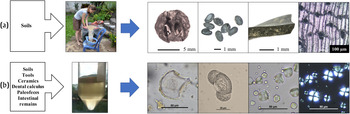
For the recovery of macrobotanical remains, water flotation, which works by separating out small, light, buoyant components—such as seeds and charcoal, but also small bones and fish scales—from the rest of the soil (Figure 2), is the most effective way to retrieve charred plant remains from archaeological sediments. However, as noted by Fritz and Nesbitt (Reference Fritz, Nesbitt, Marston, Guedes and Warinner2014), flotation can damage very fragile materials, such as oil-rich seeds and chaff. Microbotanical remains include starch, phytoliths, and pollen (Figure 2). Starch grains are the energy storage units of plants, ranging from 1 to 100 μm (1 μm = 0.001 mm), and are composed of two different glucose chains: amylose and amylopectin. They are synthesized in plastids during photosynthesis and then primarily stored in roots, seeds, and fruits. Phytoliths are microscopic silica bodies found in many plant families and are especially prominent in the grass family (Piperno Reference Piperno2006). These are released when the plant tissue that contains them decomposes, is burnt, or is digested, eventually entering the archaeological record (Pearsall Reference Pearsall2019). Pollen grains are found on the anther, the male part of the flower, and are released when mature. Different pollination syndromes (the manner in which pollen is dispersed) are known—namely, wind-pollinated, animal-pollinated, water-pollinated, and self-pollinated (Pearsall Reference Pearsall2019). All these microbotanical remains can be recovered from a number of contexts: sediments, ground and lithic stone tools, ceramic vessels, dental calculus (calcified plaque), paleofeces, and, in exceptional cases, even intestinal remains (Cagnato and Ponce Reference Cagnato and Ponce2017; Cagnato et al. Reference Cagnato, Goepfert, Elliott, Verano, Prieto and Dufour2021; Henry et al. Reference Henry, Brooks and Piperno2011; Horrocks et al. Reference Horrocks, Irwin, Jones and Sutton2004; Piperno et al. Reference Piperno, Ranere, Holst, Iriarte and Dickau2009; Therin et al. Reference Therin, Fullagar, Torrence, Gosden and Hather1999; Wang et al. Reference Wang, Liu, Ball, Yu, Li and Xing2016). Their recovery tends to be more time-consuming and also expensive, requiring chemicals to separate the microscopic plant fossils from the rest of the sample (see Pearsall Reference Pearsall2015 for protocols).
Contexts, methods, and types of plant remains that can be recovered from the archaeological record. (a) Flotation of soils leads to the recovery of macrobotanical remains that may include large pits (e.g., nance; Byrsonima crassifolia), small seeds (e.g., chia; Salvia sp.), dense kernel fragments (e.g., sapote; Pouteria sp.), and charcoal (e.g., breadnut; Brosimum alicastrum). (b) Microbotanicals can be extracted from a range of contexts, and a dedicated laboratory set-up is required to separate the phytoliths (e.g., bulliform), pollen (e.g., pine, Pinus sp.), and starch grains (e.g., manioc, Manihot esculenta, viewed under plane and cross-polarized light) from the rest of the sample. All photos by Clarissa Cagnato.

The integration of different lines of data is especially relevant if we consider that not all taxa produce diagnostic plant parts. For example, as well-illustrated by Morell-Hart (Reference Morell-Hart2019:Figure 2), while maize (Zea mays) can be recovered in kernel, cob, and cupule form (macrobotanical remains), and in microbotanical form as starch, pollen, and phytoliths, other taxa (e.g., tobacco) can often be identified based on only one of these proxies. By not including different types of recovery methods, the archaeobotanical record is not only incomplete, but can be skewed (Dickau Reference Dickau, VanDerwarker and Peres2010).
Beyond the climatic conditions which may affect the conservation of the plant remains, other factors should be considered for explaining why some plants are absent or underrepresented in the archaeological record. For example, underground storage organs (USOs), which encompass tubers, rhizomes, roots, and corms, tend to be absent in macrobotanical form (Pearsall Reference Pearsall2015), partially because of their preparation styles, as they are usually consumed fresh or boiled and therefore will be unlikely to end up carbonized (Scheel-Ybert Reference Scheel-Ybert2001). Pollination issues also play a role, notably in the case of manioc—for example, it is “under-represented in archaeological pollen assemblages since its flowering is unnecessary for propagation and cultivation (by humans), and its means of pollen dispersal limits the number of grains produced by the plant” (Jones Reference Jones1994:208). Other factors that play a role include the type of plant, and how fragile the original plant structures are (see Scarry Reference Scarry1986 for more factors), and this will depend on the relative amounts of starch, sugars, and cellulose (Popper Reference Popper, Hastorf and Popper1988). Fire itself, which often helps archaeologists to recover these plant remains centuries later in carbonized form, also partly damages the most fragile plant parts (Fritz and Nesbitt Reference Fritz, Nesbitt, Marston, Guedes and Warinner2014). Another important point is that when considering microbotanical remains, not all plants will produce diagnostic elements—for example, in the case of starch grains (Gott et al. Reference Gott, Barton, Samuel, Torrence, Torrence and Barton2006)—and in the case of phytoliths, there exists redundancy, where the same plant can produce several different morphotypes, but also multiplicity, where the same morphotype appears in numerous plants. Finally, as noted by Morell-Hart (Reference Morell-Hart2019:243), “cultural practices obviously exerted additional pressures on the recoverability of different taxa remains.” This issue is true for all plant remains, and especially true for microbotanicals recovered from artifacts, as not all plants were necessarily processed or transformed using stone tools or ceramics (Piperno and Smith Reference Piperno, Smith, Nichols and Pool2012).
While the assemblages that are eventually collected by archaeologists tend to represent only a small fraction of the original deposit (VanDerwarker Reference VanDerwarker2006), the fact that plant remains have been generally poorly documented at these early settlements and sites across the central Maya lowlands is due in part to interest, especially with regard to those from the Archaic period: “the major hindrance in finding and documenting Archaic-period sites has been a lack of sustained interest among most Mesoamerican scholars” (Rosenswig Reference Rosenswig2015:142). Another factor that complicates the locating of Archaic period settlements on the landscape is that these populations were highly mobile, did not use ceramics, and therefore left practically ephemeral remains for archaeologists to recover. Additionally, many Archaic sites are likely to be deeply buried and covered by later occupations, or by settlements being buried under water caused by rising sea levels during the Early Holocene (see Castellanos and Foias Reference Castellanos and Foias2017 and Lohse Reference Lohse2010 for good discussions and additional references on this matter). Finally, ecological and climatic factors of the region have hampered their identification (Prufer Reference Prufer2018:244). However, by utilizing standardized procedures for the recovery and quantification of the plant assemblages, as successfully implemented at the Preclassic site of Cuello (Miksicek et al. Reference Miksicek, Wing, Scudder and Hammond1991), the potential clearly exists to answer important questions about people and their plant use in the past.
Cultivation and Landscape Changes
In the Maya lowlands, calculable anthropogenic impacts and visible anthropogenic features are first dated to around 3000 b.c. (Beach et al. Reference Beach, Dunning, Luzzadder-Beach, Cook and Lohse2006; Brenner et al. Reference Brenner, Rosenmeier, Hodell and Curtis2002; Pohl et al. Reference Pohl, Pope, Jones, Jacob, Piperno, Lentz, Gifford, Danforth and Kathryn Josserand1996). However, this must not be interpreted as proof that the landscape was previously devoid of humans and human activity, but rather that this area was sparsely populated (Lohse Reference Lohse2010; Rosenswig Reference Rosenswig2015), as evidenced by the discovery of Paleoamerican human remains in caves in both Belize and the Yucatan Peninsula (Chatters et al. Reference Chatters, Kennett, Asmerom, Kemp, Polyak, Blank, Beddows, Reinhardt, Arroyo-Cabrales, Bolnick, Malhi, Culleton, Erreguerena, Rissolo, Morell-Hart and Stafford2014; González et al. Reference González, Terrazas, Stinnesbeck, Benavente, Avilés, Rojas, Padilla, Velásquez, Acevez, Frey, Graf, Ketron and Waters2013; Kennett et al. Reference Kennett, Prufer, Culleton, George, Robinson, Trask, Buckley, Moes, Kate, Harper, O'Donnell, Ray, Hill, Alsgaard, Merriman, Meredith, Edgar, Awe and Gutierrez2020). Mesoamerica is known as one of the world's primary centers of domestication, where agriculture arose independently (Piperno and Pearsall Reference Piperno and Pearsall1998). However, based on recent microbotanical and genetic studies, it would seem that none of the major crops (such as maize, squash) were domesticated (i.e., changed at the genetic and morphological level as a response to selective pressures) in the Maya lowlands (Kraft et al. Reference Kraft, Brown, Nabhan, Luedeling, Luna Ruiz, d'Eeckenbrugge, Hijmans and Gepts2014; Kwak et al. Reference Kwak, Kami and Gepts2009; Matsuoka et al. Reference Matsuoka, Vigouroux, Goodman, Sanchez, Buckler and Doebley2002; Piperno et al. Reference Piperno, Ranere, Holst, Iriarte and Dickau2009; Ranere et al. Reference Ranere, Piperno, Holst, Dickau and Iriarte2009). This fact does not necessarily imply, however, that the preceramic peoples who inhabited the central Maya lowlands were not already actively modifying their landscape to suit their needs, deliberately or inadvertently (see Smith Reference Smith2011 for a discussion on human niche construction).
Data to support early landscape changes mostly comes from palynology, the study of pollen grains. The paleoenvironmental record indicates that around 4,000 years ago there was a marked period of climatic instability—drying trend with severe precipitation—in the Maya lowlands, also seen in studies further afield in the Cariaco Basin off the coast of Venezuela (Haug et al. Reference Haug, Hughen, Sigman, Peterson and Röhl2001). This drier period sees vegetation changes and the presence of clay deposits in lake sediments, which were previously interpreted as being the result of human activity, but are now generally understood as being the result of variation in levels of precipitation (Mueller et al. Reference Mueller, Islebe, Hillesheim, Grzesik, Anselmetti, Ariztegui, Brenner, Curtis, Hodell and Venz2009). Debates have arisen on how to interpret paleoenvironmental data, especially those obtained from early studies from the Peten Lake region (see Castellanos and Foias Reference Castellanos and Foias2017 for an excellent review), as well as how to understand or consider important aspects of pollination syndromes (Ford and Nigh Reference Ford and Nigh2015) and issues related to identifying pollen grain to the species level (Lentz et al. Reference Lentz, Woods, Hood, Murph and Robin2012).
Pollen cores taken from various perennially wet environments (estuarine and near-coastal riverine areas) have shown that around 2500 b.c., there was significant deforestation in northern Belize (see Jones Reference Jones1991; Pohl et al. Reference Pohl, Pope, Jones, Jacob, Piperno, Lentz, Gifford, Danforth and Kathryn Josserand1996; Wiseman Reference Wiseman and Pohl1990). These data also show the more widespread presence of maize pollen, along with greater disturbance indicators, such as cattail (Typha sp.), Cheno-Ams, and Asteraceae, among others, and a decline in Moraceae tree pollen, the latter indicative of the presence of high forest trees (but see issues with its identification; Ford and Nigh Reference Ford and Nigh2015). These pollen data are understood as “evidence for a rapid and extensive expansion of agriculture that included maize as a significant crop” (Pohl et al. Reference Pohl, Pope, Jones, Jacob, Piperno, Lentz, Gifford, Danforth and Kathryn Josserand1996:363).
For the Preclassic period, canals, raised fields, and terraces present other types of evidence for landscape modification. One of the major issues is that scholars have tended to disagree on their function, their time of use, and whether such features were even anthropogenic (see Fedick Reference Fedick and Slater2003; Pohl and Miksicek Reference Pohl, Miksicek and Pohl1985). Turner and Harrison (Reference Turner and Harrison1983) reported widespread canal systems in northern Belize, but this was refuted by Pohl and colleagues (Reference Pohl, Pope, Jones, Jacob, Piperno, Lentz, Gifford, Danforth and Kathryn Josserand1996:366), who argued that many such features were in fact “elevated natural hummocks.” The study by Pohl and colleagues (Reference Pohl, Pope, Jones, Jacob, Piperno, Lentz, Gifford, Danforth and Kathryn Josserand1996), however, did report finding canals at San Antonio and Douglas Swamp, and minor ditching at Cob Swamp. With regard to their dating, the earlier study argued that these were built in the Late Preclassic, but used into the Classic in response to population growth, while the later assessment argued that wetland agriculture started earlier, around 1000 b.c., and that canals were used in response to increasing groundwater levels. Raised fields are also believed to have been built in the Preclassic and later abandoned (e.g., Pohl and Bloom Reference Pohl, Bloom and Feddick1996), while others argued that they were continuously used into the Late Classic (Turner and Harrison Reference Turner and Harrison1983). More recent studies have shown that wetland fields in the Rio Bravo watershed (Belize) were mainly used during the Classic period, but were also used for longer than previously thought, into the Early Postclassic period (Beach et al. Reference Beach, Luzzadder-Beach, Krause, Guderjan, Valdez, Fernandez-Diaz, Eshleman and Doyle2019). Identifying which crops were grown on them is also complex. For example, the recovery of pollen and macrobotanical remains from raised fields at Pulltrouser Swamp did not provide any firm conclusions regarding which plants were actively cultivated (Miksicek Reference Miksicek and Paul D.1983; Wiseman Reference Wiseman, Turner and Harrison1983). Other studies, not necessarily dating to the Archaic or Early to Middle Preclassic periods, however, have been more succesful at indicating the presence of cultigens such as maize, beans, squash, avocado, cacao, manioc, and arrowroot (Maranta arundinacea), as well as wetland and ruderal plant species (Beach et al. Reference Beach, Luzzadder-Beach, Guderjan and Krause2015, Reference Beach, Luzzadder-Beach, Krause, Guderjan, Valdez, Fernandez-Diaz, Eshleman and Doyle2019; Wendel Reference Wendel2019).
The existence of terraces is now undeniable (see, for example, Chase et al. Reference Chase, Chase, Fisher, Leisz and Weishampel2012; Dunning et al. Reference Dunning, Beach, Farrell and Luzzadder-Beach1998; Healy et al. Reference Healy, Lambert, Arnason and Hebda1983; Turner Reference Turner1974), especially evidenced through the use of LiDAR, a laser-based remote-sensing technology, which penetrates the dense vegetation and forest canopies to reveal features. Although excavations at the site of Chan in Belize suggest these were built starting in the Middle Preclassic (Wyatt Reference Wyatt and Brown2012), some scholars argue that they were in fact constructed in the Late Classic, in response to an increase in population (see, for example, Hageman and Lohse Reference Hageman, Lohse, Scarborough, Valdez and Dunning2003). Dating these potential agricultural features is not a simple task (Turner Reference Turner1974). The dates are often skewed towards later periods (i.e., Late Classic) due to relying on associated structures to date them (Pohl and Miksicek Reference Pohl, Miksicek and Pohl1985; Wyatt Reference Wyatt and Brown2012; but see Turner Reference Turner1974 for an argument as to why this works at Río Bec, for example). While it is beyond the scope of this article to review all the literature concerning these debates, it is evident that to produce food, ancient populations living in the Maya lowlands adapted to a range of ecological and topographical settings by investing labor and time in modifying their natural environment.
No “One Size Fits All” Model
As noted, Mesoamerica was one of several centers of plant domestication around the world (Harlan Reference Harlan1971; Piperno and Pearsall Reference Piperno and Pearsall1998; Vavilov Reference Vavilov and Chester1951). One of the key characteristics assigned to domesticated crop-users—that is, agriculturalists—is that populations were also sedentary, used ceramics, and reared livestock. These models have often been based on Eurasian ones, but considering that larger animals were not available for domestication in Mesoamerica, there is good reason to scrutinize Eurasian models applied to Maya contexts (Harris Reference Harris, Denham, Iriarte and Vrydaghs2007; Vrydaghs and Denham Reference Vrydaghs, Denham, Denham, Iriarte and Vrydaghs2007). Perhaps one of the main problems in developing local models is that agriculture in the Americas has often been equated with the use of maize as a staple (Iriarte Reference Iriarte, Denham, Iriarte and Vrydaghs2007). For example, the arrival of maize was even seen as the reason for the development of chiefdoms in the lower Amazon and Orinoco (Roosevelt Reference Roosevelt1980, cited by Shepard et al. Reference Shepard, Clement, Lima, Santos, de Paula Moraes and Neves2020). Yet research in the lowlands has revealed that mobile populations already used some domesticates (in addition to maize), even before settling down into more permanent settlements (Inomata et al. Reference Inomata, Triadan, Vázquez López, Fernandez-Diaz, Omori, Méndez Bauer, Hernández, Beach, Cagnato, Aoyama and Nasu2020; Kennett et al. Reference Kennett, Prufer, Culleton, George, Robinson, Trask, Buckley, Moes, Kate, Harper, O'Donnell, Ray, Hill, Alsgaard, Merriman, Meredith, Edgar, Awe and Gutierrez2020; Lohse Reference Lohse2010; Rosenswig Reference Rosenswig2006, Reference Rosenswig2015). This pattern suggests that small sedentary groups coexisted for a couple of hundred years with more mobile groups (Castellanos and Foias Reference Castellanos and Foias2017:38; Inomata et al. Reference Inomata, MacLellan, Triadan, Munson, Burham, Aoyama, Nasu, Pinzón and Yonenobu2015). One very recent example is the discovery at Aguada Fénix in Tabasco, Mexico, where Inomata and colleagues (Reference Inomata, Triadan, Vázquez López, Fernandez-Diaz, Omori, Méndez Bauer, Hernández, Beach, Cagnato, Aoyama and Nasu2020) bring to light the oldest monumental construction found to date in the Maya region. Particularly surprising is that it would have been built by mobile populations without marked social inequality, over a relatively short period of time of about 200 years, sometime between 1000 and 800 cal b.p. The presence of maize and manioc starch grains, recovered on associated manos and metates (i.e., grinding stones), again indicate the use of domesticates by mobile populations (Inomata et al. Reference Inomata, Triadan, Vázquez López, Fernandez-Diaz, Omori, Méndez Bauer, Hernández, Beach, Cagnato, Aoyama and Nasu2020:Supplementary Table 4).
Another issue is that there does not seem to be an agricultural revolution between the Archaic and Preclassic periods: during the latter, people continued to gather wild plants and for a long time did not rely exclusively on domesticates. This reveals that plant remains in this region cannot be used to distinguish clearly between mobile and sedentary populations, and corroborates archaeological arguments made for other regions around the world (Crowther et al. Reference Crowther, Prendergast, Fuller and Boivin2018; Fritz Reference Fritz, Denham, Iriarte and Vrydaghs2007; Iriarte et al. Reference Iriarte, Holst, Marozzi, Listopad, Alonso, Rinderknecht and Montaña2004; Leipe et al. Reference Leipe, Sergusheva, Müller, Spengler, Goslar, Kato, Wagner, Weber and Tarasov2017) that food production and the social systems they are tied to are more complex than often assumed. Continued paleoethnobotanical work in the Maya region should help to refine our views on how complex systems may develop outside of a linear “one-size-fits-all” model.
ARCHAEOBOTANICAL DATA AND OTHER INDIRECT INDICATORS OF PLANT USE
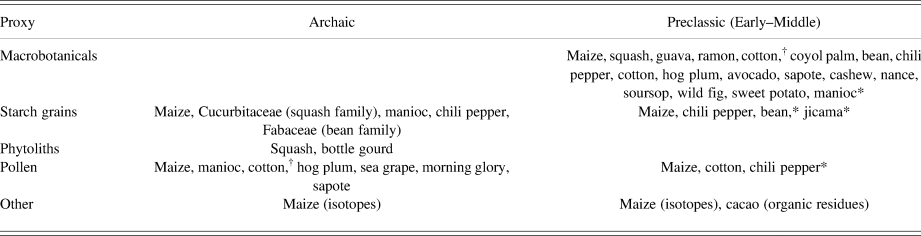
Numerous scholars working in different parts of the Maya lowlands have documented evidence for cultigens and landscape disturbance as early as the Archaic period in what is the country of Belize (Figure 1 and Table 1). At Cob Swamp, pollen cores revealed the presence of pollen grains belonging to maize and manioc, which are believed to have been introduced to the area prior to 3000 b.c., if not earlier, around 3400 b.c. (Pohl et al. Reference Pohl, Pope, Jones, Jacob, Piperno, Lentz, Gifford, Danforth and Kathryn Josserand1996). Maize pollen has also been reported in the Blue Creek area; a core taken at Laguna Verde with associated charred material was dated to between 2880 and 2580 b.c. (Morse Reference Morse2009). Other relatively early pollen grains include those of manioc and maize, found at Cobweb Swamp near Colha, dating to 2500–1000 b.c. (Jones Reference Jones1994). At the 30 m long Actun Halal rock shelter, located in the Macal River Valley, a variety of plants in pollen form was reported by Jones and Hallock (Reference Jones, Hallock and Lohse2008), notably maize, cotton (Gossypium sp.), hog plum (locally known as jocote, Spondias sp.), sea grape (Coccoloba uvifera), morning glory (Convolvulaceae), and sapote, dating between 2200 and 1380 b.c.
Summary of plant remains associated with probable consumption recovered in Archaic and Early to Middle Preclassic contexts across the central Maya lowlands. Note: The table does not include charcoal fragments from plants that were likely used as timber or fuel. * indicates the potential identification of this taxon,† see Lentz and colleagues (Reference Lentz, Beaudry-Corbett, De Aguilar and Kaplan1996) for possible consumption of cotton seed oil.

Rosenswig and colleagues (Reference Rosenswig, Pearsall, Masson, Culleton and Kennett2014) report on the recovery of different starch grains from various Archaic period tools. As well as a plano-convex biface associated with a pit feature dated to 8320–6560 cal b.p. recovered from Caye Coco, starch grains of maize, Cucurbitaceae (squash) family, manioc, and chili pepper were found. On a hammerstone from the same context, only one maize starch grain was found. Material from other preceramic sites in the Freshwater Creek drainage (Fred Smith, Patt Work, Laguna de On Island, and Doubloon Bank Lagoon) were studied for the presence of two classes of microbotanical remains: starch grains and phytoliths. While phytoliths were rare, the bifaces and unifaces recovered all revealed the presence of maize, while manioc, chili pepper, and bean family starch grains were identified in smaller quantities (Rosenswig et al. Reference Rosenswig, Pearsall, Masson, Culleton and Kennett2014).
Archaeologically detectable human activity on the landscape is also visible (Beach et al. Reference Beach, Dunning, Luzzadder-Beach, Cook and Lohse2006). Notably, as demonstrated by Pohl and colleagues (Reference Pohl, Pope, Jones, Jacob, Piperno, Lentz, Gifford, Danforth and Kathryn Josserand1996), the pollen record of sites in northern Belize shows forest disturbance around 2500 b.c. combined with agricultural intensification, in particular along swamp edges, as exemplified by the recovery of maize pollen, as well as squash and bottle gourd (Lagenaria sp.) phytoliths, in sediments from Pulltrouser Swamp (Pohl et al. Reference Pohl, Pope, Jones, Jacob, Piperno, Lentz, Gifford, Danforth and Kathryn Josserand1996). While the presence of humans in Belize during the Archaic is secure, debate exists for the central Peten Lakes region in Guatemala. Research has been ongoing for decades, and different researchers (Curtis et al. Reference Curtis, Brenner, Hodell, Balser, Islebe and Hooghiemstra1998; Mueller et al. Reference Mueller, Islebe, Hillesheim, Grzesik, Anselmetti, Ariztegui, Brenner, Curtis, Hodell and Venz2009; Vaughn et al. Reference Vaughn, Deevey, Garrett-Jones and Pohl1985; Wahl et al. Reference Wahl, Byrne, Schreiner and Hansen2006) have reached diverging conclusions regarding the nature of forest disturbance and increased soil erosion (see Castellanos and Foias Reference Castellanos and Foias2017 for a good review of the issue). What seems more or less certain is that horticulturalist-foragers were present in the region as “early as 3000–2500 b.c. in some areas and by 1500 b.c. in other parts of the Petén lowlands” (Castellanos and Foias Reference Castellanos and Foias2017:2). Between the Early and Middle Preclassic (ca. 1100–900 b.c.), permanent settlements appear with the use of ceramics in the central and southern Maya lowlands (Lohse Reference Lohse2010). However, the adoption of sedentism was not uniform, as evidenced by research at the sites of Cuello and Ceibal (Hammond Reference Hammond1991; Inomata et al. Reference Inomata, MacLellan, Triadan, Munson, Burham, Aoyama, Nasu, Pinzón and Yonenobu2015).
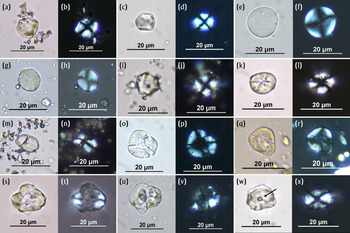
During the Middle Preclassic, ditching and canals were constructed in the Maya lowlands (Pohl et al. Reference Pohl, Pope, Jones, Jacob, Piperno, Lentz, Gifford, Danforth and Kathryn Josserand1996). Additionally, the manos and metates recovered in excavations at Pulltrouser and Cob Swamps “provide supporting evidence for maize cultivation” (Pohl et al. Reference Pohl, Pope, Jones, Jacob, Piperno, Lentz, Gifford, Danforth and Kathryn Josserand1996:365). Yet Middle Preclassic carbon isotopic data from skeletons at Cuello and Cob Swamp suggest that maize was not an important component of the human diet during this period (Pohl et al. Reference Pohl, Pope, Jones, Jacob, Piperno, Lentz, Gifford, Danforth and Kathryn Josserand1996; Tykot et al. Reference Tykot, Van der Merwe, Hammond and Orna1996; van der Merwe et al. Reference Merwe, Nikolaas, Tykot, Hammond, Oakberg, Ambrose and Anne Katzenberg2002; but see Kennett et al. Reference Kennett, Prufer, Culleton, George, Robinson, Trask, Buckley, Moes, Kate, Harper, O'Donnell, Ray, Hill, Alsgaard, Merriman, Meredith, Edgar, Awe and Gutierrez2020). Macro- and microbotanical data from this period reveal the presence of a wide variety of plants. At Ceibal, a metate fragment recovered in fill and a mano from a midden deposit, from Early and Late Middle Preclassic contexts respectively, were tested for starch grains, for a combined total of 140 starch grains (Cagnato Reference Cagnato2018a). The results revealed that they had been used to process a variety of plants, including maize (Figures 3a–3d) and chili peppers (Figures 3e–3h), as well as possibly jicama (Pachyrhizus erosus, Figures 3i–3j), beans (Phaseolus sp., Figures 3k–3l), and unidentified underground storage organs (Figures 3m–3n). Damage consistent with mechanical processes (i.e., grinding and pounding) was evidenced by the presence of crushed starch grains (Figures 3o–3r). Exposure to heat (i.e., cooking) was supported by the recovery of gelatinized starch grains (Figures 3s–3v) and by the clear damage to the hila (Figures 3w–3x) seen in the starch grains of experimentally toasted maize and baked manioc (Babot Reference Babot, Hart and Wallis2003; Cagnato Reference Cagnato2019b). At Cahal Pech (650–300 b.c.), investigations of Structure 1 of the Tolok Group revealed an undisturbed midden inside a lateral-shaped chultun. The midden has been dated to the Late Middle Preclassic period, based on ceramics and one radiocarbon date (Powis et al. Reference Powis, Stanchly, White, Healy, Awe and Longstaffe1999). Besides large quantities of faunal remains and sherds, the midden also contained charcoal fragments of wild fig (Ficus sp.), pine (Pinus sp.), glassy wood (Astronium graveolens), malady (Aspidosperma sp.), and aguacatillo (Nectandra sp.). Maize kernels, squash rind, and a potential guava rind were also found (Powis et al. Reference Powis, Stanchly, White, Healy, Awe and Longstaffe1999). From other Middle Preclassic contexts at this same site, ramon (Brosimum alicastrum Sw.), cotton, and coyol palm were reported from occupation levels. At Cuello, Miksicek and colleagues (Reference Miksicek, Wing, Scudder and Hammond1991) also found maize, squash, beans, chili, cotton, hog plum, avocado, sapote, cashew (Anacardium occidentale L.), nance (Byrsonima crassifolia (L.) H.B.K.), ramon, guava, and soursop (Annona spp.). Moreover, a possible manioc tuber was also reported (Hather and Hammond Reference Hather and Hammond1994). From Tikal, a sweet potato (Ipomoea batatas (L.) Lam.) tuber fragment was recovered (Lentz et al. Reference Lentz, Dunning, Scarborough, Magee, Thompson, Weaver, Carr, Terry, Islebe, Tankersley, Sierra, Jones, Buttles, Valdez and Ramos Hernandez2014). In addition, pollen of maize, cotton, and possibly chili pepper, dated to 500 b.c. was recovered from the Cobweb Swamp core (Jones Reference Jones1994). Finally, cacao (Theobroma cacao) residues were positively identified in two Middle Preclassic spouted vessels, both blackware spouted jars, from Colha (Powis et al. Reference Powis, Valdez, Hester, Jeffrey Hurst and Tarka2002).
Starch grains from Early and Late Middle Preclassic contexts at Ceibal, viewed in plane light (left) and polarized light (right), magnified ×600. (a–d) Maize; (e–h) chili pepper; (i–j) possible jicama (metate); (k–l) possible bean (mano); (m–n) possible unidentified underground storage organ (metate); (o–r) crushed grains; (s–v) gelatinized grains; and (w–x) damaged hilum (indicated by arrow), likely damaged by exposure to heat (cooking). Photographs by the author.

DISCUSSION
What do the archaeobotanical data tell us about ancient plant use during the Archaic and Preclassic periods? Although the plant remains from Archaic sites may be few (due to the various reasons discussed previously), and it is tricky to estimate how important a particular plant was to the diet based on the different types of proxies recovered, it would seem that Archaic and also later Preclassic populations, albeit having access to maize, continued to forage and hunt for resources. This pattern of utilizing both wild resources and domesticated plants continued into the Middle Preclassic (Lohse Reference Lohse2010), where we see a more widespread significant increase in the use of maize.
Maize, domesticated from teosinte (Zea mays spp. parviglumus) in the Balsas River Valley of southeastern Mexico (Piperno et al. Reference Piperno, Ranere, Holst, Iriarte and Dickau2009), was undoubtedly present in the central Maya lowlands prior to 3000 b.c., if not earlier, around 3400 b.c. (Pohl et al. Reference Pohl, Pope, Jones, Jacob, Piperno, Lentz, Gifford, Danforth and Kathryn Josserand1996). As already reported, other data exist for its early presence in the region, notably in the form of pollen (Jones Reference Jones1994; Jones and Hallock Reference Jones, Hallock and Lohse2008). However, even if its presence has been ascertained, its dietary importance has been more difficult to assess, even in light of recent data indicating that domesticated landraces of maize were productive enough to be a staple grain by 4300 cal b.p. (Kennett et al. Reference Kennett, Thakar, VanDerwarker, Webster, Culleton, Harper, Kistler, Scheffler and Hirth2017). A recent stable isotopic study was carried out by Kennett and colleagues (Reference Kennett, Prufer, Culleton, George, Robinson, Trask, Buckley, Moes, Kate, Harper, O'Donnell, Ray, Hill, Alsgaard, Merriman, Meredith, Edgar, Awe and Gutierrez2020) on 52 radiocarbon-dated individuals from the Maya Mountains, spanning 10,000 years. Their results indicate that maize use was highly variable between 4700 and 4000 cal b.p., a period that precedes the earliest agricultural villages in the Maya region by over 1,000 years. According to them, maize became a staple (composing at least 25 percent of their total diet) only after 4000 cal b.p., perhaps because of technological innovations such as the introduction of new maize landraces, or nixtamalization, a process whereby maize is boiled in an alkali solution, which can be obtained from slaked lime, hardwood, or shells, freshwater or marine (Cheetham Reference Cheetham, Staller and Carrasco2010). This process renders the maize kernel easier to grind, more palatable but also more nutritional, by improving access to vitamin B and amino acids (Cheetham Reference Cheetham, Staller and Carrasco2010; Coe 1994). While their dataset is the largest that has been studied to date in the region, it remains to be seen if this pattern of using maize as a staple at this early date can be detected elsewhere. Previous stable isotopic studies of individuals in the Maya lowlands have in fact shown that maize consumption during the Early Preclassic was moderate (Tykot et al. Reference Tykot, Van der Merwe, Hammond and Orna1996; van der Merwe et al. Reference Merwe, Nikolaas, Tykot, Hammond, Oakberg, Ambrose and Anne Katzenberg2002), a trend visible elsewhere in Mesoamerica (e.g., Blake et al. Reference Blake, Clark, Voorhies, Love and Chisholm1992).
While maize eventually became a staple for later Maya societies, as evidenced by the more frequent recovery of maize cobs and kernels, its role during the transition from mobile to sedentary lifestyles and towards the development of complex societies, seems to be less key than previously imagined. This pattern also applies to other parts of lowland Mesoamerica (see summary in Cagnato Reference Cagnato2019a), notably among the Olmec along the Gulf Coast (Arnold Reference Arnold2009; Killion Reference Killion2013; VanDerwarker and Kruger Reference VanDerwarker and Kruger2012) and the inhabitants of the Soconusco along the Pacific Coast (Rosenswig et al. Reference Rosenswig, VanDerwarker, Culleton and Kennett2015). Even beyond our immediate area of interest, studies have been published that question the economic significance of early cereal crops in the subsistence system (Arranz-Otaegui et al. Reference Arranz-Otaegui, Carretero, Roe and Richter2018; Liu et al. Reference Liu, Kealhofer, Chen and Ji2014). Returning to Central America, prior to intensive cultivation of maize (ca. 1000 b.c.), both wild and cultivated foods (including maize) were the basis of the subsistence in the Olmec region (Vanderwarker Reference VanDerwarker2006). In the Soconusco, evidence suggests that it is only by 1000 b.c. that full-scale maize agriculture may have been adopted, preceded by a mixed foraging-farming economy consisting of fishing, hunting, and horticulture (Rosenswig et al. Reference Rosenswig, VanDerwarker, Culleton and Kennett2015).
Archaic populations in the Maya lowlands are not what many scholars would consider traditional agriculturalists. Although it is unclear how to qualify these early populations that do not follow more traditional (Eurasian) models, Archaic people were nonetheless food producers, perhaps better viewed as low-level food producers with domesticates (Smith Reference Smith2001) or low-impact food producers (Killion Reference Killion2013). The early inhabitants of the central Maya lowlands likely took full advantage of their environment, deliberately or unknowingly modifying their landscape (Smith Reference Smith2011) as they hunted, gathered, and cultivated plants as part of their broad-based mixed subsistence system. Cultivation here is taken to be any type of human action that may improve the productivity or survival of a plant: such actions may include manipulating the soil through tilling, controlling the water input, adding additional nutrients to the soil, and also transplanting plants from one area to another (Harris and Fuller Reference Harris, Fuller and Smith2014; Langlie et al. Reference Langlie, Mueller, Spengler and Fritz2014). Over time, people in the central Maya lowlands developed and intensified a multitude of strategies that began as small homegardens and shift-and-burn (also known as swidden or shifting cultivation) plots, eventually resulting in a complex mosaic landscape that consisted of managed fallows, managed forests, and orchards (Atran et al. Reference Atran, Chase, Fedick, Knapp, McKillop, Marcus, Schwartz and Webb1993; Gómez-Pompa Reference Gómez-Pompa1987; Peters Reference Peters and Lentz2000). In some cases, fruit trees were domesticated—for example, the jocote (Spondias purpurea L.; Miller and Schaal Reference Miller and Schaal2005) and the papaya (Carica papaya L.; Chávez-Pesqueira and Núñez-Farfán Reference Chávez-Pesqueira and Núñez-Farfán2017). The Early and especially Middle Preclassic period populations are somewhat more visible on the landscape, yet the dating of landscape modification features remains a methodological problem, which is discussed further below.
Continuity between Archaic and Preclassic subsistence practices is also seen in the pattern of localized resource exploitation (Lohse Reference Lohse2010). Using data from Actun Halal and Pulltrouser Swamp, Lohse believes that the data indicate that “broad-based Archaic foraging” was taking place, whereby people utilized local trees and shrubs. Similarly, data from Early Preclassic Cuello suggest that people focused on local resources for both hunting and collecting. At Cahal Pech, plants from both the forest and house gardens were gathered (Ebert et al. Reference Ebert, Hoggarth, Awe, Culleton and Kennett2019b). One question that remains to be answered is why people continued to rely on a mixed strategy after the adoption of domesticates, especially if indeed the rainforest was truly resource-poor, as has been argued by some (Bailey et al. Reference Bailey, Head, Jenike, Owen, Rechtman and Zechenter1989; Headland Reference Headland1987). Others (e.g., Colinvaux and Bush Reference Colinvaux and Bush1991:153) have since made cogent arguments against this belief, and more recent archaeological and ethnoarchaeological studies from other parts of the world have since further supported the use of broad-spectrum diets (Barker et al. Reference Barker, Lloyd-Smith, Barton, Cole, Hunt, Piper, Rabett, Paz and Szabό2011; Greaves and Kramer Reference Greaves and Kramer2014). The data at hand do not provide definite answers to why a mixed strategy continued to be used, but some possibilities include resource diversity as a risk management strategy in the face of climatic change or seasonal availability of other resources (Lohse Reference Lohse2010; see also Winterhalder and Kennett Reference Winterhalder, Kennett, Kennett and Winterhalder2006). Another argument could be related to productivity, or lack thereof; Bowles (Reference Bowles2011:4760) found that the first farmers “were probably no more productive than the foragers they replaced, and may have been considerably less productive” (see also Kennett et al. Reference Kennett, Voorhies, Martorana, Kennett and Winterhalder2006 for maize-based agriculture on the Pacific Coast of southern Mexico).
Moving beyond simply arguments of quantity, we should also consider the quality of the foods, as “food consumption is primarily an act of incorporation which involves emotions, pleasures and feelings” (Hamilakis Reference Hamilakis1999:39). In the case of maize, it has been proposed that it was domesticated not for its grain, but rather for preparing alcoholic beverages by using the sweet stalk juice (Smalley and Blake Reference Smalley and Blake2003)—an argument that parallels the beer-before-bread theory proposed by other scholars (Braidwood et al. Reference Braidwood, Sauer, Helbaek, Mangelsdorf, Cutler, Coon, Linton, Steward and Leo Oppenheim1953; Katz and Voigt Reference Katz and Voigt1986). While some scholars have argued against this hypothesis (see, for example, responses in Smalley and Blake Reference Smalley and Blake2003), and recent isotopic data do not support this claim either (Kennett et al. Reference Kennett, Prufer, Culleton, George, Robinson, Trask, Buckley, Moes, Kate, Harper, O'Donnell, Ray, Hill, Alsgaard, Merriman, Meredith, Edgar, Awe and Gutierrez2020), we cannot discount that some foods were initially adopted and continued to be used for their value beyond simply providing calories; notably for ritual or medicinal purposes, but also for their aesthetics and taste—notable examples include tobacco, chili peppers, and achiote (Bixa orellana; Morell-Hart Reference Morell-Hart and Ardren2020). Consciously or unconsciously, this variety in foods would also have led to accessing essential minerals and vitamins. Finally, we should not discard the role that food plays in the creation and maintenance of identity (Twiss Reference Twiss and Twiss2007). The processes tied to the selection of the plant (which parts to eat, when to harvest) and techniques involved in their transformation, such as roasting, toasting, grinding, sun drying, boiling, and so on, (Zizumbo-Villareal et al. Reference Zizumbo-Villarreal, Flores-Silva and Marín2012), passed on from one generation to another, could also have served to maintain the identity of the ancient populations in the central Maya lowlands (Morell-Hart Reference Morell-Hart and Ardren2020) and provide a sense of comfort in the preparation of familiar foods using established techniques (Hastorf Reference Hastorf2017).
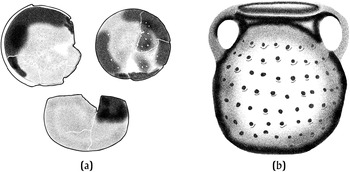
The ways in which foods are transformed and served can also be considered markers of identity (Twiss Reference Twiss and Twiss2007). Yet considering the wide range of plants that have been recovered in the area, we effectively know little of how these foods would have been prepared (i.e., boiled, peeled, mashed, grated, fermented). Some hints are provided by the presence of ceramic colanders (Figure 4a), which are believed to have been used for rinsing maize after it had undergone nixtamalization. Colanders have been found among the first ceramics during the Early Preclassic in the Belize Valley (Cunil ceramic complex), central and northern Peten (Eb complex), and the Pasion region (Xe complex), but seem to be missing from northern Belize (Swasey complex; Castellanos and Foias Reference Castellanos and Foias2017; Cheetham Reference Cheetham, Staller and Carrasco2010; Ebert et al. Reference Ebert, Pierce and Awe2019a; Garber et al. Reference Garber, Kathryn Brown and Hartman2002). Their use to rinse maize is supported by “occasional traces of white substance on colander interiors, the lack of soot on these vessels, and analogous ethnographic examples of the containers and procedures used to make nixtamal” (Cheetham Reference Cheetham, Staller and Carrasco2010:361). Ethnographic evidence is available from the Guatemalan Highlands (Figure 4b; Reina and Hill Reference Reina and Hill1978) and from the Lacandon Maya (Tozzer Reference Tozzer1907).
Ceramic colanders as evidence of maize rinsing. (a) Archaeological ceramic colander from Blackman Eddy (Belize), redrawn from Garber et al. (Reference Garber, Kathryn Brown and Hartman2002:12); (b) modern ceramic colanders used in the Guatemalan Highlands, redrawn from Cheetham (Reference Cheetham, Staller and Carrasco2010:348). Note: the drawings are not to scale.

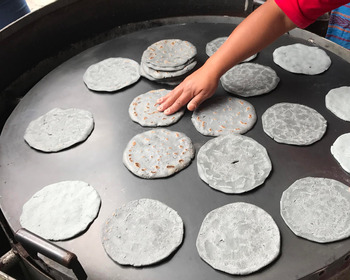
Additional information on plant processing has been evidenced by the presence of maize and other plants on Archaic tools (Rosenswig et al. Reference Rosenswig, Pearsall, Masson, Culleton and Kennett2014). The authors note that the biface was used in the preparation of various plants, including maize, chili peppers, and manioc; thus, this type of tool was clearly used for a range of functions. Similarly, a study of Preclassic artifacts from Ceibal (Cagnato Reference Cagnato2018a) indicates that more than one type of plant was processed. Damaged starch grains were observed on both the tools from Belize and from Ceibal, and for the latter, it is clear that cooked or at least thermally heated plants were processed with the help of the manos and metates. The presence of manos and metates from Pulltrouser Swamp, Cob Swamp, and Blackman Eddy was noted as providing evidence for the processing of maize. While this may have well been the case, grinding stones were likely used to process a variety of plants (and not solely maize), as evidenced by the microbotanical remains from Ceibal, but also from later periods in the Maya lowlands (Cagnato Reference Cagnato2016; Simms Reference Simms2014). Based on the absence of comales (flat ceramic griddles today replaced by metal ones; Figure 5), Cheetham (Reference Cheetham, Staller and Carrasco2010) argues that it is unlikely that tortillas could have been prepared, instead suggesting that tamales as the end product was more probable. I would note that griddles are not necessary for the preparation of tortillas; in fact, hot stones or the inside of ceramic vessels could have been used, and therefore would not necessarily exclude the preparation of both these types of dishes (see also Coe Reference Coe1994). The size and shape of ceramics can provide some general information on their function, but in our case, they can be useful only for a part of our sequence—that is, from around 1000 b.c., with the appearance of sedentary settlements with ceramic vessels. The most common forms—notably, large, unslipped jars—are linked to the storage of water or food (Cheetham Reference Cheetham, Staller and Carrasco2010; see Powis Reference Powis, Lohse and Valdez2004 for discussion on Late Preclassic assemblages), while the uses of tecomates (neckless, globular jars) are multiple: to keep and serve tortillas (Rice Reference Rice, Nichols and Pool2012), to steam tamales (Coe and Flannery Reference Coe and Flannery1967), as cooking pots, or to hold liquids (Lesure Reference Lesure1998). The latter two functions are proposed specifically for tecomates from the Pacific Coast (Chiapas, Mexico).
Blue-corn tortillas cooked on a metal comal in Highland Guatemala. Photograph by the author.

Obtaining information on preceramic food preparation is more problematic, as perishable containers (gourds/calabashes/baskets) that could have held these foods are long gone (even if some exceptions exist for later periods; see Beaubien Reference Beaubien1993; Hutson and Davies Reference Hutson and Davies2015:20). Gourds could have been used well before pottery, considering that these were present in the Americas by 10,000 years ago (Kistler et al. Reference Kistler, Montenegro, Smith, Gifford, Green, Newsom and Shapiro2014), and, as noted, the first ceramic vessels in Mesoamerica were made to look like gourds (Hutson and Davies Reference Hutson and Davies2015, citing Flannery and Marcus Reference Flannery and Marcus1994). Besides containers, tools—for example, made of wood—could well have been used (Rosenswig Reference Rosenswig2015), but again, these are unlikely to have been preserved.
Some of the major points that can be gleaned from this article are methodological, in that archaeologists, and in particular project directors, need to consider the wealth of information that can be gained from including paleoethnobotanical studies in their research programs. The importance of incorporating into the research design the need for systematic studies whereby macro- and microbotanical samples are collected from all contexts will be crucial (Morell-Hart Reference Morell-Hart2019) if we are to better understand more local patterns of plant use in the diet, but also in land use. In fact, the ability of paleoenvironmental studies to address large-scale trends across a broad region has been questioned (Dunning et al. Reference Dunning, Beach, Sierra, Jones, Lentz, Luzzadder-Beach, Scarborough and Smyth2013), and we also need to understand the more local trends before we can extrapolate on a larger scale—for example, testing whether the patterns seen by Kennett and colleagues (Reference Kennett, Prufer, Culleton, George, Robinson, Trask, Buckley, Moes, Kate, Harper, O'Donnell, Ray, Hill, Alsgaard, Merriman, Meredith, Edgar, Awe and Gutierrez2020) in Belize regarding maize consumption can be seen elsewhere. Of course, this will be largely based on obtaining well-preserved skeletal materials—not an easy endeavour. Moreover, while it is nearly always argued that the high levels of C4 plants in the diet are related to the consumption of maize, there is a clear need for more nuanced studies. Besides other tropical grasses, small-seeded plants such as goosefoot/epazote (Chenopodium ssp.) and amaranth (Amaranthus ssp.) (both in the Amaranthaceae family) follow this same photosynthetic pathway (Fedick Reference Fedick, Masson, Freidel and Demarest2020). Pollen from this family is typically used as an indicator of landscape disturbance (Jones Reference Jones1994; Wahl et al. Reference Wahl, Byrne, Schreiner and Hansen2006), while isotopic studies tend to downplay the role of this family by excluding them as providing C4 signals in their studies (e.g., Emery et al. Reference Emery, Wright and Schwarcz2000; Powis et al. Reference Powis, Stanchly, White, Healy, Awe and Longstaffe1999). One exception, perhaps, is Kennett and colleagues (Reference Kennett, Prufer, Culleton, George, Robinson, Trask, Buckley, Moes, Kate, Harper, O'Donnell, Ray, Hill, Alsgaard, Merriman, Meredith, Edgar, Awe and Gutierrez2020), who suggest that this family could have been minimally consumed, but only in individuals dating between 9600 and 4700 cal b.p. It is unclear why later, when higher C4 signals are identified, Amaranthaceae is no longer mentioned as a possibility, only maize. This is surprising, as recent studies have shown that both chenopods and amaranth figure in the archaeobotanical record of the Maya region, albeit from later time periods. For example, at Joya de Cerén, Slotten and colleagues (Reference Slotten, Lentz and Sheets2020) found that amaranth was the second most ubiquitous herb growing in the Late Classic agricultural fields. My own research leads me to believe that these plants should not be downplayed in the diet of the ancient Maya, having found both chenopods and amaranth in ritual and feasting contexts (Cagnato Reference Cagnato2016, Reference Cagnato2017). Thus, I believe that it will be critical to review this aspect if we want to characterize the diets of early populations. We also need better ways of interpreting agricultural features such as canals and terraces. Fortunately, the use of LiDAR has become more commonplace (Canuto et al. Reference Canuto, Estrada-Belli, Garrison, Houston, Acuña, Kováč, Marken, Nondédéo, Auld-Thomas, Castanet, Chatelain, Chiriboga, Drapela, Lieskovsky, Velasquez, Fernandez-Dias and Shrestha2018; Inomata et al. Reference Inomata, Triadan, Vázquez López, Fernandez-Diaz, Omori, Méndez Bauer, Hernández, Beach, Cagnato, Aoyama and Nasu2020), but archaeologists must be careful in ground-truthing what they see (Beach et al. Reference Beach, Luzzadder-Beach, Krause, Guderjan, Valdez, Fernandez-Diaz, Eshleman and Doyle2019). Finally, a better grasp of the chronology of these features is essential to really understand the development of landscape use through time and across space. The use of optically stimulated luminescence (OSL) soil-dating techniques to directly date these features, in particular the terraces (see Davidovich et al. Reference Davidovich, Porat, Gadot, Avni and Lipschits2012; Langlie Reference Langlie2016 for a New World application), might be a viable option for those working in the Maya lowlands.
By also combining microbotanical studies in a systematic manner, it will be possible to better reconstruct diet and tool use and bring to light other potential plant foods, notably underground storage organs, which are often starch-rich and may have been an important resource prior to maize becoming an eventual staple (see Cagnato Reference Cagnato2019a). Beyond our research area, USOs seem to have played a role in the diet of hunter-gather populations in Central America (Piperno et al. Reference Piperno, Ranere, Holst and Hansell2000), South America (Pearsall et al. Reference Pearsall, Chandler-Ezell and Zeidler2004; Piperno and Pearsall Reference Piperno and Pearsall1998; Scheel-Ybert Reference Scheel-Ybert2001), and even among earlier Mesolithic populations in northern Europe (Kubiak-Martens Reference Kubiak-Martens2002, Reference Kubiak-Martens, Hardy and Kubiak-Martens2016; Mason et al. Reference Mason, Hather, Hillman, Mason and Hather2002). Plants that fit this category in the central Maya lowlands and have been recovered from Archaic/Early Preclassic contexts include manioc, jicama, and sweet potatoes. Others have yet to be identified for this time period, but have been reported from later periods in the Maya region: arrowroot (Maranta arundinacea), achira (Canna sp.), and Zamia sp. (Cagnato Reference Cagnato2016; Inomata et al. Reference Inomata, Triadan, Vázquez López, Fernandez-Diaz, Omori, Méndez Bauer, Hernández, Beach, Cagnato, Aoyama and Nasu2020; Simms Reference Simms2014). This is where the application of starch grain and phytolith analyses will come in especially useful. In addition to studying artifacts, the study of dental calculus, when it is available, may also provide further direct indicators of diet (Hardy et al. Reference Hardy, Blakeney, Copeland, Kirkham, Wrangham and Collins2009; Mickleburgh and Pagán-Jiménez Reference Mickleburgh and Pagán-Jiménez2012; Piperno and Dillehay Reference Piperno and Dillehay2008), but also, more generally, of plant use, through the study of ancient alkaloids (see, for example, Eerkens et al. Reference Eerkens, Tushingham, Brownstein, Garibay, Perez, Murga, Kaijankoski, Rosenthal and Gang2018 on the presence of nicotine in dental calculus).
For the most part, the plants that are reported in the Archaic and Preclassic periods continued to be utilized in later periods (e.g., Cagnato Reference Cagnato2016, Reference Cagnato2017, Reference Cagnato2018b; Cagnato and Ponce Reference Cagnato and Ponce2017; Lentz Reference Lentz1991; Lentz et al. Reference Lentz, Dunning, Scarborough, Magee, Thompson, Weaver, Carr, Terry, Islebe, Tankersley, Sierra, Jones, Buttles, Valdez and Ramos Hernandez2014; Simms Reference Simms2014; Slotten et al. Reference Slotten, Lentz and Sheets2020), but also by the present-day Maya, who prepare a multitude of dishes using maize, chili peppers, squash, and beans, to mention but a few (Baer and Merrifield Reference Baer and Merrifield1972; Coe Reference Coe1994; Wisdom Reference Wisdom1940). It would thus seem that Maya culinary traditions have deep roots indeed. At the same time, numerous taxa reported for Classic period contexts are missing from the Archaic and Preclassic record: only fine-grained multidisciplinary work will determine whether this is due to lack of data or other factors, such as preference or access.
CONCLUSIONS
It is evident that ancient people living in the central Maya lowlands were engaged in modifying their natural environment from as early as the Archaic period, as mostly understood through pollen studies. Early and Middle Preclassic Maya likewise invested time and labor in constructing a range of agricultural features, such as canals and, later, terraces. Microbotanical data, which include pollen, starch, and phytoliths, indicate the presence of maize, chili peppers, squash family, bean family, and cotton, along with fruit trees and tubers, and present some information on which plants Archaic populations utilized and likely consumed (Jones Reference Jones1994; Jones and Hallock Reference Jones, Hallock and Lohse2008; Pohl et al. Reference Pohl, Pope, Jones, Jacob, Piperno, Lentz, Gifford, Danforth and Kathryn Josserand1996; Rosenswig et al. Reference Rosenswig, Pearsall, Masson, Culleton and Kennett2014). Preclassic period plant use is perhaps slightly better understood, considering that a wider set of data is available, from macrobotanicals to microbotanicals, including ceramic evidence, which in some cases provides organic residues that can offer clues as to what substances they may have contained. New taxa that appear in the archaeobotanical record of this period include cacao and tubers such as the sweet potato and jicama. Moreover, there seems to be a greater diversity of wild fruits, including nance, guava, soursop, and the coyol palm. While all botanical remains contribute important information, the differential representation of taxa in the archaeobotanical record has certainly introduced bias, leading to the recovery of taxa that are less fragile, and produce greater amounts of diagnostic microbotanical remains (an issue especially pertinent to maize). It is likely that a much wider range of plants was used by both Archaic and Preclassic populations, but systematic studies must be put into place where multiple lines of data are considered if we are to truly assess this scope.
The archaeobotanical and archaeological data recovered to date in this region provide a stimulating example on the diverse pathways adopted by humankind regarding food production. However, there is much we still do not know, and addressing models of domestication and how these differ from other parts of the Maya world and Mesoamerica will require additional fine-grained studies. While we know that communities continued to rely on wild resources after the adoption of maize, the causes why are certainly less evident. It is unlikely that the reasons boil down to simple economics, as food is not just a substance that sustained humans, but it is also a symbol, where aesthetics and taste probably played a vital role. These early food-producing strategies likely set the stage for what is known as the Maya civilization, which came to occupy large parts of the central Maya lowlands.
RESUMEN
La recuperación de restos macro- y microbotánicos, junto con el estudio de residuos químicos, permite indagar acerca de una serie de interrogantes de índole antropológica relacionados con las antiguas poblaciones mayas. En el presente artículo se examina la evidencia disponible a la fecha respecto a las plantas utilizadas por los pobladores precerámicos del período arcaico y por los mayas del preclásico temprano y medio en las Tierras Bajas Centrales. Los datos arqueobotánicos sugieren que las poblaciones de la época precerámica aprovecharon su rico entorno natural para recolectar diversos alimentos silvestres y cultivar plantas domesticadas como el maíz, la mandioca y el chile—modelo que continuó en el preclásico temprano y medio. A medida que los mayas se asentaron en espacios específicos, aparecen rastros más visibles de modificaciones a su entorno natural, tanto en forma de canales como de terrazas. Esta región es de particular interés en lo que respecta al desarrollo de la complejidad sociopolítica, ya que los cazadores-recolectores utilizaron plantas domesticadas durante los milenios que precedieron al inicio de la vida sedentaria. Estas primeras poblaciones prepararon el terreno para las pautas de uso de las plantas que perduraron a través del tiempo, pero también a través del espacio en la región maya.
ACKNOWLEDGMENTS
First and foremost, I would like to thank James Stemp and Jaime Awe for inviting me to write on this topic. I am also grateful to Takeshi Inomata and Daniela Triadan for their interest in starch grain analysis and for letting me study material from Ceibal, as well as to the Instituto de Antropología e Historia (IDAEH), Dirección del Patrimonio Cultural y Natural del Ministerio de Cultura y Deportes de Guatemala for providing export permits. I would also like to thank the UMR 7041 ArScAn équipe Archéologies environnementales and the ArchéoScopie department at the MSH Mondes in Nanterre (France). I especially appreciate the help of Juan Carlos Melendez with preparing some of the figures. Finally, I am grateful to Lynne Rouse, as well as to three anonymous reviewers who provided thoughtful suggestions and valuable advice on how to improve the manuscript.