Introduction
A large body of research has highlighted a “punitive turn” in penal policies in the United States, the United Kingdom, and other Western countries from the 1970s onwards (Garland Reference Garland2001; see also, from another perspective, Wacquant Reference Wacquant2010). These tougher penal policies consist of minimum sentences for recidivists, a decline in the rehabilitative ideal, an increase in the prison population, and a “culture of control.” They emphasize the individual responsibility of perpetrators; the fear they arouse in the population; and greater attention to victims (Walklate Reference Walklate2018; Rock Reference Rock2023). The “populism” of certain political leaders (Pratt Reference Pratt2007), along with specific framing by the media (Beale Reference Beale2006), is having a lasting influence on public discourse on penalties.
Other scholars dispute this “myth of punitivism” (Matthews Reference Matthews2005) or “the myth of a punitive public” (Thielo et al. Reference Thielo, Cullen, Cohen and Chouhy2016, 143) based on public opinion, which seem to them speculative rather than empirically established in the long term. European criminologists and political scientists defend a middle ground. Sonja Snacken and Els Dumortier (Reference Snacken and Dumortier2012) have labeled it as “resisting punitiveness in Europe.” Snacken (Reference Snacken2015, 397) has also referred to it as “penal moderation.” She emphasizes the fact that “levels of punitiveness vary greatly between countries and are correlated with welfare investments and political economy, different democratic political structures” and “are the result of political choices” (Snacken Reference Snacken2010, 273). Similarly, Georg Wenzelburger (Reference Wenzelburger2020) argues that political parties, institutional context, and policy feedback shape penal policies. Regarding France and Germany, Kirstin Drenkhahn, Fabien Jobard, and Tobias Singelnstein (Reference Drenkhahn, Jobard and Singelnstein2023, xviii) also argue that “penal moderation is still real” among individuals as well as judges, despite a substantial shift toward more repression in French penal policies since the 1990s. This is what makes it so interesting to focus on the French case, a relatively understudied Romano-Germanic country,Footnote 1 in order to replace it in a broader comparative perspective.
In this context, in many Western countries, various opinion polls indicate that the public is critical of the justice system for its perceived leniency (Gelb Reference Gelb, Arie and Gelb2008). These polls often refer to “justice” in general (covering civil, labor, criminal, and administrative fields), although individuals more often experience civil justice (divorce, housing, and labor disputes) rather than criminal justice. This belief may undermine the legitimacy of the justice system and the confidence of the public (Pickett Reference Pickett2019). Yet how relevant is this broad social representation? We argue that this issue calls for further empirical investigation, given its high media salience and the far-reaching policy consequences drawn from it. Indeed, politicians use these polls as indicators of the popular will to justify and enact more repressive policies (Garland Reference Garland2001; Simon Reference Simon2007; Jennings et al. Reference Jennings, Stephen, Gray and Hay2017; Fassin Reference Fassin2018), while people usually know little about actual judicial and sentencing practices (Gelb Reference Gelb2006; Gray Reference Gray, Wood and Gannon2009; Adriaenssen, Paoli, and Pleysier Reference Adriaenssen, Paoli and Pleysier2018; Kääriäinen Reference Kääriäinen2019).
This article aims to contrast abstract perceptions of criminal justice with nuanced evaluations of specific cases. In many Western countries, a paradox exists: while general perceptions of the justice system are often critically negative, assessments of individual cases are more balanced (on England and Wales, see Roberts and Hough Reference Roberts and Hough2005; on Scotland, see Hutton Reference Hutton2005; on the United States, see Dzur and Mirchandani Reference Dzur and Mirchandani2007; on Switzerland, see Kuhn and Vuillé Reference André and Vuillé2010; on Scandinavia, see Balvig et al. Reference Balvig, Gunnlaugsson, Jerr, Tham and Kinnunen2015; on Canada, see Leclerc, Niang, and Duval Reference Leclerc, Niang and Duval2017). This article provides two main contributions. First, it fills a gap in the scholarship on the variations between an abstract and a contextualized assessment of the justice system by emphasizing the relevance of a mixed-research design conceived to foster people’s reflexivity and to better grasp and understand punitive attitudes. Second, and more importantly, the article delineates some factors contributing to these differing assessments and weighs their relative importance by replacing them in a bigger picture (rather than focusing on one main factor). It examines the respective influence of conceptualizations of crime and of the objectives ascribed to sentences, the political orientations of respondents, and their demographics such as gender, age, social background, and educational level. The respondents’ firsthand experience (or lack thereof), knowledge of law and the justice system, and understanding of the criminal justice system, as well as the gravity of the offenses and the profiles of the defendant, are also considered.
To investigate these questions, we conceived a mixed-methods approach involving group interviews (seventeen groups, N = eighty) and a questionnaire distributed to a national scientific panel (N = 2,370 respondents; see Vigour et al. Reference Vigour, Cappellina, Dumoulin and Gautron2022). Each method allows for a comparative analysis of individuals’ abstract opinions, their views on real judicial decisions, and their evaluations of hypothetical cases. The group interviews help identify the underlying principles and tensions shaping public judgment on justice. Meanwhile, questionnaire responses serve to statistically validate the factors influencing such judgments, as explored through logistic regressions.
The article is structured as follows. The first section reviews key findings from existing literature, followed by a section detailing our methodological approach. The subsequent sections present the study’s main findings. While a majority of French individuals generally believe the justice system is lenient, their views become more nuanced when given detailed case contexts. They consider not just the abstract offense but also factors like the harm inflicted, the sequence of events, and the offender’s motivations, personality, and history, leading them to adjust their opinions on sentence severity. The final discussion puts into perspective the study’s primary contributions to our understanding of public attitudes toward punitiveness by shedding light on both the main factors, the underlying mechanisms, and the processes contributing to these deferring assessments. These findings yield evidence that the distrust of the judiciary is not as pronounced as implied by opinion polls, and it would likely diminish if the public had a deeper understanding of judges’ and prosecutors’ actual practices. It lends greater weight to the argument for penal moderation put forward for the Romano-Germanic countries of continental Europe (Snacken Reference Snacken2015; Drenkhahn, Jobard, and Singelnstein Reference Drenkhahn, Jobard and Singelnstein2023). The article concludes with the policy implications carried by our findings.
Understanding and explaining public attitudes toward sentencing and criminal justice
Addressing the gap between the public’s general opinion on punitiveness and its assessments on specific cases, research on public attitudes toward sentencing concentrates on two primary dimensions (Adriaenssen and Aertsen Reference Adriaenssen and Aertsen2014). First, numerous studies highlight the biases that affect public opinion (Gelb Reference Gelb2006) and discuss the most accurate methods for gauging public attitudes and opinions (Simonson Reference Simonson, Kury and Shea2011; Turner Reference Turner2018). Second, other research identifies factors that explain or predict the public’s approach to sentencing (Frost Reference Frost2010). The originality of our approach stands in contrast to the perspective taken in many of the articles presenting similar research findings. Most of them focus on one type of factor, while our research focuses on the multidimensionality of the variables shaping abstract and specific attitudes toward criminal justice and sentencing. In addition, while mostly based on opinion polls, the current research sometimes neglects the importance of putting ordinary individuals (and not a convenience sample, such as students) in a position to consider concrete situations.
How to measure public opinions and attitudes
Given this discrepancy, academic literature identifies three key limitations of opinion polls, beyond the biases of the dominant survey questions.Footnote 2 First, opinion polls rarely account for concrete knowledge of the criminal justice system. Yet a lack of familiarity with the justice system leads people to overestimate the rates of crime and recidivism, while underestimating the severity of court rulings (Gray Reference Gray, Wood and Gannon2009; Pickett and Baker Reference Pickett and Baker2014; Roberts, Pina-Sánchez, and Hough Reference Roberts, Bild, Pina-Sánchez and Hough2022). Natasha Frost (Reference Frost2010, 158) notes that “very few people have direct experience with the criminal justice system, leading most public knowledge to be second-hand” (see also Gelb Reference Gelb, Arie and Gelb2008).Footnote 3 However, public punitiveness significantly decreases when accurate information about crime rates and the workings of the criminal justice system is provided (Indermaur et al. Reference Indermaur, Roberts, Spiranovic, Mackenzie and Gelb2012; Roberts, Jackson, and Gerber Reference Roberts, Jackson and Gerber2012; Kääriäinen Reference Kääriäinen2019; Grimmelikhuijsen and van den Bos Reference Grimmelikhuijsen and van den Bos2021). Furthermore, when people engage in informed deliberation, they demonstrate greater reflexivity, becoming better equipped to move beyond initial prejudices for more nuanced judgments (Hutton Reference Hutton2005; Barker Reference Barker2006; Green Reference Green2006; Dzur and Mirchandani Reference Dzur and Mirchandani2007; Warner and Davis Reference Warner and Davis2011; Leclerc, Niang, and Duval Reference Leclerc, Niang and Duval2017).
Second, what is often termed “public opinion” tends to focus on the most severe cases (Hough and Park Reference Hough and Park2002). This focus is heightened by the media (Frost and Phillips Reference Frost and Phillips2011; Surette Reference Surette2015), which are the main sources of public information about crime and the courts (Rosenberger and Callanan Reference Rosenberger and Callanan2011), especially among those with lower educational levels (Pickett et al. Reference Pickett, Mancini, Mears and Gertz2015). Third, public responses vary based on the type of offense. People’s attitudes blend punitive measures with rehabilitative or alternative ones depending on the specifics of the case (Gromet and Darley Reference Gromet and Darley2006; de Keijser, van Koppen, and Elffers Reference De Keijser, van Koppen and Elffers2007). For instance, Frost (Reference Frost2010, 161) refers to studies indicating that the public is more inclined to favor rehabilitation for non-violent or young offenders, while being hesitant in the cases of violent and sex offenders (see Brown Reference Brown, Wood and Gannon2009).
However, polls do not capture this complexity. Beyond debates over the most accurate measures of public opinion and punitive attitudes, numerous studies aim to identify the factors influencing these opinions.
Factors explaining public attitudes
Scholarly research identifies five primary factors influencing punitive attitudes: political orientation, demographic factors (race, in particular), education level, as well as conceptions of punishment, the extent of knowledge, and direct experience with the judicial system.
Political and sociodemographic factors
Some works conclude on the existence of a consistent link between ideology and punitive attitudes (Adriaenssen and Aertsen Reference Adriaenssen and Aertsen2014), in particular between punitiveness and political conservatism (Kury and Obergfell-Fuchs Reference Kury and Obergfell-Fuchs2008; Serrano-Maillo and Kury Reference Serrano-Maillo and Kury2008; Gerber and Jackson Reference Gerber and Jackson2015; Kleck and Jackson Reference Kleck and Jackson2017). James Unnever, Francis Cullen, and Bonnie Fisher (Reference Unnever, Cullen and Fisher2007, 313) suggest that supporting harsh treatment for criminal offenders is one of the beliefs at the heart of conservative political ideology (for a critique, see King and Maruna Reference King and Maruna2009). Michael Costelloe, Ted Chiricos, and Marc Gertz (Reference Costelloe, Chiricos and Gertz2009, 43) show that conservatism is “a consistent predictor of punitiveness.” Frost (Reference Frost2010, 162) explains that conservatives are more likely to attribute crime to the individual’s decision and responsibility to break the law. Liberals typically highlight the social causes of crime. Such general conceptions of the causes of crime are linked to an individual’s level of punitiveness and to their political orientation.
Findings are less clear when it comes to the impact of gender, age, and income level (Frost Reference Frost2010; Adriaenssen and Aertsen Reference Adriaenssen and Aertsen2014; Kääriäinen Reference Kääriäinen2019). The links between these variables are rarely unequivocal across countries and seldom consistent (Roberts and Indermaur Reference Roberts and Indermaur2007; Maruna and King Reference Maruna and King2009). Regarding race, white people tend to be more punitive than Black people (Costelloe, Chiricos, and Gertz Reference Costelloe, Chiricos and Gertz2009; Kleck and Jackson Reference Kleck and Jackson2017). They are less supportive of rehabilitation and more supportive of the death penalty (Johnson Reference Johnson2008; Rosenberger and Callanan Reference Rosenberger and Callanan2011; Adriaenssen and Aertsen Reference Adriaenssen and Aertsen2014). These differences can be explained by the racial prejudice of white people and by perceived racial bias among Black people (Johnson Reference Johnson2008). Nevertheless, recent studies point out that some Black people, searching for respectability (Jefferson Reference Jefferson2023), might be more punitive, at least regarding certain types of crime (Unnever, Benson, and Cullen Reference Unnever, Benson and Cullen2008), and that “white people and Black people might support punitive measures for different reasons” (Frost Reference Frost2010, 161; see King and Maruna Reference King and Maruna2009).
Level of education, knowledge, experiences, and conceptions of the justice system
There is more consistent evidence regarding the level of education. People with a lower level of education are likely to be more punitive (Roberts and Indermaur Reference Roberts and Indermaur2007; Serrano-Maillo and Kury Reference Serrano-Maillo and Kury2008; Maruna and King Reference Maruna and King2009; Roberts, Jackson, and Gerber Reference Roberts, Jackson and Gerber2012; Spiranovic, Roberts, and Indermaur Reference Spiranovic, Roberts and Indermaur2012; Balvig et al. Reference Balvig, Gunnlaugsson, Jerr, Tham and Kinnunen2015). This impact of education as well as public criticism of the criminal justice system are largely due to a lack of understanding of crime and of the work of the courts (Gelb Reference Gelb2006; Gray Reference Gray, Wood and Gannon2009; Roberts, Jackson, and Gerber Reference Roberts, Jackson and Gerber2012): “A higher level of knowledge among laypeople mitigates their punitive attitudes. … [Yet] level of knowledge is, in general, a poor predictor for the severity of the sentence decisions of laypeople” (Kääriäinen Reference Kääriäinen2019, 409). On the contrary, attitudes to sentence severity are clearly linked to a lack of knowledge of key sentencing indicators (regarding England and Wales, see Roberts, Pina-Sánchez, and Hough Reference Roberts, Bild, Pina-Sánchez and Hough2022, 3).
The main source of information also shapes the degree of punitiveness. Punitiveness increases as the number of hours spent watching television increases (Rosenberger and Callanan Reference Rosenberger and Callanan2011) and while exposed to tabloids (Spiranovic, Roberts, and Indermaur Reference Spiranovic, Roberts and Indermaur2012). Scholarship does not find clear results on concern over crime, fear of crime, personal or vicarious victimization, and crime rates. Some find a positive impact (Costelloe, Chiricos, and Gertz Reference Costelloe, Chiricos and Gertz2009; Johnson Reference Johnson2009), and others find a negative one (Roberts and Indemaur Reference Roberts and Indermaur2007; Hartnagel and Templeton Reference Hartnagel and Templeton2008; Spiranovic, Roberts, and Indermaur Reference Spiranovic, Roberts and Indermaur2012; Pickett Reference Pickett2019). But there is consistent evidence that tougher punishment of criminals is tied to “the perception—accurate or not—that crime is increasing” (for a review, see Kleck and Jackson Reference Kleck and Jackson2017, 1575; Adriaenssen and Aertsen Reference Adriaenssen and Aertsen2014).
The literature on public opinion indicates that individuals are particularly critical of decisions associated with serious crimes. Offenses against the physical integrity of women and children elicit strong indignation (Roberts and Hough Reference Roberts and Hough2005; Leclerc, Niang, and Duval Reference Leclerc, Niang and Duval2017; Shields and Cochran Reference Shields and Cochran2020). However, other vignette-based studies point out variations in how the seriousness of certain crimes is assessed (Socia, Rydberg, and Dum Reference Socia, Rydberg and Dum2021; Kruis et al. Reference Kruis, Menard, Choi, Rowland, Frye, Kosaka and Williams2023). For example, D. J. Angelone, Damon Mitchell, and Laura Grossi (Reference Angelone, Mitchell and Grossi2015) discuss rape in relation to attitudes toward gender roles. More unanimously, a criminal record is frequently seen as an aggravating factor (Meijer et al. Reference Meijer, Annison and O’Loughlin2019). Conversely, considering the specific circumstances under which the act was committed allows for a more nuanced understanding of both the severity of the offense and the perpetrator’s responsibility (Johnson and Dawson Reference Johnson and Dawson2011). This is also true when information is available about the defendant’s demeanor during arrest and in court, such as acknowledging the facts, expressing regret, or apologizing to the victim (Corwin et al. Reference Corwin, Cramer, Griffin and Brodsky2012; Lynch and Haney Reference Lynch and Haney2014; Gautron Reference Gautron, Field and Tata2023a, 2024).
Purposes of punishment
Regarding the purposes of punishment (Canton Reference Canton2017), people who are supportive of retribution and deterrence are more likely to be punitive than individuals who are in favor of rehabilitation and restoration (Mackey, Courtright, and Packard Reference Mackey, Courtright and Packard2006; Roberts et al. Reference Roberts, Hough, Jacobson and Moon2009). Furthermore, the more an individual values rehabilitation and believes in the defendant’s chances for rehabilitation, the less likely they are to think the courts have been too lenient (Maruna and King Reference Maruna and King2009; Leclerc Reference Leclerc2012; Burton, Cullen, and Thielo Reference Burton, Cullen and Thielo2020). Yet particular attention is rarely given to the tension between retribution and rehabilitation in empirical studies. Based on quantitative analyses in French-speaking Switzerland, Noëlle Languin and colleagues (Reference Languin, Widmer, Kellerhals and Robert2004) identified three distinct penal philosophies: prospectivism focuses on the ideal of reintegration and social cohesion; contractualism emphasizes responsibility, restitution, and proportionate reparation, while ostracism is marked by severity, suffering, and retribution. However, other research suggests that individuals do not subscribe to a single penal philosophy but articulate multiple purposes for punishment (Gromet and Darley Reference Gromet and Darley2009). Support for different sentencing goals varies according to the nature and seriousness of the offense (Roberts, Crutcher, and Verbrugge Reference Roberts, Crutcher and Verbrugge2007, 86; Roberts et al. Reference Roberts, Hough, Jacobson and Moon2009; Adriaenssen and Aertsen Reference Adriaenssen and Aertsen2014), the reason for the transgression, as well as its moral assessment (Kugler et al. Reference Kugler, Funk, Braun, Gollwitzer, Kay and Darley2013). Thus, some individuals may advocate for severe sentences even when they value rehabilitative aims (McKee and Feather Reference McKee and Feather2008).
The main limitation of these bodies of literature lies in the fact that they are mainly based on opinion polls or on a convenience sample. Many research designs do not place ordinary individuals in the role of a lay judge facing concrete situations. In contrast, our research design has been specifically conceived to examine their decision-making processes, to study the gap between abstract and concrete attitudes, and to identify the respective weight of the predictive factors presented above, using the case of France.
Methods and cases
Our study employs a mixed-research design. Focus groups and a quantitative survey serve as complementary approaches to better grasp and explain the multidimensionality of public attitudes toward sentencing and criminal justice. This multi-method approach enabled us to provide a comprehensive picture and to overcome the main limitations of the studies mentioned above. This section presents the respective role of each method, their points of integration, and how they were combined to compare different ways of measuring general and specific attitudes.
Focus groups
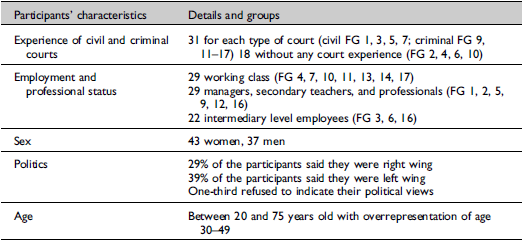
Three-hour-long interviews were conducted with seventeen groups (three to seven people in each group; eighty people in all) between November 2015 and June 2017. Focus groups were constituted based on social belonging and whether the participants had direct court experience and the type of jurisdiction: a civil court (mainly family and labor disputes) or a criminal court (offenders, victims, and jurors in a criminal trial). We were also careful to have an overall well-balanced sample according to sex, age, and political orientation (see Table 1).Footnote 4 All this information was given by the participants when they volunteered in order to set-up the groups. They also completed a four-page questionnaire on the same day as the focus group (all the questions were included in the quantitative survey including more questions).
Characteristics of the participants and groups

Table 1 Long description
The table has two columns: Participants’ characteristics and Details and groups. It contains six rows describing the experience of civil and criminal courts, employment and professional status, sex, politics, and age of participants. The first row indicates that 31 participants had experience in civil courts and 18 in criminal courts, with 18 having no court experience. The second row shows the distribution of participants by employment class, managers, and intermediary level employees. The third row lists the number of women and men participants. The fourth row details the political orientation of participants, with 29 percent identifying as right wing, 39 percent as left wing, and one-third refusing to indicate their views. The fifth row states the age range of participants, between 20 and 75 years old, with an overrepresentation of those aged 30-49.
Participants were not recruited through a polling company but directly through advertisements: 150 people volunteered over forty-eight hours after reading an advertisement for the research in municipal newsletters reported on social networks; others were contacted through posters in public institutions or associations providing legal support as well through leafleting in front of the courts and in food banks. Each participant was given a gift voucher worth forty euros to thank them for their involvement. The focus groups were conducted in a French city with a large District Court and a Court of Appeal. Two researchers among our team of seven scholars led semi-directive discussions divided into three phases. Focus groups began with a general discussion (with four main open questions, set out below), followed by a short documentary about the French justice system that participants commented on and case vignettes to be completed by the participants (for examples, see Young and Billings Reference Young and Billings2020).
The entire discussion was video recorded and fully typed up. Four researchers inductively analyzed exchanges using software to code all the transcriptions by subtheme (any speech could be coded as many times as necessary).Footnote 5 We then focused our attention on the agreements and disagreements within and between groups (Duchesne and Haegel Reference Duchesne and Haegel2007; Barbour Reference Barbour2018). We also conducted a double-blind analysis of each participant’s speech, focusing both on continuities and contradictions. Lastly, we tried to understand and, if possible, explain the similarities and the controversies: first, only with the information given by participants during the discussion and, second, in relation to their social and political characteristics as well as their political affiliation.
The focus groups allowed for the identification of specific ways in which public judgments about justice are formulated and articulated. Compared to individual interviews, the participatory and deliberative nature of group interviews offers a more nuanced and comprehensive understanding of criminal justice and punitive attitudes. In conversations with others, participants are more likely to articulate and justify their viewpoints, providing greater insight into the underlying rationale of their narratives. Second, this research design facilitates reflexivity—that is, people’s ability to distance themselves from their own stereotypes or from the views of the media.
Survey
We also administered via a tablet a questionnaire to a national scientific panel known as the Étude Longitudinale par Internet Pour les Sciences Sociales (ELIPSS) panel, a representative probabilistic random sample of the French population (2,370 respondents).Footnote 6 The questionnaire mirrored the three steps employed in the focus groups. Responses to the questionnaire helped clarify the factors influencing judgments about justice as well as the explanatory variables for these judgments, using factorial analysis and logistic regression models. This article presents the results from three logistic regression models, examining both the general opinions (such as attitudes on the severity of the courts) and specific attitudes about vignettes as well as actual court hearings and sentences. The first model included the sociodemographic characteristics of the respondents: sex, age, occupation, level of education, as well as the level of legal knowledge (15.5 percent of the respondents had no legal knowledge; 27.6 percent very low; 28.3 percent and 17.6 percent medium; and 7.9 percent between high and very high). The second model added political leaning as a variable. Finally, the third type of models incorporated both sociodemographic characteristics and any past experiences that the respondents may have had with law enforcement or the judicial system.
Comparing the different ways of measuring general and specific attitudes
The qualitative and quantitative research design was developed in parallel to answer the same research question so that the contents and the structure of the two surveys would be as close as possible (the same research team wrote the very first version of the survey before the focus groups began as well as the next versions of the questionnaire): first, general questions; second, reactions to several excerpts from a documentary; and, third vignettes. The data collection followed a sequential research design (Small Reference Small2011). We led the focus groups, and then we administered the questionnaire to get findings on a larger and more representative sample. Thus, we were able to propose the most frequent answers given in the qualitative part to the closed-ended questions in the questionnaire. Data analysis and interpretation are more akin to “nearly fully mixed designs”: “[M]ixing quantitative & qualitative approaches in an interactive way at all stages of the investigation (i.e. research objective, type of data/operations, type of analysis/inference); such that at each stage, one approach (e.g. quantitative) influences the other approach (e.g. qualitative)” (Onwuegbuzie and Burke Johnson Reference Onwuegbuzie and Burke Johnson2006, 54). Thus, there are multiple points of integration between the two methods (Teddlie and Tashakkori Reference Teddlie and Tashakkori2006). Focus groups were used to give a finer comprehensive understanding of the mechanisms identified or confirmed through the questionnaire, according to the triangulation principle (Denzin Reference Denzin2009). This research design resulted in “significance enhancement (e.g. facilitating thickness and richness of data; augmenting interpretation and usefulness of findings)” (Onwuegbuzie and Burke Johnson Reference Onwuegbuzie and Burke Johnson2006, 54). Combining these methods also enabled us to control their specific effects on the findings.
Our objective was to contrast broad and specific attitudes toward justice and the court system. The initial step focused on capturing general attitudes on this topic. In the focus groups, the very first question (“what is justice for you?”) provided insights into participants’ views on civil and criminal justice as well as on the courts. The fourth question (“what do you think about how the court system works?”) addressed general perceptions of court efficiency, sentencing, sentence adjustments, the objectives of punishment, the disparities in access to the legal system, and the differential treatment by law enforcement, prosecutors, and judges. In the quantitative survey, respondents were questioned on topics such as the role of courts, their trust in legal professionals and the police, their confidence in elected officials and other public institutions, and their perceptions of equality in treatment by police and judges.
The next two phases of our study focused on specific attitudes toward criminal justice. The debate or questions over a short film documentary and actual stories was conceived as a way to reduce asymmetries, especially for people who were working class and without any legal experience. The second phase involved gathering reactions to real court hearings and sentences, elicited by showing participants clips from a documentary, which portrayed a case heard by a criminal court (tribunal correctionnel) as well as a disputed road offense heard by a police court (tribunal de police).Footnote 7 Questions in the survey and during the group interviews dealt with the severity of the judges, their authority, their intelligibility, and their listening skills.
The third step was centered on the specific attitudes regarding detailed cases. Two vignettes were used both in the focus groups and in the survey: the first one involved a thirty-year-old delivery driver, married with two kids who was stopped by police for drunk driving, and the second one involved young people caught by the police in the act of vandalizing cars. The ambiguity of the expression “young people” was deliberate in order to see if and which participants would make a distinction between minor or adults in their sentencing. Indeed, there are specific juvenile courts in France. We incorporated a third case into the survey that included purse snatching. For comparative purposes, the first case reproduced exactly a fictitious, yet statistically representative, case that had been previously presented to judges and prosecutors in France (Danet Reference Jean2013; Gautron and Retière Reference Gautron and Retière2014). Specifically, we asked respondents what penalty they believed the courts would impose and what sentence they themselves would prefer if they were judging the case. We also inquired about the criteria they thought judges would use to determine the sentence as well as the criteria they would consider if they were in the judge’s position. A list of potential sentences or criteria was offered in the survey but not in the focus groups.
In this final phase, both the qualitative and quantitative protocols focused on how individuals interpret and weigh the various components of each scenario presented to them. Within the focus groups, the objective was to comprehend how each individual’s interpretation of these elements influenced their view of the court’s actions in these specific instances. This approach was innovative in that it prioritized the perspective of each participant; it was not the objective gravity of the case that was being evaluated but, rather, the perceived gravity. From this standpoint, we aimed to understand the context that leads some individuals to express discontent with the court’s leniency or severity.
By presenting concrete and detailed cases, the vignettes brought the respondents closer to the situation that judges face during sentencing. This shifted the focus from studying attitudes to examining decision-making processes (Green Reference Green2006). In the surveys and the interviews, respondents were placed in the role of a lay judge. Using the information provided, they had to determine the appropriate punishment for a given crime (see, for example, Gelb Reference Gelb, Arie and Gelb2008; de Keijser and Elffers Reference De Keijser and Elffers2009). In this way, the respondents gained first-hand experience of the complexities involved in rendering a judgment.
The fictive and real cases chosen were misdemeanors or middle-ranking offenses for three main reasons. First, these offenses were punishable under French law by up to ten years’ imprisonment, and, thus, they represented the vast majority of offenses committed in France (99.5 percent) and elsewhere and were therefore the most representative ones (508,000 versus 2,400 serious criminal offenses). Elsewhere, too, misdemeanors and offenses account for the bulk of crime. Second, we chose these particular cases so that they would make sense to the respondents (they or their relatives would have been directly confronted with them). Third, and this seemed crucial to us on a theoretical level, we focused on these particular cases in contrast to a lot of research work and media that concentrates on very serious, but statistically rare, criminal offenses.
France in a comparative perspective: still penal moderation despite recent tightening
Studying France is interesting in a comparative perspective. Indeed, it is a country in continental Europe that follows the civil law system. Such legal systems are based on written law and procedures. The codification of legal principles into systematic bodies of law aims to ensure a degree of predictability, while leaving room for interpretation by law professionals. Judges are required to establish the facts, apply the law to a specific case in accordance with procedural rules and precedent, and issue decisions that are properly reasoned and enforceable. In contrast, common law relies on case law to establish judges’ decisions. The judge contributes to the creation of law in the same way as the legislative branch.
Like other countries in continental Europe, the French criminal justice system is significantly less punitive than it is in the United States or Canada. However, growing criticism regarding its lack of severity has led to a tougher penal stance since the 1990s (Bastard et al. Reference Bastard, Delvaux, Mouhanna and Schoenaers2016; Vigour Reference Vigour2018). Consequently, France’s incarceration rate remains among the highest in Europe, as reported in the Council of Europe’s statistics. There has been a significant increase in alternatives to prosecution (community service, work placement, victim compensation, mandatory treatment, and so on) and simplified procedures since then (Gautron Reference Gautron, Hondeghem, Rousseaux and Schoenaers2016). In addition to sentencing at a criminal trial, the following options are now preferred: a summary judgment (the judge rules on the case without a hearing, relying on the arguments of the defense and on the prosecution’s recommendations, and issues the judgment in writing); a plea agreement since 2004 (the defendant admits to the charges and agrees to this procedure, which avoids a trial, is provisionally recorded on the criminal record, and may result in significant fines); and an immediate arraignment (appearing in court within three days after the offense). Designed to be exceptional, immediate arraignment has been in use in major urban courts since 2005 as a standard tool for managing the criminal justice system (Danet Reference Jean2013). Since the 1990s, the public prosecutor’s office has played a central role in handling criminal cases not only because of the wide range of options available for punishing an offense but also because of its authority in determining the sentence while respecting the principle of individualized sentencing, a traditional prerogative of the judge (Vigour Reference Vigour2015, Reference Vigour2018).
In a 2022 survey in France, 65 percent of one thousand respondents said that the judiciary was “not severe enough,” a marked increase from 51 percent in 2011. Only 2 percent deemed it “too severe,” while 23 percent considered it “fair.”Footnote 8 These criticisms are coupled with a rising sense of insecurity, which is at odds with the actual trends in crime numbers. For this reason, it is worthwhile to examine the basis for these perceptions and to compare them with the public’s views on the decisions actually made by judges, as well as on specific fictional cases, in order to better understand the reasons underlying the public’s assessments. In addition, France offered specific opportunities at the time the research was completed as researchers were given the opportunity to submit for free a thirty-minute questionnaire to a scientific panel—the ELIPSS panel—and researcher had free access to the data from the same ELIPSS panel, regarding previous scientific research led by other researchers.
With respect to our research results, we first present the mainly critical abstract representations of the French criminal justice before moving to the more nuanced assessments in situations of appraisal.
Results 1: predominantly critical abstract representations
While the sentiments of French interviewees often aligned with those found in media-commissioned polls, they also offered more nuanced judgments varying by the nature of the offense and the identity of the perpetrator. Yet diverse attitudes did coexist. Each reflects particular social groups or specific socio-demographic characteristics and, beyond that, differing belief systems.
Contrasting assessments depending on the offender and the nature of the offense
During the group interviews, most French respondents expressed dissatisfaction with what they saw as the justice system’s overly lenient approach, particularly toward repeat offenders. They criticized the dismissal of cases, early releases, and the failure to enforce custodial sentences. Many lamented that such leniency undermined law enforcement efforts. For example, 60 percent of the questionnaire respondents believed that “judges often release people arrested by the police.” While some drew on personal or secondhand experiences, most cited media reports. The public attributes this leniency to factors like case overload, lack of resources, or prison overcrowding and believes it fosters a sense of impunity among offenders.
However, the critiques of judicial leniency are often targeted at specific types of crimes and offenders. First, offenses against individuals, especially sexual offenses, are most commonly cited as being insufficiently punished, particularly when compared to sentences like property damage or drug-related crimes. Second, judgments are often influenced not by the intrinsic severity of the crime but, rather, by the personal characteristics of the perpetrators. Juvenile delinquency, which is often conflated with that of foreign-born youths from the “banlieues,” is a major focus of criticism. Furthermore, the perceived impunity of elites draws significant public ire (regarding the United States, see Cullen, Chouhy, and Jonson Reference Cullen, Chouhy, Jonson and Rorie2019). Group interview participants were nearly unanimous in condemning a system they saw as biased toward the rich and the powerful. They believed that the elites could easily manipulate the law and the criminal justice system, starting from the point of police involvement, or sidestep the justice system with the aid of expensive lawyers. If they do face sentences, they are often served fines that are inconsequential given their income. Even when imprisoned, white-collar criminals are thought to enjoy more favorable conditions.
This sense of deep-seated injustice and inequality is heightened since many of the respondents believed that the justice system, while overly lenient with offenses they view as serious or those committed by elites, is unduly harsh on other offenders with whom they more closely identify. In group discussions, the most frequently cited and broadly supported examples were those of traffic violations. Many felt that substantial resources are devoted to fill “state coffers,” neglecting the “real” delinquents, who are often kept at a distance through stereotyped opinions. The respondents justified the lesser gravity of traffic violations by noting that anyone could commit them due to “inattentiveness.” One such respondent was Morgan, a thirty-year-old high school economics teacher who aligns herself with the Republicans (the main French conservative party at that time). She asked why “someone who has had three glasses of alcohol” should find themselves “on the stand alongside someone who has committed a robbery.” According to her view, these offenders do not belong in prison, even if they are repeat offenders. For those who are less financially secure, it feels like a double loss in the social game—they are over-criminalized for traffic offenses, which have a great impact on their social and professional lives, while the wealthy are handed inconsequential fines.
Therefore, our first main result is that even abstract representations reveal different opinions depending on the type of crime or the perpetrator, suggesting that over-generalized assessments of public opinion should be avoided.
Socially and politically divided abstract representations
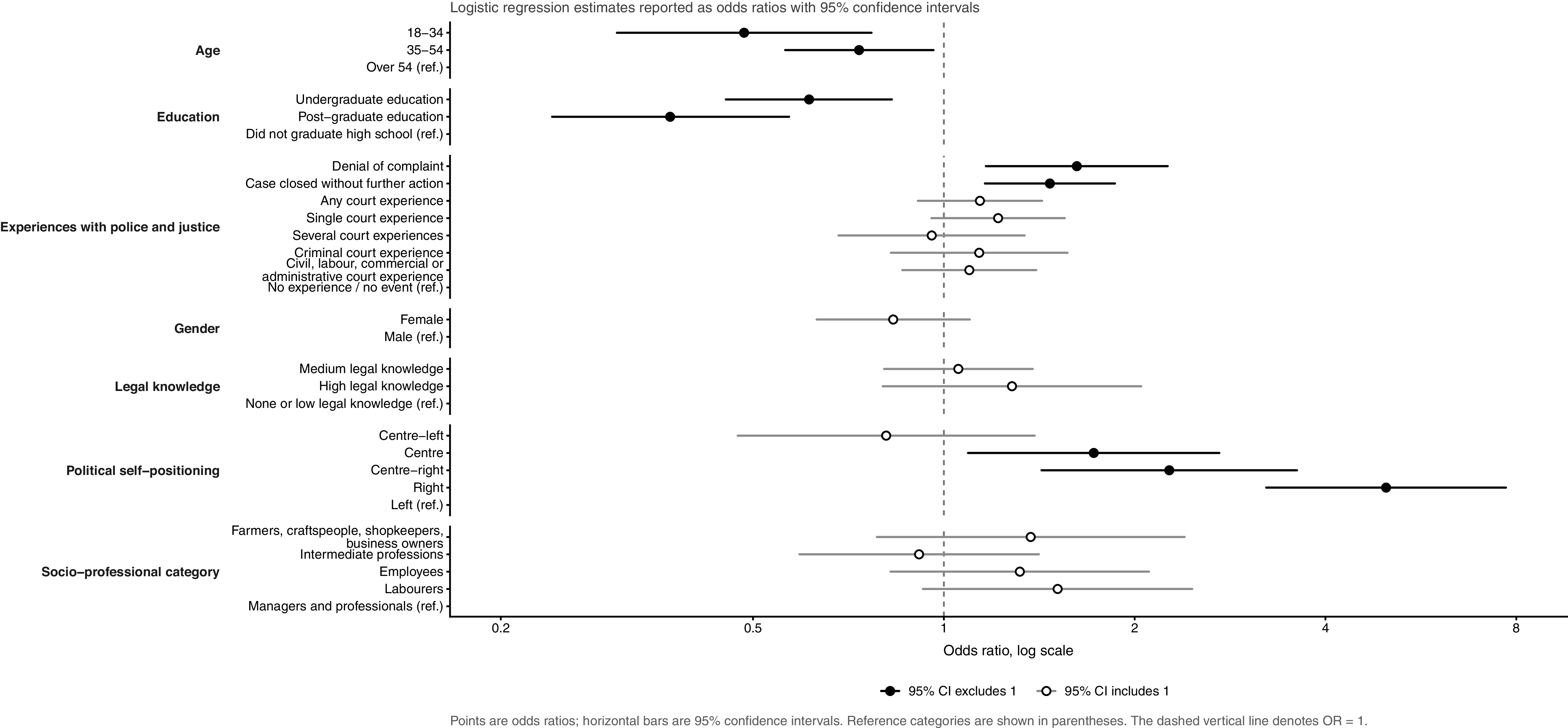
Various factors influence decontextualized views of the French criminal justice system. Logistic regression analyses from our survey reveal that younger individuals, or people with higher levels of education, are significantly less likely to criticize the perceived leniency of judges (see Table 2 and Figure 1). This trend is also evident among individuals who identify with the left or center-left political spectrum.Footnote 9 Legal knowledge and gender have no impact.
Logical regression relating to the lack of severity of judges in general

Table 2 Long description
A table comparing logistic regression models on perceptions of judicial severity. The table has 3 models with 2,248, 2,207, and varying sample sizes for models 3a to 3e. Each model includes columns for B (standard error), Odds ratio, and 95% confidence interval. Model 1 focuses on socio-professional categories, gender, age, and education. Model 2 adds political self-positioning. Models 3a to 3e detail experiences with the police and justice system. Each row lists specific categories or experiences with corresponding statistical values.
Notes: *p < 0.05; **p < 0.01; ***p < 0.001.
Correlates of agreement with the proposition that judges often release arrested people

Figure 1. Long description
Panel A: A forest plot showing the odds ratios and 95 percent confidence intervals for various factors influencing the agreement with the proposition that judges often release arrested people. The horizontal axis represents the odds ratio on a log scale, ranging from 0.2 to 8. The vertical axis lists different factors such as age, education, experiences with police and justice, gender, legal knowledge, political self-positioning, and socio-professional category. Each factor is represented by a point and a horizontal line indicating the confidence interval. Points to the right of the dashed vertical line at 1 indicate higher odds of agreement, while points to the left indicate lower odds. Factors like age over 54, post-graduate education, and certain court experiences show higher odds of agreement, while others like medium legal knowledge and specific socio-professional categories show lower odds.
Paradoxically, individuals’ perceptions of the justice system are less shaped by their prior interactions with the judiciary than by their experiences with the police. Those who have had complaints dismissed and individuals whose complaints have been disregarded are more likely to believe that the justice system frequently releases arrested individuals. Our survey results also affirm that the number of identity checks diminish confidence in the judicial system and not only trust in the police (Oberwittler and Roché Reference Oberwittler, Roché, Oberwittler and Roché2018; de Maillard Reference De Maillard2019). Other interactions with the justice system, particularly in criminal matters, also double the likelihood of harboring negative feelings toward judicial institutions, such as mistrust, fear, anger, or a sense of injustice. However, there is a notable gap between these general perceptions and the more nuanced assessments made by participants in the focus groups and panels when considering specific cases.
Results 2: in situations of appraisal, there are more nuanced assessments
In the group interviews, the respondents exhibited greater nuance in evaluating the severity of sentences in specific cases or in determining a “fair” sentence in hypothetical scenarios where both the acts committed and the characteristics of the perpetrators were provided. For instance, regarding an extract from a documentary film they watched, the synopsis of which is presented in Box 1, even the most vocal participants in the general discussions contributed to the evolving perspectives on judicial severity. Out of eighty participants, only four men from working-class backgrounds criticized the judges for leniency, focusing mainly on jail sentences and overlooking the punitive nature of suspended sentences with probation. This nuanced approach was corroborated statistically and has been observed in other countries. Among the 2,352 respondents, 3 percent believed that the film sentence was not severe enough, 46 percent deemed it “fair,” and 50 percent considered it too harsh. Statistical analyses did not enable us to sociologically characterize the 8 percent of panelists who opted for a prison sentence in all three vignettes in the questionnaire, which suggests that punitive attitudes are far from monolithic.
A clip from the documentary
The defendant is charged with discharging a shotgun twice in a public space. He consults with a public prosecutor, who informs him that such an act carries a maximum penalty of five years in prison. He argues that he did not aim at anyone and that the gun contained no live ammunition. The public prosecutor counters that these details are irrelevant under the French Criminal Code. Acknowledging the facts, he is informed about his right to an attorney and the forthcoming legal proceedings. The prosecutor indicates her intention to recommend immediate detention. The following day, he stands trial. He recounts that he retrieved his gun after a nightclub owner physically ejected and humiliated him in front of his friends and spouse. While reiterating his story for the third time, the presiding judge interjects, emphasizing that the details are immaterial to the Criminal Code, unlike the fact of firing two shotgun rounds into the air. He is subsequently sentenced to a twelve-month prison term, with six months suspended on probation for two years.
To understand the moderation of individuals’ assessments regarding concrete cases, the discussion will proceed in three steps. First, although certain social factors shape their modulation of sanctions, political beliefs have significantly less influence than on general representations. Second, both the respondents and the panelists contextualized the actions and individualized the sentences, leading to a de-escalation of punitive measures. Third, this moderation is also attributable to the multiple objectives they associated with punishment. In these three sections, we will explain the main qualitative and quantitative findings based on the mechanisms that were identified in the focus groups.
A strong depoliticization of the choice of sentence, smaller impact of social determinants
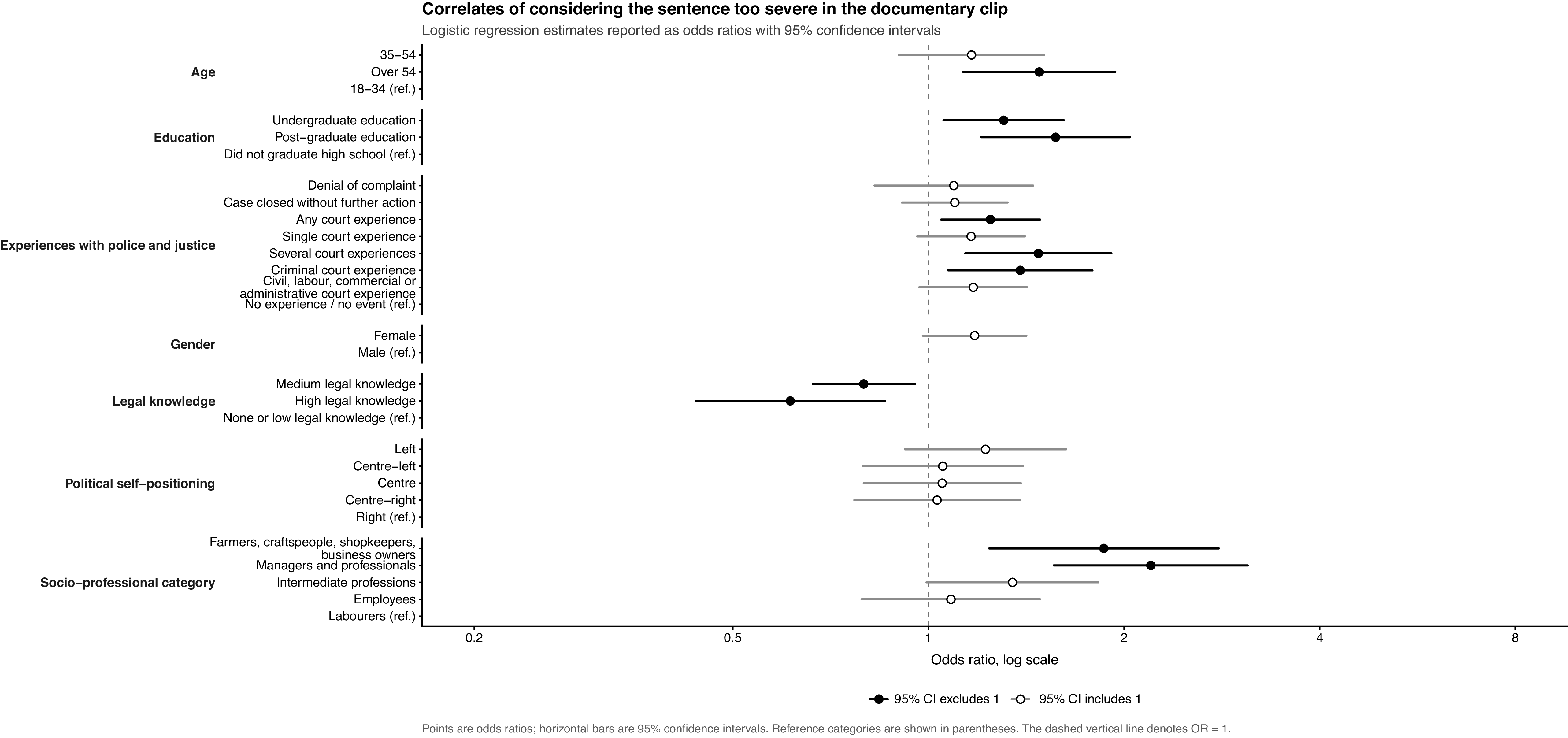
While general opinions about the justice system are strongly influenced by political orientation and sociodemographic factors, individuals’ views on justice and sentencing become much more fluid when considering specific cases. When it came to choosing sentences in hypothetical scenarios, the panelists’ age, sex, education level, and occupation had little to no impact. However, certain social determinants did influence their views on the severity of the sentence handed down in the documentary, the sentence they would impose if they were judges, and the criteria they would consider. This is evidenced by logistic regressions examining the likelihood of perceiving the documentary’s sentence as either too harsh or too lenient (see Table 3 and Figure 2). In some instances, these factors work in directions opposite to those observed in their broader opinions about the justice system.
Logistic regression on the fact that the sentence is too severe in the documentary (Models 1, 2, and 3)

Table 3 Long description
A table comparing logistic regression models on the perception of sentence severity in a documentary. The table has 3 sections: Model 1, Model 2, and Models 3a, b, c, d, e. Each model section includes columns for B (standard error), Odds ratio, and 95% Confidence Interval (CI). Model 1 (n = 2,270) examines socio-professional categories, gender, age, education, and legal knowledge. Model 2 (n = 2,225) adds political self-positioning. Models 3a-e (n = 2,225) focus on experiences with the police and the justice system. Each row lists different variables and their respective statistical values. Notable trends include higher odds ratios for certain socio-professional categories and educational levels, indicating their influence on perceiving sentences as severe.
Notes: *p < 0.05; **p < 0.01; ***p < 0.001.
Correlates of considering the sentence too severe in the documentary clip

The influence of gender appears to be minimal, except for the fact that women who found the sentence too severe more often opted for an alternative penalty besides a fine. This pattern also holds for the most highly educated, those in managerial positions, and those aged fifty-five and over, who were more critical than the eighteen-to-thirty-four age group in general questions about justice. Younger individuals tended to be harsher in specific cases, mainly because they adhered more closely to the letter of the law. They were less likely to consider circumstantial factors, whether objective or subjective. Women were also less swayed by these factors. People with high legal knowledge were significantly less likely to criticize the sentence’s severity, perhaps because their way of thinking was more similar to that of judges given their in-depth legal skills (especially the fact that the prison sentence was often significantly shorter than the maximum sentence).
Experience and practical knowledge of the justice system had a minimal impact on their stances. However, having multiple interactions with the justice system—across various types of cases—slightly increased the likelihood of finding a sentence too severe. Additionally, those who have had a complaint rejected by the police were more inclined to consider the defendant’s emotional state. Given the case context and discussions during the interviews, it can be hypothesized that such experiences would lead to increased support for private revenge mechanisms.
Contrary to abstract visions of justice, political orientation largely lost its influence when the panelists were in a judging role. Right-wing questionnaire respondents were not the most punitive, and neither were they necessarily very punitive. Two main explanations can be put forward. On the one hand, the public often had more serious offenses in mind when answering broad questions. In the general discussions during the focus groups, people actually referred to crimes that caused physical harm (murder, child sexual abuse, rape, and so on) or to repeat offenders. These types of crimes and perpetrators receive a great deal of media attention and are highly politicized, with calls for harsh punishment from right-wing politicians. By contrast, the real or fictive cases were more ordinary and less serious crimes. On the other hand, when provided with detailed information, individuals were more likely to set aside some of their preconceived stereotypes and distance themselves from certain media narratives or political statements. Three main mechanisms explain this result. A more pragmatic, rather than ideological, reasoning takes hold in such contextualized situations. Additionally, there may be an effect of methodological framing: indeed, reflecting on the criteria that should be taken into account and weighed when determining a sentence helps one to step back from previously held opinions. The weight of shared penal norms, such as gradation and individualization, may also mitigate the effects of political leaning. We will now explore these mechanisms in greater detail based on the group interviews.
Contextualizing facts and individualizing sentences
Contextualizing facts and individualizing sentences curb punitive tendencies. Confirming other studies (Roberts and Hough Reference Roberts and Hough2005), we find that the details encourage respondents to consider specific circumstances. As various scholars have noted regarding judges’ sentencing practices, the concept of severity has both “an objective (legal) side involving gradation and a narrative (dramatic) side” (Kaminski Reference Dan2009, 222; Van Oorschot Reference Van Oorschot2020). The narration of cases and contextual elements prompts both prosecutors, judges, and citizen jurors to moderate their assessment of a crime’s severity or of the protagonists’ culpability. As Clara, a twenty-year-old temporary employee in a cultural supermarket, remarked about the absence of live ammunition: “It does make a difference whether there are real bullets and an actual intent to kill, or if they are blanks intended just to scare. While we can agree that neither should be done, it certainly influences sentencing decisions.”
Considering the multitude of contextual factors that vary by case type, the respondents intuitively applied the principle of sentence individualization—a cornerstone of French criminal law—though only two women in the group interviews mentioned it explicitly. In determining the type and severity of sanctions, the panelists and group interview participants primarily focused on the nature of the offense, its specific circumstances, and any prior criminal record. They gave special attention to objective case details, such as the absence of live ammunition or the defendant’s blood-alcohol level. Sentences were then calibrated according to the defendant’s criminal history, which served as either the first or second decision-making criterion for panelists. For the vast majority, leniency was an option for first-time offenders.
Opinions varied more widely when it came to considering the perpetrator’s motivations and their emotional state at the time of the offense. Particularly among those who deemed the sentence too harsh, factors such as the humiliation that the defendant felt in the documentary were weighty. For these individuals, the accused appeared to be partially victimized by the situation. Conversely, those who found the sentence to be fair or too lenient argued that the defendant should not have taken matters into their own hands but should have alerted the authorities. For this group, the actions of the perpetrator at the time were indicative of a dangerous disposition, warranting a punitive response to deter future offenses.Footnote 10 These personal characteristics interact with the more objective factors (Tata Reference Tata2020). Both the public and legal professionals place significant weight on apologies and expressions of regret in court, viewing them as “mitigating circumstances” (Gautron Reference Gautron2024).
Simultaneously, most of the individuals factored in the defendant’s personal characteristics, professional status—including employment and income—and family situation when contemplating sentencing, albeit with differing views. For instance, the offender being a minor often served as a mitigating factor, despite reservations about the handling of juvenile delinquency. During the focus groups, many participants balanced the sentence’s effectiveness with the offender’s potential reintegration into society. Our results are consistent with a greater “societal support for more lenient punishment for youth, who are generally deemed … more responsive to rehabilitation” (Kruis et al. Reference Kruis, Menard, Choi, Rowland, Frye, Kosaka and Williams2023; see also Sparks and Wormith Reference Sparks and Stephen Wormith2021). Our findings align with research on prosecutors’ and judges’ practices (Gautron and Retière Reference Gautron, Retière and Danet2013).
Yet these social indicators can either mitigate or exacerbate the sentence depending on the situation. In the hypothetical case of drunk driving, participants were divided over the defendant’s career as a delivery driver. Most believed that the defendant’s job should result in a lighter sentence, arguing that a suspended or revoked license could lead to job loss, which would negatively impact their family. Conversely, others saw the profession as an aggravating factor, contending that the driver should have been aware of the dangers of drunk driving. In a variant of the drunk-driving scenario where the driver is a sales manager, most questionnaire respondents opted for a fine over license withdrawal, which underscored the role of social and professional status in sanction selection.
Therefore, our inquiry singles out shared justice principles based on both graduated and individualized sentencing, contingent on the offense’s severity, specific circumstances, and the defendant’s background, including criminal history. The varying opinions on employment, income, and family situation stem from the tension between the multifaceted punishment goal: whether to facilitate the offender’s reintegration into society or to instill a sense of the act’s gravity and responsibility.
Punishment and education: two articulated objectives that moderate abstract punitivism
All the rationales for punishment identified in the academic literature are reflected in our interviewees’ comments. The majority cited multiple objectives. These justifications are articulated depending on the perceived severity of the offense and the characteristics of the perpetrator. The main contribution of our study here is the fact that, contrary to most of the literature, we chose not to focus on the goal of punishment that a person prefers the most but, rather, on how people articulated the diverse purposes. Criticism of a “lenient justice system” correlates with the emphasis that people place on retribution, deterrence, societal protection, and victim compensation. In most instances, people view punishment as a necessary evil that ensures social order, upholds the rule of law, and reinforces prohibitions. The lack of faith in suspended sentences, particularly when they constitute the entire punishment, stems from the belief that an inconsequential penalty is purely symbolic. While retribution is primarily backward looking, according to one out of two of the respondents, they also highlighted concerns for deterrence (one out of three) and societal protection (one out of five). Aligning with utilitarian theories, punishment serves to collectively deter, capitalizing on the fear of punishment, a sentiment often rooted in the respondents’ own fear of incarceration. Sentencing also aims for preventive measures targeted at the offender to avert recidivism, while safeguarding society—especially victims—through incapacitation. A subset of respondents (one in five) also stressed the restorative aspects of punishment.
In addition to punitive objectives, most respondents also attributed a rehabilitative role to punishment. The dominant viewpoint remains “prospectivist,” focused on the future (Languin et al. Reference Languin, Widmer, Kellerhals and Robert2004). This goal was cited most often in the group interviews (six out of ten). However, it was frequently mentioned in conjunction with retribution, deterrence, or the protection of society (see also Gromet and Darley Reference Gromet and Darley2006) and primarily from a moral perspective. From this angle, punishment should mainly serve as an educational tool, emphasizing legal principles and the importance of prohibitions. When the participants considered sentencing options and explained their choice, they clearly stated that their aim was to raise awareness of the severity of the offense and the resulting harm to the victim as well as to inculcate values. Mandated treatment is geared more toward encouraging moral reflection than addressing any pathology, which is a sentiment shared by judges and prison staff (Gautron Reference Gautron2023b, Reference Gautron2025).
Conversely, social reintegration appeared less often in the respondents’ comments (one in five mentions). Probation or parole was virtually absent, and the social support it offers was largely overlooked (Fitzgerald et al. Reference Fitzgerald, Freiberg, Dodd and Bartels2023). Sentence adjustments are frequently perceived as a “gift” rather than a gradual, structured re-entry into society. Given the importance they placed on the sentence’s educational role and the moral transformation of the offender, respondents favored alternative sanctions such as training courses and community service for low- to mid-level crimes. In the case involving a weapon in the film, which was perceived as more severe, over four in ten respondents who considered the sentence too harsh or too lenient also supported imprisonment alternatives: work placements, community service, and, to a lesser extent, victim meetings and mandatory treatment. Interview participants who endorsed this viewpoint emphasized sanctions that would enable the offender to “gain awareness” of the act’s severity, to “educate” him, and to “prompt reflection on his actions.” This educational focus stemmed from their tendency to attribute crime to societal anomie and a lack of parental guidance. These alternative measures were also viewed as a means of debt repayment, with community service serving as a tool for re-education through work.
Due to these pedagogical expectations, the explanations that judges provide about the sanctions and their purposes during hearings are seen as just as important as the sentences themselves. The frequent comparisons between the role of a judge and that of a parent or teacher highlight a triple expectation of authority, pedagogy, and humanity. For many, the exertion of judicial authority serves to impart a “criminal lesson” to defendants who may otherwise underestimate the gravity of their actions (Vanhamme Reference Vanhamme2009). One key result of our study is the public’s concern to combine different, possibly contradictory, purposes for sentencing (this is rarely pointed out by the literature; among the exceptions, see Gromet and Darley Reference Gromet and Darley2006, Reference Gromet and Darley2009), attesting to their desire both to punish all offenses and to educate the offenders.
While advocating for educational sentences, the interviewees placed significant emphasis on custodial sentences. To them, these sentences were not always the primary form of punishment but often served as a supplementary measure. Suspended sentences, although criticized when imposed solely, were viewed as necessary deterrents. Many of the interviewees, who were often unaware that failure to comply with alternative sentences could result in imprisonment, added suspended sentences to their proposed punishments to create a looming threat over the convicted individual. Concerning the use of a weapon in the documentary, over 40 percent of the respondents prioritized a custodial sentence but for a shorter duration than the judges’ ruling. However, the group interviews also disclosed a sizable fraction of respondents who disapproved of incarceration, citing substandard conditions like overcrowding, violence, and dehumanization. Especially among those with direct or indirect experience of prison, there was a skepticism about its efficacy in rehabilitating offenders. Still, a prison-free society was deemed unrealistic; incarceration should be reserved for those truly “deserving.” This “custody threshold,” which has been previously identified in studies of judicial practice (Herzog-Evans Reference Herzog-Evans2014), is primarily influenced by an evaluation of the facts and the criminal record.
When asked to pass judgment on sentences in the documentary and hypothetical scenarios, many of the respondents recognized the complexity and subjectivity inherent in the judicial process. Although they had previously viewed justice as an arbitrary and unequal system, they now expressed difficulty in reconciling their various objectives for punishment. This struggle underlines the complexity of balancing the purposes of punishment against a variety of criteria such as the defendant’s background, the nature of the crime, and other circumstantial elements.
Discussion and conclusion
This discussion sheds light on the underlying mechanisms and processes beyond the significant discrepancy between the respondents’ generalized assessments of criminal justice and their judgments on specific cases. Although people often express critical abstract views, these negative assessments partly dissipate when they face concrete scenarios and become conscious of the contextualization inherent in judging. This finding aligns with results observed internationally (Hutton Reference Hutton2005; Kuhn and Vuillé 2010; Balvig et al. Reference Balvig, Gunnlaugsson, Jerr, Tham and Kinnunen2015; Leclerc, Niang, and Duval Reference Leclerc, Niang and Duval2017; Kääriäinen Reference Kääriäinen2019). Five main factors account for this gap.
First, the reflexivity that both the qualitative and quantitative research design induces regarding concrete cases has three effects that may lead to a reduced punitivism. Stories draw attention to specific criteria: age, sex, profession, family situation, the extent of the violation of the law, and so on. Their diversity calls for consideration of which criteria to include or exclude while sentencing (is each criterion legitimate?), how to interpret them (are they mitigating or aggravating circumstances?), and how to prioritize and weigh them. In addition, during the focus groups, the participants had to justify their positions in subgroups; the importance to be given to each criterion was discussed, and they had to present a joint decision to the entire group, which involved striking a compromise between the choices each person would have made on their own. This process led to moderation. Whether in the group interviews or in the questionnaire, sentences were not an impulsive choice but, rather, a reasoned one. This result echoes some research inspired by the dual theory process, such as Michael Sargent (Reference Sargent2004, 1485), showing that “high need for cognition individuals are less supportive of punitive measures because they endorse more complex attributions for human behavior than their low need for cognition peers.” This realization allows people to move past their initial prejudices (Warner and Davis Reference Warner and Davis2011; Leclerc, Niang, and Duval Reference Leclerc, Niang and Duval2017) as well as their experiences generated from the media, consistent with prior research (Dorfman and Schiraldi Reference Dorfman and Schiraldi2001; Pickett et al. Reference Pickett, Mancini, Mears and Gertz2015; Baranauskas and Drakulich Reference Baranauskas and Drakulich2018).
Second, based on attribution theory, another argument may be put forward to explain the discrepancy:
Attribution theories suggest that when making moral judgments, people consider both dispositional factors (internal to the individual, e.g., free will [individual ability, effort, choice, and will]) and situational factors (external influences, e.g., discrimination). … Dispositional theories (also known as “rational” or “neo-classical” theories) view personal choice as the primary cause of crime. In contrast, situational theories (also called “positivist” theories) characterize crime as the result of social forces (Garland Reference Garland2001). Existing literature, although sparse, generally shows that people assign less blame when external factors cause crime. (Yogev Reference Yogev2025, 919)
In our study, the majority of the focus group participants relied on situational, rather than dispositional, arguments to understand the facts underlying the cases. This led them to be more nuanced. A majority were lenient toward drunk driving as they explicitly associated occasional alcohol consumption with socializing outside of work hours rather than with deviant behavior and attributed it to France’s wine-drinking and bon vivant culture. Only a small minority emphasized the self-control that the delivery driver should have exercised, precisely because of his occupation. In the documentary film too, the participants developed a culturalist explanation. The shooter was perceived as someone with little education and from the carnival circuit and was seen as reacting more impulsively, driven by a sense of honor, when he was called into question in front of his wife and friends. The fact that he did not understand that a conflict could not be resolved with a weapon was interpreted as a lack of guidance, which was blamed on the family and the educational system. The few dispositional factors cited (the fact that he seems a bit simple-minded given how lost he appears in the face of legal professionals and their expectations) were interpreted as mitigating factors.
Third, the public’s concern to balance firmness with educational objectives—that is, retribution and rehabilitation—in concrete cases also explains a more moderate punitivism in practice. Indeed, individuals hold little faith that prison is an appropriate place for rehabilitation and that incarceration prevents recidivism. Consequently, for less severe offenses, individuals favor alternative sentences aimed at education and reform (see also Gromet and Darley Reference Gromet and Darley2006; Roberts and Hough Reference Roberts and Hough2011). Incarceration is viewed more as a fallback option, particularly for serious or perceived dangerous offenses. The nuances observed in the assessments of concrete cases stem therefore from the accumulation and complementarity of various punishment goals rather than from the dominance of a single one. This is rarely pointed out by the literature (for exceptions, see Roberts and Stalans Reference Roberts and Stalans2000; Gromet and Darley Reference Gromet and Darley2006, Reference Gromet and Darley2009).
Fourth, this moderation is also attributable to shared penal norms among the public implemented in contextualized cases. Widely accepted principles of justice shape individuals’ judgments. For instance, the belief that harsher sentences reduce the likelihood of re-offending underpins the severity of sentences in cases involving a criminal record. There is also a consensus on sentence proportionality and gradation (Roberts and Stalans Reference Roberts and Stalans2004). These norms are strikingly similar with the ones of judges (Gautron and Retière Reference Gautron, Retière and Danet2013; Kääriäinen Reference Kääriäinen2019). Karen Gelb (Reference Gelb, Arie and Gelb2008, 15) has also reported that, according to research from the 1980s in Canada and the United States, “there was no evidence … that judicial sentences were more lenient that the sentences of the lay respondents.” However, members of the public apply these principles differently depending on the specific circumstances of the crime and the profiles of the perpetrators. These disagreements emphasize the multidimensionality of the factors shaping both abstract and specific attitudes.
Fifth, both general and specific punitive attitudes are more nuanced and complex than opinion polls suggest. Several key insights can be gleaned from these findings. On the one hand, as Chloé Leclerc (Reference Leclerc2012, n.p.) notes, “public opinions on court severity are not static; rather, citizens are highly attuned to the specifics of individual cases.” Two factors are pivotal: the perceived seriousness of the offense (Gromet and Darley Reference Gromet and Darley2006; Roberts et al. Reference Roberts, Hough, Jacobson and Moon2009) and a history of repeat offenses or previous convictions, which generally lead to harsher judgments (Meijer et al. Reference Meijer, Annison and O’Loughlin2019).Footnote 11 More importantly, these results affirm public interest in the individualization of sentences and judicial discretion. This fact is rarely mentioned in the literature (Roberts, Crutcher, and Verbrugge Reference Roberts, Crutcher and Verbrugge2007).
On the other hand, our study urges caution regarding the coherence of distinct penal philosophies—such as contractualism, prospectivism, and ostracism—outlined by Languin and colleagues (Reference Languin, Widmer, Kellerhals and Robert2004). In the context of France, these categories function more as poles of attraction or repulsion for a minority of respondents than as comprehensive typologies. Interestingly, while political orientation does influence general opinions on punitiveness, it does not significantly affect sentencing judgments in concrete and detailed cases. Nevertheless, even if the impact of sociodemographic variables largely vanishes in the assessment of specific cases, it would be overly simplistic to conclude, as Leclerc (Reference Leclerc2012, n.p.) suggests, “that it is unproductive to search for personal explanations (such as age, sex, or socio-economic status) for public dissatisfaction with perceived judicial leniency.”
Finally, to better understand lay attitudes regarding justice, the research design should therefore (1) foster people’s reflexivity in order (2) to capture and illuminate the diversity of both abstract and concrete punitive attitudes as well as (3) the underlying explicative mechanisms, and (4) respondents should also have the opportunity to combine diverse punishment goals.
From a policy perspective, four main conclusions may be drawn from our findings. Our first result shows that quantitative surveys and polls usually overestimate citizen punitiveness. Therefore, politicians should not base their policy reforms on this sole instrument. Second, our research indicates that the distrust of the judiciary is not as pronounced as it is implied by opinion polls, and it would likely diminish if citizens had a deeper understanding of judges’ actual practices. Our research demonstrates a genuine interest and necessity among citizens for access not to ideological, theoretical, or legal narratives on what justice should be but, rather, to their actual practices and processes. It appears crucial to educate them about sentence reductions, probation, and alternative sentences. Respondents generally support these processes, yet they undervalue their punitive impact and the accompanying restrictions and oversight.Footnote 12 Conscious of the adverse effects of imprisonment, citizens are inclined to believe that other sentences are more efficacious for minor offenders, in line with previous research (Fox Reference Fox2014; Richards, Death, and McCartan Reference Richards, Death and McCartan2020). In addition, our findings prove that there is firm public interest in the individualization of sentences. Politicians should be discouraged from reducing judicial discretion to adapt sentences to the specific cases they have to judge through mandatory sentences. Finally, as the media is a key power holder in shaping narratives on the justice system (Berry et al. Reference Berry, Philo, Tiripelli, Docherty and Macpherson2012), it is crucial that the Ministry of Justice as well as legal professionals become more involved in the media to assume this educational role and provide more information about actual sentencing practices.
There are limits to our research. We need to explore the most severe offenses in future work to confirm that the public will to combine different goals of punishment through sentencing. However, Kirstin Drenkhahn, Fabien Jobard, and Tobias Singelnstein (Reference Drenkhahn, Jobard and Singelnstein2023, 255) highlight “the systematic examination of several principles of sentencing,” even regarding the most serious crimes both in France and Germany. Future research should also explore “whether the relationships between crime rates, media coverage, and punitiveness change as more people get their news from new media sources” (Roche, Pickett, and Gertz Reference Roche, Pickett and Gertz2016; Pickett Reference Pickett2019). It would also be interesting to study not only cross-sectional public attitudes but also the political mood regarding sentencing in France as well as in a comparative perspective, such as Justin Pickett (Reference Pickett2019) and Mark Ramirez (Reference Ramirez2013) did for the United States, and Will Jennings et al. (Reference Jennings, Stephen, Gray and Hay2017) did for Britain. More generally, there is a need to study punitive attitudes across different countries to explore international similarities and differences (Kugler et al. Reference Kugler, Funk, Braun, Gollwitzer, Kay and Darley2013; Drenkhahn, Jobard, and Singelnstein Reference Drenkhahn, Jobard and Singelnstein2023).
Acknowledgments
We thank Camille Bedock and Ruwani Fernando for comments on previous versions of this article as well as Fouad El Haddad who created the forest plots using the R software based on the regressions that the authors carried out. This article also benefited from comments on a presentation made at the European Society for Criminology in Florence, Italy, in September 2023. We also thank Katya Long for the translation or revisions of the first version of the article in August and November 2023. We only use one artificial intelligence tool (deepL) to check the translation of our own work when we added new (parts of) sentences or when we modified other ones, mainly in February 2024 and April–May 2025 (when we completed the literature review) and in April 2026 when we responded to the reviewers’ comments. This article is based on a research project funded by the Regional Council of Nouvelle-Aquitaine as well as the Institute for Studies and Research on Law and Justice in Paris, France (IERDJ, Grant no. 17-48). The ELIPSS panel, to which the quantitative survey was administered, was financed by the Données Infrastructures et Méthodes d’Enquête en Sciences Humaines et Sociales (Data, Infrastructures and Survey Methods in the Humanities and Social Sciences) at Sciences Po in Paris, France. There are no conflicts of interest to declare.