1. Introduction
The Early Jurassic period was marked by a short (<1 Ma) interval of extensive organic-rich deposition and extreme environmental changes termed the Toarcian Oceanic Anoxic Event (T-OAE; ~183 Ma). In most documented marine successions of this age, the maximum of organic carbon enrichment, interpreted as the consequence of widespread marine oxygen deficiency, broadly coincides with marked negative and positive carbon isotope excursions, abrupt sedimentary changes, calcification crises and marine invertebrate extinctions (e.g. Jenkyns, Reference Jenkyns1988; Röhl et al. Reference Röhl, Schmid-Röhl, Oschmann, Frimmel and Schwark2001; Cohen, Coe & Kemp, Reference Cohen, Coe and Kemp2007; Caswell, Coe & Cohen, Reference Caswell, Coe and Cohen2009; Mattioli et al. Reference Mattioli, Pittet, Suan and Mailliot2008, Reference Mattioli, Pittet, Petitpierre and Mailliot2009; Suan et al. Reference Suan, Mattioli, Pittet, Lécuyer, Suchéras-Marx, Duarte, Philippe, Reggiani and Martineau2010, Reference Suan, Nikitenko, Rogov, Baudin, Spangenberg, Knyazev, Glinskikh, Goryacheva, Adatte, Riding, Föllmi, Pittet, Mattioli and Lécuyer2011). These perturbations are thought to reflect deep and global disturbance of both the carbon cycle and climate that have been commonly related (more or less directly) to the eruption of the Karoo-Ferrar large igneous province in southern Gondwana (e.g. Hesselbo et al. Reference Hesselbo, Grocke, Jenkyns, Bjerrum, Farrimond, Bell and Green2000; Pálfy & Smith, Reference Pálfy and Smith2000; Cohen, Coe & Kemp, Reference Cohen, Coe and Kemp2007; Svensen et al. Reference Svensen, Planke, Chevallier, Malthe-Sorenssen, Corfu and Jamtveit2007).
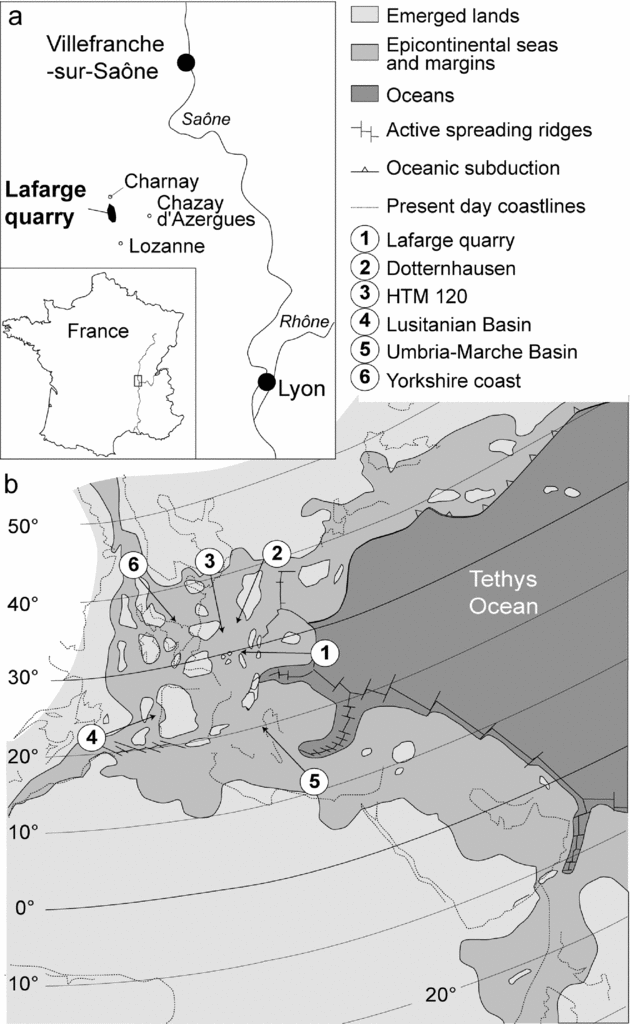
Although the sedimentary and geochemical record of the T-OAE has been intensively studied in basinal successions of northern Europe, data from shallower, marginal environments are scarce (Fig. 1), leading to large uncertainty concerning the geographical extent of environmental changes during the T-OAE. For instance, the lack of organic-carbon rich deposits in some marginal sections of northwestern Europe (e.g. southwest England, Spain) suggests that oxygen-depletion only developed locally in European shelves (van de Schootbrugge et al. Reference van de Schootbrugge, McArthur, Bailey, Rosenthal, Wright and Miller2005; McArthur et al. Reference McArthur, Algeo, van de Schootbrugge, Li and Howarth2008; Gómez, Goy & Canales, Reference Gómez, Goy and Canales2008; Gómez & Goy, Reference Gómez and Goy2011). In addition to this lack of organic carbon enrichment, the T-OAE interval in several sections of the Lusitanian Basin is dominated by gravity-flow and storm deposits (Duarte & Soares, Reference Duarte and Soares1993; Hesselbo et al. Reference Hesselbo, Jenkyns, Duarte and Oliveira2007). These sedimentological features possibly reflect CO2-forced changes in hydrological cycling and storm intensity (Hesselbo et al. Reference Hesselbo, Jenkyns, Duarte and Oliveira2007), but the absence of such sedimentological features in other northwestern European sections may alternatively point to local, tectonically controlled changes in relative sea level (Duarte & Soares, Reference Duarte and Soares1993; Kullberg et al. Reference Kullberg, Oloriz, Marques, Caetano and Rocha2001; Suan et al. Reference Suan, Pittet, Bour, Mattioli, Duarte and Mailliot2008b ).
Location of the Lafarge cement quarry. (a) Modern location. (b) Location of the study site and that of contemporaneous sites discussed in the text with respect to Toarcian geography. Palaeogeographic map modified from Mattioli et al. (Reference Mattioli, Pittet, Suan and Mailliot2008).

In this context, shallow-water deposits located between the northern and southern margin of the western Tethys might provide fundamental clues for constraining the possible links amongst changes in relative sea level, seawater oxygenation and regional oceanographic conditions across this key interval. The shallow-water fossiliferous succession exposed in the Beaujolais area (Rhône, southeastern France) preserves one of the most complete Toarcian sequences of northern Europe, extending from the lower Toarcian to the upper Aalenian. The middle Toarcian – lower Aalenian marls and limestones of this area have yielded rich ammonite assemblages that have been extensively studied and described, providing a valuable biostratigraphic framework for correlation between the northern and southern margins of the western Tethys (Elmi & Rulleau, Reference Elmi and Rulleau1993; Rulleau, Reference Rulleau2006). Interestingly, neither organic matter-rich sediments nor evidence for strong oxygen-deficiency have been reported in the lower Toarcian strata of the area, implying that bottom seawater might have remained well oxygenated throughout the early Toarcian period. However, the lower Toarcian succession of the Lafarge cement quarry has been comparatively less studied in terms of sedimentology and biostratigraphy, suggesting that these palaeoenvironmental conclusions might alternatively result from poor dating or incompleteness of the section.
In this paper we report new sedimentological, biostratigraphical and geochemical data from lower–middle Toarcian sediments of the Lafarge cement quarry that offer insight into the expression of the T-OAE in marginal area and provide new valuable bases for comparison with other contemporaneous localities. These results are then discussed within the context of the current debate about the nature and consequences of early Toarcian environmental changes.
2. Geological setting and stratigraphy
The Lower–Middle Jurassic strata of the southern Beaujolais area (Rhône Department, SE France; Fig. 1) were laid down in a series of relatively shallow extensional basins along the northeastern edge of the Central Massif (Elmi & Rulleau, Reference Elmi and Rulleau1993). The area was subsequently severely faulted and uplifted during the Cenozoic Alpine orogeny, forming a horst-graben structure with a predominant SSW–NNE orientation (Elmi & Rulleau, Reference Elmi and Rulleau1993). The Lafarge cement quarry near the villages of Belmont, Charnay, and Saint-Jean-des-Vignes (Fig. 1) exposes a very fossiliferous succession of mudstone, marlstone and limestone beds of Toarcian to Bajocian age that constitutes the best Jurassic exposure in the area (‘Couches de Belmont’; Elmi & Rulleau, Reference Elmi and Rulleau1991, Reference Elmi and Rulleau1993). The biostratigraphy of the exposures has been studied for more than 30 years, thereby constituting a reference section for regional correlations (Elmi & Rulleau, Reference Elmi and Rulleau1991, Reference Elmi and Rulleau1993; Rulleau, Reference Rulleau1997, Reference Rulleau2006).
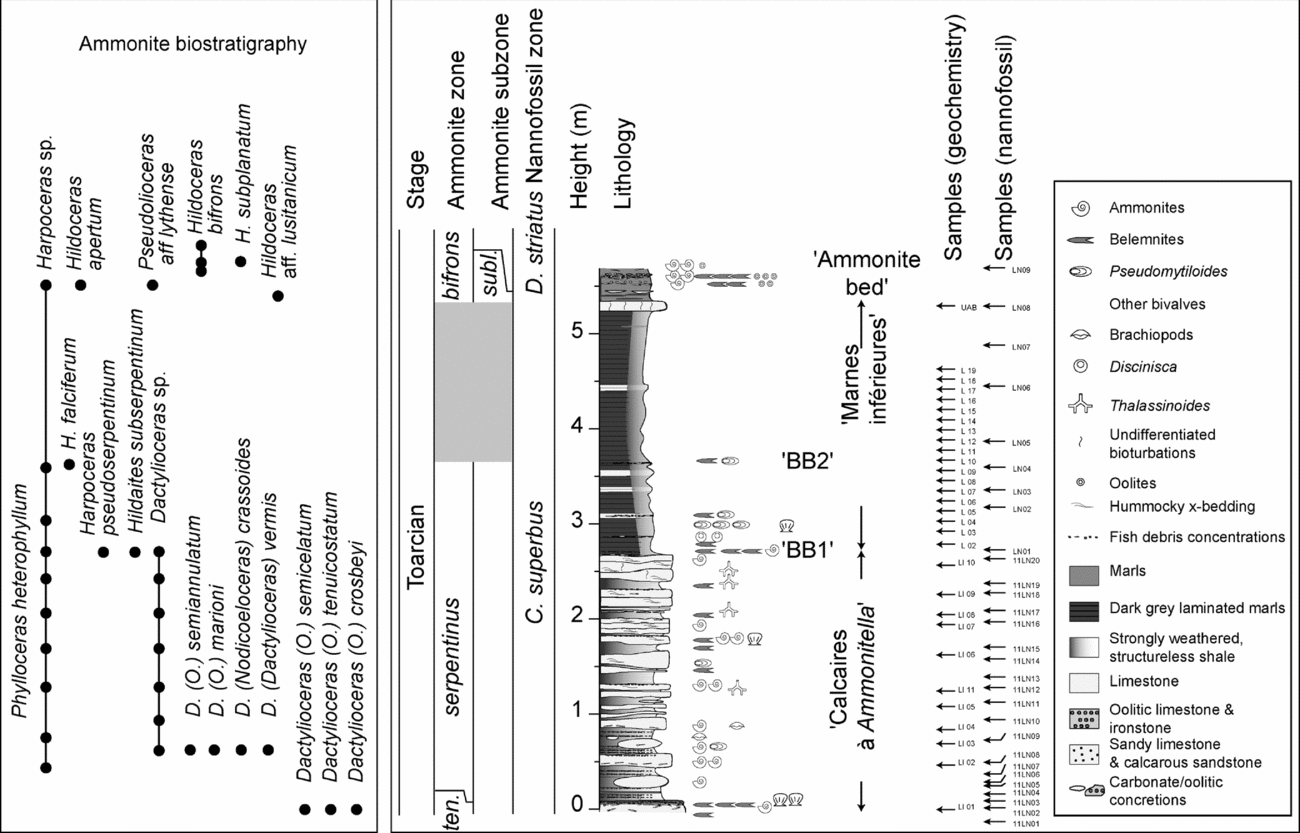
We recently carried out multidisciplinary fieldwork campaigns in the lowermost beds of the quarry to improve our understanding of the lower Toarcian interval, which was previously poorly exposed. A ~2 m-deep trench was excavated through the floor of the quarry to study the lowermost Toarcian succession. The stratigraphically lowermost part uncovered by the trench consists of a yellow-grey, massive dolomitic limestone bed that is particularly enriched in belemnite rostra in its topmost part (‘lower belemnite bed’; Fig. 2). The base of the bed yielded ammonite specimens referable to Dactylioceras (Orthodactylites) crosbeyi, Dactylioceras (Orthodactylites) tenuicostatum and Dactylioceras (Orthodactylites) semicelatum, indicating that the lowermost part of the studied succession belongs to the tenuicostatum ammonite zone (Fig. 2). This bed is overlain by a 5 cm-thick reddish bed enriched in oysters and bioclasts that likely corresponds to the reddish level mentioned by Rulleau (Reference Rulleau1997) at the transition of the tenuicostatum–serpentinum ammonite zones in another, disused part of the quarry. The overlying interval consists of a 2 m thick succession of decimetre-thick, partly dolomitized calcareous beds interbedded with severely weathered, yellowish plastic clays associated with ammonite-yielding concretions (Figs 2, 3b). The clay intervals commonly contain millimetre-thick laminae particularly enriched in fish debris, and preserve in some places less altered, blue-grey portions showing more distinct lamination. Most calcareous beds are sharp-based and laminated, and capped by thin horizons particularly enriched in disarticulated fish debris (bones and scales). The calcareous beds yielded relatively abundant belemnite rostra, juvenile and adult ammonites, bivalves (Pseudomytiloides dubius and other unidentified taxa) remains of marine reptiles and fishes and, at some levels, isolated brachiopod shells (Fig. 2). The ammonite fauna (H. serpentinum, strangewaysi and alternatum morphs, Harpoceras pseudoserpentinum) indicate that this calcareous interval belongs to the serpentinum zone and is therefore the lateral equivalent of the ‘Calcaires Jaunes à Ammonitella’ of Elmi & Rulleau (Reference Elmi and Rulleau1991, Reference Elmi and Rulleau1993; Fig. 2). The uppermost bed of the ‘Calcaires Jaunes à Ammonitella’ is a highly distinctive, irregular and massive limestone that forms the main basement of the southern part of the quarry.
Lithological log of the studied section of the Lafarge cement quarry and occurrence of age diagnostic ammonites and nannofossil. Abbreviations: subl. – sublevisoni; ten. – tenuicostatum.

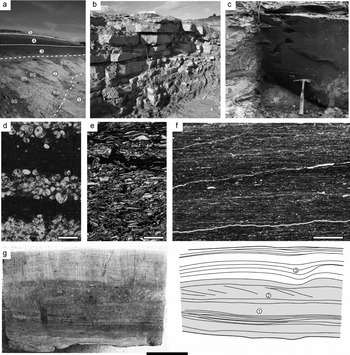
Field photographs of the basal Toarcian succession at the Lafarge quarry site and microphotographs of slabbed and thin sections of some representative samples. (a) Overview of the section showing the top of the uppermost massive limestone bed of the ‘Calcaires Jaunes à Ammonitella’ (1), black shales (BS) of the ‘Marnes inférieures’ and their extremely weathered, light coloured clay equivalent (2), the middle Toarcian marls (3), the upper Toarcian oolitic limestone bearing marls (4) and the lower Aalenian sandy limestone beds (5). (b) Detail of the exposure of the ‘Calcaires Jaunes à Ammonitella’ between 0 and 2.3 m. (c) Close-up view of the black shales of the lower part of the ‘Marne inférieures’ between 2.4 and 3.5 m, showing the strong weathering aspect on the left side. (d) Photomicrograph of the top bed of the ‘Calcaires Jaunes à Ammonitella’, showing the normally graded Coelodiscus shells concentrated into distinct lenses (scale bar = 1 mm). (e) Photomicrograph of a thin pyritic bed of the base of the ‘Marnes Inférieures’ (bed ‘BB1’ in Fig. 2) showing high concentrations of phosphatic fish debris and thin shelled bivalves (scale bar = 1 mm). (f) Photomicrograph of a black shale sample from the lower part of the ‘Marnes Inférieures’, illustrating the strong sub-horizontal lamination of the organic-rich deposits (scale bar = 1 mm). (g) Photograph (left panel) and interpretative drawing (right panel) of a vertical section across the topmost bed of the ‘Calcaires Jaunes à Ammonitella’, showing a coarser, bioturbated basal sequence consisting of Coelodiscus-yielding lamina (1), a middle sequence with cross lamination (2) and an upper, fine-grained laminated sequence with probable escape structures (3) (scale bar = 5 cm).

The calcareous unit is capped by a 2.5 m thick marly interval (Fig. 2), equivalent to the ‘Marnes inférieures’ of Elmi & Rulleau (Reference Elmi and Rulleau1991), interbedded at its base with several fining upward, centimetre-thick pyritic horizons rich in fish debris and belemnite rostra (‘bonebeds’; Figs 2, 3e). Non-weathered parts of the ‘Marnes inférieures’ consist of dark grey, finely laminated argillaceous marls containing isolated wood remains (some being preserved as ‘jet’), sporadic bivalves (isolated and clustered specimens of Pseudomytiloides dubius, isolated specimens of Bositra and Plagiostoma) and thin-shelled inarticulate brachiopods (Discinacea papyracea). The middle part of this interval yielded two fragmentary specimens of Harpoceras falciferum, a species generally used as a marker of the uppermost part of the serpentinum zone (falciferum subzone; Howarth, Reference Howarth1992a , Reference Howarth b ; Gómez, Goy & Canales, Reference Gómez, Goy and Canales2008). Nevertheless, this species ranges into the basal part of the bifrons zone in several German, English, Italian and Spanish sections (e.g. Riegraf, Werner & Lörcher, Reference Riegraf, Werner and Lörcher1984; Jenkyns et al. Reference Jenkyns, Sarti, Masetti and Howarth1985; Howarth, Reference Howarth1992a , Reference Howarth b ; Gómez, Goy & Canales, Reference Gómez, Goy and Canales2008), so that this interval may possibly belong to the basalmost bifrons zone (Fig. 2). Observations made on successive field campaigns revealed that the dark grey laminated argillaceous marls weathered rapidly into highly distinctive ‘paper shales’ that gave their name to the ‘Schistes Carton’ of the Paris Basin. Deeply weathered portions of the ‘Marnes inférieures’ are yellow, plastic and almost structureless (Fig. 3c) and appear identical in all respects to the plastic yellow clays of the underlying unit. The non-weathered parts of the ‘Marnes inférieures’ are preserved as small, fracture-bounded and discontinuous patches that, compared to the weathered part, crop out on a very limited surface of the studied exposure (Figs 2, 3a, c; see also Fig. S1 in the online Supplementary Material available at http://journals.cambridge.org/geo). The upper part of the ‘Marnes inférieures’ displays a gradual change in colour from dark grey to purple grey when non-weathered and from yellow to bright purple-red when weathered. The argillaceous marls of the ‘Marnes inférieures’ are capped by a bioturbated and micritic light grey argillaceous limestone bed. The surface of the bed yielded Hildoceras aff. lusitanicum and therefore belongs to the bifrons zone (sublevisoni subzone). Overlying purplish grey shales (reddish to pinkish when weathered) are strongly bioturbated (Chondrites) and contain disseminated phosphatized and ferruginous ooliths as well as numerous phosphatized ammonites and small belemnites (‘ammonite bed’; Fig. 2). The ammonite assemblage (Harpoceras subplanatum, Hildoceras apertum, H. bifrons, Pseudolioceras aff. lythense) is characteristic of the bifrons zone (bifrons subzone; Fig. 2). Equivalent levels from another part of the quarry yielded a large, subcomplete ichthyosaur specimen in the early 1980s (Elmi & Rulleau, Reference Elmi and Rulleau1991; Martin et al. Reference Martin, Fischer, Vincent and Suan2012). The top of this fossil-rich interval contains isolated bone elements of marine reptiles and large, saucer-shaped argillaceous limestone concretions encrusted by serpulids and bivalves.
3. Material and methods
Hand-samples of non-weathered bulk rock were collected throughout the measured succession for sedimentological, micropalaeontological and geochemical analyses. Unfortunately, it was impossible to collect non-weathered samples from the argillaceous interbeds of the lower part (<2.3 m) and geochemical data from this part were obtained using solely carbonate rich samples, leading to coarser sample spacing in this part of the studied section (Fig. 2). Non-weathered and strongly weathered samples were collected along two different horizons of the ‘Marnes inférieures’ to investigate the effect of weathering on the organic carbon isotope compositions and the proportions of carbonate and organic carbon. Slabbed and thin sections of the limestone and thin pyritic beds were prepared to characterize their macro- and micro-structural aspects and micropalaeontological content.
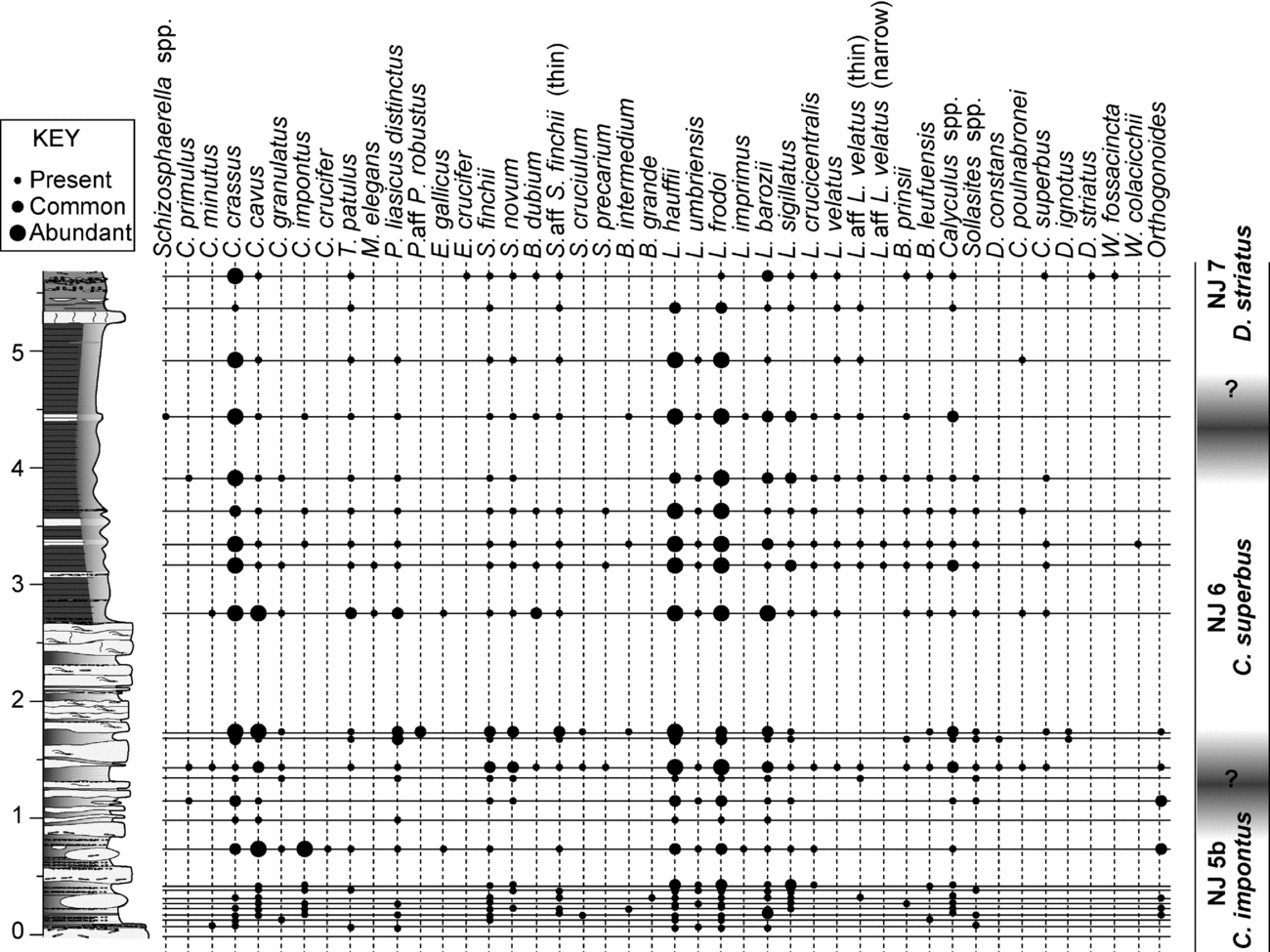
Microscope slides for nannofossil identification were prepared by powdering small amounts of bulk rock and diluting with water before spreading onto a cover slide (Bown & Young, Reference Bown, Young and Bown1998). Nannofossil identifications and semiquantitative analyses were performed in 25 samples under a light polarizing Zeiss microscope at a 1000× magnification. The studied samples are closely spaced in the basal part of the section, whilst sampling was at a lower resolution in the upper part of the studied interval (Fig. 4).
Calcareous nannofossil range chart for the Toarcian succession from the Lafarge quarry site.

Bulk rock powdered samples for stable isotope analyses were obtained by crushing 3 g of clean bulk sediment without fractures, calcite veins and macrofossils. Carbon isotope compositions of bulk carbonate (δ13Ccarb) were measured using a Thermo Fisher GasBench II preparation device connected to a Delta Plus XL isotope ratio mass spectrometer (IRMS) at the University of Lausanne. The CO2 was extracted from an aliquot of 300–600 μg of powdered rock by anhydrous phosphoric acid at 70°C. Stable isotope compositions of oxygen and carbon are expressed as per mil deviation relative to VPDB standard. Analytical precision, monitored by analyses of the laboratory standard Carrara marble was better than ± 0.05‰ for carbon and ±0.1‰ for oxygen. Carbonate contents (CaCO3, in wt%) were determined using the total peak areas of the calcite standard and samples. The resulting carbonate contents were very similar to that obtained by weighing the amount of the dry decarbonated residue following overnight acidification of about 2 g of dry bulk powdered sediment with 1M HCl. Only this latter method was used to estimate the amount of calcium carbonate in the samples chosen for testing the effect of weathering.
Stable isotope compositions of bulk organic carbon (δ13Corg) were determined by analyzing 0.3 to 12 mg of decarbonated sample with a Thermo Fisher Flash Elemental Analyzer 1112 connected to the continuous flow inlet system of a MAT 253 isotope ratio mass spectrometer (EA-IRMS) at the Institute of Geosciences in the Goethe University Frankfurt. Prior to analysis, samples were decarbonated using excess 1M HCl for 48 h in a sand bath at 50°C, rinsed with deionised water and centrifuged until neutrality was reached. Analytical precision and accuracy were monitored by replicate analyses of USGS 24 graphite standard and unknown samples. The reproducibility was better than 0.1‰ (1σ). Total organic carbon (TOC, in wt%) contents were determined using the EA peak areas.
4. Results
4.a. Sedimentology
The calcareous beds of the ‘Calcaires Jaunes à Ammonitella’ unit are erosive-based, distinctly laminated and normally graded (Fig. 3b, g). These beds frequently show low angle cross bedding (Fig. 3g) that may be associated with abundant juvenile ammonites and Thalassinoides burrows at their base. All these features indicate that the deposition of these beds took place under storm-induced oscillatory currents (distal tempestites sensu Aigner, Reference Aigner, Friedman, Neugebauer and Seilacher1985). The calcareous beds and concretions contain tremendous amounts of small calcareous shells commonly replaced by sparitic cements that form laterally discontinous laminae (Fig. 3d). Elmi & Rulleau (Reference Elmi and Rulleau1991) initially interpreted these tiny shells as the remains of juvenile ammonites (‘Ammonitella’). Although the beds studied here do indisputably preserve large amounts of juvenile ammonites in their basal part (not shown), the new observations reveal that chambers are clearly absent in both small and large specimens (Fig. 3d). Accordingly, the small shells most probably belong to the minute gastropod genus Coelodiscus, which occurs very commonly in time equivalent strata of Germany, England and southern France (e.g. Riegraf, Werner & Lörcher, Reference Riegraf, Werner and Lörcher1984; Harries & Little, Reference Harries and Little1999) and can be confused with juvenile ammonites (Etches, Clarke & Callomon, Reference Etches, Clarke and Callomon2009). It is noteworthy, however, that the abundance of Coelodiscus specimens in the lower Toarcian strata of the Lafarge quarry appears far higher than that reported in coeval successions (see Section 5.b). Therefore, the lowermost ~2.5 m thick calcareous unit of the lower Toarcian sequence in the Lafarge quarry should more appropriately be referred to as ‘Calcaires Jaunes à Coelodiscus’, but since it also contains abundant juvenile ammonites it appears preferable to keep the former lithostratigraphic name for the sake of nomenclatural stability.
The thin sections of the basal pyritic beds of the ‘Marne inférieures’ (‘bonebeds’) show that they are particle-supported and mainly cemented by pyrite (Fig. 3e). The particles mainly consist of disarticulated angular fish debris, with subordinate amounts of thin and commonly pyritized bivalve shells, as well as scarce benthic foraminifera (not shown). The particles are well-sorted and poorly graded (Fig. 3e), while the belemnites concentrated in these beds do not show preferential orientation, as has been also documented in comparable beds of the falciferum–bifrons transition in the Posidonia Shale in southwestern Germany (Röhl & Schmid-Röhl, Reference Röhl, Schmid-Röhl and Harris2005). These features indicate that the deposition of these distinctive beds likely resulted from repeated, non-directional oscillatory currents (winnowing).
4.b. Geochemistry
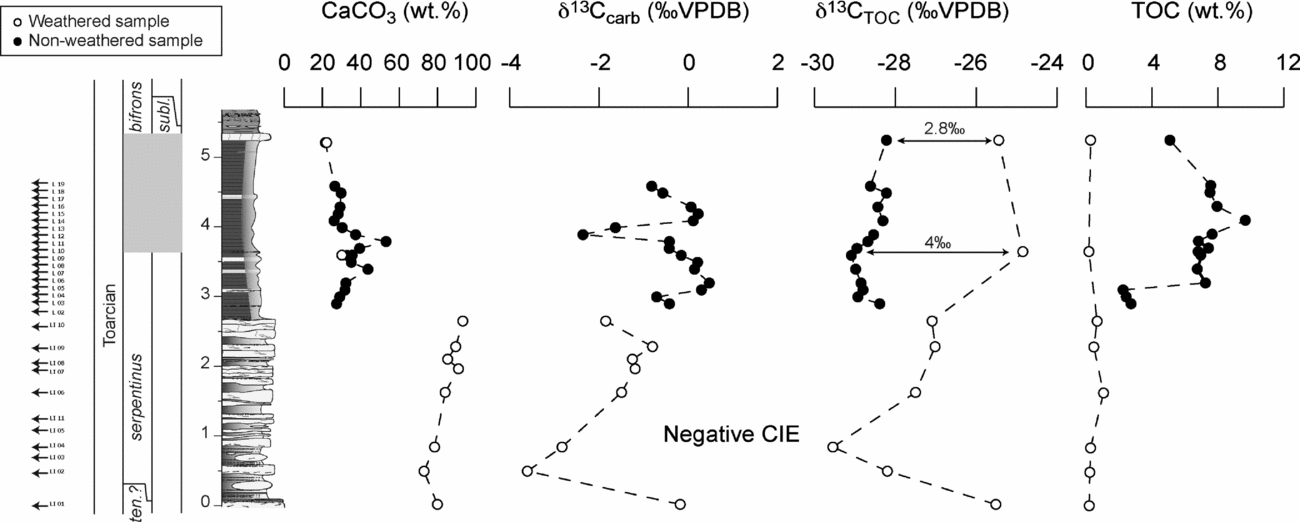
The geochemical data are reported in the online Supplementary Material at http://journals.cambridge.org/geo and in Figure 5. The samples of the calcareous unit show elevated CaCO3 concentrations between 80 and 93 wt%, while those of the ‘Marnes inférieures’ show values between 26 and 43 wt% (Fig. 5). The non-weathered samples collected from 3.65 m (sample BB2-NW) and 5.25 m (sample UAB-NW), have CaCO3 contents of 31 and 22 wt%, respectively, and the strongly weathered samples collected in the same two horizons have CaCO3 contents of 28 (sample BB2-W) and 22 wt% (Fig. 5).
Geochemical data for the Toarcian succession from the Lafarge quarry site. Abbreviations: CIE – carbon isotope excursion; subl. – sublevisoni; ten. – tenuicostatum; TOC – total organic carbon.

Total organic carbon contents are low in the calcareous beds of the basal part of the section (between 0.14 and 1 wt%) and high in the non-weathered marly unit (between 2.4 and 9.6 wt%). The non-weathered samples collected at 3.65 m (sample BB2-NW) and 5.25 m (sample UAB-NW), have TOC contents of 6.7 and 5 wt%, respectively, and the strongly weathered samples collected in the same two horizons have TOC contents of 0.1 (sample BB2-W) and 0.2 wt% (Fig. 5).
The δ13Corg and δ13Ccarb profiles record comparable changes through the lower part of the succession. Both records reveal high values in the massive limestone bed of the lowermost part of the measured section (‘lower belemnite bed’) and lowest values at the base of the ‘Calcaires Jaunes à Ammonitella’. Carbon isotope values then increase at the top of the ‘Calcaires Jaunes à Ammonitella’, forming a distinct negative carbon isotope excursion (CIE) (Fig. 5). The δ13Ccarb values increase towards the top of the ‘Calcaires Jaune à Ammonitella’ and decline slightly in the upper part of the ‘Marnes inférieures’, forming an approximately 1‰ positive excursion. The δ13Corg record a similar shift, but return to more negative values (~ –28‰) in the non-weathered portion of the ‘Marnes inférieures’ (Fig. 5).
4.c. Calcareous nannofossils
Nannofossil abundance is scarce at the base of the section until 0.37 m, and slightly increases upsection (Fig. 4). Preservation varies from moderate to good. The studied section displays a nannofossil assemblage typical of the NW Europe domain (Bown, Reference Bown1987; Bucefalo Palliani, Mattioli & Riding, Reference Bucefalo Palliani, Mattioli and Riding2002; Mattioli et al. Reference Mattioli, Pittet, Petitpierre and Mailliot2009). In detail, some Tethyan taxa, such as Schizosphaerella spp. or Mitrolithus jansae are missing, whilst high abundances of typical NW European taxa, such as Crepidolithus crassus and C. cavus (e.g. Mattioli et al. Reference Mattioli, Pittet, Suan and Mailliot2008) are recorded. This NW European affinity also influences biostratigraphy, as the first occurrence of Carinolithus superbus, marker for the NJ 6 Zone, is recorded at 1.39 m in the serpentinus ammonite Zone in an interval corresponding to the upper part of the negative CIE. This record is consistent with the observations of Bucefalo Palliani, Mattioli & Riding (Reference Bucefalo Palliani, Mattioli and Riding2002) for the Brown Moor BGS Borehole (England). Conversely, the first occurrence of C. superbus is recorded in various regions in the polymorphum/tenuicostatum ammonite Zone, in the interval prior to the negative CIE (Bucefalo Palliani & Mattioli, Reference Bucefalo Palliani and Mattioli1998; Mattioli & Erba, Reference Mattioli and Erba1999; Bodin et al. Reference Bodin, Mattioli, Fröhlich, Marshall, Boutbib, Lahsini and Redfern2010). The incertae sedis Orthogonoides is recorded in the interval corresponding to the negative CIE (Fig. 4), a feature also seen in other records of the T-OAE (Hermoso et al. Reference Hermoso, Le Callonnec, Minoletti, Renard and Hesselbo2009; Mailliot et al. Reference Mailliot, Mattioli, Bartolini, Baudin, Pittet and Guex2009).
5. Discussion
5.a. Evidence for oxygen depletion in the Beaujolais area during the T-OAE
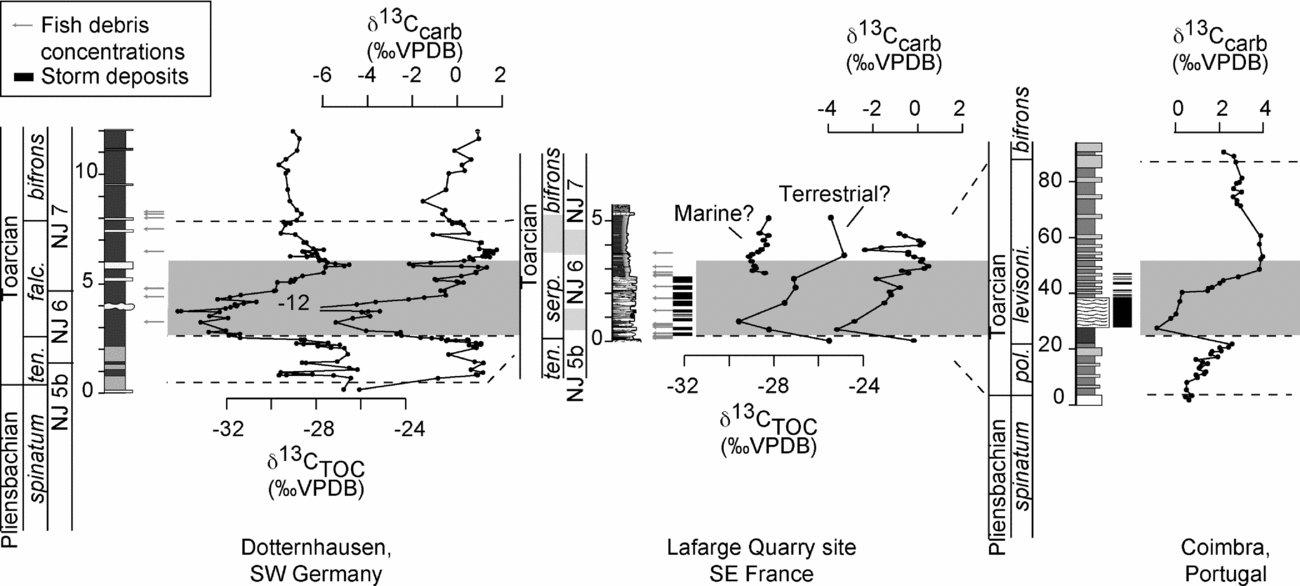
The age of the Lafarge quarry succession can be confidently constrained using the ammonite and calcareous nannofossil assemblages. Although some portions of the organic carbon isotope profiles might reflect differential preservation (see Section 5.d), the distinct CIE occurring at the base of the serpentinum ammonite zone is comparable in shape and absolute values to that recorded in most contemporaneous successions (Fig. 6). We thus attribute the negative anomaly to the well-documented CIE characterizing the onset of the T-OAE in most known localities (Hesselbo et al. Reference Hesselbo, Grocke, Jenkyns, Bjerrum, Farrimond, Bell and Green2000, Reference Hesselbo, Jenkyns, Duarte and Oliveira2007; Röhl et al. Reference Röhl, Schmid-Röhl, Oschmann, Frimmel and Schwark2001; Suan et al. Reference Suan, Nikitenko, Rogov, Baudin, Spangenberg, Knyazev, Glinskikh, Goryacheva, Adatte, Riding, Föllmi, Pittet, Mattioli and Lécuyer2011).
Comparisons of carbon-isotope and sedimentological data between the Lafarge Quarry site and contemporaneous successions of Dotternhausen (southwestern Germany) and Coimbra (Portugal). The organic carbon isotope profile on the left side at Lafarge Quarry originates from pristine black shales that are likely composed mainly of marine organic carbon, while the right profile originates from weathered samples that likely preserve alteration-resistant terrestrial particles (see text for details). Geochemical and lithological data for Dotternhausen from A. Schmid-Röhl (unpub. Ph.D. thesis, Univ. Tübingen, 1999), Röhl et al. (Reference Röhl, Schmid-Röhl, Oschmann, Frimmel and Schwark2001), and A. Frimmel (unpub. Ph.D. thesis, Univ. Tübingen, 2003); data from Coimbra are from Duarte, Oliveira & Rodrigues, (Reference Duarte, Oliveira and Rodrigues2007). Abbreviations: falc. = falciferum; pol. = polymorphum; serp. = serpentinum; ten. = tenuicostatum.

The lower Toarcian succession from the Beaujolais area shows some remarkable similarities with coeval deposits of nearby areas of the Quercy, Causses, Jura and Paris basins (‘Schistes Carton’; Broquet, Reference Broquet1980; Baudin, Herbin & Vandenbroucke, Reference Baudin, Herbin and Vandenbroucke1990; Guex et al. Reference Guex, Morard, Bartolini and Morettini2001; Emmanuel et al. Reference Emmanuel, Renard, Cubaynes, De Rafelis, Hermoso, Le Callonnec, Le Solleuz and Rey2006) but also from most sites of northwestern Europe (Posidonia Shales of southwestern and northwestern Germany, Jet Rock of the Yorkshire coast; Weitschat, Reference Weitschat1973; Hallam, Reference Hallam1967; Röhl et al. Reference Röhl, Schmid-Röhl, Oschmann, Frimmel and Schwark2001; Howarth, Reference Howarth1992a , Reference Howarth b ). The thin lamination and lack of bioturbation observed in black shales of the serpentinum–bifrons ammonite zones indicate that their deposition occurred under oxygen-depleted, presumably anoxic conditions. The presence of thin-shelled bivalves and brachiopods at several stratigraphically restricted horizons show that these conditions were temporally interrupted by less severe phases of deoxygenation, as suggested for contemporaneous deposits of southwestern Germany and England (Röhl et al. Reference Röhl, Schmid-Röhl, Oschmann, Frimmel and Schwark2001; Caswell, Coe & Cohen, Reference Caswell, Coe and Cohen2009). The yellow clays of the ‘Calcaires Jaunes à Ammonitella’ (serpentinum ammonite zone) are structurally and faunistically almost identical to that of the upper part (Fig. 3a, b). Our results indeed indicate that weathered and non-weathered shales from the same horizons possess similar CaCO3 contents, but mainly differ in terms of their TOC contents (Fig. 5). It thus appears very likely that the yellow clays of the ‘Calcaires Jaunes à Ammonitella’ represent secondary by-products of originally organic-rich, laminated shales. An additional, notable similarity between the Lafarge quarry site and other nearby records is the relatively elevated abundance of the incertae sedis Orthogonoides in the interval recording the CIE (Fig. 4), a feature also seen in the southern Paris Basin and the Causses area (Hermoso et al. Reference Hermoso, Le Callonnec, Minoletti, Renard and Hesselbo2009; Mailliot et al. Reference Mailliot, Mattioli, Bartolini, Baudin, Pittet and Guex2009). Although the biological affinity of this taxon is enigmatic, previous authors noted that Orthogonoides is commonly associated with the nannofossil Calyculus, which might have been adapted to low-nitrate, stratified water bodies (Mattioli et al. Reference Mattioli, Pittet, Suan and Mailliot2008; Mailliot et al. Reference Mailliot, Mattioli, Bartolini, Baudin, Pittet and Guex2009). Interestingly, this association is also evident at the base of the serpentinum zone in the Lafarge Quarry site (Fig. 4) and points to stressed calcareous nannofossil communities in the study site during the T-OAE.
Altogether, the new data from southern Beaujolais suggest that strong oxygen deficiency during the T-OAE was not restricted to deep basinal areas of the European epicontinental seaway but extended towards the marginal marine areas located very close to the structural high of the Central Massif. Importantly, the successions of Beaujolais, England, Germany and Luxembourg contrast markedly with those of several lower latitude sites in Portugal and Spain, where the levels equivalent to the serpentinum zone are almost devoid of evidence for strong oxygen depletion and ‘black shales’ are generally restricted to centimetre to decimetre-thick horizons at variable position within the CIE (Hesselbo et al. Reference Hesselbo, Jenkyns, Duarte and Oliveira2007; Gómez & Goy, Reference Gómez and Goy2011). The more ‘open-ocean’ sections from central and northern Italy and those from Greece show an intermediate situation, with the ‘black shales’ sometime exceeding a few metres in thickness but being generally restricted to the negative CIE (e.g. Jenkyns, Grocke & Hesselbo, Reference Jenkyns, Grocke and Hesselbo2001; Sabatino et al. Reference Sabatino, Neri, Bellanca, Jenkyns, Baudin, Parisi and Masetti2009; Kafousia et al. Reference Kafousia, Karakitsios, Jenkyns and Mattioli2011). These different lithological expressions of the T-OAE over a relatively confined palaeogeographical area confirm that, as has been suggested for other OAEs (e.g. Jenkyns, Reference Jenkyns2010; Trabucho Alexandre et al. Reference Trabucho Alexandre, Tuenter, Henstra, van der Zwan, van de Wal, Dijkstra and de Boer2010), oxygen depletion during the Toarcian period might have been strongly modulated by regional environmental conditions. In this regard, it is noteworthy that almost all sections where intense and protracted oxygen depletion has hitherto been reported (i.e. England, Germany, Luxembourg, France) are located within epicontinental basins bordered by extremely large landmasses (Fig. 1). Because the T-OAE occurred during an interval of extreme warming and possibly accelerated hydrological cycle (e.g. Bailey et al. Reference Bailey, Rosenthal, McArthur, van de Schootbrugge and Thirlwall2003; Suan et al. Reference Suan, Mattioli, Pittet, Lécuyer, Suchéras-Marx, Duarte, Philippe, Reggiani and Martineau2010; Gómez & Goy, Reference Gómez and Goy2011; Dera et al. Reference Dera, Brigaud, Monna, Laffont, Puceat, Deconinck, Pellenard, Joachimski and Durlet2011), widespread oxygen depletion during the T-OAE was possibly caused by enhanced primary productivity and density stratification that would have resulted from increased nutrient and freshwater input (Jenkyns, Reference Jenkyns1988; Baudin, Herbin & Vandenbroucke, Reference Baudin, Herbin and Vandenbroucke1990; Cohen, Coe & Kemp, Reference Caswell, Coe and Cohen2007). In this context, the proximity of large landmasses, combined with a position within a humid climatic belt (Dera et al. Reference Dera, Pellenard, Neige, Deconinck, Puceat and Dommergues2009), may have strongly exacerbated oxygen deficiency in the northernmost areas of the European epicontinental seaway (e.g. Jenkyns, Reference Jenkyns1988; Baudin, Herbin & Vandenbroucke, Reference Baudin, Herbin and Vandenbroucke1990; Bailey et al. Reference Bailey, Rosenthal, McArthur, van de Schootbrugge and Thirlwall2003) and could hence explain the occurrence of strong oxygen depletion in marginal marine settings such as that recorded in southern Beaujolais. Other factors that might have led to these marked regional contrasts include current-induced nutrient ‘trapping’ (e.g. Meyer & Kump, Reference Meyer and Kump2008; Trabucho Alexandre et al. Reference Trabucho Alexandre, Tuenter, Henstra, van der Zwan, van de Wal, Dijkstra and de Boer2010), irregular bottom topographies (Hallam & Bradshaw, Reference Hallam and Bradshaw1979; McArthur et al. Reference McArthur, Algeo, van de Schootbrugge, Li and Howarth2008) and climatically controlled amplification of carbon sequestration by clay mineral assemblages (Kennedy & Wagner, Reference Kennedy and Wagner2011). Further geochemical, mineralogical and modelling efforts are thus needed to constrain the most probable cause(s) of the strong vertical and horizontal redox gradients that developed over European shelves during the T-OAE.
5.b. A tempestitic/turbiditic event of supra regional magnitude during the T-OAE
The lower Toarcian strata from the Beaujolais area also reveal some remarkable lithological differences with most coeval nearby sites of northwestern Europe. Our observations indeed show that storm-related deposition of carbonate was volumetrically important in the serpentinum Zone at the studied site, while carbonate deposition reached a minimum in coeval basins of England, Germany and France (Röhl et al. Reference Röhl, Schmid-Röhl, Oschmann, Frimmel and Schwark2001; Mattioli et al. Reference Mattioli, Pittet, Petitpierre and Mailliot2009). The thin sections from the ‘Calcaires Jaunes à Ammonitella’ in southern Beaujolais reveal that the millimetre-sized shells of the gastropod Coelodiscus (see Section 4.a) are a major carbonate component of the calcareous beds (Fig. 3). Beds and concretions with abundant Coelodiscus have been also reported in coeval levels of southwestern Germany, southern France (Causses) and England (Riegraf, Werner & Lörcher, Reference Riegraf, Werner and Lörcher1984; Harries & Little, Reference Harries and Little1999). However, the Coelodiscus beds in those localities are generally restricted to few concretionary horizons and, to our knowledge, have never been reported to form successions of several beds with such elevated abundances. Coelodiscus is commonly associated with organic-rich shales and it is therefore generally acknowledged that the genus thrived under low-oxygen levels (e.g. Etter, Reference Etter1996). Nevertheless, the ecology of this genus is controversial, with some authors describing Coelodiscus as planktonic carnivore (Bandel & Hemleben, Reference Bandel and Hemleben1987) and others regarding it as a truly epibenthic form (Einsele & Mosebach, Reference Einsele and Mosebach1955; Fischer, Reference Fischer1961; Etter, Reference Etter1996). Regardless, their tremendous abundance and extremely small size in the study site suggest that they may have developed and suffered mass-mortality during short-term (bloom-like) events; their preservation as normally graded laminae (Fig. 3d) additionally suggests that their shells were subsequently reworked and transported by storm-induced currents, eventually forming thick Coelodiscus-beds interbedded with finer grained siliciclastic material.
The black shale sequence is also notable for the occurrence of several thin pyritic horizons enriched in belemnites and disarticulated fish debris (Fig. 3e). Very similar levels have also been documented in the black shale sequences of the falciferum–bifrons ammonite zones in northwestern Germany (Schmid-Röhl, unpub. Ph.D. thesis, Univ. Tübingen, 1999; Röhl et al. Reference Röhl, Schmid-Röhl, Oschmann, Frimmel and Schwark2001; Röhl & Schmid-Röhl, Reference Röhl, Schmid-Röhl and Harris2005) and Italy (Jenkyns, Reference Jenkyns1988). The genesis of these levels was previously attributed to sediment-starvation or winnowing and interpreted as indicative of a maximum flooding (Schmid-Röhl, unpub. Ph.D. thesis, Univ. Tübingen, 1999; Röhl et al. Reference Röhl, Schmid-Röhl, Oschmann, Frimmel and Schwark2001; Röhl & Schmid-Röhl, Reference Röhl, Schmid-Röhl and Harris2005). In southern Beaujolais and southwestern Germany, however, there are more than five levels dispersed throughout the succession (Fig. 6), making the maximum flooding interpretation rather unlikely. In this regard, it is noteworthy that the particles of the ‘bonebeds’ in the study site are well sorted, while many of these levels occur at the top of thick storm beds (Figs. 2, 3e and 6). These characteristics suggest that their genesis more probably resulted from repeated storm-induced cycles of winnowing and redeposition. This interpretation is in line with the storm origin proposed for coeval HCS-bearing beds enriched in fish remains of the basal serpentinum Zone in the nearby Causses Basin (Leptolepis bed; Mailliot et al. Reference Mailliot, Mattioli, Bartolini, Baudin, Pittet and Guex2009 and references therein).
Importantly, storm-related carbonate deposition has also been reported from contemporaneous sections located at lower palaeolatitudes, for instance in most known lower Toarcian sections of the Lusitanian Basin in Portugal (Duarte & Soares, Reference Duarte and Soares1993) and, to a lesser extent, in some localities of the Umbria-Marche Basin in Italy (Monaco, Reference Monaco1994). In the deeper areas of these basins, this interval records abundant gravity-flow deposits (Monaco, Reference Monaco1994; Hesselbo et al. Reference Hesselbo, Jenkyns, Duarte and Oliveira2007) which might be genetically linked, through massive sediment destabilization, to storm activity (Monaco, Reference Monaco1994; Myrow & Southard, Reference Myrow and Southard1996). In Portugal, gravity-flow and storm deposits make their appearance at the base of the CIE and disappear towards its top, consistent with a link with this severe carbon cycle perturbation (Hesselbo et al. Reference Hesselbo, Jenkyns, Duarte and Oliveira2007; Duarte, Oliveira & Rodrigues, Reference Duarte, Oliveira and Rodrigues2007). Nevertheless, it has been also suggested that these sedimentological features might reflect local tectonic uplift restricted to the Lusitanian Basin (Duarte & Soares, Reference Duarte and Soares1993; Suan et al. Reference Suan, Pittet, Bour, Mattioli, Duarte and Mailliot2008b ). In this context, our new record is significant in showing that distal storm deposits are also recorded during the negative CIE in a marginal marine succession of southeastern France. In addition, Röhl et al. (Reference Röhl, Schmid-Röhl, Oschmann, Frimmel and Schwark2001) noted that at Dotternhausen, ‘rare and thin silty layers (<1 mm), characterized by a sharp base, are only found within sediments of the elegantulum- and exaratum-subzones’ and interpreted these layers as distal tempestites or turbidites. Remarkably, these two subzones also precisely correspond to the interval recording the negative CIE in this section. Finally, sharp-based, graded ‘event’ beds, also likely formed by storm-driven currents, were recently identified in coeval mudstones of the basal exaratum subzone of Yorkshire (Ghadeer & Macquaker, Reference Ghadeer and Macquaker2012). These observations therefore imply that these sedimentological features are most likely not localized phenomena and point to the existence of a tempestitic/turbiditic event of supra-regional magnitude across tropical shelves of the western Tethys during the T-OAE.
5.c. Transient shallowing, increase of storm activity or changes in platform morphology?
The occurrence of storm and gravity deposits within the stratigraphically limited interval recording the Toarcian CIE in several contemporaneous, fine-grained successions at tropical latitudes can be attributed to three main mechanisms, namely transient shallowing event(s), changes in storm activity or shifts in sediment redistribution linked to changes in platform morphology. A classical sequence stratigraphic approach would tend to favour the former explanation, because storm deposits formed above the storm wave base are taken to reflect deposition at relatively shallow depth in most sequence stratigraphic models (e.g. Posamentier, Jervey & Vail, Reference Posamentier, Jervey, Vail, Wilgus, Posamentier, Ross and Kendall1988; Walker & Plint, Reference Walker, Plint, Walker and James1992). Nevertheless, a sea-level fall of significant magnitude during the CIE would have led to substantial changes in base level in nearby emerged areas of the study site (Massif Central), which would have in turn increased the input of coarser grained siliciclastics in the marine realm, as exemplified by the upper Toarcian-Aalenian sequence of the same section (Elmi & Rulleau, Reference Elmi and Rulleau1993). On the contrary, the lowermost Toarcian sequence is characterized by fine-grained siliciclastic deposits, which suggest that its deposition took place at some distance from source sediment area. In addition, a shallowing event during this interval appears incompatible with available biostratigraphic and sedimentological data, which indicate that fine-grained transgressive sediments of this age were deposited unconformably over older strata or even basement rocks in most documented areas (Hallam, Reference Hallam1967; Wignall, Newton & Little, Reference Wignall, Newton and Little2005; Galbrun, Gabilly & Rasplus, Reference Galbrun, Gabilly and Rasplus1988; Röhl & Schmid-Röhl, Reference Röhl, Schmid-Röhl and Harris2005; Suan et al. Reference Suan, Nikitenko, Rogov, Baudin, Spangenberg, Knyazev, Glinskikh, Goryacheva, Adatte, Riding, Föllmi, Pittet, Mattioli and Lécuyer2011). We note, however, that several rapid and transient shallowing events interrupting a deepening trend (e.g. linked to footwall uplift of half-graben systems) might have left little evidence in available stratigraphic records but discrete hiatuses or distal storm deposits within fine-grained sequences, and might therefore have remained mostly unnoticed by previous workers. Given the relatively few detailed records available from shallow marine successions of this age, this explanation, though yet lacking supportive evidence, remains plausible and might deserve further testing.
On the other hand, it is widely recognised that the storm wave base may not have been at constant depth over geological periods (e.g. Ito et al. Reference Ito, Ishigaki, Nishikawa and Saito2001), and should have varied as a function of palaeogeography and palaeoclimatic conditions. This is particularly true for tropical areas, where storm deposits would have been mostly formed by currents generated by tropical cyclones (Marsaglia & Klein, Reference Marsaglia and Klein1983; PSUCLIM, 1999), the activity of which is influenced by seawater temperatures (Emanuel, Reference Emanuel1999, Reference Emanuel2005; Knutson et al. Reference Knutson, McBride, Chan, Emanuel, Holland, Landsea, Held, Kossin, Srivastava and Sugi2010). Nevertheless, relationships between tropical cyclones and climatic parameters are highly complex and spatially variable since the intensity, frequency, duration and track of tropical cyclones are influenced by the interplay of several other factors that include the thermal structure of the ocean or vertical wind shear (e.g. Emanuel, Reference Emanuel2005; Knutson et al. Reference Knutson, McBride, Chan, Emanuel, Holland, Landsea, Held, Kossin, Srivastava and Sugi2010). It is noteworthy, however, that most global climate models produce a broader tropical cyclone belt and more intense tropical cyclones under higher pCO2 and warmer conditions (Fedorov, Brierley & Emanuel, Reference Fedorov, Brierley and Emanuel2010; Knutson et al. Reference Knutson, McBride, Chan, Emanuel, Holland, Landsea, Held, Kossin, Srivastava and Sugi2010). In this regard, there is now robust geochemical and palaeontological evidence showing that the T-OAE was a time of severe warming, with seawater temperatures in the tropics rising more than 7°C across the CIE in a few hundreds of kiloyears (Bailey et al. Reference Bailey, Rosenthal, McArthur, van de Schootbrugge and Thirlwall2003; Suan et al. Reference Suan, Mattioli, Pittet, Lécuyer, Suchéras-Marx, Duarte, Philippe, Reggiani and Martineau2010; Gómez, Coy & Canales, Reference Gómez, Goy and Canales2008; Dera et al. Reference Dera, Brigaud, Monna, Laffont, Puceat, Deconinck, Pellenard, Joachimski and Durlet2011). Similarly, the coeval generalized transgression would have led to the formation of vast and shallow epicontinental seas, which also favour the development of intense tropical cyclones towards higher latitudes (PSUCLIM, 1999; Knutson et al. Reference Knutson, McBride, Chan, Emanuel, Holland, Landsea, Held, Kossin, Srivastava and Sugi2010). Accordingly, the appearance of storm deposits within otherwise fine-grained siliciclastic successions of SE France and Portugal during the CIE could conceivably reflect a poleward expansion of the tropical cyclone belt in response to rising seawater temperatures and accompanying transgression. Because the CIE is often considered to reflect the massive input of greenhouse gases into the oceanic-atmosphere system (Hesselbo et al. Reference Hesselbo, Grocke, Jenkyns, Bjerrum, Farrimond, Bell and Green2000, Reference Hesselbo, Jenkyns, Duarte and Oliveira2007; Cohen, Coe & Kemp, Reference Caswell, Coe and Cohen2007), this explanation would have the merit of accounting for the apparent coincidence between the interval yielding storm and gravity flow deposits, and the CIE (Fig. 5). Importantly, tropical cyclones cannot form in equatorial areas (<5°) due to insufficient Coriolis effects and are also extremely unlikely to occur at subpolar to polar latitudes, where sea surface temperatures are too low to support tropical storm development (PSUCLIM, 1999). Although high-latitude sea surface temperatures during the Early Jurassic period may have been considerably different from today, Coriolis parameters were certainly identical to present day conditions. Accordingly, an interesting prediction of the tropical storm model would be that storm and gravity-flow deposits should be overall less abundant in the high latitude and equatorial sites spanning the T-OAE. Further investigation of these yet poorly known areas will therefore constitute a crucial test of the respective validity of the two above cited hypotheses (i.e. sea-level fall versus increased cyclone activity).
An additional factor that may have exerted a strong influence on the distribution of storm and mass-flow deposits across the T-OAE is the efficiency of sediment transfer in relation to changes in geometries of adjacent carbonate platforms and shelves. The T-OAE indeed records a major crisis of carbonate production in shallow water carbonate platform settings (Bodin et al. Reference Bodin, Mattioli, Fröhlich, Marshall, Boutbib, Lahsini and Redfern2010), reflected by a major decrease of CaCO3 accumulation in adjacent basins (Suan et al. Reference Suan, Mattioli, Pittet, Mailliot and Lécuyer2008a ; Léonide et al. Reference Léonide, Floquet, Durlet, Baudin, Pittet and Lécuyer2012). Because carbonate platforms characterized by low carbonate production generally adopt homoclinal ramp morphologies (e.g. Schlager, Reference Schlager2005), this carbonate production crisis would have logically enhanced the downslope, storm-induced sediment redistribution as compared to rimmed platforms, where much of the hydraulic energy is stopped by reef-building organisms (e.g. Pomar & Kendall, Reference Pomar, Kendall, Lukasik and (Toni) Simo2008). It has been proposed that the carbonate platform crisis during the T-OAE was caused by nutrient excess and changes in seawater carbonate chemistry resulting from higher CO2 levels (Suan et al. Reference Suan, Mattioli, Pittet, Mailliot and Lécuyer2008a ; Bodin et al. Reference Bodin, Mattioli, Fröhlich, Marshall, Boutbib, Lahsini and Redfern2010). Incidentally, changes in platform geometry and sediment transfer would also account for the temporal coincidence between the CIE and the appearance of storm deposits. Because storm intensity also influences platform and shelf morphology (Quiquerez et al. Reference Quiquerez, Allemand, Dromart and Garcia2004), these two factors are likely to have influenced each other and constitute plausible, non-mutually exclusive causes of the widespread development of storm deposits during the T-OAE.
5.d. Extreme weathering of organic-rich shales and implications for palaeo-oxygenation and carbon cycling reconstructions
The new observations presented herein also have major implications for palaeo-oxygenation and carbon cycling reconstructions, not only for the T-OAE interval but plausibly also for most ancient events of widespread oxygen deficiency. Our results indeed show that intense weathering at the study site has produced some dramatic effects on the physical and geochemical characteristics of the T-OAE succession. This weathering has led to a total destruction of the lamination and an almost complete loss of the organic carbon of the originally organic-rich Toarcian sequence over most of the exposure (Figs 3a, c, 5; see also Fig. S1 of the online Supplementary Material at http://journals.cambridge.org/geo). A similar, intense weathering of organic-rich shales has been reported in surface and subsurface studies of marine organic-rich sequences (e.g. Littke et al. Reference Littke, Klussman, Krooss and Leythäuser1991; Petsch, Berner & Eglinton, Reference Petsch, Berner and Eglinton2000; L.Y.G. Rakotondratsima, unpub. Ph.D. thesis, Institut national polytechnique de Lorraine, 1995). This intense transformation of both the composition and structure of originally organic-rich, laminated strata likely involves intense organic matter oxidation as well as pyrite and carbonate loss due to exposition to O2-rich surface water and freeze-thaw cycles (Broquet, Reference Broquet1980; Littke et al. Reference Littke, Klussman, Krooss and Leythäuser1991; Petsch, Berner & Eglinton, Reference Petsch, Berner and Eglinton2000; L.Y.G. Rakotondratsima, unpub. Ph.D. thesis, Institut national polytechnique de Lorraine, 1995). A field survey of other ‘Schistes Carton’ sequences in the Paris Basin (Broquet, Reference Broquet1980) suggests that dramatic loss of CaCO3 and organic matter can occur within a few months. To our knowledge, however, the structureless and organic-lean yellow plastic clays from the Lafarge quarry represent the most extreme documented by-product of such weathering processes. We suggest that the intense fracturing of the sequence may have significantly enhanced, through higher permeability and water penetration, the alteration of the organic-rich shales. Differential water infiltration through faults and fractures may also help to explain the dramatic lateral changes in preservation state of the dark grey marl beds seen over a few centimetres across fractures (Fig. 3c; see also Fig. S1 in the Supplementary Material). Because intense fracturing and winter freeze-thaw cycles characterize vast modern mid- to high-latitude areas, it is likely that such extreme weathering of organic-rich deposits constitutes a widespread, possibly overlooked phenomenon. Our new data and observations thus suggest that the absence of both lamination and elevated TOC contents in clay lithologies should be interpreted with extreme caution in terms of palaeo-oxygenation when used on sedimentary sequences with very limited surface exposure.
In addition, comparison of organic carbon isotope data from weathered and non-weathered intervals indicates that intense weathering has preferentially removed the 12C-enriched organic fraction, leading to considerably heavier δ13Corg values in weathered samples (Fig. 5). Interestingly, the recorded differences (2.8 and 4‰) are comparable to those reported between the δ13Corg of black shales dominated by marine organic matter and macrofossil wood remains in Yorkshire and Argentinian sections spanning the T-OAE (Hesselbo et al. Reference Hesselbo, Jenkyns, Duarte and Oliveira2007; Al-Suwaidi et al. Reference Al-Suwaidi, Angelozzi, Baudin, Damborenea, Hesselbo, Jenkyns, Mancenido and Riccardi2010). Because marine organic matter is far more labile than terrestrial organic matter, we suggest that the residual organic matter in weathered samples at the study site is mainly composed of 13C-enriched, alteration-resistant terrestrial particles. Such a preferential preservation would explain why extremely low δ13Corg values (<32‰) typical of the CIE in many organic rich T-OAE sections (e.g. Röhl et al. Reference Röhl, Schmid-Röhl, Oschmann, Frimmel and Schwark2001; Kemp et al. Reference Kemp, Coe, Cohen and Schwark2005; Sabatino et al. Reference Sabatino, Neri, Bellanca, Jenkyns, Baudin, Parisi and Masetti2009; Hermoso et al. Reference Hermoso, Minoletti, Rickaby, Hesselbo, Baudin and Jenkyns2012) are absent in the weathered portion of the basal serpentinum Zone in the study site (Figs 5, 6). Our new data thus support the idea that differential preservation of organic matter may have dramatic consequences on the resulting bulk δ13Corg profiles. These biases should therefore be more systematically integrated when using the magnitude and shape of bulk δ13Corg profiles to constrain the causes of past episodes of global carbon cycle perturbations (e.g. Beerling & Brentnall, Reference Beerling and Brentnall2007).
6. Conclusions
Our new sedimentological, biostratigraphical and geochemical data from southern Beaujolais, southeastern France, show that the T-OAE interval is characterized by laminated and organic-rich shales (up to 10 wt% TOC) associated with a fauna typical of oxygen-depleted environments. These new results document for the first time the presence of the ‘Schistes Carton’ facies typical of the nearby basins in the southern Beaujolais area and show that strong oxygen deficiency expanded upon marginal marine settings close to the Central Massif high during the T-OAE. The base of the lower Toarcian sequence in the study site, however, is unusual in that it is marked by the occurrence of volumetrically important storm deposits containing tremendous concentrations of the very small, low-oxygen-tolerant gastropod Coelodiscus. The interval recording these storm deposits coincides with a marked 5‰ negative carbon isotope excursion and hence correlates precisely with that documenting gravity flow and storm deposits in lower latitude sections, pointing to the existence of a major tempestitic/turbiditic event over tropical areas across the T-OAE. Although several explanations remain possible at present (e.g. rapid shallowing events) we favour climatically induced changes in platform morphology and storm activity as the main drivers of these sedimentological features. In addition, our new observations are significant in showing that recent weathering has almost totally erased the main lithological and geochemical criteria (lamination and high TOC values) commonly used to identify strong oxygen depletion over most of the studied exposure and substantially modified the isotopic composition of the remaining organic carbon. Consequently, it is here suggested that: 1) extreme caution should be applied when interpreting the lack of typical black shale facies in surface exposures with very limited area coverage; and 2) differential organic matter preservation should be more systematically taken into account when discussing the causes of large carbon isotope excursions.
Acknowledgments
We acknowledge the generous logistical support of Lafarge and financial support from the Musée des Confluences de Lyon. We thank J. Fiebig and S. Hofmann (Goethe Frankfurt University) for their invaluable help with organic carbon isotope measurements and L. Nicod (Université de Lausanne) for the thin sections. We also warmly thank all the volunteers who provided crucial help and entertainment during the fieldwork campaigns (V. Perrier, J. Schlögl, J. Milad, J. Plancq, E. Sarroca, K. Janneau, O. Ambrosini, K. Poure, V. Fischer and the members of the GeoPaleo section). G. Suan gratefully acknowledges postdoctoral support from the Alexander von Humboldt Foundation. Hugh Jenkyns and David Kemp are thanked for their detailed and constructive reviews that improved the quality of the manuscript. This is Paleorhodania contribution #3.