

DISCUSSION POINTS
-
• What are the similarities and differences between the two prominent classes of clathrate compounds, hydrates, and inorganic clathrates?
-
• Is there the potential for cross-fertilization between the inorganic clathrates and hydrates research areas? If so, what are these?
-
• How are clathrate compounds playing a role in energy harvesting?
Introduction
Structural properties of clathrates
A clathrate compound comprises a host lattice which traps guest molecules. The term Clathrate originates from the Latin word “Clathratus” which means “to encage”. In the case of clathrate hydrates (often simply referred to as “Hydrates”), the host is composed of hydrogen-bonded water molecules which are arranged in a three-dimensional crystalline lattice. Reference Sloan and Koh1 The guests that can be trapped within the water host lattice comprise small molecules, e.g., methane, carbon dioxide, hydrogen. When the guest is a gas molecule, the compound is termed as a gas hydrate (if the gas is methane, the term methane hydrate can be also used). Typically, there is a maximum of one guest per cage, and the compounds are nonstoichiometric in that some cages can remain vacant in the clathrate lattice. Important to note here is that the guest molecules interact with the hydrate cage walls only via weak van der Waals forces. Reference Sloan and Koh1
Inorganic clathrates share structural similarities with clathrate hydrates with the important difference being that the host is now comprised of inorganic atoms (typically Group IV elements, such as Si, Ge, and Sn) that are covalently bonded. The guests are atoms, typically alkali and alkaline earth metals, such as Na, K, Ba, etc. As in the case of the clathrate hydrates, the host lattice of the inorganic clathrates is comprised of cages in which these guests reside. Reference Beekman and Nolas2 Interactions between guest atoms and the framework may be ionic or covalent depending on the chemical composition. The only guest gas molecule that has been suggested from experiments to occupy the inorganic clathrate framework so far is molecular hydrogen. Reference Neiner, Okamoto, Condron, Ramasse, Yu, Browning and Kauzlarich3 In this case, van der Waals interactions may occur between guest molecules and the host framework.
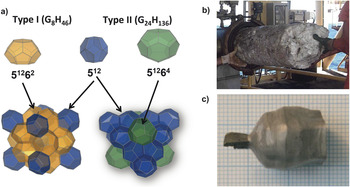
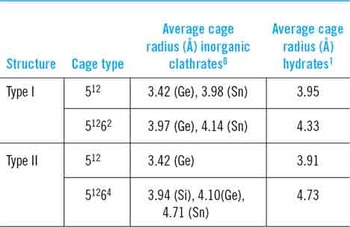
Figure 1(a) shows the most common clathrate structures found in both the hydrates and inorganic clathrates, known as Type I and Type II. Note that the hydrate field tends to use the nomenclature structure I (sI) and structure II (sII), respectively, instead. Type I forms a primitive cubic crystal structure composed of two types of cavities: a small pentagonal dodecahedral cavity, denoted 512 as it comprises 12 pentagons in the faces of the cavity, and a large tetrakaidecahedral cavity, denoted 51262 as it comprises 12 pentagons and 2 hexagons in the faces of the cavity. Type II forms a face centered cubic crystal structure also composed of two types of cavities: the small 512 cavity and a larger hexakaidecahedral cavity, denoted 51264 as it comprises 12 pentagons and 4 hexagons in the faces of the cavity. The unit cell of Type I contains 2 small cages and 6 large cages, while the unit cell of Type II contains 16 small cages and 8 large cages. Typically, the average cage sizes for Types I and II range from around 3.3–5 (Å) depending on the host and guest composition. Note that the cage sizes are smaller for the inorganic clathrates compared to the hydrates due to the stronger covalent bonding in the former framework (see Table 1). The stoichiometric formula for Type I and Type II structures is given by G8H46 and G24H136, respectively, where G is the guest and H is the host. Clathrate hydrate structures are often formed with partial guest filling of large or small cages. Conversely, all Type I inorganic clathrate structures show mostly full occupancy of the cages, and only a few Type II structures show partial filling of the cages. Reference Krishna, Baranowski, Martinez, Koh, Taylor, Tamboli and Toberer5
(a) Schematic of the common clathrate structures, Types I and II. For the clathrate hydrates, the host (H) comprises hydrogen-bonded water molecules and the guest (G) molecules are gas molecules (e.g., methane). For the inorganic clathrates, the host elements are Group IV elements covalently bonded together (e.g., Si) and guest elements are alkali and alkaline earth metals (e.g., Na, Ba) (Courtesy of S. Chakraborty, CSM). Physical appearance of clathrates: (b) gas hydrate plug from a gas pipeline (Courtesy of Petrobras); (c) inorganic clathrate single crystals (Ba8Ga16Ge30) for possible applications as a TE material. Reference Christensen, Abrahamsen, Christensen, Juranyi, Andersen, Lefmann, Andreasson, Bahl and Iversen4 (Reprinted with permission Ref. Reference Christensen, Abrahamsen, Christensen, Juranyi, Andersen, Lefmann, Andreasson, Bahl and Iversen4, © Nature Publishing Group).

Typical clathrate cage sizes for Type I and II structures. Note that the average cage radius is calculated from the center of the cage to the center of the framework atom. The “true” available space can be estimated by subtracting the van der Waals radius of the framework atom from the average cage radius.

While Fig. 1(a) provides the cage topology of the clathrates, Figs. 1(b) and 1(c) show the physical appearance of these materials, which look quite different. Gas hydrates (or clathrate hydrates) look similar to ice, which is not surprising since hydrates are composed of around 85 mole% water. Conversely, the inorganic Ba8Ga16Ge30 clathrate has a metallic luster similar to its constituent elements. Reference Christensen, Abrahamsen, Christensen, Juranyi, Andersen, Lefmann, Andreasson, Bahl and Iversen4 Although only the most common clathrate structures (Types I and II) are shown in Fig. 1, there are in fact several other clathrate structures, some of which are common to both the hydrates and inorganic clathrates (see Table 2).
Examples of different clathrate types that have been synthesized their space groups and representative compositions. Clathrate hydrate compositions and structures are identified in blue for clarity. (Modified from Refs. Reference Sloan and Koh1 and Reference Pouchard, Cros and Nolas7–Reference Shevelkov, Kovnir and Fassler9).

The guest species in clathrate compounds are often required to template the cages of the host lattice. With only water comprising the hydrate host lattice, the composition of gas hydrates is only varied in terms of guest species (and the guest/host ratio). This leads to their properties often resembling ice, hence the clathrate hydrates are electrically resistive. Reference Waite, Santamarina, Cortes, Dugan, Espinoza, Germaine, Jang, Jung, Kneafsey and Shin10 However, for the inorganic clathrates, the chemical diversity arises from the fact that a wide range of elements can be substituted both in the framework and guest sites. Hence, the inorganic clathrates span the entire spectrum from being insulators to semiconductors to superconductors. Reference Nolas11 This wide range of properties can be attributed to the guest–host interactions (bonding, charge transfer from guest to host and vice-versa).
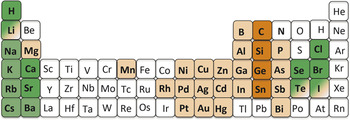
Figure 2 illustrates all the elements that make up the inorganic clathrate structure either as part of the framework, or guest, or both. Note, for the Te and I guest species, these guests can also take part in the host structure. (Note: certain guests in the hydrates can also take part in the host structure, via hydrogen bonding with the host structure, and these compounds are called semiclathrates). Reference Shin, Kim, Strobel, Prasad, Sugahara, Lee, Sloan, Sum and Koh12 Inorganic clathrates can be selectively synthesized to include mixed host and/or guest compositions. Partial substitution of Group IV host elements with Group III or Group V elements to offset the charge contributed by the guest atoms to the framework is often carried out to tune the electronic properties of inorganic clathrates (e.g., in Ba8Al16Si30 partial substitution of Si atoms by Al on the framework compensates for the charge donated by the Ba guest). The type of clathrate composition is often chosen depending on the application of interest. The limited variability in composition for hydrates leads to a narrower (interrelated) range of applications for hydrates compared to inorganic clathrates.
Illustrating the diversity in composition of host and guest species in the inorganic clathrates. Green elements: guest, orange elements: neutral hosts, beige elements: charged hosts. Modified from Refs. Reference Rogl8, Reference Shevelkov, Kovnir and Fassler9, and Reference Beekman, Nolas and Nolas13.

With such contrasting compositions of the hydrates and the inorganic clathrates, the stabilities and hence synthesis methods are dramatically different. In general, gas hydrates are stable at high pressure and low temperature, and therefore synthesis requires the application of these high P, low T conditions to a stirred autoclave/reactor cell containing water and gas. Conversely, the inorganic clathrates are stable at ambient T, P. Inorganic clathrate synthesis has been demonstrated by a wide variety of solid state chemistry techniques, such as direct reaction of elements at high temperatures or high pressure, by thermal decomposition from the precursor phase, crystallization from a melt, chemical transport techniques, redox reaction of a precursor phase, etc. Reference Beekman and Nolas2,Reference Krishna, Baranowski, Martinez, Koh, Taylor, Tamboli and Toberer5
Synthesis methods of clathrate compounds result in structures with cages either fully or partially occupied, depending on the synthesis technique and the size of the guest and framework atoms. Experimental observations indicate that the size of the guest atom/molecule is an important consideration in predicting if an atom/molecule is a suitable candidate to be a guest. Reference Sloan and Koh1 For clathrate hydrates, the ideal range of guest to host size ratios is around 0.8–0.9. For inorganic clathrates, a similar concept applies, with the exception that since the guests can be charged, using an ionic versus covalent radius for the guest to compute the guest to host ratio is often debated. Although, there are many possibilities for choosing guest atoms, the synthesis of clathrates (hydrates and inorganic) has been limited to only select types of guests (e.g., hydrocarbons and noble gases in hydrates and alkali/alkaline earth metals in inorganic clathrates).
More than one guest can occupy a clathrate cage in only a few instances at very high pressures. For clathrate hydrates, after 2002 it was determined that contrary to previous understanding, multiple guest occupancy of cages was possible for molecular hydrogen and other guests, such as N2, He, Ne. Reference Sloan and Koh1,Reference Mao, Mao, Goncharov, Struzhkin, Guo, Hu, Shu, Hemley, Somayazulu and Zhao14 This concept of multiple occupancy has been reported recently in the inorganic clathrates for one instance of double Na guest occupancy in Type II Si clathrates under high pressure (5 GPa) and high temperature (600–1000 °C) conditions. Reference Yamanaka, Komatsu, Tanaka, Sawa and Inumaru15 Another interesting aspect of clathrate hydrates is the possibility of guest exchange, i.e., CH4 in the hydrate framework may be exchanged with CO2. Reference Baldwin, Stevens, Howard, Graue, Kvamme, Aspenes, Ersland, Husebø and Zornes16 In inorganic clathrates, only in the type II Na x Si136 system, the sodium guest can be either evacuated by heating under vacuum, or inserted when heating the partially filled Na x Si136 in the presence of sodium vapor. Reference Reny, Gravereau, Cros and Pouchard17 Alternatively, inserting lithium in low Na x Si136 structures has been accomplished by electrochemical methods. Reference Langer, Dupke, Trill, Passerini, Eckert, Pöttgen and Winter18,Reference Wagner, Raghavan, Zhao, Wei, Peng and Chan19
Clathrate compounds can also undergo structural phase transformations. This is a well-known phenomenon in clathrate hydrate science, e.g., during the formation of Type I (sI), although the temperature, pressure and composition conditions are thermodynamically favorable for Type I, Type II (sII) hydrate can be also formed and eventually transitions to the favorable Type I. Reference Sloan and Koh1 This phenomenon is less common in inorganic clathrates, with only one reported instance of structure transformation from Type VIII to Type I. Reference Li, Fang, Deng, Kang, Shen, Wei and Ruan20 However, it should be noted that in the latter transformation both Types VIII and I have the same stoichiometry but belong to a different space group (Table 2).
Clathrate developments—knowledge and application
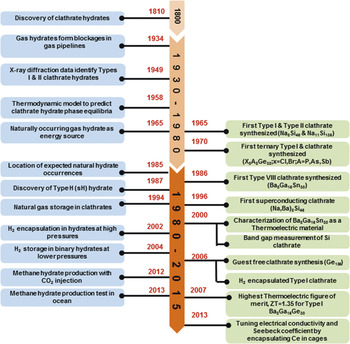
With the discovery of clathrate hydrates preceding at least one and a half centuries before the inorganic clathrates were discovered, it is not surprising that the knowledge base of the hydrates is far greater than the inorganic clathrates. A clear trend can be observed in which the technological discoveries or potential applications of the hydrates have been the driving force for the scientific advancements in understanding the structure and properties of hydrates. In inorganic clathrates, the synthesis of new structures and their characterization is a major research focus, and in addition exploring the potential application areas. Figure 3 summarizes the key technologically significant discoveries for the clathrate hydrates and inorganic clathrates.
Timeline of key important discoveries having potential impact to applications of clathrate hydrates (left) and inorganic clathrates (right).

Research on hydrates started in the 1800s when these compounds were first reported by Davy, Reference Davy21 with studies on these compounds after this initial discovery being driven by scientific curiosity. With the finding in 1934 by Hammerschmidt Reference Hammerschmidt22 that hydrates can form blockages in gas pipelines, research activity and publication numbers increased significantly and led to investigations of thermodynamic methods to avoid these blockages from occurring. Structure determination Reference Von Stackelberg23 and subsequent model development Reference Platteeuw and Van der Waals24 were reported in the late 1940s and in the 1950s. The 1960s saw the first report by Makogon and Cieslewicz Reference Makogon and Cieslewicz25 of hydrates occurring in nature, which resulted in a second increase in research activity and publication numbers. More recent research has focused on other technological applications, such as gas storage in hydrates. Reference Mao, Mao, Goncharov, Struzhkin, Guo, Hu, Shu, Hemley, Somayazulu and Zhao14,Reference Gudmundsson, Andersson, Levik and Parlaktuna26,Reference Florusse, Peters, Schoonman, Hester, Koh, Dec, Marsh and Sloan27 A unique gas hydrate structure which comprises square faces in some of the cages was discovered in 1987 and more recently found to exist in nature. Reference Ripmeester, John, Ratcliffe and Powell28 Very recently, gas production has been achieved from hydrate deposits under the permafrost and in oceanic sediments. Reference Collett, Fyre, Goldberg, Hasubo, Koh, Malone, Shipp and Torres29 Technology driven research is clearly illustrated with the hydrates.
As indicated by Kasper on discovering Type I and Type II inorganic clathrates in 1965, these structures are closely analogous to the clathrate hydrates. Reference Kasper, Hagenmuller, Pouchard and Cros30 The first synthesis of framework co-substitution with other atoms than from Group IV was reported by Menke and von Schnering. Reference Menke and von Schnering31 Subsequent research has focused on the synthesis of inorganic clathrates with various guest–host elements. This continues to be an active area of research, both fundamentally to synthesize new structures and for tuning properties for potential applications, such as thermoelectrics (TEs) and photovoltaics. Reference Kawaji, Horie, Yamanaka and Ishikawa32–Reference Guloy, Tang, Ramlau, Böhme, Baitinger and Grin35 Interestingly, since both the hydrates and inorganic clathrates have cage structures/void space, they have been suggested for hydrogen storage. Reference Neiner, Okamoto, Condron, Ramasse, Yu, Browning and Kauzlarich3,Reference Mao, Mao, Goncharov, Struzhkin, Guo, Hu, Shu, Hemley, Somayazulu and Zhao14,Reference Florusse, Peters, Schoonman, Hester, Koh, Dec, Marsh and Sloan27 For the last decade, the main focus for inorganic clathrates has been improving their TE properties by investigating various guest–host elements. Reference Christensen, Johnsen and Iversen36 Si and Ge clathrate structures without guests have been suggested from computational calculations to have wide band gaps. Reference Adams, O’Keeffe, Demkov, Sankey and Huang37 Hence, a few researchers have been investigating guest-free Si–Ge Type II clathrates for photovoltaics absorber materials. Reference Krishna, Baranowski, Martinez, Koh, Taylor, Tamboli and Toberer5,Reference Baranowski, Krishna, Martinez, Raharjo, Stevanović, Tamboli and Toberer38
In addition to the structural similarities between the inorganic clathrates and hydrates, the role and dynamics of the guest species can have a major impact on the stability of the materials, including thermodynamic stability and ease of compound synthesis. Somewhat unique to both these classes of compounds is that the “guest” tends to be imprisoned in the host structure, until external forces are applied, e.g., a dynamic vacuum to release the guests and produce empty jails/cages.
Despite having very similar crystalline structures comprising a guest–host concept (section “Clathrate guest–host interactions”), the clathrate hydrates and inorganic clathrates exhibit very different properties, which are largely attributed to the different compositions of the compounds and the nature of guest–host interactions. These different properties lead to vastly different technological (potential) applications as well as different thermodynamic stability conditions. Specifically, clathrate hydrates typically require high pressures and low temperatures for stability, whereas inorganic clathrates typically are stable under ambient conditions.
Along with the vastly different guest–host compositions of hydrates and inorganic clathrates comes very different technological applications. Hydrates applications include:
-
(i) Energy recovery from naturally occurring methane hydrate deposits (see methane hydrate case study for more details). Reference Collett, Fyre, Goldberg, Hasubo, Koh, Malone, Shipp and Torres29,Reference Paull, Dallimore, Enciso, Green and Koh39
-
(ii) Energy storage and transportation, where methane hydrates are synthesized from methane/natural gas. This application is particularly appealing for stranded gas applications where no pipeline is present, and therefore methane/natural gas can be stored in hydrates and transported in a refrigerated truck/vessel. Reference Gudmundsson, Andersson, Levik and Parlaktuna26,Reference Gudmundsson and Borrehaug40,Reference Koh, Sloan, Sum and Wu41
-
(iii) Gas separation (see a sieving phenomenon). Reference Eslamimanesh, Mohammadi, Richon, Naidoo and Ramjugernath42
-
(iv) Carbon dioxide sequestration in which carbon dioxide is trapped in the hydrate lattice. Reference Park, Kim, Lee, Huh, Park, Lee and Lee43
-
(v) Desalination using hydrates since the lattice will be formed from the hydrate former and seawater, while excluding the salt ions; on dissociating the hydrate, purified water can be produced, leaving behind concentrated seawater. Reference Kubota, Shimizu, Tanaka and Makita44 A key challenge is the separation of hydrate crystals from the remaining concentrated seawater.
-
(vi) Proton conductivity using ionic clathrates. This potential application is suggested to be facilitated by deformations in the hydrogen-bonding clathrate host structure, which provides “proton transport paths and/or a change in the motional state of water” molecules. Reference Shin, Cha, Seo and Lee45
Inorganic clathrates applications include:
-
(i) Thermoelectricity, i.e., generating energy from waste heat, which is currently the most well studied application of inorganic clathrates. Reference Stefanoski, Beekman, Nolas and Nolas46
-
(ii) Photovoltaics—Guest-free silicon and germanium clathrates are known to have wide quasi-direct band gaps. For the Type II structure, the band gap varies from 1.7 to 0.8 eV for silicon and germanium clathrate, respectively, therefore these materials are of interest for photovoltaic applications. However, synthesizing a semiconducting clathrate is a challenge that needs to be addressed if these materials are to be used for solar cells. Reference Martinez, Krishna, Baranowski, Lusk, Toberer and Tamboli47
-
(iii) Rechargeable batteries—The most recent application of inorganic clathrates is as an electrode in rechargeable batteries. Specifically, silicon clathrates are considered potential candidates as anode materials for lithium ion batteries. Lithiation studies of Ba x Si136 clathrates are being investigated to assess if silicon clathrates could be viable for this application. Reference Yang and John48
Clathrate guest–host interactions
The guest–host interactions of clathrates are unique to these classes of compounds and can have an integral role in their structure, stability, and properties. It is well understood that the guest atoms/molecules are required to template the cage/lattice formation. Some key fundamental questions that have intrigued the clathrate communities regarding the guest–host compounds are: How do guests interact with the framework atoms? What is the impact on the electrical and thermal properties in the presence of guests? Do guests interact? Can guests be removed from the clathrate structure? Despite the prominent influence the guest–host interactions can have on the clathrates, there have been only limited studies of these interactions, and our understanding is still evolving. Reference Sloan and Koh1,Reference Christensen, Abrahamsen, Christensen, Juranyi, Andersen, Lefmann, Andreasson, Bahl and Iversen4,Reference Gatti, Bertini, Blake and Iversen49 This is largely due to the limitations/difficulties of studying these phenomena since typically a combination of advanced experimental techniques is required to probe these guest–host interactions. Reference Tse, Ratcliffe, Powell, Sears and Handa50 In addition to experimental studies, theoretical calculations and molecular simulations have also been applied to investigate these interactions. Reference Gatti, Bertini, Blake and Iversen49,Reference Buch, Devlin, Monreal, Jagoda-Cwiklik, Uras-Aytemiz and Cwiklik51–Reference Khan54 This section will highlight the key understanding in the hydrates and inorganic clathrates, and compare and contrast these guest–host interactions in the two systems.
Guest–host interactions in the clathrate hydrates comprise weak van der Waals interactions, even when the guest has the ability to hydrogen-bond to the water molecules, as well as when the guest is a nonhydrogen bonding former. Reference Sloan and Koh1,Reference Buch, Devlin, Monreal, Jagoda-Cwiklik, Uras-Aytemiz and Cwiklik51 These guest–host interactions are key to determining the structure and stability of gas hydrates, with the host lattice collapsing/destabilizing in the absence of guests occupying the host water cages. The stability of the clathrate hydrate lattice can depend on the interaction energy between the guest species and cage walls, as well as the extent to which a guest will distort the cage it occupies. Reference Kumar and Sathyamurthy52,Reference Khan54 However, as a general rule, guest species which are of a size that fits in a cage without too much strain and/or not too loosely tend to be best at stabilizing the hydrate structure and preventing cages from collapsing. Reference Buch, Devlin, Monreal, Jagoda-Cwiklik, Uras-Aytemiz and Cwiklik51,Reference Khan54 It has been suggested that hydrate guest molecules can occupy an off-center position in a water cage, e.g., as indicated from CO2 single crystal studies by Udachin et al. Reference Udachin, Ratcliffe and Ripmeester55
Similar to the clathrate hydrates which require guest occupants to impart stability on the host framework; inorganic clathrates are thermodynamically stable when the cages are occupied. The empty clathrate structures (e.g., empty Si136 and Ge136 Type II clathrates) are in fact energetically metastable with respect to its diamond structured allotropes. Reference Beekman and Nolas2 The inorganic clathrate framework is more rigid than the hydrate framework because of the covalently bound Group IV elements in the former structure. This relatively strong bonding imparts structural stability to these compounds under ambient conditions, when either completely or partially occupied by the guests. Similar size constraints as in the case of clathrate hydrates exist for inorganic clathrates to determine if a guest can be encapsulated in a framework. Reference Pouchard, Cros and Nolas7 In general, the guest species within the inorganic framework cannot be removed while maintaining a stable structure. Although one exception has been demonstrated for Na x Si136, where most of the Na guest species can be removed by heating under vacuum. For such low Na guest levels (less than 3000 ppm), the Na guests have been proposed to interact with one another forming dimers. Reference Krishna, Baranowski, Martinez, Koh, Taylor, Tamboli and Toberer5 A guest-free Ge clathrate was reported to be synthesized using an ionic liquids method, Reference Guloy, Tang, Ramlau, Böhme, Baitinger and Grin35 however, when applying this method to Si clathrates fully occupied Type I and Type II structures were produced. Reference Blosser and Nolas56
Both clathrate hydrates and inorganic clathrates show intrinsically low thermal conductivity due to the coupling between guest and host vibrations. Reference Tse, Shpakov, Belosludov, Trouw, Handa and Press57,Reference Takabatake, Suekuni, Nakayama and Kaneshita58 In clathrate hydrates this coupling leads to thermal conductivities even lower than ice. Guest atoms are considered to “rattle” within the cage and the extent to which they rattle depends on the size of the guest atom and the cage. In the inorganic clathrates, this concept has been widely exploited for TE applications.
In the inorganic clathrate systems, the guest–host interactions can be complex and as a result has interesting consequences on the electrical properties. One versatile aspect of the inorganic clathrates is that its electronic behavior can be tuned to be insulating, semiconducting or even metallic, depending on the host and guest elements. The electronic properties can be understood as a combination of ionic and covalent bonding. The exact chemical nature of the guest atom, i.e., either ionic or neutral, is still debated. Reference Gatti, Bertini, Blake and Iversen49
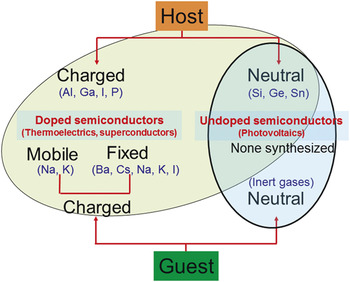
Figure 4 illustrates the concepts of having neutral versus charged guests and hosts, and their resultant properties. A first approach to understanding the electronic properties of inorganic clathrate compounds is by a simple electron counting scheme based on the Zintl rule. According to this rule, charge transfer between the guest and framework atoms occurs to attain the valence requirement of the host (octet rule). For example, in a Si clathrate if some of the Si atoms are substituted by Al, the framework is no longer neutral and net charge of the framework depends on the number of Si sites substituted by Al (Al being in Group III has a valence of 3, and so when bonding with Si it is one electron deficient from satisfying the octet rule). In this type of case in which the framework is electron deficient, the host would be cationic. Similarly, anionic clathrates can be synthesized, e.g., with P in Group V substituting some of the Si framework atoms, which would result in excess framework electrons. Such substitution of Group IV atoms with nonGroup IV atoms will result in a charged host framework. Reference Gatti, Bertini, Blake and Iversen49
Versatility of guest–host inorganic clathrate systems classified by the charge on the host and guest species.

Similarly, charge transfer from guests to hosts can also occur. For example, in Ba8Si46, each Ba donates 2 excess electrons to the framework, resulting in net anionic framework. In this situation, the clathrate structure is a heavily doped n-type semiconductor. In fact, Ba8Si46 is a superconductor at 8 K. Reference Yamanaka, Enishi, Fukuoka and Yasukawa59 However, when the framework is made of Group IV atoms that are covalently bonded, the octet rule is satisfied, resulting in a neutral framework (assuming there are no guest atoms). When the cages are unoccupied, the empty Group IV clathrate structure is known to be an intrinsic semiconductor, which is attractive for photovoltaic applications.
While the charged guest–host systems have been heavily explored, little is known about the properties of inorganic clathrates with neutral guests, because such systems have not been realized yet. Such systems would be promising alternatives to synthesizing guest-free Group IV clathrates. In the presence of an inert or weakly interacting guest, the framework is suggested to be neutral. Reference Connétable60 Recent studies on computing the energetics of inert gas guests (Ar, Xe, Ne) encapsulated in Group IV clathrates suggested that such systems were energetically favorable and identified Xe24Sn136 to be the most promising candidate (energetically) for possible synthesis of neutral clathrates. Reference Karttunen and Fässler61 Synthesis of inert guest clathrates would be a breakthrough for achieving semiconducting clathrates for photovoltaic applications.
Guest mobility and defects in clathrates
In a broader context, defects in crystal structure refer to a break in the periodicity of the lattice. Depending on the defect and the material in question, the consequences can be fatal or vital. Reference Queisser and Haller62 The most common type of defect in clathrate structures is a vacancy, in which there is a missing atom/molecule in the host framework. Defects in clathrates can facilitate guest diffusion and/or removal through the clathrate lattice. Therefore, the presence of defects can help in facilitating filling of the hydrate lattice with molecular hydrogen, or in guest removal from inorganic clathrates for semiconducting applications. Other defects particularly found in the inorganic clathrates are related to substitutional defects or line defects, such as dislocations.
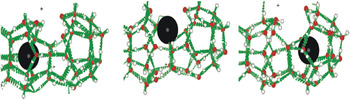
The presence of vacancies in the clathrate framework can facilitate guest diffusion. Specifically, guest “hopping” through cages with vacancies has been proposed to enable rapid diffusion of a guest through the hydrate lattice, as shown in Fig. 5. Reference Peters, Zimmermann, Beckham, Tester and Trout63 Davidson and Ripmeester Reference Davidson and Ripmeester64 also suggested that the host water molecules are more mobile than guests, which is consistent with Buch et al.’s suggestion that a vacancy will expand the “opening in the cage wall.” Reference Buch, Devlin, Monreal, Jagoda-Cwiklik, Uras-Aytemiz and Cwiklik51
Illustration of a methane molecule (black sphere) hopping from the donor cage (left), to between the cages (middle), to the acceptor cage (right). The methane molecule is able to hop from the acceptor cage to the donor cage via a vacancy in the five-membered water ring in Type I (sI) hydrate. (Reproduced from Ref. Reference Nistor, Van Tendeloo, Amelinckx and Cros68 with permission from © 2008 American Chemical Society).

More details of the mechanism of guest diffusion through the clathrate lattice have been studied for hydrates. For example, a higher energy barrier was calculated for methane “hopping” through the 5-membered water rings of an occupied hydrate cage to an adjacent empty cage, compared to hopping through corresponding 6-membered water rings. Reference Peters, Zimmermann, Beckham, Tester and Trout63 However, methane and carbon dioxide would distort 6-membered rings as they passed through. Therefore, methane or carbon dioxide diffusion can be facilitated (with lower energy) by invoking the mechanism in which there is a water vacancy or vacancy defect in the host lattice cages, i.e., a broken hydrogen-bond, with this defect generating a “large hole” in the cage wall. Reference Buch, Devlin, Monreal, Jagoda-Cwiklik, Uras-Aytemiz and Cwiklik51,Reference Demurov, Radhakrishnan and Trout65
Similarly, the most common defect that is found is the inorganic clathrate structure is the presence of vacancies. Both Ge and Sn clathrates are reported to have framework vacancies, whereas Si clathrates do not have any vacancies as a consequence of the strong covalent Si–Si bond strength relative to Ge–Ge or Sn–Sn bonds. In Type I clathrate, there are three crystallographically unique framework sites (24k, 16i, and 6c) of which vacancies are reported on the 6c site because the weak bond strength of atoms occupying this position relative to the other sites. Reference Shi, Yang, Bai, Yang, Wang, Chi, Salvador, Zhang, Chen and Wong-Ng66
Preliminary calculations were also performed for Na x Si136 Type II clathrates to investigate the energetics of Na guest diffusion pathways in the presence of vacancies. The results indicated that vacancies can facilitate Na guest removal from the clathrate lattice, and guest mobility through 6-membered rings was more favorable than that through 5-membered rings of the cages. Reference Krishna, Martinez, Baranowski, Brawand, Koh, Stevanovic, Lusk, Toberer and Tamboli67 It should be noted that no vacancies have been experimentally observed in this particular system, but the driving force for Na diffusion through the framework still needs to be investigated. However, transmission electron microscopy measurements have revealed other defects in the system, such as the presence of dislocations and stacking faults. Reference Nistor, Van Tendeloo, Amelinckx and Cros68 These observations were only made for Type II Si clathrates with Na guests (in low concentration), while similar measurements for Type I structures did not reveal any dislocations (and guest concentration was high). These dislocations may facilitate guest removal from the lattice. Again, the exact mechanism for guest removal needs further investigation. Reference Nistor, Van Tendeloo, Amelinckx and Cros68
Structure characterization tools and concepts
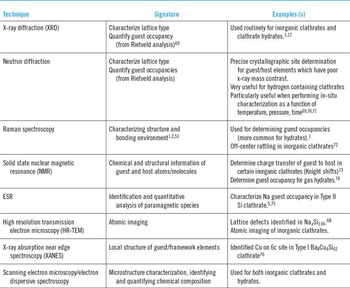
Due to the similarities of the clathrate hydrates and inorganic clathrate structures and their void cages, analytical tools are similar for characterizing the structure of these compounds, e.g., solid-state nuclear magnetic resonance (NMR) and Raman spectroscopy, x-ray and neutron diffraction (Table 3). However, experimental set-up for clathrate hydrates requires low temperatures to be maintained to prevent the cages from collapsing (e.g., for atmospheric pressure measurements, liquid N2 temperatures are required for hydrates to remain stable). Currently, the guests that occupy cages in the clathrate hydrates are different from inorganic clathrates. But there are evolving applications or concepts involving inert guests in inorganic clathrates and molecular hydrogen in both hydrates and inorganic clathrates, where the knowledge of characterizing these guest species developed in the hydrate field could be useful and applied to the inorganic clathrates.
Summary of the structure characterization techniques applied to clathrates.

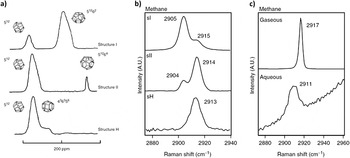
In the hydrates, there are only weak van der Waals interactions between guest and host molecules, however, the guest spectroscopic signature can still be dependent on the cage type and structure. For example, Figs. 6(a) and 6(b) show the characteristic guest signatures for Xe in the large and small cages of Types I, II, H from NMR spectroscopy, and methane in the large and small cages of Types I, II, H (and in the gaseous and aqueous phases) from Raman spectroscopy, respectively. These signatures could apply to weakly interacting guest–host inorganic clathrate systems, e.g., H2 in Type I Na5.5(H2)2.15Si46 clathrates was found to have a similar NMR chemical shift (approximately 4 ppm) to H2 in Type II hydrates. Reference Neiner, Okamoto, Condron, Ramasse, Yu, Browning and Kauzlarich3 If inert inorganic clathrates were to be synthesized, one can speculate that the guest occupancy signatures would be similar to that in the hydrates.
(a) Solid state NMR spectroscopy can be used to detect the guest environments within the clathrate cages. In this example, 129Xe NMR is used to detect xenon in the small, middle and large cages of sI, sII (Types I and II), and sH hydrates. (Reproduced from Ripmeester and Ratcliffe 1990; in Sloan and Koh, 2007). (b) Raman spectroscopy can be used to detect the guest environments in the clathrate cages. In this example, Raman spectra are shown of the C–H stretching vibration of methane in sI, sII, sH (Type I, II, H) clathrates (left), and also gaseous and aqueous environments (right). (Collected by Subramanian and Hester; in Sloan and Koh, 2007). (Reproduced from Ref. Reference Sloan and Koh1 with permission from CRC Press).

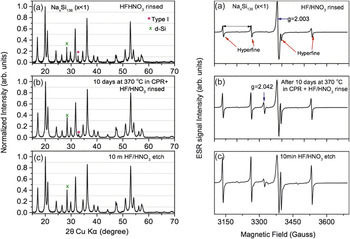
Some additional characterization techniques may be used depending on the nature of the guest species. For example, an electron spin resonance (ESR) technique can be used for both qualitative and quantitative determination of paramagnetic atoms. Reference Yahiro, Yamaji, Shiotani, Yamanaka and Ishikawa75,Reference Ammar, Cros, Pouchard, Jaussaud, Bassat, Villeneuve, Duttine, Ménétrier and Reny77 The ESR technique is useful for characterizing low levels of sodium containing Type II clathrate, since other techniques like powder x-ray diffraction (PXRD) become unreliable for these low sodium levels. In Fig. 7, a comparison of PXRD and ESR images for three Type II silicon clathrate (Na x Si136) samples with different sodium occupancy is shown. The PXRD data are not sensitive to sodium occupancy (x) below 1, whereas ESR is very sensitive to sodium content in the samples, as is inferred by the reduction of the central peak (conduction electron peak) relative to the hyperfine splitting peaks of sodium guest.
XRD and ESR spectra of Na x Si136 clathrate with varying sodium content (x < 1). (Left) XRD spectra for all compositions of low sodium Type II silicon clathrate are similar, whereas ESR spectra are different (right). The reduction of the central peak in the ESR spectra with respect to the hyperfine splitting peaks of sodium indicates lower sodium content in those samples. (Reproduced from Ref. Reference Krishna, Baranowski, Martinez, Koh, Taylor, Tamboli and Toberer5 with permission from © The Royal Society of Chemistry).

Apart from the above mentioned techniques, property characterization of these clathrates is also routinely done. For example, inorganic clathrates for TE applications are often characterized by Seebeck coefficient, electrical conductivity, and thermal conductivity measurement which determine the TE figure of merit. For inorganic clathrates to be used for photovoltaics (PV), band gap measured by optical spectroscopy techniques is critical. In the case of inorganic clathrate superconductors, magnetic susceptibility measurement along with NMR found Knight shifts is important.
Potential cross-fertilization between two different classes of compounds
To-date, the two research areas of inorganic clathrates and hydrates have been conducted independently from one another. However, there could be potential cross-fertilization between these research areas, as suggested below.
-
(i) Synthesis of guest-free clathrates and hydrates is fundamentally interesting. For example, guest-free silicon clathrates can have novel photovoltaic applications. Reference Krishna, Baranowski, Martinez, Koh, Taylor, Tamboli and Toberer5,Reference Martinez, Krishna, Baranowski, Lusk, Toberer and Tamboli47,Reference Krishna, Martinez, Baranowski, Brawand, Koh, Stevanovic, Lusk, Toberer and Tamboli67 Routinely, sodium-guests trapped in silicon clathrates are removed by heating under a vacuum. Very recently, this vacuum removal technique has been applied to remove neon guests from clathrate hydrates. This is the first reported synthesis of empty clathrate hydrates. Reference Falenty, Hansen and Kuhs78
-
(ii) Amorphous precursors to the final crystal structure have been reported during hydrate nucleation investigations using computer simulations. Reference Walsh, Koh, Sloan, Sum and Wu79 This can lead to faster nucleation rates. Applying this finding from hydrates to clathrates may enable tuning of the guest occupancy (in contrast to precursors of sodium silicide where the Na-to-Si ratio is large), as well as faster synthesis.
-
(iii) Seed crystallization methods have been used in hydrates. Reference Sloan and Koh1 This could be applied to inorganic clathrate synthesis to produce novel structures, such as empty hosts for PV.
-
(iv) Hydrogen storage has been demonstrated in hydrates but requires low temperature and high pressure conditions. Since silicon clathrates are stable at room temperature, exploring empty clathrates as a storage medium for hydrogen would be an attractive application.
Most significant technological applications
Due to the unique structure–properties and guest–host chemistry, clathrates and hydrates may have several technological applications. Reference Sloan and Koh1,Reference Beekman and Nolas2 However, in this section, the most promising state-of-the-art applications of the clathrates are presented. These include promising TE materials using inorganic clathrates and harvesting energy from methane (clathrate) hydrate natural deposits.
In sections “Inorganic clathrates for TE applications: Harvesting energy from waste heat” and “Harvesting the energy from methane hydrates under the ocean and permafrost”, case studies of the most technologically promising applications of clathrate materials are presented. Specifically for inorganic clathrates, the key aspects and challenges of the themoelectrics application are discussed. It should be noted that the field for TE applications for inorganic clathrates is still evolving and focusing fundamental understanding of how the chemical compositions can impact the TE properties. Conversely for the clathrate hydrates, the field is highly application driven, with the resource potential and key outstanding issues for recovering the energy from naturally occurring methane hydrates being a major global focus.
Inorganic clathrates for TE applications: Harvesting energy from waste heat
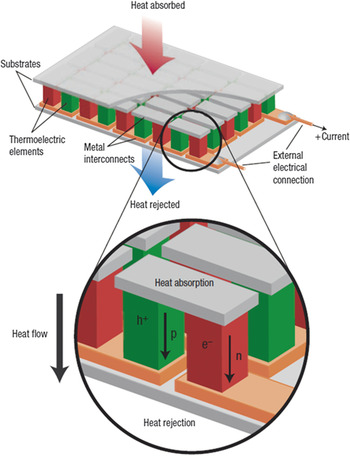
A staggering 50% of total energy consumed by the U.S. annually is dissipated as waste heat. TE materials offer promising route to harvest some of this waste heat directly to electricity. TE materials when maintained under a temperature gradient, the high thermal energy carriers on the hot side flows to the cold side, thereby generating a potential difference that can be used to power an external load. This principle is called the Seebeck effect and conversely, when electric current is passed through a TE material, they provide cooling and this is called the Peltier effect. A TE generator (TEG) consists on “legs” made of a n-type and a p-type TE material, which are connected electrically in series but thermally in parallel (see Fig. 8). Many such TEGs are then connected together to form a module to generate a usable amount of electricity. Because TEGs are solid-state devices with no moving parts, they are known to be extremely reliable and hence have found use in niche applications for over several decades Reference LaLonde, Pei, Wang and Jeffrey Snyder81 (e.g., power generation in space, pacemakers).
TE module consisting of several n and p type legs. In the Seebeck effect, when the TE legs are maintained under a temperature gradient, a voltage will be generated. Reference Snyder and Toberer80 (Reprinted with permission Ref. Reference Snyder and Toberer80, © Nature Publishing Group).

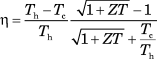
The efficiency of a TE material is related to fundamental properties of the material namely, Seebeck coefficient (S), electrical conductivity, (σ) and thermal conductivity (κ). The figure of merit of a TE material is given by, ZT = σS 2 T/κt, where T is the absolute temperature. The total thermal conductivity (κt) is the sum of the electronic contribution (κe) and lattice contribution (κl). Although maximum increase in ZT is expected from materials simultaneously exhibiting high σ (low Joule heating) & S and low κ (to maintain the temperature gradient), the conflicting interdependence amongst all three factors makes it a challenging task to identify high ZT materials. Heavily doped semiconductors offer a compromise between these parameters and are considered promising TE materials. The TEG efficiency (η) is related to ZT by the equation,
 $\eta = {{{T_{\rm{h}}} - {T_{\rm{c}}}} \over {{T_{\rm{h}}}}}{{\sqrt {1 + ZT} - 1} \over {\sqrt {1 + ZT} + {{{T_{\rm{c}}}} \over {{T_{\rm{h}}}}}}}$
, where T
h and T
c are the hot side and cold side temperatures, respectively. For example, current state-of-art TE materials with ZT ∼ 1 have device efficiencies of less than 10%. ZT of TE materials has been stagnant around 1 for many decades. For practical applications, TE materials with ZT around 2 are required since they would enable ∼40% improvement in device efficiencies.
Reference Yang, Yip and Jen82
With recent advances made in increasing the efficiency of TE materials, one of the active areas of TE research in the last decade has been toward the application of TEGs for recovery of waste heat from automobile exhaust. Approximately 70% of the fuel's energy is dissipated at the exhaust and it is estimated that a 5% boost in the fuel economy can be achieved by using a TEG to harvest this waste heat.
Although inorganic clathrate structures were first synthesized in 1965, Reference Kasper, Hagenmuller, Pouchard and Cros30 it was not until 1998 that Nolas identified them as promising material system for the realization of phonon glass electron concept concept, which described the ideal characteristics of a TE materials. Reference Nolas, Cohn, Slack and Schujman33 The phonon glass concept can be realized in the inorganic clathrates because they have large open framework cage structure which encapsulates guest atoms that are weakly bound to the cages, and the origin of low lattice thermal conductivity is associated with the “rattling” of the guest atoms within the cages. In fact, the lattice thermal conductivities of inorganic clathrates are on the order of few W/mK, which is very low compared to other classes of materials investigated for TE applications. Reference Snyder and Toberer80 When the encapsulated guest is in a relatively large cage, they are known to occupy off-center positions away from the center of the cage which can lead to glass-like thermal conductivity at low temperatures. Suekuni et al. studied the relationship between the lattice thermal conductivity of various Type I inorganic clathrates as a function of the cage radius and suggested that lattice thermal conductivity values scale well with the free space available for the guest ion in the cage. Reference Suekuni, Yamamoto, Avila and Takabatake83 Therefore, by appropriately choosing the guest and framework elements, the lattice thermal conductivity can be further tuned.
The electron crystal concept in the inorganic clathrates is realized because in these crystalline guest–host compounds, the electrical conductivity takes places mostly through the clathrate host framework and is largely unaffected by the rattling guest. The framework is doped by the presence of the guest atoms that transfer charge to the framework. Tuning the doping in these classes of materials is accomplished by appropriately choosing the chemical composition of the guest–host elements. According to the Zintl rule, for a clathrate compound with a formula A8B16X30, where A is a alkaline earth metal (Ba, Sr), B is a Group III element (e.g., Al, Ga), and X is an element from Group IV (e.g., Si, Ge Sn), the alkaline earth cation donates two electrons each to the Group III framework element and hence the clathrate would be an intrinsic semiconductor if the precise charge compensation is achieved. Experimentally, such charge balance is rarely attained and these compounds are heavily doped semiconductors (∼1020–1021 electrons/cm3). Reference Krishna, Baranowski, Martinez, Koh, Taylor, Tamboli and Toberer5 The A and B element ratios can be tuned to make both n-type and p-type doped semiconductors.
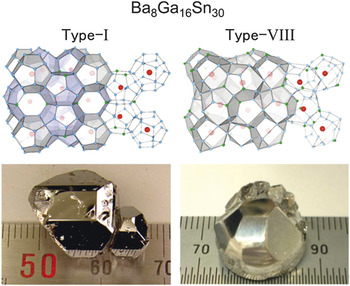
Of all the types of clathrates described in section “Introduction”, Type I structures are most studied for TE application as the chemical composition of these structures can be tuned to have doping levels suitable for maximizing ZT. More recently, Type VIII structures are also being investigated as TE materials. Both the Type I and Type VIII structures have the same stoichiometry but in the Type VIII structure the guest atoms are encapsulated in distorted pentahedron cage. Like the Type I structure, low lattice thermal conductivities are also observed in the Type VIII structure. In addition to low lattice thermal conductivity, both n-type and p-type behavior is demonstrated in Type VIII Ba8Ga16Sn30 clathrate on tuning the composition of guest/host elements. Figure 9 shows a schematic of the Type I and Type VIII crystal structures along with the synthesized single crystals of Ba8Ga16Sn30 clathrate. Reference Takabatake, Suekuni, Nakayama and Kaneshita58
A schematic of the Type I and Type VIII crystal structures along with the synthesized single crystals of Ba8Ga16Sn30 clathrate (Reprinted from Ref. Reference Peters, Zimmermann, Beckham, Tester and Trout63, © 2014 by the American Physical Society).

Although the extremely low lattice thermal conductivity of the clathrates is attractive for TE applications the inability to precisely control the doping level to optimize the ZT is a setback. In addition, the TE properties are dependent on the synthesis technique and so far clathrate single crystals are known to have superior TE performance when compared to poly crystalline materials. The most widely investigated clathrate materials for TE applications are Ba8Al16Si30, Ba8Ga16Ge30, and Ba8Ga16Sn30 compounds and some of their quaternary compounds achieved by framework alloying. Type I Ba8Al16Si30 is always known to be Al deficient (i.e., less than 16 Al on the framework) and therefore results in a heavily doped n-type semiconductor. Whereas Ge clathrate framework is known to incorporate more Ga and thus has the highest ZT reported for clathrates (e.g., ZT ∼ 1.63 at 1100 K for n-type Ba8Ga16Ge30 and ZT ∼ 1.1 at 900 K for p-type Ba8Ga16Ge30). Reference Prokofiev, Sidorenko, Hradil, Ikeda, Svagera, Waas, Winkler, Neumaier and Paschen84 There are only a handful of inorganic clathrates with ZT > 1 and by optimizing carrier concentration in these materials, higher ZT can be achieved. Although there are several reports on substituting multiple atoms on the framework site to increase the power factor (σS 2) and hence increase ZT, this still remains a major challenge for this class of materials. Reference Christensen, Johnsen and Iversen36 Recently, a 50% power factor enhancement in clathrates was achieved by partially substituting Ba guest by Ce in Ba8Au x Si46−x . Reference Prokofiev, Sidorenko, Hradil, Ikeda, Svagera, Waas, Winkler, Neumaier and Paschen84
Future directions & outstanding questions for inorganic clathrate TE materials
-
(i) Controlling carrier concentration: One of the biggest challenges with the clathrate TE materials is controlling of stoichiometry and hence the carrier concentration. As a consequence of this, generating p-type materials is much harder. Only very few systems have demonstrated p-type behavior. The ZT of n-type materials is greater than 1, whereas in the case of p-type material, ZT is below 0.5. Therefore, controlling stoichiometry is critical in further optimizing the ZT. Availability of both n-type and p-type TE material will be crucial for the fabrication of TE modules.
-
(ii) Cost of the TE materials: One important factor that needs further consideration in designing TEGs is the cost-efficiency trade-off. Although inorganic clathrates offer promise as TE materials, most of the high ZT clathrates contain expensive elements like Ge. Therefore, cost per W is the metric that one should keep in mind when thinking about new TE materials or when optimizing existing TE materials.
-
(iii) Critical abundance of the TE materials: For sustainability, it is essential to incorporate materials that are critically abundant. Most of the promising clathrate TE materials have high risk of scarcity (e.g., Gallium, Germanium). Choosing elements such as Al and Si as the major components of clathrate TE materials and optimizing their performance will render the use of clathrates for TE applications more realizable.
Harvesting the energy from methane hydrates under the ocean and permafrost
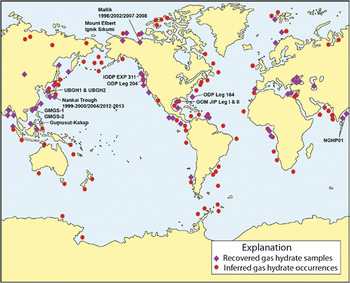
Methane hydrates occur naturally in oceanic sediments and under the permafrost in arctic regions all around the world (Fig. 10). The interest of clathrate hydrates as an energy resource has nucleated significant interest in terms of providing an alternative energy supply, which potentially is far greater than all the conventional energy resources currently available. Even conservative estimates suggest that the global methane hydrate energy resource is at least twice that of conventional oil and gas resources. However, along with this potential energy resource is associated an environmental concern of methane emissions from these global deposits.
Locations along the continental margins and in arctic regions where methane hydrates occur naturally in sediments under the ocean seafloor and under the permafrost. The major hydrate drilling, exploration, and production programs are indicated in the labels. Recovered gas hydrate samples have been obtained during drilling expeditions for gas hydrates, while inferred occurrences are based on seismic signatures (Reproduced from Collett et al.; Adapted from Kvenvolden with permission). Reference Collett, Fyre, Goldberg, Hasubo, Koh, Malone, Shipp and Torres29,Reference Kvenvolden85

The ability of methane hydrates (gas hydrates) to compress the large amounts of gas into the hydrate framework (i.e., 160 volumes of gas can be contained within 1 volume of hydrate at standard temperature and pressure conditions) leads to a number of different energy applications for these compounds (as summarized in 1.3). These applications can be categorized in terms of hydrates for technological applications versus hydrates as a hazard. One aspect of hydrates which is considered a hazard and by far the most prevalent in the petroleum industry is the potential of hydrates to form blockages in subsea oil and gas pipelines. This can lead to severe safety and economic risks, with potential damage of equipment and safety risks to personnel, and loss of production for an extended period of time while the hydrate blockage is remediated. This section will focus on a case study of methane hydrates as an energy resource.
The vast amounts of energy trapped within oceanic and arctic sediments containing methane hydrate have led to major national energy programs focusing on: determining the locations of these naturally occurring deposits; estimating the extent of the resource in the different locations, as well as within regions (Alaskan North Slope, Gulf of Mexico, Japan, India, Korea, China) and globally; advancing the technologies to recover this trapped energy.
It is clear that the countries/nations who envision that the recovery of these methane hydrate deposits will lead to significant socioeconomic/energy security improvements are the ones who are making the greatest investments and advancements in this endeavor to provide technologically and economically acceptable methods to recover this energy. For example, in the last decade there has been a shift in the field explorations from the Mallik field in Canada and the U.S. Alaskan North Slope, producing from on-land deposits under the permafrost, to more recently Japan producing from oceanic deposits for the first time. Also, Korea and Japan are planning further oceanic production tests over the next few years. Other notable national hydrate programs include the Indian National Gas Hydrate Program and the Chinese National Hydrate Program.
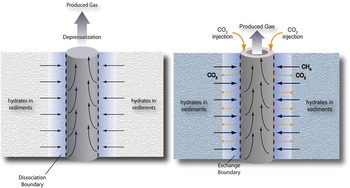
The methods that can be applied to produce energy from methane deposits include disturbing the thermodynamics of methane hydrates, i.e., depressurizing, heating, or using chemical injection to move the hydrates outside the pressure stability zone for hydrates (Fig. 11). Therefore, the methane gas is produced during this energy recovery rather than the hydrate solid, making the energy recovery process closer to conventional petroleum production, and thereby enabling much of the technology developed in petroleum production to be applicable for methane hydrate recovery.
Thermodynamic methods for dissociating methane hydrates in natural reservoirs for methane release and recovery, including depressurization (left) and carbon dioxide injection (right). Reference Koh, Sum and Sloan86 (Reproduced from Ref. Reference Koh, Sum and Sloan86 with permission from © 2014 American Institute of Publishing.)

Methane recovery from methane hydrate natural deposits from under the permafrost (on land) was first considered by Makogon in the 1960s, and also attempted and achieved in a controlled test in the Mallik well in the Mackenzie Delta, Canada using the methods of thermal stimulation and depressurization. These first production tests were followed by production trials in the North Slope of Alaska to recover methane from hydrate deposits under the permafrost using depressurization and carbon dioxide injection (Fig. 11). In the latter case, the concept involves injecting carbon dioxide into the well formation so that there could be a dissociation/replacement of methane in the hydrate for carbon dioxide, i.e., methane could be released from the methane hydrate deposit, while carbon dioxide could be captured within the hydrate in the reservoir.
From the numerous exploration expeditions, the consensus has been that the wealth of energy in methane hydrate deposits lies beneath the ocean, rather than under the permafrost. However, the state-of-the-art prior to 2013 considered the technological knowledge for producing methane from hydrate deposits in the ocean being far too limited to enable a successful oceanic production test. Yet in March 2013, a paradigm shift occurred with the first successful oceanic production test being performed 80 km off the coast of Japan at the Eastern Nankai Trough and about 1 km deep (and about 270 m below the ocean floor). This first ocean production test was run by the Tokyo-based state oil company, Japan Oil, Gas and Metals National Corporation (JOGMEC). [Nature, 476, 25 April 2013, In focus news]. This production test to recover energy (in the form of methane gas) from hydrate deposits in the deep ocean sediments was achieved using depressurization.
The environmental impacts of methane hydrates have been speculated on for several decades. Reference Sloan and Koh1,Reference Ruppel and Noserale87 These impacts have spanned myths of hydrate deposits causing landslides and even being linked to the cause of ships disappearing in the Bermuda Triangle, to more considered concerns of methane gas emissions due to methane hydrate recovery or natural emissions. Reference Paull, Dallimore, Enciso, Green and Koh39 In the case of methane gas emissions during hydrate recovery, this is a concern that requires careful assessment and monitoring during long term production tests. The next deep ocean production tests off the coast of Japan and also off the coast of Korea will involve the installation of monitoring wells to record the pressure and temperature conditions of the well during production and also likely is environmental monitoring. Conversely, the methane gas emissions due to the natural occurrence of methane hydrate deposits in the absence of man-made stimulation of production/drilling have been consistently considered insignificant compared to other methane release mechanisms. Reference Ruppel and Noserale87
Future directions & outstanding questions for methane hydrates
-
(i) Energy resource coupled to energy security is a major driving force for the continued development of advancing the technology to harvest this energy source.
-
(ii) The key scientific/technological outstanding questions to be addressed for methane hydrate recovery include:
-
(a) Can long term production be performed in a safe and controlled manner, with sustained production rates?
-
(b) Can recovery be performed while overcoming flow assurance problems, including hydrate reformation and plugging in the production lines/facilities, sand production/plugging?
-
(c) Will there be any significant environmental issues associated with long term production from methane hydrates?
-
(d) Can long term production from methane hydrates be proven to be technologically and economically viable?
-
Conclusions
This article has highlighted the state-of-the-art potential energy applications of crystalline guest–host compounds, the inorganic and water (hydrates) clathrates. The guest–host interactions of these compounds play a significant role in the structure, stability, and properties of these materials. Therefore, fundamental understanding of these guest–host interactions is a key to controlling the structure–property relations for the different energy applications. The different and diverse compositions for inorganic clathrates compared to hydrates lead to very different applications. For example, the former can be considered for photovoltaic, TE, and battery applications, conversely the latter hydrates are considered for fuel storage or recovery applications. This article has focused on a case study for each material type, in which the applications are the closest to being realized compared to other applications, and if successful, could have significant impacts on the energy landscape for energy materials and energy resource availability. The future research landmarks may see greater cross-fertilization between the two fields of inorganic clathrates and hydrates, with enclathration of weakly interacting guest species (inert) within the inorganic clathrate framework which would impart van der Waals guest–host interactions, similar to those found in the clathrate hydrates. In addition, to the fundamental novelty of such a new concept, enabling inert guest molecules to occupy the cages of the inorganic clathrates could lead to improved semiconductor materials.
Acknowledgments
CAK would like to thank the NSF REMRSEC (DMR-0820518) center at CSM for facilities support. LK would like to thank the Energy Research in Extreme Environments (EFree) Center, an Energy Frontier Research Center funded by US Department of Energy, Office of science under award number DE–SC0001057 for salary support. Thanks to R. Collins for his helpful feedback on this article.