Introduction
Like many non-profit organisations that work to promote environmental conservation, zoos rely heavily on volunteers to conduct educational tours, explain exhibits and provide other services that aid the diffusion of conservation values. Understanding how and to what extent the volunteers value their experiences, including their interactions with other volunteers and their perception of the zoo as a conservation organisation, may help establish the role that these institutions fulfil in promoting a social and environmental identity for retired people. This study's aims were to understand how volunteers perceive their service experience, and to explore the ways in which that service is perceived as personally useful and meaningful.
Previous studies have identified the motivations for volunteerism as altruism, the social contacts, and personal needs fulfilment (Wuthnow Reference Wuthnow1993). Volunteering can enhance self-esteem, promote learning, facilitate social interaction, and enable the expression of personal values; overall, it is associated with psychological wellbeing, primarily through a sense of effectiveness (Piliavin and Siegl Reference Piliavin and Siegl2007). Older adults are particularly likely to be involved in volunteer activities, and volunteerism may serve distinctive functions for retirees (Erlinghagen and Hank Reference Erlinghagen and Hank2006). Volunteer work provides the opportunity to remain socially connected for people who are no longer in the workforce (O'Shea Reference O'Shea2006). In addition, generative social motivations marked by obligations to future generations appear to be particularly important among older volunteers (Narushima Reference Narushima2005; Okun, Barr and Herzog Reference Okun, Barr and Herzog1998), which is consistent with the theory of ego-integrity in late adulthood proposed by Erikson (Reference Erikson1985).
Recent research has begun to investigate the motivations, identity impacts, and rewards for social co-operation in society through the study of volunteerism in specific contexts that may allow volunteers to express values that are important to them. In their study of AIDS volunteers, Omoto and Snyder (Reference Omoto and Snyder2002) demonstrated that motivations could be attributed to a desire to serve an identity associated with a community, and that collective (social) identity development occurred for those served by the volunteers as well as the volunteers themselves. These results led the researchers to conclude that the social consequences of volunteering included a positive sense of self-in-community and satisfaction with their role in diffusing information in that community.
A search of the volunteer literature identified only two studies that specifically addressed the personal experiences that predispose a person later to volunteer at a zoo. Kidd and Kidd (Reference Kidd and Kidd1997) found that childhood pet ownership and parental role modelling predicted willingness to volunteer, whereas satisfaction with the role was attributed to the teaching opportunities afforded through volunteering. Narushima (Reference Narushima2005), on the other hand, found that elder volunteers gained an improved sense of wellbeing and generative purpose within the social economy. Neither study considered how volunteer group experiences might have contributed to their results. Turning to the broader literature on volunteering, Piliavin, Grube and Callero (Reference Piliavin, Grube and Callero2002) discussed the development of a role identity in pro-social behaviour, and have shown that such identities (e.g. as a blood donor or volunteer) are important predictors of continued involvement.
The impact of volunteering and its outcomes on identity is pertinent to the present study because they may be associated with the commitment to pro-environmental causes. Beyond individual identity, serving as a zoo volunteer also places people in a group with a particular social role and may help form a collective identity and status. Ashmore, Deaux and McLaughlin-Volpe (Reference Ashmore, Deaux and McLaughlin-Volpe2004) described the aspects of collective identity that can reveal the value of a specific type of social experience to the individual, including interdependence, social embeddedness, behavioural involvement, and the content and meaning of the identity's role. Studies of individual and collective identity among volunteers may help explain the satisfaction and motivations associated with volunteerism. Furthermore, understanding volunteer collective identity may also contribute to the theory of how social groups are activated for political objectives (Brewer Reference Brewer2001). Zoo volunteerism may reflect and develop an environmental identity – a sense of oneself in relation to the natural world (Clayton and Opotow Reference Opotow, Brook, Clayton and Opotow2003). Connections with nature can form an important part of a person's identity. Environmental identity has been measured primarily at the individual level, where it reflects individual values as well as a sense of interdependence with nature (Clayton Reference Clayton, Clayton and Opotow2003), but it can also be conceptualised as a collective identity that affiliates people with like-minded others who reinforce and help to develop one's values as well as to enhance the ability to act upon them (Kempton and Holland Reference Kempton, Holland, Clayton and Opotow2003; Opotow and Brook Reference Opotow, Brook, Clayton and Opotow2003; Zavestoski Reference Zavestoski, Clayton and Opotow2003).
The study of zoo volunteers
The aims of the study reported in this paper were to examine the ways in which experiences as a zoo volunteer both reflect and help create individual and collective identity, with particular reference to its relationship to environmental or nature-related interests and concerns. The project sought to discover whether a zoo volunteer group constituted a valuable collective identity, what the contribution of group membership was to the volunteers' environmental identity, and the consequences of the identification. Of particular relevance for older people, experiences as zoo volunteers may not only facilitate social connections that are hard to come by after retirement, but also enable the expression of deeply held values that can be passed on from one generation to the next.
Methods
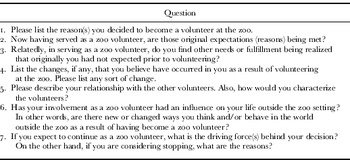
The study was conducted in two phases, each at a different New York City zoo. An initial phase was conducted at the Central Park Zoo in 2006, where 30 volunteers responded in writing to seven open-ended questions concerning the motivations and satisfactions of volunteering and related experiences (Table 1). The second phase that followed at the Bronx Zoo in the same year used a grounded theory methodology to analyse data collected through one-on-one interviews (with 21 volunteers) that were structured around a discussion guide derived from the first phase results. The interviews conducted during the second phase at the Bronx Zoo were followed by the administration of Luhtanen and Crocker's (Reference Luhtanen and Crocker1992) collective self-esteem scale (CSE).
Central Park Zoo volunteers: self-completion survey questions

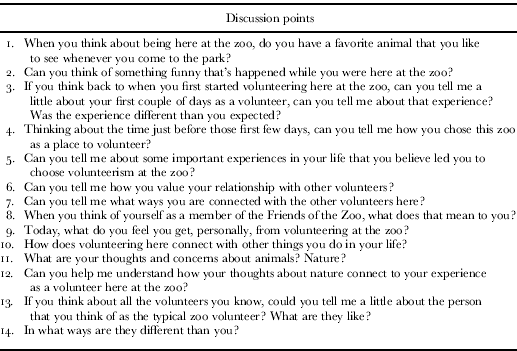
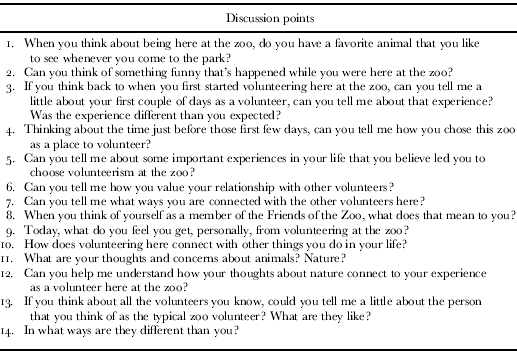
The Central Park Zoo questionnaire was group administered to each day-group of volunteers, with safeguards to ensure anonymity. Two members of the research team coded the written responses independently, and then compared findings, discussed the few discrepancies in coding, and refined the analysis. The Bronx Zoo interviews sought a deeper understanding of how zoo volunteerism was experienced and subjectively rationalised, and how the informants perceived the group interactions as contributing to their sense-of-self. To explore this concept in detail, the second phase used audio-recorded interviews and grounded theory analysis of the transcripts to explore the reconstructed and rationalised story of the volunteer from his or her own perspectives (Glaser and Strauss Reference Glaser and Strauss1967; Strauss and Corbin Reference Strauss and Corbin1998; Charmaz Reference Charmaz, Denzin and Lincoln2000). The discussion guide (Table 2) used open-ended questions to allow the participants to articulate their views in their own words (McCracken Reference McCracken1988; Patton Reference Patton1990; Weiss Reference Weiss1994).
Bronx Zoo volunteers: discussion guide points
Following the interviews, the collective self-esteem scale was administered to the Bronx Zoo participants. The scale has four dimensions: perceived public regard for a group, personal regard for that group, importance of the group identity to the individual's sense-of-self (compared with other collective identities they may consider important), and membership esteem, which characterises how the participant feels they are perceived as a contributor to the group. The instrument was modified from the original scale by substituting the name of the zoo volunteer group (Friends of the Zoo) in lieu of the generic ‘social groups’ and modified for grammatical consistency. The instructions were written on the instrument and were also given orally by the interviewer.
Verification
The results from these analyses were presented back to the study participants for verification. The consensus was that the results accurately reflected their experience and perceptions. The majority felt that these results affirmed support for the idea that they might have a ‘collective environmental identity’ based on the constructs that were outlined in a preliminary version of this manuscript.
The participants
Volunteers at both zoos are scheduled to work on a regular day once a week, creating fairly stable long-serving groups of alongside colleagues. Their activities are generally limited (at both zoos) to serving either as in-park exhibit explainers or as tour guides, or, at the Bronx Zoo, as guides for pre-scheduled groups. At the Central Park Zoo, the volunteers in two of the day-groups were mostly retirees. They were invited to participate and all agreed to do so. Because the invitations to participate were extended to all members of the two day-groups, the 30 participants ranged in age from the early twenties through to the late seventies, although the mean age was 60 years and all but three were aged over 60 years. At the Bronx Zoo, purposive sampling deliberately sought retiree volunteers across the full range of experience, from recent entrants to those with many years' service. All those asked agreed to participate. Among the 21 participants, two said they were semi-retired and all the others identified themselves as retired. The participants were uniformly Caucasian and predominantly of Judeo-Christian faiths. With two exceptions, they were raised in communities within an hour's drive of the zoo. Their ages ranged from 55 to 76 years (mean 65).
Results
The Central Park Zoo volunteers
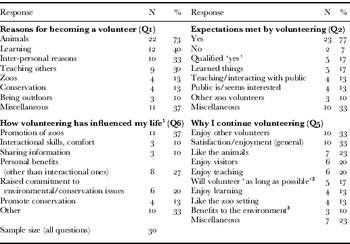
The primary motivation for most Central Park Zoo volunteers was a desire to spend time with zoo animals. This motivation was followed by an interest in learning, a desire for social interaction, and the desire to teach others (some participants offered more than one response). Four people cited the zoo itself, conservation, or being outdoors as a motivation (Table 3). Most felt that their expectations about volunteerism were met. Twenty-nine of the 30 participants characterised their relationships with and perceptions of the other volunteers as positive. When asked about any unanticipated benefits of volunteering, 16 (53%) described their social interactions with other volunteers as satisfying, and around one-quarter indicated that contacts with visitors, learning, teaching or fulfilling personal needs were positive experiences.
Central Park Zoo volunteers: responses to questions

Notes: 1. Outside the zoo. 2. And variations, such as I am a ‘lifer’. 3. And benefits to conservation. FOZ: Bronx Zoo Friend of the Zoo.
When asked if volunteering at the zoo had influenced their lives outside the zoo, the most frequent response was that the respondent had become an active promoter of zoos (Table 3). Fewer stated that they had become more committed to conservation and environmental concerns, or that they had become more active in the public promotion of conservation. When asked about changes they experienced as a result of volunteering at the zoo, the answers predictably identified increased knowledge of animals (23%), experience of environmental conservation (23%), various personal changes (50%), and skills development (40%). Nearly all the volunteers intended to continue in the role, and among those who gave reasons, more cited social interactions with other volunteers than their relationships with the animals, the prime motivation for volunteering in the first place. In sum, the survey results suggested that the volunteer experience was very positive; that volunteers joined for personal reasons, such as the desire to be around animals, to learn, and to increase their social interaction; and that the personal significance of the zoo as a conservation organisation increased as a result of volunteering. The value of lifelong learning, particularly about the animals, and the opportunities for social interaction with other volunteers were both motivators and unintended benefits of volunteerism. The Bronx Zoo study which followed allowed a more detailed exploration of these themes.
The Bronx Zoo volunteers
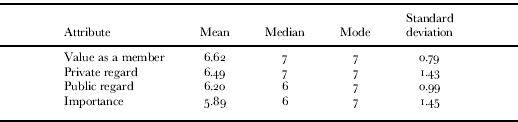
The Bronx Zoo volunteers reported a high degree of collective self-esteem across all dimensions of the CSE scale (Table 4). Many of their responses were at the extremes of the seven-point Likert scale, although 10 of the 21 respondents disagreed or responded neutrally to at least one statement. Notably, the perceived public regard was almost as high as the private regard. These quantitative results provide support for the suggestion that ‘zoo volunteer’ constitutes a valuable collective identity. The interviews explored the reasons for this. Three themes were found prominent, that zoo volunteering provides experiences that: satisfy the wish to affiliate with nature, satisfy the desire to give back to a community through a local cultural institution, and create a sense of embeddedness in a group that in turn validates the members' shared concerns and social priorities. All three themes suggest that the role of ‘zoo volunteer’ is useful as an identity construct.
Collective self-esteem scale scores
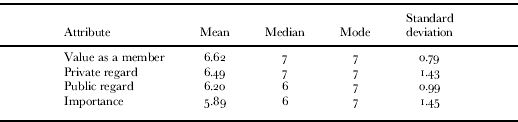
Note: N=21. The possible range of the scale is from 1 to 7, where 1=completely disagree and 7=completely agree.
Affiliation with nature
The biophilia hypothesis proposes that people have an innate predisposition to affiliate with non-human animals and nature (Kellert and Wilson Reference Kellert and Wilson1993). The interviewees expressed such a tendency through descriptions of love for nature and a desire to affiliate with animals and nature that they could manifest through zoo volunteering. First, nearly all the respondents stressed their love and emotional connection to animals, and their appreciation for the natural setting of the zoo landscape. Secondly, they said that these shared interests and motivations provided a basis for much group camaraderie and a sense of group identity. Finally, rooted in a love and interest in animals, some participants also described how their work at the zoo embodied their personal values for lifelong learning about nature.
As with the Central Park Zoo volunteers, the most frequently identified primary motivation for volunteering among the Bronx Zoo participants was a deep-seated love of animals. As one said, ‘You know, I just, I don't know, I just love them, you know, and I just like taking care of them, and I like being around them’. The Bronx Zoo participants described the unique ability of the zoo to provide opportunities to affiliate with living animals. In fact, many respondents described emotional and somewhat familial relationships with the animals, even encompassing death as a natural but regrettable conclusion to relationships. As one said:
Tuss was a sweet elephant. I don't know if you knew her. And I used to, ah, talk to her, not that she listened, but I would talk to her. She was my favourite. Elephants in general are nice and she was … I saw her every week because she used to be at zoo centre, so I became attached to her, I guess … and, but all living things die, which is what I tell the children. So, she went.
Following this vein, the volunteers communicated their emotional affiliation with the zoo animals and that the disposition was comfortably shared with the others. One informant put it like this:
You know if there's something upsetting, like I said, the death of the animals … and we loved the sea lions. When Bandit died, we were so, so upset but other people wouldn't understand that.
These stories of bonds with animals support the idea that biophilia is deeply ingrained in zoo volunteerism and acknowledged as a shared value within the group. The characterisation of this affinity was described as something special or incomprehensible to those not associated with the zoo, which suggests that zoo volunteers perceive their relationships with animals to be the basis for a special in-group bond. As well as the animals, the Bronx Zoo has a sizable tree and plant collection that is designed to create the impression of a natural forest. While most participants considered their love of animals to be a primary motivation, a few also described the zoo setting as providing a restorative connection to nature. A particularly lucid statement was:
I don't see the zoo as nature. It's … it's not nature, and I've seen nature and I enjoyed it. But I think I enjoy it for the same reason that I enjoy being in the zoo, so maybe there is a connection that you're, you can be alone … you really don't have, I don't have the distractions when I'm here. … I do get that same kind of feeling, say, when I'm out, out in the middle of a big lake, or standing on top of a mountain.
In addition to the chance for physical experiences with animals and nature, the zoo stimulated volunteers to develop their attachment to nature by expanding their personal knowledge. Some of their responses characterised this stimulus as personally fulfilling, as clearly evident in the following:
It's grown a lot because now I sit down and I'll read the encyclopaedia or something like that in my spare time just, maybe it just goes up into your head. What about this animal? Let me check it out. And I'll go to the library and use their books, or the few that I have in my house, it's like, something just pops into your mind. ‘Why is this animal doing this?’ or ‘what does this animal really, how does it make its home?’ Or something like that, and I'll go and check it out. When you're here, your knowledge just grows and grows and grows.
The passion for lifelong learning appeared to be shared among the volunteers and was a substantial foundation for their social connections and mutual support. The commitment to environmental knowledge and awareness was also characterised by many as a source of pride and status within the group. As one volunteer said:
On Thursdays before the business meeting starts, someone might say, ‘I read something in the paper’ or ‘What about this? Did you see this?’ Then we'll have a little discussion about that. Some people are just … it's a very compatible group with, ah, with all primarily, I'm sure they have other interests too, but ah, when they're here, this is what they're here for. And their interest is wonderful. … The woman I was with knows more about gorillas than anyone God has ever created. [She was always] there to back me up. When I got a question I couldn't answer, I could turn to her and say, ‘here's the real expert’.
The commitment to lifelong learning about nature appeared to be an important attribute of the group identity. The desire among the volunteers to affiliate with the zoo animals was widely shared and the topic of many conversations, while the acquisition of knowledge about animals or nature had a valuable social mediating function. The volunteers all perceived their experience of the zoo as part of a life-goal to connect with nature, and interpreted this in the context of their life histories. Two of the participants chose significant life-experiences to rationalise their current emotional connection to volunteerism and animal-protection activities, while 18 described the synergy between a personal wish for affiliation with nature and a desire to give something back to the community.
Place identity
Many responses to the interviews suggested that the Bronx Zoo was important to the volunteers' sense-of-place, as is consistent with place-identity theory (Proshansky Reference Proshansky1978). Place-identity theorists have used zoos to illustrate the ways in which urban children develop an urban identity (Proshansky, Fabian and Kaminoff Reference Proshansky, Fabian and Kaminoff1983). Place identity has been shown to have an affective dimension that is emotional and symbolic and that includes place-attachment and social bonding as part of the complex understanding of the meaning of place (Kyle, Graefe and Manning Reference Kyle, Graefe and Manning2005). In these interviews, place attachment was evident in three ways: a desire to give back to a place that is significant to one's identity; an effort to invest in social bonding across generations at a specific place; and an embedded engagement with the zoo as a place with symbolic meaning for the Bronx and New York City. The first, the need to give back service to the community, was important for many of the volunteers. Two respondents explicitly described volunteerism at the zoo as returning value to the community (the Bronx or the Bronx Zoo) from which they had received gifts during their formative years. One put the idea like this:
[One time I realised] that everybody I grew up with was dead, deported or institutionalised. It really scared me and I started thinking about what was different, what was different about me. I thought that the only [thing] different about me and the guys I was hanging out with was that I had this alone place and they didn't. That's when I decided that I better start giving back one way or another to the zoo. And the volunteer thing just came as a progression.
As for the second aspect of place attachment, during the interviews many participants recalled fond childhood memories of the zoo. As an interpretation of place identity, nostalgia may be part of an effort to ensure generative continuity in their families. The stability of a 100 year-old cultural institution afforded these volunteers an opportunity to connect memories of their childhood to new interactions with their children and grandchildren. Several specifically reflected on their own life experiences. They described frequent childhood visits to the zoo, the symbolic role of the zoo in family history, and how they strove to continue family traditions. One woman described the intergenerational connections very well:
Well, I always loved the Bronx Zoo. I, I'm a Bronx girl, I always went to the Bronx Zoo. You know, I would walk from my house down Fordham Road, and there was an entrance over there on Fordham. … So you just came in that way, and when my granddaughter was … and my kids were young, I brought them to the zoo all the time … and then my granddaughter was born and my husband and myself took her constantly to the zoo.
On the third aspect, most participants reflected on the institution as an iconic place that links the present to the past. As one said, ‘It's like famous. I grew up in the Bronx Zoo, I came to the Bronx Zoo, I can remember when the elephants were close and you could feed them peanuts’. Only two of the respondents discussed the symbolic value of the zoo in ways that did not refer to spending their childhood in the community. In both cases, they nonetheless reconciled their relationship to the zoo in place identity terms and by reference to their family identity. One participant cited her Bronx-native husband and son as part of her sense of attachment to the zoo. The other saw her volunteer activities as a logical outgrowth of a desire for connections to important symbols of her new home and her need to give something to a new community. As she remembered, ‘The Bronx Zoo was in big letters. This was something that we wanted to be associated with … and this was a way that I could volunteer’.
Collective environmental identity
One underlying question for this study was whether zoo volunteers might display evidence of a collective environmental identity (Clayton and Opotow Reference Opotow, Brook, Clayton and Opotow2003). As noted earlier, connections with nature can form an important part of personal identity (Clayton Reference Clayton, Clayton and Opotow2003), but how the social aspects of nature-based experience inform that identity has not been demonstrated. Our interviews offered insights into whether it was positive experiences within the social group, appreciative social feedback, or the mechanism for articulating and expressing environmental values within a social network, which promoted the group identity based on shared environmental concerns. What emerged from the interviews was evidence of a self-nurturing, dynamic and self-regulating group, which is consistent with the developmental understanding of collective identity theory (McGrath, Arrow and Berdahl Reference McGrath, Arrow and Berdahl2000; McGrath and Tschan Reference McGrath and Tschan2004). The group believed that their activities helped nurture future generations, provided valuable social equity for their relationships with other groups, and supported a role in social activism that seeks to change social norms. The volunteers' comments showed that many had incorporated their role at the zoo as a part of their social identity.
A shared perception of group identity is grounded in some sense of similarity. One-half of the volunteers attributed their in-group bond to similar political leanings and shared values about animals and the environment. Two informants expressed these ideas well:
Because the other volunteers, of all the people that I know in my life, really do care about animals and they talk about animals. I mean, we talk about everything, you know, TV and house repair and re-modelling and real estate, but they really talk about animals and really care about animals and we really share a lot.
And I would think most – all – the people who volunteer at the zoo are all environmentalists, to a certain degree, you know. Whether or not they voted for the person that's in charge now or the person who wasn't in charge, they're still environmentalists, you know.
More than this, the participants were able to satisfy their needs for affiliation with other volunteer group members. Many affirmed that their group met outside their volunteer commitments and had invested in one another as part of a ‘family’. One said, ‘It's like a family, you know, an extended family’. Another remarked:
We have an extremely copacetic [sympathetic, supportive] group. Um, and we love each other's company. We see each other outside of the zoo too. We have become brothers and sisters, we really have.
These strong in-group bonds were equally prominent among the responses of the Central Park Zoo volunteers, for more than one-half mentioned the unanticipated fulfilment of strong social relationships. Many also described the diversity of the group as a great strength. The pervasive positive characterisation of these relationships in the interviews suggested that these bonds were highly valued. The salience of positive group interactions around animals and animal-related discussion was recognised as creating the identity of a group member. As one perceptive volunteer neatly remarked:
Somebody once said … that people came here for the animals and stayed here for the people. Which means that, what motivates them to come is one thing, but then it becomes a social activity. They become part of a group, and that really becomes more important than what they were originally doing.
A practical impact of the identity as a zoo volunteer was legitimacy for promoting the group's values within the wider community. One motivation for volunteerism that emerged was the desire to nurture more environmentally responsible values in society, and several believed that their status as a zoo volunteer gave them some authority in this role. A few drew a parallel between their training as teachers and their current pro-environmental avocation, while one saw zoo volunteering as a logical outgrowth of her animal-rights activism:
I want to spend a day of my life every week coming here and making people enjoy the zoo. Especially kids, to make them love and respect animals, because I think in the world today, a lot of people just don't have enough of a respect for animals. There's a lot of mistreatment and I hope that my being with them maybe imparting to them how wonderful animals are, there won't be so many kids mistreating animals.
This collective identity empowered the participants, in part because the status and knowledge gained through their volunteer network provided them with social capital in other in-group situations. Nine of the respondents felt their affiliation with the zoo was an important source of pride. As one said:
I'm, you know, very proud. When you tell somebody that you're a volunteer at the zoo, people get [to say] ‘Oh, how nice!’ and ‘how lovely!’ and this and that, and they get all excited. It's something to be proud of.
Some described heightened standing variously with grandchildren, card groups, dinner companions, workmates, friends and friends' children. One felt that the volunteer status increased his authority, while another focused on volunteer experiences as personal affirmation: ‘I just feel like it's part of my personal experience and family and I like to share it because I feel it's important and it's a part of who I am’. Fine and Harrington (Reference Fine and Harrington2004) characterised small groups as the domain in which individuals frame their agreement on social issues and develop the motivation to promote social change. This motivation was modestly exemplified by a participant who drew on her zoo volunteer identity as authority to evaluate other zoos and wildlife programmes:
We're also [both] extremely critical and also willing to [give a] pat on the back when we go to other zoos … one of the things that happens with all of us, is when we go into another zoo, it's very hard to keep your mouth shut and not tell people that you are a volunteer, especially if you see volunteers in that zoo.
More commonly, the informants' responses suggested that the identity as a zoo volunteer provides a motivation for environmental activism beyond the zoo. Some participants engaged in animal protection and environmental advocacy, others reported donations to wildlife conservation or animal-rights causes, and many signed petitions or participated in letter writing campaigns. These findings were similar to the personal behaviour change and pro-wildlife activism reported to us in the initial Central Park Zoo study. An example of this penchant for activism was provided by a participant who was comfortable with her membership in the anti-zoo animal-rights group, People for the Ethical Treatment of Animals (PETA) alongside her identity as a zoo volunteer. She valued being a PETA member to support policy change, but found her zoo volunteer identity to be more authoritative when speaking on environmental issues. She said:
I write letters all the time and get into big political discussions with people about, what they are doing to protect the environment. Now I can back it up and say, ‘I'm a FOZ [Friend of the Zoo] and I happen to know that’, you know.
Another participant attributed his increased activism directly to his association with the zoo:
Participant: I don't want to get on a pulpit here, on a soapbox, but it's an important thing, since the world, the planet is getting to be in pretty bad shape and people have just got to stand up and do something about it. We can't wait for the next guy to do it because the next guy is you.
Interviewer: You speak with a great passion for this issue. How did you come to feel that way?
Participant: I think probably since my association with the zoo and the awareness, maybe it was a mild awareness, but being here and studying the animals and being amongst all these wonderful species that we have that are endangered to various degrees and becoming aware of that, I think that's really what stimulated this whole thing.
Discordant views on collective identification with zoo volunteers
A rare discordant note among the generally positive views about social support associated with volunteering arose in one interview. This volunteer did not accord priority to the social aspects of the group and claimed that it was insufficient motivation. She summarised the goals of being in the group as working with the public, teaching and transferring values. Her entire interview confirmed that while she derived a great deal of support from the in-group activities, she believed strongly that her willingness to promote environmentally responsible values in society had been under-used by the zoo. Two of the long-standing volunteers had a slightly different relationship to the group experience. One self-described loner said that he avoided social interaction with other volunteers, preferring to spend his time alone with the zoo animals. The other characterised her volunteerism as a way to keep busy. She claimed not to have any relationship with other volunteers but acknowledged that she enjoyed the social interaction because it filled time and met her need for social contact.
Discussion
This study has shown that zoo volunteerism is a fulfilling and personally rewarding occupation. The interviews with Bronx Zoo volunteers confirmed many findings from the preceding survey of Central Park Zoo volunteers. The most important themes were: the desire to affiliate with animals, the role of continued learning and teaching, the importance of the volunteer social network, and the influence of the volunteer experience on commitment and advocacy for zoo and conservation issues beyond. Some of the findings are consistent with previous literature on volunteerism as a mechanism that satisfies desires for altruism, learning, social interaction, self-esteem, value-expression and sense of meaning or purpose, and some echo the research evidence that volunteerism contributes to an extension of what people understand by social identity (Piliavin, Grube and Callero Reference Piliavin, Grube and Callero2002).
These results also add to a growing body of evidence that biophilia is an important component of human motivation (Kellert and Wilson Reference Kellert and Wilson1993). Zoo volunteerism fulfils an emotional need for affiliation with living animals, while allowing volunteers to affirm their place-identity within a social network that shares, facilitates and promotes environmental values. As such, the evidence suggests that being one of a group of zoo volunteers provides a social dimension to environmental identity and helps to create or nurture a collective environmental identity. It also appeared that the retired volunteers were highly motivated by their group experience. The Collective Self-Esteem scale scores in combination with the interviews showed that considerable importance and self-esteem attached to being a member of Friends of the [Bronx] Zoo. The results from the interviews of Bronx Zoo volunteers, and the validation provided by the written descriptions from the Central Park Zoo volunteers, suggest that they actively pursue within-group development to several ends. They help validate an individual's environmental concerns, provide a nurturing atmosphere for members to develop a self-actualised environmental identity, and give individuals a sense of self-esteem as a member of a group that supports their environmental advocacy. The advocacy dimension of the zoo volunteer identity accords with the theoretical proposition, that the experience of a collective identity galvanises values and motivates activism in society (Brewer Reference Brewer2001; Fine and Harrington Reference Fine and Harrington2004). This study was limited to self-reporting and therefore did not assess the outcomes or effectiveness of the volunteers' pro-environmental activities.
Generalisability
Although many of the study participants derived validation from the social context of being a tour guide or from their external social networks, validation for two of the participants derived from their personal association with the zoo rather than a social connection. They seemed to engage with zoo volunteerism to fulfil their conservation orientation, an environmental identity separate from the collective identity of the volunteer group. The exceptional motivation underlines the importance of considering individual differences in understanding the impact of volunteerism on identity. The place identity findings reported here were not explored with the volunteers at the Central Park Zoo and therefore may be particular to the Bronx Zoo and less relevant for organisations with a lower public profile. We suspect that not all volunteer opportunities have the same potential for tying people to either their communities or their personal histories.
Conclusions
The results of this study suggest that zoo volunteers have a collective environmental identity that is motivated by their personal values and facilitated by both the environmental advocacy goals of the zoo's mission and shared experiences. Volunteers who feel the desire to connect with non-human animals and nature derive a great deal of personal affirmation from their shared experiences as zoo volunteers. The symbolic value of a zoo offers them a unique opportunity to build upon a sense of place-attachment, by providing cues for important life-shaping memories, by creating opportunities to contribute to shaping the values of future generations, and by association with a group whose members see their common identity as important as their sense of self. The high level of evaluative importance accorded to the collective environmental identity of zoo volunteer was reinforced by the within-group social interactions and by the externally ascribed social status.
The experience of volunteerism at the Bronx Zoo afforded retirees opportunities not only for social interaction and value expression but also for establishing a collective environmental identity. This helped to fulfil the generative social motivations that characterise the retirement years, by providing emotional support for their work as environmental conservation advocates who seek to change public discourse. Further research should examine other ways in which retired adults achieve collective environmental identities, and other collective identities that encourage the expression of deeply-held values while also fulfilling the generative needs associated with this stage of life.
Acknowledgements
The authors wish to thank the many volunteers at the Wildlife Conservation Society's Bronx Zoo and Central Park Zoo for their participation in this study and their review of the findings. We also thank Jane Ballantyne, Claire DeRoche and Leslie Schneider, the volunteer coordinators who welcomed us into their groups, Tom Webler and Victor Pantesco for their encouragement, Marsha Semmel, Dan Lukash and the Institute of Museum and Library Services for their personal support and funding through Grant #LG-25-05-0102-0, and all our collaborators who gave us the time to explore the topic. We also thank our former boss, now retired Richard Lattis, for his faith in our work.