I. INTRODUCTION
In an article published in Social Research in the winter of 1977, the Budapest-born economist John C. Harsanyi (1920–2000) reflected on the policy implications of utilitarianism:
No doubt, since social utility is defined in terms of people’s vNM [von Neumann-Morgenstern] utility functions, our utilitarian theory will tend to assign higher social priorities to those individual desires for which people are willing to take considerable risks in order to satisfy them. But this is surely as it should be. Other things being equal, we should give higher social priorities to intensely felt human desires; and one indication that somebody feels strongly about a particular desired objective is his willingness to take sizable risks to attain it. For example, if a person is known to have risked his life in order to obtain a university education (e.g., by escaping from a despotic government which had tried to exclude him from all higher education), then we can take this as a reasonably sure sign of his attaching very high personal importance (very high utility) to such an education; and I cannot see anything wrong with our assigning high social priority to helping him to such an education on the basis of this kind of evidence (1977a, pp. 643–4).
In the above, autobiographical allusions support the conviction that the degree of risk-bearing helps socially prioritize individual objectives. By 1977, with his main objective of pursuing an academic career long achieved, the University of California (Berkeley) professor had good reasons to regard the highly risky and emotionally charged decision to leave Communist Hungary as a rational decision motivated by the intensely felt desire to get university degrees (MA in economics, Sydney, 1953; PhD in economics, Stanford, 1959).
Though this success story resembles that of many intellectuals, especially Hungarians, who left Eastern Europe before or after World War II (see Marx [Reference Marx1994] 1997), there is more to Harsanyi’s story than just escaping Stalinism to obtain a university education. When he reached Australia in late 1950, Harsanyi, a fully qualified pharmacist since 1942, had already entered a doctoral program in botany, which he quit soon after the Germans occupied Budapest in March 1944. He had likewise received a doctorate in philosophy, with minors in sociology and psychology, from the University of Budapest. While studying philosophy, Harsanyi developed an interest in the axiomatic approach. Written under the supervision of Gyula Kornis, his 1947 PhD thesis was devoted to the logical structure of philosophical errors and centered on axiom-derived errors. From sociology, Harsanyi took the notion of Verstehen as a technique of understanding the social world. His occasional emphasis on the inadequacies of psychology, which went together with the great expectations he placed on it, seems to suggest a more complex relationship with that discipline; though the references to projective techniques as early as 1950, when almost no economist was aware of them, indicate some influence. That was the general intellectual baggage Harsanyi took with him when leaving Budapest.
Following emigration, Harsanyi confronted new worlds, the understanding of which was of great practical importance for the penniless émigré trying to find a place for himself. To “a man to whom the intellect and the life of science and rigorous inquiry were very important aspects of life” (Arrow Reference Arrow2001a, p. 5; see also Polsby Reference Polsby2001, p. 26), a scientific theoretic approach may have appeared an invaluable resource for accompanying that transition. It is significant that the latter occurred at a time when Harsanyi was switching emphasis from sociology to economics. The kind of economics he endorsed from the 1950s took him away from Verstehen and its qualitative research methods, but not quite so.Footnote 1
From the mid-1950s onwards, Harsanyi made several seminal contributions to welfare economics and game theory. Regarding the former, the idea of deriving morality from an imaginary change of positions argument was undoubtedly of special significance. It is unclear whether this should be regarded as “one of the most important innovations in moral theory in this century” (Weymark Reference Weymark1995, p. 314), but there is little doubt that the empathy notion was central to Harsanyi’s welfare economic work (Fontaine Reference Fontaine2001). As to his work on game theory, which eventually won him the Nobel Prize in Economic Sciences in 1994, the analysis on non-cooperative games, especially the transformation of games with incomplete information into games with complete but imperfect information, played a foundational role in the economics of information (Myerson Reference Myerson1999, p. 1077). With the notion of “type,” Harsanyi extended the realm of game theory to situations where the players do not know each other’s preferences. In the process, he opened up new horizons for the study of strategic interactions in the real world.
Towards the end of his life, while reflecting on the making of interpersonal utility comparisons, Harsanyi (Reference Harsanyi1997, p. 143) described two alternative approaches:
One is to take a third-person perspective and to try to infer the two individuals’ satisfaction levels from the laws of human psychology. Yet, in actual fact, our understanding of these psychological laws is as yet very far from being sufficient for doing so.
This is why I have suggested in earlier publications that we must use an alternative approach by taking a first-person perspective and by trying to achieve an empathetic understanding of what it may be like to be in either individual’s objective position with the relevant individual’s own personal attitudes.
It is historically significant that these two approaches permeate his work on welfare economics even though only the former, and that in a modified version, is found in his game theory. Though it prompted Harsanyi to take a “third-person perspective,” the turn to game theory and hypothetico-deductive models in the mid-1950s, because of its emphasis on rationality postulates, did not imply unreasonable reliance on the laws of human psychology. It did not lead him to abandon the “first-person perspective” in welfare economics either. Rather, Harsanyi was led to redefine empathetic understanding as a process in which one imaginatively places oneself under the influence of the causal variables (biological inheritance, past life history, current environmental conditions) that determine some else’s preferences. In so doing, he provided a deductive interpretation of the change of positions, which made his welfare economic work consistent with the more distant approach characteristic of his game theoretic work. This is worth noting given that Harsanyi’s welfare economic and game theoretic work shared a common preoccupation with the problem of eliciting private information.
Section II describes the context surrounding Harsanyi’s entrance into economics and relates his hesitation between the “first-person perspective” and the “third-person perspective” in his welfare economics to tensions between his new theoretical interests and the legacy of his Hungarian upbringing. This section likewise evokes the turn to game theory in the mid-1950s, with Harsanyi leaping at the opportunity to distance himself from the economic agents whose behavior he studied. Section III deals with Harsanyi’s new emigration experience in the United States and the associated effort to lessen the tensions between his theory of games and his theory of morality. I conclude by arguing that the example of Harsanyi suggests that, in making theorization part of the overall process to embrace the world, historians of economics may shed a new light on its past.
II. BECOMING AN ECONOMIST IN SYDNEY
Less than a week after Harsanyi’s birth on 29 May 1920, the Trianon Treaty was signed, leaving Hungary with only a third of its former territory and much of its population outside prewar borders. More than ever, Budapest was the economic and intellectual center of the country with a significant part of its population of Jewish religion or origin. As many other Hungarians of Jewish extraction, Harsanyi’s parents, who owned a pharmacy, had converted to Christianity. With anti-Semitism still alive in Central Europe, they were determined to provide their son with an education that could shield him from the erring ways of the era.Footnote 2 After eight years at the Fasori Lutheran Gymnasium in Budapest, Harsanyi won the first prize in mathematics in a nationwide competition, but, disappointed with the purist preoccupations of some of his teachers, he preferred to study pharmacy. And, in 1942, after becoming a fully qualified pharmacist, with Central Europe dominated by Germany and with Hungary playing Hitler’s game, Harsanyi decided to continue his studies to prolong military deferment. Under the pressure of events, but in conformity with his training as a pharmacist, he specialized in botany. In May 1944, after the Germans entered Budapest, Harsanyi was drafted into the labor force and on the verge of being deported he managed to escape to hide in a monastery in the center of the city. When the Red Army entered Pest in January 1945, he was able to join his parents in the ghetto and then move to their house.Footnote 3
Harsanyi as a young man (Courtesy Anne Harsanyi).

With normalization under way, Harsanyi resolved to take up his studies once again, preparing for a doctorate in philosophy with minors in sociology and in psychology. By 1947, after meeting Anne Klauber, his future wife, he had completed his dissertation, “The Logical Structure of Philosophical Errors,” under Gyula Kornis. His was an explanation centered on axiom-derived errors. As philosophical theories differed with regard to the scope of validity of their axioms and the latter derived from induction, Harsanyi correlated differences in philosophical systems with differences in the justness of their generalizations.
After teaching various sociological subjects as university assistant at a Budapest university institute and making his anti-Marxist views public in the process, he had to quit. Pondering his chances of success in a society where Sovietization was already well under way, anti-Semitism recurrent and many activities nationalized, he decided to emigrate with Anne and her parents. They crossed the Austrian border illegally in April 1950 and eventually reached the American zone in Vienna. There they stayed for two months before going to Salzburg, where they waited for an Australian landing permit. For some five months, John spent his days reading at the Amerika Haus Library, maintained by the U.S. Armed forces, perfecting his knowledge of English and studying social science journals and books.Footnote 4
Towards Welfare Economics
Harsanyi, Klauber, and her parents arrived in Sydney aboard an Italian ship from Genoa on 29 December 1950. A few days later, John and Anne got married. Penniless but resourceful, the Harsanyis started to work: Anne did some sewing work and John took up a factory job. The 1948 Australian Aliens Act allowed the Government to direct immigrants to unskilled manufacturing and construction employment, where they were most needed; moreover, it required two years before immigrants could enter work of their choice. Logically, then, Harsanyi became an unskilled laborer in a factory and held other comparable positions, such as statistical clerk, before he eventually launched himself on a university career.Footnote 5
Soon after arrival, John went to the University of Sydney to enquire about the possibility of studying sociology, but the professor he met there was interested in aboriginal languages, which was not exactly the kind of sociology Harsanyi had in mind. Eventually, he leaned towards economics. This move was not just accidental: his interest was piqued by economics books and journals he had read at the library of the Amerika Haus in Salzburg. Harsanyi was thus admitted as a candidate for the MA in early 1951. Thanks to his degrees from the University of Budapest, he had to complete only three courses in two years, studying “Economics III” and “Statistics II” in the first year and “Economics IV” in the second. The description of these courses in the university calendars of 1952 shows that they were not the only, or indeed even the main, source of inspiration for Harsanyi’s theoretical preoccupations in the first half of the 1950s. Unsurprisingly, his MA thesis, “Inventions and Economic Growth” (1953a), which drew to some extent on “Economics III,” hardly related to his welfare economics work of the first half of the 1950s. It offers a rather conventional exposition of the pure theory of inventions peppered with a few sociological references and supplemented with a brief analysis of the economics of patent reform.Footnote 6
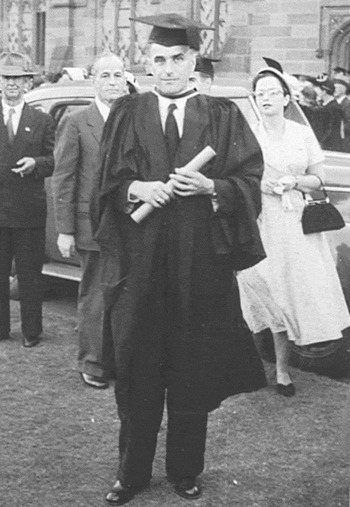
John Harsanyi (with Anne in the background) at the MA graduation ceremony in 1953 (Courtesy Anne Harsanyi).

Given the orientation of his later work, special reference should be made to “The Extension of Economic Analysis to Human Activities Outside the Field of Business Life,” a 10-page appendix closing the thesis. There, Harsanyi showed great confidence in the explanatory power of economics and even lamented that “[l]ittle serious consideration has … been given to the possibility that the field in which economic analysis can be profitably applied may extend in fact over a considerable part of the territory of some of these other social sciences” (p. 81). He pointed to the similarities between the “economic approach” and the “functional method,” “which consists in analyzing any social institution in terms of its ‘social function,’ i.e. in terms of the social needs it satisfies. This comes, however, very near to analyzing it in terms of ‘utility,’ as the economist would do” (p. 82). As what came to be called “economics imperialism” was still in its infancy and represented no more than uncoordinated attempts by individual scholars, influences are easily identifiable in the appendix. For the “functional method,” Talcott Parsons was the obvious reference though Robert K. Merton’s distinction between latent and manifest functions, as presented in Social Theory and Social Structure (1949), may have given Harsanyi a better grasp of this method and its limits. Kenneth E. Boulding’s “Is Economics Necessary?” (1949) exerted some influence as well because it endorsed a definition of economics as a generalized theory of choice, and above all because of its emphasis on the bearing of economics on problems of political science. On this latter aspect, Harsanyi was aware of Duncan Black’s (Reference Black1948, Reference Black1950) innovative work at the intersections of economics and political science and he likewise vaunted the merits of Joseph A. Schumpeter’s Capitalism, Socialism and Democracy ([1942] 1950).Footnote 7
Though he did not have yet the game-theoretic knowledge which would allow him to produce an economic analysis of politics in the second half of the 1950s, his ambitions were already clear: “I hope to be able to show, in a future essay of mine,” Harsanyi wrote at the end of his thesis, “that the theory of political equilibrium (of the balance of power) is capable of formalization as a theory of a special kind of ‘maximizing behaviour,’ quite comparable to the theory of the equilibrium of a market economy. The main use of a formal theory like this would be to facilitate the understanding of the complex interaction of political forces—just as the main use of the usual formal economic theory is to facilitate the understanding of the complex interaction of market forces, which would be hard to disentangle on a mere common-sense level” (1953a, p. 89).Footnote 8
By 1953, Harsanyi was no longer a novice economist. The originality of his first publication, “Cardinal Utility in Welfare Economics and in the Theory of Risk-Taking” (1953b), can best be understood when it is remembered that he was then experiencing new worlds: learning the subtleties of the English language, getting used to a foreign culture, experiencing new jobs, and immersing himself in the field of economics. All this was part of a general effort to digest novelty and explained that his welfare economics work often included elements of personal experience.
Harsanyi’s first contribution to welfare economics was published in Chicago’s Journal of Political Economy in October 1953. How the work of an obscure Hungarian émigré could land in one of the leading economics journals at the time is something of a mystery. The fact is that the article built on the analysis of choice under uncertainty by Milton Friedman and Leonard J. Savage, which may have provoked the interest of the members of the economics department at the University of Chicago, who, together with Earl J. Hamilton, edited the journal.Footnote 9 The article bore no marks of Harsanyi’s earlier interest in the axiomatic approach in the context of the explanation of philosophical errors. Its philosophical dimension had more to do with the question of what made a value judgment impersonal than with the axiomatization of social choice, as envisaged in Kenneth J. Arrow’s ([Reference Arrow1951a] 1963) Social Choice and Individual Values. And when the philosophical nature of the argument—the original analysis of the possibility of impersonal judgments of preference concerning social welfare (the impartial observer theorem)—is considered closely, one sees that it owes less to Harsanyi’s training as a philosopher than to informed extrapolations from his own experience. Readers need not put themselves in the shoes of the 33-year-old émigré, who identified himself as “formerly of the University of Budapest” and was still uncertain about his prospects in Australian society, to grasp personal resonances in the following:
If somebody prefers an income distribution more favorable to the poor for the sole reason that he is poor himself, this can hardly be considered as a genuine value judgment on social welfare. But if somebody feels such a preference in spite of being wealthy himself, of [sic] if somebody who is in fact poor expresses such a preference, but does it quite independently of the fact of being poor himself, this may well be a value judgment of the required kind.
Now, a value judgment on the distribution of income would show the required impersonality to the highest degree if the person who made this judgment had to choose a particular income distribution in complete ignorance of what his own relative position (and the position of those near to his heart) would be within the system chosen. This would be the case if he had exactly the same chance of obtaining the first position (corresponding the highest income) or the second or the third, etc., up to the last position (corresponding to the lowest income) available within that scheme.
This choice in that hypothetical case would be a clear instance of a “choice involving risk.” Of course, in the real world value judgments concerning social welfare are usually not of this type. … But they may still be interpreted as an expression of what sort of society one would prefer if one had an equal chance of being “put in the place of” any particular member of society (Harsanyi Reference Harsanyi1953b, pp. 434–5).Footnote 10
For someone who had escaped Communist Hungary only three years previous, the observation that “This choice in that hypothetical case would be a clear instance of a ‘choice involving risk,” (p. 435) was more than a theoretical acknowledgement of the rationalization of individuals’ reactions to risk, as undertaken by Friedman and Savage in their seminal articles on the subject.Footnote 11
Stimulated by John von Neumann and Oskar Morgenstern’s ([Reference von Neumann and Morgenstern1944] 1947) inspiring approach, Friedman and Savage’s “The Utility of Choices Involving Risk” (1948) and “The Expected-Utility Hypothesis and the Measurability of Utility” (1952) provided Harsanyi with a theoretical framework that could helpfully structure his reflections on risky decisions. The question, “Are the cardinal utility of the theory of risk-taking and the cardinal utility of welfare economics different things?” which formed the original title of Harsanyi’s 1953 article, betrays an effort to associate impersonal value judgments concerning social welfare with judgments of preference; yet, it also testifies to the economist’s effort to show against Friedman and Savage that the quantity being maximized by individuals in choices involving risk could be identified with the quantity being given special significance in public policy. Finally, it should be noted that Harsanyi associated the requirement of impersonality—taken as the detachment of the individual from his objective economic situation—with equiprobability. For all his impersonality, Harsanyi’s individual remained amazingly close to the author himself who, being “in complete ignorance of what his own relative position (and the position of those near to his heart) would be within the system chosen” and yet wishing to do his best to succeed, was willing to believe that the various positions available in society were equally open to him.Footnote 12
In August 1953, Harsanyi applied for the position of Lecturer in Economics at the Department of External Studies of the University of Queensland, Brisbane. In his application, he indicated his areas of special interest and expertise as follows: “(1) Welfare Economics;” “(2) The Economics of Technical Progress;” and “(3) In general: Borderline Problems between Economics & Other Social Sciences.” Game theory was not listed, although one can read the following under “General Remarks” at the bottom of the application: “At present I am working on an analytical model for political balance-of-power situations, on the basis of the Neumann-Morgenstern Theory of games & of the Theory of Bargaining developed in Economics.”Footnote 13
When he got his new position in Brisbane in early 1954, Harsanyi had a nascent interest in game theory, but his work concerned mainly welfare economics issues, as evidenced by the publication of two important articles—“Welfare Economics of Variable Tastes” (1953–54) and “Cardinal Welfare, Individualistic Ethics, and Interpersonal Comparisons of Utility” (1955). The former was rather sparse on theoretical references and did not thank any readers for comments, revealing that Harsanyi had thought it mostly by himself, and accordingly approached problems rather unconventionally. In that article, Harsanyi (1953–54, p. 204) challenged “the unrealistic assumption that the consumers’ tastes remain constant in the period under investigation” and proposed “a method of dealing with changes in the consumers’ welfare when their tastes change.”
A few things deserve to be noted regarding his effort. First, it supplemented Sydney Schoeffler’s (Reference Schoeffler1952) attempt to provide methods by which welfare judgments could be made with changing individual tastes. Harsanyi connected the welfare of the consumer to his or her objective economic situation and subjective taste, and distinguished between the latter and his or her system of preferences to the extent that the subjective taste of the consumer can vary without the order of his or her preferences being affected. Harsanyi did not provide a very precise definition of an individual’s taste, but the idea that it “may be regarded as a complementary good to the commodities consumed by him in so far as the latter’s utility for him depends on the presence of an appropriate taste and may change with a change in his taste” (1953–54, p. 206) was enough to convey the main message, namely that the welfare derived from an “objective economic situation” by an individual varied with his or her consumption skills.
Second, Harsanyi’s argument had significant policy implications, in terms of development. Here the argument fed off his own experience of an émigré trying to cope with Australian consumption habits: “It must be decided again and again,” he wrote, “whether a given amount of resources benefits the consumers more if it is used for gratifying their present tastes in food, in housing, in music, etc.—or if it is used for educating these consumer’s [sic] tastes, for altering their irrational likes and dislikes … and for habituating them to new consumption goods” (p. 213).Footnote 14 By inhabiting the position of the theorist, Harsanyi could equally endorse that of the agents he studied if only because his own tastes were changing under the pressure of an entirely new environment; as a result, he was led to consider the level of information of agents in relation to that of the theorist (on that general issue, see Sent Reference Sent1998). He thus noted that “a given consumer is in general able to compare the utility he derived from a certain group of commodities when his taste was T 1, with the utility he now derives from another group of commodities when his taste is T 2” (p. 206). Yet, “not only the person concerned can form a judgment as to whether his welfare has increased or decreased from one time to another, but a careful observer can also form a reliable opinion on that matter on the basis of this person’s expressive behaviour. Furthermore, psychology offered various projective techniques, which can usefully supplement simple observation in deciding the question of whether an individual’s subjective well-being has risen or fallen” (p. 207).Footnote 15 Here, one finds an illustration of Harsanyi’s views on the nature of social scientific knowledge. While he acknowledged that agents develop knowledge about their own situation, Harsanyi remarked that social scientists can likewise form some idea about the agents’ situation through observation of real-life or imagined situations. Needless to say, in suggesting that it was necessary to go beyond the market behavior of consumers and explore their “verbal statements” and “expressive gestures,” Harsanyi showed more boldness than most of his contemporaries in economics.
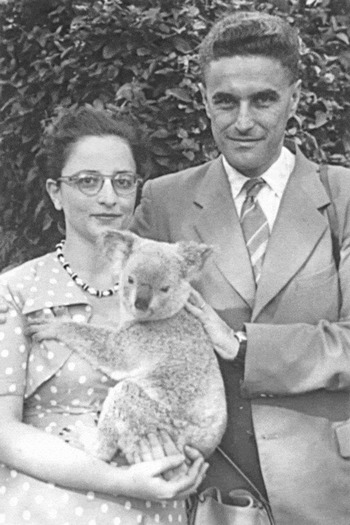
Changing worlds: John and Anne Harsanyi at the Lone Pine Koala Sanctuary in Queensland, Australia (Courtesy Anne Harsanyi).

An elaboration of the 1953 article, the classical “Cardinal Welfare, …” (1955) studied the foundations of welfare judgments. When set against the background of his earlier philosophical interests (see Fontaine Reference Fontaine2007), Harsanyi’s extension of the von Neumann-Morgenstern-Marschak axioms to the study of impersonal choice—taken “as a choice between ‘uncertain’ prospects” (1955, p. 316)—appeared as an attempt to broaden the scope of applications of axioms from individual to ethical preferences. One of the points of the article was the possibility of interpersonal comparisons of utility, and more importantly the conclusion that they “are not value judgments based on some ethical or political postulates but rather factual propositions based on certain principles of inductive logic” (p. 320).Footnote 16
Published in August 1955, that article revealed an effort to cover some of the relevant literature in welfare economics. Again, the issue of the impersonality of value judgments concerning social welfare was central, this time giving rise to a more sophisticated treatment organized around the distinction between “subjective” and “ethical” preferences. To characterize the latter, Harsanyi (Reference Harsanyi1955, p. 315) referred to the preferences of the individual “when he forces a special impartial and impersonal attitude upon himself.” The addition of the criterion of impartiality to that of impersonality betrayed a significant variation, which was encouraged by Harsanyi’s reflection in the interval on the relation of the consumer’s welfare to his subjective preferences and objective economic situation as well as the reading of J. N. Findlay’s (Reference Findlay1954) “The Justification of Attitudes.” Now, while forming value judgments concerning social welfare, the issue was not merely a matter of abstracting from one’s objective economic situation (and the subjective preferences implicitly associated with it),which could easily be taken care of by the equiprobability hypothesis. One “ought to judge the utility of another individual’s position … in terms of the attitudes and tastes of the individual actually holding this position” (Harsanyi Reference Harsanyi1955, p. 316). A closer look at the difference between impersonality and impartiality reveals that the former focuses on an observer who is detached from his social position in the social situation under consideration and accordingly looks at it from outside, while impartiality emphasizes instead an observer considering the situation from inside though the eyes of others.Footnote 17
Having been made aware of the notion of Verstehen while studying German sociologists, especially Max Weber, at the University of Budapest, it made sense for Harsanyi to take a first-person perspective and try to judge the utility of others by imagining being in their position with their subjective attitudes and tastes. In so doing he was simply acknowledging that in the process of constructing social scientific knowledge, some consideration is due to the agents’ own viewpoints. With Harsanyi’s emigration to Australia and direct contact with a foreign culture, the Weberian concept of empathetic understanding probably took on even more reality and appeared as a wise prerequisite for someone who wished to establish the (then highly contested) possibility of interpersonal utility comparisons. To most economists, however, it was largely terra incognita. While dealing with interpersonal utility comparisons, Harsanyi, the economist, had good reasons therefore to go beyond Verstehen.Footnote 18
Harsanyi was convinced that “people do make, or at least attempt to make, interpersonal comparisons of utility, both in the sense of comparing different persons’ total satisfaction and in the sense of comparing increments or decrements in different persons’ satisfaction. The problem is only what logical basis, if any, there is for such comparisons” (1955, pp. 316–7). Taking the position of the theorist, he reiterated the argument of the article on variable tastes: “we have two indicators of the utility that other people attach to different situations: their preferences as revealed by their actual choices, and their (verbal or nonverbal) expressions of satisfaction or dissatisfaction in each situation” (p. 317).Footnote 19 If the use of these two indicators did not pose problems for intrapersonal comparisons, it did for interpersonal. More specifically, Harsanyi pointed to a “metaphysical problem” and a “psychological difficulty.” Drawing on his earlier philosophical work, he considered the former an interesting “logical possibility,” “for, in principle, identical preferences may well correspond to different absolute levels of utility … and identical expressive reactions may well indicate different mental states with different people,” but in actuality he denied it, concluding that “in the case of persons with similar preferences and expressive reactions we are fully entitled to assume that they derive the same utilities from similar situations” (p. 317).
The “psychological difficulty,” on the other hand, referred to the fact that “different people’s preferences and their expressive reactions to similar situations may be rather different” (p. 317). Here Harsanyi had in mind the “question of how psychological differences between people … (for example, differences in consumption habits, cultural background, social status, and sex and other biological conditions, as well as purely psychological differences, inborn or acquired) affect the satisfaction that people derive from each situation” (pp. 317–8). His broad definition of the “psychological,” notably its allowance for cultural and social elements, made it possible for his personal experience of emigration to play some role in the shaping of the problem. And the two solutions—which became the hallmark of his view on interpersonal utility comparisons and which he later described as the first-person perspective and the third-person perspective—he put forward for dealing with the “psychological difficulty” can best be understood when replaced within that broader context. The first, empirical, was based on the possibility for “some individuals to make direct comparisons between the satisfactions open to one human type and those open to another” (p. 318; emphasis added), which presupposed a form of empathetic understanding. Though there are a number of “psychological differences” between individuals, it is interesting to note that Harsanyi placed special emphasis on the cultural ones: “though the cultural patterns and attitudes of an individual born and educated in one social group can be considerably changed by transplanting him to another,” he wrote, “usually they cannot be completely assimilated to the cultural patterns and attitudes of the second group,” so it may happen that “we cannot find any individual whose personal experience would cover the satisfactions of both these classes” (p. 318). In preferring the more restrictive “some” over the first-person plural pronoun “we,” Harsanyi meant to show that although people in general make interpersonal utility comparisons, knowledgeable theorists could nonetheless claim some specific competence on that score. When a theorist was confronted with another culture, however, this epistemic advantage was undermined as there were risks of “large margins of error.” This may explain in turn why Harsanyi, who relied heavily on observation as a method for understanding the world, adopted a more distant approach when it came to considering the second solution to the “psychological difficulty.”
That solution, though more indirect, was based on the general knowledge of psychological laws explaining the variable satisfactions people derive from each situation. Here, too, Harsanyi had reservations but for a different reason: the presumably unsatisfactory state of psychological knowledge. At the same time, the second solution had the advantage of freeing the interpersonal utility comparisons from excessive reliance on specific personal experience, which was especially important to someone whose parcours may have convinced that there were “cases where no one individual can possibly have wide enough personal experience to make direct utility comparisons in terms of the first method” (p. 319).
By the mid-1950s, then, Harsanyi’s welfare economics work displayed some tension between an approach—centered on empathetic understanding and inspired by sociology—in which social scientists gained knowledge about the social world by putting themselves in the shoes of the agents they studied, and a more indirect approach in which much weight was placed on the psychological laws of satisfaction. If the former approach seemed problematic given the distance between Harsanyi, the Hungarian émigré, and Australian society, the latter had its own faults based on the presumed inadequacies of psychological knowledge.
After five years of studying economics and persisting doubts about the best way to approach the social world, Harsanyi was willing and ready to explore new routes. That his 1955 article closed with stressing the analogy between welfare economics and the theory of statistical decisions, and that it pointed to the figure of a “rational man (whose choices satisfy certain simple postulates of rationality and impartiality)” (p. 321), indicated that Harsanyi had already absorbed some of the new ideas of the time.Footnote 20
Enter Game Theory
By the mid-1950s, Harsanyi had read von Neumann and Morgenstern’s book and though he had yet to absorb it, he appreciated the significance of its contribution to the mathematization of political equilibrium.Footnote 21 As early as January 1953, in the appendix to his MA thesis, he had expressed his interest in the formalization of political equilibrium on the basis of the utility maximization assumption. The main influence then was Duncan Black, but from the summer of that year whenever Harsanyi had to describe his intention to build analytical models of “political balance-of-power situations” (to use his own words), he mentioned the Theory of Games and the economic theory of bargaining as the two bases for his work. As bargaining was instrumental in reaching settlements in those situations, it became central to Harsanyi’s reflection on the distribution of power within society.
In 1955, Harsanyi wrote “Approaches to the Bargaining Problem Before and After the Theory of Games” (1956b), his first contribution to cooperative game theory. There, he showed the mathematical equivalence of Frederik Zeuthen’s and John Nash’s theories and went on to compare John Hicks’s with the Nash-Zeuthen theory. As we have seen, in the analysis of interpersonal utility comparisons, Harsanyi continued to recognize the merits of empathetic understanding, though he was now more aware of its limits. He likewise considered a more distant approach based on the laws of human psychology, but the knowledge of these laws appeared largely inadequate. While studying bargaining, he endorsed models of abstraction more suitable to his ambitions.Footnote 22
The discussion of the unpredictability of the outcome of bargaining is exemplary of the way Harsanyi viewed the differences between the theorist’s and the agent’s approach to the social world: “In practical life,” he wrote, “experienced businessmen, politicians, diplomats, etc., seem to be often quite able to predict the terms of different agreements with reasonable accuracy when they have sufficient information on the bargaining situation. Of course, information on the two parties’ general economic and political strength alone may not suffice: the outcome may depend significantly on such ‘accidental’ factors as the bargaining skill of the two parties’ actual representatives.”Footnote 23 Thanks to the Nash-Zeuthen theory, theorists could remedy their comparative disadvantage, but some abstraction was needed first: “it is a perfectly legitimate question … to ask what sort of agreement tends to result from a given objective and political balance of power between two parties (as well as from subjective attitudes on their part) if all disturbing forces are assumed away (e.g., by postulating perfect rationality and perfect knowledge)” (1956b, p. 145). The Nash-Zeuthen theory met Harsanyi’s expectations in so far as it proposed a solution that maximized the product of the bargainers’ utilities, where these were measured by von Neumann-Morgenstern cardinal-utility indices.
For the information social scientists might hope to gather from observation of the two parties’ behavior, the Nash-Zeuthen theory substituted a highly abstract and distant analysis, in which bargainers were equated with mathematical game theorists.Footnote 24 Departing from the first-person perspective, this approach could to some extent be associated with the third-person perspective. Thus, when he defined the postulate of symmetry, Harsanyi noted: “The bargaining parties follow identical (symmetric) rules of behaviour (whether because they follow the same principles of rational behaviour or because they are subject to the same psychological laws)” (p. 149).Footnote 25 Once again, psychological knowledge played no minor role in approaching the social world, but, in pointing to the virtues of psychological models, Harsanyi underscored their complementarities with the axiomatic method, which took him even farther from empathetic understanding.
At the time he wrote the 1956 article, very few people were interested in game theory in Australia. In the United States, although it still provoked contrasted reactions, it attracted the attention of a heterogeneous group of people.Footnote 26 Harsanyi, who had been deterred from emigrating to the United States because the Hungarian quota was filled in 1950, was then probably glad to learn that the Rockefeller foundation offered fellowships to Australians for study there. At the end of 1955, he sent his application, describing his research project in terms that suggested some continuity between his work on welfare economics and his work on bargaining: “To analyze the conditions for different patterns of social change and for social equilibrium, and to explain the distribution of income and power among different groups by means of theoretical models.” His application was well received and in September 1956, some six years after berthing at Sydney, the Harsanyis, who had just become Australian citizens, left for California.Footnote 27
III. THE ROAD TO AMERICA
Having been in contact with Arrow, Harsanyi went to Stanford to study for his PhD. What the Stanford economist said about his meeting with the now Australian economist confirms that, despite notable achievements, more than six years after leaving Budapest, Harsanyi continued to think of himself as an émigré: “[O]n his arrival,” wrote Arrow (Reference Arrow2001b, p. F749), “I found out quickly enough that his knowledge of economics (or at least of economic theory) was such that there was little we could teach him. Further, it was also clear that he had already worked out the ideas for founding cooperative game theory on the basis of bargaining analysis which were to form his dissertation. I finally asked him why he was bothering to take a PhD, since neither the Stanford department nor I were to provide much value added. He was candid; the PhD was a necessary step in his academic career.”
From October 1956 to June 1957, Harsanyi did all his course work, mainly economics, statistics, and mathematics, while thinking about his dissertation, with Hendrik Houthakker as official supervisor since Arrow was on leave. In the summer, Harsanyi went to Pittsburgh at the invitation of Herbert Simon, who organized a Social Science Research Council seminar there. Harsanyi attended with a view to “discussing the prospects of applying the theory of games to the analysis of social organizations.”Footnote 28 In Pittsburgh, he found interested and informed colleagues with whom he discussed his views on cooperative game theory; moreover, he familiarized himself with the theory of bounded rationality, which did not distract him much from the quest for establishing the rationality postulates founding the theory of cooperative games. Harsanyi was confident that theories of rational behavior of the hypothetico-deductive form could explain a variety of empirical facts on the basis of a limited number of axioms. He found the theory of bounded rationality of some interest to analyze social organizations and he likewise acknowledged its higher degree of realism in comparison with the more prescriptively oriented theories of rational behavior associated with economics and game theory. There remains that his attachment to the axiomatization of decision-making and his endorsement of the theory of subjective expected utility were not conducive to developing the insights arrived at by Simon, especially as Harsanyi tended to downplay the difference between Simon’s theory and the traditional theory of rational behavior. Of course, like Simon, Harsanyi meant to describe actual behavior but, as he put it in a later article, “only to the extent to which this behavior is in fact rational (or to the extent to which possible deviations from perfect rationality have no significant effect on the outcome)” (1961a, p. 193).Footnote 29
At the end of the summer, with his one-year fellowship expiring, Harsanyi went to the Cowles Foundation for Research in Economics—then directed by James Tobin—at Yale University. The Cowles Foundation had welcomed a number of European émigrés in the 1930s and 1940s, and it was hardly surprising therefore that Harsanyi landed there. He was close to Cowles’s commitment to applying statistical and mathematical methods to economics and other social sciences. Moreover, Harsanyi went to Cowles to work with Jacob Marschak, whose postulates he had used in his analysis of the foundations of welfare judgments. After some three months there, he produced “Bargaining in Ignorance of the Opponent’s Utility Function,” a discussion paper dated December 1957.Footnote 30
By that time, with the International Geophysical Year giving special prominence to scientific activities all around the world, the launch of Sputnik I was still on the mind of many in American society. In suggesting that the Soviet Union had the scientific and technical expertise to launch intercontinental ballistic missiles, it increased the sense of self-doubt of many policy makers in the United States. Unsurprisingly, the military, and more generally the defense community, could hardly find reassurance in the assumption that the two bargaining parties have full knowledge of each other’s utility functions and the implications game theory associated with it in terms of the expectations two rational bargainers can form about each other’s strategies. Was it, after all, enough and reasonable to consider that a “rational bargainer will not expect a rational opponent to grant him larger concessions than he would make himself under similar conditions” (Harsanyi Reference Harsanyi1957, p. 2)? Was it not more important to know what bargainers actually do when they are assumed not to know each other’s utility functions? Being at Cowles, Harsanyi was in good place to sense the main concerns of the military at the time and his extension of the analysis of the Nash-Zeuthen theory to situations in which the opponent’s utility function was unknown indicates that he was willing to tackle some of those concerns.Footnote 31
As we have seen, the 1956 article argued that the Nash-Zeuthen theory offered a valuable substitute for the kind of knowledge developed by bargainers themselves. Harsanyi meant to place the scientific theoretic approach to bargaining on the same footing as the lay approach, based on practical experience. By the same token, he suggested that as long as the behavior of bargainers is rational, theorists could understand it better than agents themselves. With one international crisis following another and the military’s demand for expertise on bargaining issues growing accordingly, it is no accident that “Bargaining in Ignorance of the Opponent’s Utility Function” shifted emphasis from the social scientist’s lack of information vis-à-vis agents to agents’ lack of information about each other’s utility function. In effect, in the maximization program of each individual, a subjective estimate replaced the utility function itself. In the heated context of the Cold War, one interesting, though not especially reassuring, result of this generalization of the Nash-Zeuthen theory was that “there is always the possibility that agreement will fail even if both parties use their optimal strategies … because each party has to select his optimal policy on the basis of the information available to him, and if on the basis of this information he overestimates the concessions he can obtain from his opponent, then the two parties will insist upon mutually incompatible demands, and agreement must fail” (1957, p. 10).
Unlike the work on interpersonal utility comparisons, the developments associated with bargaining theory underscored the difficulty of gathering information about another’s subjective features or, to put it differently, the errors entailed by the exercise of figuring out another’s utility function appeared more consequential when that other was an opponent and that opponent the Soviet Union. In the Cold War context, misinformation about the opponent’s utility function could bring about a variety of loathsome outcomes, including nuclear war. This is another way of saying that Harsanyi had moved towards different theoretical problems and approached them differently. There is no reason to believe that he repudiated the notion of empathetic understanding. Rather, it seemed of little help to people with different cultural backgrounds. More importantly, it was useless within his new theoretical framework. As long as the opponents are rational, Harsanyi wrote, “neither of them will be able to obtain any information at all on the other party’s true attitudes, during the negotiations” (p. 12). Driven as he was by particular theoretical problems, Harsanyi had no hesitation in donning the clothes of the game theorist, setting his task as the building of a rationality-based theory and accordingly delegating the task of examining real bargaining and real bargainers to empirical research.Footnote 32
Harsanyi came back to Stanford in December 1957 for six additional months as visiting assistant professor. While his wife was working on a MA in psychology, he was teaching mathematical economics for graduate students and finishing his dissertation. In the latter, in keeping with his ambition to build “a general theory of the distribution of income and of power within society,” Harsanyi (Reference Harsanyi1956b, p. 157) proposed a bargaining model that generalized Nash’s theory of two-person bargaining for the n-person case. In view of that ambition, the turn to game theory had no reason to diminish his interest in welfare economics though, because of its implied endorsement of the third-person perspective, it could pose a consistency problem. Concerning welfare economics in general and interpersonal utility comparisons in particular, it was indeed more difficult to do without the first-person perspective.Footnote 33
Around the time Harsanyi left Stanford in the summer of 1958, “Ethics in Terms of Hypothetical Imperatives” (1958) came out in Mind. This philosophical article went back to some of the themes of earlier papers, notably impartiality. Its publication in Mind was no accident: Findlay’s “The Justification of Attitudes,” published in the same journal in 1954, had influenced the formulation of the concept of ethical preferences. Harsanyi (Reference Harsanyi1958, p. 309) proposed an ethical theory combining the hypothetical-imperative view of moral rules with Adam Smith’s theory of the impartial spectator, “which regards moral rules as rules of behaviour that a well-informed and intelligent impartially sympathetic observer would recommend for general observance.” The reference to Smith deserves to be noted, but it should not mislead. Harsanyi vaunted the merits of Smith’s impartial spectator, but he set aside the change of positions and the empathetic understanding that accompany it, preferring instead to draw the reader’s attention to the possibility of formalizing “the requirements of impartiality and sympathetic humanism … in terms of a small number of formal axioms—as has already been done by welfare economists for a more limited field—in which case moral rules could be put in the form: ‘If you want your behaviour to satisfy axioms A1, A2, … , An, then do X (or refrain from Y)’ ” (pp. 309-10). He insisted that the observer “must judge the consequences that a given action has for various people, ‘sympathetically’ … i.e. in terms of the attitudes, wants, desires, preferences of these people themselves—rather than in terms of some independent standard” (p. 311), but even there the emphasis was on axiomatization and not on empathetic understanding as a means for reaching to others’ preferences.
Harsanyi had gone to Stanford to explain the “distribution of income and power among different groups,” a research project that suggested some complementarity between his welfare economics and game theory. After two years in America, this research program had proven especially fertile, but given the ongoing axiomatization of welfare economics (and his presence at Stanford played no negligible role in that respect), Harsanyi was led to tailor his work to the expectations of the profession. In that respect, if the turn to bargaining theory, and more generally the involvement with American economics, did not take Harsanyi away from the analysis of interpersonal utility comparisons, it did to some extent from the first-person perspective.
The Harsanyis left America in the summer of 1958 and eventually returned to Brisbane. At the end of December, however, John resigned from the University of Queensland to take up a research position in the department of social philosophy at the Australian National University in Canberra. Very quickly, Harsanyi felt isolated, for very few people, if any, were interested in game theory there. As he recounted jokingly: “[W]hen I looked in the Australian National University Library for Von Neumann and Morgenstern’s book, it was there, but it was under games and physical exercises” (Harsanyi in Ross Reference Ross and Arrow2000, p. 48).
Still, it is there that Harsanyi started to write his first book manuscript, published some twenty years later as Rational Behavior and Bargaining Equilibrium in Games and Social Situations (1977b). In the latter, he redefined the process whereby an individual sets aside his own objective situation and subjective features to imagine those of another. Now the individual making welfare judgments was said to evaluate the utility associated with another’s social position by placing himself under the influence of the causal variables (see p. 147 above) that determine the other’s preferences rather than by simply adopting the other’s subjective attitudes themselves (1977a, p. 638; 1977b, p. 58). In other words, the change of positions characteristic of the first-person perspective was redefined in such a way as to make it compatible with the third-person perspective, with the laws of human psychology taking over empathetic understanding. As Harsanyi wrote, “the possibility of meaningful interpersonal utility comparisons will remain, as long as the different individuals’ choice behavior and preferences are at least governed by the same basic psychological laws” (1977b, p. 58). It is difficult to establish how much of the material of the 1977 book was written in the late 1950s, but the articles of that period certainly contained the seeds of the above redefinition and indicated more generally than Harsanyi was now more comfortable with the position of an outside observer making extrapolations about the choices of agents than with that of an inside observer trying to understand the world through their eyes.
During the two and a half years he spent in Canberra, Harsanyi maintained wide interests. Thus, in 1959, following the publication of “A Bargaining Model for the Cooperative n-Person Game,” a condensation of his PhD dissertation, he wrote “Explanation and Comparative Dynamics in Social Science” (1960a), in which he criticized social science for its excessive reliance on static explanations and its relative neglect of dynamic analysis.Footnote 34 This article gave some idea of the way Harsanyi viewed social science at the time. First, there was the advocacy of an integrated explanatory theory of society, of “one basic theory common to all social sciences rather that merely … independent theories particular to the various disciplines” (p. 136). Second, there was the idea that society is ruled by dynamic laws and that a satisfactory analysis requires explaining why the institutions and cultural patterns of each society have become the way they are. Finally, Harsanyi remarked that “[s]ocial institutions and cultural traditions have an important role as explanatory variables fundamentally because of their stability” (p. 141).
Despite several references to Weber in the article, the role of empathetic understanding in the building of social scientific knowledge was conspicuous by its absence. The intellectual legacy inherited from years in Budapest was still there but it had been transformed by the confrontation with economics. Weber’s ground-breaking effort to provide a consistent conceptual framework for social science could still be referred to as an example of what needed to be done, but when it came to building a “general theory” of social arrangements, the main reference was now the model of rational behavior, as developed by economists and enriched by game theorists. The move away from the first-person perspective, as illustrated by Harsanyi’s endorsement of that model, is obvious in two other articles, “On the Rationality Postulates Underlying the Theory of Cooperative Games” (1961a) and “Theoretical Analysis in Social Science and the Model of Rational Behaviour” (1961b). In the latter, in particular, he clearly differentiated the viewpoint of social scientists from that of “[n]aïve observers [who] too often content themselves with explanations in terms of differences in the prevalent value attitudes, without even considering the possibility of explanations in terms of the objective conditions” (p. 68). And, in the former article, while crediting game theory for providing “criteria for defining what sorts of mutual expectations can be rationally entertained by the players of a game concerning one another’s strategies” (1961a, p. 179), Harsanyi likewise took a third-person perspective position and relied on the symmetry postulate. His position was that of an observer facing substitutable and perfectly rational agents.
By the time the two papers above appeared, Harsanyi knew he would leave Australia. Thanks to Arrow and Tobin, he had been offered a full professorship at Wayne State University in Detroit. The circumstances surrounding his appointment are worth noting as they revealed that, despite his Stanford PhD, several articles in leading journals and the support of two prominent American economists, Harsanyi had good reason to feel an outsider in American academia. Although he was now Australian, the American administration continued to count him in the Hungarian quota. As a result, “Wayne State had to certify that no American would be able to do this, and this was actually so because they paid only $10,000 a year, which was a ridiculous sum” (Harsanyi in Ross Reference Ross and Arrow2000, p. 55). It seems that Arrow had advised Harsanyi to accept anything because he knew that otherwise no university would pay for interviewing him from Australia (p. 57).
Harsanyi arrived at Wayne with a number of important published papers and a few others ready for submission or publication. Most of the latter appeared in 1962. These publications (1962a; 1962b; 1962c; 1962d; 1962e; 1962f) indicate that the two years spent in the United States were followed by an intense period of reflection, which gave Harsanyi the opportunity to look into two different directions: the relationship between the theory of games and the theory of morality on the one hand, and the relationship between cooperative and non-cooperative games on the other.Footnote 35 Once the change of positions was redefined in such a way as to make it compatible with the perspective characteristic of his work on game theory, Harsanyi found it natural to tackle the former issue. While contemplating solutions to the bargaining problem, he had consistently disregarded ethical solutions and preferred instead to rely on the self-interestedness of rational agents. At the outset of “Models for the Analysis of Balance of Power in Society,” however, Harsanyi wrote: “Apart from their applications in the social sciences, these bargaining models, I think, also have interesting philosophical implications, in that they throw new light on the concept of rational behaviour, and on the relationship between rational behaviour and moral behaviour” (1962c, p. 442).Footnote 36 Now, it was not so much the perspective of advocating bargaining models over arbitration models that concerned Harsanyi as the possibility of placing game theory and ethics under a general theory of rational behavior. He thus noted that “the postulates of joint efficiency (Pareto-optimality) and of symmetry among individuals are common to game theory and to ethics (as well as to welfare economics)” (p. 460). There remained differences, of course, but, given the orientation of his work in the late 1950s and early 1960s, notably the turn to game theory and the accompanying emphasis on rationality postulates, Harsanyi found it more opportune to stress points of similarity.
From the early 1960s, in a context where, with the exception of Thomas Schelling, most game theorists were interested in cooperative game theory (Myerson Reference Myerson2001, p. 22), Harsanyi started to pay more attention to non-cooperative games, that is, games in which it is impossible and/or unprofitable for all players to agree on a joint strategy. He considered three cases: “(Case 1) there is no possibility of enforcing agreements once concluded … (Case 2) there is no possibility of negotiating agreements for lack or costliness of communication facilities between the players … (Case 3) the players are ignorant or misinformed about one another’s (or even about their own) utility functions and/or strategical possibilities, which makes them insist, as a price of their cooperation, on excessive demands that could not all be satisfied at the same time.” Harsanyi hastened to add: “But even these conditions are not always absolute obstacles to cooperation” (1962c, p. 454). In other words, he approached non-cooperative games with the idea that there was an inherent cooperative element in them. It is not surprising therefore that in listing the requirements for rational behavior in a non-cooperative game, he added joint efficiency and Zeuthen’s decision rule, which characterized rational behavior in cooperative games, to Nash’s mutual optimality (pp. 455–6). With these three requirements, Harsanyi was able to arrive at a new solution concept, which included the solution for the cooperative game as a special case. Even if his nascent interest in non-cooperative games indicated a greater sensitivity to obstacles to cooperation, it was important for Harsanyi to relate non-cooperative to cooperative games to the extent that real-life social situations, including “total wars,” always included an element of cooperation (p. 457).
In January 1964, after almost three years in Detroit, Harsanyi left to California where he remained until his death in August 2000. He had been offered a visiting professorship at Berkeley, which resulted in his appointment as a full professor in the fall. It was not long before he wrote his famous paper on games with incomplete information, the original version of which was read at the fifth Princeton Conference on Game Theory in April 1965. In this article, drawing on his Cowles discussion paper of 1957, Harsanyi provided an original approach to problems of incomplete information, centered on the concept of a type. Basically, he reduced games with incomplete information—in which players can lack full information about some important aspects of the game—to equivalent games with complete information.
In an article celebrating the contributions of Harsanyi, Nash, and Reinhard Selten, Faruk Gul (Reference Gul1997, p. 166) has noted that “it was difficult and rare for researchers [in the late 1960s] to study situations in which one person knew something that others did not. It was not that economists found situations in which one agent was more informed than another to be unimaginable; the difficulty was coming up with a coherent modeling device for such situations.” From that formulation, it is clear that Gul wished to emphasize the implications of Harsanyi’s work by presenting it as studying situations where agents have different information. It should be remembered, however, that the three-part article on incomplete information was the culmination of a long-lasting preoccupation with the way the theorist can obtain information about those agents—a preoccupation that permeated Harsanyi’s earlier work on welfare economics. As we have seen, Harsanyi considered two approaches, which have often split sociologists and economists in the twentieth century. As he moved from an approach centered on empathetic understanding to the more distantiated perspective associated with game theory, Harsanyi imperceptibly shifted emphasis from the social scientist’s lack of information vis-à-vis agents to agents’ lack of information about each other.Footnote 37 In the process, he succeeded in providing economists with an analytical framework they could use to study a number of problems related to the distribution of information among agents. At the same time, however, he consolidated the perspective of a distant observer whose knowledge can replace (and even enable the theorist to dispense with) that of real people.
IV. CONCLUSION
It is a long way from Budapest to Berkeley. It took some fifteen years for Harsanyi to reach his final destination. In the interim, he made significant contributions to welfare economics and game theory. His objective was that of a general theory of the distribution of income and of power within society. Still, in comparison to the work on interpersonal utility comparisons, the analysis of bargaining offered a more abstract approach, one in which the knowledge agents could form about the social world was de-emphasized at the expense of the consistency of their behavior with a number of postulates. As Harsanyi became more of a game theorist, the whole issue of eliciting an agent’s private information took a particular form, with the theorist being able to achieve some result without relying on empathetic understanding and concomitantly acknowledging to himself some kind of epistemic advantage over the agent. Given subsequent developments, such as mechanism design theory, one realizes that Harsanyi’s orientation has had a long-lasting and deep influence on economic theorizing, both at the prescriptive and descriptive level.Footnote 38
In view of the above, it may be useful to remember that Harsanyi’s turn to economics was mostly accidental. Had he met a proper sociologist in Australia, he might have explored human behavior and society from a very different perspective. It is not unusual for social scientists, especially economists, to regard academic theorizing as being cut off from what may be called “personal experience.” In the eyes of many, there appears to be a clear dividing line between what one does as a theorist and what one does in other capacities. As a result, the mutual influences between theoretical and personal transformations are often left unexplored. Experience of displacement informed Harsanyi’s conception of knowledge acquisition in social science and probably encouraged his eventual endorsement of a third-person perspective. In turn, in the process of reflecting on the best position wherefrom to observe society, Harsanyi found in theory a rationalization for his own choices, which may have helped him adjust to new environments more easily. That Harsanyi’s experience of forced and voluntary emigration sheds some light on his academic theorizing and that the latter provides interesting insights into his personal transformations suggests that much remains to be uncovered by making theorizing part of the individuals’ overall effort to embrace the world.