More than just a question of numbers
The Peruvian press regularly publishes articles on prison conditions, focusing in particular on security failures, corruption and health risks. However, these articles very rarely – if ever – examine or highlight the issue of serious overcrowding in the majority of Peruvian prisons, or take into account the destabilizing impact it has on efforts to maintain order. Overcrowding is perhaps the most serious of the many obstacles that prison authorities must tackle on a daily basis, given its aggravating influence on a host of other detention-related problems.
The intuitive solution would be to build more prisons, and to build them faster. That approach would certainly alleviate overcrowding in the short term. However, a coherent policy cannot rely solely on progressively building more prisons throughout Peru. Instead, it is vital to get to the root of the problem. In Peru, and in Latin America as a whole, incarceration has become the punitive measure of choice, in preference to alternative measures and sentences.
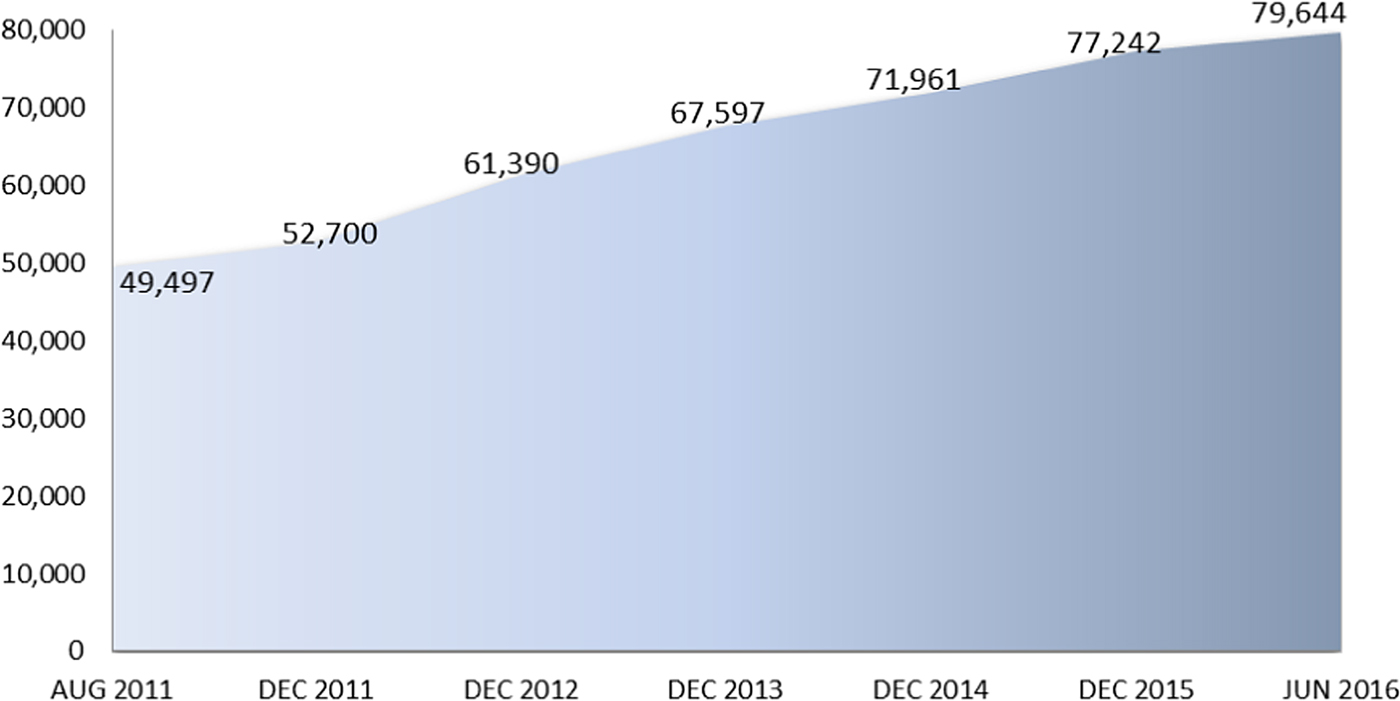
Growth of the prison population (August 2011–June 2016)
Figure 1 shows the steady growth of the prison population in Peru. It indicates that the prison population grew by almost 30,000 people in less than five years, a 60.9% increase. In other words, during this period the Peruvian prison system has had to accommodate 6,000 additional inmates each year. Although prison capacity has also increased over the same period, it has not expanded at the same rate as the prison population; the percentage difference amounts to 128%, according to data from the Unit of Statistics at the Peruvian National Penitentiary Institute (Instituto Nacional Penitenciario, INPE).Footnote 1 Just to maintain overcrowding at a stable level, the prison service would have to build a new 500-bed prison every month. From a budgetary point of view, that approach would be unsustainable, even without taking into account the staff required to deal with administrative and security issues and manage these hypothetical new inmates.
Growth in prison population between August 2011 and June 2016. Source: data from the Unit of Statistics at INPE.

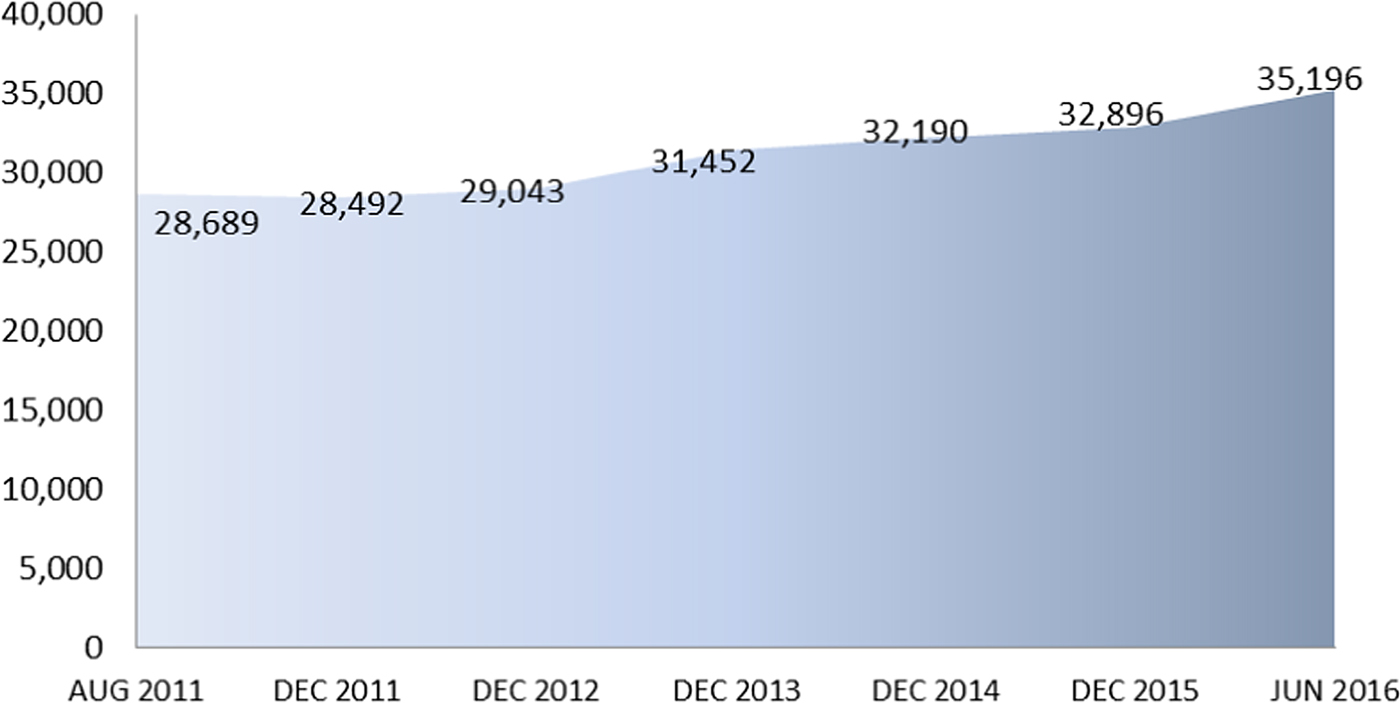
Increase in prison capacity (August 2011–June 2016, Figure 2)
Efforts to expand prison capacity face a financial stumbling block: marginal cost, meaning the additional cost of increasing production by one unit. For the purposes of this analysis, marginal cost is the cost of accommodating one additional inmate. While the marginal cost might not be significant in cases where there is spare infrastructure capacity (as is the case in the Netherlands, for example), the situation becomes more complicated in prison facilities already operating at full capacity. In the short term, the marginal cost of the rising numbers of prisoners translates into the overuse of prison facilities. This results in substandard detention conditions that are not only harmful to prisoners, but also have a negative impact on everyone directly or indirectly connected to the penitentiary system: officials, family members, lawyers, providers of goods and services, and so on. In the long term, in order to absorb marginal costs, overcrowding must be reduced, either by increasing the capacity of existing penitentiary facilities or, if that is not possible, by building new ones. However, it might take a number of years for these new facilities to be built and become operational.
Increase in prison capacity between August 2011 and June 2016. Source: data from the Unit of Statistics at INPE.

Three ways to reduce overcrowding
It may seem obvious, but in order to reduce overcrowding, the following steps must be taken: (1) fewer people must be sent to prison, (2) more prisoners must be released, and (3) efforts must be made to expand the prison infrastructure. Of these measures, only the third falls within the competence of the Peruvian prison service, INPE. The prison service cannot legally disregard a judicial detention order, release prisoners unilaterally before they have served their sentence or curtail a period of pretrial detention. Furthermore, the construction of new prison facilities is subject to the availability of budgetary resources, which are proposed by the executive and ultimately approved by the legislative branches of government.Footnote 2
In Peru, an increase in crime has contributed to the growth of the prison population as more prison sentences are handed down, new criminal offences are created, fast-track legal proceedings are regularly used to deal with offenders caught in flagrante delicto, prison privileges enabling early release have gradually been eliminated, and there is a significant drop in the number of presidential pardons issued. Although these measures may have been necessary, they did not take into account the extent to which the prison population would increase, nor the budgetary resources that the prison service would require to absorb the impact of that growth. Although prisons form part of the criminal justice system, they have long been viewed as its least important element. Public opinion is more concerned with capturing criminals (the job of the National Police of Peru) and prosecuting them (a task that falls to the judiciary).
Previously, offender programmes included, for example, “Building Routes of Hope and Choices” (“Construyendo rutas de esperanza y oportunidades”, or CREO) and “Strengthening of Social Competences for the Non-Criminal Re-offending of Those Released” (“Fortalecimiento de competencias sociales para la no reincidencia delictiva de liberados”, or FOCOS). Now, given the lack of resources for implementing offender programmes essential for rehabilitation, prison sentences have almost exclusively become a means of retribution and confinement, disregarding the principles of rehabilitation and socialization.
To be more accurate, although offender programmes exist, their effectiveness is undermined by the conditions in prisons. Furthermore, one cannot assume that all prisoners want to improve their behaviour and become law-abiding citizens. Thus, whatever clear goals the prison service might set for prisoner rehabilitation, overcrowding has a significant impact on the success of any such programmes. This is because, among other things, overcrowding:
-
• reduces the areas available for workshops and classrooms;
-
• reduces the space available for providing health care;
-
• leads to arguments and fights among prisoners over cells and prison blocks;
-
• limits facilities for visits by family members, friends or defence lawyers;
-
• provides an incentive for prison staff to make a profit by granting prison privileges; and
-
• imposes a need for heightened security and inmate-monitoring measures.
Alternative sentencing measures
The principle of using criminal law as a last resort, or ultima ratio, is increasingly falling out of favour. Society demands tangible results, and prisons are viewed as an ideal means of exerting social control over undesirable behaviour. In high-profile cases,Footnote 3 the State has been exercising its ius puniendi – its “right to punish” – in response to public outrage, and cases are speedily dealt with by the courts. But this is the exception rather than the rule. This approach proves somewhat less effective in court cases that do not garner media coverage.
In such cases, even when legislation has been adopted to alleviate overcrowding,Footnote 4 the criteria applied have not produced a significant drop in the prison population. Even minor offences, such as failure to pay child or spousal support, carry a possible prison sentence,Footnote 5 in spite of the fact that the criminal profiles of these offenders bear no resemblance to those of murderers, rapists or violent thieves. In other words, people who should never have been put in prison end up being detained with extremely dangerous and professional criminals.
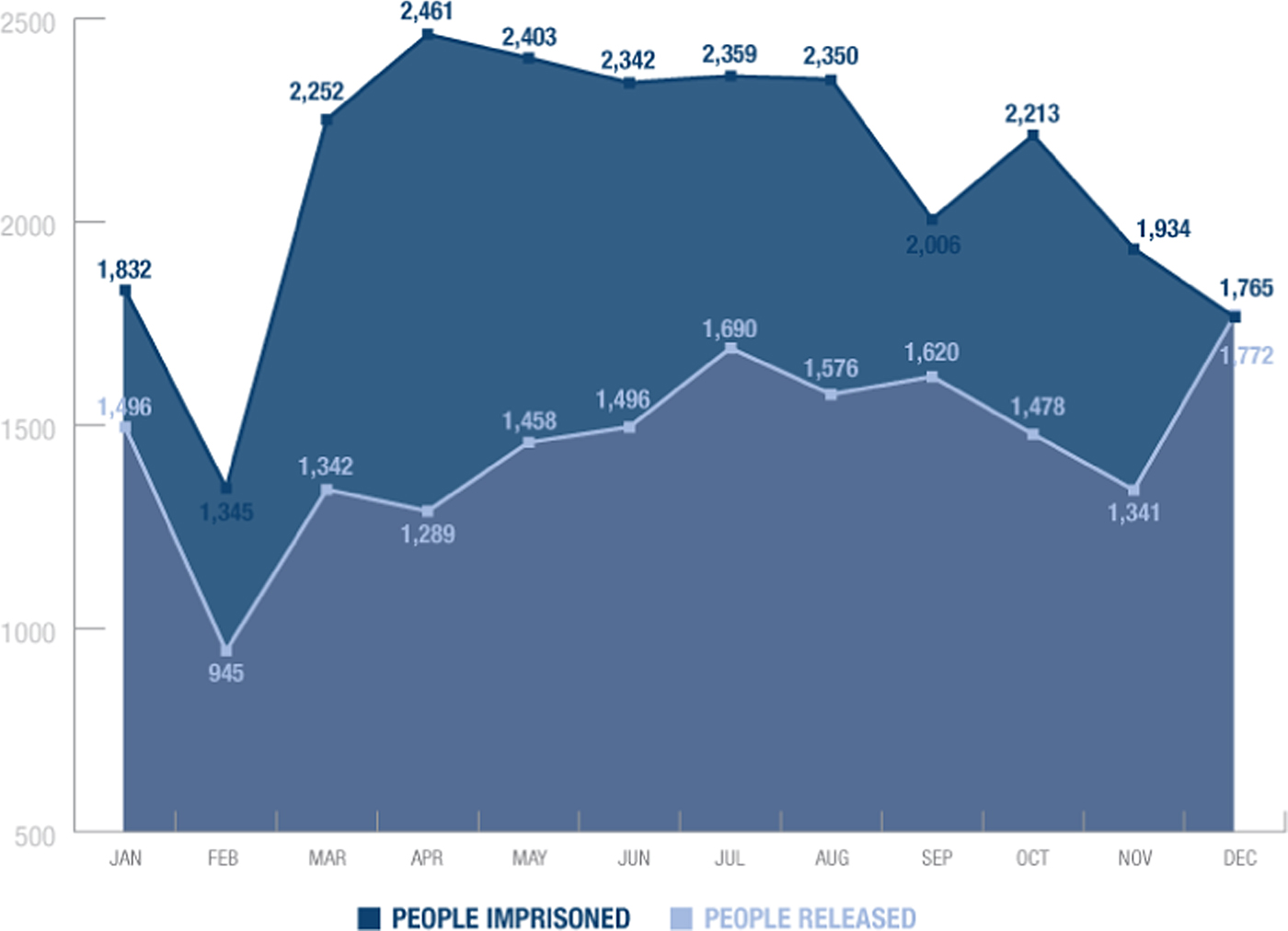
When handing down sentences, judges are often reluctant to use conditional release under supervision or to impose community service, even though the Criminal Code provides some alternatives to prison sentences when incarceration is not required by law, as seen, for example, in Article 28 of the Peruvian Criminal Code regarding types of sanctions.Footnote 6 At the pretrial stage, the socioeconomic status of the defendant plays a decisive role in determining whether he or she is placed in pretrial detention. Someone with a degree and a steady job is less likely to be imprisoned than someone who never finished school and has no regular employment. Biased judicial decisions have led to a large number of detainees being released after only a few months, owing, for example, to insufficient grounds for incarceration or a failure to meet the specific legal criteria for placing a suspect in pretrial detention. Figure 3 illustrates this trend by contrasting the number of individuals who were first incarcerated with the number of individuals released, both during the year 2015.
Prisoners detained and released in 2015, by month. Source: data from the Unit of Statistics at INPE.

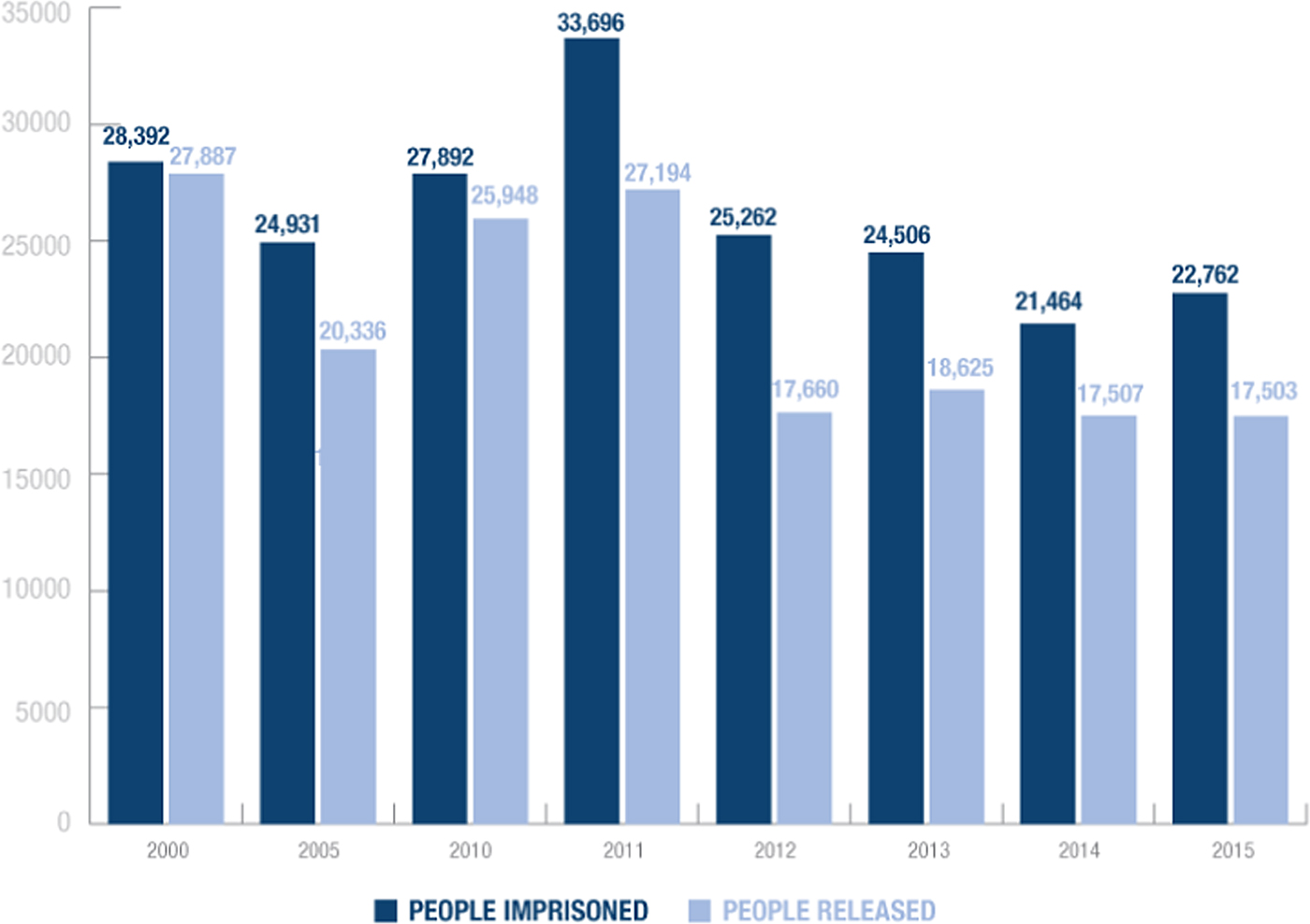
However, in previous years the number of people sent to prison and the number of detainees released was similar, as is illustrated in Figure 4.
Prisoners detained and released between 2000 and 2015, by year. Source: data from the Unit of Statistics at INPE.

A long-term solution
Although the prison service does, if given appropriate resources, have the means to reduce overcrowding and its ill effects by building new detention facilities, this is obviously a short-term solution as the influx of inmates remains impossible to predict. In August 2011, for example, there was no indication that the prison population would increase by 30,000 over the following five years.
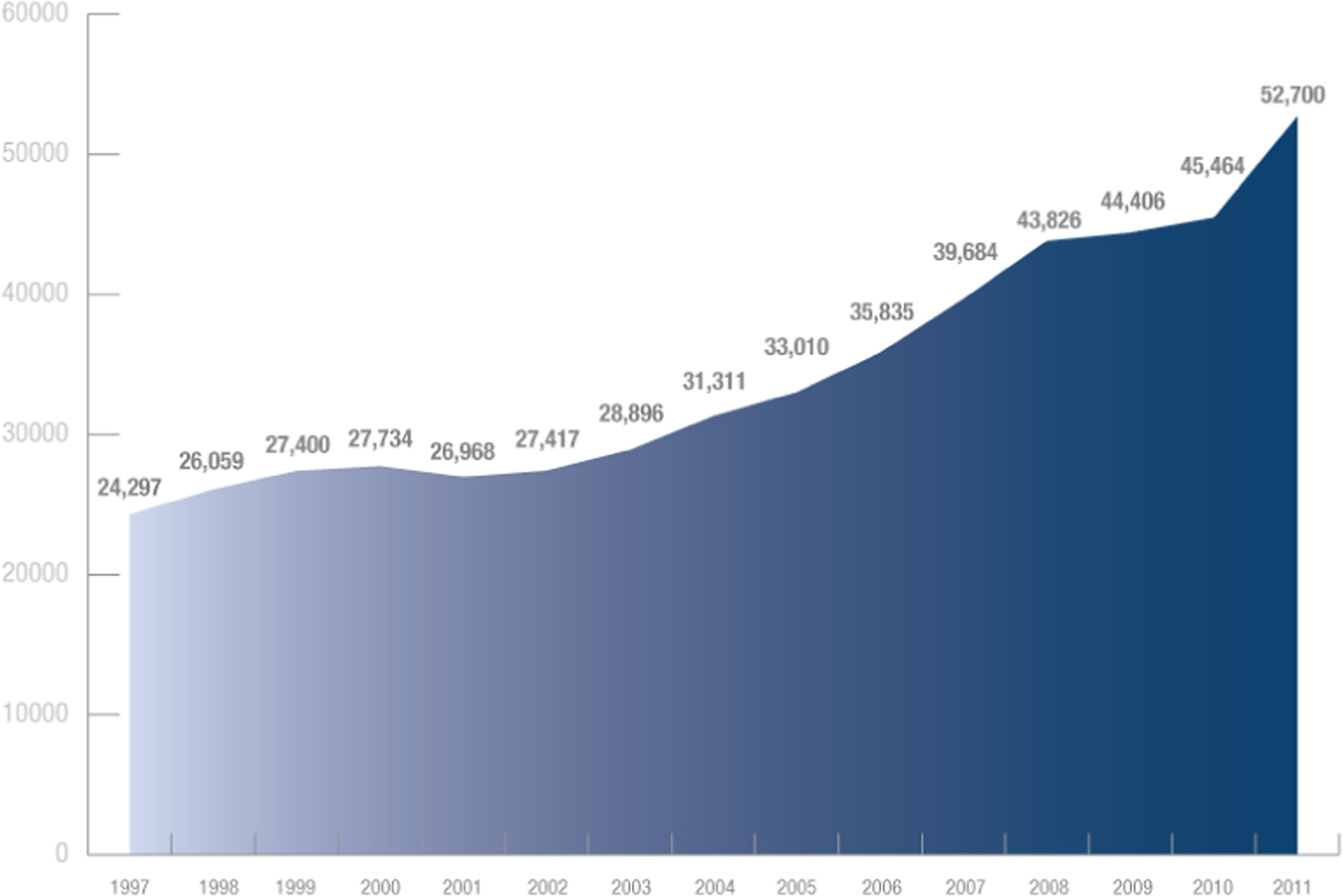
To put it another way, the prison population between 1997 and 2011 grew at a slower rate than during the 2011–16 period, albeit with an upward trend. The only reasonable conclusion to be drawn, based on the circumstances described above, is that the numbers will continue to rise. Indeed, with the exception of the 2001–02 period, the prison population has continued to increase year on year.
Some of the reasons why the prison population has tended to increase since 2011 are the normative changes made to the Peruvian Criminal Code and Code of Criminal Execution, in which penalties have increased and new crimes have been included, and penitentiary benefits have been eliminated.Footnote 7
If we take Figure 5 as a guide, it seems likely that the prison population will exceed 100,000 by 2019. These statistics indicate that it is necessary to reassess the kind of penitentiary system that Peru needs. Even with private investment, the State will not be able to cope with the influx of inmates, and the time will come when the disparity between prison capacity and the size of the prison population will make it physically impossible to accommodate more inmates.
Growth in the prison population between 1997 and 2011. Source: data from the Unit of Statistics at INPE.

There are various options for avoiding this scenario; for example, crime prevention programmes to be implemented by all levels of government (local, regional and national), with a specific focus on children and adolescents at risk. Additionally, this author suggests that alternatives to detention be used so that not all offenders are sent to prison, and that there is a need to end the excessive use of pretrial detention. Furthermore, although one cannot hope to fully eliminate the problem of crime, if violence ceases to be a regular part of educational, family and urban environments, fewer people may be tempted into a life of crime in the first place.