INTRODUCTION
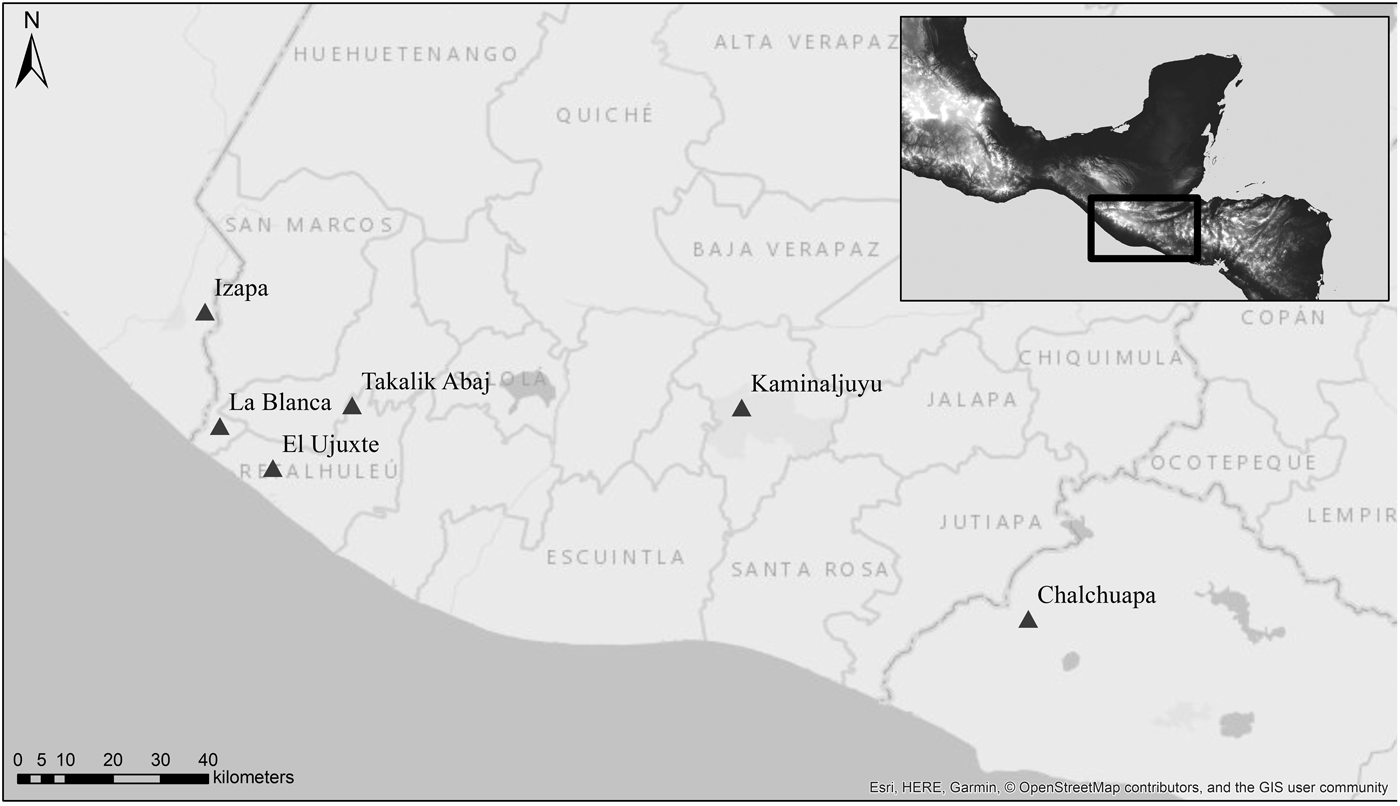
The archaeological site of Izapa in southern Mexico is widely known for its iconographic style and large corpus of stone monuments. With an occupational history spanning from at least the Preclassic era to the time of the Spanish conquest, Izapa remains one of the most important pre-Hispanic sites in southeastern Mesoamerica (Figure 1). Much of what is known about Izapa's cultural history stems from the fieldwork and ensuing publications by the New World Archaeological Foundation (NWAF). The NWAF directed the most intensive and large-scale excavations of the site during 1961–1965 (Clark and Lee Reference Clark and Lee2013; Ekholm Reference Ekholm1969; Lowe Reference Lowe1993; Lowe et al. Reference Lowe, Lee and Espinoza1982; Navarrete Reference Navarrete2013). The focus of early excavations included the site center; Groups A and B. Group B, the oldest sub-complex at the site, consists of 20 mounds and a large acropolis located on the eastern edge of central Izapa and was the most intensively excavated area of the project. Early investigations into the Group B mounds lead to the discovery of numerous offerings and burials, particularly for the Protoclassic period (100 b.c.–a.d. 250; Lieske Reference Lieske2013; Lowe et al. Reference Lowe, Lee and Espinoza1982). The exclusive placement of burials in Group B indicates that the plaza was of particular importance to the builders of Izapa and its subsequent occupants.
Izapa and its neighbors; map of southern Mesoamerica. Map by the author.

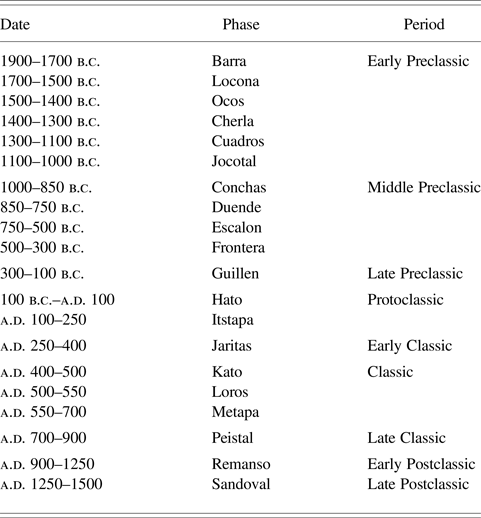
Izapa's rise as a regional center began during the Middle Preclassic (1000–300 b.c.) bolstered by the decline of La Blanca (Clark and Lowe Reference Clark, Lowe and Pye2013:83; Love Reference Love2002a). The zenith of Izapa's growth occurred in the Late Preclassic (300–100 b.c.; Clark Reference Clark, Clark and Lee2013:142; Lowe et al. Reference Lowe, Lee and Espinoza1982:179). This florescence was accompanied by massive architectural expansion and the erection of numerous stone monuments. Following this period, architectural construction dwindled greatly with minimal additions fashioned during the first century a.d. (Lowe et al. Reference Lowe, Lee and Espinoza1982:133). In contrast, Group F, a collection of architectural mounds five km north of central Izapa, expanded considerably during the Protoclassic period (100 b.c.–a.d. 250).
The Hato phase (100 b.c.–a.d. 100), following the close of the Late Preclassic, marks the beginning of an abrupt shift in Izapa's political organization. Activity within Izapa's central zones declined sharply and appear limited to the northern and western peripheries of the site (Rosenswig et al. Reference Rosenswig, López-Torrijos, Antonelli and Mendelsohn2013, Reference Rosenswig, López-Torrijos and Antonelli2015). Occupation of Izapa's central zones rose again during the Itstapa phase (a.d. 100–250) only to decline once more during the Early Classic Jaritas phase (a.d. 250–400). By the subsequent Kato phase (a.d. 400–500), Izapa's central zones appear occupationally abandoned (Lowe et al. Reference Lowe, Lee and Espinoza1982:147; Rosenswig and Mendelsohn Reference Rosenswig and Mendelsohn2016:362).
The decline of occupation seen during the beginning of the Protoclassic was accompanied by the cessation of stone monuments, minimal architectural construction, the adoption of urn burial practices, and the increased use of foreign ceramics from Central America as grave goods (Clark Reference Clark, Clark and Lee2013; Clark and Lowe Reference Clark, Lowe and Pye2013:84; Lowe et al. Reference Lowe, Lee and Espinoza1982:191, 194). The drastic change in social practices seen throughout the Hato phase suggests a reconfiguration of Izapa's ruling class. The brief occupational hiatus witnessed during the Hato phase and the shift in Izapa's political structure may have been the result of environmental conditions (Macías et al. Reference Macías, Espíndola, García-Palomo, Scott, Hughes and Mora2000, Reference Macías, Luis Arce, Capra, Saucedo and Manuel Sánchez Núñez2018), reorganization of internal dynamics (Mendelsohn Reference Mendelsohn2017a), or intrusion from an outside source (Lowe et al. Reference Lowe, Lee and Espinoza1982). Although additional architectural construction and repairs occurred at the site's center, it appears most construction following the Late Preclassic took place at Group F and around the peripheries of Izapa's core (Lowe et al. Reference Lowe, Lee and Espinoza1982; Rosenswig and Mendelsohn Reference Rosenswig and Mendelsohn2016; Rosenswig et al. Reference Rosenswig, Culleton, Kennett, Lieske, Mendelsohn and Núñez-Cortés2018). Nevertheless, Izapa's central zones remained an important space for local peoples as they continued to place offerings in Group B during the Classic (a.d. 250–900) and Postclassic (a.d. 900–1500) eras (Lieske Reference Lieske2013:127–128; Lowe et al. Reference Lowe, Lee and Espinoza1982:135, 153).
Our understanding of the Protoclassic period at Izapa and the forces that contributed to shifts in social practices has grown with the addition of new data from recent excavations and further research (Macías et al. Reference Macías, Luis Arce, Capra, Saucedo and Manuel Sánchez Núñez2018; Mendelsohn Reference Mendelsohn2017a, Reference Mendelsohn2017b, Reference Mendelsohn2018; Rosenswig and Mendelsohn Reference Rosenswig and Mendelsohn2016; Rosenswig et al. Reference Rosenswig, López-Torrijos, Antonelli and Mendelsohn2013, Reference Rosenswig, López-Torrijos and Antonelli2015, Reference Rosenswig, Culleton, Kennett, Lieske, Mendelsohn and Núñez-Cortés2018). This article adds to recent contributions regarding Izapa's shifts in political and cultural practices by highlighting Izapa Group B burial patterns from the Middle Preclassic (1000–300 b.c.) until the beginning of the Early Classic (a.d. 250–400), after which burials in central Izapa appear to cease. I compare central Izapa's burial patterns, or seeming lack thereof, with that of patterns found in other parts of the site, namely Group F, as well as contemporaneous sites in the region, specifically El Ujuxte, Takalik Abaj, and Kaminaljuyu. Burials that date later than the Protoclassic (a.d. 100–250)/Early Classic transition (a.d. 250–400) are beyond the purview of this paper and are not addressed here. Because no skeletal remains were found at Izapa, comparative discussions of burials are limited to grave type, associated grave goods, and burial location within the site. The analysis of burial practices at Izapa furthers our understanding of the importance of Group B as sacred space. Further comparison of burial traditions to neighboring civic-ceremonial centers provides insights into regional relationships among sites during the Preclassic and Protoclassic periods.
Chronological sequence of the Soconusco.

GROUP B LAYOUT AND ARCHITECTURE: EVIDENCE OF SACRED SPACE
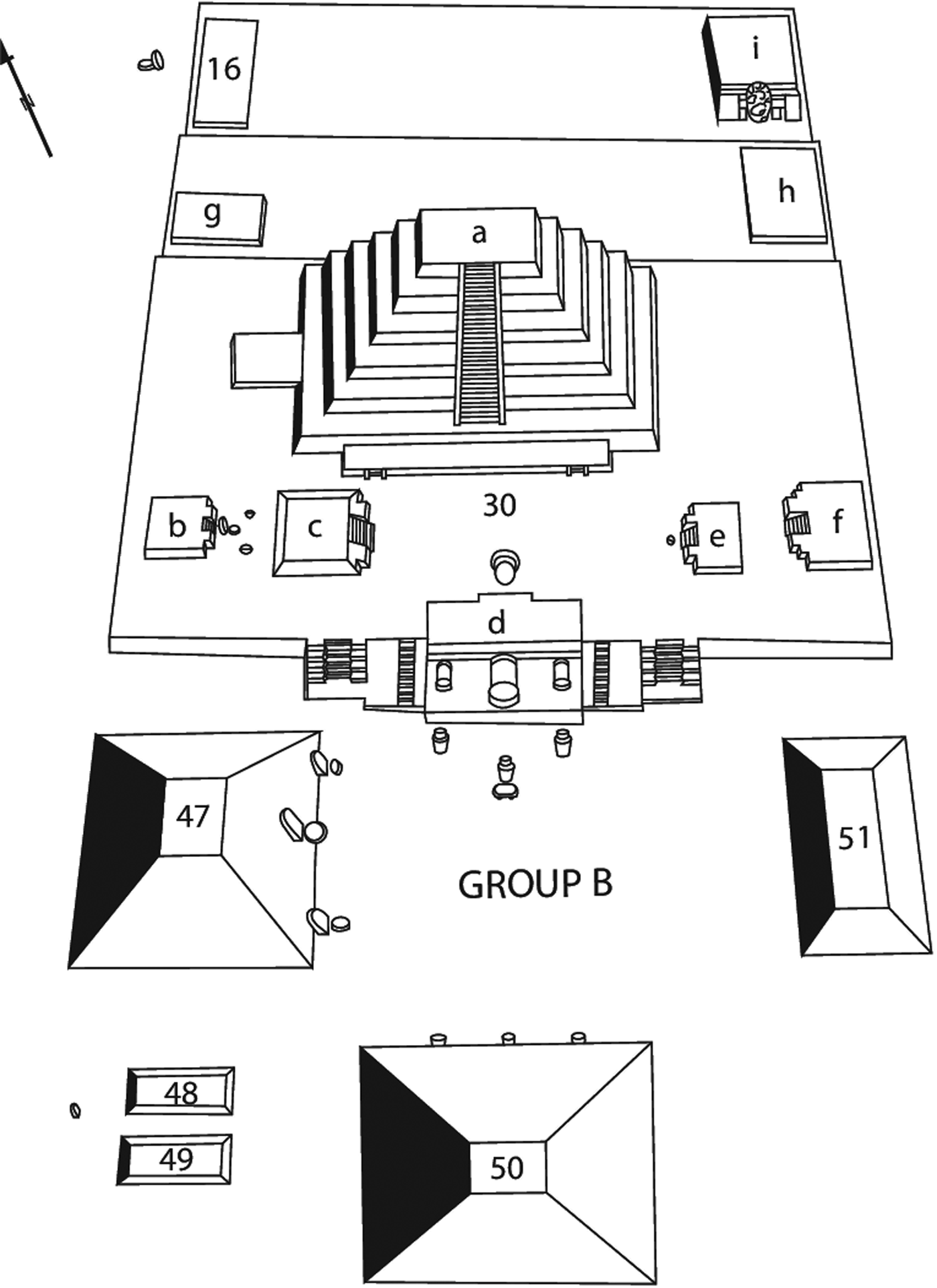
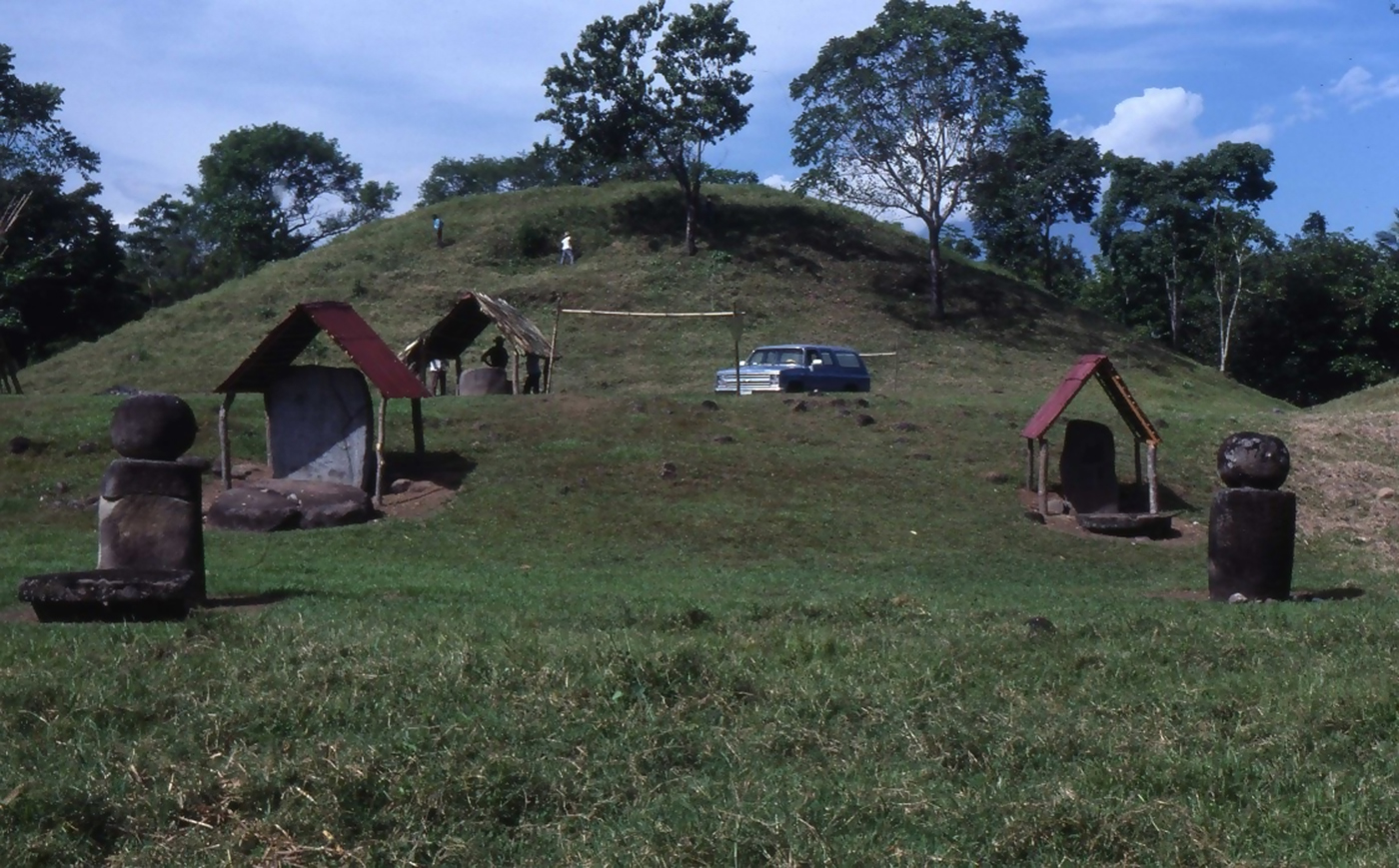
Izapa's beginnings as a civic-ceremonial center appear to have revolved around the construction of Mound 30a, Group B's largest pyramid. Group B, as originally defined by Stirling (Reference Stirling1943), consists of several mounds and monuments located on the eastern edge of central Izapa. The Group B plaza entails a large open-cornered plaza fashioned by four pyramidal platforms; Mounds 30a, 47, 50, and 51. The plaza's northern pyramid, Mound 30a, appears situated upon a larger platform or acropolis, which was a later construction built around the central pyramid. The Mound 30a pyramid was joined by nine small supplementary platforms (Mounds 30b–30i; Mound 16) erected on top of the false acropolis. These platforms were generally rectangular with a broad, flat surface that may be used to support additional structures (Figure 2). As suggested by the stratigraphy of the mound, the acropolis surrounding Mound 30a and the accompanying nine supplementary structures were constructed much later than the Mound 30a pyramid. The Group B plaza contained several stone monuments; these include 15 stelae, 10 altars, 15 miscellaneous stone monuments as well as a sculpture of a jaguar in the round, three pillars with accompanying stone balls, and a carved throne placed in the lower courtyard (Figures 3 and 4; Lowe et al. Reference Lowe, Lee and Espinoza1982; Norman Reference Norman1973).
Izapa Group B Plaza with accompanying stone monuments. Dimensions are approximate (Lowe et al. Reference Lowe, Lee and Espinoza1982:178, Figure 9.1). Drawing by author from Lowe et al. Reference Lowe, Lee and Espinoza1982:Figure 9.1.

Mound 30a, facing north, with re-erected stone monuments. Stelas 9 and 10 with their accompanying altars are displayed alongside stone columns and a small throne. Photograph courtesy of the New World Archaeological Foundation (NWAF).

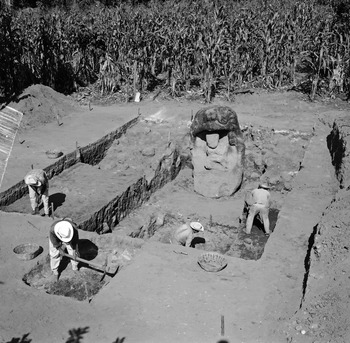
New World Archaeological Foundation excavations of “El Leon” (Miscellaneous Monument 2) in front of Mound 30i. El Leon is the earliest known stone monument found at Izapa and the only sculpture in the round. Photograph courtesy of the New World Archaeological Foundation (NWAF).

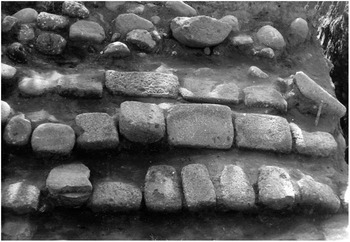
Several architectural and organizational elements mark Group B as a particularly special place within the site. Among these elements include the use of cut-stone blocks, first seen in Izapan architecture during the Guillen phase (300–100 b.c.), found in the outer walls of the Mound 30 acropolis and as part of the steps in the stairways of the secondary building platforms (Figure 5). Evidence of cut-stone blocks, a process of stone sculpting which requires meticulous pecking with hammerstones, is found almost exclusively at Group B and distinguishes its architecture from those of other plazas (Clark Reference Clark, Clark and Lee2013:132). In addition to the use of cut-stone blocks, fragmented pieces of carved monuments were used as part of the outer exterior of Mounds 30b, 30c, 30e, and 30f (Lowe et al. Reference Lowe, Lee and Espinoza1982:188, 194). The use of monument fragments and cut-stone blocks in the architectural design suggest more attention to detail was afforded the Mound 30 sub-complex than any other set of known buildings constructed at the site.
Cut-stone steps from Mound 30f. The incorporation of cut-stone blocks as an architectural feature is exclusive to Group B, highlighting the care placed on the construction of these mounds. Photograph courtesy of the New World Archaeological Foundation (NWAF).

In addition to incorporating fragmented stone monuments as architectural features, numerous stone monuments were used to line the plaza on its northern, western, and southern boundaries. The stone monuments positioned at Group B are the most diverse of any plaza at the site; this in conjunction with the distinct architectural elements found at Group B implies the plaza had specialized functions (Clark Reference Clark, Clark and Lee2013:140). Although Izapan iconography does not portray kings or leaders, Guernsey (Reference Guernsey2006:131) suggests the sculptural assemblage at Group B conveyed messages of rulership and authority with the use of pan-Mesoamerican astronomical metaphors carved on the stone monuments.
The architectural layout of the Group B plaza also signifies the area's importance as a place of power and authority. The Mound 30 sub-complex received multiple additions throughout the Middle Preclassic. By the end of the Frontera phase (500–300 b.c.), Group B consisted of at least Mound 30a and its acropolis; these resembled the contemporaneous pyramid Complex A at La Venta, the Olmec capital on the Gulf Coast with its large northern pyramid on an acropolis (Clark Reference Clark, Clark and Lee2013:142). Mound 30a and its acropolis also mirror the appearance of the main pyramid complex at La Blanca, the regional center which preceded Izapa's rise to power (Love Reference Love2002a). The modeling of Mound 30a and its acropolis after regional centers of power emphasizes the plaza's importance within the site; the significance of Group B is implicit in its design.
Group B has the longest construction history of any architecture found at Izapa's central zones. The design and restrictive nature of the Group B plaza, the elaborate detailing of its architecture, and the unique types of stone monuments associated with the plaza, all mark Group B as a special place. Given the importance Group B had to the original builders of Izapa, it is no surprise that subsequent elites used this space to house their deceased.
IZAPA BURIAL PRACTICES
Izapa Group B
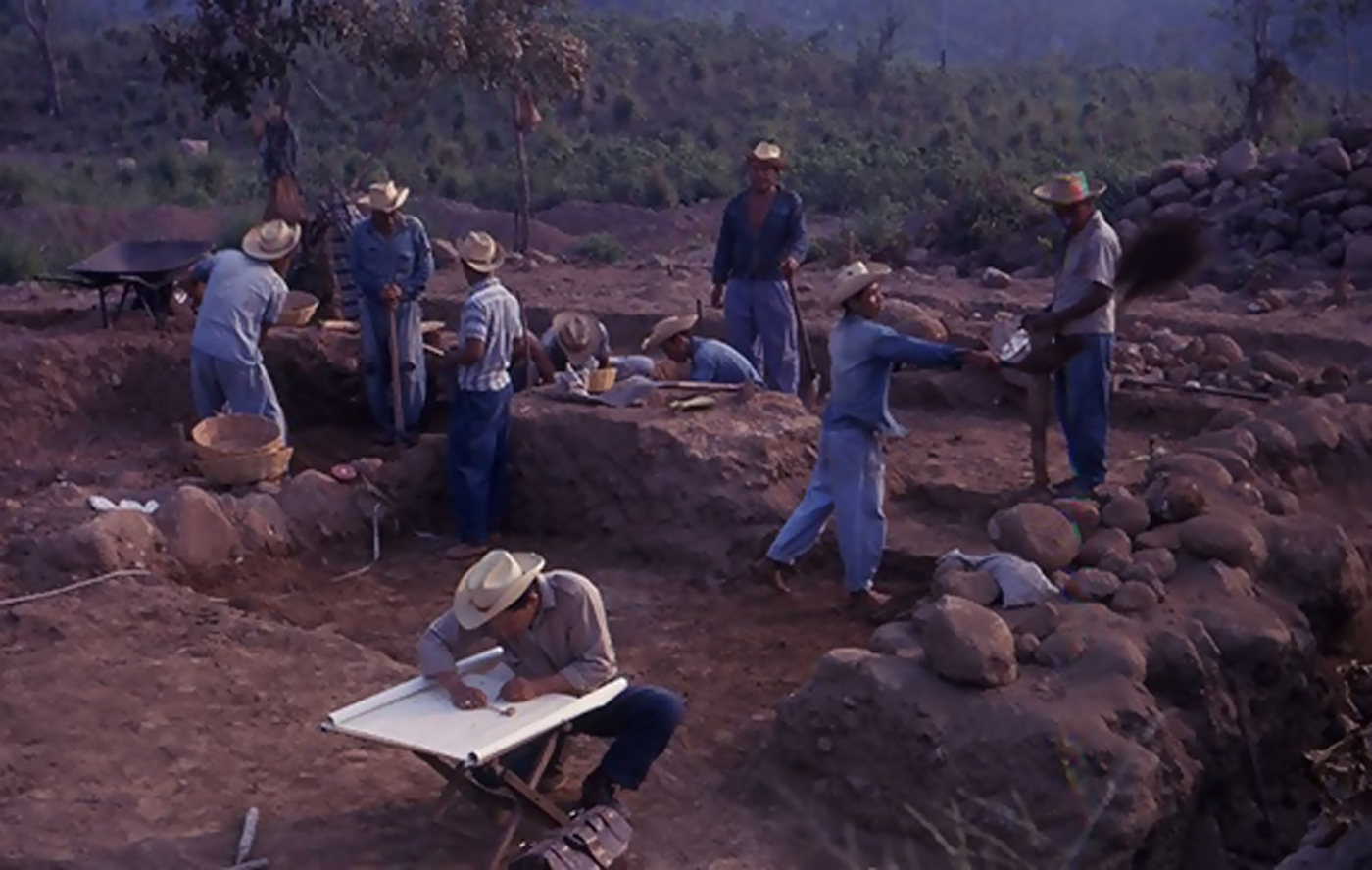
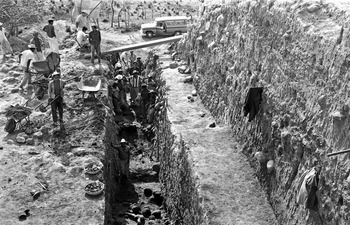
The NWAF excavated Izapa Group B extensively during its four consecutive field seasons at the site (Figure 6). Throughout the course of this project, more than twenty trenches/test pits were excavated in Mounds 30a–30f alone. Mound 30a, Group B's central pyramid, was the most heavily excavated mound in Izapa's central zones. Excavation units were placed along the slopes of the mound, through the summit, and tunneled through the southern face of the pyramid. In the final two field seasons, attempts to uncover the entirety of Mound 30a's northeast quadrant became the principle focus of the continued excavations (Figure 7). The intensive excavation of the mound exposed several internal structures but surprisingly failed to yield any burials or elaborate offerings (Ekholm Reference Ekholm1969; Lowe et al. Reference Lowe, Lee and Espinoza1982).
New World Archaeological Foundation excavations at Izapa took place from 1961–1965 and were focused particularly on Groups A and B within the central zones of Izapa. Photograph courtesy of the New World Archaeological Foundation (NWAF).

Overview of Trench 30a-L in Mound 30a. Half of the crew excavated this trench during the last two months of the final field season in 1965. Photograph courtesy of the New World Archaeological Foundation (NWAF).

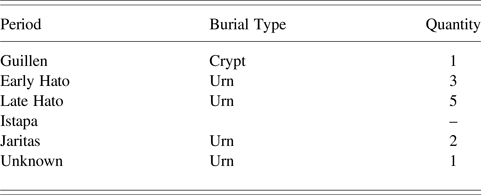
Conversely, excavation of the small Mound 30b and 30d platforms south of Mound 30a during the first two field seasons led to the discovery of nine elaborate urn burials and several offerings from the Protoclassic (a.d. 100–250) as well as one Early Classic (a.d. 250–400) urn burial. Excavations of the small Mound 30e platform during the final field season (1965) uncovered another intrusively placed Early Classic urn burial in addition to a well-placed stone crypt from the Late Preclassic (300–100 b.c.). These discoveries account for all known burials in central Izapa with the exception of a single Postclassic urn burial in Group G (Table 2; Lowe et al. Reference Lowe, Lee and Espinoza1982:191). Although investigation of the site core continues (Mendelsohn Reference Mendelsohn2017a; Rosenswig and Mendelsohn Reference Rosenswig and Mendelsohn2016; Rosenswig et al. Reference Rosenswig, López-Torrijos, Antonelli and Mendelsohn2013, Reference Rosenswig, López-Torrijos and Antonelli2015, Reference Rosenswig, Culleton, Kennett, Lieske, Mendelsohn and Núñez-Cortés2018), no new burials have been confirmed.
Izapa Group B burials.

The acidic soils of the piedmont zone result in poor preservation of organic materials, including human remains. As such, Izapa's burials contained no bones. Consequently, all cache deposits found during excavation were labeled as offerings due to the absence of human remains. Lowe identified the offerings thought to be burials in their feature records; all offerings that contained a large urn were considered urn burials. The burials identified by Lowe in Group B consist of a single crypt placed in Mound 30e and 11 urn burials distributed throughout Mounds 30b, 30d, and 30e (Lowe et al. Reference Lowe, Lee and Espinoza1982:191,194).
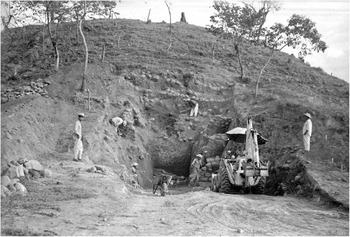
Without grave markers, it may not have been possible to identify the caches as burials. Thus, the various miscellaneous offerings collected from mound excavations, particularly jade pieces, may represent grave goods or adornments, even though human remains are not present (Clark Reference Clark, Clark and Lee2013:118). Excavation methods employed by the NWAF included the use of large-scale tractor trenches and tunneling with the aid of a backhoe, thus complicating the identification of intrusive pits and potential burial contexts (Figure 8; Lowe et al. Reference Lowe, Lee and Espinoza1982:84). Even so, the total number of possible burials with accompanying grave goods is small (Clark Reference Clark, Clark and Lee2013:118–119).
Excavation of the southern base of Mound 30a. A tractor was used to aid in the excavation, making it difficult to identify intrusive pits. Photograph courtesy of the New World Archaeological Foundation (NWAF).

Despite the expansion of Izapa's architectural constructions, no discernable burials and very few (two) offerings were found attributed to the Preclassic at Izapa (Lieske Reference Lieske2013:127). Izapa's earliest burial, a Late Preclassic construction, was only identifiable due to its carefully laid cut-stone crypt. This lack of burials during the Preclassic may indicate that during this era Izapa's elite were buried elsewhere or with perishable materials that, alongside their skeletal remains, have not survived.
The subsequent Protoclassic was a time of great transformation for Izapa, and the placement of burials and offerings uncovered at Group B is a reflection of that change. With the exception of two Early Classic interments, all urn burials at Group B have been attributed to the early Protoclassic or Hato phase (100 b.c.–a.d. 100). Lowe et al. documented eight urn burials in their 1982 monograph; yet feature records indicate there were nine urn burials (Lieske Reference Lieske2013:161). Of these nine urn burials, eight have been attributed to the early or late Hato phase. Missing information on the ninth burial (Burial 30d-8) makes it difficult to date its placement (Lieske Reference Lieske2013:183). No burials were placed at Group B during the second half of the Protoclassic (a.d. 50–250), although a number of offerings are present.
Evidence of the return of the urn-burial tradition to Group B consists of two intrusive Jaritas-phase (a.d. 250–400) urn burials in Mounds 30b and 30e, just below the surface. These Jaritas-phase burials are the last known burials located at Izapa's central zones, followed by a complete abandonment of the site's ceremonial core (Lowe et al. Reference Lowe, Lee and Espinoza1982:147; Rosenswig and Mendelsohn Reference Rosenswig and Mendelsohn2016:362).
In the absence of skeletal remains, the analysis of Izapa's interments is limited to burial context. As such, the criteria selected to describe and analyze Izapa's burials include grave type, associated grave goods, and burial location. The data derived from these investigations provide important correlates for regional comparison.
Grave Type
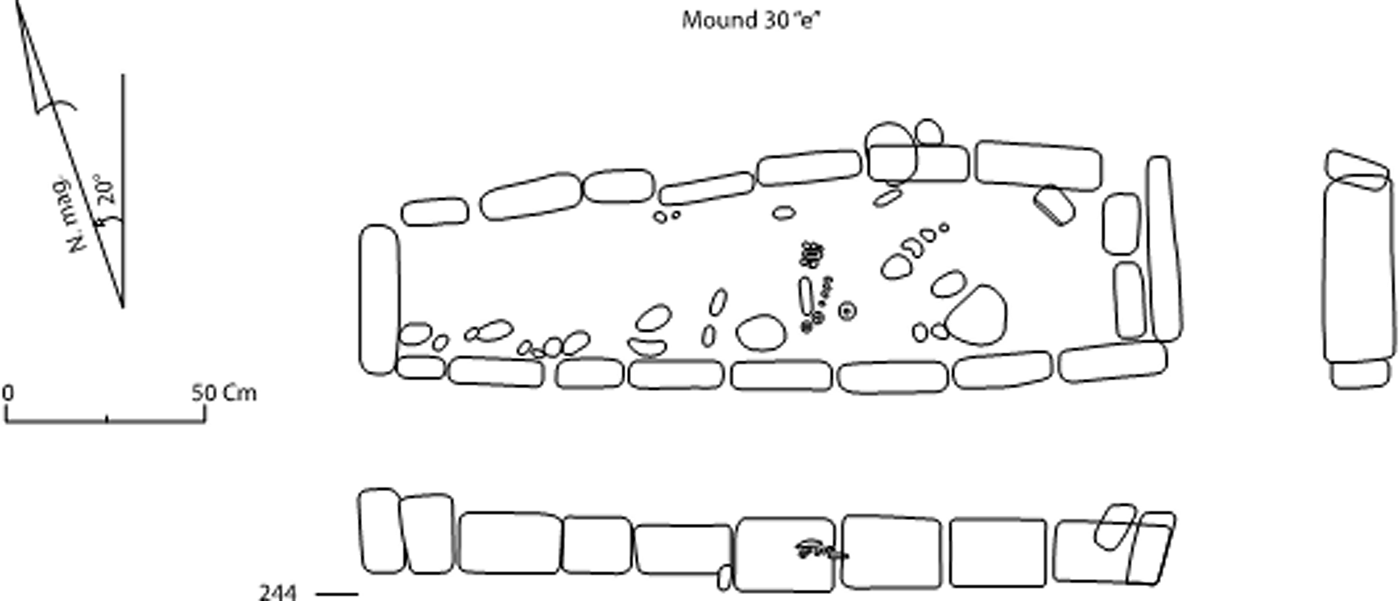
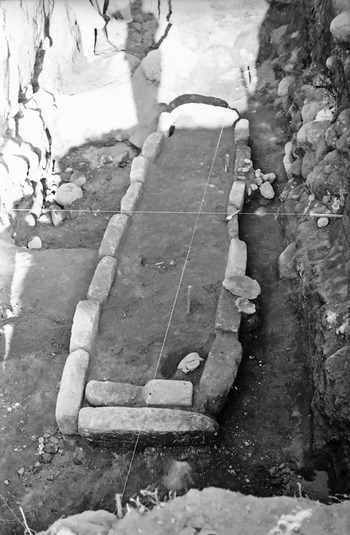
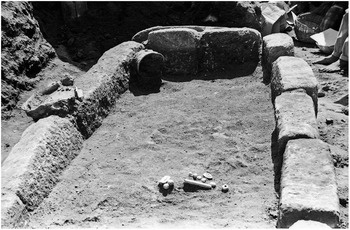
Only two types of burials can be found in central Izapa; a stone crypt and urn interments. Izapa's Late Preclassic interment, Burial 30e-1, was a crypt placed within Mound 30e (Figure 9). The crypt itself was composed of a single course of cut-stone set on edge, the same stone processing method seen in Late Preclassic architecture at Group B (Lowe et al. Reference Lowe, Lee and Espinoza1982:194). The interior of the crypt measured 1.75 m in length, 40 cm wide on the western end, and 30 cm wide on the east end. Neither cover nor bones were found in the crypt but the size of the grave suggests an extended internment with the head buried facing west (Figure 10; Lowe et al. Reference Lowe, Lee and Espinoza1982:194).
Plan view and profile of the stone crypt found in Mound 30e, the only known Late Preclassic interment at Izapa. Drawing by the author after original drawing by Eduardo Martínez.

Burial 30e-1, facing west. Jade adornments were found in the middle of the crypt with vessels from Offering 30e-3 in the northeast corner and along the northern wall. Photograph courtesy of the New World Archaeological Foundation (NWAF).

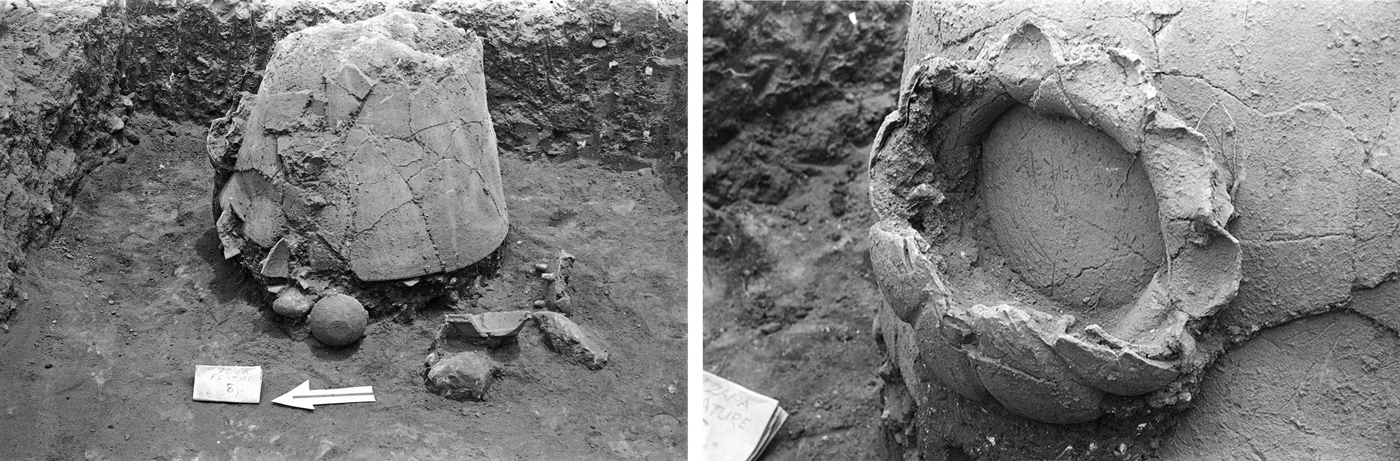
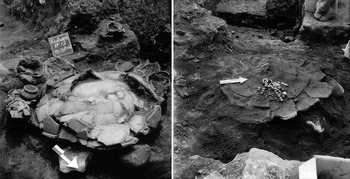
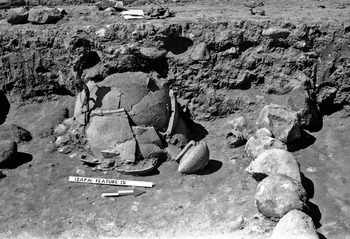
The most common grave type found at Izapa were urn burials. These burials primarily consisted of large urns, in which the deceased would have been placed, accompanied by an inverted dish or urn, which served as a cover (Figure 11). No bones remained inside the urns, but based on accompanying adornments, it is likely that only one individual was positioned inside each urn. One exception is Burial 30d-7, Izapa's most elaborate burial, which contained two sets of earspools suggesting two individuals may have been placed in the vessel (Figure 12). The urn vessels themselves were large and varied in size with an estimated range between 50 centimeters to 1 meter in maximum diameter. Differences among urn burials were primarily limited to the size of the interment vessel and accompanying mortuary furniture.
Burial 30d-4 (Offering 30d-8), Hato-phase burial. The bottom photograph is an image of a bowl set on edge. The decorative arrangement are sherds of a fractured pot. Photographs courtesy of the New World Archaeological Foundation (NWAF).

Burial 30d-7, Izapa Group B's most elaborate urn burial. Two sets of jade earspools suggest that two individuals may have been placed in the urn. Photographs courtesy of the New World Archaeological Foundation (NWAF).

Grave Goods
Ceramic vessels were the most prominent grave goods discovered among central Izapa's burials. Of the 97 vessels found, 55 of these were bowls. Of these bowls, 12 were tetrapod bowls and 11 were tripod bowls. Also included as mortuary furniture were jars (n = 21), vases (n = 12), dishes (n = 4), ollas (n = 2), a single incense burner, a censer stand, and an unidentified vessel (Lieske Reference Lieske2013:155–157; Lowe et al. Reference Lowe, Lee and Espinoza1982). Very few of these vessels were local pots (Lowe et al. Reference Lowe, Lee and Espinoza1982:139).
The oldest ceramic grave goods came from the Late Preclassic crypt (Burial 30e-1) unearthed in Mound 30e. Alongside jade pieces, the crypt contained seven ceramic vessels; three of which were found smashed against the north wall. The other four vessels were located in a fallen position at the southwest corner of the crypt. Four of the seven bowls, one a nubbin tetrapod and two flanged bowls with effigy heads, were exotic wares imported from either the highlands of Guatemala or El Salvador during the Late Preclassic (Lowe et al. Reference Lowe, Lee and Espinoza1982:194). The ceramic offerings found in Burial 30e-1 are the first example of Usulutan resist-decorated pottery at the site. This type of pottery is absent from the sherd collections for the Late Preclassic period at Izapa, suggesting these types of vessels were exclusive to burials (Lowe et al. Reference Lowe, Lee and Espinoza1982:135).
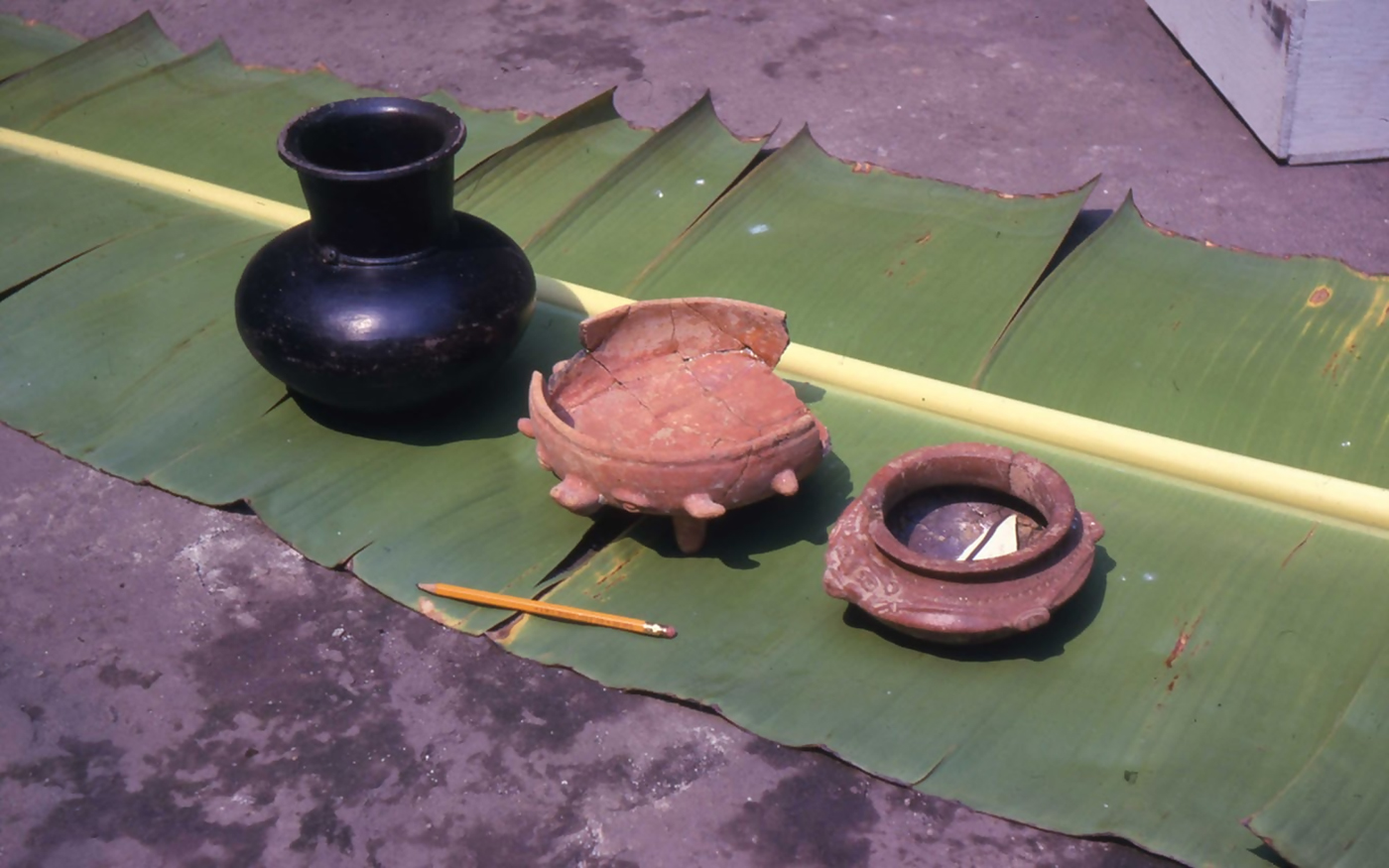
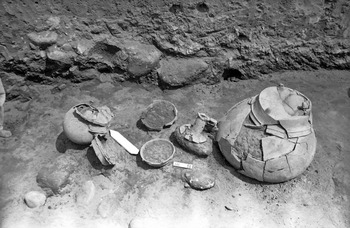
The majority of pottery included in central Izapa's nine Protoclassic urn burials were also exotic wares (Figure 13). Over 80 percent of the ceramic vessels associated with urn burials from the central axis and western portion of Mound 30d were imports excluding the urns and their coverings. Of the urn burials found in the eastern portion of the mound, the ceramic grave goods were 60 percent imported. All imported vessels with negative-resist found in the Protoclassic urn burials at Group B were repainted with local styles and designs (Lowe Reference Lowe1993:190). The sherds from these burials were not represented elsewhere in the ceramic collection for Izapa's central plazas during the Protoclassic (Lowe Reference Lowe1993:180). Conversely, the ceramic vessels which accompanied Group B's Early Classic urn burials were local products, a stark contrast to the exotic wares found in Izapa's Protoclassic urn burials (Lowe et al. Reference Lowe, Lee and Espinoza1982:147).
Selected vessels from Burial 30d-4 and Burials 30d-5. The polished black vessel appears to be from the Quezaltenango region of Western Guatemala. Photograph courtesy of the New World Archaeological Foundation (NWAF).

Several of the exotic wares included in these burials were Usulutan pottery. This decorative technique, derived from western El Salvador or possibly eastern Guatemala, spread along the Pacific Coast and into the Maya area throughout the Late Preclassic (Demarest and Sharer Reference Demarest and Sharer1982:819). During the Protoclassic, wavy-line Usulutan decoration in the Maya lowlands became common. This intrusive element in lowland Maya ceramic assemblages may be evidence of highland immigrations or strong interactions (Demarest and Sharer Reference Demarest and Sharer1982:819). Usulutan wares at Izapa, however, were only found in burial contexts and were not represented in other parts of the site (Clark and Lowe Reference Clark, Lowe and Pye2013:79). The lack of Gulf Coast vessels in any of central Izapa's burials suggest that, by the Late Preclassic, Izapa began to demonstrate stronger ties with Central America, the impetus of which was likely the collapse of La Venta.
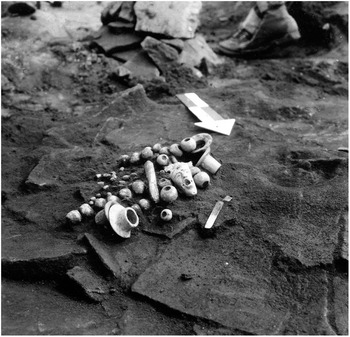
Outside of ceramic grave goods, eight of the 12 burials contained jade pieces, primarily adornments. Jade adornments include earspools, round beads, tubular beads, and pendants. Jade or greenstone were trade items, likely coming from Guatemala. Izapa's earliest burial (Burial 30e-1) included several jade pieces: 10 jade beads, a jade pendant, and two earspools, one with a bead in its throat (Figure 14). The jade pieces were laid out in the center of the crypt in such a way to suggest the burial may have been that of a child or an individual of small stature (Clark Reference Clark, Clark and Lee2013:119).
Jade pieces from Burial 30e-1. New World Archaeology Foundation monthly reports suggest that one of the earspools was stolen shortly after exhumation of the crypt. The missing earspool is not pictured here. Photograph courtesy of the New World Archaeological Foundation (NWAF).

Seven of the nine Protoclassic burials also included jade artifacts. The most elaborate urn burial (Burial 30d-7) contained several jade pieces including numerous beads, a human head pendant, two incised fish pendants, two sets of earspools, and a jade axe (Figure 15). The figurine head is depicted with a large open mouth and extended lips, as if blowing; possibly demonstrating wind-god attributes (Lowe et al. Reference Lowe, Lee and Espinoza1982:193). The pendant also has double interconnected perforations on the cheeks, chin, and forehead. The double set of earspools may indicate two individuals were placed in the urn (Lieske Reference Lieske2013:183).
Close-up of the jade pieces found in Burial 30d-7, Izapa's most elaborate urn burial. Among these jade pieces were two sets of earspools, round and tubular beads, and face-shaped pendant with wind-blowing features. Photograph courtesy of the New World Archaeological Foundation (NWAF) and Lowe et al. Reference Lowe, Lee and Espinoza1982:193, Figure 9.12.

Six of the twelve burials possessed grave goods besides jade pieces and ceramic vessels; these include 44 tuff stones, a zoomorphic (opossum) stone scepter, squared pumice, a hematite-strip mirror, soapstone, a stone ring, and a smooth unworked stone of irregular shape (Lieske Reference Lieske2013:155–157; Lowe et al. Reference Lowe, Lee and Espinoza1982:193). Notably, no obsidian was included in any of central Izapa's burials.
The use of luxury goods and exotic wares as mortuary furniture suggest the burials were elite and convey messages of wealth, power, and prestige. The foreign nature of the ceramic and jade grave offerings may also be indicative of increased regional interactions with Central America.
Location
Although the NWAF investigated every mound group at Izapa, other plazas were not explored to the same extent at the Mound 30 complex. As revealed by the excavations, no structure within Group B received more revisions and additions than Mound 30a. Yet, no burials were found in any of the layers of construction. Instead, Izapa's earliest known burial was placed in a small platform mound in front of the southern face of Mound 30a. The estimated age of the burial crypt and the construction of the platform appear to coincide; the crypt does not seem to be intrusive (Lieske Reference Lieske2013:98).
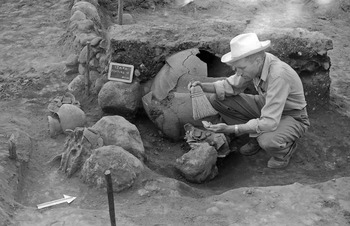
Eight of the nine Protoclassic urn burials were situated in the small Mound 30d platform (Figure 16). Four of the nine were placed just below the surface, while the other four Hato-phase urn burials were found 60–120 cm below the surface. Those found at a deeper depth were classified as early Hato, while the four with the shallow placements were said to be late Hato (Lowe et al. Reference Lowe, Lee and Espinoza1982:139). Burials were placed predominantly on the centerline or eastern portion of the mound, with only a single burial found on the western half of the platform. Lowe (Reference Lowe1993:181) believed that the urn burials were intrusively placed in Mound 30d in association with the stone monuments, including the small throne and pillars with stone spheres found in the lower courtyard of the plaza. Two of the earliest urn burials, Burials 30d-1 and 30d-2, were found in line with Stelae 9 and 24 and the centerline for Mounds 30a and 30d. Burial 30d-9, of the same age, was the only burial found in the western portion of Mound 30d and appears to correlate to Stela 8 (Figure 17; Lowe Reference Lowe1993:180).
Protoclassic interment Burial 30d-5, exhumed with the aid of Ross T. Christensen from Brigham Young University. Photograph courtesy of the New World Archaeological Foundation (NWAF).

Burial 30d-9, Early Hato phase. The only urn burial found on the western portion of Mound 30d. Its placement may be correlated to Stela 8. Photograph courtesy of the New World Archaeological Foundation (NWAF).

Little is known concerning the provenience and content of Burial 30d-8, as minimal information is available. Lowe made no mention of this burial in his publications and it was not included in the reconstruction of the burials and offerings as illustrated by Eduardo Martínez Espinosa. Although the cache was labeled in relation to Mound 30d in the field (offering 30d-14), coordinates given for the interment actually place the urn burial in the upper courtyard delineated by Mounds 30a, 30c, 30d, and 30e, and not within the Mound 30d platform. It is possible that the given coordinates are inaccurate, as the original feature record for this burial is missing (Lieske Reference Lieske2013:184). If Burial 30d-8 was in actuality located in the upper courtyard, it may have been positioned there in relation to Stela 24 and Altar 20.
The latest burials interred in Group B were two Early Classic urn burials placed in Mounds 30b and 30e. Burial 30b-1 was found just 25 cm below the surface. The urn was placed on the center line of the mound closely surrounded by ceramic grave goods. Burial 30e-2 was similarly placed in Mound 30e (Figure 18).
Burial 30e-2, one of two Late Classic urn burials (Lowe Reference Lowe, Lee and Espinoza1982:196, Figure 9.14). Photograph courtesy of the New World Archaeological Foundation (NWAF).

All of the burials in Group B were placed in the small platform mounds in front of the southern face of the plaza's central pyramid. This is likely due to the platforms proximity and relationship with Stelae 8, 9, 10, and 24, making the symbolism or meaning of the stone monuments and the messages they conveyed all the more important to the history of Group B (see Guernsey Reference Guernsey2006; Lowe Reference Lowe, Lee and Espinoza1982; Norman Reference Norman1973).
Izapa Group F Burials
Once established at Group B, the urn-burial tradition continued north of the Izapa's core at Group F. Construction of Group F's numerous mounds occurred predominantly during the Protoclassic following a disruption in occupation at Izapa's ceremonial core. At its center, Group F contains a sizable platform or acropolis (Mound 125) with a large terraced pyramid to the north (Mound 125a) and several supplementary platforms (Mounds 125b–125e). Extensive excavations by the NWAF uncovered much of the Mound 125 sub-complex. Rigorous trenching through the Mound 125 acropolis and its supplementary mounds unearthed 61 burials and offerings (Lowe et al. Reference Lowe, Lee and Espinoza1982:231–233). Of the burials placed at Group F, the ceramic grave goods of seven burials date to the late Protoclassic (Istapa phase) with an additional five burials dated to the Early Classic (a.d. 250–400). Subsequent burials were found dated to Late Classic and Postclassic eras (Lowe et al. Reference Lowe, Lee and Espinoza1982). Pending future publications (John E. Clark, personal communication 2016), information regarding Group F burials is presently limited to Lowe et al.’s (Reference Lowe, Lee and Espinoza1982) publication and an unpublished report by Lee with feature records archived at the NWAF.
All of the burials placed in Group F during the Protoclassic and Early Classic periods were urn burials and were positioned in Mound 125a. Six of the seven Istapa-phase burials found at Group F were accompanied by few locally produced ceramic pots. Only one of the urn burials included several vessels, jade earflares and beads, and obsidian blade fragments (Lowe et al. Reference Lowe, Lee and Espinoza1982:141). None of the Istapa burials at Group F contained Usulutan ceramics or foreign wares, a notable difference from Hato-phase patterns found at Group B. Two jade necklaces with central pendants, one of which was face-shaped, were found associated with the Istapa-phase burials (Lee Reference Lee2015; Mendelsohn Reference Mendelsohn2017a:342)
The five Jaritas (a.d. 250–400) urn burials found at Group F included more grave goods then their antecedents in Mound 125a. These large urn burials contained numerous ceramic vessels, jade necklaces and bracelets, and obsidian blades (Lowe et al. Reference Lowe, Lee and Espinoza1982:145). The majority of ceramic goods associated with these burials were locally produced pottery with crude, brownish paste. The two exceptions were a polished black globular jar, indicative of western highland Guatemala (Lowe et al. Reference Lowe, Lee and Espinoza1982:Figure 7.19e), and a smudged black-and-white tripod jar from western Chiapas or the Gulf Coast (Lowe et al. Reference Lowe, Lee and Espinoza1982:Figure 7.19 g).
Summary of Izapa's Burial Patterns
A drastic shift in burial practices occurred at Izapa between the Preclassic and Protoclassic periods. Although dedicatory offerings often accompanied episodes of construction, there is little to no evidence of interments in any of the mounds during the Preclassic with the exception of Burial 30e-1, a cut-stone crypt placed in a supplementary mound on the Mound 30 acropolis. The Protoclassic is marked by the introduction of elite urn burials intrusively placed in Mound 30d. Mortuary furniture that most commonly accompanied these interments consisted primarily of foreign ceramic wares, often painted over with local designs (Lowe et al. Reference Lowe, Lee and Espinoza1982:139).
No burials were identified by Lowe at Group B for the Istapa phase (a.d. 100–250). Conversely, several urn burials are attributed to the Istapa phase at Group F. The Protoclassic urn burials at Group F were far less extravagant than their predecessors at Group B. Grave goods for Group F Istapa burials were primarily comprised of a few local pots, although one large urn burial carried several pieces of jade and obsidian. Mendelsohn (Reference Mendelsohn2017a) posits that the burials identified by Lowe as Late Hato at Group B may be misinterpreted Istapa-phase burials. If this is the case, the proposed Istapa-phase burials at Group B differ greatly from the Istapa-phase burials at Group F, as the burials to the north were much less elaborate and contained primarily local ceramic wares as grave goods.
The Early Classic period saw the return of the urn-burial practice at Group B with the placement of two urn burials in Mounds 30b and 30e. These interments end the burial tradition at Group B. The urn-burial tradition continued at Group F with the placement of five additional urn burials in Mound 125a for the Early Classic period.
Grave goods at Izapa consisted mainly of jade pieces and ceramic wares. The use of Usulutan wares and foreign ceramics almost exclusively belongs to the burials at Group B. Conversely, Group F burials for the Protoclassic and Early Classic periods contained mainly local wares. The exotic nature of the Group B grave goods for the Late Preclassic and Protoclassic indicates stronger ties to Central America for these periods. By the Early Classic, burials at Group B included only local wares.
Burials placed in Izapa's central zones are exclusive to Group B, likely the area's most sacred space. These burials were placed in a small platform in front of Mound 30a, possibly correlated with Stelae 8–10. Group F burials for the Protoclassic and Early Classic periods were located exclusively in Mound 125a. Burials at Izapa were situated in the center of ritual activity for both the site's central zones and Group F.
Izapa's burial patterns, including grave type, associated grave goods, and location of burials, demonstrate a shift in tradition for the Protoclassic, a time period of great regional change in southeastern Mesoamerica. Comparison of Izapa's burial patterns to those of its neighbors provides insights into regional trends and connections.
NEIGHBORING REGIONAL CENTERS: EXCAVATIONS AND BURIALS
Izapa's development as a civic-ceremonial center was shaped by interregional networks and relationships. El Ujuxte, Takalik Abaj, and Kaminaljuyu were some of the largest civic-ceremonial centers neighboring Izapa during the Late Preclassic and Protoclassic periods. These cities were tied together in a network of exchange, as demonstrated through shared iconographic symbols and trade items (Guernsey Reference Guernsey2006:6). These sites were selected for comparison based on proximity to Izapa and participation in the same network of interaction. Included in this section is a brief introduction to these regional centers, their histories of excavation, and burial patterns.
Quantity of burials among these sites varied depending on quality of preservation and the focus of excavation projects. El Ujuxte and Kaminaljuyu are the only two sites which had human remains. The sites in the piedmont zone, Izapa and Takalik Abaj, did not. The burials included in this section date exclusively from the Middle Preclassic to the Protoclassic. Additional burials have been identified at some of these sites for other time periods but are not discussed here.
El Ujuxte
El Ujuxte, Izapa's nearest competitor in the Soconusco, rose as a regional center ca. 600 b.c. (Love Reference Love2002a; Love and Guernsey Reference Love, Guernsey and Lesure2011:72). The city grew significantly during the Late Preclassic and reached its largest size at the beginning of the Protoclassic Pitahaya phase (100 b.c.–a.d. 100; Love and Guernsey Reference Love, Guernsey and Lesure2011:73). The boundaries of the El Ujuxte polity may have bordered those of the Izapa polity during the Late Preclassic, making it an important neighboring center. El Ujuxte was later abandoned following the Protoclassic with only minimal remnants of Early Classic materials found on the surface (Love Reference Love, Love, de Hatch and Escobedo2002b, Reference Love2007; Love and Guernsey Reference Love, Guernsey and Lesure2011:55, 73).
Excavations at the site began in 1995 and unearthed a series of residential mounds. These domestic contexts were identified in the northeastern sector of the site. Eleven residential structures were excavated; of these, seven contained funerary remains. A minimum number of 35 individuals were uncovered. Some of these individuals were interred as sacrificial offerings, not as principal burials. Sixteen individuals were identified as the primary individual of interment. Of these, 10 were associated with grave goods. More than half of the burials were placed in the center or summit of residential mounds (Arredondo Leiva Reference Arredondo Leiva, Love and V2000:14). Recent revisions to the pottery sequence at El Ujuxte divide the Protoclassic into the Pitahaya phase (100 b.c.–a.d. 100) and the Sierra phase (a.d. 100–200; Love Reference Love2018). Several of the burials, possibly even half, date to the later Sierra phase, while the others date to the early Pitahaya phase (Michael Love, personal communication 2018). Thus far, funerary remains have only been found in domestic contexts outside of the site's ceremonial precinct.
Love (Reference Love, Laporte and Escobedo1998:310) proposed that placing the dead within residential locales was a change in practice, which occurred following the Conchas period (1000–850 b.c.) during the Middle Preclassic. This shift in practice may have been the result of increased importance imparted to genealogy and inheritance (Arredondo Leiva Reference Arredondo Leiva, Love and V2000; Guernsey Reference Guernsey2012:148). It is also possible some of these domestic contexts began as residential structures and evolved into communal or lineages houses during later periods (Michael Love, personal communication 2018).
Takalik Abaj
Takalik Abaj, some 50 kilometers southeast of Izapa, developed into a sizable commercial center during the Middle Preclassic with continued expansion throughout the Late Preclassic. The apex of the city's growth occurred during the Protoclassic period with one of the largest repositories of stone monuments along the Pacific Coast (Schieber de Lavarreda Reference Schieber de Lavarreda and Carcache2012; Schieber de Lavarreda and Orrego Corzo Reference Schieber de Lavarreda, Orrego Corzo, Guernsey, Clark and Arroyo2010b:180).
Although excavations at the site began in 1976, only two burials have been found thus far; both are lavish royal tombs. While further excavation of the site may yield more burials or tombs, poor preservation is as problematic at Takalik Abaj as it is at Izapa. In both cases, the absence of burials may be the result of decomposition and the lack of obvious grave markers or numerous grave goods and adornments for most non-elite individuals.
While burials at Takalik Abaj are few in number, the site is home to the oldest known Maya tomb in Mesoamerica. Burial 2, a lavish royal tomb found in a cavity two m south of the central axis point of Structure 6, is estimated to have been placed around 500 b.c. Grave goods included hundreds of jade beads and several ceramic bowls. No bones were found but the individual appears to have worn two bracelets, two anklets, and a jade loincloth. Among the artifacts present was a pendant with a vulture's head, a symbol of early Maya status (Atwood Reference Atwood2013; Pinedo González Reference Pinedo González2013; Schieber de Lavarreda and Orrego Corzo Reference Schieber de Lavarreda, Orrego Corzo and del Aguila Flores2013).
Takalik Abaj's only known Protoclassic burial was a royal tomb found intrusively placed in Structure 7A, a Middle Preclassic structure. While no human remains were found, interior residues suggest the body may have been coated in red cinnabar. Grave goods include 18 jade beads, two jade earspools covered in cinnabar, mosaic iron pyrite mirrors, a jade mosaic mask, two obsidian blades, and carved fish made of greenstone. The burial is believed to have housed the last of the Maya rulers at Takalik Abaj (Schieber de Lavarreda Reference Schieber de Lavarreda, Laporte, Arroyo, Escobedo and Mejía2003).
Kaminaljuyu
Kaminaljuyu, located in the Valley of Guatemala, rose to prominence during the Late Preclassic as populations abandoned the nearby site of Naranjo (Arroyo Reference Arroyo2010; Sanders et al. Reference Sanders, Diskin and Coe1974:98). Similar to Takalik Abaj and El Ujuxte, the apogee of the site took place during the Protoclassic, at which time Kaminaljuyu rose to impressive heights of power and wealth demonstrated by the elaborate tombs attributed to this era (Inomata et al. Reference Inomata, Ortiz, Arroyo and Robinson2014; Inomata and Henderson Reference Inomata and Henderson2016; Sanders et al. Reference Sanders, Diskin and Coe1974:100; Shook and Kidder Reference Shook and Kidder1952). The city benefited from a strategic location between the Pacific slope and the Maya lowlands, as well as control of two very large obsidian sources.
Of the sites examined here, Kaminaljuyu has the longest and most extensive history of excavation, beginning in 1925 by Manuel Gamio. The first Preclassic burials found at Kaminaljuyu were excavated by the Carnegie Institution of Washington under the direction of Kidder from 1937–1955. These burials include two elaborate tombs as well as simple and pit burials. Additional Preclassic and Protoclassic burials were uncovered during the Pennsylvania State University Kaminaljuyu Project in 1968–1970 and later by excavations directed under Popenoe de Hatch and Maria Teresa Robles in 1984.
Burials found at Kaminaljuyu include one Middle Preclassic burial, one Late Preclassic burial, and 15 Protoclassic burials, as well as interments for other time periods (Ball Reference Ball, Michels and Sanders1973; Bebrich Reference Bebrich, Sanders and Michel1969; Borhegyi Reference Borhegyi1956; Kidder et al. Reference Kidder, Dennings and Shook1946; Kirsch Reference Kirsch, Michels and William T.1973; Popenoe de Hatch Reference Popenoe de Hatch1997; Shook and Kidder Reference Shook and Kidder1952). During the Protoclassic (Verbena–Arenal phases, 100 b.c.–a.d. 150), Kaminaljuyu saw a surge in the construction of monumental architecture, some designed to serve as burial structures for the city's elite. Two elaborate tombs, the most lavish burials found at the site, were found inside the largest mound (Mound E-III-3) at the site and were surrounded by several stone monuments (Kaplan Reference Kaplan2000, Reference Kaplan, Love and Jonathan2011; Parsons Reference Parsons1986; Shook and Kidder Reference Shook and Kidder1952). The mound seems to be a mortuary mound, housing what appears to be two successive rulers. The grave goods for the tombs included pottery, obsidian blades, carved stone vessels, jade adornments, mica ornaments, iron pyrite mirror, flints, and mushroom stones (Sanders et al. Reference Sanders, Diskin and Coe1974:102; Thompson Reference Thompson2005). Tomb 1 carried 298 offerings, while Tomb 2 held 157 grave goods (Shook and Popenoe de Hatch Reference Shook and Popenoe de Hatch1999:304). Both the construction of the mound and the tombs demonstrate that power was concentrated in the hands of individual rulers.
Aside from two royal tombs, approximately 16 burials have been uncovered dating to the Protoclassic phase. Six of the burials are identified as sacrificial offerings (Thompson Reference Thompson2005). Most of these interments were simple pit burials, although four of these burials can be classified as crypts. Mortuary furniture for these burials include a few pottery vessels, obsidian blades, and manos and metates (Kirsch Reference Kirsch, Michels and William T.1973; Popenoe de Hatch Reference Popenoe de Hatch1997; Sanders et al. Reference Sanders, Diskin and Coe1974:100). These burials were modest in comparison to the lavish tombs of the same era.
REGIONAL BURIAL PRACTICES: IZAPA AND ITS NEIGHBORS
Grave Type
Four types of interments were identified throughout these four sites. These consist of tombs, crypts, urns, and simple burials in middens, trash pits, or construction fill. The most diverse grave types were found at Kaminaljuyu, which included royal tombs, crypts, and simple burials in construction fill and pits. Excavations at Takalik Abaj have only uncovered royal tombs, although continued work may yield other types of graves at the site's center. No graves have been identified in El Ujuxte's ceremonial precinct thus far; identifiable burials are predominantly simple burials restricted to elite residential structures. Central Izapa's grave types are few: a single crypt and several urn burials. Without preservation of skeletal remains, it is difficult to confirm simple burials at Izapa and Takalik Abaj in the same way that they are identified at Kaminaljuyu and El Ujuxte.
The quantity of burials at all of these sites increased during the Protoclassic. The introduction of urn burials as a grave type demonstrates a shift in practice at Izapa. This grave type is found neither at Takalik Abaj nor Kaminaljuyu. Among El Ujuxte residential burials, one small urn burial containing a human skull has been found but does not compare to the elaborate urn burials ascribed to Izapa (Arredondo Leiva Reference Arredondo Leiva, Love and V2000:14). The lack of urn burials in these neighboring sites may be further evidence of the foreign nature of this practice to the region.
Lack of tombs at Izapa during the Preclassic and Protoclassic periods also distinguishes Izapa from surrounding regional centers. Preclassic tombs can be found at a number of sites in the Chiapan interior (Agrinier Reference Agrinier1964; Lee Reference Lee1974), the Gulf Coast (Drucker et al. Reference Drucker, Heizer and Squier1959), and at Takalik Abaj (Schieber de Lavarreda and Orrego Corzo Reference Schieber de Lavarreda, Orrego Corzo and del Aguila Flores2013). Protoclassic tombs are also found at Takalik Abaj (Schieber de Lavarreda Reference Schieber de Lavarreda, Laporte, Arroyo, Escobedo and Mejía2003), as well as Kaminaljuyu (Shook and Kidder Reference Shook and Kidder1952), Tikal (Coe Reference Coe1990), and other Maya lowland centers, but neither at the central zones of Izapa nor, thus far, at El Ujuxte. This seems to be the case despite intensive excavation of Izapa's ceremonial precinct. Thus, it appears that, in contrast to its neighbors outside of the Soconusco, Izapa was not invested in the construction of tombs (Lowe et al. Reference Lowe, Lee and Espinoza1982:316–317).
Grave Goods
Protoclassic burials exhibited the most diverse and abundant mortuary goods at all of the sites. Of these, the most elaborate grave goods are associated with tombs at Kaminaljuyu and Takalik Abaj and urn burials at Izapa. The quantity and quality of grave goods vary significantly among the sites, with Kaminaljuyu having the most luxurious mortuary furniture of the group. Izapa's most elaborate urn burial (Burial 30d-7) and Takalik Abaj's royal tomb for the Protoclassic are modest in comparison to the extravagance of Kaminaljuyu's royal tombs of the same time. The lavishness of the tombs suggests an increase in power and wealth at Kaminaljuyu not seen at Izapa, Takalik Abaj, or El Ujuxte.
The most common grave goods found among all of the sites were ceramic vessels. The majority of ceramic grave goods at Izapa Group B were primarily exotic wares likely from Central America including Usulutan pottery. This is true for Late Preclassic and Protoclassic Group B burials and is indicative of shifting regional relationships and networks. This trend is a marked difference from Protoclassic and Early Classic burials at Izapa Group F, El Ujuxte, Takalik Abaj, and Kaminaljuyu, which included primarily locally produced wares in their burials and offerings for the same periods. Kaminaljuyu's more elaborate interments contained a few Usulutan wares in conjunction with local pottery.
With the exception of El Ujuxte, several burials among the other sites included jade pieces, particularly adornments. Izapa's Late Preclassic crypt, six Protoclassic urn burials, and one Early Classic burial contained jade adornments in the form of beads, earspools, and pendants. Middle Preclassic and Protoclassic tombs at Takalik Abaj housed several jade pieces, while just five of the Protoclassic burials at Kaminaljuyu had jade pieces, the most extravagant examples being Tombs 1 and 2 (Schieber de Lavarreda and Orrego Corzo Reference Schieber de Lavarreda, Orrego Corzo, Quiché and del Aguila Flores2010a, Reference Schieber de Lavarreda, Orrego Corzo and del Aguila Flores2013; Shook and Kidder Reference Shook and Kidder1952).
Both Burial 30d-7, Izapa's most elaborate burial, and the Protoclassic tomb at Takalik Abaj contained small jade fish pendants (Schieber de Lavarreda and Orrego Corzo Reference Schieber de Lavarreda, Orrego Corzo, Quiché and del Aguila Flores2010a). The pair of fish pendants from Izapa differed from the single pendant at Takalik Abaj, as the Izapan pair had numerous decorative incisions and several perforated holes (Lowe Reference Lowe1993:197, Figure 3f). The pendant at Takalik Abaj was plain with few incisions and no perforated holes (Schieber de Lavarreda and Orrego Corzo Reference Schieber de Lavarreda, Orrego Corzo, Quiché and del Aguila Flores2010a). While the significance of the fish is uncertain, they may relate to the myth of the hero twins as they transformed into fish in the underworld (Lowe Reference Lowe1993; Stross Reference Stross1994:13). The fish pendants included in Burial 30d-7 at Izapa and Burial 1 at Takalik Abaj may have been related to this important pan-Mesoamerican myth.
Location within the Site
Aside from a small Postclassic urn burial in Group G, all of Izapa's burials were limited to two locales, Group B and Group F. Within Group B, all known burials were restricted to the Mound 30 sub-complex. Similarly, Group F urn burials were circumscribed to the Mound 125 sub-complex, the largest and most elaborate complex in the northern precinct (Lowe et al. Reference Lowe, Lee and Espinoza1982:231). Unlike the Protoclassic urn burials uncovered at Izapa Group F and the majority of Protoclassic burials at Kaminaljuyu, Group B's urn burials were not placed in a large or central pyramid; rather, they were positioned south of Mound 30a (the plaza's principal pyramid) in small platforms Mounds 30b, 30d, and 30e.
The burying of elite at Group B seems an obvious choice given its role as a place of ritual, power, and authority. The decision to cache elite remains in small platform mounds at Group B was likely correlated with Stelae 8–10, 24, their accompanying altars, and the pillar/ball complex and throne in the lower courtyard of the Group B plaza.
The placement of elite burials in areas delineated by monumental architecture and stone monuments is an obvious trend seen throughout Mesoamerica, including Takalik Abaj and Kaminaljuyu. El Ujuxte is an exception, as no known stone monuments or burials have been found at the site's ceremonial precinct. All known burials at El Ujuxte were positioned within and outside of residential structures. Of the burials unearthed at the site, more than half were found in the center or summit of a mound (Arredondo Leiva Reference Arredondo Leiva, Love and V2000:14). Additional burials may exist in unexplored areas of El Ujuxte, but for now all that can be said with certainty is that El Ujuxte elites buried their dead in domestic contexts during the Late Preclassic and the Protoclassic. If this was a trend practiced by others in the Soconusco, it may account for the lack of Middle and Late Preclassic burials at Izapa's central plazas.
Excavations at Izapa, Takalik Abaj, and Kaminaljuyu demonstrate that ruling elite deposited their dead in places of astronomical and political importance to the occupants of these cities. These places combine aesthetic, cosmological, political, and economic elements to convey messages of wealth, power, and legitimacy of rulership.
DISCUSSION
The placement of elite burials in ceremonial precincts at regional centers is a well-documented practice seen throughout Mesoamerica during the Preclassic era. Consequently, the lack of Preclassic burials at Izapa is unusual. Despite extensive excavation of the site's ceremonial core, the number of Preclassic burials (n = 1) and offerings (n = 2) is small. Although poor preservation of skeletal remains is likely a contributing factor for the absence of more mortuary interments, it seems that Izapa buried their elite outside of their ceremonial precinct for much of the Preclassic (Lowe et al. Reference Lowe, Lee and Espinoza1982:141). At El Ujuxte, Izapa's adjacent regional center in the Soconusco, the deceased were buried in residential structures as opposed to the site's core; this, too, may have been the practice at Izapa.
The subsequent Protoclassic period was an important era for southeastern Mesoamerica and was the apex of growth for many sites, including El Ujuxte, Takalik Abaj, and Kaminaljuyu. An increase of caching burials and offerings at ceremonial and political sectors accompanied the expansion of monumental architecture, as ruling elites used the dead to display wealth and power. The splendor of Protoclassic burials at these sites coincides with continuous growth and expansion from the Late Preclassic to the Protoclassic period. This does not appear to be the case at Izapa. Izapa's growth as a regional center climaxed during the Late Preclassic. Despite the placement of elite burials at Group B during the Hato phase, the occupation at Izapa's core declined, architectural construction dwindled, and the erection of stone monuments halted for this period (Lowe et al. Reference Lowe, Lee and Espinoza1982). These changes in social practices indicate a reconfiguration of Izapa's political organization at this time.
The introduction of elite urn burials to Izapa was a practice not witnessed at El Ujuxte, Takalik Abaj, or Kaminaljuyu during the Preclassic and Protoclassic periods. The use of urn interments and lack of tombs marks Izapa as different from its neighbors in the Chiapan interior, the Maya lowlands, Takalik Abaj, and Kaminaljuyu (Lowe et al. Reference Lowe, Lee and Espinoza1982). Interestingly, it appears thus far that El Ujuxte was also void of tombs. The use of royal tombs may have been a mortuary practice in which some sites in the Soconusco did not participate (Lowe et al. Reference Lowe, Lee and Espinoza1982:316).
The types of ceramic vessels included as grave goods at Izapa also characterize the site as distinctive. The predominance of exotic ceramics, particularly Usulutan wares, as Late Preclassic and Protoclassic grave goods was not an Izapan trend seen at these other sites. While Usulutan wares were included among the numerous pots found in Kaminaljuyu's royal tombs, the majority of the ceramic grave goods were local. The ceramic vessels which accompanied the burials at El Ujuxte and Takalik Abaj appear to also have been locally produced. The high preference for foreign wares in central Izapa's burials was different than what was seen at surrounding regional centers.
The inclusion of Usulutan exotic wares in Group B's Late Preclassic burial in place of trade wares from the Gulf Coast suggests an abandonment of Izapa's Olmec ties in favor of stronger relations with Central America (Lowe et al. Reference Lowe, Lee and Espinoza1982:141). This shifting of regional networks was likely due to the decline of La Venta, the Olmec center in the Gulf Coast. Connections to Central America became even more prominent during the Protoclassic period. The Protoclassic Hato-phase (100 b.c.–a.d. 50) burials were comprised of predominantly foreign ceramic wares, many of which were repainted according to local style and design. The local pots that were included as grave goods incorporated exotic forms (Lowe Reference Lowe1993:190).
While numerous Protoclassic Itstapa-phase (a.d. 100–250) ceramic offerings were found in Mound 30d, all known burials for that time were placed in the Mound 125 complex at Group F, Izapa's northern precinct and the new center of ceremonial activity for the site. Only local wares were included in Itstapa burials at Group F and in the Early Classic burials at Groups B and F (Lowe Reference Lowe, Lee and Espinoza1982:145). Thus, only burials from the Late Preclassic Guillen (300–100 b.c.) and early Protoclassic Hato (100 b.c.–a.d. 100) phases incorporated exotic wares from the southeast.
The cause of the reconfiguration of the Izapa polity during the Protoclassic Hato phase is still unclear; it may have been internal or perhaps instigated by an outside force. Lowe et al. (Reference Lowe, Lee and Espinoza1982:194) argued that the cessation of both architectural construction and stone monument erection combined with the introduction of new burial practices and preference for foreign ceramic wares “leads to the inevitable conclusion that a new ethnic or cultural alignment, or domination, had come to pass, bringing an end to the Guillen phase.”
Conversely, Mendelsohn (Reference Mendelsohn2017a:338–339, 2018) argues that the introduction of the urn burial tradition represents greater emphasis on individual leaders and may represent the first examples of a burial tradition exclusive to kings. This claim is further supported by fact that as of yet, no earlier urn burial tradition has been identified in the southeast. Lowe et al. (Reference Lowe, Lee and Espinoza1982:141) mention contemporaneous urn burials at El Jobo and El Sitio, two sites near Izapa. Mendelsohn believes this may suggest the urn burial tradition was exclusive to the Soconusco. The abrupt change in social practices and incorporation of exotic grave goods in Izapa's burials may be indicative of changes in network affiliations more than a foreign intrusion from the southeast.
Environmental factors may have also contributed to the sudden hiatus in occupation at Izapa's central zones during the Hato phase. Macías et al. (Reference Macías, Luis Arce, Capra, Saucedo and Manuel Sánchez Núñez2018) estimate that between the years 30 b.c. to a.d. 80, Izapa was flooded by lahars, a destructive mudflow, from the eruption of the San Antonio volcano. This mudflow would have devastated Izapa's crops and surrounded Izapa's architectural core. This regional disruption likely played a role in the abrupt decline in Hato-phase construction and occupation and may very well have been the impetus for the reconfiguration of the Izapa polity.
Whatever the cause for the changes in Izapa's political structure, the continued use of Group B as a place of great significance and ritual is certain. The number of offerings and burials placed in Group B is significantly more than any other location in central Izapa. As well, the number of Protoclassic burials and offerings found in Group B greatly outnumber those placed there for all other phases, suggesting the act of caching in this locale was of particular importance during Izapa's period of political reorganization. Caching as a practice has often been used to delineate sacred spaces. The choice to place burials and offerings in this locale to venerate their dead supports the notion that Group B was viewed and used as sacred space. Such ritual activities bind the living to the dead and promote remembrance of the past (Hope Reference Hope2003:116). Placing burials and offerings in a particular landscape creates and fortifies relationships between communities and place (Pearson Reference Pearson1999:124). Thus, these ritual events matter more for the present in which they take place than the past; they reinforce ties among the living as well as ties between the living and the dead (Hope Reference Hope2003:117).
If the introduction of the urn burial tradition to Izapa was the result of outside invasion, the appropriation of the site's most sacred place, the center of political and ritual activity, through the practice of caching burials and offerings would help establish legitimacy for foreign occupants. The placing of foreign elites in the place most venerated by the site's previous occupants sends a powerful message regarding authority and rulership. Burying their dead at Izapa Group B could thus be seen as an attempt to authenticate a connection with the local past. This attempt to establish continuity is further supported by the repainting of exotic ceramic wares with local designs and incorporating them into the burials as grave goods.
By burying their dead at Izapa's hub of political and ritual activity, a new elite class could link themselves to the land, establish continuity with previous political polities, and begin creation of new social memory. The construction of new social memory, as an aspect of political power, may help legitimatize intrusive political polities. In this situation, the dead serve as active participants in the creation of new social ties as they are used to legitimize the rulership of their descendants.
Conversely, if Izapa and the Soconusco did not witness a foreign invasion, then the move of Izapa's political and ritual activity to Group F and the changes in social practices, including new burial traditions, was likely the result of the reorganization of internal political structures, perhaps motived by the natural disaster which disrupted Izapa's florescence (Macías et al. Reference Macías, Luis Arce, Capra, Saucedo and Manuel Sánchez Núñez2018; Mendelsohn Reference Mendelsohn2018). In this scenario, the move away from Izapa's central zones indicates a break in tradition and changing power dynamics manifested through new architectural development in the north and the emphasis on individual rulers through the urn burial practice. Even if the urn burial tradition was a consequence of new emphasis on the display of kings or rulers (Mendelsohn Reference Mendelsohn2017a), the choice to place burials not just at Group F, but also at Group B demonstrates the importance of the Group B plaza. No matter the cause of changes to Izapa's political structure, the caching of burials and offerings at Group B suggests that, for Izapa's elite, ties to this space of power mattered and the placement of burials in this locale authenticated that power. Although it remains unclear whether the cause of Izapa's political reconfiguration was internal or external, in both circumstances, placement of elite burials at Group B offers legitimacy and a semblance of continuity in rulership.
CONCLUSION
Izapa remains one of the most important Preclassic sites in the Soconusco region of southern Mexico. From small beginnings, Izapa grew in power and affluence throughout the Preclassic, as evidenced by large-scale architectural expansion and the erection of numerous stone monuments throughout Izapa's core. Specifically, the Group B plaza was of particular importance. Containing the oldest known constructions at Izapa, Group B was further demarcated by the incorporation of special architectural features (cut-stone blocks and monument fragments), the placement of numerous unique stone monuments, and the remnants of the only known Preclassic burial.
The Protoclassic period embodied significant administrative change for Izapa that began with the cessation of stone monuments and the decline in site construction. Expansion north of the site core (Group F) increased, resulting in the abandonment of Izapa's central zones by the middle of the Early Classic. The introduction of urn burial practices in the Group B plaza accompanied these larger site changes. In conjunction with the establishment of the urn burial practice, many of the grave goods, particularly ceramics, were of a foreign origin. The placement of numerous elite burials and offerings during the Protoclassic period further cemented the importance and sacredness of the Group B plaza. Despite the desertion of Izapa's central zones by the Early Classic period, Group B remained an important part of the site's legacy and collective memory as numerous offerings continued to be placed in the plaza until the Spanish conquest.
Although a comparative analysis of regional mortuary practices demonstrates some similar trends shared by Izapa and its neighbors, it predominately highlights how distinctive Izapa was, particularly following the close of the Late Preclassic. The Protoclassic was an era of great change for southeastern Mesoamerica, but there are not many overarching patterns that can be assumed for the region in terms of mortuary practices. At some sites, regional network systems may have had the strongest effect on cultural patterns; in other cases, local influence may have been the leading force for social development and practices (Lowe et al. Reference Lowe, Lee and Espinoza1982:317). The urn burial tradition, once introduced to Izapa, lasted a millennium at the site and is an important feature of its history. Additional excavations at Izapa and surrounding areas, as well as further work at Preclassic sites in El Salvador and the highlands of Guatemala, may help illuminate the origin of these practices introduced to Izapa around 100 b.c.
RESUMEN
El sitio arqueológico de Izapa, ubicado al sur de Chiapas, es ampliamente conocido por su gran corpus de monumentos de piedra y su estilo iconográfico. Debido a su importancia en la región y su larga historia ocupacional, Izapa es uno de los sitios más excavados en la región de Soconusco. Gran parte de lo que se sabe sobre la historia cultural de Izapa, se deriva del trabajo de campo y las publicaciones subsecuentes de la Fundación Arqueológica del Nuevo Mundo (NWAF por sus siglas en inglés). La NWAF dirigió las excavaciones más intensivas y de gran escala en el sitio durante el período de 1961 a 1965. El foco de las excavaciones tempranas incluyeron el centro del sitio; Grupos A y B. El Grupo B, el subcomplejo más antiguo del sitio, consta de 20 montículos y de una gran acropolis situada en el borde oriental del centro de Izapa. Este grupo corresponde a la zona más excavada del sitio.
Las investigaciones tempranas en los montículos del Grupo B llevaron al descubrimiento de numerosas ofrendas y entierros, particularmente fechadas para el período protoclásico (100–250 d.C.). La colocación exclusiva de los entierros en el Grupo B indica que la plaza fue de importancia particular para los constructores de Izapa y sus ocupantes posteriores. La colocación de estos entierros coincide con un cambio en los patrones políticos y culturales que incluyeron un declive en la ocupación, en la construcción arquitectónica y en el cese de los monumentos de piedra.
Este artículo se centra en los patrones funerarios del Grupo B desde el preclásico medio (1000–300 a.C.) hasta el comienzo del clásico temprano (250–400 d.C.), debido a que posterior a estos períodos los entierros en esta área parecen cesar. Comparo los patrones funerarios del centro de Izapa central con los patrones encontrados en otras partes del sitio, tal como, el Grupo F, así como sitios contemporáneos en la región, específicamente El Ujuxte, Takalik Abaj y Kaminaljuyu. Debido a que no se encontraron restos óseos en Izapa, las discusiones comparativas de los entierros se limitan al tipo de tumba, los bienes asociados al entierro y la ubicación de estos dentro del sitio. La comparación de las prácticas de enterramiento en Izapa y sus centros regionales vecinos proporciona una visión de las relaciones regionales entre los sitios y permite comprender los cambios culturales que Izapa experimentó durante los períodos preclásico y protoclásico.
Aunque el análisis comparativo de las prácticas funerarias regionales demuestra algunas tendencias similares compartidas por Izapa y sus vecinos, destaca predominantemente lo distintivo de Izapa, particularmente después del cierre del preclásico tardío. Por lo tanto, no hay muchos patrones generales que se puedan asumir para la región en términos de prácticas mortuorias. En algunos casos, las redes interregionales pueden haber tenido el mayor efecto sobre los patrones sociales. En otros casos, la influencia local pudo haber sido la fuerza principal para el desarrollo social y las prácticas. La tradición funeraria de la urna, una vez introducida en Izapa, duró un milenio en el lugar, aunque la fuente de la práctica es aún desconocida. El trabajo adicional en sitios preclásicos en El Salvador y el altiplano de Guatemala, puede ayudar a iluminar el origen de estas prácticas introducidas en Izapa alrededor del año 100 a.C., particularmente si los ocupantes extranjeros de Izapa continuaban enterrando a sus difuntos de maneras tradicionales de sus lugares de origen.
ACKNOWLEDGMENTS
I thank Rob Rosenswig for the invitation to participate in this special edition of Ancient Mesoamerica and for his helpful suggestions and revisions. Information concerning Izapa's Group B burials was derived primarily from notes and field reports prepared by Gareth W. Lowe, with illustrations by Eduardo Martínez. Access to field notes and photos regarding Izapa's burials and offerings were provided courtesy of the New World Archaeological Foundation in San Cristobal de las Casas, Chiapas, Mexico. Many thanks to Michael Love and Christa Schieber de Lavarreda for their correspondence and for generously sharing their field reports and articles. I thank Arlene Colman for her aid in retrieving NWAF photos for this article. Keitlyn Alcantara-Russel, Carla Hernandez Garavito, and Terren Proctor are acknowledged for their helpful suggestions and edits in preparing this manuscript.