Introduction
The word however is an adverb and an adverb alone. The current online Oxford (Oxford English Dictionary Online, n.d.) and Cambridge (Cambridge English Dictionary Online, n.d. a) English dictionaries both have it listed solely as an adverb for British English. At the risk of awakening yet another descriptivist versus prescriptivist war, it must however be acknowledged that however is often used as a conjunction. This can, and frequently does, lead to confusion though, as the reader has to read on before realising that in fact that however was actually being used as a conjunction (or ‘connective’ in modern grammatical parlance). ‘However the cat walked down the street …’ surely has the reader thinking something along the lines of ‘In whatever manner the cat walked down the street …’ But a typical case of what I shall in this article call conjunctive howeveritis would reveal a complete (well, incomplete actually) sentence along the lines of, ‘However the cat walked down the street, even though it rarely ventured from the house.’ Not only are we now left with a sentence fragment, but in such an instance the reader would have to backtrack and subsequently assume the However was in fact being used as a coordinating conjunction. To me this is inefficient and an enemy of lucid writing. The Cambridge English Dictionary raises the warning flag high with the following example (Cambridge English Dictionary Online, n.d. b):
Am I heading toward a prescriptivist's diatribe here? No, taking a stance is not the purpose of this paper at all. Rather, the intent is to quantify different uses of however over time and across genres through diachronic and synchronic analyses of various corpora. I acknowledge that a major US dictionary (Merriam-Webster, 2015) now has the word listed as a conjunction in addition to an adverb, even though its use as a conjunction is not actively encouraged. As implied by the Cambridge example above, it appears that conjunctive howeveritis is closely related to the word but, or more specifically the lack thereof, and I also explore this hypothesis to the best of my abilities. Finally, conjunctive howeveritis, that is, transmogrifying the adverb however into a conjunction, is perhaps the extreme result of avoiding the much-maligned but. A more nuanced approach is to legitimately use however as a conjunct (i.e., as a conjunctive adverb). Thus: ‘However, the cat walked the street …’ The use of however as a conjunctive adverb is therefore also examined.
Terminology
In essence, an adverb can serve one of three distinct functions in a phrase: as a conjunct (i.e., a conjunctive adverb), disjunct, or adjunct. Conjuncts are defined as ‘logical connectors that generally provide a link to a preceding [1] sentence or clause [2].’ (Greenbaum, Reference Greenbaum2000: 177–181). Disjuncts and adjuncts are of little concern here. Briefly, disjuncts provide insight on style or content whereas adjuncts are concerned with space, time, process, or focus. However can be used in all three constructs, but for the purposes of this study, and given the focus on conjunction as the key concept, disjunct and adjunct forms of however were pooled given that the 17,000 sentences in the corpora described below were interrogated manually. The position the word appeared in the sentence was simply divided into ‘sentence-initial’ and ‘within-sentence.’
Corpora
The Ngram Viewer (Google Books 2015) of the Google Books corpus was chosen for tracking trends over time (i.e., diachronic analysis) because by including > 30 million books (Michel et al. Reference Michel, Shen, Aiden, Veres, Gray, Pickett, Hoiberg, Clancy, Novig, Orwant, Pinker, Nowak and Aiden2011) it is the only corpus that enables resolution at a fine temporal scale (yearly) over a long period of time. It is also currently the world's largest corpus; it has been crudely estimated (Michel et al., Reference Michel, Shen, Aiden, Veres, Gray, Pickett, Hoiberg, Clancy, Novig, Orwant, Pinker, Nowak and Aiden2011) to include 6% of all books ever written.
The Ngram Viewer was used to search different forms of however and but from 1900 to 2008 (the most recent year of the corpus). Forms varied by (i) position in sentence and (ii) part of speech (conjunction or adverb). An Ngram is effectively the probability that a string of text (N) will occur (Michel et al., Reference Michel, Shen, Aiden, Veres, Gray, Pickett, Hoiberg, Clancy, Novig, Orwant, Pinker, Nowak and Aiden2011). In our instances, each string contains a single word, and we are thus concerned with unigrams (N = 1). The Ngram Viewer presents results as percentages, but I have converted these back to pure probabilities, as that is what an ngram represents.
The Ngram viewer distinguishes between ‘British’ and ‘American’ speech. ‘British’ presumably refers to ‘Great Britain’ and not just Britain (and may even extend to the United Kingdom) but it might possibly mean ‘English’, and ‘American’ most likely refers to the United States of America (USA), being the only one of America's 35 sovereign states to have English as the sole official language throughout. In any case, I have retained the Ngram Viewer nomenclature for ‘British’ but have replaced ‘American’ with ‘North American’ because most American countries are situated in South or Central America, and I also did not want to exclude the possibility of including Canada.
As with any corpus though, it has its limitations and restrictions, which is why I turned to two other publicly accessible corpora for what are essentially synchronic analyses that enable more in-depth consideration of the use of however. For example, the Ngram Viewer is not able to distinguish functions of adverbs, namely, adjunct, disjunct, or conjunct. Also, the Ngram Viewer does not provide ready access to the sentences themselves, and it therefore is impossible to sample from them and assign usage.
The British National Corpus (BNC) (Brigham Young University, n.d. a), contains over 100 million words and covers the 1980s through to 1993. For the purposes of this synchronic study, I consider this a distinct time period linguistically and am thus attaching the synchronic label. Unfortunately (and in contrast to the Ngram Viewer), the BNC does not allow one to search for the use of however as a conjunction simply because it is tagged consistently as an adverb! While the algorithm is sufficiently flexible to allow for parts of speech to be stipulated, it nonetheless always treats however as an adverb irrespective of how the writer may have used it. But, in contrast to the Google Books corpus, the sentences that the word appears in can be easily retrieved.
The BNC also provided the opportunity to look beyond books alone. Five genres, namely, academic, fiction, magazine, miscellaneous, newspaper, and non-academic were assessed (thus 5 × 1,000 = 5,000 sentences). The corpus provides the source of the sentence, and if the presented sentence were incomplete or ambiguous, the source was looked up and the ambiguity solved. This was rarely required, and on just one occasion the sentence was so unclear or disjointed that a replacement sentence was chosen using the random selection function. As with the Google Books corpus, each entry was categorised as being at the start or within a sentence (respectively labelled ‘sentence-initial’ and ‘within-sentence’), whether it was used as a conjunction or an adverb, and if an adverb, it was further noted if it were used as a conjunctive adverb (labelled thus) or not.
Similarly, 1,000 sentences were randomly selected from the Wikipedia corpus, which is also hosted by Brigham Young University (Brigham Young University, n.d. c), with each occurrence of however being assigned to one of the same categories as given above.
The Corpus of Global Web-Based English (GloWbE) (Brigham Young University, n.d. b) was used to investigate whether or not the conjunctive usage of however varies across countries (or countries’ web domains at least). Ten countries where English is listed as an official language were chosen. This by no means implies that English is the dominant language in that particular country, but that does not matter for the purposes of this exercise. The choice of country was restricted by which countries were available on the database. I arbitrarily chose two countries (or autonomous regions or kingdoms) from all five of the United Nations’ macro-geographical regions, as follows:
-
• Africa: South Africa and Tanzania;
-
• Americas: Canada and the United States of America (USA);
-
• Asia: Hong Kong and Singapore;
-
• Europe: Great Britain and Ireland (Republic of Ireland);
-
• Oceania: Australia and New Zealand.
Because of the large number of sentences to be analysed manually (17,000 in total across the three corpora) each corpus was reassessed the minimise misclassifications. Because the data were binomially distributed I used a Generalised Linear Mixed Model (GLMM) with a Logit link function to test the null hypothesis that that there are no differences in the means across genres. Genre was modelled as the fixed effect, and sub-genre was modelled as a random effect (nuisance term). Where F probabilities were < 0.05, post hoc Least Significant Difference (LSD) tests were applied to pair-wise comparisons between means. In the presented tables, means within the same column and followed by different letters are significantly different (P < 0.05) according to the post hoc Least Significant Difference (LSD) tests. Some row totals may depart slightly from 100% owing to rounding and back-transformation. An analogous approach was adopted for analysis of the GloWbE dataset, but in this case country and sub-genre were respectively modelled as the fixed and random effects. All GLMMs were conducted in GenStat Sixteenth Edition (VSN International Limited, U.K.).
Results
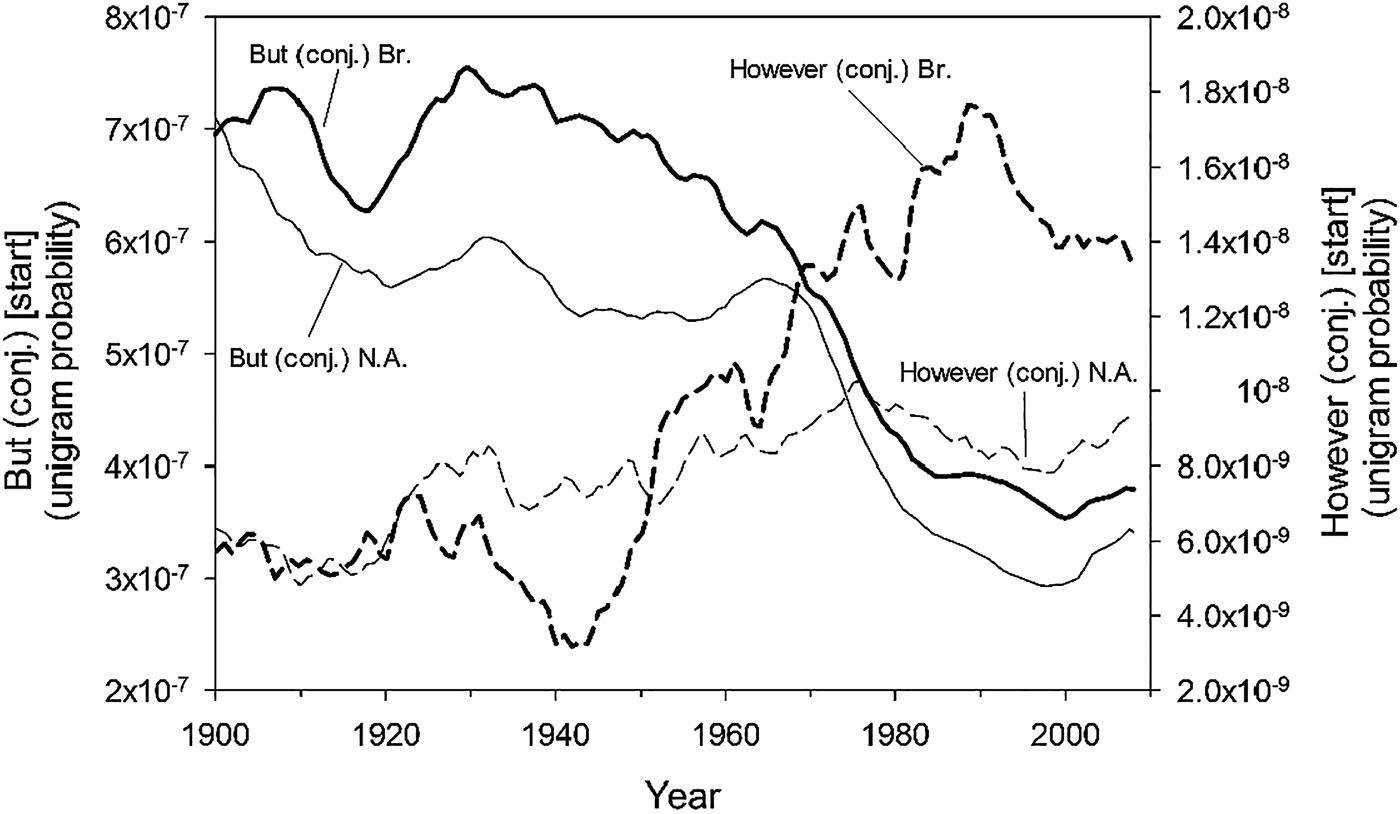
The overall decline in But as a sentence-initial conjunction follows roughly similar paths in British and North American lexicons, especially since the 1970s (Figure 1). In contrast, while sentence-initial However increases in both countries, the trend is much stronger for British English, which experienced a steep incline following the Second World War and continued to increase steeply until reaching a peak around the 1990s. In contrast, the increase started earlier in North America but has also been markedly less pronounced on the whole, as illustrated by the much flatter curve in Figure 1.
Five-year moving average of British (Br.) and North American (N.A.) unigram probability of However and But as sentence-initial conjunctions (conj.) from 1900 to 2008

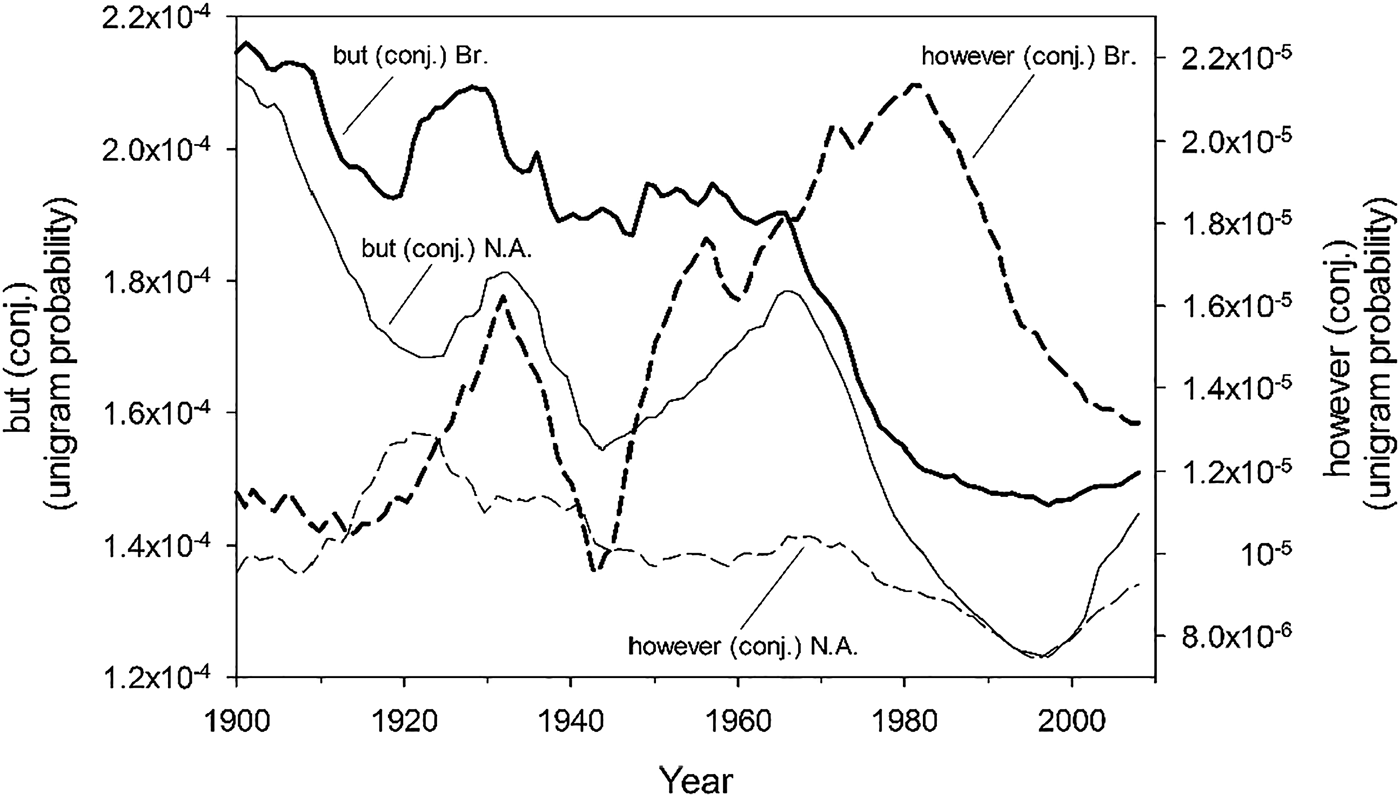
Five-year moving average of British (Br.) and North American (N.A.) unigram probability of however and but as within-sentence conjunctions (conj.) from 1900 to 2008

The trends within sentences are more opaque, but some generalisations can be made. In British English the within-sentence use of but as a conjunction has declined steadily. This has not however been neatly mirrored by a concomitant increase in the use of however as a within-sentence conjunction. Rather, after an initial increase until around 1930, within-sentence conjunction use decreases drastically through to the Second World War, after which it increases again for several decades before undergoing a precipitous decline in the late 1980s. The North American story is equally messy, with use generally declining over the decades, but there has been a steady increase since the 1990s. Overall, however has been used much less as a within-sentence conjunction in North America than in Britain, and experienced only a gentle decline over the last century relative to the pronounced troughs and peaks of the British path for the word and also relative to the within-sentence use of but as a conjunction, which roughly follows the trends observed in Britain but at a lower unigram probability.
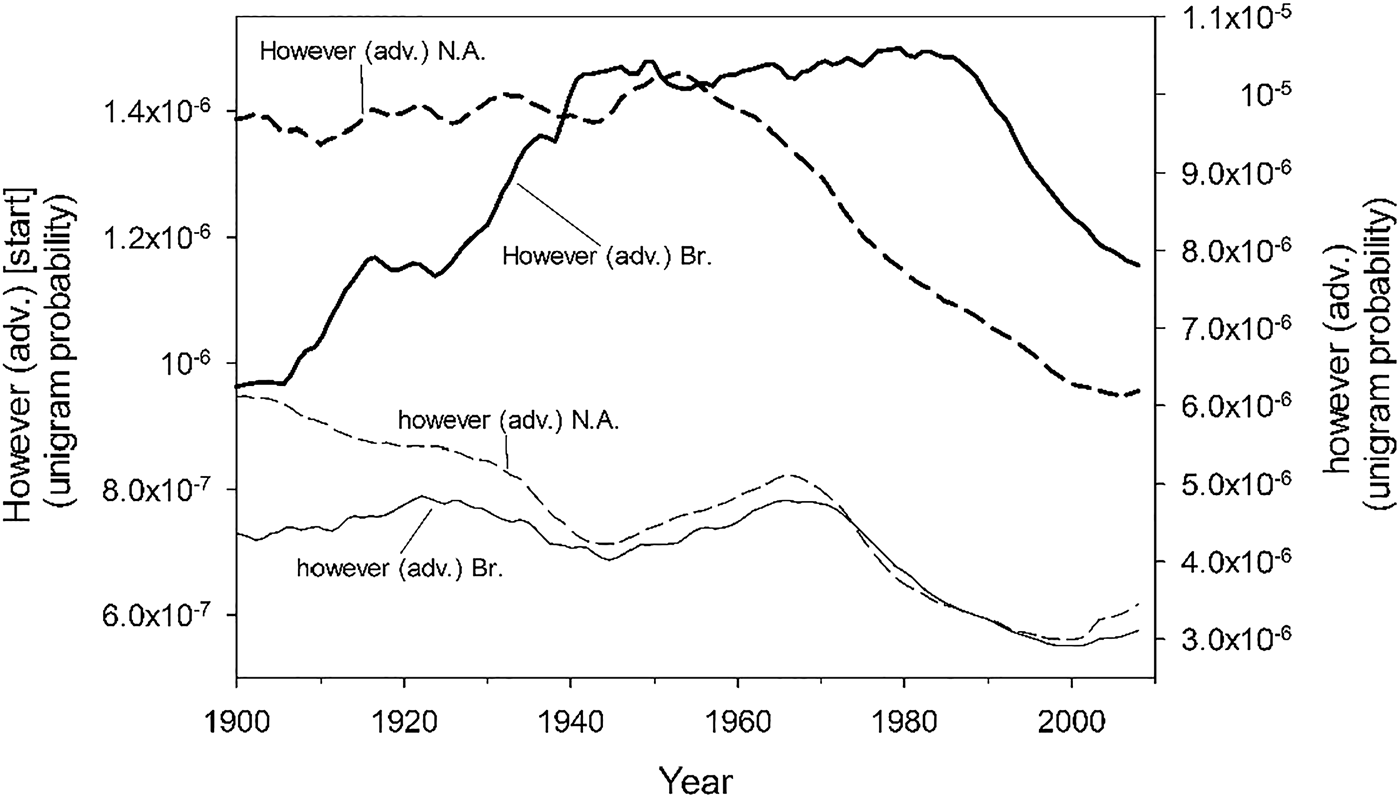
The adverbial use of however (keeping in mind that one cannot distinguish between conjunct, disjunct or adjunct in Google Ngram Viewer) follows remarkably similar paths for Britain and North America for within-sentence usage since the war but traces somewhat different trajectories as a sentence-initial, but both have been experiencing a steady downward trend in recent decades (Figure 3).
Five-year moving average of British (Br.) and North American (N.A.) unigram probability of however and but as sentence-initial and within-sentence adverbs (adv.) from 1900 to 2008

It is also worth noting that the unigram probability of however as an adverb, be it at the start or within a sentence (Figure 3), is a few of orders of magnitude higher than its use as a conjunction (Figure 1).
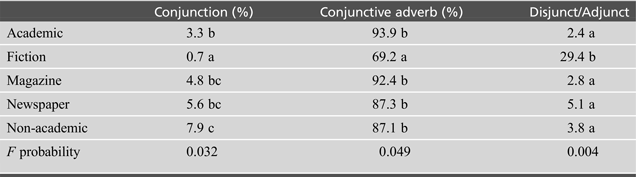
Analysis of the British National Corpus revealed a statistically significant effect of genre on the frequency of however as conjunction, as a conjunctive adverb (i.e., a conjunct), and as an adjunct/disjunct (Table 1). Fiction is the stand-out genre, hosting statistically significantly less of the conjunction and the conjunctive adverb usages, and more usage of adjuncts/disjuncts than any of the other genres (Table 1). The use of the conjunction was an order of magnitude lower than all other disciplines and the use of adjuncts/disjuncts and order of magnitude higher. The difference, while still significant, was less between fiction and the other genres for the conjunctive adverbial use.
Percentage frequency of however, regardless of position within a sentence, across genres from a random sample (binomial total) of 5,000 however-containing sentences from the British National Corpus (1,000 per genre)

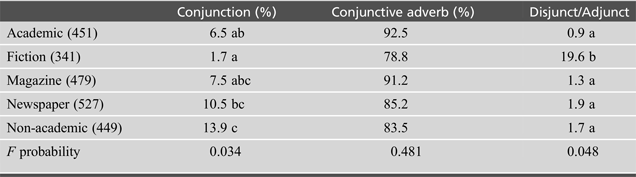
Percentage frequency of sentence-initial However across genres from a random sample of 2,247 However-containing sentences from the British National Corpus

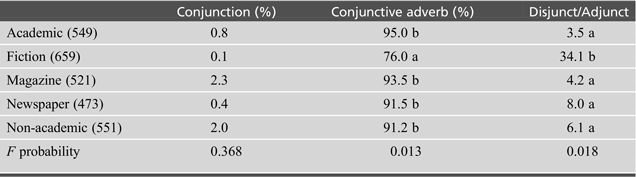
Numbers in parentheses after genres represent sample sizes
When considering the use of However solely at the start of a sentence, a statistically significant order-of-magnitude higher frequency of the word was observed for fiction in comparison to the other genres. Similarly, a statistically significant effect of conjunction was observed, with the fiction genre being statistically different from newspaper and non-academic writing but not the other categories.
The within-sentence use of however also revealed a statistically significant and order-of-magnitude higher percentage frequency of the disjunct/adjunct usage, and conversely a statistically significant lower use of the conjunctive adverb than for all other genres (Table 3). No significant effect of conjunction use was observed across genres.
Percentage frequency of within-sentence use of however across genres from a random sample of 2,753 sentences from the British National Corpus

Percentage frequency of however from a random sample of 1,000 however-containing sentences (sentence-initial = 607, within-sentence = 393) from the Wikipedia Corpus

The Wikipedia corpus revealed a strong preference of the conjunctive adverb form both at the start and within sentences, yet all but complete avoidance of the disjunct/adjunct.
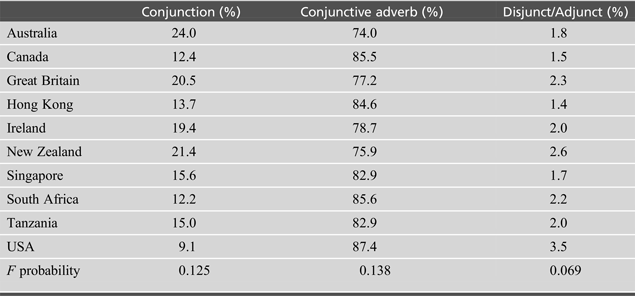
No significant country effects were observed for any of the word forms (Table 5).
Overall percentage occurrence of However/however across countries as a conjunction, a conjunctive adverb, and as a non-conjunctive adverb (disjunct or adjunct) in a stratified random sample of 9,000 sentences (9 countries x 1,000 sentences per country) containing However/however (Corpus of Web-Based Global English)

Separate analyses on the use of conjunct and adjunct/disjunct adverbial uses of However as a sentence initial and however within a sentence also revealed no significant effects (P > 0.05).
Conclusions
Conjunctive howeveritis, the use of however as a coordinating conjunction, has been demonstrated in this analysis to be a fairly widespread phenomenon, although it is still generally an order of magnitude lower than the grammatically legitimate use of the word as a conjunct, i.e., as a conjunctive adverb. Despite being an incredibly large dataset, the Google Books corpus likely understates the extent of conjunctive howeveritis considerably because for most books the red pen of the copy editor is granted licence to correct such errors, and it may also simply be that be that writers of fiction are more orthodox in their grammatical usage preferences. Of course, not all books in the Google Books corpus are fiction, but it is certainly the dominant genre (Michel et al. Reference Michel, Shen, Aiden, Veres, Gray, Pickett, Hoiberg, Clancy, Novig, Orwant, Pinker, Nowak and Aiden2011). These suppositions that fiction writers are better versed in English grammar and that the rigorous editing process in books eliminates many errors are generally well supported by the analyses of the British National Corpus, especially the order of magnitude higher use of the word as a disjunct/adjunct in fiction relative to other literature, and the significantly lower incidence of conjunctive howeveritis than in all other genres. Furthermore, the Corpus of Web-based English, which could reasonably be expected to represent much less heavily edited and texts on the whole, revealed levels of conjunctive howeveritis that were about one or two orders of magnitude higher than observed for any genre in the Google Books corpus. Interestingly, the result for the Wikipedia corpus fell roughly half-way between the two, perhaps suggesting an intermediate level of editing and/or grammatical knowledge.
The lack of significant differences in the use of however across a broad selection of countries that host English as at least one of their official languages was perhaps surprising, given the well-documented differences in the language in many other aspects throughout the world (Norton, Reference Norton1997; Crystal, Reference Crystal2003). Perhaps this finding reflects a homogenising effect of the Internet. It may also in part be an artefact of the corpus itself, as countries are identified by the domain extensions, and the text in the document may not necessarily have been written by an author from that country.
It is of course impossible with this study design to infer causation for conjunctive howeveritis, and the two reasons I proffer - the misconception that a sentence should not commence with But and the conception that however sounds more impressive - cannot be disentangled; nor are they mutually exclusive. It is worth noting though that Figure 1 demonstrated a clear increase in sentence-initial However over time and a concomitant decrease in But. Whilst this represents the first attempt to quantify the phenomenon, it is certainly not the first time it has been observed. In his seminal A Dictionary of Modern English Usage the lexicological genius Fowler (Burchfield, Reference Burchfield2004: 121) himself lamented the phobia of starting a sentence with But and its equally maligned cousin conjunction And:
There is a persistent belief that it is improper to begin a sentence with And, but this prohibition has been cheerfully ignored by standard authors from Anglo-Saxon times onwards … The widespread public belief that But should not be used at the beginning of a sentence seems to be unshakeable. Yet it has no foundation.
Likewise, across the Atlantic, Garner, arguably the most respected North American lexicographer, had this to say on these aspersed conjunctions:
It is a gross canard that beginning a sentence with but is stylistically slipshod. In fact, doing so is highly desirable in any number of contexts, as many stylebooks have said (many correctly pointing out that but is more effective than however at the beginning of a sentence) (Garner Reference Garner2003: 118)
Garner (Reference Garner2001: 20) summed it up even more succinctly in an earlier text: ‘[the] idea that it is poor grammar to begin a sentence with And or But … is nonsense baggage that so many writers lug around.’ The latest edition of the eminent Chicago Manual of Style (2015: 5.206) supports this view for the North American language by clearly stating that the idea that a conjunction cannot be used to commence a sentence has ‘no historical or grammatical foundation.’
The question that remains is what does the future hold. From a presciptivist's viewpoint we simply need better education, for, as demonstrated in the introduction, conjunctive howevereitis is inefficient because it requires the reader to retrace their steps. Also, even though a hard-line prescriptivist must acknowledge that English is an evolving language, the retort to this descriptivist line of argument is that conjunctive howeveritis actually represents regression rather than evolution, given that it introduces inefficiency in terms of text processing. In other words, it does not introduce an element of positive adaptiveness, such as the introduction of a new word does.
I believe that conjunctive howeveritis can mostly be traced to what Gardener so aptly described as the ‘unshakable’ belief that a sentence cannot be started with a coordinating conjunction. A century later, it appears to be neither shaken nor stirred. It is my hope that this paper will help to shake things up again before they settle on an efficient use of the word however.
 ANDREW HAMILTON is an Adjunct Professor at Federation University Australia and an Honorary Principal Fellow at The University of Melbourne. He is a biophysical scientist with broad interests in modelling biological systems, but is also fascinated with scientific writing. Here he has applied his quantitative skills to an element of grammar that he has noticed over the years of reading students’ assignments and colleagues’ work. Email: andrew.hamilton@federation.edu.au