Introduction
Prognostication is the skill of predicting illness behavior, including terminal outcomes (Christakis, Reference Christakis2001), and enables patients with dementia and their families to prepare for the end of life (van der Steen et al., Reference van Der Steen, Radbruch and Hertogh2014; Ansari et al., Reference Ansari, Pomerantz and Abedini2019). Dementia has traditionally been associated with a prolonged decline (Lunney et al., Reference Lunney, Lynn and Hogan2002; Murray et al., Reference Murray, Kendall and Boyd2005), and people with dementia can remain in an advanced stage of functional and cognitive impairment for months to years, with a chronic risk of sudden death (Widera and Bernacki, Reference Widera, Bernacki, Cherny, Fallon, Kaasa, Portenoy and Currow2015). Death results from a dynamic interaction between multiple pathophysiological factors causing a “chain of events” (ABS, 2017). For many patients, prognostication is confounded by comorbid age-related life-limiting conditions, which can pose independent risks for mortality and dementia progression (Brown et al., Reference Brown, Sampson and Jones2012). People may die before reaching an advanced stage of dementia from cancer, cardiovascular, and cerebrovascular diseases (van De Vorst et al., Reference van de Vorst, Koek and Bots2016). In fact, most people diagnosed with dementia will die exhibiting only moderate cognitive decline (Aworinde et al., Reference Aworinde, Werbeloff and Lewis2018).
Perhaps understandably, there is uncertainty whether to introduce a palliative approach following an initial diagnosis of dementia, when treatments for comorbidities fail, or when advanced symptomatology is present (Davies et al., Reference Davies, Maio and Paap2014; van Riet Paap et al., Reference van Riet Paap, Mariani and Chattat2015). The advantage of clinician and family concordance that dementia is a life-limiting illness ensures that there is a decreased risk of futile life-prolonging treatments at the end of life (van Der Steen et al., Reference van Der Steen, Onwuteaka-Philipsen and Knol2013). This facilitates quality end-of-life care for people with dementia through appropriate pain and symptom management to promote comfort, limitation of invasive or aggressive interventions, and avoidance of hospitalization where such treatments are likely to be performed (van der Steen et al., Reference van Der Steen, Radbruch and Hertogh2014). People with dementia are at a higher risk of adverse outcomes during hospitalization, including mortality (Singh et al. Reference Singh, Edwards and Duric2019, Sampson et al., Reference Sampson, Blanchard and Jones2009). Yet, it may be unclear whether emerging symptoms have treatable sources or indicate transition to the terminal phase, and families or nursing homes may seek hospitalization for investigation and diagnosis (Denning et al., Reference Denning, Greenish and Jones2012, Reyniers et al., Reference Reyniers, Houttekier and Cohen2014). Otherwise, hospitalization may be required following unanticipated medical and psychosocial crises, including falls or carer stress (Pohontsch et al., Reference Pohontsch, Scherer and Eisele2017; Sadak et al., Reference Sadak, Foster Zdon and Ishado2017).
Generally, the focus of acute hospital treatment is to resolve presenting medical concerns, which may mask underlying terminal processes in elderly patients (Blaney et al., Reference Blaney, Crawford and Elder2011). Clinicians may struggle to distinguish between dementia progression, exacerbations of comorbid illnesses, and the dying process itself (Small et al., Reference Small, Froggatt and Downs2007; Thune-Boyle et al., Reference Thune-Boyle, Sampson and Jones2010; Lamahewa et al., Reference Lamahewa, Mathew and Iliffe2018). The initiation of end-of-life care in hospital typically occurs only days prior to death, forcing rapid psychosocial adjustment for families (Tan et al., Reference Tan, Lee and O'Connor2012; Lewis, Reference Lewis2014). This highlights the need to gain an understanding of how trajectories culminating in death during hospital admission unfold for patients with dementia. Consequently, we sought clinician and family understanding of dementia trajectories in relation to the end of life in hospital. In doing so, we carefully examined interpretations of the pathophysiological dynamic underpinning transitions to the end of life.
Methods
Design
Two theories, social constructionism and complexity theory, informed the study design. Social constructionism suggests that knowledge about dementia evolves through intersubjective social processes in which the negotiation and sustaining of meaning occurs (Berger and Luckmann, Reference Berger and Luckmann1966; Harding and Palfrey, Reference Harding and Palfrey1997). Second, complexity theory examines how underlying attitudes concealed within care practices shape emergent clinical outcomes such as end-of-life care. To make such sense of this, qualitative semi-structured interviews focused on participants’ narratives of either the professional experience of caring for patients with dementia at the end of life or experiences of a loved one's diagnosis, illness, and death (Polkinghorne, Reference Polkinghorne1988) (See supplementary file for interview sample). The study received ethics approval from the Monash Health Human Research Ethics Committee (Ref. No. 15242A).
Sample
The setting for the study was the General Medicine unit in a large university hospital in Melbourne, Australia. Medical, nursing, and social work clinicians (n = 20) were purposively recruited to provide clinical perspectives on the end-of-life care for patients with dementia. These participants ranged in experience from recent graduates to senior physician consultants and managers. Bereaved family members (n = 12) of 10 deceased patients who had a documented diagnosis of dementia and a period of end-of-life care were invited to participate 2–3 months following death via a letter outlining the purpose of the study. Bereaved family members were listed as primary next-of-kin in patient files and included spouses (2), daughters (6), sons (3), and 1 daughter-in-law.
Data collection
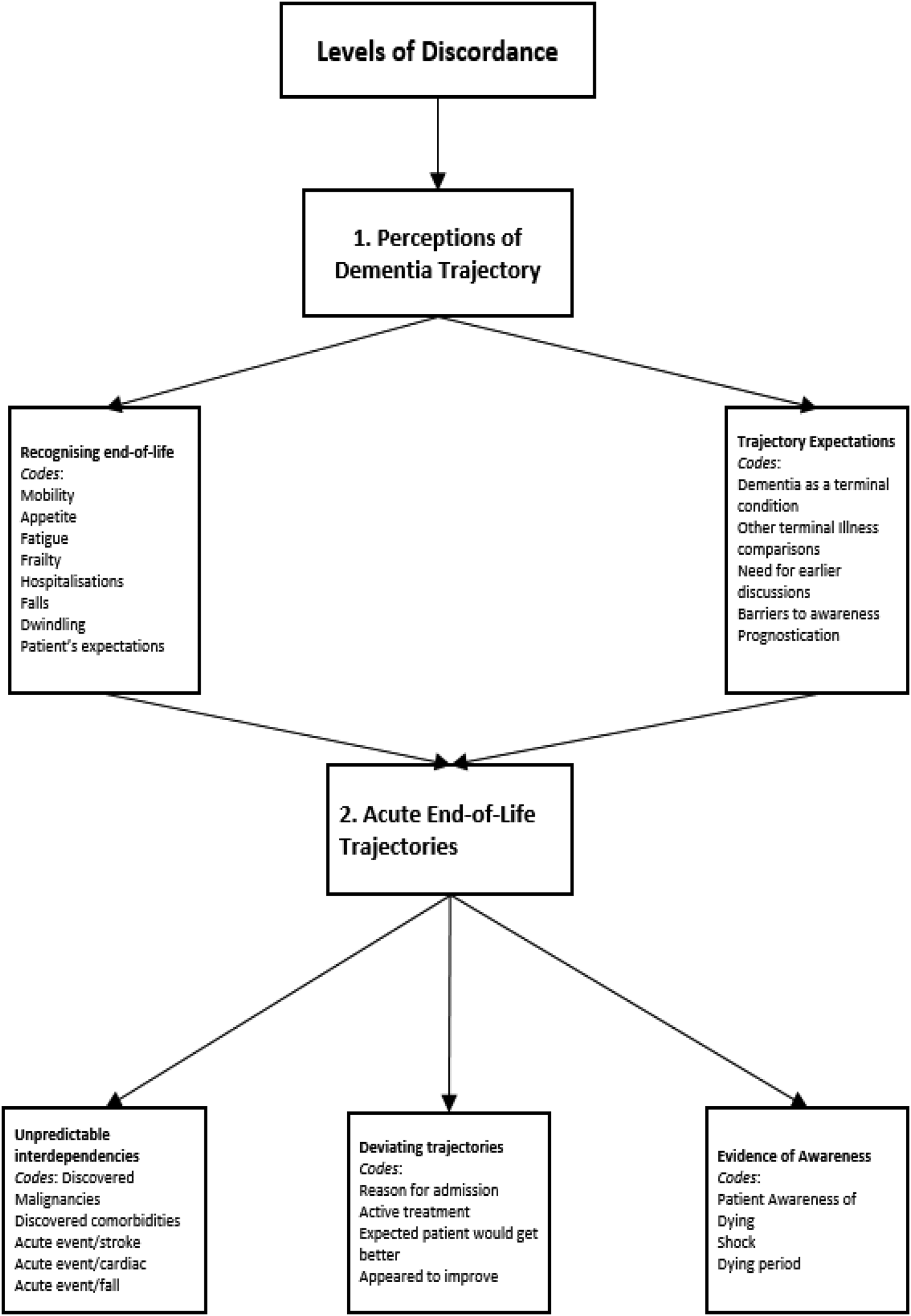
Interviews were conducted at the hospital, families’ homes, or over the phone. Interpreting services were offered for participants from culturally and linguistically diverse backgrounds. Participants signed a written consent form prior to the interview. Interviews were audio-recorded and transcribed with identifying details removed. Data were electronically coded using NVivo. Transcripts underwent formal thematic narrative analysis to identify themes and develop insights into the patterns of meaning present (Braun et al, Reference Braun, Clarke, Terry, Rohleder and Lyons2015). Three authors (F.M., D.W.K., and F.Mc.D.) jointly analyzed findings and developed a coding map to represent the data (see Figure 1, coding diagram). Saturation occurred when no new codes or themes were evident in the transcripts. Analytical rigour was achieved using critical reflexivity during multidisciplinary discussion, prolonged immersion with data forms (i.e., manual transcribing, repeated readings, and exploration of alternate coding systems), and indicated by emerging coherence and consistency across participant narratives (Creswell and Poth, Reference Creswell and Poth2017; Maher et al., Reference Maher, Hadfield and Hutchings2018).
The codes recognized in the data are laid out to demonstrate the pathway to the themes and subthemes reported.

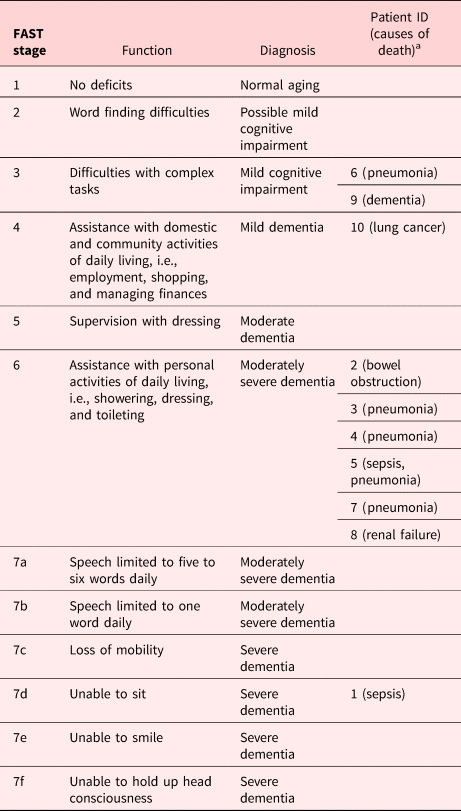
Using data derived from medical records, the stage of dementia for patients was assessed using the validated Functional Assessment Stage Tool (FAST) guidelines (Reisberg, Reference Reisberg1988). The functional ratings of the FAST differentiate mild cognitive impairment from moderate to severe stages of dementia. Staging was confirmed through family collateral obtained during the interview process.
Results
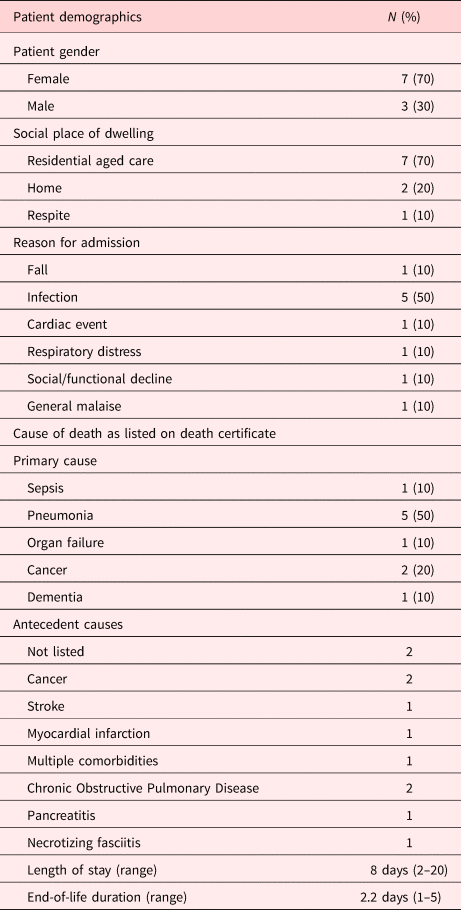
Most patients exhibited mild to moderately severe functional impairment on their FAST scores prior to admission. All but two patients were residing in a nursing home at the time of admission (see Table 1). While families often held informal discussions with nursing home staff regarding treatment limitations, only one patient had a formal Advance Care Plan, and only one patient died at an advanced stage of illness (see Table 2).
Sociodemographic and medical characteristics

Patient stage of dementia based on the FAST guidelines (adapted from Reisberg, Reference Reisberg1988) alongside cause of death for participants

a Causes of death as extracted from the death certificate.
Qualitative analysis demonstrated divergence between the clinicians and families’ experiences of end-of-life admissions (see Figure 2). The first theme highlights the broad constructions of the dementia trajectory and expectations regarding prognosis. The second theme demonstrates how end-of-life events unfold in the acute care context.
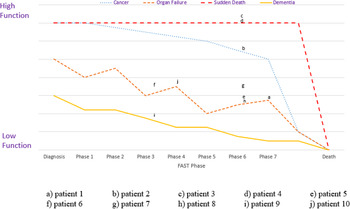
Patients with dementia at varying FAST phases are positioned against the trajectories accounted for by their death to illustrate the complexity of what determined their actual death.

Theme 1. “The light gradually gets turned down”: perceptions of the dementia trajectory
Trajectory expectations
The first source of dissonance concerned awareness of dementia as a terminal condition. Clinicians overwhelmingly viewed dementia as a progressive life-limiting illness. Death was attributed to failing bodily functions or vulnerability to life-threatening infections:
“If people haven't fallen to opportunistic problems like pneumonia or a urinary tract infection, I base it on when people lose basic drives … it's really that stage [when] it's defined as a terminal illness.” (Registrar)
Alternatively, families did not interpret dementia as a terminal diagnosis. Rather, comorbid life-limiting illnesses were considered a greater threat to life expectancy and well-being:
“I got the feeling other things would become more of a concern — more serious things like the cancer.” (Son, patient 8)
Given the myriad of concomitant health factors, it was difficult for families to predict how deterioration would eventually unfold. Although families expected cognitive decline accompanying dementia, drastic physical decline was less anticipated but often equally confronting:
“We knew it would only get worse in a matter of time, but the thing is, no one actually expects it … to actually witness it in the last two weeks? It's quite sad.” (Son, patient 5)
The onset of dementia and intermingling comorbidities had often insidiously evolved, leaving little time to elicit patient's expectations regarding the future. Regardless, and despite their confusion, several patients indicated awareness their life was nearing its end:
“She used to come out with comments like ‘I'm just sitting here waiting for God to take me’ … that sort of thing.” (Son, patient 6)
Yet it must be acknowledged that patients’ awareness of their mortality often fluctuated due to underlying cognitive oscillations:
“He would go from 'I might as well die … can you get me some pills' … the next minute he would say, 'Well what are we doing for my 95th? What are we doing for my 100th?'” (Daughter 2)
Recognizing the end of life
Cognitive and physical deterioration marked the transition into the final phase of life. Clinicians adhered to traditional models of dementia deterioration characterized through a gradual loss of awareness and consciousness:
“My metaphor is they go from being a 100-watt light bulb to a 40-watt and then to a 15-watt … then the light just gradually gets turned down; they don't burn as brightly.” (Consultant)
Families developed an awareness of progression primarily through frailty, loss of appetite, increased fatigue, and declining mobility:
“She became frail, so with her frailty there was an expectation that we were getting to the ‘end game’, so to speak, not that she was distressed or unwell [daughter-in-law: she was just slowly winding down] she was slowly winding down.” (Son, patient 6)
Both clinicians and families recognized eating changes indicated changing health. During hospitalization, however, families perceived the loss of appetite as a symptom of underlying acute illness requiring treatment, whereas clinicians viewed anorexia as a natural sign of dying:
“People die of dementia, there's no doubt about that. We see patients that come in not eating and that's a difficult discussion with relatives, until you can convince them that stopping eating is actually a terminal part of dementia.” (Consultant)
Families often observed gradual and incremental changes over a prolonged period, making it difficult to discern progression to moderate and severe stages of dementia. Frailty and dependence became normalized. A sudden acute event interrupted an otherwise gentle decline:
“It was unexpected. We thought we had years with dad. We did not see it coming. We just had no idea it was gonna happen.” (Daughter, patient 1)
Theme 2. “Put together, holding on and letting go”: acute end-of-life trajectories
Unpredictable interdependencies
Most patients in this study presented to hospital with undifferentiated medical concerns or complaints. Aside from one case, the decision to hospitalize nursing home residents was initiated by staff in consultation with the family. Hospital clinicians viewed mortality as an emergent outcome reflecting interdependencies between an acute insult and vulnerable systemic health:
“Because they usually come in with chest infections and then dementia is something ‘over there’ [gestures] … it's not necessarily put together so they're like … once he's over that chest infection, he'll go back to normal.” (Nurse Unit Manager)
Consistent with this perception, families tended to describe initial presenting complaints as common health issues that could be resolved through uncomplicated treatments:
“They said ‘she's got pneumonia’. Normally everybody treats pneumonia with antibiotics, so there's [an] expectation antibiotics should fix it.” (Son, patient 6)
Families were often prepared early in the admission that patients had a guarded prognosis based on their frailty and complex comorbidities, yet still hoped that treatment would follow a linear course to recovery. However, patients’ health did not behave in a predictable manner:
“I can remember talking to them on those first couple of days. They were still hopeful that they were going to get the infection under control. But it became apparent a few days later that it wasn't.” (Daughter, patient 4)
Alternatively, several patients responded to treatment and were "medically cleared" for discharge. As a result, families often discussed increased care requirements with patients’ nursing homes or engaged with social work around discharge planning:
“A gentleman came into hospital very unwell, but then seemed stable, so we got involved … . I felt he was worse and checked with the medical team. They said ‘Yeah, still for care, he's stable enough, he might die before he goes, he might not’, and he died.” (Social Worker)
Deviating trajectories
Comparison between clinicians and families’ views of the aetiology lead to end-of-life highlighted divergence. Clinicians expected that end-of-life events occurring in hospital were the typical consequence of a dementia trajectory:
“It's not a sudden event like a heart attack. There is another complicating factor that has bought them to end-of-life.” (Social Worker)
Pneumonia and infection were commonly reported causes of mortality in this patient population:
“The [dementia patients] at end-of-life come in with pneumonia.” (Nurse)
However, several families reported deviations when incidental events occurred, seemingly unrelated to dementia, which ultimately contributed to death. In these instances, the clinical course to mortality was discordant with families’ expectations:
“The CT brain came through with a small bleed in the brain.” (Daughter, patient 10)
In other cases, symptoms, such as the loss of appetite or breathlessness, were later attributed to malignancies. Given the age and frailty of the patients, diagnostic investigations were unnecessarily burdensome and probably futile:
“They found a mass on her lung … because the death certificate says ‘pneumonia’ we don't know whether that was cancerous, because at 92 they're not going to do a biopsy or anything.” (Daughter, patient 5)
Evidence of awareness
None of the patients in this study had been referred to palliative care services prior to their final admission. Although clinicians viewed dementia as a terminal illness, in the hospital setting, the integration of a palliative approach only commenced in the final phase of life:
“In general medicine, usually when we are going to palliate them, they've got hours or days.” (Nurse)
The initiation of palliative care occurred reactively and suddenly, leaving little time for families to adjust to the patients’ death:
“It was a shock that it happened so quickly." (Son, patient 6)
Due to acute illness, most patients were generally drowsy and were not consciously aware of the transition to the end-of-life care. Despite this, a few families believed that patients were "holding on":
“He was letting go but he was trying to hang on as well …. I think in his mind he was thinking ‘I've got to hold on for as long as I can for [wife] to get used to it.’” (Daughter patient 10)
Families’ perceptions of patients’ mental resistance strongly contrasted with the cognitive deficits associated with dementia. One wife observed her husband gripping on to cords and bed rails and reasoned “his brain was saying ‘well, don't let go because if you let go, I'm gone!’” (Wife, patient 8).
Even at the end of life, and despite dementia, families related to the patients as intentional and conscious beings. Families distinguished between body and mind during the dying process, as two separate but interacting processes:
“Why are you making all of this effort when it's your time to go? But it's just the body, it's not so much the mind, it's the body closing down or doing what it needs to do.” (Daughter, patient 3)
Discussion
This study examined how clinicians and families understood the dementia trajectory in relation to the end-of-life care in hospital. Clinicians drew from a broad and objective perspective of the dementia trajectory on a continuum from diagnosis to death, anticipating that most end-of-life scenarios were a consequence of illness severity or traditional complications such as infection rather than a sudden or unanticipated event. Although a gradual pattern of physical and cognitive deterioration resonated across families’ accounts, several relatives described the end-of-life events in hospital stemming from alternate medical crisis and trajectories, such as organ failure and cancer. These findings suggest limitations of traditional trajectory models in the acute hospital context, where chronic illnesses and acute events intersect and challenge dominant understandings of terminal pathways.
The notion of an observable and distinct trajectory, which allows accurate prognostication, appeals to deterministic notions of predictability leading to a “good death,” where patients are able to exert some control over the circumstances of their demise (Christakis, Reference Christakis2001; Murray et al., Reference Murray, Kendall and Boyd2005). In our study, dominant narratives regarding the prolonged dwindling pattern informed clinician's understandings, whereas the experiences of some families suggested divergence. This is not suggesting that either group's construction was inaccurate; rather that the end of life in hospital for a patient with dementia often involves a collision of trajectories. Although several disease-centric models of palliative care highlight specific needs that arise from dementia symptomatology (van Der Steen et al., Reference van Der Steen, Radbruch and Hertogh2014), little attention has been paid to approaches that address the intersection between primary and secondary illnesses, comorbidities, or complications.
It is tempting to reiterate the importance of education about illness progression and signs of dying for families of people with dementia. Certainly, comprehensive advance directives may ensure that early signs of deterioration and dying are recognized and people with dementia receive appropriate end-of-life care in a familiar environment cared for by those who know them best. However, in many cases where symptoms are ambiguous, families — along with nursing homes — are placed in the difficult position of determining the appropriateness of hospital admission, without the benefit of medical expertise to ascertain the exact cause of illness (Pohontsch et al., Reference Pohontsch, Scherer and Eisele2017). This also disregards the possibility, albeit small in the current sample, of hospitalization resulting from psychosocial crises (Sarak et al., 2017). A limitation of this study is a lack of perspectives from nursing home staff, which would achieve a holistic systemic understanding of end-of-life admissions for people with dementia from aged care facilities.
Alternatively, hospital admissions can be beneficial for people with mild to moderate stages of dementia. Many patients will require hospitalization for the treatment of nonlife-threatening injuries and psychosocial optimization. Only a relatively small population will receive end-of-life care in hospital (AIHW, 2019). Death in hospital may not necessarily reflect a failure in prognostication, but rather occur due to unforeseen events. Although ideally hospitalization near the end of life is avoided, a more pragmatic approach is to enhance the general quality of hospital care for patients with dementia, who may unexpectedly deteriorate following admission.
Both clinicians and families used metaphors to explain and simplify the clinical changes they observed as people with dementia deteriorated. The use of metaphors to simplify the dementia trajectory can be advantageous when condensing a myriad of physical and cognitive symptoms observed over a relatively long period into a cohesive narrative. Skillful communication conveying illness progression is vital to facilitate family's preparation for the end of life (Lewis, Reference Lewis2014). However, care is required to ensure that information regarding poor prognosis is communicated clearly, as families can feel that healthcare professionals "beat around the bush" rather than directly naming the dying process (Hovland and Kramer, Reference Hovland and Kramer2019). Perhaps, a solution for clinicians is to integrate an understanding that the dementia trajectory can be nonlinear with a potential downhill spiral during every admission. Complexity lies therein: which trajectory is the patient following at any moment in time? Such education for patients and families would alleviate the pressure to provide precise and deterministic prognostications, because uncertainty can prevail, given the frailty that accompanies this diagnosis (Christakis, Reference Christakis2001).
Limitations
The study did not include nursing home staff, which could provide further insight regarding the decision to seek hospitalization for ambiguous symptoms. Given the study was situated in the south-eastern region of Melbourne, Australia, there was cultural diversity within both the family and clinician sample. Although not an explicit specific focus of the present study, further research could generate awareness of how cultural differences shape the awareness of illness trajectories and attitudes toward the risks or benefits of hospital care at the end of life.
Conclusion
When patients with mild to moderate dementia are admitted to the acute hospital setting with concurrent infections or acute events, prognostication based on a single trajectory becomes risky. Patients with dementia presenting to hospital may only be in a moderate phase of a dementia illness trajectory and yet be more likely to die from comorbid illness or events rather than dementia itself. Care is needed to untangle the families’ expectations of illness progression and education that dementia is life-limiting but may also complicate other conditions (Brown et al., Reference Brown, Sampson and Jones2012). The integration of a combined trajectory model may assist clinicians to better prepare patients and families for the end-of-life transitions in hospital.
Supplementary material
The supplementary material for this article can be found at https://doi.org/10.1017/S1478951521000109.
Funding
This research received no specific grant from any funding agency, commercial, or not-for-profit sectors.
Conflict of interest
There are no conflicts of interest.