INTRODUCTION
Subjective cognitive complaints (SCC) are an integral component of the diagnostic criteria for mild cognitive impairment (MCI) (Albert et al., Reference Albert, DeKosky, Dickson, Dubous, Feldman, Fox and Phelps2011; Petersen, Reference Petersen2004; Winblad et al., Reference Winblad, Palmer, Kivipelto, Jelic, Fratiglioni, Wahlund and Petersen2004). SCC have utility in that they are often the impetus for a patient to seek an evaluation or present to a memory clinic. However, the inclusion of SCC as a core diagnostic feature has been questioned, given the inconsistent relationship between self-reported SCC and objective cognitive functioning in MCI (Lenehan, Klekociuk, & Summers, Reference Lenehan, Klekociuk and Summers2012; Roberts, Clare, & Woods, Reference Roberts, Clare and Woods2009; Ryu, Lee, Kim, & Lee, Reference Ryu, Lee, Kim and Lee2016). This weak relationship is further attenuated by at least two factors: (1) individuals with objective cognitive impairment may demonstrate anosognosia or reduced awareness of their cognitive decline (Galeone, Pappalardo, Chieffi, Iavarone, & Carlomagno, Reference Galeone, Pappalardo, Chieffi, Iavarone and Carlomagno2011; Hill et al., Reference Hill, Mogle, Wion, Munoz, DePasquale, Yevchak and Parisi2016; Roberts et al., Reference Roberts, Clare and Woods2009; Starkstein, Reference Vogel, Stokholm, Gade, Andersen, Hejl and Waldemar2014; Vogel et al., Reference Vogel, Stokholm, Gade, Andersen, Hejl and Waldemar2004), leading them to underestimate or under-report SCC; and (2) self-reported SCC in older adults have been found to be more strongly related to emotional factors such as depression and anxiety (Buckley et al., Reference Buckley, Saling, Ames, Rowe, Lautenschlager, Macaulay and Ellis2013; Ryu et al., Reference Ryu, Lee, Kim and Lee2016; Slavin et al., Reference Slavin, Brodaty, Kochan, Crawford, Trollor, Draper and Sachdev2010; Studer, Donati, Popp, & von Gunten, Reference Studer, Donati, Popp and von Gunten2013; Yates, Clare, & Woods, Reference Yates, Clare and Woods2017) and personality characteristics such as neuroticism (Reid & MacLullich, Reference Reid and MacLullich2006; Slavin et al., Reference Slavin, Brodaty, Kochan, Crawford, Trollor, Draper and Sachdev2010), than to actual cognitive ability, which may lead cognitively normal individuals to overestimate or over-report cognitive problems.
The original diagnostic criteria for MCI required only self-reported SCC. Although the original criteria state that it is “preferable” to have a patient’s SCC corroborated by an informant, this is not a requirement (Petersen, Reference Petersen2004; Petersen et al., Reference Petersen, Smith, Waring, Ivnik, Tangalos and Kokmen1999). Subsequent revisions to the criteria stipulate that the subjective complaint or concern can be obtained from either the patient, an informant (Winblad et al., Reference Winblad, Palmer, Kivipelto, Jelic, Fratiglioni, Wahlund and Petersen2004), or a skilled clinician observing the patient (Albert et al., Reference Albert, DeKosky, Dickson, Dubous, Feldman, Fox and Phelps2011; Petersen et al., Reference Petersen, Aisen, Beckett, Donohue, Gamst, Harvey and Weiner2010). These three sources are considered equally valid and reliable for the purposes of making an MCI diagnosis, as concern from any one of them is sufficient to fulfill the criterion. In addition to a subjective complaint, the current diagnostic criteria for MCI also include: objective evidence of cognitive impairment (typically considered 1 to 1.5 standard deviations (SDs) below normative means on one or more cognitive measures), preservation of independence in functional activities, and not meeting criteria for dementia (Albert et al., Reference Albert, DeKosky, Dickson, Dubous, Feldman, Fox and Phelps2011).
Despite the widespread use of these diagnostic criteria, research has shown that they produce MCI samples that are heterogeneous with respect to their neuropsychological performance and Alzheimer’s disease (AD) biomarker characteristics (Clark et al., Reference Clark, Delano-Wood, Libon, McDonald, Nation, Bangen and Bondi2013; Edmonds et al., Reference Edmonds, Delano-Wood, Clark, Jak, Nation, McDonald and Bondi2015; Nettiksimmons, DeCarli, Landau, & Beckett, Reference Nettiksimmons, DeCarli, Landau and Beckett2014). By applying statistical techniques, such as cluster analysis or latent profile analysis, we have previously identified unique MCI subtypes in several different datasets. These include subtypes with deficits primarily in one cognitive domain (e.g., memory; language), and others with multi-domain impairments (Bondi et al., Reference Bondi, Edmonds, Jak, Clark, Delano-Wood, McDonald and Salmon2014; Clark et al., Reference Clark, Delano-Wood, Libon, McDonald, Nation, Bangen and Bondi2013; Delano-Wood et al., Reference Delano-Wood, Bondi, Sacco, Abeles, Jak, Libon and Bozoki2009; Edmonds et al., Reference Edmonds, Delano-Wood, Clark, Jak, Nation, McDonald and Bondi2015; Eppig et al., Reference Eppig, Edmonds, Campbell, Sanderson, Delano-Wood and Bondi2017; Libon et al., Reference Libon, Xie, Eppig, Wicas, Lamar, Lippa and Wambach2010).
Critically, our empirically derived classifications have also yielded a large subtype of individuals who appear to represent false-positive diagnostic errors. These are individuals who were classified as MCI based on the conventional diagnostic criteria, but actually perform within normal limits on a comprehensive battery of neuropsychological tests (Bondi et al., Reference Bondi, Edmonds, Jak, Clark, Delano-Wood, McDonald and Salmon2014; Clark et al., Reference Clark, Delano-Wood, Libon, McDonald, Nation, Bangen and Bondi2013; Edmonds et al., Reference Edmonds, Delano-Wood, Clark, Jak, Nation, McDonald and Bondi2015, Reference Edmonds, Ard, Edland, Galasko, Salmon and Bondi2018; Eppig et al., Reference Eppig, Edmonds, Campbell, Sanderson, Delano-Wood and Bondi2017). Within the Alzheimer’s Disease Neuroimaging Initiative (ADNI), this false-positive subtype, which comprises as much as one-third of the ADNI MCI cohort, demonstrates normal AD cerebrospinal fluid (CSF) and neuroimaging biomarkers (Bangen et al., Reference Bangen, Clark, Werhane, Edmonds, Nation, Evangelista and Delano-Wood2016; Edmonds et al., Reference Edmonds, Delano-Wood, Clark, Jak, Nation, McDonald and Bondi2015, Reference Edmonds, Eppig, Bondi, Leyden, Goodwin, Delano-Wood and McDonald2016). They also show a low rate of progression to AD along with a high rate of reversion to a classification of cognitively normal (Edmonds et al., Reference Edmonds, Delano-Wood, Clark, Jak, Nation, McDonald and Bondi2015), and they remain functionally independent over time (Thomas, Edmonds, Delano-Wood, & Bondi, Reference Thomas, Edmonds, Delano-Wood and Bondi2017).
The propensity for the conventional criteria to over-diagnose MCI is thought to be driven by the reliance on SCC as a core criterion (Edmonds et al., Reference Edmonds, Delano-Wood, Galasko, Salmon and Bondi2014; Lenehan et al., Reference Lenehan, Klekociuk and Summers2012), and by the use of a single memory test to determine objective cognitive impairment (Bondi et al., Reference Bondi, Edmonds, Jak, Clark, Delano-Wood, McDonald and Salmon2014; Brooks, Iverson, Holdnack, & Feldman, Reference Brooks, Iverson, Holdnack and Feldman2008; Brooks, Iverson, & White, Reference Brooks, Iverson and White2007; Jak et al., Reference Jak, Preis, Beiser, Seshadri, Wolf, Bondi and Au2016).
In a previous study (Edmonds et al., Reference Edmonds, Delano-Wood, Galasko, Salmon and Bondi2014), we cross-sectionally examined the discrepancy between participant- and informant-report on the Everyday Cognition (ECog) questionnaire in three empirically derived MCI subtypes: amnestic MCI, mixed MCI, and cluster-derived normal (CDN, i.e., false positives). At this baseline exam, we found an inverse relationship between discrepancy scores and objective memory performance. Specifically, the cognitively intact CDN group, who we concluded had been erroneously classified as MCI in ADNI, overestimated their cognitive problems relative to their informant. On the other hand, the amnestic MCI group, who had significant objective memory impairment on comprehensive neuropsychological testing, underestimated their cognitive problems compared to their informant.
These results provide evidence supporting the notion that inclusion of SCC in the criteria for MCI likely contributes to confusion and misdiagnosis (Lenehan et al., Reference Lenehan, Klekociuk and Summers2012). The mixed MCI group, who had a milder memory impairment relative to the amnestic MCI group, but additional deficits in language and attention/executive function domains, was generally similar in their report of cognitive difficulty relative to their informants’ report.
What remains unclear from the results of our cross-sectional study is how SCC might change over time in our empirically derived MCI subtypes. Other recent cross-sectional studies using similar discrepancy score methods have found increasing unawareness of cognitive problems with increasing objective cognitive impairment (Lehrner et al., Reference Lehrner, Kogler, Lamm, Moser, Klug, Pusswald and Auff2015; Rattanabannakit et al., Reference Rattanabannakit, Risacher, Gao, Lane, Brown, McDonald and Farlow2016). Understanding these patterns of change is important to further elucidate the nature of SCC in those with progressive cognitive impairment as well as in those who remain cognitively normal over time. Therefore, we sought to investigate longitudinal change in the discrepancy between self- and informant-report on the ECog across MCI subtypes and normal control (NC) participants over a 24-month period.
For the amnestic and mixed MCI subtypes, we predicted that ECog discrepancy scores would increase over the 2-year interval, reflecting participants’ greater underestimation of their cognitive problems relative to their informant. We also predicted that the increase in discrepancy scores would be related to worsening objective cognitive performance in the amnestic and mixed MCI subtypes. Furthermore, we hypothesized that the CDN and NC groups would be similar, in that both self- and informant-reported SCC would remain consistent over time, resulting in stable ECog discrepancy scores. We expected objective cognitive functioning to remain stable in the CDN and NC groups. Lastly, we hypothesized that increasing ECog discrepancy scores reflecting unawareness would be observed in participants with abnormal CSF AD biomarkers and in those who progressed to AD.
METHODS
Data were obtained from the ADNI database (adni.loni.usc.edu). ADNI was launched in 2003 by the National Institute on Aging (NIA), National Institute of Biomedical Imaging and Bioengineering (NIBIB), Food and Drug Administration (FDA), private pharmaceutical companies, and non-profit organizations. The primary goal of ADNI is to test whether neuroimaging, other biological markers, and clinical and neuropsychological assessment can be combined to measure the progression of MCI and early AD. ADNI is the result of efforts of many coinvestigators from a range of academic institutions and private corporations, and participants have been recruited from over 50 sites across the United States and Canada. Participants included in ADNI are ages 55 to 90, completed at least 6 years of education, and are free of any significant neurological disease other than AD. All ADNI participants have a study partner who has frequent contact with the participant (an average of 10 hours per week or more) and accompanies the participant to clinic visits. This study was approved by the Institutional Review Boards of all of the participating institutions. Informed written consent was obtained from all participants. For more information, see www.adni-info.org.
Participants
Participants were 475 non-demented ADNI participants (353 with MCI and 122 cognitively normal) from our original sample (n=605; Edmonds et al., Reference Edmonds, Delano-Wood, Galasko, Salmon and Bondi2014) who completed the ECog at their 12-month and 24-month follow-up visits. MCI participants were diagnosed by ADNI based on conventional diagnostic criteria (Petersen et al., Reference Petersen, Aisen, Beckett, Donohue, Gamst, Harvey and Weiner2010). Specific criteria for MCI were: (1) subjective memory complaint reported by participant or study partner; (2) Mini-Mental State Examination (MMSE) score between 24 and 30; (3) global Clinical Dementia Rating Scale (CDR) score of 0.5; (4) abnormal memory function documented by scoring below an education-adjusted cutoff on delayed free recall of Story A from the Wechsler Memory Scale-Revised (WMS-R) Logical Memory II subtest (Wechsler, Reference Wechsler1987), and (5) general cognition and functional performance sufficiently preserved to an extent that they could not qualify for a diagnosis of AD.
Normal control (NC) participants were individuals who were classified as cognitively normal by ADNI. Criteria for this classification were: (1) no subjective memory complaint; (2) MMSE score between 24 and 30; (3) global CDR of 0; (4) intact memory function based on delayed recall of Story A from the WMS-R Logical Memory II; and (5) no significant impairment in cognition or activities of daily living (Petersen et al., Reference Petersen, Aisen, Beckett, Donohue, Gamst, Harvey and Weiner2010). We included only “robust” NC participants in our sample (n=122), which we defined as individuals who had at least one year of follow-up data and who remained classified as cognitively normal by ADNI for the duration of their study participation (up to 8 years of follow-up).
All MCI participants had been classified into one of three empirically derived cognitive subtypes in our previous study (Edmonds et al., Reference Edmonds, Delano-Wood, Galasko, Salmon and Bondi2014). These subtypes were determined by converting each MCI participant’s raw score on six neuropsychological variables (two language scores, two attention/executive function scores, and two memory scores) into standardized Z-scores, based on the means and SDs of the robust NC group. The Z-scores were then entered into a hierarchical cluster analysis. Of note, the six neuropsychological variables used in the cluster analysis were from participants’ baseline neuropsychological evaluation and were entirely separate from the measures that were used by ADNI to determine whether a participant had a diagnosis of MCI.
Materials and Procedure
Subjective cognitive complaints
All participants and their study partners completed the ECog at their baseline, 12-month, and 24-month ADNI visits. The ECog assesses an individual’s ability to perform everyday tasks relative to 10 years ago. This instrument has been validated in MCI and AD samples, and informant-report on the ECog has been associated with performance on neuropsychological testing and brain volumes in regions important for episodic memory and executive functioning (Farias et al., Reference Farias, Mungas, Reed, Cahn-Weiner, Jagust, Baynes and Decarli2008, Reference Farias, Park, Harvey, Simon, Reed, Carmichael and Mungas2013). The ECog consists of 39 items rated on the following scale: 1=no change or actually performs better than 10 years ago; 2=occasionally performs the task worse than 10 years ago but not all of the time; 3=consistently performs the task a little worse than 10 years ago; 4=performs the task much worse than 10 years ago; 9=do not know (these responses were treated as missing values; on average, self-reports and informant-reports contained 1.4 and 3.1 do not know responses, respectively, across all three time points).
Discrepancy scores on the ECog were calculated for each participant by subtracting the informant’s rating from the participant’s rating for each individual item. A total discrepancy score was then calculated for each participant by averaging the discrepancy ratings for all 39 items. A positive total discrepancy score indicates that the participant is over-reporting or overestimating their cognitive decline relative to their informant, while a negative total discrepancy score indicates that the participant is under-reporting or underestimating their cognitive decline relative to their informant.
Objective cognitive performance
Objective cognitive performance over time was examined using the following neuropsychological tests: Animal Fluency, total score; 30-item Boston Naming Test (BNT), total score; Trail Making Test (TMT) Parts A & B, time to completion; and Rey Auditory Verbal Learning Test (AVLT) 30-min delayed free recall and recognition. These six neuropsychological variables are the same as those used in the original cluster analysis to determine MCI subtypes (Edmonds et al., Reference Edmonds, Delano-Wood, Galasko, Salmon and Bondi2014). They were selected because they assess three different domains of cognitive ability and they were administered to all ADNI participants. For the current study, three cognitive domain Z-scores were calculated to capture performance within each of the cognitive domains: language (mean Z-score for Animal Fluency and BNT), attention/executive function (mean Z-score for TMT Parts A & B), and memory (mean Z-score for AVLT recall and recognition). We also examined objective cognitive performance on the MMSE, a measure that was not included in the cluster analysis to determine MCI subtypes.
CSF biomarkers
CSF AD biomarkers, including beta-amyloid (Aβ1–42), hyperphosphorylated tau (p-tau), and total tau (t-tau), were processed using Roche Elecsys immunoassays. Biomarker positivity was determined by concentration cutoff scores which were optimized for ADNI (Hansson et al., Reference Hansson, Seibyl, Stomrud, Zetterberg, Trojanowski, Bittner and Shaw2018): <977 pg/mL for Aβ1–42,>.025 for p-tau/Aβ1–42, and>.27 for t-tau/Aβ1–42.
Procedure
All ADNI participants completed diagnostic measures (i.e., MMSE, CDR, and WMS-R Logical Memory) at their ADNI screening visit. They then underwent a baseline evaluation, at which point they completed the neuropsychological evaluation and the ECog questionnaire and underwent lumbar puncture for CSF collection. According to the ADNI procedure manuals, the window from screening to baseline was 28 days. Participants were followed longitudinally with repeat assessments every 6 to 12 months.
Statistical Analyses
Differences between the four groups (amnestic MCI, mixed MCI, CDN, NC) in demographics and clinical outcome were examined using one-way analyses of variance and chi-squares with post hoc t test comparisons. Differences in SCC on the ECog (i.e., discrepancy scores, self-report, and informant-report) as well as objective cognitive performance (i.e., cognitive domain Z-scores; MMSE total score) over the 24-month interval were examined using 3 (visit: baseline, 12 months, 24 months)×4 (group) mixed analyses of covariance (ANCOVAs) controlling for age and education. Post hoc pairwise comparisons were conducted to examine change over time within each group, with Bonferroni correction for multiple comparisons (3 visits/3 comparisons; p=.05/3=.02). A multivariate analysis of covariance (MANCOVA) controlling for age and education was used to examine differences in ECog discrepancy scores between the groups (4 groups/6 comparisons; p=.05/6=.008).
Correlational analysis was used to examine the relationship between change in ECog scores and change in objective cognitive performance; change scores on the ECog and on objective cognitive measures were calculated by subtracting baseline score from score at 24 months. Finally, multivariate analysis of variance (MANOVA) and MANCOVA examined differences in ECog scores between groups based on baseline CSF biomarker positivity (positive vs. negative for each biomarker) and based on clinical outcome (3 groups/3 comparisons; p=.05/3=.02).
RESULTS
Characteristics of the Cluster and Normal Control Groups
Demographics
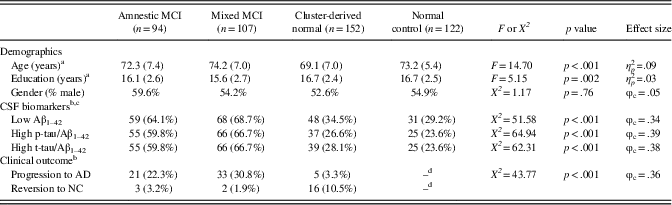
Demographic characteristics of the cluster-derived subtypes and NC group are presented in Table 1. There was a significant age difference between groups, as the CDN group was younger than the amnestic MCI, mixed MCI, and NC groups. There was also a significant education difference, with the mixed MCI group being less educated than the CDN and NC groups. There was no significant sex difference between groups.
Demographic characteristics, CSF biomarkers, and clinical outcome for the cluster groups and NC group

a Data are summarized as mean (SD).
b Data are summarized as raw number of participants (% of participants).
c Number of participants in CSF analyses: Amnestic MCI: n=92, Mixed MCI: n=99, CDN: n=139, NC: n=106.
d The NC group was not included in this analysis since NC participants were selected on the basis of remaining normal (did not progress/revert) throughout the course of their participation in ADNI.
Neuropsychological performance
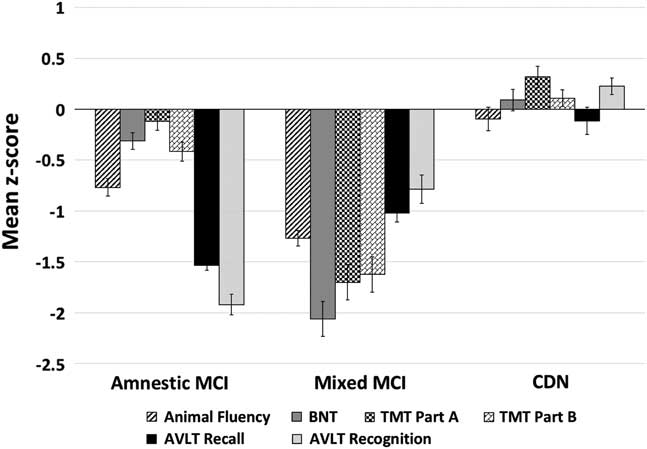
Mean performance for each cluster-derived MCI subtype on the neuropsychological battery at baseline is shown in Figure 1. The pattern of performance in this subsample (n=475) is nearly identical to what was observed in the full sample in our previous study (n=605; Edmonds et al., Reference Edmonds, Delano-Wood, Galasko, Salmon and Bondi2014). Specifically, the amnestic MCI group demonstrated an isolated memory impairment (scores below 1.5 SD on delayed free recall and recognition); the mixed MCI group showed significant deficits in multiple cognitive domains (scores below 1.5 SD on naming and attention/executive function measures, and below 1.0 SD on animal fluency and delayed free recall); and the CDN group—despite their ADNI MCI diagnosis—performed within normal limits on all six measures.
Neuropsychological performance for the cluster-derived MCI subtypes. Error bars denote standard error of the mean. BNT=Boston Naming Test; TMT=Trail Making Test; AVLT=Rey Auditory Verbal Learning Test; CDN=cluster-derived normal.

CSF biomarkers
Consistent with our previous study (Edmonds et al., Reference Edmonds, Delano-Wood, Galasko, Salmon and Bondi2014), the amnestic and mixed MCI groups had a higher percentage of individuals with positive CSF AD biomarkers relative to the CDN and NC groups, which did not differ from one another; see Table 1.
Clinical outcome
At the 24-month follow-up visit, 59 of the participants were diagnosed with probable AD based on the National Institute of Neurological and Communicative Disorders and Stroke and the Alzheimer’s Disease and Related Disorders Association (NINCDS/ADRDA) criteria, and another 21 participants reverted to a classification of cognitively normal (i.e., no longer met ADNI criteria for a diagnosis of MCI); see Table 1. There were no differences in demographics between those who progressed to AD, reverted to normal, or remained diagnosed with MCI.
Longitudinal Discrepancy Scores on ECog
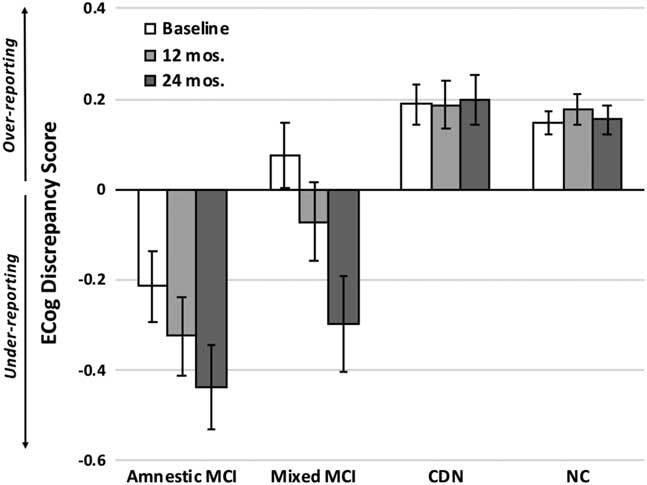
Analyses of change in ECog discrepancy scores over time using a 3×4 mixed ANCOVA with age and education as covariates revealed a significant main effect of group (F(3,469)=15.5; p<.001;
 $\eta ^{2} _{p} {\equals}.09$
) and a significant interaction between visit and group (F(5.9,915.1)=7.70; p<.001;
 $\eta ^{2} _{p} {\equals}.05$
); see Figure 2. Post hoc pairwise comparisons showed that ECog discrepancy scores were significantly lower (i.e., greater underestimation of cognitive decline) at 24 months compared to baseline for the amnestic MCI (p=.001) and mixed MCI (p<.001) subtypes. The mixed MCI subtype also exhibited a significant decrease from 12 to 24 months (p=.001). ECog discrepancy scores did not significantly differ over time for the CDN or NC groups.
Mean ECog discrepancy score for the cluster-derived MCI subtypes and NC participants at baseline, 12 months, and 24 months. Error bars denote standard error of the mean. CDN=cluster-derived normal; NC=normal control.

A MANCOVA controlling for age and education compared ECog discrepancy scores between groups. Results showed that the amnestic MCI group had lower discrepancy scores than the CDN and NC groups at all time points (p’s<.001), and lower discrepancy scores than the mixed MCI group at baseline (p<.001) and 12 months (p=.009; trend significance level with Bonferroni correction). The amnestic and mixed MCI groups did not differ at 24 months. The mixed MCI group had lower discrepancy scores than the NC group at 12 months (p=.009; trend significance level with Bonferroni correction), and lower discrepancy scores than the CDN and NC group at 24 months (p’s<.001). The CDN and NC groups did not differ at any time point.
Longitudinal Self-report and Informant-report on ECog
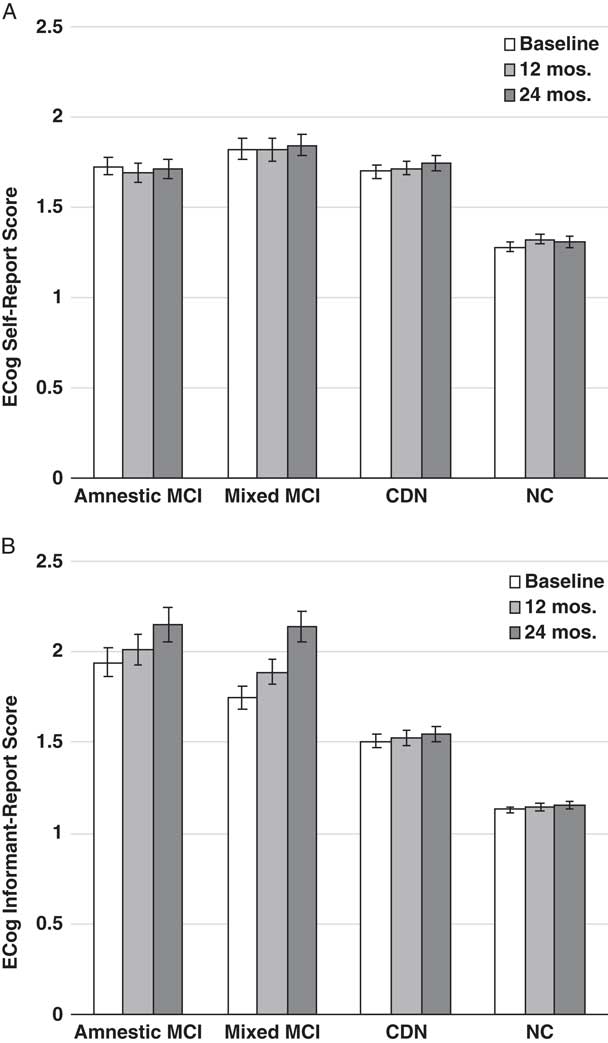
To examine the nature of the discrepancy in ECog scores, analyses of change were also conducted separately for self- and informant-report. For self-reported SCC, a 3×4 mixed ANCOVA with age and education as covariates revealed a significant main effect of group (F(3,469)=31.6; p<.001;
 $\eta ^{2} _{p} {\equals}.17$
), but no significant main effect of visit, and no interaction between visit and group; see Figure 3A. Post hoc pairwise comparisons showed no significant change in self-reported SCC over time for any group.
Mean (A) self-reported and (B) informant-reported ECog score for the cluster-derived MCI subtypes and NC participants at baseline, 12 months, and 24 months. Error bars denote standard error of the mean. CDN=cluster-derived normal; NC=normal control.

In contrast, for informant-reported SCC, a 3×4 mixed ANCOVA with age and education as covariates revealed a significant main effect of group (F(3,469)=61.47; p<.001;
 $\eta ^{2} _{p} {\equals}.28$
) and a significant interaction between visit and group (F(5.8,904.1)=11.36; p<.001;
 $\eta ^{2} _{p} {\equals}.07$
); see Figure 3B. Post hoc pairwise comparisons showed a significant stepwise increase in informant-reported SCC from baseline to 24 months for both amnestic and mixed subtypes (p’s<.001). Specifically, the mixed MCI subtype showed an increase in informant-reported SCC from baseline to 12 months (p=.009) and both the amnestic and mixed MCI groups showed an increase from 12 to 24 months (p’s≤.001). There was no significant change in informant-reported SCC over time for the CDN or NC groups.
Longitudinal Objective Cognitive Performance
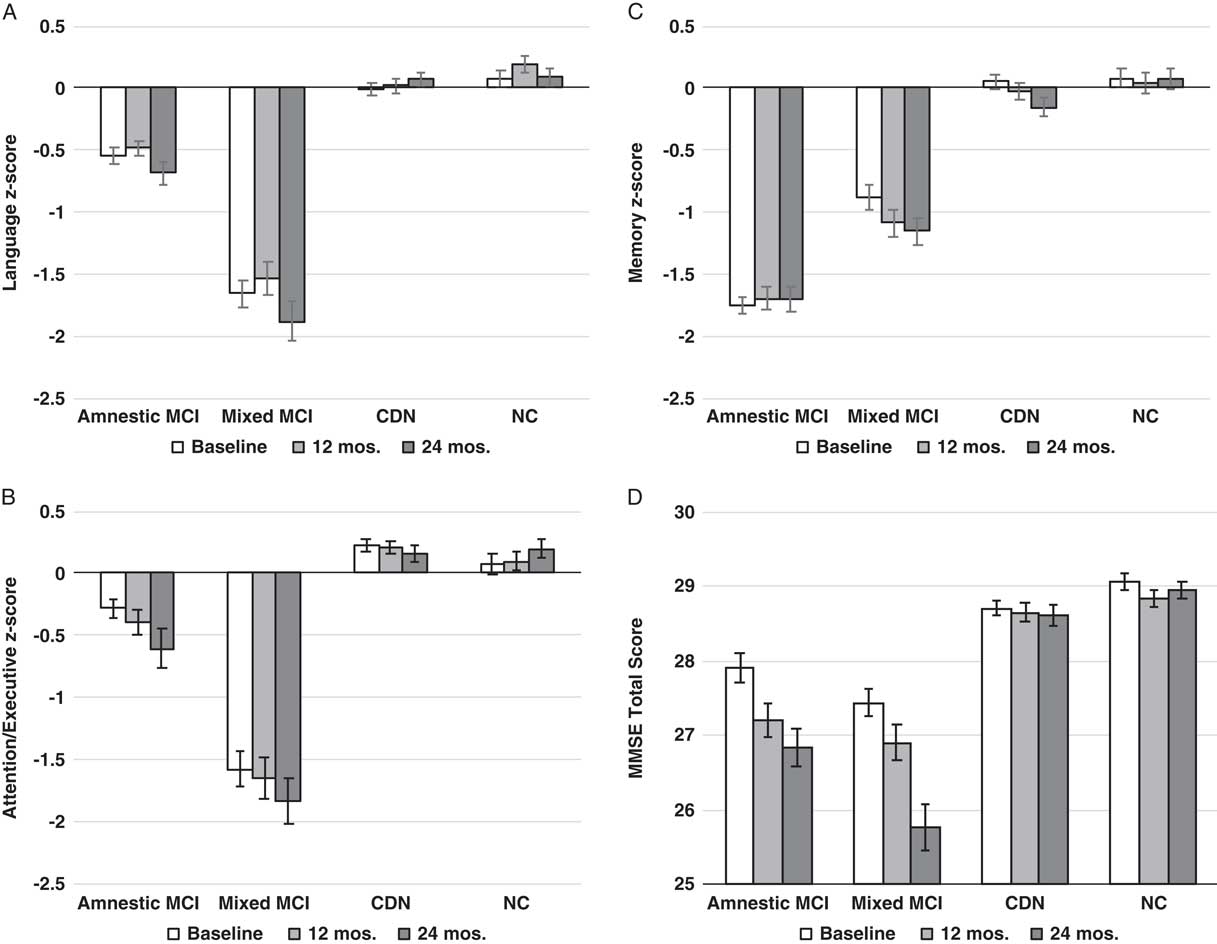
Language domain
Analysis of change in the language domain over time using a 3×4 mixed ANCOVA with age and education as covariates revealed a significant main effect of group (F(3,459)=109.29; p<.001;
 $\eta ^{2} _{p} {\equals}.42$
) and a significant interaction between visit and group (F(5.7,865.1)=4.16; p=.001;
 $\eta ^{2} _{p} {\equals}.03$
); see Figure 4A. Post hoc pairwise comparisons indicated a decline in performance from 12 to 24 months in amnestic MCI (p=.002) and mixed MCI (p<.001). The CDN group’s performance remained stable over time. The NC group’s performance improved from baseline to 12 months (p=.008) and returned to baseline at 24 months.
Mean (A) language domain Z-score, (B) attention/executive function domain z-score, (C) memory domain Z-score, and (D) MMSE total score for the cluster-derived MCI subtypes and NC participants at baseline, 12 months, and 24 months. Error bars denote standard error of the mean. MMSE=Mini-Mental State Examination; CDN=cluster-derived normal; NC=normal control.

Attention/executive function domain
Analysis of change in the attention/executive function domain over time revealed a significant main effect of group (F(3,453)=79.94; p<.001;
 $\eta ^{2} _{p} {\equals}.35$
) and a significant interaction between visit and group (F(5.4,812.1)=3.11; p=.007;
 $\eta ^{2} _{p} {\equals}.02$
); see Figure 4B. Post hoc pairwise comparisons indicated a decline in performance from baseline to 24 months in the amnestic MCI group (p=.02). Performance in the mixed MCI, CDN, and NC groups remained stable over time.
Memory domain
Analysis of change in the memory domain over time revealed a significant main effect of group (F(3,459)=114.25; p<.001;
 $\eta ^{2} _{p} {\equals}.43$
) and a significant interaction between visit and group (F(5.9,899.6)=2.47; p=.02;
$\eta ^{2} _{p} {\equals}.02$
); see Figure 4C. Post hoc pairwise comparisons indicated a decline in performance in the mixed MCI group from baseline to 12 months (p=.01) and from baseline to 24 months (p=.001). The CDN group showed a decline from baseline to 24 months (p=.001) and from 12 to 24 months (p=.02); however, it should be noted that their performance at all time points was still well within the normal range. Performance in the amnestic MCI and NC groups remained stable over time.
MMSE
Analysis of change in MMSE scores over time revealed a significant main effect of group (F(3,463)=48.17; p<.001;
 $\eta ^{2} _{p} {\equals}.24$
) and a significant interaction between visit and group (F(5.7,878.5)=9.06; p<.001;
 $\eta ^{2} _{p} {\equals}.06$
); see Figure 4D. Post hoc pairwise comparisons indicated a stepwise decrease in MMSE scores from baseline to 24 months for the amnestic and mixed MCI subtypes (p’s<.001). Specifically, there was a decrease in MMSE scores from baseline to 12 months for both amnestic MCI (p<.001) and mixed MCI (p=.02), and a decrease from 12 to 24 months for the mixed MCI subtype (p<.001). Neither the CDN nor NC groups exhibited a significant change in MMSE scores over time.
Relationship Between ECog Scores and Objective Cognitive Performance Over Time
Correlational analysis revealed a significant relationship between increasing ECog discrepancy scores (indicating greater underestimation of cognitive decline) and decreasing objective cognitive performance over time in amnestic MCI (language domain: r=.25; p=.02; MMSE: r=.25; p=.02) and mixed MCI (attention/executive function domain: r=.27; p=.006; MMSE: r=.30; p=.002). There were no significant correlations in the CDN or NC groups.
Correlations were also used to examine self- and informant-report separately. There were no significant relationships between change in self-reported SCC and change in objective cognitive performance in any of the groups. In contrast, increasing informant-reported SCC were related to decreasing objective cognitive performance in the amnestic MCI (language domain: r=-.34; p=.001; attention/executive function domain: r=-.28; p=.008; memory domain: r=-.28; p=.009; MMSE: r=-.33; p=.001) and mixed MCI groups (language domain: r=-.27; p=.006; attention/executive function domain: r=-.35; p<.001; MMSE: r=-.32; p=.001); there was also a significant correlation in the CDN group (memory domain: r=-.23; p<.005), although objective performance remained within normal limits. There were no significant correlations with informant-report in the NC group.
Relationship Between ECog Scores and CSF Biomarkers
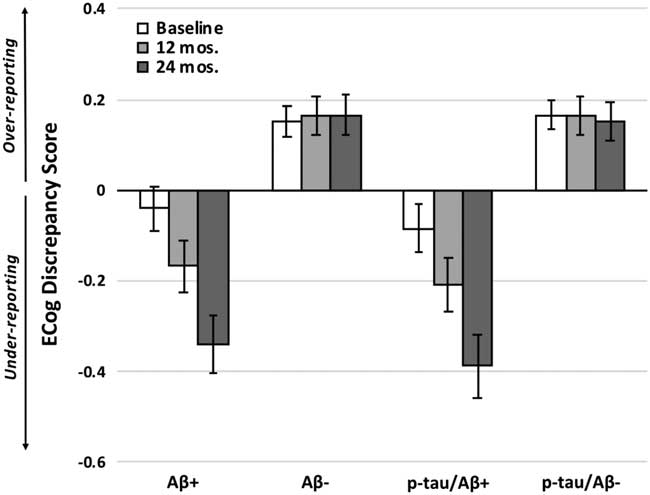
Analyses using MANCOVA with age and gender as covariates showed that participants positive for CSF AD biomarkers at baseline had increasing ECog discrepancy scores over time (indicating greater underestimation of cognitive decline) relative to those who were biomarker negative (Aβ1–42: F(1,432)=29.96; p<.001;
 $\eta ^{2} _{p} {\equals}.07$
; p-tau/Aβ1–42: F(1,432)=23.93; p<.001;
$\eta ^{2} _{p} {\equals}.05$
; t-tau/Aβ1–42: F(1,432)=23.78; p<.001;
$\eta ^{2} _{p} {\equals}.05$
); see Figure 5. Specifically, informant-reported SCC increased over time in those who were biomarker positive (Aβ1–42: F(1,432)=40.55; p<.001;
 $\eta ^{2} _{p} {\equals}.09$
; p-tau/Aβ1–42: F(1,433)=31.40; p<.001;
$\eta ^{2} _{p} {\equals}.07$
; t-tau/Aβ1–42: F(1,433)=32.21; p<.001;
$\eta ^{2} _{p} {\equals}.07$
), while change in self-reported SCC did not differ between the positive and negative groups.
Mean ECog discrepancy score for participants who were positive or negative at baseline for CSF AD biomarkers Aβ1–42 and p-tau/Aβ1–42. (Findings for t-tau/Aβ1–42 are not shown, as they were nearly identical to p-tau/Aβ1–42.) Error bars denote standard error of the mean.

Relationship Between ECog Scores and Clinical Outcome
A MANOVA showed that the participants who were diagnosed with AD at 24 months (n=59) demonstrated increasing ECog discrepancy scores over time (indicating greater underestimation of cognitive decline) relative to those who reverted to cognitively normal (n=21) or remained diagnosed with MCI (n=268) during the 24 month period (F(2,467)=56.39; p<.001;
 $\eta ^{2} _{p} {\equals}.20$
). Specifically, informant-reported SCC increased more over time in those who progressed to AD (F(2,467)=66.01; p<.001;
 $\eta ^{2} _{p} {\equals}.22$
), while change in self-reported SCC did not differ between groups.
DISCUSSION
We examined longitudinal change in the discrepancy between self- and informant-reported SCC on the ECog in empirically derived MCI subtypes and cognitively normal groups. For participants who were categorized as amnestic or mixed MCI based on their baseline neuropsychological test performance, results showed increasing ECog discrepancy scores over the 24-month period. This disparity was driven by an increase in informant-reported SCC despite stable self-reported SCC. There was a striking inverse relationship between increasing ECog discrepancy scores (indicating greater underestimation of cognitive decline) and decreasing performance on objective cognitive testing in both the amnestic and mixed MCI subtypes. This finding is consistent with a previous study which found that informant-reported, but not self-reported, subjective memory complaints were related to patients’ objective memory performance and integrity of medial temporal lobe structures (Fyock & Hampstead, Reference Fyock and Hampstead2015). Results of the current study also showed that increasing unawareness was associated with CSF AD biomarker positivity and progression to a diagnosis of AD.
Taken together, the findings demonstrate that MCI participants’ underappreciation of their cognitive deficits at baseline progressively worsened over the 24 months of follow-up. In stark contrast, participants who were determined to be cognitively normal on neuropsychological testing had a tendency to over-report cognitive difficulty at all three time points, with remarkable consistency in both self- and informant-report over time. This pattern was seen for both the robust NC group and for the CDN group—a large subtype of ADNI participants who have been intensively studied by our group and appear to be misdiagnosed with MCI based on conventional diagnostic criteria (Bangen et al., Reference Bangen, Clark, Werhane, Edmonds, Nation, Evangelista and Delano-Wood2016; Bondi et al., Reference Bondi, Edmonds, Jak, Clark, Delano-Wood, McDonald and Salmon2014; Edmonds et al., Reference Edmonds, Delano-Wood, Galasko, Salmon and Bondi2014, Reference Edmonds, Delano-Wood, Clark, Jak, Nation, McDonald and Bondi2015, Reference Edmonds, Eppig, Bondi, Leyden, Goodwin, Delano-Wood and McDonald2016; Eppig et al., Reference Eppig, Edmonds, Campbell, Sanderson, Delano-Wood and Bondi2017; Thomas et al., Reference Thomas, Edmonds, Delano-Wood and Bondi2017).
Findings from the current study extend those of our previous cross-sectional ECog study—which suggested that SCC contribute to misdiagnosis of MCI (Edmonds et al., Reference Edmonds, Delano-Wood, Galasko, Salmon and Bondi2014)—in several ways. First, they demonstrate that self-reported SCC are even more misleading in later stages of MCI since individuals who decline cognitively are increasingly likely to under-report cognitive problems. Support for this interpretation comes from a recent study in the ADNI cohort which found that anosognosia was associated with conversion from MCI to AD within 5 years (Gerretsen et al., Reference Gerretsen, Chung, Shah, Plitman, Iwata, Caravaggio and Graff-Guerrero2017), as well as a large longitudinal study of older adults (n=2092) which found that awareness of memory impairment begins to decline 2–3 years before dementia onset and is associated with several different types of dementia-related neuropathologies (Wilson et al., Reference Wilson, Boyle, Yu, Barnes, Sytsma, Buchman and Schneider2015).
The finding of more profound anosognosia over time in the amnestic and mixed MCI subtypes is also consistent with a longitudinal study showing that increasing unawareness was related to cognitive decline over a 24-month period (Silva et al., Reference Silva, Moser, Pfluger, Pusswald, Stogmann, Dal-Bianco and Lehrner2016), and a cross-sectional study showing that the discrepancy between self- and informant-reported cognitive decline increased along the diagnostic continuum from cognitively normal to MCI to AD (Rattanabannakit et al., Reference Rattanabannakit, Risacher, Gao, Lane, Brown, McDonald and Farlow2016).
Reduced insight into one’s cognitive abilities has been linked specifically to decline in episodic memory, with one study showing decreased self-awareness between diagnostic groups, from non-amnestic MCI (who tended to over-report cognitive problems, similar to normal controls), to amnestic MCI, to AD (Lehrner et al., Reference Lehrner, Kogler, Lamm, Moser, Klug, Pusswald and Auff2015). We were unable to examine a non-amnestic MCI subtype in the current study, as ADNI enrolls primarily amnestic MCI. However, the reported relationship between insight and episodic memory could help explain our somewhat counterintuitive finding of better insight in the mixed MCI subtype relative to amnestic MCI at baseline and 12 months. At these first two time points, the mixed MCI group’s memory impairment was less severe than the amnestic-only MCI group, and their self-reported SCC were fairly consistent with their informants’ report. By 24 months, however, the mixed MCI and amnestic MCI groups no longer differed in their level of under-reporting on the ECog, secondary to progressive cognitive decline in the mixed MCI subtype, including a decline in episodic memory abilities.
Another major way in which the current study contributes to the broader literature on SCC is by showing that the CDN group did not differ from the robust NC group in terms of self-reported SCC, informant-reported SCC, or objective cognitive performance at any time point. These results add to the accumulating body of evidence that the CDN group—which accounts for a significant proportion of the ADNI MCI cohort—represents false-positive diagnostic errors (Bangen et al., Reference Bangen, Clark, Werhane, Edmonds, Nation, Evangelista and Delano-Wood2016; Bondi et al., Reference Bondi, Edmonds, Jak, Clark, Delano-Wood, McDonald and Salmon2014; Edmonds et al., Reference Edmonds, Delano-Wood, Galasko, Salmon and Bondi2014, Reference Edmonds, Delano-Wood, Clark, Jak, Nation, McDonald and Bondi2015, Reference Edmonds, Eppig, Bondi, Leyden, Goodwin, Delano-Wood and McDonald2016; Eppig et al., Reference Eppig, Edmonds, Campbell, Sanderson, Delano-Wood and Bondi2017; Thomas et al., Reference Thomas, Edmonds, Delano-Wood and Bondi2017). Previous studies have suggested that MCI patients have intact awareness of their cognitive abilities (for review, see Piras, Piras, Orfei, Caltagirone, & Spalletta, Reference Piras, Piras, Orfei, Caltagirone and Spalletta2016), which appears contrary to our results. However, the likely inclusion of a significant number of cognitively normal false-positive individuals in other MCI samples would contribute to these discrepant findings.
Other researchers have also highlighted the unacceptably high rate of diagnostic errors resulting from conventional diagnostic criteria for MCI. For example, Lenehan et al. (Reference Lenehan, Klekociuk and Summers2012) concluded that SCC should be discarded from the diagnostic criteria for MCI after showing that they resulted in elevated rates of both false negative (62% error rate) and false positive (20% error rate) classifications. While current findings suggest informant-reported SCC have more utility in tracking objective cognitive impairment, including this as a criterion in the diagnosis of MCI would be problematic for patients who lack a knowledgeable informant.
Along with self-reported SCC, the other major contributor to diagnostic inaccuracy is basing the criterion of “objective cognitive impairment” on only one memory test. This method results in very high rates of false positive errors (Brooks et al., Reference Brooks, Iverson and White2007, Reference Brooks, Iverson, Holdnack and Feldman2008; de Rotrou et al., Reference de Rotrou, Wenisch, Chausson, Dray, Faucounau and Rigaud2005; Klekociuk, Summers, Vickers, & Summers, Reference Klekociuk, Summers, Vickers and Summers2014), with one longitudinal study noting that the rate of reversion or “recovery” from MCI back to cognitively normal after 12 months was as high as 48% (de Rotrou et al., Reference de Rotrou, Wenisch, Chausson, Dray, Faucounau and Rigaud2005). Our contention based on several recent studies is that using comprehensive neuropsychological assessment and removing the subjective component of the diagnostic process dramatically improves the sensitivity and specificity of MCI diagnosis, leading to stronger relationships with CSF AD biomarkers (Bondi et al., Reference Bondi, Edmonds, Jak, Clark, Delano-Wood, McDonald and Salmon2014), regional gray matter atrophy in temporal lobe regions (Goerlich et al., Reference Goerlich, Votinov, Dicks, Ellendt, Csukly and Habel2017), and rates of progression to AD (Bondi et al., Reference Bondi, Edmonds, Jak, Clark, Delano-Wood, McDonald and Salmon2014; Jak et al., Reference Jak, Preis, Beiser, Seshadri, Wolf, Bondi and Au2016).
The consistent over-reporting of SCC in the CDN and NC groups, despite normal objective cognition over time, suggests that self-reported SCC do not predict impending cognitive decline within a 24-month period. This finding appears to be somewhat at odds with a body of literature showing that self-reported SCC may have prognostic value for predicting future dementia in cognitively normal individuals, although many of these studies examined a longer follow-up interval. For example, a meta-analysis of 28 studies found that older adults with subjective memory complaints but no objective impairment were more likely than those without complaints to develop dementia over 4 years (conversion rate of 2% vs. 1%) (Mitchell, Beaumont, Ferguson, Yadegarfar, & Stubbs, Reference Mitchell, Beaumont, Ferguson, Yadegarfar and Stubbs2014).
Other research has shown that SCC may occur even earlier in the disease process, with one study finding that self-reported subjective memory complaints (which were present in 56% of the elderly sample) increased one’s risk for future cognitive impairment, and these complaints preceded a diagnosis of MCI by over 9 years (Kryscio et al., Reference Kryscio, Abner, Cooper, Fardo, Jicha, Nelson and Schmitt2014). Although a recent review of the literature found that self-reported SCC were associated with an increased risk of progression to dementia, the authors (Mendonca, Alves, & Bugalho, Reference Mendonca, Alves and Bugalho2016) emphasized that SCC should not be over-interpreted as a harbinger for cognitive decline. Importantly, they noted the very high prevalence of SCC in community-dwelling older adults (prevalence of approximately 50% to 60%) and state that the vast majority of participants with cognitive complaints do not progress to cognitive impairment (Mendonca et al., Reference Mendonca, Alves and Bugalho2016).
Despite the reported sensitivity (but presumably very low specificity) of self-reported SCC in cognitively normal individuals, these complaints appear to become less useful as cognitive impairment progresses and, based on our results, eventually become misleading. The changing utility of SCC were demonstrated in a study (Wolfsgruber et al., Reference Wolfsgruber, Wagner, Schmidtke, Frolich, Kurz, Schulz and Jessen2014) which found that memory complaints were associated with increased risk for AD in individuals with very mild memory impairment; however, they became less predictive at later stages of MCI, and in fact the highest rate of conversion to AD was seen in participants who had objective memory impairment but reported no memory complaints.
Another study suggested that this transition in awareness may be specific to those individuals harboring amyloid pathology in the brain (Vannini et al., Reference Vannini, Amariglio, Hanseeuw, Johnson, McLaren, Chhatwal and Sperling2017). This study found that cognitively normal individuals with increased amyloid pathology demonstrated heightened awareness (hypernosognosia), while MCI patients with increased amyloid pathology demonstrated impaired awareness (anosognosia); normal insight was seen in MCI patients with low levels of amyloid (Vannini et al., Reference Vannini, Amariglio, Hanseeuw, Johnson, McLaren, Chhatwal and Sperling2017). In the current study, when biomarker status was examined agnostic to diagnostic group, participants who were positive for CSF AD biomarkers showed increasing levels of unawareness over time, while those who were biomarker negative showed stable levels of awareness. The suggested “flip” in awareness over the course of the disease could potentially reconcile the discrepant literature with regard to the utility of self-reported SCC, although it is unclear how to determine the specific point at which this transition in awareness occurs. What is clear from the current study and the existing literature, however, is that self-reported SCC have no place in the diagnostic criteria for MCI.
Other studies have found no relationship between memory complaints and amyloid pathology. Data from the Australian Imaging, Biomarkers and Lifestyle (AIBL) study found no evidence of a relationship between amyloid level and self- or informant-reported SCC (Hollands et al., Reference Hollands, Lim, Buckley, Pietzak, Snyder, Ames and Maruff2015); nor did a large meta-analysis of 55 studies by Jansen et al. (Reference Jansen, Ossenkoppele, Knol, Tijms, Scheltens, Verhey and Zetterberg2015), which concluded that cognitively normal and SCC groups did not differ in amyloid positivity rates, suggesting that the presence of SCC in a memory clinic population is not associated with increased risk of AD. Additionally, Wilson and colleagues (2015) showed that transactive response DNA-binding protein 43 (TDP-43), tau tangles, and gross cerebral infarcts were the pathologies associated with development of anosognosia a few years before a diagnosis of dementia. This was not examined in the current study, as ADNI’s biomarker characterization does not capture TDP-43 pathology and incompletely addresses vascular pathology.
A caveat of the current study is the inherent limitation of using informant-report as a measure of a participant’s functioning, given that an informant’s perspective could be biased by several variables. These include the nature of the relationship between participant and informant, the amount of time spent together, emotional factors such as level of caregiver burden, the informant’s cognitive status, recall bias, or any motivator that an informant might have to make the participant appear more or less impaired. Data were not available to examine the effect of these informant characteristics on SCC. Nevertheless, informant-report on the ECog did correspond with the pattern of objective cognitive performance observed over time in each group, indicating that informant-report is valid for the purpose of determining participants’ level of awareness via discrepancy scores.
Another caveat is that results are reported at a group level and, given individual variability, there may be cases were self-reported SCC have utility at an individual level. Nevertheless, the stronger relationship between informant-reported SCC and progression to AD, coupled with the lack of relationship between self-reported SCC with objective cognition and progression, indicates that informant-report should be prioritized whenever possible.
A final limitation of this study is the lack of assessment of visuospatial functioning, as some patients may show prominent visuospatial impairment and previous research has identified a visuospatial MCI subtype (Clark et al., Reference Clark, Delano-Wood, Libon, McDonald, Nation, Bangen and Bondi2013). However, visuospatial measures in ADNI are limited, and those that are available have psychometric properties that limit their ability to discriminate between normal and mildly impaired individuals (e.g., ceiling effect; Eppig et al., 2017).
Strengths and unique aspects of this study include the longitudinal use of ECog discrepancy scores to quantify awareness over time, the examination of well-characterized, empirically derived MCI subtypes, and the inclusion of a robust normative reference group. Our results demonstrate that self-reported SCC become increasingly misleading as objective cognitive impairment becomes more pronounced. Through removal of self-reported SCC from the criteria for MCI and increased use of comprehensive neuropsychological assessment, diagnostic accuracy can be improved. Such improvements are critical both for the purposes of providing patients with an accurate clinical diagnosis, and for selecting appropriate participants for research studies and clinical trials of MCI.
ACKNOWLEDGMENTS
Funding/Support: This work was supported by the Alzheimer’s Association (AARG-17-500358 to E.C.E.; AARF-17-528918 to K.R.T.), the U.S. Department of Veterans Affairs Clinical Sciences Research and Development Service (Career Development Award-2 1IK2 CX001415 to E.C.E.), and the NIH (R01 AG049810 to M.W.B.; K24 AG026431 to M.W.B.; P50 AG05131 to D.R.G.). Data collection and sharing for this project was funded by the Alzheimer’s Disease Neuroimaging Initiative (ADNI) (National Institutes of Health Grant U01 AG024904) and DOD ADNI (Department of Defense award number W81XWH-12-2-0012). ADNI is funded by the National Institute on Aging, the National Institute of Biomedical Imaging and Bioengineering, and through generous contributions from the following: AbbVie, Alzheimer’s Association; Alzheimer’s Drug Discovery Foundation; Araclon Biotech; BioClinica, Inc.; Biogen; Bristol-Myers Squibb Company; CereSpir, Inc.; Cogstate; Eisai Inc.; Elan Pharmaceuticals, Inc.; Eli Lilly and Company; EuroImmun; F. Hoffmann-La Roche Ltd and its affiliated company Genentech, Inc.; Fujirebio; GE Healthcare; IXICO Ltd.; Janssen Alzheimer Immunotherapy Research & Development, LLC.; Johnson & Johnson Pharmaceutical Research & Development LLC.; Lumosity; Lundbeck; Merck & Co., Inc.; Meso Scale Diagnostics, LLC.; NeuroRx Research; Neurotrack Technologies; Novartis Pharmaceuticals Corporation; Pfizer Inc.; Piramal Imaging; Servier; Takeda Pharmaceutical Company; and Transition Therapeutics. The Canadian Institutes of Health Research is providing funds to support ADNI clinical sites in Canada. Private sector contributions are facilitated by the Foundation for the National Institutes of Health (www.fnih.org). The grantee organization is the Northern California Institute for Research and Education, and the study is coordinated by the Alzheimer’s Therapeutic Research Institute at the University of Southern California. ADNI data are disseminated by the Laboratory for Neuro Imaging at the University of Southern California.