Introduction
Differential use of benthic and water column habitats is a major axis of diversification in the adaptive radiation of notothenioid fishes (Eastman & DeVries Reference Eastman and DeVries1982, Eastman Reference Eastman1993, Eastman & McCune Reference Eastman and McCune2000), and the divergent buoyancies of various species reflect occupation of these habitats (Eastman Reference Eastman1993, Eastman & Sidell Reference Eastman and Sidell2002). Since all notothenioids lack a swim bladder, buoyancy modification is accomplished through reduction of skeletal ossification and/or deposition of lipids as a source of static lift. Measurements of buoyancy are expressed as percentage (or relative) buoyancy (%B), calculated as weight in water/weight in air ×100. The range of interspecific variation in this measurement among notothenioids encompasses neutrally buoyant species with no weight in water (%B ≈ 0) as well as heavy benthic species (%B ≈ 6.0) (Eastman Reference Eastman1993). Most notothenioids, however, are intermediate between these two extremes (Eastman & DeVries Reference Eastman and DeVries1982, Eastman & Sidell Reference Eastman and Sidell2002) and the ancestral benthic habitat is retained by most species (Eastman Reference Eastman1993).
It has been assumed that measurements of buoyancy exhibit sufficiently small levels of intraspecific variation to reliably characterize the ecology of various notothenioid species or species groups. However, there has been no examination of the magnitude of geographic intraspecific variation in buoyancy in any species. There is a noteworthy example of ontogenetic variation in buoyancy involving the large Antarctic toothfish Dissostichus mawsoni. Juveniles of this species (standard length (SL) = 189 mm) are heavy (%B = 5.3), subadults (SL = 200–500 mm) are intermediate (%B = 3–4%) and adults (SL > 800 mm) are neutrally buoyant (Near et al. Reference Near, Russo, Jones and DeVries2003). Such a dramatic change in percentage buoyancy is probably atypical in notothenioids. Nothing is known about the buoyancies of larvae or newly settled juveniles in any notothenioid species. Buoyancy measurements to date have been made on species from single localities - either McMurdo Sound (Eastman & DeVries Reference Eastman and DeVries1981, Reference Eastman and DeVries1982) or the South Shetland Islands (Eastman & Sidell Reference Eastman and Sidell2002). Since the majority of notothenioids have a circum-Antarctic distribution (Gon & Heemstra Reference Gon and Heemstra1990), there are communities across many shelf areas of the Southern Ocean that share some of the same species. Thus these repeated communities around Antarctica offer the opportunity to examine geographic intraspecific variation in buoyancy in order to better understand this key aspect of notothenioid biology that, with respect to ecology, is the hallmark of the notothenioid radiation.
In this paper we present results from a comparison of buoyancy measurements among populations of four notothenioid species sampled at McMurdo Sound in East Antarctica and the South Shetland Islands in West Antarctica. We made these comparisons: 1) to determine if there is geographic intraspecific variation in buoyancy, and 2) to consider whether any documented variation is of substantive significance in the ecology of these species, particularly habitat use.
Materials and methods
Specimens were collected in the southern Scotia Arc in March 2001 and 2003 and in February–March 2006. These collections were made in conjunction with demersal fish trawl surveys of the South Shetland Islands aboard the RV Yuzhmorgeologiya, expeditions conducted by the United States Antarctic Marine Living Resources Program. Specifics regarding fishing gear, primarily a commercial size bottom trawl, and sampling design have been previously reported (Kock & Jones Reference Kock and Jones2002, Near et al. Reference Near, Russo, Jones and DeVries2003, Flores et al. Reference Flores, Kock, Wilhelms and Jones2004). The data for the McMurdo Sound sample was the basis for other publications highlighting these populations (Eastman & DeVries Reference Eastman and DeVries1981, Reference Eastman and DeVries1982, Eastman Reference Eastman1993) with the exception that sample sizes were increased for the present study by including some previously excluded gravid specimens of Trematomous bernacchii and T. hansoni. There were no gravid specimens among our samples from the South Shetland Islands. Eastman & DeVries (Reference Eastman and DeVries1982) provide sampling locations and methods used for specimen collection at McMurdo Sound. These included baited bottom traps, fishing with a hook and line and, in the case of the neutrally buoyant Pleuragramma antarcticum, removal of specimens from the stomachs of Dissostichus mawsoni Norman, 1937 captured on a set line at 300–500 m.
We targeted four species from major notothenioid clades for comparison, the bathydraconid Gymnodraco acuticeps Boulenger, Reference Boulenger1902 and the nototheniids Pleuragramma antarcticum Boulenger, Reference Boulenger1902, Trematomus bernacchii Boulenger, Reference Boulenger1902 and Trematomus hansoni Boulenger, Reference Boulenger1902. We made buoyancy and standard length (SL) measurements on freshly captured specimens using previously described methods (Eastman & DeVries Reference Eastman and DeVries1982, Eastman & Sidell Reference Eastman and Sidell2002, Near et al. Reference Near, Russo, Jones and DeVries2003). Briefly, this involves weighing heavily anaesthetized fish in air and then in seawater at ambient temperature. To weigh fish in water, we attached a light rod to the balance pan with adhesive clips and tied a line with a barbless hook to the other end of the rod. This apparatus projected off the side of the balance and over an insulated water container. We obtained weight in water by hooking the fish through the lower jaw, lowering it into the container, removing air from oral and branchial cavities and taking the weight when the balance display stabilized. The sample (Table I) consists of 98 specimens from the South Shetlands Islands (water temperature = 0–2°C) and 97 specimens from McMurdo Sound (water temperature = -1.9°C). The differences in water temperature are of no consequence because changes in the density of seawater between 0°C and 5°C are < 0.1%. Some notothenioids, including P. antarcticum, use neutral lipids as a source of static lift; changes in ambient pressure with depth have relatively little effect on these substances (Bone & Moore Reference Bone and Moore2008, p. 103). Furthermore, errors in buoyancy measurements attributable to changes in salinity, temperature and pressure are small, totalling only about + 0.15% of the weight of fish in air (Corner et al. Reference Corner, Denton and Forster1969), and usually disregarded (Denton & Marshall Reference Denton and Marshall1958). Weights for McMurdo specimens were made in an onshore laboratory with an electronic balance whereas those for South Shetlands specimens were taken aboard ship with a mechanical balance. These differences in methodology reflect the reality of Antarctic field research in that buoyancy measurements now need to be made aboard ship because most species found in the proximity of near shore research stations have been studied.
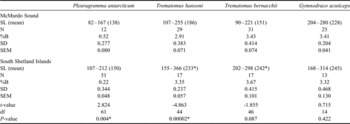
Summary of data and comparison of measurements of buoyancy for total sample by geographic region. SL = range of standard length measurements in mm (and mean, * if significant), N = number of specimens, %B = mean percentage buoyancy, SD = standard deviation, SEM = standard error of the mean. Results of t-tests for each species are at bottom of table. Significant P-value (<0.05) is indicated with an asterisk.

Prior to statistical analysis we transformed the buoyancy data to natural logarithms (ln) to correct for inequality of variances. Because many of the buoyancy values for Pleuragramma antarcticum were 0, we added 0.5 to all values and transformed them to square roots (Sokal & Rohlf Reference Sokal and Rohlf1981, p. 423). Buoyancy values in Table I are untransformed with the 0.5 factor removed, but reported levels of significance are for ln- or square root-transformed data. We performed F-tests to ensure that variances between samples were equal and then utilized descriptive statistics and two-sample t-tests to summarize and compare measurements of size (standard length) and buoyancy between the McMurdo and South Shetland populations. For each species we tested the null hypotheses that there is no difference in the mean SL and mean percentage buoyancy between McMurdo and South Shetland populations. To determine whether or not there were ontogenetic changes in buoyancy, we used a general linear model to conduct an analysis of covariance for the relationship between mean buoyancy and standard length (the covariate).
Results
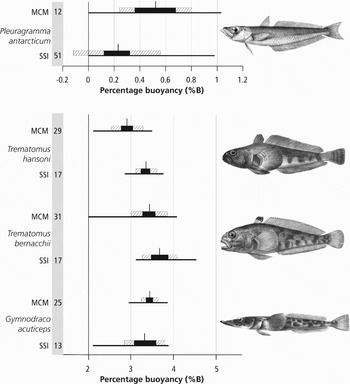
Table 1 provides mean values and descriptive statistics for buoyancy measurements from 195 specimens arranged by species and geographic region. The Dice-Leraas diagram in Fig. 1 shows the distribution of buoyancy measurements and facilitates comparison of the paired samples. Samples showed some departures from normality, common in analyses of morphological data (Simpson et al. Reference Simpson, Roe and Lewontin1960), with left skewing in T. bernacchii from McMurdo and G. acuticeps from the South Shetland Islands, and right skewing in P. antarcticum from the South Shetlands. When rounded to one decimal place, dispersion (1 standard deviation) of percentage buoyancy values around the mean was ± 0.2–0.5 %B units for the entire sample. In comparisons of means, two-sample t-tests indicated that the mean percentage buoyancy was significantly different between samples of Pleuragramma antarcticum and T. hansoni from the two localities (Table I). Whether this significance is biologically meaningful is considered below in the discussion.
Dice-Leraas diagram (modification of Hubbs & Hubbs Reference Hubbs and Hubbs1953) showing comparison of measurements of buoyancy for samples of four species from McMurdo Sound (MCM) and the South Shetlands Islands (SSI). Shaded column following locality provides sample size. Heavy horizontal line is the range, short vertical line is the mean, rectangle shows 1 SD on each side of the mean with black portion indicating ± 2 SEM. For sample sizes > 30, 2 SEM approximates the 95% confidence limits for the mean (Sokal & Rohlf Reference Sokal and Rohlf1981, p. 152). Therefore when black rectangles overlap, interspecific differences among measurements of buoyancy are not significant. Fish drawings from Boulenger (Reference Boulenger1902).

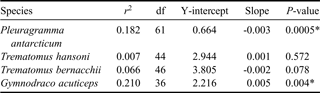
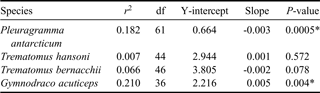
The South Shetlands samples had larger mean standard lengths and larger size ranges of specimens for all four species (Table I), but two-sample t-tests indicated that only the samples of Trematomus bernacchii and T. hansoni were significantly larger than the McMurdo samples. Bivariate plots of percentage buoyancy against standard length for each of the eight samples (not shown) indicate slight to moderate ontogenetic increases in buoyancy (lower %B) in all species except G. acuticeps where buoyancy decreases (higher %B) with standard length. Since we sought to determine whether these ontogenetic changes were significant, we pooled the data for the two localities for each species and used this in an analysis of covariance with standard length as the covariate. Although the size range of specimens for this analysis was somewhat restricted, the relationship of percentage buoyancy to standard length was significant for P. antarcticum and G. acuticeps (Table II). Similar to the pattern observed in all other notothenioids studied to date (Eastman & Sidell Reference Eastman and Sidell2002, Near et al. Reference Near, Russo, Jones and DeVries2003), buoyancy increased with standard length in P. antarcticum, but decreased with standard length in G. acuticeps (Table II, negative and positive values for slopes, respectively).
Analysis of covariance for the relationship between percentage buoyancy and standard length for total sample of each species examined. Significant P-values (<0.05) indicated with an asterisk.
Discussion
Overview of intraspecific variation in buoyancy
In our intraspecific comparisons of buoyancy measurements from geographically separated samples of four notothenioid species, mean buoyancies were statistically significant in P. antarcticum and T. hansoni, although we consider these differences as normal biological variation without substantive significance. Buoyancy measurements of ±1 standard deviation around the mean encompass the majority (≈68%, Sokal & Rohlf Reference Sokal and Rohlf1981, p. 102) of the sample. Including data from this and previously published papers, the standard deviations for percentage buoyancy measurements from 23 adequate (N ≥ 7) samples are ± 0.2–0.6 %B units, with a modal value of ± 0.4 %B units. It should not be surprising that there is dispersion in these measurements during adult life because the percentage buoyancy reflects the density of the fish and this may be influenced, in both the short- and long-term, by gut contents, nutritional condition, and reproductive state. Mitigation of the effects of these variables is not biologically realistic because they constitute normal aspects of the daily and yearly life cycles. Furthermore, the influence of these variables may actually be less than expected - reproductive status in particular has been shown to be of little consequence. Sexual dimorphism in percentage buoyancy has been shown to be unusual in notothenioids (Eastman & Sidell Reference Eastman and Sidell2002). Furthermore, removal of the gonads did not affect percentage buoyancy in the oyster toadfish Opsanus tau (Fine et al. Reference Fine, McKnight and Blem1995) and in zebrafish, Danio rerio, gravid and nongravid fish had the same mean densities (Robertson et al. Reference Robertson, Lindsey, Dumbarton, Croll and Smith2008). As Fine et al. (Reference Fine, McKnight and Blem1995) note, in a negatively buoyant benthic fish spending most of its time on the substrate, as is the case in three of our four species, there is minimal selective advantage for precise control of buoyancy.
Ontogenetic change in percentage buoyancy (a lower %B with growth as measured by weight or length) is another factor contributing to intraspecific variation in this measurement. A size effect on percentage buoyancy in notothenioids is generally detectable if buoyancies are obtained from a sufficiently large size range of the specimens. For example, the effect of weight on buoyancy has been documented in large samples of some nototheniids and channichthyids. In four species with percentage buoyancies of 3–5% and spanning a 3–5-fold range of body weights, there is about a 1% decrease in percentage buoyancy with increasing weight (Eastman & Sidell Reference Eastman and Sidell2002). The most striking example of an ontogenetic decrease among notothenioids is seen in the large neutrally buoyant nototheniid Dissostichus mawsoni where percentage buoyancy falls from 4% in 25 cm SL juveniles to 0% in ≥ 81 cm SL adults (Near et al. Reference Near, Russo, Jones and DeVries2003).
The decline in percentage buoyancy with size is probably attributable to the nature of fish growth. Changes in weight are relatively greater than changes in length given the approximately cubic (W = aL3) relationship between length and weight (Busacker et al. Reference Busacker, Adelman, Goolish, Schreck and Moyle1990). Moreover, increasing weight represents growth of relatively low-density muscle and viscera with its contained lipid whereas increase in length represents growth of high-density skeletal tissues (Donaldson et al. Reference Donaldson, Fagerlund, Higgs, McBride, Hoar, Randall and Brett1979). Furthermore, the skeleton in teleosts, unlike that in terrestrial vertebrates, comprises a constant (rather than increasing) proportion of the body weight regardless of the size of the individual (Reynolds & Karlotski Reference Reynolds and Karlotski1977).
The unexpected finding of an ontogenetic increase in percentage buoyancy in Gymnodraco acuticeps may reflect the fact that this species has a notably different shape, with relatively more bone and less soft tissue, than the typical notothenioid (Fig. 1). The head is long and wide and the trunk is narrow with a relatively small amount of muscle. However, the size range of specimens in our sample is only 2-fold and our result should be regarded as provisional.
Buoyancy and ecology - Pleuragramma antarcticum
The neutrally buoyant Pleuragramma antarcticum is the most specialized of the notothenioids for pelagic life as its entire life cycle, including egg and larval stages (Vacchi et al. Reference Vacchi, La Mesa, Dalu and Macdonald2004), is confined to the water column or platelet ice. While usually considered neutrally buoyant, its measured percentage buoyancy is 0–1% with means of 0.2–0.5%. There are disadvantages of having no weight in water including the tendency to rise in the water column and instability or maneuverability problems when motionless, drifting in currents or coasting. Thus fish living in the water column, including Pleuragramma, are frequently negatively buoyant (Davenport Reference Davenport1999), with percentage buoyancies somewhat >0%.
Our South Shetlands sample of Pleuragramma was significantly more buoyant (lower %B) than the McMurdo sample, reflecting the fact that 32 of 51 specimens from this sample had a %B of 0. Although these specimens were not significantly larger than the McMurdo specimens (Table I), they were captured in the summer (versus early spring for McMurdo) and this is probably associated with better condition and a higher lipid content. Although this difference in buoyancy is statistically significant, as noted previously, we regard these small differences in buoyancy as normal variation associated with the life cycle and therefore of little biological consequence.
Pleuragramma antarcticum is one of the most lipid-rich notothenioids (Freidrich & Hagen 1994, Hagen et al. Reference Hagen, Kattner and Friedrich2000) and has become a textbook example of the utilization of triacylglycerols as a source of static lift for buoyancy (Bone & Moore Reference Bone and Moore2008, pp. 105–106). The lipid is stored in large sacs and these sequestered lipids are hypothesized to be unavailable for metabolism (DeVries & Eastman Reference DeVries and Eastman1978, Eastman & DeVries Reference Eastman and DeVries1989), although Pleuragramma also has other lipid stored in typical adipose tissue that may be metabolically labile. There has been no experimental study of energetic use of lipid from either tissue. It has been observed, however, that juvenile Pleuragramma (SL = 29–115 mm) exhibit a pronounced ontogenetic lipid accumulation during the winter and maintain a stable amount of lipid according to size, suggesting that they were able to maintain condition by feeding rather than utilizing stored lipids (Hubold & Hagen Reference Hubold, Hagen, Battaglia, Valencia and Walton1997). Lipid content is also proportionally higher in adult versus juvenile specimens (Friedrich & Hagen Reference Friedrich and Hagen1994), indicating that an ontogenetic change in lipid content could reflect an unobserved change in buoyancy with age in this species. Unfortunately measurements of buoyancy were not performed on these specimens. As mentioned above, this probably accounts for some of the differences between our samples of this species.
Buoyancy and ecology - Trematomus hansoni and T. bernacchii
Both T. hansoni and bernacchii are benthic species, and at McMurdo Sound both exhibit similar depth preferences (Eastman & DeVries Reference Eastman and DeVries1982). At 2.9–3.7%, mean percentage buoyancies of our four samples span a wider range (especially at the low end) than might be expected in benthic species. However, as Webb (Reference Webb1990) notes, higher tissue densities (leading to a greater percentage buoyancy) are not always desirable because aspects of a species behavior or life cycle may involve periods of time in the water column. This is especially true in the case of T. hansoni. At both McMurdo Sound and the South Shetland Islands T. hansoni is more buoyant than T. bernacchii, and the magnitude of the difference between these species is nearly identical in both of the sampled areas (Table I; Fig. 1). There is ample evidence that the greater buoyancy in T. hansoni reflects behavioural and ecological differences involving water column activities. For example, when compared to T. bernacchii, T. hansoni shows more spontaneous swimming activity when kept in captivity (Eastman Reference Eastman1993) and takes more prey from the water column (Montgomery et al. Reference Montgomery, Foster, Milton and Carr1993, Foster & Montgomery Reference Foster and Montgomery1993). In the Ross Sea Trematomus bernacchii is a generalized benthic feeder on infaunal and epifaunal polychaetes, amphipods and molluscs (Vacchi et al. Reference Vacchi, La Mesa and Castelli1994, La Mesa et al. Reference La Mesa, Dalú and Vacchi2004) whereas in this same locality T. hansoni is planktivorous on small copepods (Foster & Montgomery Reference Foster and Montgomery1993) or piscivorous on juvenile fish and eggs (La Mesa et al. Reference La Mesa, Vacchi, Castelli and Diviacco1997), and can be considered very plastic in its overall feeding behaviour (Pakhomov Reference Pakhomov1998a).
Unlike Pleuragramma, T. hansoni and T. bernacchii are not lipid-rich. Although T. bernacchii has 5–11% lipid (as %dry weight) in its skeleton, there is no significant contribution of lipid to buoyancy (i.e. the skeleton plus lipid is not positively buoyant) in either of these species sampled near Mawson Station in East Antarctica (Phleger et al. Reference Phleger, Nichols, Erb and Williams1999).
Buoyancy and ecology - Gymnodraco acuticeps
Gymnodraco acuticeps leads a primarily benthic existence, including guarding of its eggs on the bottom (Evans et al. Reference Evans, Cziko, Cheng and DeVries2005). Since bathydraconids have a reduced ascending process on the premaxilla, jaw protrusion is limited (Iwami Reference Iwami1985, Balushkin & Voskoboinikova Reference Balushkin and Voskoboinikova1995) and they are less reliant on benthic food sources than are most of the phyletically basal notothenioid clades. The pointed jaws and large fang-like teeth of G. acuticeps are more suited to impaling swimming prey than for rooting on the bottom. Furthermore, its relatively low percentage buoyancy (3.3–3.4%), falls within the 3.1–3.7% range of channichthyids (Eastman & Sidell Reference Eastman and Sidell2002), and reflects a preference for feeding in the water column. In McMurdo Sound G. acuticeps feeds primarily on water column fishes including Pleuragramma antarcticum and Pagothenia borchgrevinki (Eastman Reference Eastman1985). In the Indian Ocean sector of the Southern Ocean, G. acuticeps consumes mostly mesopelagic myctophids (Pakhomov Reference Pakhomov1998b) and at the South Shetland Islands it eats primarily nototheniid fish (Takahashi & Iwami Reference Takahashi and Iwami1997).
During one of our cruises (Eastman & Lannoo Reference Eastman and Lannoo2003) we obtained video (viewable at http://www.oucom.ohiou.edu/dbms-eastman/bathydraconid.htm) showing a bathydraconid, probably Bathydraco macrolepis, holding position a few metres off the bottom at a depth of 1200 m. It is headed into the current, with the trunk horizontal to the substrate and only the pectoral fins moving. If such hovering behaviour proves to be a common foraging strategy in some bathydraconids, it would explain lower than expected percentage buoyancy measurements.
In summary, we have detected statistically significant intraspecific differences in buoyancy for two of four notothenioid species sampled from two widely separated near-shore regions of Antarctica. However, these intraspecific differences are sufficiently small, a few tenths of a percent, such that they are of no biological significance as far as the ecology of these species is concerned. The water column of the Southern Ocean is a vast space that is seasonally productive but underutilized by fishes, and the evolutionary diversification in buoyancy within several notothenioid clades has produced species able to permanently or temporarily utilize these water column resources.
Acknowledgements
We thank the officers and crew of the RV Yuzhmorgeologiya. Support for collecting in the South Shetland Islands was provided by the United States Antarctic Marine Living Resources (AMLR) Program. A.L. DeVries assisted in the some of the data collection in the South Shetlands. B.M. Fitzpatrick provided helpful comments on the manuscript. We are grateful to Danette Pratt for producing Fig. 1. JTE was supported by NSF grant ANT 04-36190.