Bovine glycomacropeptide (GMP) is a by-product resulting from chymosin hydrolysis of κ-casein during cheese making (Eigel et al., Reference Eigel, Butler, Ernstrom, Farrel, Harwalker, Jeness and Whitney1984; Dziuba and Minkiewicz, Reference Dziuba and Minkiewicz1996; Brody, Reference Brody2000). It is a C-terminal 64 amino acid residue peptide (residues 106–169) (Supplementary Fig. S1), to which oligosaccharides including those composed of N-acetylgalactosamine, galactose and N-acetylneuraminic acid (sialic acid) are O-glycosidically linked through threonine. GMP has a unique amino acid composition with no aromatic amino acids (phenylalanine, tyrosine and tryptophan) as well as other amino acids including arginine, histidine and cysteine. GMP is known to have various biological activities, many of which depend on the activity of its constituent sugar, sialic acid. For example, in vitro studies showed that GMP inhibited binding of Cholera toxin to its receptor (Kawasaki et al., Reference Kawasaki, Isoda, Tanimoto, Dosako, Idota and Ahiko1992) and hemagglutination by influenza virus (Kawasaki et al., Reference Kawasaki, Isoda, Shinmoto, Tanimoto, Dosako, Idota and Nakajima1993). In both studies, removal of sialic acid from GMP by sialidase treatment resulted in complete loss of inhibitory activity. Sialic acid is also thought to be an important nutrient to promote brain growth of infants. Wang et al. (Reference Wang, Yu, Karim, Hu, Sun, McGreeby, Petocz, Held and Brand-Miller2007) reported that piglets fed a diet supplemented with GMP containing 6% sialic acid had significantly higher learning ability than did control animals fed diet with no supplementation of GMP.
We have recently reported purification of GMP containing 13% sialic acid from bovine whey protein isolate (Nakano and Betti, Reference Nakano and Betti2020). We are now interested in producing glycopeptide with higher sialic acid content by cleaving non-glycosylated region of GMP (Supplementary Fig. S1) with proteinase. If such a glycopeptide is obtained, it could be a potent ingredient for functional food. Also, sialic acid rich glycopeptide could be added to infant formulas because sialic acid concentration is much lower in cow's milk than in human milk (Wang and Brand-Miller, Reference Wang and Brand-Miller2003). As far as we know, there has been no information available on production of sialic acid rich glycopeptide from GMP. In order to cleave GMP, papain may be an interesting enzyme to be tested. Nakano and Ozimek (Reference Nakano and Ozimek1999) reported promising information in this regard. These authors, in a study of bovine milk glycosaminoglycan, hydrolyzed bovine whole milk with papain and separated the obtained hydrolysate into two fractions, one containing glycosaminoglycan and the other containing glycopeptide with sialic acid. They suggested that the latter was derived from the C-terminal peptide of κ-casein containing GMP. If GMP is treated with papain, it may be possible that sialic acid containing glycopeptide is still preserved as a fragment of GMP, although the amount of sialic acid recovered in the fragment or its size is unknown. This study was, therefore, undertaken to determine whether a sialic acid rich glycopeptide fraction can be produced from GMP by papain digestion, and if so to characterize it by chemical analysis and chromatographic and electrophoretic techniques.
Materials and methods
Materials
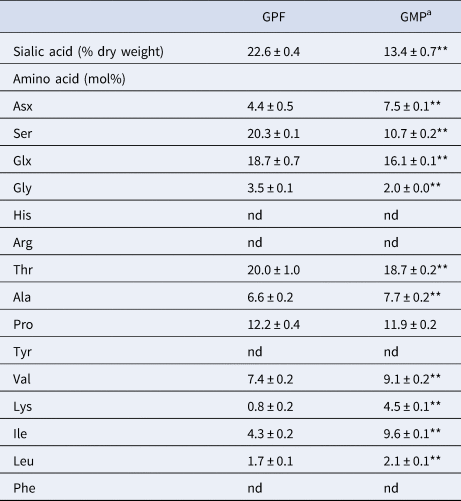
A sample of GMP was a product prepared in our previous study using anion exchange chromatography on Diaion HPA75 (Mitsubishi Chemicals, Tokyo, Japan) (Nakano and Betti, Reference Nakano and Betti2020). Its sialic acid content and amino acid composition are given in Table 1. Twice crystallized papain, Sephacryl S-100-HR, blue dextran, sialic acid (N-acetylneuraminic acid) from Escherichia coli and 2-thiobarbituric acid were obtained from Sigma-Aldrich Canada Ltd., Mississaga, ON, Canada. Diethylaminoethyl (DEAE)-Sephacel and Superdex-75 10/300 GL column were products of GE Healthcare, Baie d'Urfé, PQ, Canada. Cellulose acetate strips (Sepraphore III) for electrophoresis was obtained from Pall Corporation, Ann Arbor, MI, USA.
Analysis of sialic acid and amino acid in GPF and GMP

Preparation of glycopeptide from GMP by papain hydrolysis
Approximately 25 mg of GMP sample was incubated with twice crystallized papain (4 μg/mg of sample) in 0.5 ml of 0.1 M sodium acetate, pH 6.5 containing 0.005 M disodium EDTA and 0.005 M cysteine hydrochloride at 65°C (Nakano and Ozimek, Reference Nakano and Ozimek1999) for 2 h (see below for discussion of incubation time). After hydrolysis, the incubation mixture was applied to a 2 ml column (Bio-Lad Poly-Pep) of DEAE-Sephacel equilibrated with water adjusted to pH 3.5 with 1 M HCl. Glycopeptide released from GMP by papain hydrolysis was adsorbed on the column and eluted by applying 1 M NaCl. Papain having isoelectric point >8 (supplier's information) is not adsorbed on the column at an acidic pH. Fractions (~2 ml) collected were monitored for absorbance at 220 nm and sialic acid. Sialic acid containing fractions were pooled, exhaustively dialyzed in water using molecular weight cutoff 6000–8000 dialysis tube and then freeze-dried to obtain a glycopeptide fraction (GPF), which was kept at 4°C until analyzed. This experiment was repeated three times to obtain three replicates.
Analytical methods
The content of sialic acid was determined by the modified thiobarbituric acid reaction (Nakano et al., Reference Nakano, Nakano, Ahn and Sim1994, Reference Nakano, Ikawa and Ozimek2007), in that cyclohexanone used as a chromophore extracting agent in the original method (Warren, 1959) was replaced by 1-propanol to improve the efficiency of analysis. The content of phosphorus was determined by the malachite green dye binding method (Van Veldhoven and Mannaerts, Reference Van Veldhoven and Mannaerts1987). Amino acid analysis was carried out on samples hydrolyzed with glass distilled 6 M HCl in the presence of nitrogen gas at 110°C for 24 h as previously described (Nakano and Betti, Reference Nakano and Betti2020). Cysteine, methionine and tryptophan were not analyzed. Statistical analysis was carried out using a t-test [Graph Pad QuickCalcs] to detect significant difference (P < 0.01) between means of results.
Chromatographic and electrophoretic methods
For gel filtration chromatography, a sample (~5 mg) of GMP or GPF was applied to a 0.9 cm × 57 cm column of Sephacryl S-100 equilibrated and eluted with 0.1 M sodium acetate, pH 7.0. Fractions (~0.5 ml) collected were monitored for absorbance at 220 nm and sialic acid. Void volume (V 0) and total column volume (V t) were determined using blue dextran and NaCl, respectively. The partition coefficient (K av) of GMP or GPF peak was calculated using the formula: K av = (V e − V 0)/(V t − V 0), where V e represents the volume of the peak fraction. Size exclusion HPLC on Superdex-75, and electrophoresis on cellulose acetate strips were carried out following the methods reported previously (Nakano and Ozimek, Reference Nakano and Ozimek2015).
Results and discussion
Papain digestion
In a preliminary experiment, GMP was incubated with papain for 20 min, 1, 2 or 4 h, and the size of glycopeptide released from GMP was examined by gel filtration chromatography on Sephacryl S-100 (chromatogram not shown). The results indicated that the partition coefficient (Kav) for a major peak of glycopeptide increased with increasing time of incubation (0.58, 0.61 and 0.66 at 20 min, 1, and 2 h, respectively) and remained constant (0.66) at 4 h. This suggests that most (close to 100%) of GMP was hydrolyzed during 2 h incubation (see the Methods).
Deproteinization
In order to remove papain from the incubation mixture containing GMP hydrolysate, we first tested a trichloroacetic acid (TCA) method, which has been used for deproteinization of papain treated bovine milk (Nakano and Ozimek, Reference Nakano and Ozimek1999). TCA was added to the incubation mixture to a concentration of 7% (wt/vol) as reported by Nakano and Ozimek (Reference Nakano and Ozimek1999) and the precipitate of papain formed was removed by centrifugation. The supernatant obtained was then dialyzed in water and the non-dialyzable fraction retained in dialysis tube was freeze-dried to obtain GPF. With this method, however, the yield of GPF obtained was variable and low accounting for <30% dry weight of GMP. We did not check whether the low yield was due to co-precipitation of glycopeptides with papain in 7% TCA. We then tested anion exchange method using DEAE-Sephacel (see Methods), which resulted in a higher yield of GPF with less variation (see below) than did the TCA method. We did not use immobilized papain, with which if papain removal process is not required, we may be able to save time. However, immobilized papain may be too expensive for routine use.
Anion exchange chromatography
Glycopeptides in GPF were adsorbed on DEAE-Sephacel and eluted with 1 M NaCl (chromatogram shown in Supplementary Fig. 2S) accounting for 48.1 ± 0.3% (sd, n = 3) dry weight of GMP. There was no detectable level of sialic acid in fractions containing unadsorbed material, suggesting that almost all (close to 100%) sialylated glycopeptides were adsorbed on the column.
Analysis of sialic acid and amino acids
Analytical data for GPF and GMP samples are given in Table 1. The sialic acid content (% dry weight) was 1.7 times higher in GPF (22.6) than in GMP (13.4). From the total sialic acid contents in GPF and GMP and the yield of GPF, the recovery of GPF sialic acid is calculated to be 81.1%. This suggests that most of sialic acid (or sialylated oligosaccharide attached to peptide) in GMP was recovered in GPF, a non-dialyzable fraction of GMP hydrolysate. We did not measure the content of sialic acid, if any, in the dialyzable fraction.
The amino acid analysis of GPF showed that there was no detectable level of contaminating amino acids including phenylalanine, histidine, arginine and tyrosine, suggesting no contamination of this preparation with papain, which was effectively eliminated as intended using DEAE-Sephacel.
Amino acid composition was significantly different (P < 0.01) between GPF and GMP. The lysine content (<1 mol%) was much lower (>5 times) and the serine content was ~2 times higher in GPF (20.3 mol%) compared to GMP (10.7 mol%). Contents of asparagine/aspartic acid and isoleucine were ~2 times lower in GPF. Contents of glutamine/glutamic acid, glycine and threonine were slightly higher whereas those of alanine, valine and leucine were slightly lower in GPF than in GMP. Only the exception seen among the amino acid contents was the content of proline (~12 mol%), which was relatively constant between the two preparations.
These results suggest that most glycopeptides were released by enzymatic cleavage of non-glycosylated region of GMP (e.g., Lys-116 to Pro-120) (Supplementary Fig. S1), and thus residues (e,g. Thr-131. Thr-133 and Thr-135), to which oligosaccharides are attached (Eigel et al., Reference Eigel, Butler, Ernstrom, Farrel, Harwalker, Jeness and Whitney1984), were conserved in non-dialyzable glycopeptide.
There is limited information available concerning chemical composition of papain hydrolysate of GMP. Cheng et al. (Reference Cheng, Gao, Song, Ren and Mao2015) and Tian et al. (Reference Tian, Wang, Tang, Han, Leng and Mao2015) prepared papain hydrolysate from commercially available crude GMP to examine its biological activities. Both groups of researchers reported that their samples of hydrolysate contained considerable amounts of contaminating amino acids including phenylalanine, histidine and arginine, which were also found in their sample of GMP. However, the sample they analyzed may not be comparable to our sample of GPF due to the difference in sample preparation method. Our sample of GPF was isolated by anion exchange chromatography followed by dialysis. Anion exchange chromatography was used for deproteinization (i.e. removal of papain), whereas dialysis was used for removal of small dialyzable materials (including fragments of glycopeptide and chemicals used for incubation buffer for papain proteolysis). Although Cheng et al. (Reference Cheng, Gao, Song, Ren and Mao2015) and Tian et al. (Reference Tian, Wang, Tang, Han, Leng and Mao2015) reported enzyme inactivation which was done after papain digestion, they did not describe in detail the method of deproteinization and removal of small dialyzable materials.
Small amounts of contaminating amino acids found in commercial GMP samples used by Cheng et al. (Reference Cheng, Gao, Song, Ren and Mao2015) and Tian et al. (Reference Tian, Wang, Tang, Han, Leng and Mao2015) (see above) may be removed by anion exchange chromatography. Nakano and Ozimek (Reference Nakano and Ozimek2015) refined commercial preparation of crude GMP using chromatography on DEAE-Sephacel to obtain a product with undetectable level of contaminating amino acids.
Gel filtration chromatography, size exclusion HPLC and cellulose acetate electrophoresis
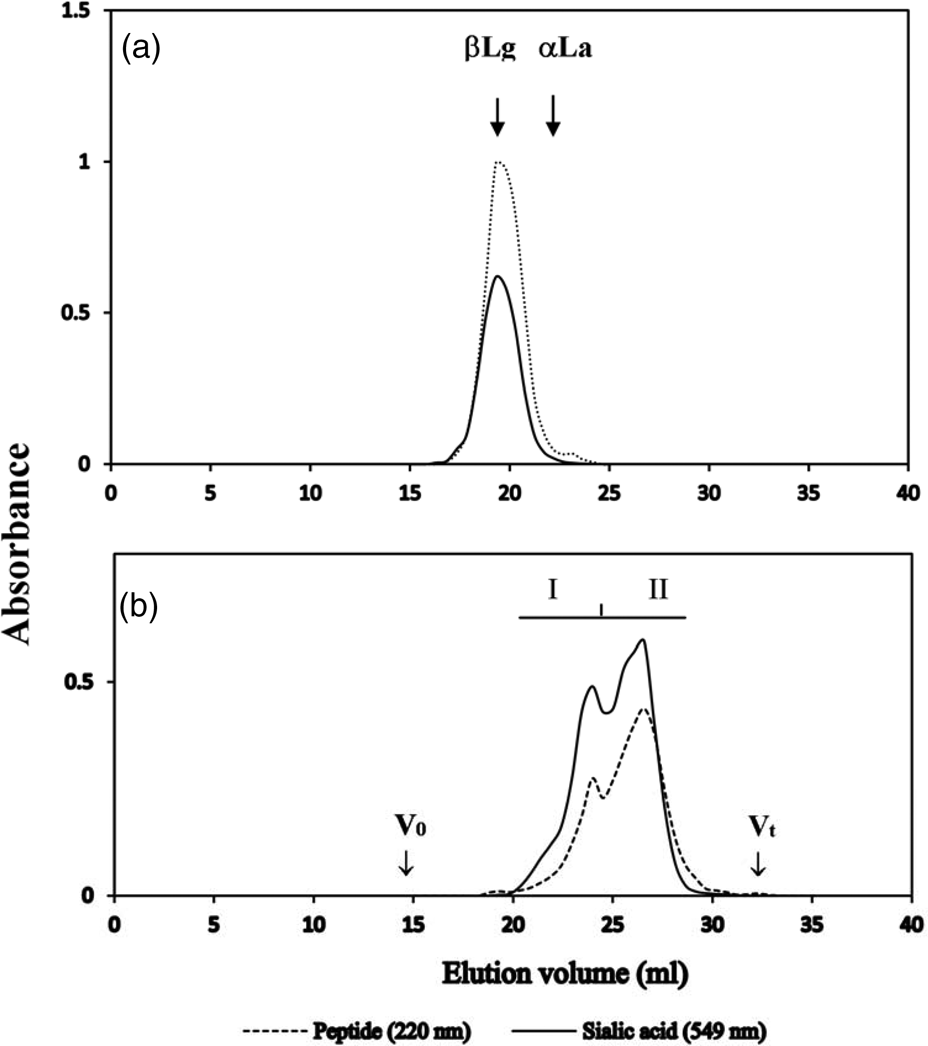
Results obtained by gel filtration chromatography of GMP and GPF on Sephacryl S-100 are shown in Figure 1. GMP was eluted in a single peak with K av, 0.27, which was close to that (0.28) of dimeric β-lactoglobulin (36.6 kDa) peak, whereas GPF was eluted in two peaks with K av, 0.52 (fraction I) and 0.66 (fraction II), both of which were greater than the K av (0.47) of α-lactalbumin (14.2 kDa) peak. Fraction I accounted for 42 and 30% of recovered sialic acid and peptide (monitored by measuring absorbance at 220 nm), respectively, whereas fraction II accounted for 58% and 70% of recovered sialic acid and peptide, respectively. This suggests that sialic acid to peptide ratio, which is calculated to be 1.40 for fraction I, and 0.82 for fraction II, is 1.7 times higher in fraction I than in fraction II. It may be interpreted that the larger molecular size (or lower K av) seen for fraction I (than fraction II) is due to the higher concentration of sialic acid in fraction I. The sialic acid concentration is estimated to be approximately 32 and 19% for glycopeptides from fractions I and II, respectively, if they are obtained as purified products with 100% recovery. Gel filtration chromatography, which is not an efficient technique for large scale production of food ingredient, may be useful for laboratory scale preparation of highly sialylated glycopeptide for research purposes.
Chromatography of GMP and GPF on a column of Sephacryl S-100. Chromatograms A and B show elution patterns for GMP and GPF, respectively. A 50 μl aliquot of each fraction was used for sialic acid assay, whereas for measurement of absorbance at 220 nm, 10 times diluted aliquot from each fraction was used. βLg and αLa in chromatogram A denote elution volumes of dimeric β-lactoglobulin (36.6 kDa) and α-lactalbumin (14.2 kDa), respectively. In chromatogram B, I and II show two pooled peak fractions used to calculate sialic acid to peptide ratios. See text for other details.

Elution patterns of GMP and GPF were also examined using size exclusion HPLC on Superdex-75 (Supplementary Fig. S3). GMP monitored by measuring absorbance at 214 nm gave a single peak with retention time, 27.11 min, which was close to the retention time (27.50 min) of dimeric β-lactoglobulin (36.6 kDa). GPF showed two peaks eluting at 34.34 min (fraction I) and 36.44 min (fraction II), both of which emerged later than did α-lactalbumin (14.2 kDa) (31.35 min). Fractions I and II accounted for 30 and 70% of recovered peptide, respectively, the result being identical to that seen with Sephacryl S-100 chromatography (see above).
The electrophoretic mobility determined by monitoring sialic acid and phosphorus on cellulose acetate strips was found to be faster in GPF than in GMP (Supplementary Fig. S4). The mobility of GPF relative to that of GMP as 1.0 ranged from 1.1 to 1.3. This difference is mainly due to the lower content of basic amino acid, lysine and higher content of sialic acid (a negatively charged sugar) in GPF than in GMP. Phosphorus detected on cellulose acetate strips was probably derived from Ser-149, a main phosphorylation site of GMP (Eigel et al. Reference Eigel, Butler, Ernstrom, Farrel, Harwalker, Jeness and Whitney1984). This suggests that GPF contains glycophosphopeptide.
Future study related to GPF with high sialic acid content
Since Iijima et al. (Reference Iijima, Takahashi, Namme, Ikegami and Yamazaki2004) studied H2O2 scavenging activity of free sialic acid, and reported that sialic acid reacts with an equimolar amount of H2O2, it is of considerable interest to know the reactivity of H2O2 to the GPF obtained in the present study. Although Cheng et al. (Reference Cheng, Gao, Song, Ren and Mao2015) examined H2O2 scavenging activity in GMP and its papain hydrolysate and reported a higher activity in the latter, these authors did not investigate the H2O2 scavenging activity of sialic acid of their papain hydrolysate of GMP.
Further research is also needed for investigation of the effect of GPF on the growth of bifidobacteria. In this regard, Tian et al. (Reference Tian, Wang, Tang, Han, Leng and Mao2015) reported that the sialic acid content in papain hydrolysate of GMP is not directly related to the growth promotion of bifidobacterium. However, Idota et al. (Reference Idota, Kawakami and Nakajima1994) examined growth-promoting effects of GMP as a source of sialic acid, and reported an enhanced growth of bifidobacteria by GMP.
In conclusion, a highly purified GPF was prepared from GMP by papain digestion followed by anion exchange chromatography and dialysis. Major differences seen between GMP and GPF included: higher sialic acid content; lower lysine and higher serine contents; smaller molecular size; and faster electrophoretic mobility in the latter. GPF may be a useful product as an ingredient of functional foods as well as baby formulas. Further research is needed to develop large scale production methods to produce sialic acid rich glycopeptide.
Supplementary material
The supplementary material for this article can be found at https://doi.org/10.1017/S0022029920000783.
Acknowledgments
We thank Mr. Timothy O'Mara, Itochu Chemicals America Inc., New York, for kindly supplying anion exchange resin sample of Diaion HPA75 for this study. This study was supported in part by a grant from the Natural Sciences and Engineering Research Council of Canada.