Exploring the role of thioredoxin in cereal grain germination
Thioredoxins, small proteins that catalyse thiol–disulphide exchanges, function in regulating the cellular redox environment. The thioredoxin system in plants is particularly complex, with approximately 20 classical thioredoxins having been identified in Arabidopsis thaliana (Meyer et al., Reference Meyer, Reichheld and Vignols2005). Research during the past two decades has witnessed the emergence of h-type thioredoxins (Trxs h) as key redox proteins that act as central regulators of seed germination. Extensive evidence in cereals, generated in large part by the Buchanan laboratory, indicates that, following addition of water, oxidized disulphide proteins in the dry seed are reduced to the sulphydryl state by Trx h (Kobrehel et al., Reference Kobrehel, Wong, Balogh, Kiss, Yee and Buchanan1992; De Gara et al., Reference De Gara, de Pinto, Moliterni and D'Egidio2003; Maeda et al., Reference Maeda, Finnie and Svensson2004). Trx-linked reduction, which takes place during germination, increases both solubility and proteolytic susceptibility of storage proteins, facilitating the emergence and growth of new seedlings (Cho et al., Reference Cho, Wong, Marx, Jiang, Lemaux and Buchanan1999; Wong et al., Reference Wong, Cai, Tanaka, Vensel, Hurkman and Buchanan2004; Faris et al., Reference Faris, Wang and Wang2008).
Given the function of Trx h in germination, it was of interest to explore its role further by engineering overexpression of Trx h5 (Arabidopsis numbering) in the starchy endosperm of barley. In transgenic barley seeds, germination, as well as release of α-amylase, was accelerated (Wong et al., Reference Wong, Kim, Ren, Cai, Cho, Hedden, Lemaux and Buchanan2002) and activity of the starch-degrading enzyme, pullulanase, was increased (Cho et al., Reference Cho, Wong, Marx, Jiang, Lemaux and Buchanan1999). While these changes were observed in barley, the question arose as to whether this mechanism applied to other monocot as well as dicot plants. In a more recent study Trx h was shown to play a role in germination of a dicotyledonous plant, the legume Medicago truncatula (Alkhalfioui et al., Reference Alkhalfioui, Renard, Vensel, Wong, Tanaka, Hurkman, Buchanan and Montrichard2007).
Results of these earlier experiments, demonstrating effects of Trx h overexpression on barley germination, spurred interest in determining effects of such a change on barley's close relative, wheat. Wheat was of particular interest because it is the world's most widely grown crop with production of over 600 million tons in countries of Europe, Asia, North Africa and the Americas. In fact, the area sown to wheat has doubled over the past 50 years and production per hectare has almost tripled.
Up- and down-regulation of thioredoxin in wheat grain
Like the barley studies, the first approach to modulating Trx h expression in wheat was to increase its expression in protein bodies of the endosperm. Overexpression of Trx h5 was driven by the B-hordein endosperm-specific promoter and protein body targeting sequence and reached levels 30 times that of the null segregant (Cho et al., Reference Cho, Wong, Marx, Jiang, Lemaux and Buchanan1999). Protein solubility of grain from transgenic lines was increased by 14% in the gliadin fraction. The grain also showed lowered allergenicity, as demonstrated in almost 30 trials in a widely used canine model for human allergies (Buchanan et al., Reference Buchanan, Adamidi, Lozano, Yee, Momma, Kobrehel, Ermel and Frick1997; del Val et al., Reference del Val, Yee, Lozano, Buchanan, Ermel, Lee and Frick1999); the gliadin fraction of the transgenic line, which contains the strongest allergens, was three times less allergenic than its companion null segregant (Li et al., Reference Li, Ren, Cho, Zhou, Kim, Guo, Wong, Niu, Kim, Morigasaki, Lemaux, Frick, Yin and Buchanan2009). The effect of overexpressed Trx h5 on other protein fractions, i.e., albumins/globulins and glutenins, was not significant.
Down-regulation of Trx h9
The fact that overexpression of Trx h5 speeds up seed germination raised the question as to what would happen if Trx h expression were lowered. In these experiments an antisense Trx h gene (PTrx) from the monocot grass, Phalaris coerulescens, linked to the wheat α-gliadin promoter and targeted to the cytosol (Li et al., Reference Li, Ren, Cho, Zhou, Kim, Guo, Wong, Niu, Kim, Morigasaki, Lemaux, Frick, Yin and Buchanan2009), was engineered into a Chinese white wheat variety. This Trx h gene codes for a protein with 95% similarity to a wheat Trx h gene and 65% similarity to Arabidopsis Trx h9 (accession number: NP_187483). Due to amino acid similarity to Arabidopsis Trx h9, the targeted gene is termed wheat Trx h9 in this publication.
In general, underexpression of Trx h in these studies demonstrated effects on germination and the activity of associated enzymes that were opposite those obtained with Trx h5 overexpression in barley (Cho et al., Reference Cho, Wong, Marx, Jiang, Lemaux and Buchanan1999). All nine transgenic wheat lines studied showed significant down-regulation of Trx h9 compared to a non-transgenic control. Four lines expressed at < 20% that of the control and one of these, no. 5, was used for the detailed analyses described below. Silencing of Trx activity was maximally decreased at 30 d post-anthesis to 25% that of the null segregant; however, the loss progressively decreased, so that at the end of the monitoring period (>70 d post-anthesis) the difference essentially disappeared. It should be noted that suppression of Trx activity was reduced to a greater extent during germination than during grain development. It is important to note that wheat Trx h9 differs markedly from other wheat Trxs, thus likely leading to specific silencing of wheat Trx h9 by the antisense Ptrx. In future research, it is of interest to determine whether Trx h isoforms, other than h9, are affected under these conditions; however, because of amino acid differences among the various wheat Trxs h, a significant effect seems unlikely.
The decrease in Trx h9 expression also led to a decrease in α-amylase activity in the initial phases of growth but, by maturity, the loss had disappeared. Unlike Trx and α-amylase, activity of pullulanase, a starch-debranching enzyme, was lowered up to 20% at 70 d post-anthesis relative to a null segregant. Thus, in mature seeds there was little effect on Trx or α-amylase activity, but a sustained, although relatively small, effect on pullulanase activity.
Protection of transgenic grain from pre-harvest sprouting
Down-regulation of Trx h9 raised the possibility that germination might be suppressed, given that overexpression of a Trx h resulted in accelerated germination in barley. This suppression of germination could result in a solution to a chronic, economically costly problem, known as pre-harvest sprouting (PHS), in cereals such as wheat and particularly in white wheat. PHS is caused by prolonged or untimely rainfall or high humidity occurring late in the growing season, causing grain to germinate on the spike before harvest. Sprouting makes threshing difficult, and, if harvested, the grain is downgraded in quality and sold for animal feed because, when grain sprouts, enzymes that convert starch to sugar are activated and negatively impact baking quality traits important to end-users. Having to sell the grain for animal feed obviously leads to severe economic losses for growers (Beuerline, Reference Beuerline2001).
The problem of PHS is particularly acute in white wheat varieties, the demand for which is increasing due to their use in high-fibre, white flour products. US consumers are interested in increasing fibre consumption through whole-grain foods, and white wheat has become increasingly popular in making those products which then have an appearance and taste similar to traditional products made from processed, fortified red wheat flour. The market for white wheat has grown in the US for both domestic and export use. In China and South Asia, white wheat is the predominant variety grown, and in Australia virtually all wheat is of the white variety, which is cultivated in an attempt to capture the vast Asian noodle market.
Owing to potential economic benefits, farmers worldwide have tried to increase production of white wheat, but PHS has historically been a major deterrent to more extensive production. PHS is a major problem in China (Xiao et al., Reference Xiao, Yan, Zhang and Sun2004) and throughout the world (Imtiaz et al., Reference Imtiaz, Ogbonnaya, Oman and van Ginkel2008). For example, in China 83% of the wheat-planting region is subject to sprouting damage and, in one of the major cultivation areas for white wheat varieties, sprouting regularly occurs in more than 20% of the crop (Xiao et al., Reference Xiao, Zhang, Yan and Lin2002). PHS is also an increasing problem in the US where unexpected rains have led to significant portions of the durum and spring white wheat succumbing to sprout damage, resulting in staggering financial losses. Because of the significance of its economic losses for growers and the likelihood that such changes will increase with global climate change, PHS has far-reaching consequences for the sustainability of the wheat industry.
Because of these losses, extensive efforts have been made to understand the genetic basis for PHS and develop control strategies. Indeed, the failure of seed from the transgenic lines of a white wheat variety, Shengkang No. 1, underexpressing Trx h9 to germinate in the head for up to 7 d after being subjected to PHS conditions (Fig. 1; Li et al., Reference Li, Ren, Cho, Zhou, Kim, Guo, Wong, Niu, Kim, Morigasaki, Lemaux, Frick, Yin and Buchanan2009) is an exciting advance for wheat growers. Importantly, the null segregant heads (Fig. 1, upper), under PHS conditions, had numerous new seedling sprouts, compared to no sprouts on transgenic heads (Fig. 1, lower). This phenotype was observed in up to fourth-generation seed with no diminution in protection against PHS. Thus, the reduced germination in the transgenic seeds from a line in which antisense PTrx was active offers a potential avenue to control PHS. To validate the effectiveness of this approach it is important to note that the eight other independent lines underexpressing Trx h9 showed similar effects, as did lines from a strong-gluten, white wheat cultivar, Yumai34, and a weak-gluten white wheat cultivar, Yumai18, into which the same construct was introduced.
Spikes from homozygous transgenic plants (lower) and null segregants (upper) 7 d after treatment to induce pre-harvest sprouting. (A colour version of this figure can be found online at http://journals.cambridge.org/ssr).

Yield and quality of transgenic grain versus control
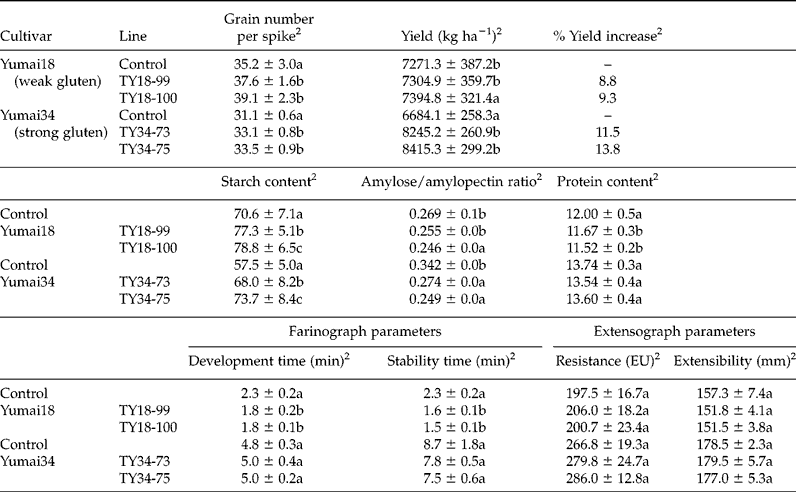
While protection against PHS is important to growers and the wheat industry, the trait would not be widely adopted if the introduction of the antisense construct had a negative impact on other important traits related to agronomic performance and quality. One issue that arises is field germination. In contrast to controls, transgenic spikes tested for PHS fail to sprout for 7 d under sprouting conditions in an environmentally controlled growth chamber. In the field germination is also delayed but, once germinated, plants grow normally and harvest is only minimally delayed. To investigate the effects of antisense PTrx on grain yield and quality properties, grain from homozygous transgenic lines of Yumai18 (weak gluten) and Yumai34 (strong gluten) grown in the field from 2007 to 2009 was compared to grain from their wild-type Yumai18 and Yumai34 parents (Ren et al., Reference Ren, Wang, Wang, Li, Niu, Wang and Yin2010). Results from the analysis of field-grown grain showed that yield and quality properties of both transgenic lines were generally affected positively. Relative to parental lines, grain number per spike and yield of transgenic lines were significantly increased (Table 1). Total starch content (Table 1), amylopectin content and peak, trough and final viscosities (data not shown) were significantly increased in transgenics, although the ratio of amylose to amylopectin was reduced (Table 1).
Grain properties of control and two transgenic lines from two varieties of field-grown wheat1

1 Complete data set in Ren et al. (Reference Ren, Wang, Wang, Li, Niu, Wang and Yin2010).
2 Values followed by different letters are significantly different at P < 0.05.
The effects of the transgene on protein quality differed between the two varieties. Thus, the content of total protein (Table 1) was the same in the strong gluten variety (Yumai34) but significantly decreased in the weak gluten variety (Yumai18). Content of albumin, globulin and glutelin decreased significantly in most cases, while content of gliadin showed a significant increase in the two transgenic lines of the weak-gluten variety (data not shown). There were no significant differences in development time and stability time of dough from transgenic lines versus controls in the strong-gluten line; however, these parameters decreased significantly in the weak-gluten line (Table 1); contents of albumin, gliadin, and glutelin decreased significantly in both lines of the two wheat cultivars (data not shown). In summary, transferring PTrx into wheat improved certain starch paste traits of both wheat cultivars. Certain farinograph and extensograph properties of the high-gluten variety did not change, while farinograph properties of the low-gluten variety decreased slightly compared to the parental control.
Owing to the difficulties for reliably assessing PHS tolerance in the field, spikes were removed from plants prior to harvest and subjected to PHS testing in the laboratory (Li et al., Reference Li, Ren, Cho, Zhou, Kim, Guo, Wong, Niu, Kim, Morigasaki, Lemaux, Frick, Yin and Buchanan2009). Results of these tests were as shown in Fig. 1, with control heads germinating and transgenic heads not undergoing PHS (J.-P. Ren, unpublished results).
Intra- and intercellular redox communication
The fact that the up- and down-regulation of Trx in the described experiments takes place in the endosperm, while many of the phenotypic responses take place in the embryo and aleurone layer, raised the question as to how this inter-organellar communication takes place. Recent studies in the Lemaux and Buchanan laboratories, focused on Arabidopsis thaliana, have provided clues to an answer. Based on T-DNA induced mutations and Trx h fusions to green fluorescent protein (GFP), Trx h9 was found to be associated with the plasma membrane and to be able to move from cell to cell (Meng et al., Reference Meng, Wong, Feldman, Lemaux and Buchanan2010) – properties believed to be unique among the Trxs studied (Gelhaye et al., Reference Gelhaye, Rouhier and Jacquot2004). Relative to known Trx h counterparts, analysis of Trx h9 from both Arabidopsis and cereals revealed a 17-amino-acid N-terminal extension in which the second glycine and fourth cysteine were highly conserved in other species. Mutagenesis experiments demonstrated that the glycine was required for membrane binding, and both the glycine and cysteine were needed for movement (Meng et al., Reference Meng, Wong, Feldman, Lemaux and Buchanan2010). A three-dimensional model of Trx h9 was consistent with its being reduced by glutaredoxin, as found for its counterpart from poplar (Gelhaye et al., Reference Gelhaye, Rouhier and Jacquot2003), rather than by NADP-thioredoxin reductase.
By demonstrating membrane localization and intercellular mobility of Trx h9, the results suggest a role for this thioredoxin in cell to cell communication, relaying information to maintain cellular redox balance and possibly functioning in redox signalling. Thus, by up- or down-regulating Trx in the endosperm it is possible that relevant information is communicated to other compartments of the seed or the plant through a redox signalling network. The unexpected localization of Trx h9 in the membrane likely has implications for its function in an intercellular network responsible for communication between, for example, endosperm, embryo and aleurone, and an apparent role in germination and mitigation of PHS. Existence of such a communication network was suggested in earlier work published from the Buchanan and Lemaux laboratories (Wong et al., Reference Wong, Kim, Ren, Cai, Cho, Hedden, Lemaux and Buchanan2002).
Concluding remarks
Lack of weather predictability makes it difficult, if not impossible, for farmers to control PHS and prevent crop loss. In the future, owing to global climate change, the situation with unpredictable rainfall is expected to become even more difficult. These kinds of changes are already being seen, for example, in Australia, where lengthy periods of drought were brought to a dramatic end by widespread flooding. The unpredictable changes in weather patterns worldwide could exacerbate the already troublesome and costly problem of PHS and crop harvests. Thus, a proactive effort to develop strategies to ameliorate negative impacts of PHS and increase sustainability of crop production is most assuredly in agriculture's best interests. The work described in this study demonstrates the striking effects of manipulating the levels of a key redox protein, thioredoxin, in wheat grain. Up-regulation of Trx h5 in barley results in a faster germination time and α- amylase production and an increase in pullulanase activity. Up-regulation in wheat results in grain that causes a reduced allergenic response in an atopic dog model. Down-regulation of the unique Trx h9 in wheat grain leads to a dramatic reduction in preharvest sprouting. In sum, these results indicate the critical role expression of thioredoxin plays in determining properties of the cereal grain.
Acknowledgements
J.-P.R. and Y.L. were supported financially by the National Natural Science Foundation of China (30771332; 30971771). B.B.B. and P.G.L. acknowledge support, respectively, from the California Agricultural Experiment Station and the USDA Cooperative Extension Service, both through the University of California.