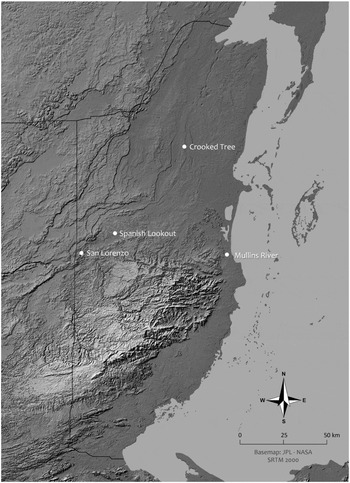
Stemp et al. (Reference Stemp, Awe, Prufer and Helmke2016) published data on 81 preceramic (Archaic) points from Belize, Central America. In this comment, we report four more chipped chert bifaces recently recovered in Belize (Figure 1). Based on metrics (Table 1), technology, and style, three are classified as Lowe and one as a Sawmill point (Kelly Reference Kelly1993; Lohse et al. Reference Lohse, Cameron Griffith, Rosenswig and Valdez2006; Stemp et al. Reference Stemp, Awe, Prufer and Helmke2016).
Figure 1.Map of the preceramic point finds (Map by C.G.B. Helmke).
Table 1.Measurements of the Four Preceramic Points from Belize.
Lowe Point from Crawford Bank (Crooked Tree)
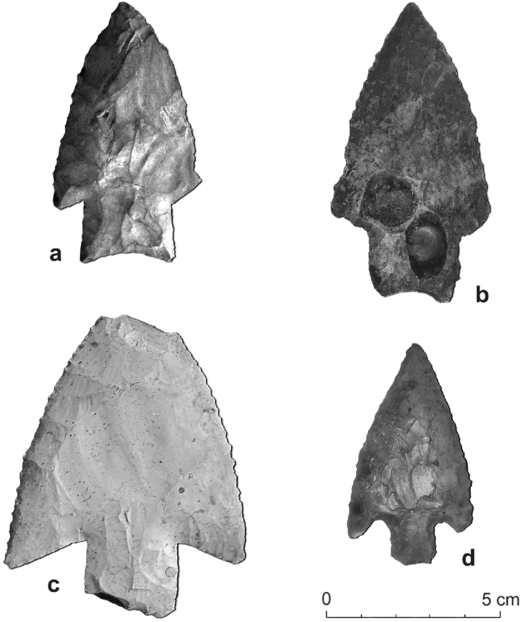
The Lowe point (Figure 2a) from the Crawford Bank site was found during a test excavation conducted in 2017 by the Belize River East Archaeology project (BREA) (Harrison-Buck et al. Reference Harrison-Buck, Willis, Murata and Craig2018). The site is located on the eastern side of Crooked Tree Island along the shoreline of the Crooked Tree Lagoon, which today becomes seasonally inundated during the rainy season. The BREA team dug a narrow 1- x 12-m strip trench (Operation 35) divided into ten 1- x 2-m sub-units (Squares A–J), with the long axis of the trench running east-west. A shallow layer of topsoil was removed to reveal an eroded, undulating limestone surface that probably was the ancient lagoon shoreline. Abundant lithic debitage and formal preceramic stone tools were found across the limestone feature. A dense deposit of Pomacea shells and lithic material was found heaped up against the eastern edge of the limestone feature in Square J, on top of a gray, sandy surface extending east. It was on this surface, about 1.40 m to the east of the shell and lithic heap, that the Lowe point was found in situ, about 5 cm below the ground surface.
Figure 2.The preceramic points from Belize (Photographs by E. Harrison-Buck, W.J. Stemp, G. Wrobel, and C.G.B. Helmke).
This biface is heavily patinated. Based on the color of the stone and some observable banding, it is likely made from Northern Belize Chert-Bearing Zone chert (Hester and Shafer Reference Hester and Shafer1984). Alternate-opposite beveling occurs on the left-hand side of both edges of the biface. There are additional flake scars extending from the tip on the right-hand side of both edges of the artifact, which are not traditional beveling. There is an old pot lid on one face of the biface stem, indicating burning of the artifact at some point in the past, prior to the development of the patina. One of the large barbs is snapped off. The stem base is concave, and there is basal thinning on both faces of the stem produced by multiple flake removals.
Lowe Point from San Lorenzo
In 2016, the Mopan Valley Preclassic Project recovered a Lowe point (Figure 2b) at the Xunantunich hinterland community of San Lorenzo. A project member, Jason Whitaker, found the point in the cobble- and artifact-rich construction fill of a low domestic platform. Most of the cultural materials within the fill date to the Late Classic period. The fact that this preceramic artifact was found within a later archaeological context raises the possibility that the Maya inhabitants of San Lorenzo recycled and used it as a spear point or knife (see Stemp et al. Reference Stemp, Awe, Prufer and Helmke2016), and later discarded it in platform fill. Two recently discovered preceramic sites are within close proximity of San Lorenzo. At nearby Early Xunantunich (1 km to the south), Kathryn Brown has identified a buried paleosol dating to the preceramic period (Brown et al. Reference Brown, Cochran, McCurdy and Mixter2011), and Rachel Horowitz (Reference Horowitz2017) identified a preceramic occupation at the Callar Creek Quarry (5 km north of San Lorenzo).
The biface is made from fine-grained brown chert. Identification of the raw material source is hampered by the significant patination and burning of the artifact, which has caused discoloration and produced two large pot lids on one face. Horowitz (personal communication, 2017) notes that fine-grained brown chert is found locally. The biface has alternate-opposite beveling on the left-hand side of both edges due to resharpening. Beveling is limited to 37.9 mm from the blade tip on the left edge on the face without the pot lids and 23.7 mm from the tip on the left edge on the face with the pot lids. The edges are also serrated due to pressure flaking of the edges. Both barbs have snapped off the artifact. The base is concave with basal thinning in the form of multiple flake scars on both faces of the stem. The corners at the base of the stem are damaged.
Lowe Point from Mullins River
Several years ago, a non-archaeologist found the third point lying on the ground surface along a four-mile stretch of the Coastal Highway in southern Belize (Figure 2c) near the junction of Mullins River Road. In June 2017, we were granted permission to record and photograph it.
The biface is completely covered in a whitish-gray patina and has a bending fracture at the tip. Extending down the left-hand side of both edges is the characteristic alternate-opposite beveling due to resharpening. The resharpening of the point has produced a slight asymmetry in the outline of this artifact, as well as the serration along the biface edges. One of the barbs is smaller than the other. It is likely that the smaller barb was damaged and subsequently repaired. The base of the stem is flat and damaged on one corner. Unlike the two previously reported points, the Mullins River Lowe point does not possess basal thinning of the stem. There is only one flake scar originating from the base of the stem.
Sawmill Point from Spanish Lookout
A tour guide reported this Sawmill point (Figure 2d) in 2016. It was found in the Mennonite community of Spanish Lookout.
The biface is made from fine-grained gray chert of unknown origin and is partially patinated. Minimal alternate-opposite beveling is present on the left-hand side of one edge of the artifact, extending 15.9 mm from the distal tip. The tip of one of the barbs has broken off in a bending fracture. Both corners of the stem base have been damaged. Basal thinning of the stem can be seen in multiple flake scars on both faces of the stem.
Conclusion
Of the three Lowe points reported here, the Crawford Bank point is the smallest. Its length, width, and thickness are below the mean of examples reported elsewhere in Belize. Although the other two Lowe points fall within the size range of other known examples, the Mullins River point is slightly longer and wider than average. The dimensions of the Sawmill point from Spanish Lookout are commensurate with the 21 other examples previously reported from Belize (see Stemp et al. Reference Stemp, Awe, Prufer and Helmke2016: Table 1). These four points come from locations that add to our understanding of the geographic distribution and extent of the preceramic presence in Belize.






Stemp et al. (Reference Stemp, Awe, Prufer and Helmke2016) published data on 81 preceramic (Archaic) points from Belize, Central America. In this comment, we report four more chipped chert bifaces recently recovered in Belize (Figure 1). Based on metrics (Table 1), technology, and style, three are classified as Lowe and one as a Sawmill point (Kelly Reference Kelly1993; Lohse et al. Reference Lohse, Cameron Griffith, Rosenswig and Valdez2006; Stemp et al. Reference Stemp, Awe, Prufer and Helmke2016).
Map of the preceramic point finds (Map by C.G.B. Helmke).
Measurements of the Four Preceramic Points from Belize.
Lowe Point from Crawford Bank (Crooked Tree)
The Lowe point (Figure 2a) from the Crawford Bank site was found during a test excavation conducted in 2017 by the Belize River East Archaeology project (BREA) (Harrison-Buck et al. Reference Harrison-Buck, Willis, Murata and Craig2018). The site is located on the eastern side of Crooked Tree Island along the shoreline of the Crooked Tree Lagoon, which today becomes seasonally inundated during the rainy season. The BREA team dug a narrow 1- x 12-m strip trench (Operation 35) divided into ten 1- x 2-m sub-units (Squares A–J), with the long axis of the trench running east-west. A shallow layer of topsoil was removed to reveal an eroded, undulating limestone surface that probably was the ancient lagoon shoreline. Abundant lithic debitage and formal preceramic stone tools were found across the limestone feature. A dense deposit of Pomacea shells and lithic material was found heaped up against the eastern edge of the limestone feature in Square J, on top of a gray, sandy surface extending east. It was on this surface, about 1.40 m to the east of the shell and lithic heap, that the Lowe point was found in situ, about 5 cm below the ground surface.
The preceramic points from Belize (Photographs by E. Harrison-Buck, W.J. Stemp, G. Wrobel, and C.G.B. Helmke).
This biface is heavily patinated. Based on the color of the stone and some observable banding, it is likely made from Northern Belize Chert-Bearing Zone chert (Hester and Shafer Reference Hester and Shafer1984). Alternate-opposite beveling occurs on the left-hand side of both edges of the biface. There are additional flake scars extending from the tip on the right-hand side of both edges of the artifact, which are not traditional beveling. There is an old pot lid on one face of the biface stem, indicating burning of the artifact at some point in the past, prior to the development of the patina. One of the large barbs is snapped off. The stem base is concave, and there is basal thinning on both faces of the stem produced by multiple flake removals.
Lowe Point from San Lorenzo
In 2016, the Mopan Valley Preclassic Project recovered a Lowe point (Figure 2b) at the Xunantunich hinterland community of San Lorenzo. A project member, Jason Whitaker, found the point in the cobble- and artifact-rich construction fill of a low domestic platform. Most of the cultural materials within the fill date to the Late Classic period. The fact that this preceramic artifact was found within a later archaeological context raises the possibility that the Maya inhabitants of San Lorenzo recycled and used it as a spear point or knife (see Stemp et al. Reference Stemp, Awe, Prufer and Helmke2016), and later discarded it in platform fill. Two recently discovered preceramic sites are within close proximity of San Lorenzo. At nearby Early Xunantunich (1 km to the south), Kathryn Brown has identified a buried paleosol dating to the preceramic period (Brown et al. Reference Brown, Cochran, McCurdy and Mixter2011), and Rachel Horowitz (Reference Horowitz2017) identified a preceramic occupation at the Callar Creek Quarry (5 km north of San Lorenzo).
The biface is made from fine-grained brown chert. Identification of the raw material source is hampered by the significant patination and burning of the artifact, which has caused discoloration and produced two large pot lids on one face. Horowitz (personal communication, 2017) notes that fine-grained brown chert is found locally. The biface has alternate-opposite beveling on the left-hand side of both edges due to resharpening. Beveling is limited to 37.9 mm from the blade tip on the left edge on the face without the pot lids and 23.7 mm from the tip on the left edge on the face with the pot lids. The edges are also serrated due to pressure flaking of the edges. Both barbs have snapped off the artifact. The base is concave with basal thinning in the form of multiple flake scars on both faces of the stem. The corners at the base of the stem are damaged.
Lowe Point from Mullins River
Several years ago, a non-archaeologist found the third point lying on the ground surface along a four-mile stretch of the Coastal Highway in southern Belize (Figure 2c) near the junction of Mullins River Road. In June 2017, we were granted permission to record and photograph it.
The biface is completely covered in a whitish-gray patina and has a bending fracture at the tip. Extending down the left-hand side of both edges is the characteristic alternate-opposite beveling due to resharpening. The resharpening of the point has produced a slight asymmetry in the outline of this artifact, as well as the serration along the biface edges. One of the barbs is smaller than the other. It is likely that the smaller barb was damaged and subsequently repaired. The base of the stem is flat and damaged on one corner. Unlike the two previously reported points, the Mullins River Lowe point does not possess basal thinning of the stem. There is only one flake scar originating from the base of the stem.
Sawmill Point from Spanish Lookout
A tour guide reported this Sawmill point (Figure 2d) in 2016. It was found in the Mennonite community of Spanish Lookout.
The biface is made from fine-grained gray chert of unknown origin and is partially patinated. Minimal alternate-opposite beveling is present on the left-hand side of one edge of the artifact, extending 15.9 mm from the distal tip. The tip of one of the barbs has broken off in a bending fracture. Both corners of the stem base have been damaged. Basal thinning of the stem can be seen in multiple flake scars on both faces of the stem.
Conclusion
Of the three Lowe points reported here, the Crawford Bank point is the smallest. Its length, width, and thickness are below the mean of examples reported elsewhere in Belize. Although the other two Lowe points fall within the size range of other known examples, the Mullins River point is slightly longer and wider than average. The dimensions of the Sawmill point from Spanish Lookout are commensurate with the 21 other examples previously reported from Belize (see Stemp et al. Reference Stemp, Awe, Prufer and Helmke2016: Table 1). These four points come from locations that add to our understanding of the geographic distribution and extent of the preceramic presence in Belize.