The first case of COVID-19 in New York City (NYC) was reported on March 1, 2020, and “community-wide transmission” was declared on March 15, 2020. 1 The US President declared a national emergency on March 13, 2020, 2 2 days after the Word Health Organization officially declared COVID-19 a pandemic, with cases reported in 114 countries at that time. 3 Case counts in NYC increased from 274 cases per day (weekly mean) during March 8–14 to 5,132 cases per day by the week of March 29–April 4. Hospital admissions also peaked the week of March 29 with a mean of 1,566 admissions per day. With a median duration of hospitalizations at 6 days, peak hospitalizations for New York State were noted on April 12, and peak deaths in New York City (NYC) were noted concurrently during the week of April 5 with a weekly mean of 566 deaths per day. 4,Reference Thompson, Baumgartner and Pichardo5
As local hospitals surpassed their patient capacity, New York State, under the direction of the New York State Governor, made the decision to transform the Jacob K. Javits Convention Center in NYC into an alternate care site (ACS), the Javits New York Medical Station (hereafter termed Javits), which became the largest field hospital in the history of the United States. Initially envisioned as a 1,000-bed facility, Javits was staffed by ∼850 uniformed personnel from the US Public Health Service Commissioned Corps (USPHS) and the US Department of Defense (DoD), including US Army, Navy, and Air Force. This staff supported a Federal Emergency Management Agency (FEMA) request for assistance under military and unified chains of command. Clinical staffing was later supplemented by civilian healthcare providers. 6
Javits was originally intended to be a non–COVID-19 facility, with the goal of accepting non–COVID-19 patients transferred from local area hospitals. The first non–COVID-19 patient was admitted to Javits on March 31, 2020. However, the demand for capacity to care for COVID-19 patients surpassed the need for additional capacity for non–COVID-19 patients. On April 2, 2020, the New York governor and the US President announced that Javits would begin to admit COVID-19 patients and expand to 2,500 beds. Reference Governor Andrew7 The 11 non–COVID-19 patients were transferred to the US Navy Hospital Ship Comfort stationed nearby at Pier 90 in Manhattan while Javits was quickly reconfigured to treat COVID-19 patients. Updates were made to the admission criteria and infection control plan, including acquisition of additional oxygen delivery systems, devices for pulse oximetry and heart rate monitoring, and pharmaceuticals needed to treat large numbers of patients with COVID-19 and comorbidities. Additionally, the DoD built a 48-bed intensive care unit (ICU) to provide appropriate critical care (eg, mechanical ventilation) for COVID-19 patients who required critical care services. On April 4, 2020, the first COVID-19 patients were admitted to Javits.
USPHS officers designed and oversaw infection control at Javits, leveraging their experience in operating federal medical stations (FMSs), which are typically deployed in disaster settings and are designed to treat low-acuity patients in a supportive care environment. 8 Many USPHS officers had experience operating an Ebola treatment unit in Liberia, West Africa, in 2014, Reference Lushniak9 and they applied lessons learned from healthcare worker (HCW) safety practices and protocols of the Ebola response to Javits.
Due to the uncertainty regarding transmission pathways of SARS-CoV-2 at that time, rapid deployment of personnel, and limited supplies of particular personal protective equipment (PPE), HCW safety at Javits presented unique challenges. Additionally, the need to provide critical care services in an ACS exceeded the low level of acuity typically supported in a FMS. For example, chronic medical or behavioral health conditions of displaced persons in disaster settings that could not be addressed in shelters for the general population.
Previously published results suggest that COVID-19 infection rates among HCWs at Javits were low. Reference Clifton, Krammer and Laing10 In this study, the SARS-CoV-2 infection rate among uniformed staff was 1.7%, and the infection rate of those who provided direct care to COVID-19 patients was 0.9% based on RT-PCR and serology testing performed. In this report, we provide an overview of the HCW safety program implemented at Javits and share strategies and lessons learned that can be adapted to other ACS or traditional hospital settings that are operating in a surge or crisis capacity.
Setting
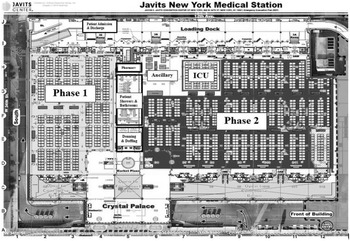
The Jacob K. Javits Convention Center is a large convention center in NYC with 760,000 square feet of exhibition space. To transform this space into an ACS, large exhibition hall areas were transformed into patient wards and the remainder of the space was closed to the public. Moveable partition walls separated patient care areas from the rest of the facility, and 3 patient care areas (ie, “phases”) were built within the exhibition halls. The US Army Corps of Engineers provided a standard design for ACS development. The design was retrofitted to support structural and medical requirements of state, tribal, local, and territorial entities during the COVID-19 pandemic. The US Army Corps of Engineers has constructed >35 ACSs across the country in a variety of building types, including convention centers and arenas, using modifications of the standard design for each facility. Reference Kimmon11,12 Phase 1, designated as the first space that would accept patients, initially was designed as a 1,000-bed area with 1 large, central nursing station. Phase 2 was a 2,000-bed care area adjacent to phase 1, separated by an enclosed space filled by the pharmacy, patient restrooms, and PPE donning and doffing stations at staff entry and exit points (Fig. 1). Phase 3 was a 1,200-bed area similar to phase 1 that was never occupied.
Javits New York medical station phase 1 and phase 2 floor plan.

Each patient room was its own “pod” created by 3 temporary walls, a curtain door, and a ceiling open to the general exhibition area (Fig. 2). Phase 1 became the main patient care area, with staffing, oxygen concentrators, and portable oxygen tanks to support 512 medical beds. Phase 2 was converted to house a 48-bed ICU along with radiology, laboratory, and medical maintenance stations in ready-made DoD field-hospital containers where staff provided patient care services as well as calibration and repair of the medical equipment. A liquid oxygen, bedside oxygen delivery system was plumbed to provide oxygen to all ICU beds as well as all patient rooms in phase 2. All patients requiring oxygen delivery via high-flow nasal cannula and ventilators were cared for in phase 2. The Javits command center was separate from the patient care area, located 1 floor above phases 1 and 2.
Javits New York medical station patient pods.

Infection control methods
Patient isolation
The patient care areas were segregated from all other non–patient care and support areas as well as the command center. The isolation of patient care areas from all other services eliminated the need for non–patient-care staff to use PPE beyond a surgical mask, which was required for anyone entering Javits as universal source control. Patient admission and discharge areas were also located away from patient care areas, preventing any contact between patients and non–patient care staff not wearing appropriate PPE.
Engineering controls
Patient rooms in all phases were not individually ventilated and were open to the airflow of the exhibition hall (Fig. 1). Establishing airborne infection isolation rooms was not feasible at Javits. However, the airflow in the patient care areas was reversed to maintain a negative-pressure differential in relation to all other spaces. Engineering and Javits safety staff routinely checked pressure differentials, achieved by a simple tissue test 13 that involved holding a tissue at the entry point to the patient areas to visually assess the air stream. The purpose of the negative pressure differential was to limit the dispersion of aerosols to non–patient care areas and to increase the frequency of air exchanges with the external environment. Outdoor air circulation was increased as much as possible while maintaining a comfortable internal temperature.
Administrative measures
To reduce exposures to known COVID-19 patients, as well as to reduce PPE usage, only essential personnel were authorized to enter the patient care areas. This required the reduction or elimination of many traditional oversight activities. For example, support services needing access to patient care areas were asked to send only the minimum number of staff. Daily briefings with clinical managers led to the implementation of additional administrative controls, such as the reduction of some staffing shifts from 12 hours to 8 hours to reduce the physiological burden of prolonged PPE wear, and provision of relief staff. Furthermore, staff break areas were relocated closer to patient care areas to facilitate appropriate rest breaks.
Personal protective equipment
Minimum requirements for PPE were established based on whether the individual would be within 2 m (6 feet) of the patient (Table 1). The minimum PPE requirements for staff working in patient care areas but not within 2 m of patients included a NIOSH-approved N95 filtering face-piece respirator (N95), eye protection, and gloves. The use of an N95 respirator was recommended due to concern about the aerosolization of SARS-CoV-2 and the limited air-filtration controls in the patient care areas. Staff who came within 2 m of patients additionally wore a surgical mask over the N95 respirator to protect it from surface contamination and a disposable gown. As an additional precaution in the absence of more definitive PPE guidance for ACS, staff performing aerosol-generating procedures (eg, intubation) were required to wear a NIOSH-approved N95 respirator with face shield or, as an alternative to an N95 respirator, a powered air-purifying respirator (PAPR), as well as bouffant caps. Scrubs, shoe covers, and lockers were provided to anyone entering the patient care areas. In non–patient care areas (eg, Command Center, restroom, hallways), all staff at Javits were required to wear a surgical mask. Disposable surgical masks were provided to all individuals upon entrance into Javits and werereplaced only when grossly soiled or physically damaged to conserve supply.
Personal Protective Equipment Matrix

Note. PPE, personal protective equipment; ICU, intensive care unit; CPR, cardiopulmonary resuscitation; PAPR, powered air-purifying respirator; AGP, aerosol-generating procedure.
Because of global shortages of N95 respirators and the uncertainty of resupply, the safety team implemented an N95 respirator extended-use and limited-reuse policy to maximize the safe use of the existing supply of respirators. Each individual was provided up to 5 NIOSH-approved N95 respirators. An individual would use an N95 respirator for the duration of a shift, store it in a dated paper bag in a ventilated area in Javits after doffing, and then reuse the same respirator 6 days later. Upon re-entry to the patient care area, a new respirator would be included as part of the donning procedure, unless 5 days had passed from the last use of a stored respirator, in which case the stored respirator was reused up to a maximum of 5 uses according to the CDC limited-reuse guidance. 14 The Javits extended use and reuse practice was determined by a number of data points: the estimated duration of viable SARS-CoV-2 on respirator material, Reference van Doremalen, Bushmaker and Morris15 expected time until degradation of respirators, 16 existing inventory, estimated staff census, and likelihood of resupply.
All staff wearing N95 respirators were medically cleared, fit-tested, and trained in accordance with the Occupational Safety and Health Administration (OSHA) respiratory protection standard. 17 The safety team provided an in-person PPE donning and doffing demonstration, and a video recording of proper donning and doffing steps was repeatedly played on a TV screen as staff waited in line at the donning station.
When in the patient care areas, staff were not permitted to remove any of the minimally required PPE (gloves, eye protection, N95 respirator, surgical mask, gown for patient care personnel). Staff would apply hand sanitizer on their gloves in between patients for the extended use of gloves during the glove supply crisis. If PPE were to be removed for any reason (restroom, food/drink, shift change, PPE breach, etc), staff were required to exit the patient care area and doff at the designated doffing station. The safety team routinely did walk throughs to monitor and reinforce PPE compliance in patient care areas. The most common issue observed during these walk throughs was staff noncompliance with wearing eye protection. Safety officers would individually speak with staff members to correct noncompliance and with clinical leadership to reinforce healthcare safety processes. Protocols involving everything from the use of specific equipment to architectural layout and workflows were frequently revised for improvements based on the feedback from the walk throughs and the frontline providers themselves. Staff received notifications of updated protocols during meetings at the beginning of each shift as well as through communication channels established through military and unified chains of command.
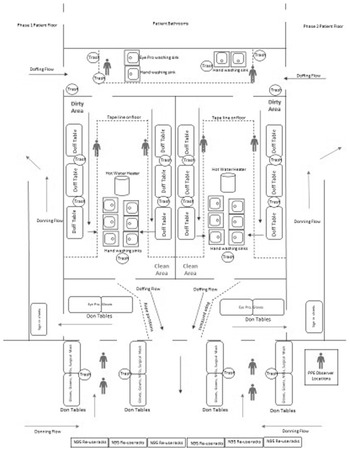
Single entry and exit points to and from the patient care areas were established with associated donning and doffing stations. This design differed from a traditional hospital or clinical setting, where PPE is donned and doffed before entering or after exiting individual patient rooms. The donning and doffing stations were purposefully separated from each other to ensure a unidirectional flow of traffic to minimize potential for cross contamination, though this process did create additional challenges with delays in entry into and exit from patient care areas, particularly during shift changes (Fig. 3). Staggering of shifts and breaks was implemented to reduce congestion and time burden on staff.
Donning and doffing flow.

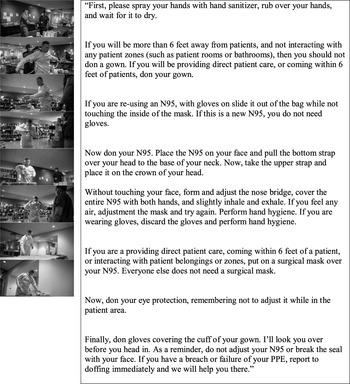
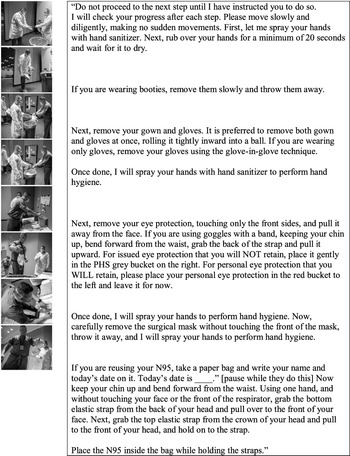
PPE donning and doffing are high-risk activities that need oversight to ensure adherence to proper technique to avoid self-contamination. Reference Chughtai, Chen and Macintyre18 The safety team thus actively monitored and assisted in the donning and doffing of all PPE at these stations 24 hours per day. Members of the safety team who did not have prior training or experience with infectious disease PPE were given on-the-job training by more experienced safety officers to ensure that they were proficient in PPE protocols. The use of checklists and scripts promoted consistency and minimized errors in the donning and doffing processes. See Figure 4 and Figure 5 for photo montages demonstrating the donning and doffing processes and associated scripts.
Donning process and script.

Doffing process and script.

Staff tracking
Sign-in sheets on entry to patient care areas allowed for accountability of personnel and for calculation of PPE burn rates. 19 Based on these sign-in sheets, >250 staff members entered the patient care areas during peak shift changes and >1,200 entries were recorded per day.
Patient census
From March 31, 2020, to May 2, 2020, Javits had a cumulative intake of 1,095 patients (48 ICU patients and 1,047 medical ward patients). All were transferred from local NYC area hospitals. All COVID-19 patients had either a documented positive SARS-CoV-2 RT-PCR test result or a clinical diagnosis of COVID-19 at the transferring hospital. All were clinically stable or improving at the time of transfer and did not have other complex medical conditions. One exception was made in response to a crisis situation at a medical center in Queens, New York, when 27 COVID-19 patients were to the Javits ICU (including10 patients that were on ventilators) after their oxygen distribution systems were overloaded. The median length of stay at Javits was 4.6 days (interquartile range, 3.1–6.9). Reference Brady, Milzman and Walton20 Of 1,095 patients, 967 (88%) were discharged directly from Javits to home; 103 patients (9%) were transferred back to local NYC hospitals or the US Navy Ship Comfort. There were 6 deaths (0.6%), and the remainder of patients left against medical advice or were transferred to skilled nursing facilities. Refer to Figure 6 for daily and cumulative patient intakes and discharges.
Daily and cumulative patient intakes and discharges.

Process for staff reporting sick
Javits staff could access sick-call medical services if they developed COVID-19–like symptoms. COVID-19–like symptoms were defined as any 1 or more of the following: temperature ≥100°F or subjective fever, cough, shortness of breath, sore throat, or atypical symptoms (at the time defined as muscle aches, nausea, vomiting, diarrhea, loss of smell or taste). In addition, all staff were screened for COVID-19 symptoms and fever upon each entry to Javits. If DoD and USPHS personnel developed symptoms, they were instructed to isolate in their hotel rooms and to contact Javits Medical Triage by phone.
Mild and moderate symptoms were evaluated via telehealth (telephonic and/or video with daily follow up). In-person assessments were conducted only when the evaluating clinician deemed it necessary. Personnel in isolation for COVID-19–like symptoms were asked about subjective symptoms of fever or to check their temperature, and to self-monitor their oxygen saturation daily, once portable pulse-oximeters were acquisitioned. SARS-CoV-2 RT-PCR testing was completed typically within 24 hours of symptom onset. Between April 1 and May 5, 2020, sick call records revealed that 138 DoD and 11 USPHS service members were assessed for COVID-19-like symptoms, were tested by nasopharyngeal RT-PCR testing, and were isolated for a minimum of 7 days according to the CDC guidance at the time. Of the 149 DoD and USPHS symptomatic individuals tested, 13 (8.7%) had SARS-CoV-2 detected; the remainder of test results were negative. A single negative test, in the setting of widespread community transmission, was determined to be insufficient to discontinue isolation for COVID-19–like symptoms, given the high suspicion for COVID-19 and the concern for potential staff-to-staff transmission. Personnel were allowed to return to work when they met the CDC criteria for the symptom-based strategy for discontinuing transmission-based precautions. 21
Discussion
Developing a safety plan for HCWs providing care to patients with COVID-19 demands careful preparation and a multidisciplinary team approach. In this report, we have outlined strategies particularly applicable to respiratory droplet- or aerosol-transmitted infectious disease pandemics that successfully protected HCWs at the nation’s largest ACS. Other ACSs may want to consider engineering and administrative controls employed at Javits to help protect frontline workers during public health crises.
When designing an HCW safety plan for an ACS, employee safety must be prioritized from the outset. The patient care areas must be carefully designed to ensure proper controls and entry and exit points for staff and patients, minimizing unnecessary exposure and preventing cross contamination. Safety programs must be rigorously implemented, communicated, and strictly adhered to throughout the mission. All staff must understand isolation procedures if they develop symptoms to prevent transmission to others. The strict isolation policy for even mild COVID-19–like symptoms at Javits decreased staff availability; >10% of available staff were isolated for at least 7 days. Although a major outbreak among the Javits staff was averted, it was important to consider the mission impact and to discuss plans to backfill staff in case a significant number need to isolate.
PPE programs should consider including position-specific PPE requirements based on exposure risk, appropriate general and task-specific training, donning and doffing protocols with direct observation, and oversight of PPE compliance. Limitations in PPE availability require mindful planning and education on extended use and reuse of PPE with processes based on scientific data, risk analysis, hazard assessment and calculation of PPE burn rates to ensure ongoing availability of limited resources.
Results of a seroprevalence study published in the Moribidity and Mortality Weekly Report suggest that HCWs at Javits were successfully protected, given an overall infection prevalence rate of 1.7% and only 0.9% in those providing direct care to COVID-19 patients. Reference Clifton, Krammer and Laing10 A 1.7% prevalence at Javits is lower than rates reported in many other prevalence studies of HCWs Reference Moscola and Jarrett22–Reference Sikkema and Nieuwenhuijse25 ; however, community transmission may have been a greater factor in those studies. One large cohort study of HCWs in the greater NYC area who were tested between April 20 and June 23, 2020, showed a 13.7% prevalence of SARS-CoV-2 antibodies, Reference Moscola and Jarrett22 very close to the 14% seroprevalence of random adults tested in New York State during that time. In contrast, the military staff at Javits originated predominately from US jurisdictions where COVID-19 prevalence was low. After they arrived in NYC, single-occupancy housing in hotels limited their exposure to community transmission. Furthermore, the military command structure provided controls and restrictions on movement that may have reduced exposure risk outside the work environment.
We have described the safety measures implemented during a crisis situation; however, in the absence of controls, it was not possible to determine which aspects of the safety plan were effective. Specific measures outside of CDC guidance were implemented (eg, bouffant caps, scrubs, and shoe covers), and we were unable to determine whether these additional measures provided particular benefit for the protection of HCWs.
In conclusion, the low SARS-CoV-2 infection rate at Javits, an ACS established during a crisis response, demonstrates that the HCW safety program was overall effective. The development of a strong infection control plan centered around HCW and staff safety is vitally important, particularly in surge and crisis situations. The lessons learned from operating the nation’s largest COVID-19 ACS can be adapted to other environments during public health emergencies.
Acknowledgments
The views expressed in this manuscript are those of the authors and do not necessarily represent the official policy or position of any US government agency including the US Public Health Service, US Food & Drug Administration, the US Environmental Protection Agency, Centers for Medicare & Medicaid Services, Centers for Disease Control and Prevention or the Department of Defense.
Financial support
No financial support was provided relevant to this article.
Conflicts of interest
All authors report no conflicts of interest relevant to this article.