Early emerging and persistent externalizing symptoms, characterized by conduct problems, oppositional defiance, and attention deficit and hyperactivity difficulties, are associated with prolonged impairments for children and substantial psychological, social, and economic costs for society (Foster Jones, & The Conduct Problems Prevention Research Group, Reference Foster and Jones2005; Rivenbark et al., Reference Rivenbark, Odgers, Caspi, Harrington, Hogan, Houts and Moffitt2018). In identifying the antecedents of these problems, studies have repeatedly shown that unsupportive parenting – as reflected in disengagement and difficulties tailoring caregiving responses to children's needs, emotional states, and abilities – increases children's risk for externalizing symptoms (Campbell, Reference Campbell, McCartney and Phillips2006; Dix, Gershoff, Meunier, & Miller, Reference Dix, Gershoff, Meunier and Miller2004; Pinquart, Reference Pinquart2017). To further understand why unsupportive parenting poses a risk for children, developmental psychopathology models have posited that children's processing of negative emotions is a key mechanism underlying their vulnerability to externalizing symptoms (Crick & Dodge, Reference Crick and Dodge1994; McCrory & Viding, Reference McCrory and Viding2015; Runions & Keating, Reference Runions and Keating2007). Research on externalizing problems has largely examined the later stages of information processing (e.g., interpretations, attributions, and response generation) as risk processes for children exposed to parenting difficulties (Dodge, Reference Dodge2006; Hankin, Snyder, & Gulley, Reference Hankin, Snyder, Gulley and Cecchetti2016; Lansford, Reference Lansford, Malti and Rubin2018). However, there is emerging evidence supporting the role of attention biases to negative emotion cues during the early encoding stages of processing as risk mechanisms accounting for relations between parenting difficulties and the emergence of other psychological (e.g., internalizing) problems (Gulley, Oppenheimer, & Hankin, Reference Gulley, Oppenheimer and Hankin2014; Perez-Olivas, Stevenson, & Hadwin, Reference Perez-Olivas, Stevenson and Hadwin2008).
In extending this work, our goal was to test children's attention to negative (i.e., anger, sadness, and fear) adult facial expressions as a mediator of the prospective association between unsupportive parenting and children's externalizing problems. Although attention biases to emotion are regarded as essential parts of organizing and regulating emotional responses to stressors (Thompson, Reference Thompson2008; Todd, Cunningham, Anderson, & Thompson, Reference Todd, Cunningham, Anderson and Thompson2012), research has rarely examined these processes in relation to children's emotional reactivity to stressful events. Consequently, conceptual models have generated widely varying interpretations on the meaning or function of attention biases to negative emotions (Lindblom et al., Reference Lindblom, Peltola, Vänskä, Hietanen, Laakso, Tiitinen and Punamäki2017). Thus, consistent with the organizational approach in developmental psychopathology (Cicchetti, Reference Cicchetti, D.2016), the second objective of this paper was to further delineate the emotional reactivity patterns that underpin the mediating role of affect-biased attention in the association between unsupportive parenting and children's externalizing problems.
Biased attention to negative emotions as mediators of unsupportive parenting
Conceptual frameworks share the premise that children's attention to negative emotions develop from their earlier family experiences and serve as filters for organizing children's coping and adjustment (McCrory & Viding, Reference McCrory and Viding2015; Todd et al., Reference Todd, Cunningham, Anderson and Thompson2012). According to attachment and social information processing theories, children develop representations or knowledge structures about the characteristics and meaning of social relationships from the quality of their interactions with caregivers. These representations, in turn, are theorized to have important implications for children's mental health by serving as guides for efficiently filtering, encoding, and processing subsequent social and emotional stressors in a wide array of settings that expand beyond the family (e.g., Dykas & Cassidy, Reference Dykas and Cassidy2011; Thompson, Reference Thompson2008). Despite the consistent theoretical emphasis on children's attention to stressful emotional stimuli as mechanisms accounting for their adjustment to family interactions, there are three primary models that vary considerably in their accounts of how and why affect-biased attention processes are hypothesized to mediate children's vulnerability to family difficulties.
First, as illustrated by Figure 1a, the sensitization model proposes that hypervigilance to negative emotional stimuli following exposure to harsh family environments may enhance children's abilities to proactively protect themselves from interpersonal harm at the cost of increasing their vulnerability to psychopathology (Harms, Leitzke, & Pollak, Reference Harms, Leitzke, Pollak, LoBue, Perez-Edgar and Buss2019; McCrory, Gerin, & Viding, Reference McCrory, Gerin and Viding2017; Pollak, Reference Pollak2003). Greater attention devoted to negative cues is part of a larger pattern of preemptively defending against threatening interpersonal events that is also reflected in heightened fear and distress reactivity to stressful events. Thus, if this sensitization process is operating, a derivative hypothesis is that the experience of unsupportive parenting processes should trigger interrelated, concomitant increases in children's attention biases toward negative emotions and their emotional distress to social stressors. As emotional and attentional processes become increasingly coupled together and organized around defending against interpersonal distress, these attention biases are hypothesized to undermine children's mental health.
(a) The sensitization model formulation of the nature of the interplay between children's attention biases to negative emotion and their emotional reactivity as risk mechanisms in the association between unsupportive child-rearing contexts and their externalizing problems. The unshaded double-headed arrow signifies the correlation between fearful reactivity and attention processes and unshaded unidirectional arrows denote the positive direction of the correlation. (b) The defensive exclusion model formulation of the nature of the interplay between children's attention biases to negative emotion and their emotional reactivity as risk mechanisms in the association between unsupportive child-rearing contexts and their externalizing problems. The unshaded double-headed arrow signifies the correlation between fearful reactivity and attention processes and unshaded unidirectional arrows denote the negative direction of the correlation. (c) The emotion learning model formulation of the nature of the interplay between children's attention biases to negative emotion and their emotional reactivity as risk mechanisms in the association between unsupportive child-rearing contexts and their externalizing problems. The unshaded double-headed arrow signifies the correlation between hostile reactivity and attention processes and unshaded unidirectional arrows denote the negative direction of correlation.

Second, consistent with the sensitization framework, the defensive exclusion model proposes that children's fearful distress reactions to interpersonal stress are key mechanisms underlying the mediational role of affective-biased attention. However, the defensive exclusion model diverges from the sensitization model in proposing that unsupportive rearing contexts increase the likelihood that children will suppress attention to painful emotional information as a way of coping with the overwhelming increases in distress (Bretherton & Munholland, Reference Bretherton, Munholland, Cassidy and Shaver1999; Dykas & Cassidy, Reference Dykas and Cassidy2011; Thompson, Reference Thompson2008). Adult emotional displays of negative affect may be particularly unsettling for children because they may signify direct imminent interpersonal threat or lack of accessibility to social and emotional support. Thus, as illustrated in Figure 1b, the defensive exclusion model would be supported if unsupportive parenting predicted reductions in children's attention to negative emotions through its association with concomitant increases in fearful distress reactions to family stressors. In the second part of the proposed mediational chain, difficulties openly attending to negative emotions are further posited to increase children's disruptive behavior problems by inhibiting emotion understanding and self-regulatory (e.g., emotion regulation) capacities (Bretherton & Munholland, Reference Bretherton, Munholland, Cassidy and Shaver1999; Pollak, Cicchetti, Hornung, & Reed, Reference Pollak, Cicchetti, Hornung and Reed2000; Thompson, Reference Thompson2008).
Third, in accord with the defensive exclusion framework, the emotion learning model proposes that diminished attention to negative emotions mediates the link between unsupportive caregiving contexts and children's externalizing problems. However, the emotion learning framework complements the defensive exclusion model in proposing that children's experiences with unsupportive caregiving environments limit children's responsiveness to negative emotions (Blair, Reference Blair2013; Susman, Reference Susman2006). Thus, diminished attention to negative emotions is further posited to be part of a larger neurobehavioral profile marked by greater callousness, antagonism, and hostility. Therefore, as illustrated by the conceptual model in Figure 1c, the emotion learning model would garner empirical support if unsupportive parenting predicted the co-occurrence of decreases in their attention to negative emotions and increases in hostile reactivity to challenging, emotion-laden events in the family.
To our knowledge, research has yet to directly test the relative viability of the sensitization, defensive exclusion, and emotion learning formulations of affect-biased attention in models of unsupportive parenting. Consistent with sensitization models, some studies have shown that associations among harsh family environments and children's psychological problems are mediated by their heightened attention to negative emotion cues (Gibb, Schofield, & Coles, Reference Gibb, Schofield and Coles2009; Gulley et al., Reference Gulley, Oppenheimer and Hankin2014; Shackman & Pollak, Reference Shackman and Pollak2014). However, other studies testing various parts of this mediational cascade have yielded contradictory results. For example, consistent with hypotheses from defensive exclusion and emotion learning models, there is some evidence indicating that family aggression, anger, and abuse is associated with diminished attention to negative emotions and, in turn, greater child psychological difficulties (e.g., Davies, Coe, Hentges, Sturge-Apple, & Ripple, Reference Davies, Coe, Hentges, Sturge-Apple and Ripple2018; Pine et al., Reference Pine, Mogg, Bradley, Montgomery, Monk, McClure and Kaufman2005; Saxbe, Del Piero, Immordino-Yang, Kaplan, & Margolin, Reference Saxbe, Del Piero, Immordino-Yang, Kaplan and Margolin2016). Moreover, in all of these studies, the assessment of family adversity was exclusively or predominantly designed to capture variations in exposure to threat (e.g., aggression, hostility, abuse) rather than lack of support in the family unit. Thus, the limited research does not offer a sufficient empirical base for formulating hypotheses on whether unsupportive parenting may increase children's risk for behavior problems by sensitizing or suppressing their attention to negative emotions.
To address this significant gap, the first objective of this study was to examine children's duration of attention to adult facial expressions of negative emotions as a mediator in the association between unsupportive parenting and their externalizing symptoms. Given that conceptualizations have posited that variations in children's encoding and processing of anger, fear, or sadness may all operate as risk mechanisms (e.g., Blair, Reference Blair2013; Harrison & Gibb, Reference Harrison and Gibb2015; Shackman & Pollak, Reference Shackman and Pollak2014), we specifically assessed their collective attention to these three emotions to provide a more comprehensive analysis of their processing of negative emotions. Toward testing the relative viability of the three attention models, the second objective of this paper was to further delineate the emotional reactivity patterns that underpin the mediating role of affect-biased attention in the association between unsupportive parenting and children's externalizing problems. Emotion sensitization, defensive exclusion, and emotion learning models offer differing hypotheses on the nature of affect-biased attention. Likewise, although all three models share the premise that emotional reactivity to social stressors is a key process underpinning variations in children's attention to negative emotions, they differ in their characterizations of the form (i.e., hostile vs. fearful distress) of emotional reactivity and the directionality of its association (i.e., negative or positive) with children's processing of negative emotions. Therefore, we specifically examined whether the mediational role of changes in attention biases to expressions (i.e., anger, fear, and sadness together) of negative emotions in the association between unsupportive parenting and children's externalizing problems were related to concomitant changes in their fearful distress and hostile responses to family adversity.
The applicability of the unsupportive parenting cascade for mothers and fathers
Although researchers have repeatedly called for more research on the developmental implications of paternal parenting (e.g., Cabrera, Volling, & Barr, Reference Cabrera, Volling and Barr2018; Schoppe-Sullivan & Fagan, Reference Schoppe-Sullivan and Fagan2020), the limited work on the interplay among socialization contexts and children's encoding and processing of emotions has predominantly been rooted in research on maternal characteristics. As a result, it is unclear whether theories on the affect-biased attention processes in child-rearing contexts operate as risk mechanisms in comparable ways for mothers and fathers. Even in the loosely related literature on relations between maternal and paternal parenting and children's broader outcomes (e.g., self-regulation, behavior problems), the mixed and sparse findings in the literature do not provide a sufficient knowledge base for formulating hypotheses about differences and similarities in the processes and sequelae associated with unsupportive parenting by mothers and fathers. For example, in support of the comparability of psychological sequelae across parent gender, some studies have shown that lower levels of maternal and paternal support are similar in their relations to children's self-regulation difficulties and behavior problems (e.g., Kawabata, Alink, Tseng, van IJzendoorn, & Crick, Reference Kawabata, Alink, Tseng, van IJzendoorn and Crick2011; Steenhoff, Tharner, & Væver, Reference Steenhoff, Tharner and Væver2019). However, other research has shown that maternal and paternal unsupportive parenting may be linked with children's functioning in different ways that do not readily fit a consistent pattern. For example, findings from some studies have revealed that lower paternal, but not maternal, support predicted poorer child functioning in the form of emotion regulation and externalizing problems (e.g., Cabrera, Shannon, & Tamis-LeMonda, Reference Cabrera, Shannon and Tamis-LeMonda2007; National Institute of Child Health & Human Development [NICHD] Early Child Care Research Network, 2004). Conversely, other research indicated that lower maternal support uniquely predicted higher levels of children's externalizing problems over and above the null findings of paternal support as a predictor (e.g., Denham et al., Reference Denham, Workman, Cole, Weissbrod, Kendziora and Zahn-Waxler2000). Finally, still other studies have generated null findings on the relations between both maternal and paternal unsupportive parenting and children's behavior problems (e.g., Demmer, Puccio, Stokes, McGillivray, & Hooley, Reference Demmer, Puccio, Stokes, McGillivray and Hooley2018; Warmuth, Cummings, & Davies, Reference Warmuth, Cummings and Davies2020).
In further obscuring the empirical landscape, no studies have examined relations among maternal and paternal unsupportive parenting and children's attention to emotions. The only study, to our knowledge, that has tested whether children's attentional processing of emotions varied as a function of maternal and paternal characteristics focused on assessments of parental depression and anxiety rather than parental child-rearing characteristics (Aktar et al., Reference Aktar, Mandell, de Vente, Majdandžić, Oort, van Renswoude and Bögels2018). Findings from this cross-sectional study of infants indicated that maternal and paternal emotional problems were unrelated to eye-tracking measures of children's duration of attention to fearful, sad, or angry facial expressions. Therefore, to address this significant gap, another aim of our study was to examine children's attention to adult expressions of negative emotions as a mediator in the associations among maternal and paternal unsupportive parenting and children's externalizing symptoms. Given the dearth of findings on the joint operation of maternal and paternal parenting practices as predictors of their affect-biased attention and their externalizing problems, we offered no hypotheses on whether the mediational pathways would differ for mothers and fathers.
The present study
In summary, the first objective of this multimethod, multi-informant study was to examine for the first time whether children's attention to negative (i.e., anger, sadness, and fear) emotional expressions by unfamiliar adults mediated associations among maternal and paternal unsupportive parenting practices and their externalizing symptoms. Following analytic recommendations (e.g., Maxwell & Cole, Reference Maxwell and Cole2007), our mediational analyses were conducted within a prospective, lagged design across three annual measurement occasions. Observational assessments of maternal and paternal unsupportive parenting at the first wave were specified as predictors of change in children's duration of attention to negative facial expressions across a 1-year period. In turn, change in children's collective attention to negative emotions was examined as a predictor of change in their externalizing problems based on multiple informants (i.e., mothers, fathers, and teachers) and methods (i.e., clinical interview, surveys) over a 2-year period. We specifically used eye-tracking procedures to assess children's affect-biased attention during a visual search task that was designed to assess children's maintenance of attention to the negative emotion cues following their initial identification (Gibb, McGeary, & Beevers, Reference Gibb, McGeary and Beevers2016).
As part of the primary analyses, we tested two alternative explanations that centered on the possibility that the mediational role of attention biases is an artifact of third variables. First, there is some empirical evidence to indicate that children who are male or from lower socioeconomic status backgrounds experience greater emotion processing impairments, adverse child-rearing conditions, and externalizing symptoms (e.g., Jouriles & Norwood, Reference Jouriles and Norwood1995; McClure, Reference McClure2000; Raver, Blair, Garrett-Peters, & Family Project Key Investigators, Reference Raver, Blair and Garrett-Peters2015; Rose & Rudolph, Reference Rose and Rudolph2006). Therefore, it is plausible that the mediational pathways are simply spurious products of child gender, limited household occupational resources, and prior behavioral problems as predictors. Second, because research has shown that children's cognitive processing difficulties are related to their exposure to unsupportive parenting and their externalizing problems (e.g., Blair et al., Reference Blair, Granger, Willoughby, Mills-Koonce, Cox and Greenberg2011; Clark, Prior, & Kinsella, Reference Clark, Prior and Kinsella2002), any findings supporting diminished attention to emotions as a mediator may be an artifact of children's slower processing speed in identifying the mismatching stimuli (i.e., negative faces) in the visual search task. Thus, we also examined whether mediating effects of affect-biased attention remained significant after the inclusion of parental occupational level and children's gender, latency to detect the negative faces, and prior behavioral problems as covariates. In addition, to better understand the underlying function of attention biases, we followed up any significant mediational findings by testing whether the association between unsupportive parenting and changes in children's affect-biased attention were partially explained by concomitant changes in children's distress and hostile responses to family adversity. We specifically assessed children's emotional responses to family adversity in an interparental conflict task because the triadic nature of the task permitted an analysis of children's reactivity to the behaviors and emotions of both parents in a stressful context.
Finally, we specifically tested the mediational role of affect-biased attention variables during children's transition to the early elementary school period for several reasons. First, developmental models have designated the transition from early to middle childhood as a “switch point” for the translation of earlier rearing experiences into more stable patterns of psychological adaptation and adjustment (Del Giudice & Belsky, Reference Del Giudice, Belsky, Buss and Hawley2011; Del Giudice, Angeleri, & Manera, Reference Del Giudice, Angeleri and Manera2009). Second, children's greater dependency on the family, heightened neurobiological sensitivity, and growth in emotion understanding during this period are specifically proposed to increase their sensitivity to family characteristics and alter their attention to emotion cues (Koss & Gunnar, Reference Koss and Gunnar2018; Shonkoff & Phillips, Reference Shonkoff and Phillips2000; Thompson, Reference Thompson2000). Third, during this developmental period, meaningful individual differences in children's biases to attend to negative emotions are theorized to emerge and have significant implications for children's mental health (Gibb et al., Reference Gibb, McGeary and Beevers2016; Todd et al., Reference Todd, Cunningham, Anderson and Thompson2012).
Method
Participants
Participants included 240 families (i.e., mother, father, and preschool child) from a moderate-sized metropolitan area in the United States. We recruited through multiple agencies including local preschools, Head Start agencies, and public and private childcare providers. Families were eligible to participate if: (a) the mother, father, and child were all willing to participate; (b) the caregivers were in an intimate relationship; (c) the parents and the child had regular sustained interactions as a triad (i.e., at least 2 to 3 days per week) for the past year; (d) the child was four or five years old at Wave 1; and (e) the child had no significant cognitive, sensory, or motor impairments that may have compromised the validity of assessments.
The average age of children at Wave 1 was 4.64 years (SD = .44), with 56% of the sample consisting of girls. Median household income of the families was $36,500 per year (range = $2,400 - $121,000), with most families (70%) receiving public assistance. Highest education levels attained by parents were as follows: (a) 18% no high school diploma or GED; (b) 29% high school diploma or GED; (c) 31% vocational or associate's degree or some college; (d) 12% bachelor's degree; and (e) 10% graduate degree. Almost half of the families were Black or African American (49%), followed by smaller percentages of families who identified as White (43%), multiracial (6%), or another race (2%). Approximately 15% of family members were Latinx. Parents lived together for an average of 3.36 years and had, on average, daily contact with each other and the child (range = daily to two or three days a week). All parental dyads were in romantic relationships and served as parental figures for the children. At Wave 1, 99% of the mothers were biological parents; the remaining 1% were foster parents. Male partners were biological parents in 74% of the cases and either father figures (19%), stepfathers (5%), or foster fathers (1%). Nearly half of the adults (49%) were married. The longitudinal design consisted of three annual measurement occasions beginning when children were in their last year of preschool. Retention rates across contiguous waves of data collection were 97% and 94%.
Procedures and measures
Parents and children participated in visits to a research center laboratory at each of the three waves of data collection. All research procedures were approved by the Institutional Review Board at [the University of Rochester] under the title “[Children's Development in the Family]” prior to conducting the study (Approval # 00030261). Families were compensated monetarily for their participation.
Maternal and paternal unsupportive parenting
At Wave 1, mothers, fathers, and children were asked to work together to build a model house using LEGO blocks (Schoppe, Mangelsdorf, & Frosch, Reference Schoppe, Mangelsdorf and Frosch2001). Because the objective was to create a context that elicits child bids for parental support and assistance, the model house was selected to ensure that children could not successfully build the house without parental assistance. No further instructions were provided to maximize the likelihood that parents would adopt characteristic ways of interacting with their children. Trained coders rated videotaped records separately for mothers and fathers to assess individual differences in maternal and paternal unsupportive parenting. Disengagement, Sensitivity, and Warmth scales were specifically adapted from the Iowa Family Interaction Scales (IFIRS; Melby & Conger, Reference Melby, Conger, Kerig and Lindahl2001) and were rated along 9-point scales, ranging from (1) not at all characteristic to (9) mainly characteristic. The Disengagement scale assessed the extent to which the parent is emotionally detached, apathetic, and withdrawn from the child in a way that conveys clear disinterest and withdrawal from the child, whereas the Sensitivity scale indexed parental tendencies to tailor their responses to their children's needs, interests, emotional states, and abilities in a way that promotes interaction synchrony (e.g., maximizing children's involvement and success in the task, responding sensitively to their children's distress and emotional difficulties, structuring the task in autonomy supportive ways). Finally, the Warmth scale measured the degree to which the parent expresses liking, appreciation, care, or concern through verbalizations (e.g., compliments, words of encouragement), facial expressions (e.g., winking, genuine smiles), gestures (e.g., thumbs up sign), and behaviors (e.g., hugs). To calculate interrater reliabilities, reliability coders independently rated a random subset (i.e., 21%) of the videos rated by the primary coder. Intraclass correlation coefficients (ICC), indexing interrater reliability, ranged from .90 to .93 for the three maternal rating scales and .93 to .96 for the three paternal rating scales.
Children's affect-biased attention
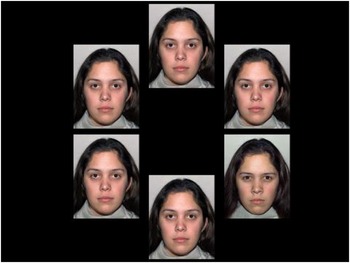
To assess children's attentional biases to negative emotions at Waves 1 and 2, we administered a modified visual search task (Davies et al., Reference Davies, Coe, Hentges, Sturge-Apple and Ripple2018). The procedure consists of a synthesis of visual search (Armstrong & Olatunji, Reference Armstrong and Olatunji2012) and passive viewing (e.g., Harrison & Gibb, Reference Harrison and Gibb2015) tasks. In the visual search component of the task, children were presented with a series of circular matrices consisting of six faces of the same adult (see Figure 2 for an illustration). Each matrix contains five faces displaying neutral emotions and one target face in which the adult expressed anger, sadness, or fear across the trials. Children were instructed to always watch the screen and find the face that was different than the others with their eyes and without pointing or talking. In accord with passive viewing tasks (e.g., Harrison & Gibb, Reference Harrison and Gibb2015), experimenters deliberately refrained from providing instructions on what to do after the children identified the target emotion face other than to watch the screen the entire time. Therefore, the unstructured nature of the task following emotion identification was designed to capture individual differences in their attention allocation to each of the three negative emotions following their detection.
Illustration of a slide from the visual search task.

Emotion stimuli for the task were derived from the NimStim Face Stimulus Set (Tottenham et al., Reference Tottenham, Tanaka, Leon, McCarry, Nurse, Hare and Nelson2009) and consisted of color photographs of female and male adult actors varying in race (i.e., Black or White). Face stimuli were displayed in an 8.6 cm × 6.7 cm height to width format and configured in a circle with .10 cm between each image horizontally and .5 cm vertically. At the beginning of each trial, a central fixation image (e.g., star) was presented until the child was focused on the screen. This was followed by the appearance of the circular matrix of adult faces (i.e., one negative emotion face, five neutral faces) displayed for 3,500 ms (see Figure 2 for an illustration of a visual search trial). After five practice trials, 24 target trials were conducted, with each of type of negative emotion (i.e., anger, sadness, fear) displayed eight times in a randomly generated order. The position of the target face in the matrix varied randomly across the trials. We decided on the number and nature of the trials based on the use of similar, past paradigms with preschool children (e.g., LoBue, Reference LoBue2009) and pilot research indicating that limiting the trials to 24 minimized boredom and fatigue in young children.
The visual search task was developed and administered using Tobii Studios software and a 17-inch TFT Tobii T60 eye-tracking monitor (60 Hz data rate, 1,280 × 1,024 pixels) to display stimuli and record eye movements. The Tobii infrared eye tracker assesses the position of gaze by tracking the center of the pupil and the corneal surface reflection. Participants completed a five-point calibration procedure before the task consisting of tracking specific points across the center of the screen to the corners of the monitor. Gaze data are accurate to 0.5 degrees with an error (drift) of 0.1 degree. Participants sat approximately 60 cm from the monitor during the task. For each trial, predefined areas of interest (AOIs) for measurement of attention consisted of the entire contour of each of the six adult faces in the matrix. Fixations were defined as gaze positions that were stable within a 1-degree visual field for a span of at least 100 ms within an AOI. We used the Tobii Fixation filter to identify fixations based on a velocity threshold of 0.42 pixels/ms.
We used duration of attention during the visual search task to assess children's attention to negative emotion stimuli (Guastella, Carson, Dadds, Mitchell, & Cox, Reference Guastella, Carson, Dadds, Mitchell and Cox2009). Duration of attention assessments were aggregated across anger, sadness, and fear trials. Because individual differences in duration of attending to negative emotions may reflect variations in task engagement or preferences to attend to non-social stimuli (e.g., avoiding faces in the task), our aim was to assess children's selective attention to negative faces relative to neutral faces. Therefore, the attention duration measure for each negative emotion was calculated as the average length of participant fixation to the target AOI (i.e., negative face) divided by the sum of the average length of fixation for all the faces (i.e., target face + five neutral faces). Due to our interest in children's attention to negative emotions after they are initially detected, trials were only included in the calculation of proportions if children fixated on the AOI with the negative emotion. Data were considered missing in the calculation of variables if children did not fixate on at least half of the trials (i.e., at least 12 of 24). Split half reliabilities for the duration of attention to negative emotions at each wave (r = .79 at Wave 1 and r = .78 at Wave 2) exceeded previous reports in the literature (i.e., rs in the low .30 s; Gibb et al., Reference Gibb, McGeary and Beevers2016). Because any significant findings for duration of attention to negative emotions may be an artifact of differences in children's speed in identifying mismatching stimuli, we also assessed children's latency to fixate on the target emotion across the 24 trials at Waves 1 (split half r = .65) and 2 (split half r = .51).
Children's externalizing problems
We assessed children's externalizing problems at Waves 1 and 3 using multiple informants and methods. First, mothers completed the Diagnostic Interview Schedule for Young Children, Version IV (DISC-IV-YC; Luby et al., Reference Luby, Heffelfinger, Measelle, Ablow, Essex, Dierker and Kupfer2002; Luby, Mrakotsky, Heffelfinger, Brown, & Spitznagel, Reference Luby, Mrakotsky, Heffelfinger, Brown and Spitznagel2004), a structured psychiatric interview designed for administration by lay interviewers with minimal training. The DISC-IV-YC yields psychometrically sound, dimensional ratings of psychopathology based on tallies of symptoms reported by the mothers (i.e., 1 = presence; 0 = absence). The externalizing symptoms measure consisted of symptom counts from 34 items comprising the DISC-IV-YC Oppositional Defiant Disorder (ODD; “Done things just to annoy people/make them mad”) and Attention-Deficit Hyperactivity Disorder (ADHD; “Often has trouble waiting for turns [as in standing in line]”) Modules. Alpha coefficients were .89 at Wave 1 and .91 at Wave 2. Second, fathers completed five externalizing scales from the parent version of the MacArthur Health and Behavior Questionnaire (HBQ; Ablow et al., Reference Ablow, Measelle, Kraemer, Harrington, Luby, Smider and Kupfer1999): Oppositional Defiant (e.g., “Gets back at people”), Conduct Problems (e.g., “Lies or cheats”), Overt Hostility (e.g., “Does things to annoy others”), Inattention (e.g., “Distractible, has trouble sticking to any activity”), and Impulsivity (“Does dangerous things without thinking”). The 39 items across the scales were summed together to create father reports of externalizing symptoms at Waves 1 (α = .93) and 3 (α = .94). Finally, teachers completed the same five HBQ externalizing subscales as the father from the teacher version of the instrument (Ablow et al., Reference Ablow, Measelle, Kraemer, Harrington, Luby, Smider and Kupfer1999). Internal consistency for the teacher report of externalizing problems was .96 at each wave.
Children's distress and hostile responses to family stress
To determine if children's behavioral responses to family stress underpin their attention biases, we assessed children's distress and hostile reactivity to a disagreement task involving their parents at Waves 1 and 2. In the parental disagreement task, mothers and fathers discussed common, problematic disagreements in their relationship. In accord with previous procedures (Gordis, Margolin, & John, Reference Gordis, Margolin and John2001; Grych, Reference Grych and Bornstein2002), parents were informed during consent and prior to the interaction that their child would join them in the room as they discussed the issues. While the child was in a separate room, parents first selected problematic issues to discuss during the 10-min task. After parents selected disagreement issues, an experimenter escorted the child into the room and introduced them to a set of toys. The parents then engaged in the interaction after the experimenter left the room. The task was video recorded for subsequent coding.
Trained raters coded the video records of children's distress and hostile reactivity to the challenging family interaction using previously established coding systems. First, using a previous coding scheme for assessing behavioral reactivity to parental conflict (e.g., Davies, Sturge-Apple, Winter, Cummings, & Farrell, Reference Davies, Sturge-Apple, Winter, Cummings and Farrell2006), coders rated children's Distress and Anger on dimensions ranging from 1 (none) to 5 (intense). High levels of distress were defined as intense, chronic displays of anxiety, tension, fear, and sadness, whereas elevated Anger ratings were defined by angry and aggressive behaviors that reflected substantial difficulties regulating arousal. Second, to strengthen assessments of children's distress and hostile responses, we used another coding system to assess children's Behavioral Dysregulation, Coercive Control, Fearful Distress, and Comfort along 9-point (1 = Not at all characteristic; 9 = Mainly characteristic) dimensional scales (Davies, Coe, Martin, Sturge-Apple, & Cummings, Reference Davies, Coe, Martin, Sturge-Apple and Cummings2015). Behavioral Dysregulation was characterized by child behaviors that were aimless and undercontrolled in their quality (e.g., frantic, high activity, disorganized forms of aggression, yelling and screaming in an uncontrolled manner). Likewise, the Coercive Control code reflected children's aversive, angry, and domineering efforts to control the parents or their interactions. The Comfort code assessed the degree to which the child was genuinely content, relaxed, and satisfied during the interaction. Finally, Fearful Distress was defined by children's anxiety, fear, worry, and vigilance displays in facial expressions and behaviors (e.g., freezing). Two trained coders independently rated over 21% of the videos to assess interrater reliability at each wave. Mean ICC was .84 at Wave 1 and .81 at Wave 1, with ranges from .68 (i.e., Discomfort) to .96 (i.e., Hostility) and .73 (i.e., Discomfort) to .89 (i.e., Anger) at Wave 2.
Our codes were designed to yield two a priori higher-order factors: (a) distress reactivity, consisting of Distress, Discomfort (i.e., Comfort code reverse scored), and Fearful Distress scales; and (b) hostile reactivity, consisting of Anger, Behavioral Dysregulation, and Hostility scales. To determine whether they reflected the two higher-order dimensions, the six codes were submitted to principal components analysis (PCA) at each wave. Based on analyses of Eigenvalues and the scree plots, the findings supported a two-factor solution at Waves 1 (variance accounted for 66.0%) and 2 (variance accounted for 74.2%). Supporting the hypothesized factor structure, the PCA solutions at each wave indicated that Distress, Discomfort, and Fearful Distress loaded onto one factor while Anger, Coercive Control, and Behavioral Dysregulation loaded onto the other factor (all loadings > .68; all Eigenvalues > 1.6). Therefore, Distress, Discomfort, and Fearful Distress scales were specified as manifest indicators of a latent construct of children's distress reactivity at each time point. Likewise, we specified the Anger, Coercive Control, and Behavioral Dysregulation scales as manifest indicators of latent constructs of children's hostile reactivity at each wave.
Demographic covariates
Two covariates derived from a maternal demographic interview included: (a) children's gender (1 = female; 2 = male) and (b) parental occupational level based on the Hollingshead nine-point Occupational scale (1 = farm laborers/menial service workers; 9 = higher executives, proprietors of large businesses, and major professionals) of the usual occupations of the parents (M = 3.05, SD = 1.99, Range = 1 to 9) (Hollingshead, Reference Hollingshead1975).
Plan for primary analysis
Data in our sample were missing for 9.8% of the values. Because full-information maximum likelihood (FIML) methods for estimating data maximizes the accuracy of regression and standard error estimates for all types of missing data (i.e., missing completely at random, missing at random) when the amount of missing data is less than 20% (Schlomer, Bauman, & Card, Reference Schlomer, Bauman and Card2010), we used FIML to retain the full sample of families for primary analyses. We conducted all primary analyses using structural equation model (SEM) analyses with Amos 25.0 software (Arbuckle, Reference Arbuckle2017).
In examining children's attentional bias to negative emotion cues as a mediator of associations among maternal and paternal unsupportive parenting, we used latent difference score modeling (LDS; McArdle, Reference McArdle2009) to index individual differences in intraindividual change in attentional bias and their externalizing problems. LDS change analyses were specifically estimated for children's: (a) duration of attention to negative emotion cues from Wave 1 to 2; and (b) externalizing symptoms from Wave 1 to 3. LDS change analyses for children's externalizing symptoms were derived from latent measures of externalizing symptoms at each time point based on manifest indicators from the three informants. Consistent with standard procedures for conducting LDS analyses, we regressed the later assessment of each target construct onto the previous assessment of the variable and the latent difference score while constraining both paths to 1 (see McArdle, Reference McArdle2009). Following the established approach for estimating the proportional change components in the LDS analyses, we also specified a structural path between the initial level of the variable and the latent growth parameters for the duration of attention to negative emotions and externalizing problems constructs (e.g., McArdle, Reference McArdle2009). Multi-indicator latent constructs indexing maternal and paternal unsupportive parenting at Wave 1 were specified as predictors of LDS changes in children's duration of attention to negative emotions from Wave 1 to 2 and externalizing symptoms from Wave 1 to 3. LDS change in duration of attention was, in turn, estimated as a predictor of children's externalizing problems from Wave 1 to 3.
Because the mediational role of duration of attention to angry emotions may be an extraneous product of differences in children's abilities to quickly identify the target emotion, we also specified an LDS analysis of children's average latency to fixate on the target emotions in the visual search task at Waves 1 and 2. Consistent with the structural path estimates for the LDS analysis of attention duration, maternal and paternal unsupportive parenting practices at Wave 1 were specified as predictors of the latent difference score indexing change in children's latency to first fixate on the negative emotions from Wave 1 to 2. LDS change in latency to first fixation, in turn, was further specified as a predictor of LDS change in children's externalizing problems from Wave 1 to 3.
As a control, we specified children's externalizing symptoms at Wave 1 as a predictor of LDS change in the children's attention duration measure. In addition, we estimated correlations between (a) each of the variables at Wave 1, (b) the residuals of the LDS growth parameters for the attention duration and latency to first fixation measures, and (c) the error terms of comparable manifest indicators of the externalizing measures across the waves. Covariates of parental occupational level and child gender were initially examined as predictors of LDS changes in each of the endogenous variables (i.e., attention duration, latency to first fixation, and externalizing problems). However, child gender failed to predict any of the endogenous variables, or alter the pattern of significant findings in the primary and follow-up analyses. Therefore, we reported on the more parsimonious analyses that excluded child gender from the analyses. As a final model specification, we tested the measurement invariance for the latent construct of children's externalizing symptoms by comparing the fit of a model in which indicators of each latent variable over time were constrained to be equal with a model in which the factor loadings varied freely across the waves. The difference in fit between the models was not significant, Δ χ2 = 2.50, df = 2, p = .29. Therefore, to maximize parsimony, we utilized the constrained measurement model in the primary analyses.
Results
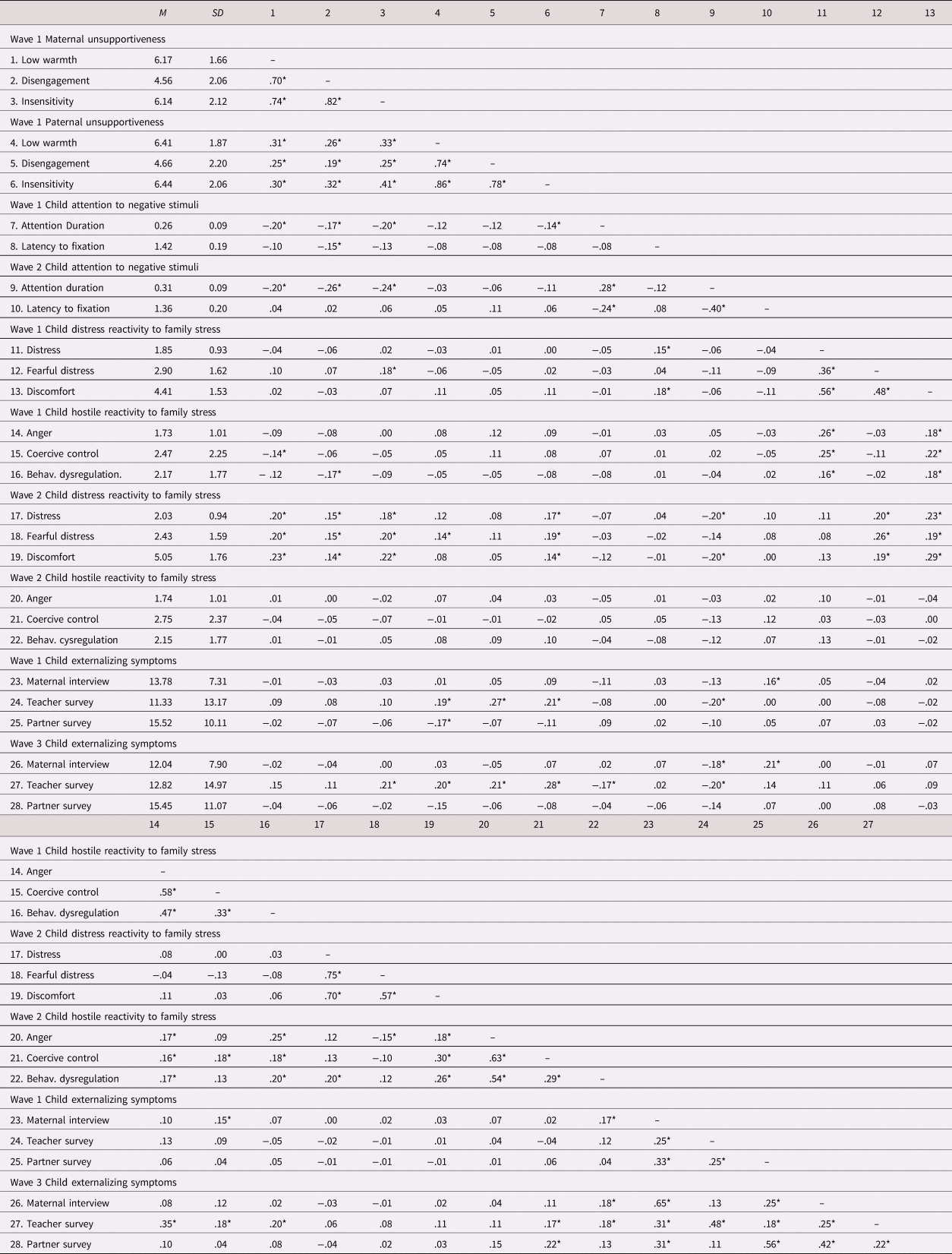
Table 1 depicts the means, standard deviations, and correlations among the primary variables in the analyses. In support of our aim of creating multi-informant, multimethod latent constructs of externalizing symptoms, maternal interview and teacher and father surveys were, on average, moderately correlated at each wave (Mean r = .29, range = .22 to .42). Measures of maternal, but not paternal, unsupportive parenting were significantly associated with children's lower duration of attention to negative emotions at Wave 2. Lower attention of duration at Wave 2 was also significantly related to the majority of the measures of children's distress reactivity to family stress at Wave 2 and their externalizing problems at Wave 3. Finally, measures of maternal and paternal unsupportive parenting were also significantly correlated with some of the measures of children's fearful distress reactivity to family stress at Wave 2 and their externalizing problems at Wave 3.
Means, standard deviations, and correlations among the primary variables in the study analyses.

Note. *p < .05.
Primary analyses: Affect-biased attention as a mediator of parental unsupportiveness
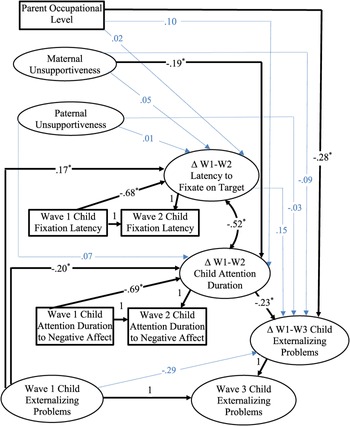
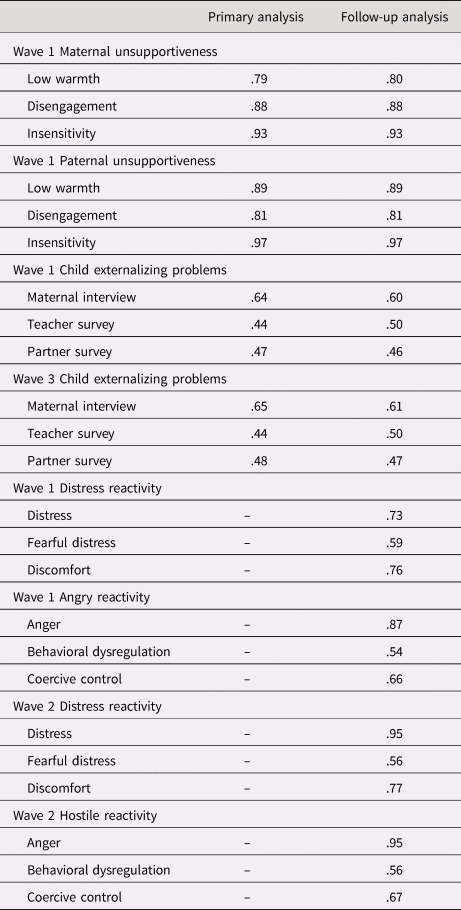
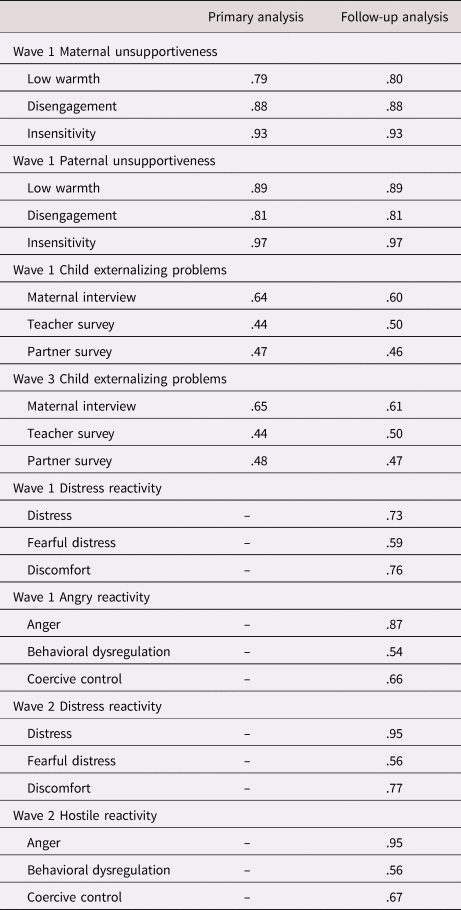
Figure 3 depicts the results of the primary analyses. The SEM provided a good representation of the data, χ2 (79, N = 240) = 154.30, p < .001, root mean square error of approximation (RMSEA) = .05, comparative fit index (CFI) = .96, and χ2/df ratio = 1.70. Given the complexity of the model, Figure 3 does not show the correlations between the exogenous variables. In addition, to maximize clarity in the presentation of the results, the loadings of the manifest variables onto their latent constructs are presented in Table 2 rather than the figure. All loadings were significant (p < .001) and moderate to high in magnitude (M = .70; Range = .44 – .97). Findings for covariates in Figure 3 indicated that parent occupation level predicted decreases in children's externalizing problems from Wave 1 to 3, β = −.28, p = .02. Children's externalizing problems at Wave 1 also predicted longer latencies to fixate on the target emotions from Wave 1 to 2, β = .17, p = .03, and decreases in their duration of attention to the negative emotions from Wave 1 to 2, β = −.20, p = .01. However, change in children's latency to first fixate on the target emotions from Wave 1 to 2 was unrelated to maternal and paternal unsupportive parenting at Wave 1 or their changes in externalizing problems from Wave 1 to 3.
Structural equation model testing changes in children's duration of attention to negative emotions as a mediator of the association between maternal unsupportive parenting and changes in their externalizing problems after controlling for latency to fixate on target emotions using latent difference score analyses. Note. * p < .05.

Standardized loadings of the manifest indicators for the latent constructs in the primary and follow-up structural equation model (SEM) analyses.
In turning to tests of the first link in the hypothesized mediational chain, paternal unsupportive parenting did not significantly predict children's duration of attention to negative emotions after inclusion of maternal unsupportive parenting and the covariates. In contrast, maternal unsupportive parenting was a significant predictor of decreases in children's attention to negative emotions, β = −.19, p = .004, from Wave 1 to 2. Inspection of the paths for the second part of the mediational model revealed that increases in children's externalizing symptoms from Wave 1 to 3 were predicted by decreases in their duration of attention to negative emotions from Wave 1 to 2, β = −.23, p = .04. In addition, we conducted asymmetrical confidence interval analyses to examine whether the indirect or mediational path was significant (MacKinnon, Fritz, Williams, & Lockwood, Reference MacKinnon, Fritz, Williams and Lockwood2007). In supporting mediation, the results indicated that the indirect path for Wave 1 maternal unsupportive parenting, decreases in children's attention to negative emotions from Wave 1 to 2, and their increases in externalizing problems from Wave 1 to 3 was significant, 95% CI [.004, .199]. Additional pairwise parameter comparisons indicated that maternal unsupportive parenting was a significantly stronger predictor of children's diminished attention to emotions than paternal unsupportive parenting, z = 2.48, p = .01.
Follow-up analyses: Child negative reactivity as an explanatory mechanism
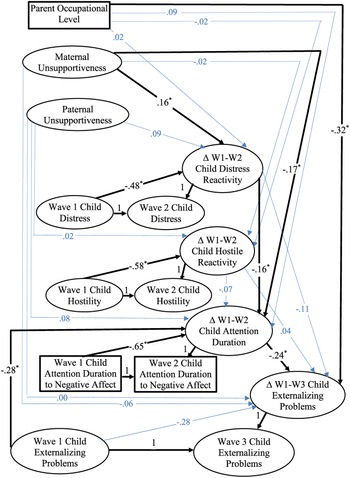
Based on the evidence for the mediational role of children's attention to negative emotions, we proceeded to test the complementary hypotheses that children's distress and angry reactivity to family (i.e., parental disagreement) adversity account for why maternal unsupportive parenting predicted decreases in their duration of attention to negative emotion cues. Consistent with the primary analyses, we included maternal and paternal unsupportive parenting, children's externalizing symptoms, and parental occupational level variables as predictors of LDS change in children's: (a) duration of attention to negative emotions from Wave 1 to 2 and (b) externalizing symptoms from Wave 1 to 3. In turn, LDS change in children's duration of attention to negative emotions was estimated as a predictor of change in their externalizing symptoms from Wave 1 to 3. In addition, we introduced LDS changes in children's distress reactivity and hostile reactivity to family adversity from Wave 1 to 2 into the model as possible mechanisms underpinning the mediational role of diminished attention to negative emotion cues. Accordingly, we specified paths between the Wave 1 predictors (i.e., maternal and paternal unsupportive parenting, parental occupational level) and the LDS change in children's distress and hostile reactivity to family conflict. In turn, we simultaneously estimated LDS changes in the two forms of emotional reactivity as predictors of change in their attention to negative emotions and externalizing symptoms. Consistent with our approach to analyzing externalizing symptoms, LDS change estimates for distress and hostile reactivity variables were parametrized as multi-indicator latent constructs at Waves 1 and 2.
The resulting model provided a satisfactory fit with the data, χ2 (120, N = 240) = 486.49, p < .001, RMSEA = .05, CFI = .92, and χ2/df ratio = 1.70. As shown in Table 2, the loadings of the manifest indicators for the latent constructs were all significant (p < .001) and moderate to high in strength. Figure 4 depicts the structural part of the SEM findings. Change in hostile reactivity to conflict from Wave 1 to 2 was unrelated to the Wave 1 parenting predictors and covariates and did not predict children's diminished attention to negative emotions or their externalizing problems. In contrast, maternal unsupportive parenting at Wave 1 predicted subsequent LDS increases in children's distress reactivity to family conflict from Wave 1 to 2, β = .16, p = .048. As further hypothesized, children's increases in distress reactivity from Wave 1 to 2 predicted concomitant decreases in their duration of attention to negative emotions, β = −.17, p = .02. Decreases in children's attention to negative emotions, in turn, continued to predict their externalizing problems from Wave 1 to 3 in a comparable way to the previous models, β = −.24, p = .03.
Structural equation model examining children's increases in fearful distress and hostile reactivity to family conflict as mechanisms underlying the mediational role of children's attention to negative emotions the association between maternal unsupportive parenting and changes in their externalizing problems. Note. * p < .05.

We conducted additional analyses to explore the strength of children's distress reactivity as a mechanism underpinning the mediational role of their diminished attention to negative emotions by dichotomizing the mediational cascade involving children's distress reactivity and attention to negative emotions into two interlocking indirect pathways. In the first part of the cascade, we tested the significance of the indirect pathway involving maternal unsupportiveness, changes in children's distress reactivity, and their changes in attention to negative emotions. Results of the asymmetrical confidence interval analyses indicated that the indirect path was significantly different from 0, 95% CI [−.00382, −.00001]. In supporting the second part of the cascade, comparable analyses of the indirect path involving children's distress reactivity, attention to negative emotions, and externalizing symptoms was also significant, CI [.00001, .00013]. Thus, each pair of indirect path tests collectively support a cascade whereby maternal unsupportive parenting predicted children's diminished attention and, in turn, their greater externalizing problems through its relation with children's greater fearful reactivity to family conflict.
Discussion
Although many developmental psychopathology models conceptualize children's attention to emotions as explanatory mechanisms linking parenting quality with children's psychopathology (Dykas & Cassidy, Reference Dykas and Cassidy2011; Harms et al., Reference Harms, Leitzke, Pollak, LoBue, Perez-Edgar and Buss2019; McCrory et al., Reference McCrory, Gerin and Viding2017), little is known about its operation and function as a mediator of children's vulnerability to behavior problems in unsupportive rearing environments. To address this significant gap, our study examined whether children's attention to negative (i.e., angry, sad, fearful) emotional displays mediated prospective associations among maternal and paternal unsupportive parenting and children's externalizing symptoms. Whereas the mediational analyses for paternal unsupportive parenting were not significant, the findings indicated that children's decreases in their duration of attention to negative facial expressions over a 1-year period from preschool to kindergarten selectively mediated the link between maternal unsupportive behaviors and their increases in externalizing problems from preschool to first grade. The findings further indicated that the mediational role of diminished attention to negative emotions was not a spurious product of children's difficulties in quickly processing and identifying the mismatching stimulus (e.g., anger) in the larger matrix of neutral faces in the search task. Rather, consistent with the defensive exclusion model (Dykas & Cassidy, Reference Dykas and Cassidy2011; Thompson, Reference Thompson2008), follow-up analyses showed that concomitant increases in children's fearful distress reactivity to family stress (i.e., interparental conflict) partially accounted for the association between maternal unsupportive parenting and their decreases in duration of attention to angry faces over the 1-year period. Relatedly, the findings can be interpreted as more broadly supporting attachment theory and its proposition that children who experience low levels of maternal support may develop a defensive coping mechanism of avoiding aversive emotional information based on their implicit schema about the aversive nature of social relationships.
The nature and meaning of affect-biased attention in unsupportive caregiving contexts
Models on children's processing of emotions have generated contrasting hypotheses about the directionality of children's affect-biased attention processes as risk mechanisms in adverse socialization contexts. The sensitization model posits that family stressors confer risk to children's mental health by heightening their attention to negative emotional stimuli (e.g., Harms et al., Reference Harms, Leitzke, Pollak, LoBue, Perez-Edgar and Buss2019; McCrory et al., Reference McCrory, Gerin and Viding2017; Pollak, Reference Pollak2003). Conversely, defensive exclusion and emotion learning conceptualizations propose that children's decreases in attention to negative emotions underpin their vulnerability to family stressors (Bretherton & Munholland, Reference Bretherton, Munholland, Cassidy and Shaver1999; Thompson, Reference Thompson2008). Thus, our findings are more consistent with hypotheses derived from defensive exclusion and emotion learning models. More specifically, maternal unsupportive parenting predicted children's diminished duration of attention to negative emotional displays by adults over a 1-year period. Children who experienced greater decreasing attention to negative emotions, in turn, were more likely to exhibit increases in externalizing problems over a 2-year period. Additional analyses testing the significance of this indirect path further revealed that diminished attention to negative facial expressions was a significant mediator in the association between maternal unsupportive parenting and children's subsequent externalizing symptoms over time.
However, these findings, in themselves, do not provide definitive guidance on why suppressed attention to negative emotions serves as a mediator due to the differing meanings attributed to diminished attention across conceptualizations (Lindblom et al., Reference Lindblom, Peltola, Vänskä, Hietanen, Laakso, Tiitinen and Punamäki2017). On the one hand, emotion learning models have proposed that decreases in attention to negative emotions reflect impairments in processing and understanding of the relational significance of emotion displays that develop, in part, from unsupportive socialization contexts and, in turn, lay the foundation for disruptive (e.g., conduct) behavior problems (Blair & Zhang, Reference Blair and Zhang2020; Susman, Reference Susman2006). Thus, decreased attention to negative emotions is part of an emerging mechanistic profile characterized by diminished distress (i.e., unemotional) and greater coerciveness in stressful family and interpersonal conditions. On the other hand, the defensive exclusion model proposes that reductions in children's attention to threatening or unsettling interpersonal information following exposure to parenting difficulties are part of a self-protective response to their increasing tendencies to respond with fearful distress to family adversity (Dykas & Cassidy, Reference Dykas and Cassidy2011; Thompson, Reference Thompson2008).
To further test the viability of these models, we specifically examined whether children's changes in their fearful distress and hostile reactivity to family adversity (i.e., interparental conflict) accounted for concomitant decreases in attention to negative emotions in the wake of their exposure to maternal unsupportive parenting. In support of the defensive exclusion model, our findings showed that maternal unsupportive parenting predicted increases in children's fearful distress responses to family adversity over a 1-year period. Increases in fearful distress reactivity, in turn, were associated with concomitant decreases in children's duration of attention to adult expressions of negative emotions. Moreover, decreases in attention to negative emotions continued to significantly predict increases in children's externalizing problems over a 2-year period with the inclusion of hostile and distress reactivity as predictors. Thus, in accord with the defensive exclusion interpretation, the results of the follow-up analyses suggest that the reduced attention to negative emotional displays may have a self-protective function. That is, young children's efforts to minimize the conscious processing of aversive emotional displays by adult strangers may be a manifestation of their implicit, negative prototypes of general social relationships and a strategy for protecting themselves from the increasing tendency to experience fearful distress in threatening interpersonal (i.e., interparental conflict) situations (Bretherton & Munholland, Reference Bretherton, Munholland, Cassidy and Shaver1999; Dykas & Cassidy, Reference Dykas and Cassidy2011; Fraley & Brumbaugh, Reference Fraley and Brumbaugh2007).
If our findings suggest that diminished attention to negative emotions serves to defensively block the encoding of painful emotional information as a short-term way to regulate their rising levels of distress, then how does it explain why it is also associated with increases in children's externalizing problems? According to emotion knowledge conceptualizations (Bassett, Denham, Mincic, & Graling, Reference Bassett, Denham, Mincic and Graling2012; Campbell et al., Reference Campbell, Denham, Howarth, Jones, Whittaker, Williford and Darling-Churchill2016), children's abilities to identify the nature, origins, and relational meaning of emotional expressions hinges on sufficiently attending to the features of negative emotions. Given that preschool children's impairments in emotion knowledge have been identified as precursors of their externalizing problems (e.g., Denham et al., Reference Denham, Caverly, Schmidt, Blair, DeMulder, Caal and Mason2002; Trentacosta & Fine, Reference Trentacosta and Fine2010; von Salisch, Denham, & Koch, Reference von Salisch, Denham and Koch2017), diminished attention to negative emotions may increase disruptive behavior problems by inhibiting the acquisition of emotion knowledge domains (e.g., emotion recognition, emotion perspective taking).
Relatedly, social information processing theory proposes that children's attention to social–emotional stimuli lays the foundation for their subsequent attributions of intent, arousal regulation, and generation and enactment of problem-solving strategies (Crick & Dodge, Reference Crick and Dodge1994; Lemerise & Arsenio, Reference Lemerise and Arsenio2000). Consistent with the aggressogenic implications of children's diminished attention to aversive emotional cues, some studies have shown that children who allocate less attention to negative stimuli tend to exhibit higher levels of hostile attributions, negative emotional arousal, and the endorsement of aggressive solutions to interpersonal problems (Horsley, de Castro, & van der Schoot, Reference Horsley, de Castro and van der Schoot2010; Schippell, Vasey, Cravens-Brown, & Bretveld, Reference Schippell, Vasey, Cravens-Brown and Bretveld2003). Likewise, children's preference to use less socio–emotional information in interpreting hostile intent in stressful peer situations is linked with higher levels of aggression (Dodge & Newman, Reference Dodge and Newman1981). Thus, diminished attention to negative emotions may also increase children's risk for externalizing symptoms by increasing their hostile interpretations, negative affect, and aggressive solutions to interpersonal challenges. As a further extension of social information processing theory, it is also possible that attentional avoidance of negative emotions may potentiate children's negative behaviors (e.g., noncompliance) in ways that elicit aversive responses through others. In reflecting a transactional, evocative process, the resulting negative treatment by adults or peers may, in turn, be a more proximal risk factor for the intensification of externalizing problems (Rothenberg et al., Reference Rothenberg, Lansford, Alampay, Al-Hassan, Bacchini, Bornstein and Malone2020).
Gender-specific pathways of unsupportive parenting
Although the evidence supported the role of diminished attention to negative affect as a mediator of maternal unsupportive parenting, comparable paths for paternal unsupportive parenting as a predictor were not significant. In fact, paternal unsupportive parenting failed to predict subsequent change in children's attention biases to negative emotions and their hostile and distress responses to parental conflict. These gender-specific findings may be rooted in different roles of mothers and fathers as caregivers. Given that defensive exclusion processes are proposed to be manifestations of insecure attachment, it is possible that the gender-specific findings may be a product of the tendency for children to utilize mothers as primary attachment figures (Kerns, Mathews, Koehn, Williams, & Siener-Ciesla, Reference Kerns, Mathews, Koehn, Williams and Siener-Ciesla2015; Koehn & Kerns, Reference Koehn and Kerns2018; Lucassen et al., Reference Lucassen, Tharner, Van IJzendoorn, Bakermans-Kranenburg, Volling, Verhulst and Tiemeier2011). Thus, fathers may play a more significant role as secure bases through other parenting behaviors (e.g., autonomy support, engaging in stimulating and challenging play) that increase their children's problem-solving abilities, social skills, and confidence to explore physical and social worlds (Kerns et al., Reference Kerns, Mathews, Koehn, Williams and Siener-Ciesla2015; Schoppe-Sullivan & Fagan, Reference Schoppe-Sullivan and Fagan2020).
Moreover, although our findings indicated that maternal unsupportive parenting was a significantly stronger predictor of children's decreases in attention to negative emotions than paternal unsupportive parenting, more research is needed before drawing conclusions about the scope and consistency of parent gender as a moderator. For example, at a methodological level, the predictive role of paternal parenting may have been diluted by the triadic nature of the interaction task. Although the triadic interaction task may approximate the division of caretaking responsibilities that occur in the home, paternal engagement in parenting has been shown to vary considerably based on individual differences in maternal gatekeeping behaviors that upregulate or downregulate father involvement in caregiving (Altenburger, Schoppe-Sullivan, & Kamp Dush, Reference Altenburger, Schoppe-Sullivan and Kamp Dush2018; Stevenson et al., Reference Stevenson, Fabricius, Cookston, Parke, Coltrane, Braver and Saenz2014). Thus, assessing paternal parenting qualities in dyadic interactions may be a useful complement to triadic tasks, particularly in terms of parsing father parenting quality from differences in maternal gatekeeping. In addition, much of the previous research documenting the distinctive sequelae of paternal parenting are based on samples that are largely, if not exclusively, comprised of biological fathers (e.g., Cabrera et al., Reference Cabrera, Shannon and Tamis-LeMonda2007; Herbert, Harvey, Lugo-Candelas, & Breaux, Reference Herbert, Harvey, Lugo-Candelas and Breaux2013; NICHD Early Child Care Research Network, 2004). Conversely, our sample of families contained a greater difference in the proportion of biological mothers (99%) and fathers (74%). Although the participants in our study may, in many ways, more closely approximate the proportion of biological parents in US households than these previous studies (Grall, Reference Grall2020; Schoppe-Sullivan & Fagan, Reference Schoppe-Sullivan and Fagan2020), the sampling characteristics may have increased the power of maternal unsupportive parenting to predict children's functioning relative to fathers’ unsupportive parenting.
Study limitations and qualifications
Beyond the qualifications identified in interpreting findings on the relative roles of maternal and paternal unsupportive parenting, there are several limitations that warrant discussion. First, although our sample is from diverse racial and socioeconomic backgrounds, our findings may not necessarily generalize to children and families in different social conditions (e.g., affluence, maltreatment) or developmental periods. Toward further delineating the bounds of generalizability, identifying possible moderators (e.g., child gender, length of interparental relationship) of the mediational pathways is an important direction for future research. Second, diminished attention biases may not necessarily emerge in the context of other dimensions of parenting difficulties or serve as precursors of other forms of child psychopathology. For example, some studies have shown that more threatening forms of parenting difficulties (e.g., anger, aggression, physical abuse) are related to greater, rather than diminished processing of negative emotions using brain imaging, reaction time, and event-related potential measures (e.g., Briggs-Gowan et al., Reference Briggs-Gowan, Pollak, Grasso, Voss, Mian, Zobel and Pine2015; Pollak & Tolley-Schell, Reference Pollak and Tolley-Schell2003; Pozzi et al., Reference Pozzi, Simmons, Bousman, Vijayakumar, Bray, Dandash and Whittle2020). Third, although our selection of 24 trials in our study was comparable to previous tasks with young children (LoBue, Reference LoBue2009), the small number of trials precluded assessments of children's attention to specific types of negative emotion. Given that some conceptual models propose that the risk associated with affect-biased attention may vary based on specific displays (e.g., anger, fear) of negative emotions (Pollak & Tolley-Schell, Reference Pollak and Tolley-Schell2003; Viding & McCrory, Reference Viding and McCrory2018), examining the relative mediational roles of children's duration of attention to specific forms of negative emotions in the association between family adversity and their psychological problems is an important task for future research. Fourth, because our assessments of affect-biased attention were limited to three negative emotions, future research would benefit from expanding assessments of children's attention to other emotion stimuli (e.g., positive affect). Finally, although our longitudinal analyses of change in children's affect-biased attention, emotional reactivity, and externalizing symptoms are consistent with analytic recommendations for rigorously testing mediational pathways, our approach does not rule out all possible third variables.
Conclusion
In sum, little is known about the role of children's attention to negative emotions as mechanisms accounting for children's earlier experiences with adverse rearing environments and their externalizing problems. To address this knowledge gap, our multimethod, multi-informant longitudinal study tested children's attention to negative emotions as a mediator of relations among maternal and paternal unsupportive parenting and their externalizing symptoms during the transition to the early elementary years. Consistent with the defensive exclusion model, maternal unsupportive parenting predicted decreases in children's attention to negative emotions over a 1-year period. Declines in attention to negative adult emotions, in turn, were associated with increases in children's externalizing symptoms across a two-year period even with the inclusion of covariates. Additional analyses designed to understand the underlying function of children's attention biases indicated that increases in their distress reactivity to parental conflict partially accounted for the association between maternal unsupportive caregiving and their concomitant decreases in attending to negative faces. In further support of the defensive exclusion model, the findings suggested that children's experiences with adversity and their greater fearful distress may prompt them to reduce their attention to unsettling and threatening contexts as a way to preemptively limit the subsequent experience of anxiety and discomfort (Dykas & Cassidy, Reference Dykas and Cassidy2011; Zimmermann & Iwanski, Reference Zimmermann and Iwanski2015). Thus, the findings are valuable in beginning to address critical theoretical questions on the underlying meaning or function of children's diminished attention to negative emotions.
Acknowledgments
The study was conducted at Mt. Hope Family Center, University of Rochester. The authors are grateful to the families who participated in this project. We would also like to thank Mike Ripple and Mt. Hope Family Center Staff who assisted with the study.
Financial Statement
This study was supported by a grant from the Eunice Kennedy Shriver National Institute of Child Health and Human Development (R01 HD065425) awarded to Patrick T. Davies and Melissa L. Sturge-Apple. Jesse L. Coe is funded by the Eunice Kennedy Shriver National Institute of Child Health and Human Development (T32 HD101392).
Conflicts of Interest
None.