Introduction
The increased number of disasters and people affected, coupled with the threats from climate change have drawn national and international attention to the risks of disasters and what can be done about them. Community, national, and international participants are more aware of the importance of taking action before disasters occur through disaster risk reduction (DRR), including emergency preparedness efforts, as well as through disaster response and recovery. The international community has strived to develop new and improved approaches to disaster response, recovery, disaster risk reduction, and emergency preparedness. A Primary Health Care (PHC) strategy (Health Emergency Management or HEM) is one possible method by which improved health emergency management may occur.Reference Van Damme, Van Lerberghe and Boelaert1
Recent developments and initiatives have contributed to an improved strategy for health emergency management in general. Humanitarian reforms aimed at making the international response to disasters more consistent and predictable, have given rise the Cluster approach, including the Global Health Cluster, which is lead by the World Health Organization (WHO) and a number of other health-related clusters such as Protection, Early Recovery, Nutrition and Water, Sanitation and Hygiene. Other initiatives include the Hyogo Framework for Action (HFA) 2005-2015, (which identifies strengthening of disaster preparedness as one of the five priority areas for building the resilience of nations and communities to disasters) and the 2009 Global Platform for Disaster Reduction conference which emphasized the increasing commitment of the international community to DRR and emergency preparedness. The scope of the Pan American Health Organization's Program for Disaster Preparedness and Response over the past three decades has expanded to include disaster risk reduction, including concerted efforts to make health facilities safer and better prepared to respond to disasters. The World Disaster Reduction campaign on Hospitals Safe from Disasters and the allied 2009 World Health Day theme have given prominence to health issues in the disaster risk reduction community and helped draw attention to the health sector's role in DRR and emergency preparedness. This has led to the establishment of the global thematic platform on disaster risk reduction for health. These developments all contribute to the improvement of HEM and how PHC can contribute to this process needs to be better understood.
The concept of bridging HEM and PHC is relatively new. Van Damme et al (1) suggested that an adapted strategy combining characteristics from PHC and emergency medical assistance would have to be developed, recognizing that emergency medicine is not synonymous with the broader concept of health emergency management. Strengthening health systems based on PHC principles can provide the basis of community-centered health emergency management, while strengthening health emergency management offers protection of the health system and public health.
The concept and importance of PHC was re-emphasized in the 2008 World Health Report.2 This report has re-focused the world's attention on the renewal of PHC as a set of values and principles for all sectors. Evidence from high income countries suggests that access to comprehensive PHC improves health outcomes. The literature also supports the concept that an integrated approach to primary care can improve health in low income countries.Reference Macinko, Starfield and Erinosho3 This global re-emphasis of PHC recently necessitates the health sector and the broader disaster community to think about HEM from the perspective of primary health care.
Primary health care, PHC, as defined in the World Health Report 2008, may be depicted as a strategy to organize health systems and society to promote health which is embedded in a set a values and principles for guiding the development of health systems. This includes; universal coverage for all people to have access to health care, people-centered services which focuses health service delivery at a community level, healthy public policies from all sectors aimed at improving health and effective leadership of the health system which promotes participation of all components of society to address public health needs.2
Understanding both how PHC is perceived and understood in the literature and what key disaster topics related to PHC are being published is an important step to be able to lay the foundation of a PHC strategy for disaster risk management.
The objective of this literature review was to document two areas. First, how in the general published literature are disasters and PHC and primary care being conceptualized. Second, to document what topics and lessons learned are being published regarding disasters and primary health care. These results will help to develop an understanding of how we comprehend PHC in the context of disasters and the relationship between PHC and health emergency management as well as identify key lessons learned, gaps and future directions.
Methods
This literature review was conducted by searching online scientific and grey literature databases. These included the following: Medline, Embase, PubMed, Reliefweb, National Library of Medicine (NLM), Central American Network for Disaster Health Information (CANDHI), SCIRUS,(scientific database), Federal Emergency Management Agency (FEMA), AccessUN, PAIS, National Fire Protection Agency, CINHAL,(Cumulative Index to Nursing and Allied Health Literature), WHO regional databases and the internet (via Google Scholar). Primary Health Care or Primary Care coupled with the term disaster was searched in either title or abstract fields. However, in some grey literature sources the terms were searched as a keyword because more restrictive searches revealed negligible search results. This process revealed a large pool of potential articles as of June 2009.
From the potential articles, redundancies were excluded as well as those that did not follow the 2009 International Strategy for Disaster Risk Reduction (ISDR) definition of disaster or the 1978 World Health Organization definition of Primary Health Care or Primary Care. Due to the common usage of emergency in medicine, the term ‘emergency’ elicited mostly unrelated results and therefore was not used. National Library of Medicine and Reliefweb searches were restricted to English text limits due to diversity of languages offered within these databases. Overall, 119 articles were retrieved via the search criteria.
Results
How PHC/PC is Conceptualized
The terms Primary Health Care and Primary Care are very often used interchangeably in almost all of these articles. Only 7% (8/119) clearly defined the term primary health care or primary care in the context of the paper.
Fifty percent (59/119) of the papers use the term primary health care and primary care to mean the care provided by certain clinicians, most commonly physicians in high income countries (89%). Forty four percent describe primary health care and primary care by the actual activities that were done such as act as gatekeeper, immunizations, prescriptions, and provision of basic medical services. Twenty one percent describe a set of attributes that the system would provide like accessibility, continuity, utilization and also level of care. Community oriented care as a concept was only discussed in four papers.
Only 4% (5/119) of papers emphasized the values and principles of primary health care, including human rights and social justice, for guiding the development of health systems. These were highlighted in examples of large international organizations as well as the US-based community health center (CHC) models.
Characteristics of Articles Retrieved
Table 1 describes the characteristics of the articles retrieved. Only 29% target low income countries where disasters are more common and 16% included research.
Characteristics of articles retrieved (LIC = low income country)

Topics and Lessons Learned
There is strong support in the literature for the importance of primary health care (as widely described) in preparedness, response and recovery.Reference Perrin4–Reference Fernald and Clawson9 These comments originate from a variety of countries, high income to low income including the United States, Armenia, and Pakistan.Reference Millin, Jenkins and Kirsch5–Reference Fernald and Clawson9 Primary health care often has been described as a very important component of the health sector with respect to health needs during disaster, and therefore should be incorporated in the planning for response to these events.
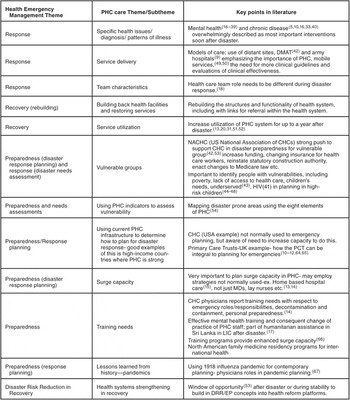
The majority of the literature related to PHC and disasters stems from disaster response, with less specific literature focusing on DRR, preparedness and recovery. Table 3 summarizes the most common themes encountered from the primary health care literature.
Preparedness—In terms of preparedness, there are some examples in the US10 and the United KingdomReference Hodgkin and Perrett11,Reference Tregoning12 that using current PHC infrastructure can help build capacity for community disaster risk reduction and for disaster response (The community health center example in the US and primary care trusts in the UK). Also, building infrastructure for surge capacity in the primary health care system including employing strategies that are not normally used has been described.Reference Mazowita13,Reference Summerhill, Mathew, Stipho, Artenstein, Jagminas and Russo-Magno14 Examples include surge capacity of the known health care providers, but also consideration of roles of lay people in the health response, as well as alternate models of care like the Canadian example of home based hospital care.Reference Hogg, Lemelin, Huston and Dahrouge15
Response—Strong messages for disaster response include the need for mental healthReference Birketvedt, Rafey, Stein, Ho, Karson and Smith16–Reference Weisaeth, Dyb and Heir39 and chronic disease interventionsReference Millin, Jenkins and Kirsch5,10,Reference Birketvedt, Rafey, Stein, Ho, Karson and Smith16,Reference Redwood-Campbell and Riddez33 soon after the disaster and during conflicts, primary care team roles needing to be modified during disasters,Reference Calderon-Abbo18 and the importance of identifying vulnerable groupsReference Clark, Besch, Murphy, Vick, Gurd and Broyles41–48 in disaster-affected communities. Models of care described include the use of mobile clinics,Reference Krol, Redlener, Shapiro and Wajnberg49,Reference Lane50 the advantage of using distant sites to provide clinical care, and the importance of Disaster Medical Assistance Teams (DMAT)Reference Henderson, Lillibridge, Salinas, Graves, Roth and Noji42 and army hospitalsReference Fernald and Clawson9 focusing on mostly primary health care services and only dedicating a smaller part of the work to other services like surgery.
Recovery—Utilization patterns of primary health care facilities after a disaster have been demonstrated to be elevated for periods of longer than a year.Reference Mazowita13,Reference de Bocanegra, Moskalenko and Kramer20,Reference Polusny, Ries, Schultz, Calhoun, Clemensen and Johnsen31,Reference Soeteman, Yzermans, Spreeuwenberg, Lagro-Janssen, Bosch and van der Zee51 This increased utilization pattern is not just related to servicing the needs of the injured, but also reflects the psychosocial needs of those who were affected by the disaster. Other rebuilding concepts include how to best rebuild health facilities, to integrate risk reduction into recovery and reconstruction, and to rebuild the health system using a PHC-centered approach.
Health care reform in Mexico before and after the 1985 earthquake is an example of how cuts in health care programs are not inevitable in response to emergencies or disasters. Soberon et al describe the importance of a universal and equitable health system when the majority of a population is in need.Reference Soberón, Frenk and Sepúlveda53 This resonates with the emphasis on a PHC approach.
Bremer, using the 2001 Gujarat earthquake experience, considers how assigned indicators (the eight elements of the PHC system based on the 1978 Alma Ata) for measuring the level of heath care, together with the assessments of vulnerability may improve disaster preparedness and management.Reference Bremer54 In addition to mapping disaster prone areas and identifying vulnerabilities, documenting strengths of the health care system were crucial to the strategic development of preparedness and relief. In the US primary health care facilities have access to the ‘primary care facility and program assessment guide’ to determine needs for disasters.55
Discussion
Literature
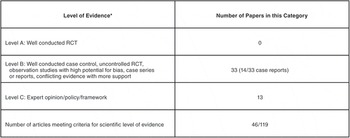
The literature, although arguably not often methodologically strong, (Table 2) does however highlight the importance of primary health care in HEM. A limitation of this review is that it targeted mostly the published and available literature. This may represent publication bias. Since much of this literature and lessons learned in disasters are often not published formally, perhaps most important lessons are still waiting to be shared.
Level of Evidence (n = 119)

*taken from Hadorn DC et al Reference Hadorn, Baker, Hodges and Hicks63
Themes: Primary health care and disasters (CHC = Community Health Center)

The term ‘disaster’ as defined by ISDR 2009 was used as a search term. The term ‘emergency’ was not used because it elicited a large number of unrelated topics. When ‘health emergency management’ was searched with ‘primary health care’, no reference sources were found.
The lack of clarity about the terminology, for both the term primary health care and health emergency management is a challenge. For example, the terms primary health care and primary care are often used interchangeably and the definitions and conceptual understanding about what PHC is still varies in the literature and in practice. This is despite the Alma Ata declaration and the 2008 World Health Report, where PHC is clearly defined as a health system based on clear managerial and organizational structure. Components of PHC differ considerably as demonstrated by Haggerty et al, where >25 operational definitions of attributes have been described.Reference Haggerty, Burge, Levesque, Gass, Pineault, Beaulieu and Santor57 The term “primary care” has also been defined in various ways. When primary care is distinguished from PHC, the definition of primary care usually refers to care provided by certain clinicians including a set of activities that primary care ‘does’ and a level of care as an entry point into the system. Primary care is often more closely associated with the PHC principle of person-centered care which also provides comprehensive and integrated responses and continuity of care.2 Recent literature in the field of primary health care has called for greater clarity when specifying PHC in terms that allow for more standardized measurement and rigorous evaluation.Reference Macinko, Starfield and Erinosho3 A method to improve this situation is to encourage publication of literature using the WHO definitions of primary health care as the standard by which PHC and primary care is described in the literature.
Similarly, the terms related to health emergency management are not always clear. The key words; emergency, disaster, crisis, risk, humanitarian action, risk reduction, mitigation, preparedness, response, recovery, rehabilitation, reconstruction, hazard and vulnerability are not clearly defined when used in the literature.
In terms of disasters, there is a large body of experience in primary health care which is not documented, or if it is reported, is largely inaccessible. Many health personnel from government and non governmental organizations (NGOs), for example, have experiences working in PHC or primary care disaster settings. Although this has improved with the advent of the internet, the NGO community, governments and others involved in the health sector in disaster risk reduction, preparedness, response and recovery must be encouraged to share these experiences.
Open and available publication is the only way to make lessons identified in evaluations and reports easily accessible to the global community. Another limitation is that the articles were sometimes limited to English in certain databases. Future reviews might find benefit in searching other languages in greater detail, with the example of Spanish language articles originating in Latin America as one further option.
Not unexpected was the observation that although low income countries are most affected by disasters, the majority of published literature still reflects experiences in high income countries. In addition, most of the studies and documents do not include adequate representation of authors from low income countries. This is not unique to the topic of disaster primary health care.56 There may be multiple reasons for this imbalance such as inadequate research partnerships between high and low income counties, lack of funding and time for researchers in low income countries and possibly lack of experience, expertise, and mentorship in health research. In order to hear the message and experiences of colleagues in low income countries, the research community needs to be cognizant of the importance of working in partnerships with colleagues from the north and south in true collaboration.
The missing pieces
The literature describes primary health care and medical assistance in disasters as concepts that have not, as of yet, been brought together effectively. The challenge has been that they have been conceived as fundamentally different models of providing health care. The reality in disaster situations is that both are needed together.Reference Macinko, Starfield and Erinosho3,Reference Fan58 A description of the possible synergies between the four strategic areas of the PHC renewal process and humanitarian health action is described in the World Health Organization Health Action in Crisis annual report.59 Humanitarian Health Action has also been considered as part of the PHC renewal strategy in this document.
The literature does not reflect an extensive conceptualization of PHC for emergencies and disasters. On the other hand, the disaster literature is reporting the importance of PHC as part of the disaster response and DRR and emergency preparedness agenda. This development, combined with the reality of more than 1.3 billion people being faced with emergencies and humanitarian crisis, makes a strong case for the re-examination of PHC in disasters and emergencies and creates an opportunity to ask how to best bridge PHC and Health Emergency Management, and especially emergency medical assistance.
Most of this literature did not overtly describe the link between primary health care initiatives and the values and principles of human rights, social justice or health equity as described in the World Health Report 2008.2 When this link was identified, it was predominantly by some of the large international organizations.2,Reference Perrin4,1059 Community health centers in the United States, by nature of their mandate to serve low income and medically underserved communities, identify equity as a key for the provision of primary healthcare in preparing and responding to disasters.10 The healthcare reform in Mexico after the 1985 earthquakes emphasized the importance of a universal and equitable health system through an ambitious primary care program.Reference Soberón, Frenk and Sepúlveda53 Interesting also is the fact that few publications described the humanitarian principles as the basis of either the work being done or the paper being written.
Given the nature of disasters and conflict and primary health care needs, the humanitarian principles and the WHO values of health equity, health of communities, reliable health authorities and participation, these should be the foundation of all primary health care initiatives related to disasters. How to actually integrate these concepts into decision making, programming and service delivery in health and social sectors at all levels is the next step.
There continues to be a lack of ‘multidisciplinary’ and ‘multi-sector’ co-authorship' in the literature. The majority of papers published are case reports from the provider experience, navigating the system during a disaster. If these articles, for example, included the combined perspectives of different types of health care providers, policy makers, health planners, government and educators, the lessons learned, links to policy, legislation and education would be much stronger. Instead, these experiences are fragmented without the holistic or larger perspective often demonstrated.
The applicability of lessons learned from high to low income countries is salient and requires consideration. It appears that some lessons learned from high income countries could sometimes be applied to low income countries, but would need to be evaluated for that specific context. It is still unclear as how to best support primary health care in a country or region with weak primary health care systems. Priorities could be tested with a Delphi consensus of colleagues in low income countries but key disaster indicators for PHC need to be identified and validated with how to best integrate HEM as a key element of the PHC approach.
Developing PHC Specific Disaster Indicators
In order to measure the impact of a disaster on the primary health care system, the Gujarat paper demonstrates how indicators can be developed based on the eight elements of the Primary Health Care system.Reference Bremer54 These eight elements include; education, local disease control, expanded program for immunization, mother and child family planning, essential drugs, nutrition and food supplies, treatment of diseases and safe water/sanitation. This allows a broad evaluation and assessment of public health. The challenge to date is that the specific indicators representing each of the elements need to be tailored to a disaster setting and then subsequently to the specific context. For example, indicators that may be included for PHC for the disaster context may include: mental health indices, chronic disease rates, and number of primary health workers and lay health workers educated and trained for rapid response to disasters. Identifying ‘disaster related PHC indicators’ testing and validation in different settings would allow for the objective measurement of disaster impact on PHC system but it would also significantly contribute to implementation, monitoring, and evaluation of disaster risk reduction, preparedness response and recovery in meeting the health needs of disaster-affected communities.
The International Disaster Response; The PHC Need
There is a very clear message in the literature. If the emergency medical response is not available within the first days after a sudden-impact disaster, then the disaster response for health should focus predominantly on supporting community needs and PHC capacities.Reference Kazzi, Langdorf, Handly, White and Ellis6,Reference Hlady, Quenemoen, Armenia-Cope, Hurt, Malilay and Noji7,Reference Hodgkin and Perrett11,Reference Redwood-Campbell and Riddez33,Reference Henderson, Lillibridge, Salinas, Graves, Roth and Noji42,Reference Krol, Redlener, Shapiro and Wajnberg49,Reference Fan58,Reference Edwards, Young and Lowe60–-Reference Smith, Traum and Poole62 This has implications for foreign medical teams which are often delayed. Good local infrastructure is needed to support safe and reliable hospitals and other health facilities that will function after the disaster. Restoring access to PHC or primary care services is a priority in health emergencies and disasters and in periods of stability by some international organizations.Reference Perrin4
How the international community supports primary health care needs will vary and will depend on the context of the affected country. For example, the disaster health response should aim to support and strengthen the current PHC system by capacity building and working with local health care providers in existing community health structures rather than ‘importing’ international ‘care.’ An international community that supports locally defined PHC through principles of risk reduction, preparedness and response contributes to a more resilient community.
Conclusions
This review of literature found a relatively limited number of references which relate PHC to the broad field of disasters. The literature consistently reports that PHC is an important aspect of effective health disaster response and recovery, as well as disaster risk reduction for health and emergency preparedness. PHC therefore needs to be given more prominence in strengthening of health emergency management. There is a need to increase the quality of research related to disasters and primary health care which would be assisted by clarification of terminology and to encourage paper authorship from low income countries. There is also still a need for organizations involved in PHC for disasters to publish findings in sources that are accessible. Developing PHC specific indicators related to disasters and validating these indicators will help to reduce risks, strengthen emergency preparedness and make disaster response and recovery more effective, thus improving health outcomes for people at risk of emergencies, disasters and other crises.
Abbreviations:
DDR = disaster risk reduction
HEM = Health Emergency Management
PHC = primary health care
WHO = World Health Organization