The development of reliable and valid parent-report measures of child language has facilitated many advances in basic research and clinical practice. The two instruments of this type that are most widely used are Rescorla's Language Development Survey (Rescorla, Reference Rescorla1989, Reference Rescorla, Rescorla and Dale2013) and the MacArthur–Bates Communicative Development Inventories (CDI; Fenson et al., Reference Fenson, Marchman, Thal, Dale, Reznick and Bates2007). They take advantage of the much greater evidence available to parents and the fact that it is more representative of the child's full experience and language competence. Both of these instruments, but especially the CDI, have been adapted to numerous languages as diverse as Spanish, Danish, Russian, Chinese, American Sign Language, and others (Dale, Penfold, & Fenson, Reference Dale, Penfold and Fenson2011; see http://mbcdi.stanford.edu/adaptations.htm).
These measures have many potential clinical and research uses, such as screening for early delay, identifying children with unusual profiles, and examination of the influence of other biological and behavioral variables on language development (Fenson et al., Reference Fenson, Marchman, Thal, Dale, Reznick and Bates2007). Almost all of the potential uses of these early language measures rest on the assumption that individual differences have a long-term significance. For that reason, they can help identify children who are at elevated risk later in life and therefore merit early intervention, or within the normal range, they provide illuminating evidence for the sources of later individual differences in a range of skills and therefore contribute to theoretical understanding of those skills.
The focus of the present paper is on predictions from measures of vocabulary obtained between 16 and 30 months of age to language, literacy, and mathematics outcomes in the later school years. The term “predictions” here refers both to correlational and regression examination of relationships across the full range of ability and to the outcomes of early delay. It is only fairly recently that we have had valid measures for this early period that can be obtained for large samples of young children and that enable examination of potential prediction from such early ages.
This study's restriction to school-age outcomes reflects the fact that there is already a substantial body of research on longitudinal relations within the preschool period (for reviews, see Fenson et al., Reference Fenson, Marchman, Thal, Dale, Reznick and Bates2007; Law & Roy, Reference Law and Roy2008; Lee, Reference Lee2011). For example, Lee (Reference Lee2011) conducted a secondary analysis of data from the National Institute of Child Health and Human Development Early Child Care Research Network (2005). Parent-reported 24-month vocabulary on the CDI: Words and Sentences was a moderately strong predictor (r = .36) of the Preschool Language Scales auditory comprehension and expressive communication subscales at 54 months. Hayiou-Thomas, Dale, and Plomin (Reference Hayiou-Thomas, Dale and Plomin2012) analyzed parent-report measures (short-form adaptations of the CDI, providing a composite vocabulary–grammar measure) obtained at 2, 3, and 4 years in the Twins Early Development Study. Predictions from 2 to 3, from 3 to 4, and from 2 to 4, were .59, .63, and .48, respectively. Bornstein, Hahn, Putnick, and Suwalsky (Reference Bornstein, Hahn, Putnick and Suwalsky2014) observed correlations in a similar range (.25–.49) from 20-month vocabulary to several 48-month language measures. With respect to the outcomes of early delay, defined by low scores relative to norms, a substantial body of research (see Rescorla & Dale, Reference Rescorla and Dale2013, for several reviews of this literature) has confirmed great variability in outcome. Although these “late talkers” (child's vocabulary falling within the lowest 10% of children at that age) are at considerable risk for later problems, many of them, perhaps half, will have moved into the normal range by the end of the preschool period, at least on measures of vocabulary and grammar. However, performance often remains below the mean even after this “catch-up,” and those children are therefore at continuing risk, though no greater than other children in the low normal range at the same age (Dale, McMillan, Hayiou-Thomas, & Plomin, Reference Dale, McMillan, Hayiou-Thomas and Plomin2014).
In contrast, much less evidence is available for predictions from early measures into the school years. Three studies have reported correlations across this time span for individual differences in oral language with large, representative English-speaking samples. Lee (Reference Lee2011) found that 24-month vocabulary predicted Grades 1, 3, and 5 Woodcock–Johnson Psycho-Educational—Revised (WJ-R) picture vocabulary scores at .27, .27, and .25, respectively. Hayiou-Thomas et al. (Reference Hayiou-Thomas, Dale and Plomin2012) found that their age 2 vocabulary–grammar composite predicted 10-year vocabulary and 12-year vocabulary, syntax, figurative language, and making inferences at .21, .18, .17, .20, and .12, respectively. Predictions from age 3 were only slightly higher. Bornstein et al. (Reference Bornstein, Hahn, Putnick and Suwalsky2014) found correlations in the range of .20–.33 from 20-month vocabulary to age 10 verbal intelligence measures. In addition, Hohm, Jennen-Steinmetz, Schmidt, and Laucht (Reference Hohm, Jennen-Steinmetz, Schmidt and Laucht2007) found in a small sample of German children that scores on the Receptive–Expressive Emergent Language Scale at 10 months were significantly related to several measures of language performance (including test of vocabulary, sound blending, spelling, and a sentence repetition test) and grades at age 11 years, but almost exclusively for girls (median r = .46; for boys, median r = .10). The sample for this study was constructed to have high variability in risk.
One of the most important reasons for concern about early language is its potential significance for the acquisition of reading, which in turn is the most important determinant of educational success. Reading skills are substantially based on oral language skills, especially but not only vocabulary (National Early Literacy Panel, 2008). However, as noted by Lee (Reference Lee2011), few studies of the emergence of literacy have extended beyond the period from preschool or kindergarten through second grade. In Lee's study, early vocabulary predicted third grade WJ-R letter–word identification, word attack, and passage comprehension at .22, .12, and .28, respectively; at fifth grade, the correlations for letter–word identification and passage comprehension were .23 and .25. Within the Twins Early Development Study, Harlaar, Hayiou-Thomas, Dale, and Plomin (Reference Harlaar, Hayiou-Thomas, Dale and Plomin2008) examined predictions from early language measures to teacher ratings of reading ability, using a nationwide evaluation rubric based on the UK National Curriculum goals for literacy. Language scores at 2 years predicted reading at ages 7, 9, and 10 at .23, .26, and .29, respectively. Again, prediction from age 3 was only slightly higher.
Few studies of late talkers have followed children into the school years, and they are all studies of small samples. The most comprehensive long-term follow up of children identified as late talkers below the age of 2 is Rescorla's (Reference Rescorla, Rescorla and Dale2013) longitudinal study. Children identified as late talkers at 24–31 months were compared at later ages with a sample matched for age, socioeconomic status (SES), and nonverbal ability (N = 40 and 39, respectively). They were assessed at ages 8, 9, 13, and 17 on language, cognitive, and academic achievement. In most cases, the two groups differed significantly, with effect sizes generally in the range of 0.5 to 1.0, though sometimes even larger. Of note, later differences were observed for all aspects of language assessed: vocabulary, grammar, narratives, and verbal memory.
Rescorla's study also provides the only long-term outcome information on literacy in late talkers. Late talkers scored lower at age 8 on a composite of WJ-R letter–word identification and passage comprehension, and on a measure of reading comprehension but not decoding at age 13. There were no differences on the reading measures at age 17 despite the differences that remained on oral language measures. Rescorla notes that very few of the late talkers scored below the 10th percentile on any of the language or reading measures at age 17.
LIMITATIONS TO PREVIOUS RESEARCH
Taken together, the limited body of evidence presented above suggests that measures as early as the third year of life have continuing predictive significance into the second decade, though there are some exceptions to this result. Nevertheless, there are some specific and important gaps in the present knowledge base. First, correlational studies of the entire distribution are with the exception of Hohm et al.’s study of German children, to our knowledge, available only for English, and mainly in a White, US, UK, or Australian population with exceptions such as the National Institute of Child Health and Human Development study (National Institute of Child Health and Human Development Early Child Care Research Network, 2005). Languages with different structures, such as greater versus lesser morphological complexity, might show differences in patterns of prediction, as might societies with differing amounts of SES variability or different daycare or school systems. Second, the primary analytic methods used have been correlations and regressions, which assume a linear relationship for the prediction. It would be useful to know if the early measures are more sensitive predictors of outcomes in particular parts of the scale. Studies of late talkers are most often based on relatively small clinically referred samples, or children parent referred as late talkers from the general population. This recruitment process can miss many children, perhaps especially those with a different profile. Another limitation to this design is that there is generally not an explicit comparison with the outcomes of other groups, such as the next 10%, the median 10%, or the top 10%. A few studies, however, such as Hayiou-Thomas et al. (Reference Hayiou-Thomas, Dale and Plomin2012), identify late talkers using a statistical criterion (usually the lowest 10%) within a population-representative sample. Such a design has the power to overcome these limitations. Unlike the overall correlational studies, late talker research has been conducted in several languages, but none of them extend beyond the preschool period.
Studies of individual differences in early language development have consistently found small gender differences favoring girls (Eriksson et al., Reference Eriksson, Marschik, Tulviste, Almgren, Pereira and Wehberg2012). Little is known about gender differences in the stability of language and literacy, given the absence of longitudinal studies with adequate sample size to examine gender effects.
THE PRESENT STUDY
The present study is designed to address some of these limitations by obtaining follow-up information in sixth grade (approximately 12 years of age) on a large and diverse sample of Danish children who were assessed in the Danish CDI norming study (Bleses et al., Reference Bleses, Vach, Slott, Wehberg, Thomsen and Madsen2008). The Danish National Test system was implemented in the public schools in Denmark in 2010. The test system includes 10 mandatory tests in six subjects, administered individually to children from second grade through eighth grade, and offers a unique opportunity to follow academic achievement of Danish children through the period of compulsory schooling.
The Danish context is a particularly interesting one for the study of longitudinal relationships. More than 95% of 3- to 5-year-olds are in daycare (http://sm.dk/arbejdsomrader/dagtilbud/Tal%20og%statistik). Childcare in Denmark (the term preschool is generally not used) has traditionally, and uniformly, focused on supporting children's social skills rather than early academic skills. These facts can be seen as specific aspects of the lower degree of SES variability in Denmark compared to the United States overall (Organization for Economic Cooperation and Development [OECD], 2014). According to 2015 data from the OECD Centre for Opportunity and Equality (http://www.oecd.org/social/inequality.htm), Denmark has the lowest gini coefficient among OECD countries, and the lowest income difference ratio of 5.2 between the richest 10% and poorest 10% (cf. OECD mean = 9.6; United States = 18.8). This lower degree of SES variability may entail less environmental variability and influence on individual differences overall during childhood. It is possible that longitudinal prediction might be stronger in this context. However, there have been no published longitudinal studies of Danish children from the early stages into the school years.
Finally, Danish is for other reasons a good comparison to the comprehensive English literature because Danish and English are similar in important ways. Both Danish and English are Germanic languages. In addition, like English, Danish has a somewhat deep orthography, mainly due to substantial changes in the spoken language that date back to the early middle ages and to a substantial influx of foreign words and their spelling from other languages (Elbro, Reference Elbro, Joshi and Aaron2006). Furthermore, initial reading in Danish is traditionally taught by means of a variety of instructional methods, such as the whole-word approach, contextual cues, phonics, and easy book reading (Elbro, Reference Elbro, Joshi and Aaron2006).
We addressed the following research questions:
-
1. How well does early vocabulary predict later educational outcomes, including language, the closely related skills of literacy, and the most distantly related skills of mathematics?
-
2. What is the role of SES? (a) Does prediction from early vocabulary actually reflect the influence of SES and (b) do SES differences moderate the prediction so that the correlations vary by SES levels?
-
3. How do those predictions vary with the age and gender of the child at the initial assessment?
-
4. Is there a nonlinearity in sensitivity, that is, regions where small CDI differences make larger differences in prediction than in other regions?
-
5. What are the educational outcomes of the delayed group, and how do they compare with the outcomes for the median 10% and the top 10% of early vocabulary?
METHOD
Participants
Children in the current study were part of the norming study of the Danish version of the CDI (Bleses et al., Reference Bleses, Vach, Slott, Wehberg, Thomsen and Madsen2008), conducted in 2002 and 2003. Inclusion criteria were Danish citizenship; born in Denmark; attaining the exact age of 8, 9, 10, . . ., or 30 months in the first week of June 2002; and no reported speech, hearing, or other serious (chronic) health problems. Parents of 3,714 children between 16 months and 36 months, all native speakers of Danish, completed the CDI report and a background questionnaire addressing child and parent characteristics. The sample was balanced with respect to gender (51% girls, 49% boys), but the educational and occupational level of the parents was somewhat higher than the national average (Bleses et al., Reference Bleses, Vach, Slott, Wehberg, Thomsen and Madsen2008). For this paper, we restricted the sample to children between 16 and 30 months (N = 2,863), both for comparability to other CDI projects, which generally target that age range, and because the sample was smaller at the ages above 30 months.
The Danish Ministry of Education has made National Danish test data available for researchers. In the CDI norming study, we had not registered the civil registration number (CPR number) that all children are assigned at birth by the Central Office of Civil Registration. However, by using child and parent names, with the help of the Central Office of Civil Registration, via CPR numbers, we were able to link the original CDI data for 2,120 children to Danish National Test scores in reading and math. Even though there is some attrition in the National Test data set (between 2.4% and 3.4% for the National Test in reading and math; cf. Beuchert & Nandrup, Reference Beuchert and Nandrup2014), the attrition in our study was due to insufficient information on child and parent name, which made it impossible to match child name with the CPR. The resulting sample is balanced with respect to gender (51% girls and 49% boys), and the imbalance of SES measures of the original sample is maintained. Compared to all Danish children 1–3 years of age based on a sample obtained from Statistics Denmark in 2003, our sample includes a lower percentage of parents having obtained only a basic education (primary school or high school; 4% vs. 28%) or a short vocational education (e.g., electrician; 45% vs. 52%). Conversely, a higher percentage of parents in our sample had a medium education (e.g., teacher; 30% vs. 11%) or a high education such as an advanced university education (21% vs. 9%).
Measures
Assessing early expressive vocabulary
Expressive vocabulary skills were assessed using the Danish adaptation (Bleses et al., Reference Bleses, Vach, Slott, Wehberg, Thomsen and Madsen2008) of the CDI (Fenson et al., Reference Fenson, Marchman, Thal, Dale, Reznick and Bates2007). The Danish CDI: Words and Sentences, includes a 725-word vocabulary checklist, which is organized into 22 semantic categories such as sound effects and animal sounds, nouns (animals, vehicles, and toys), verbs, function words, and so on. Parents mark which words they have heard their child produce. The vocabulary checklist was used to generate a measure of the total number of early words produced by a child. The reliability and validity of the original CDI has been demonstrated in numerous studies, summarized in Fenson et al. (Reference Fenson, Marchman, Thal, Dale, Reznick and Bates2007) and Law and Roy (Reference Law and Roy2008). Measures of internal consistency and test–retest reliability for the CDI: Words and Sentences are generally above 0.9, and measures of concurrent validity with examiner-administered measures are generally between 0.7 and 0.9. For the validity of the Danish CDI, see Bleses et al. (Reference Bleses, Vach, Slott, Wehberg, Thomsen and Madsen2008). Consistent with most other research on late talkers (Rescorla & Dale, Reference Rescorla and Dale2013), we have defined early delay as the child's vocabulary falling within the lowest 10% of children at that age.
Assessing reading and math skills
The Danish National Tests, administered at the end of the school year, are web based (i.e., students take the test online at a computer), objective (i.e., the system chooses the items and calculates the results), and adaptive (i.e., based on a Rasch model, each student is presented with a sequence of items of different difficulty levels based on performance on the previous items where the difficulty level of the items and the pupil ability is measured on the same logit scale). The items are multiple-choice questions with a varying number of options. The Danish National Tests in reading evaluate students’ ability within three areas: language comprehension (semantics of individual words, homonyms, language use, and idioms), decoding (word identification in concatenated words and word reading), and reading comprehension (comprehension of written texts). All tasks within the three areas require some text reading, but for language comprehension, a picture task without text was used as well. The Danish National Tests in math evaluates students' ability in numbers and algebra, geometry, and mathematics in use, but we analyzed only the numbers and algebra score in the present paper because these are symbolic systems, which seem more comparable to language than geometry or mathematics in use. This test evaluates students' knowledge of integers, decimals, and fractions, and their skills in arithmetic, percentage calculations, and ability to read graphs.
The Danish National Tests provide a valid estimate of student abilities (Beuchert & Nandrup, Reference Beuchert and Nandrup2014). For example, lower scores are associated with low birth weight, special education needs, and lower SES; all together, student and parental background explain approximately 13%–21% of the variance in performance. Ninth-grade school examinations provided an external measure of validity; when they were regressed on the same-subject National Test data, the earlier national test results explained 48%–49% of the Danish and math examination marks (Beuchert & Nandrup, Reference Beuchert and Nandrup2014).
Analytic strategy
Multiple regression analysis was used to determine the prediction from the early vocabulary measure, together with age, gender, and SES, to the four educational outcomes of language comprehension, decoding, reading comprehension, and numbers and algebra, taken from the national sixth-grade test. SES was measured by grouping children into four categories based on their parents’ educational status as described earlier (see Participants). The regression analysis determined the effect of age, gender, and SES on mean levels of performance, as well as evaluating the unique variance contributed by vocabulary and SES. To address the question of whether prediction was more accurate for some subgroups that others, supplementary correlations were calculated by age, gender, and SES level.
To explore the nature and possible nonlinearity of the vocabulary-outcome measure relationships, we obtained quantile curves in the following way. For each value on a grid between –2.1 and 2.1 with a spacing of 0.025, we considered the 500 nearest neighbors, that is, the 500 children closest with their CDI score to the given value. Within these 500 children, we determined the empirical 10%, 25%, 50%, 75%, and 90% quantile of the results from the National Test. For each of the five quantile levels, we obtained in this way a curve of quantile values versus CDI score values. This curve was smoothed by a Lowess smoother with a bandwidth of 0.2. In the corresponding scatterplots, extreme values of the National Test results were set to the upper and lower boundaries of the range shown on the y-axis and extreme values of the z score were set to –3 or 3, respectively. The middle (median) curves in each figure are the most revealing of the relationship.
To provide a visual comparison of the distribution of outcomes on each of the sixth-grade language/literacy measures for children with early vocabulary delay (bottom 10%, N = 209) with those for children in the median 10% (45th–55th percentile, N = 215) and the top 10% (N = 212), histograms for the three groups on that measure were superimposed.
RESULTS
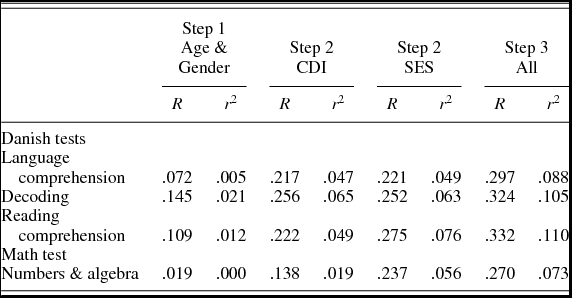
To examine the first research question, how well early vocabulary predicts language, literacy, and mathematical outcomes, multiple regression analyses were performed, and summarized in Table 1. When CDI vocabulary was added as a predictor, it accounted for an additional 4.2%, 4.4%, and 3.7% of the variance in the language and literacy measures, but only 1.9% of the mathematics measure. When SES was added prior to CDI vocabulary, the figures were comparable, but somewhat higher for reading comprehension and mathematics. When both were added, the total variance accounted for was nearly as large as the sum of the two individual variances described above. These results, suggesting largely unique effects for vocabulary and SES are consistent with the findings (not included in the table) that SES is almost completely uncorrelated with CDI vocabulary (r = .032), although it is correlated with the later measures: with language comprehension (r = .209), with decoding (r = .205), with reading comprehension (r = .252), and with numbers and algebra (r = .236).
Hierarchical regression with age and gender in Step 1, CDI vocabulary or SES in Step 2, and age, gender, SES, CDI in Step 3 for the four National Test outcomes
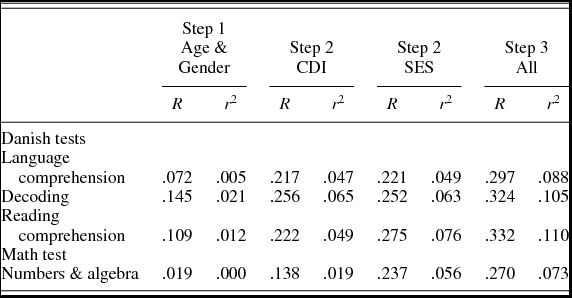
Note: CDI, MacArthur–Bates Communicative Development Inventories; SES, socioeconomic status; R, standardized regression coefficient.
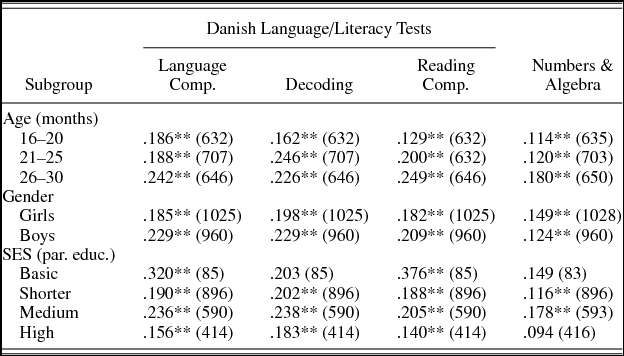
To address the second part of research question two as well as question three, supplementary correlation analyses were conducted. To explore potential changes in the degree of prediction as children grow from 16 to 30 months, correlations were computed within each of three age ranges: 16–20, 21–25, and 26–30 months (see Table 2). The table also includes correlations separately for boys and girls, and stratified by the four SES categories. The correlations generally grow modestly across the age group, with the single exception of decoding between 21 and 25 months and 26 and 30 months. For the language and literacy measures, but not the mathematics measure, the correlations are higher for boys than for girls. With respect to SES, the lowest correlations were observed in families with high parental education, but there was little other pattern.
Longitudinal prediction of r (N) values for four National Test scores by CDI vocabulary for selected subgroups
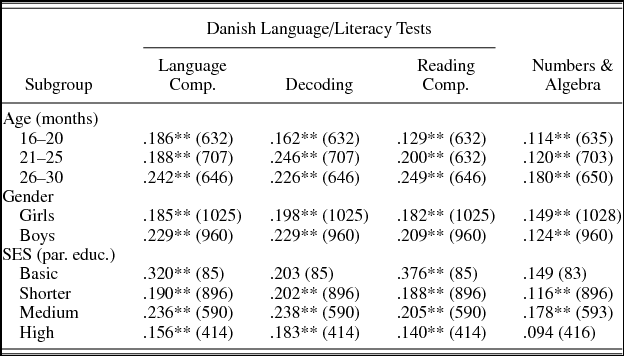
Note: CDI, MacArthur–Bates Communicative Development Inventories; SES, socioeconomic status.
**p < .01.
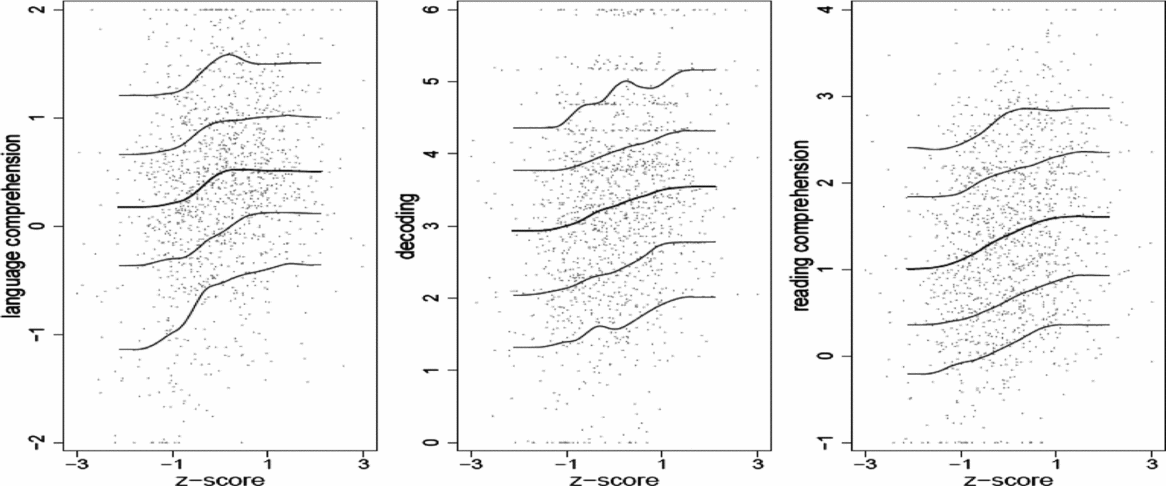
To investigate the fourth research question, whether the predictive discrimination of small differences with the level of CDI vocabulary score, we inspected smoothed quantile curves of the National Test outcomes in language and literacy in dependent on the z score (Figure 1). We restricted this analysis to children of 21 months and above, due to the very weak (“trivial” in Cohen's system) prediction from vocabulary below this age.
Scatterplots of three sixth-grade National Test results versus CDI z scores obtained at 21–30 months and smoothed 10%, 25%, 50%, 75%, and 90% quantile curves.

The curves, especially that for Language comprehension, appear to change in slope over the range of the predictor. However, the apparently flat slopes at the extremes of the curves are based on small numbers of subjects. Spline regression analyses were performed to determine if there were inflection points (“knots”) within the main body of the data (±2 SD) where the slope of a linear regression line changed significantly. For Language comprehension, there was a significant decrease in the slope at approximately z = 0.01, showing greater sensitivity in the below-average range than in the above-average range. For both decoding and reading comprehension, no such inflection points were detected.
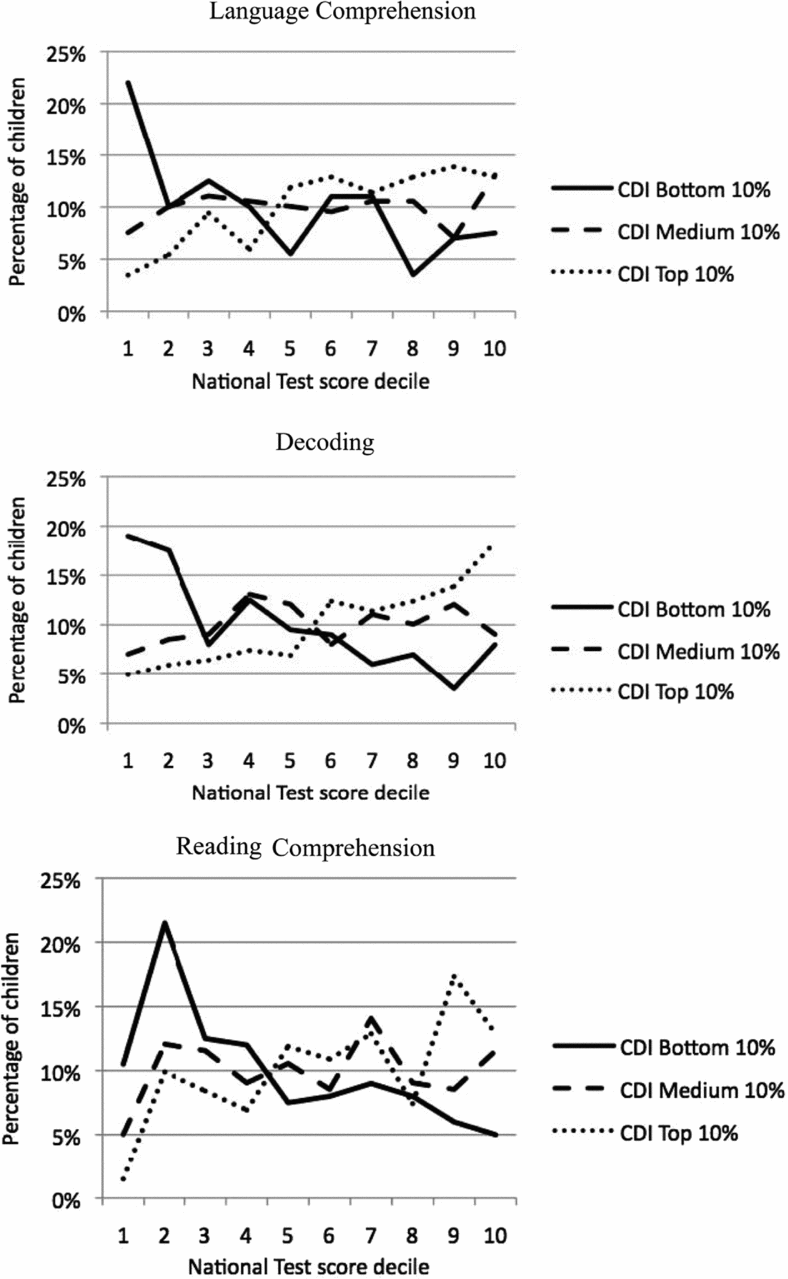
Finally, examining the fifth research question, concerning outcomes for the delayed group (lowest 10%) in comparison to outcomes for a median and top group, Figure 2 presents histograms for the three groups for each of the language and literacy measures.
Charts showing the percentage of children in deciles 1–10 on the Danish National Test in sixth grade for three groups of children differing in CDI score as 16- to 30-month-olds, namely, bottom 10%, median 10% (45%–55%), and top 10% on the CDI.
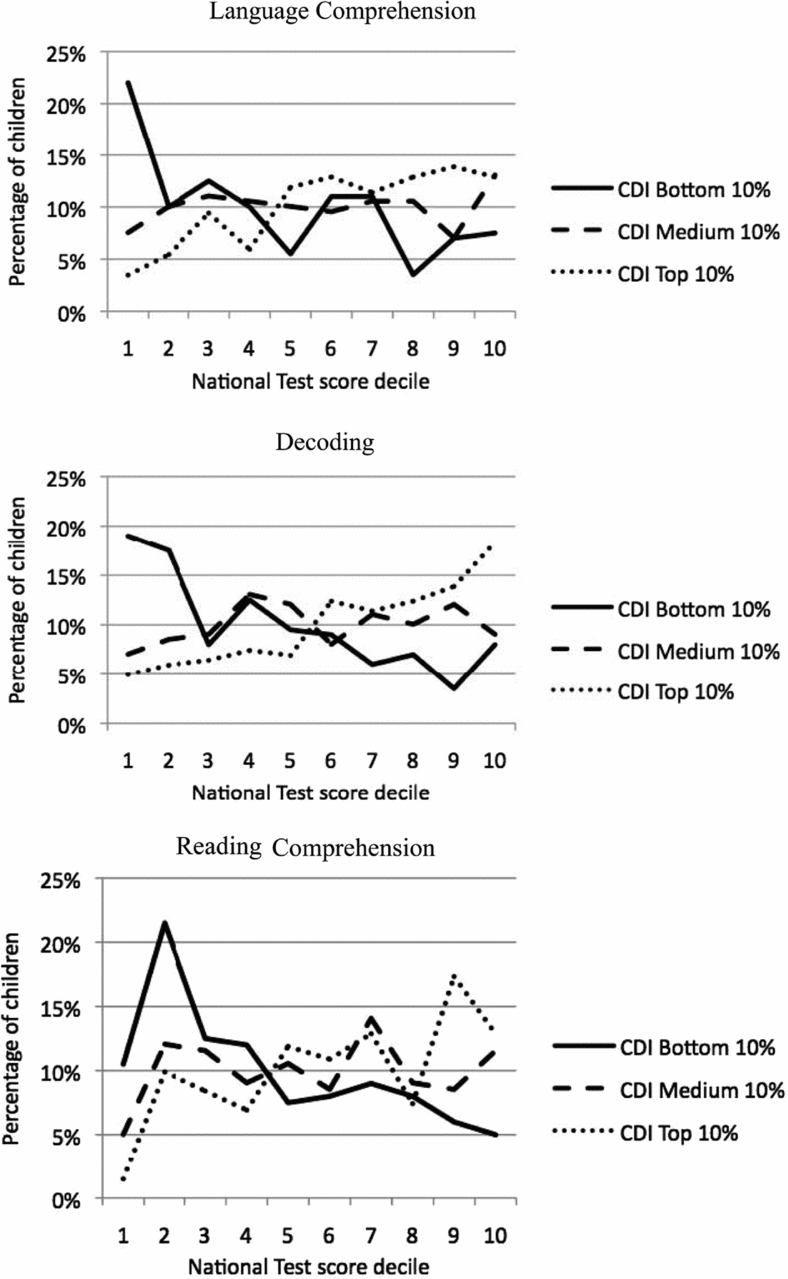
Consistent with the correlations, children in the lowest group were more likely to show low scores later, while verbally precocious children (top 10%) were more likely to show high scores later. The results for the median 10% show a more uniform distribution across the range.
Children in the early delay group had an elevated chance (22%, 19%) of remaining in the lowest 10% later on language comprehension and decoding, respectively, though not for reading comprehension (10.5%). However, a subgroup of these children showed good development later; 40%, 34%, and 36% were in the upper half on Language comprehension, decoding, and reading comprehension, a result that is consistent with much other research on outcomes of very early language delay (Rescorla & Dale, Reference Rescorla and Dale2013). Examination of the prediction for children in the top group shows that obtaining a very high vocabulary score early does not necessarily imply high performance in school later. The probability of remaining in the initial high category is even lower than for children with early delay remaining in the lowest group: 7.5%, 8%, and 5%, respectively. However, it is very unlikely that these children will experience problems and end up in the bottom 10%: 3.5%, 5%, and 1.5% for the three measures, respectively.
DISCUSSION
To address the first research question of how well early vocabulary predicts later educational outcomes, we conducted regression and correlation analyses predicting vocabulary scores at 16–30 months of age with sixth-grade outcomes in Danish language and reading as well as math. The r 2 values from the regression and the simple correlations both indicate a very modest degree of prediction, at best reaching the level of “weak” in terms of Cohen guidelines. The interval between early vocabulary assessment and outcome measures constituted more than three quarters of the children's lives, and undoubtedly comprised a host of family, school, health, and other sources of variability. As expected, the prediction was stronger for language and literacy outcomes than for the math measure. To our knowledge, this is the first documentation of academic achievement prediction from language measured at this young in a large and diverse sample. It is also notable that the prediction is significant across the board for both boys and girls (cf. Hohm et al., Reference Hohm, Jennen-Steinmetz, Schmidt and Laucht2007).
It is also illuminating to consider these results in the context of other research on early language and emergent literacy measures and their prediction to later academic outcomes. A comprehensive meta-analysis was conducted as part of the report of the National Early Literacy Panel (2008; see chap. 2). Considerably stronger predictions, in the range of 0.4 to 0.6, were found for some measures, particularly aspects of print awareness and phonological awareness. Measures of oral language yielded weaker correlations, typically around .3–.35. Furthermore, within the domain of oral language, vocabulary was less predictive than other measures such as grammar. Lonigan and Shanahan (Reference Lonigan and Shanahan2010) argue that these findings show that oral language is necessary for literacy, but far from sufficient. It should also be kept in mind that the overwhelming majority of the studies summarized by the National Early Literacy Panel included children 4 years of age and older. Though there was little evidence that the predictions from 4-year-olds and those from kindergartners were different, it is likely that prediction from 2-year-olds would be different. The correlations obtained here (.13 to .25) are similar to those obtained in more recent research in English following the National Early Literacy Panel report, and discussed earlier by Lee (Reference Lee2011), Harlaar et al. Plomin (Reference Harlaar, Hayiou-Thomas, Dale and Plomin2008), and Hayiou-Thomas et al. (Reference Hayiou-Thomas, Dale and Plomin2012), even though we examine a different language and consider a longer time span. These results thus also suggest that the relatively smaller SES variability in Denmark compared to the United States and Danish children's almost 100% daycare attendance is not enough to eliminate long-term effects of variability in early language skills.
What is the theoretical and applied significance of these correlations? From a theoretical perspective, it is important to acknowledge that these correlations are not necessarily evidence of causality. Early vocabulary differences could causally initiate a cascade of differences in grammar, pragmatics, metalinguistic awareness, literacy, and intellectual development. However, early vocabulary differences and later academic differences could be independent manifestations of underlying abilities or of general neuropsychological functioning (see, e.g., Scarborough, Reference Scarborough, Catts and Kamhi2005).
From an applied perspective, these weak correlations are not strong enough to justify clinical decision making on their own. At present, late talking in children below 2 years 6 months is not sufficient in itself to justify speech–language therapy (Rescorla & Dale, Reference Rescorla and Dale2013). However, based on promising results of early low-cost interventions in homes (e.g., van Steensel, McElvany, Kurvers, & Herppich, Reference van Steensel, McElvany, Kurvers and Herppich2010) and by increasing the instructional quality in daycares (e.g., Keys et al., Reference Keys, Farkas, Burchinal, Duncan, Vandell and Li2013; National Institute of Child Health and Human Development Early Child Care Research Network, (2005), the results do warrant that late talkers (in particular if late talking is combined with other indices of increased risk, such as family history of language/literacy learning difficulties, low SES, and poor comprehension) receive some kind of increased educational support in their homes or in daycares.
A further perspective on the magnitude of these predictive correlations, weak but significant given the large sample size, is provided by a comparison with other variables that are related to educational outcomes at this stage of development, particularly reading. Our observed correlations in the range of .13 to .25 are comparable in size, based on percentage of variance accounted for, to a Cohen d effect size measure for an intervention of 0.26 to 0.52, that is, the small to moderate range. Utilizing summary statistics provided by Lipsey et al. (Reference Lipsey, Puzio, Yun, Hebert, Steinka-Fry and Cole2012) based on American studies, we can say that this effect size is comparable to 1 year's mean growth in reading scores (Grades 5–6, d = 0.32; Grades 6–7, d = 0.23). This is somewhat smaller than the eligible–ineligible for free/reduced lunch difference on the National Assessment of Educational Progress scores (d = –0.45 to –.74), and smaller still than ethnic differences (Black/Hispanic/White) on the National Assessment of Educational Progress (d = 0.53 to –.83). These statistics are a reminder of how little we can explain of individual differences in reading overall at present.
For our second research question, we wanted to investigate the role of SES in predicting later educational outcomes. Three aspects of the results suggest that SES and CDI vocabulary play largely independent roles. CDI vocabulary itself is not significantly correlated with SES. Adding SES as a predictor (Table 1) after CDI vocabulary had nearly as large an effect on the prediction as it had when it was entered prior to vocabulary. Finally, examination of prediction from vocabulary within the four SES categories showed little variation. Together, these results indicate that early vocabulary is an SES-independent predictor. However, the generalizability of this conclusion is unclear because it rests upon the lack of a correlation between SES and early CDI vocabulary scores. In another Danish study with a more representative sample in terms of parental education, substantial SES-related differences in child outcomes were observed (Bleses, Højen, Jørgensen, Jensen, & Vach, Reference Bleses, Højen, Jørgensen, Jensen and Vach2010); that is, the lack of SES differences in the current study could be due to the biased nature of the sample.
The third research question concerned how these predictions vary with the age at first measurement and gender. There is a growing consensus that early vocabulary measures are credible sources of information of child language development. Our results show that a vocabulary measure taken as early as the second year of life is a significant predictor of language and literacy and, less so, of math skills. With respect to gender, we found higher correlations for boys than for girls for all three Danish language outcome measures. We had made no predictions at this question, and the result is opposite to that of Hohm et al. (Reference Hohm, Jennen-Steinmetz, Schmidt and Laucht2007); further research is needed to clarify the reasons for this difference.
Examination of scatter plots and smoothed quantile curves investigating the fourth research question suggested the lower range of z scores is more sensitive with respect to long-term prediction, but spline regression analysis confirmed this statistically only for language comprehension.
Finally, addressing the fifth research question, we examined the outcomes of early delay. This is one of the very first studies of the long-term academic outcomes of a large and diverse sample of late talkers. In contrast to the findings of Rescorla (Reference Rescorla, Rescorla and Dale2013), children with an early delay were more likely to continue to have problems (overrepresentation in both the bottom 10% and the bottom half of the distribution), although it was also true that about a third of the late talkers moved into the upper half of the distribution. Precocious children were not as likely to remain in the top 10% group; however, their chances of ending up with reading problems were low.
Limitations and future directions for research
All the children in this study were monolingual Danish speakers at the time of initial assessment. As societies become increasingly multilingual, there is a strong need for similar kinds of longitudinal information for children who are growing up in a bilingual context. For these children, it is even more challenging to make clinical decisions about language impairment or risk of language impairment.
Conclusion
The main finding of this study is that educational outcomes can be predicted from a very early (below 2 years) measure of language development, namely, the size of the parent-reported productive vocabulary with effect sizes (in proportion of variance accounted for) comparable to 1 year's mean growth in reading scores. However, there is great variability in outcome. Supplementation with other relevant information, such as family history of learning difficulties, low SES, and poor comprehension, may somewhat improve the prediction. Intervention studies, however, have demonstrated that children's language development can be accelerated by parent-based interventions in the toddler and early preschool range or by increasing the instructional quality of daycares. Such low-cost, and ideally low-stress, interventions may be highly appropriate responses to late talking. However, more basic research on the mechanism by which early vocabulary differences result in later academic differences is needed. Understanding which associations are truly causal versus reflecting common underlying factors is essential for selecting optimal targets for intervention.
ACKNOWLEDGMENTS
We extend warm thanks to parents for their contribution to the original CDI study. The MBCDI study was funded by a grant from the Carlsberg Foundation and the Research Council for the Humanities.