Scholars of Chinese politics have observed two patterns in the state of the internet in China. First, the Chinese government has imposed tight control over the internet (Boas Reference Boas2006; Hassid Reference Hassid2008; Kalathil and Boas Reference Kalathil and Boas2003; MacKinnon Reference MacKinnon2008; Rodan Reference Rodan1998; Taubman Reference Taubman1998). In particular, top officials and key political institutions that directly represent the regime have rarely been criticized on the internet or its associated social media. Nor has the legitimacy of the party-state system been allowed to be openly challenged. Secondly, however, there is an increasing amount of negative information about the government on the internet (King et al. Reference King, Pan and Roberts2013; Lorentzen Reference Lorentzen2014; Shirk Reference Shirk2010; Tang and Huhe Reference Tang and Huhe2014; Yang et al. Reference Yang, Tang, Zhou and Huhe2014). Low-profile officials and institutions and various policy issues, especially those at the local level, have become frequent targets of negative reporting and critical debate on the internet (e.g. Han Reference Han2015).
Given such mixed information on the internet, we are motivated to investigate how exposure to the internet shapes support for the regime. Is the censorship of high-profile politics or the government’s proactive strategies effective in boosting regime support? To what extent and in what ways does the online negative information about the government undermine regime support? What is the net effect of internet use in contemporary China? To answer these questions, we explore the complex effect of the internet in an integrated way. We do so by parsing the political consequences of the internet and analysing the direct and indirect effect of internet use on regime support, defined as general support for the political system. Specifically, we argue that while internet use may directly boost viewers’ support for the regime as a whole due to state control and intervention, everyday exposure to negative information about rank-and-file officials and institutions decreases people’s evaluation of government performance in specific policy areas. More importantly, decreased evaluation of government performance can in turn erode general support for the regime.
We test these hypothesized effects of the internet through a mediation analysis of newly collected data in the greater Beijing area. The results of our analysis indicate that the direct effect of political use of the internet on the support for the political system is positive. However, at the same time, the use of the internet indirectly decreases regime support through decreasing the public’s evaluations of government performance. The total effect of the internet on regime support is positive. These findings imply that, in the cyberspace of contemporary China, the challenges of the internet and the responses of the government are in a race for the heart and soul of Chinese citizens. The government is getting the upper hand at the moment since its censorship strategies effectively help the regime win the support of internet users. Nevertheless, at the same time, the ever-mounting challenges from the internet to the daily operations of government and the limits of state control indicate the detrimental influence of the internet for the regime in the long run.
This study contributes to the extant literature in the following ways. Firstly, our research extends the studies of the internet in China, the largest authoritarian country. Compared with previous studies, we provide a more comprehensive understanding of the internet effect. In our study, different effects of internet use are presented in an integrated framework: the direct effect on regime support, the effect on evaluations of government performance, the indirect effect on regime support through changing performance evaluations, and the total effect on regime support as the sum of the direct and indirect effect. In this framework, we specifically explore one mechanism through which the use of the internet influences diffuse support for the authoritarian regime. We treat the evaluation of government performance as a mediating variable and explicitly submit this causal relationship to an empirical test.
Secondly, our study also contributes to the broader literature of the democratic potential of the internet in authoritarian environments. Recent years have witnessed a heated debate between optimists and pessimists. The former believe that the spread of the internet and its associated new media is able to undermine authoritarian rule through democratizing the public sphere (Diamond Reference Diamond2010; Howard and Hussain Reference Howard and Hussain2011; Shirky Reference Shirky2011). The latter, disappointed by the failure of the internet to promote political change in such countries as China, Singapore, Iran, Russia and Cuba, however, contend that the internet can serve as another instrument for the government and help consolidate the authoritarian regime (Gunitsky Reference Gunitsky2015; Lorentzen Reference Lorentzen2014; MacKinnon Reference MacKinnon2011). Despite their disagreements, both camps focus mainly on large-scale events such as protests (Farrell Reference Farrell2012; Tang and Huhe Reference Tang and Huhe2014). Less frequently considered is how everyday use of the internet changes people’s attitudes. As our study indicates, the internet may not have directly triggered political upheavals, but it can exacerbate people’s ‘dissatisfaction with matters of economics or day-to-day governance’ of the state (Lynch Reference Lynch2011: 5) and thus prepare the public for future collective action. Our research thus joins an emerging enterprise that explores the more nuanced, but not less important, effects of the internet (Lei Reference Lei2011; Tang et al. Reference Tang, Jorba and Jensen2012; Tang and Huhe Reference Tang and Huhe2014). Through a theoretical explication and an empirical test of the micro-process of the Internet, our study helps to identify the causal effects of the internet that can support the argument about its effect on political change in authoritarian countries.
Moreover, by explicitly relating evaluations of government performance to regime support, this study also advances theoretical studies of political support in authoritarian countries. Scholars based in democratic countries tend to stress the distinction between object-specific support and general support for the political system (Easton Reference Easton1975; Gibson and Caldeira Reference Gibson and Caldeira1992; Seligson and Muller Reference Seligson and Muller1987). Our treatment and analysis of these two types of political support indicate that they are closely related in authoritarian countries. Due to the lack of separation of power and office alternation between competing parties, the dissatisfaction with specific government agencies can readily lead to a perception of the regime’s overall incompetence and illegitimacy. Our study, therefore, draws attention to contextualizing political support in authoritarian countries.
The challenges of the internet to the Chinese government
In parallel with its fast economic growth, China has made great progress towards becoming the country with the largest internet population in the past few decades. The number of internet users reached 618 million (45.8% of the total population) by the end of 2013. Despite a digital divide between different segments of the population (Guo and Chen Reference Guo and Chen2011; Tang et al. Reference Tang, Jorba and Jensen2012), access to the internet and the importance of the internet for obtaining information have increased tremendously for ordinary Chinese citizens. An important consequence of the rapid spread of the internet is the ever-increasing amount of negative reporting and criticism of the government.
The challenges of the internet are two-fold. Firstly, the internet expands citizens’ access to alternative information that would otherwise be unavailable. Due to the anonymity, fast speed and low cost of internet communication, the public are exposed to negative information about the government on an unprecedented scale. In the era of the new media in China, it is often the case that negative stories about the government – such as corruption scandals of officials, the brutality of law enforcement and injustice in judicial cases – break first on the internet. The market competition for audience has driven the traditional media, especially the commercial sector, to follow the critical reporting on the internet (Xiao Reference Xiao2011; Yang Reference Yang2009). Online news stories and topics of internet discussions are therefore often quickly picked up by the traditional media and gain national prominence (Zhou and Moy Reference Zhou and Moy2007).
The second and more subtle challenge of the internet is that it enables the critical discussion of news events. The content of online discussion in China often moves quickly from specific events to general problems in the political, economic and legal systems (Herold and Marolt Reference Herold and Marolt2011; Sullivan Reference Sullivan2012; Tang and Yang Reference Tang and Yang2011; Yang Reference Yang2009; Zhou Reference Zhou2009), and many social and political events can lead to intense online debate that is not to the benefit of the state. For instance, a case of official corruption can invoke a discussion about the authoritarian nature of the regime such as the lack of checks and balances in the political system. A tragic accident involving a school bus can give rise to widespread criticism of the neglect of safety and well-being of ordinary citizens by the state. Even the success of a grand government project that is supposed to boost public support can be framed as negative on the internet. For example, Min Tang and Narisong Huhe (Reference Tang and Huhe2014) show that the success of China’s space programmes has been interpreted by many netizens as a mere ‘face project’ for the regime or even as a waste of precious resources that should have been used to improve the lives of ordinary citizens.
The government’s response to challenges
Authoritarian regimes around the world have tried to avoid the destabilizing effects of the internet through sophisticated regulation and censorship (Boas Reference Boas2006; Harwit and Clark Reference Harwit and Clark2001; Kalathil and Boas Reference Kalathil and Boas2003; Rød and Weidmann forthcoming; Rodan Reference Rodan1998; Taubman Reference Taubman1998). The Chinese government is particularly successful in this regard. The methods of censorship and control include requiring the registration of real names, deleting unfavourable posts, blocking websites that contain sensitive information and organizing an army of pro-government internet commentators (such as the 50 Cent Party). Through employing such technological and institutional means, the authoritarian state of China has managed to use the growth of the internet to promote economic development, technological innovation and globalization and, at the same time, reduce its harmful political effects.
A major characteristic of state control of the internet in China is its selectivity. Most notably, Gary King et al. (Reference King, Pan and Roberts2013) contend that the state distinguishes between two kinds of information on the internet, depending on whether it has a mobilizing potential for collective action. Relying on data collected from Chinese social media, King et al. (Reference King, Pan and Roberts2013) show that posts related to political mobilization are more likely to be censored than posts of mere public criticism. While King et al. (Reference King, Pan and Roberts2013) treat all online criticisms without a potential for collective action in the same way,Footnote 1 a larger body of literature suggests that the censorship strategy of the regime can be more sophisticated and tends to evolve over time (Creemers Reference Creemers2017; Liebman Reference Liebman2011; Lorentzen Reference Lorentzen2014; Shirk Reference Shirk2010; Shirky Reference Shirky2011; Yang et al. Reference Yang, Tang, Zhou and Huhe2014; Zhao Reference Zhao2000). In particular, these studies have shown that the government differentiates between criticism of institutions and officials that have different political significance and imposes censorship accordingly. Generally speaking, negative information on the internet is mostly allowed to target institutions and officials of lower political significance or solvable problems, while direct criticism of the broader political system is censored to a greater extent, albeit not totally banned (Brady 2008: 80; Lorentzen Reference Lorentzen2014: 411). This selective strategy is metaphorically expressed as allowing the people to ‘swat flies but don’t beat tigers’ (Lorentzen Reference Lorentzen2014: 411).
Following this censorship strategy, the government sets the limit of both critical reporting and negative framing. It thus protects some individuals and institutions while leaving others to be exposed and criticized. As a result, top political leaders and significant political institutions such as the key apparatus of the centre in Beijing and the Communist Party (CCP) itself are not subject to either negative reporting of facts or critical discussions. Information on leadership politics and internal deliberations within the party remain blacked out in the media and the internet (Shirk Reference Shirk2010). With few exceptions, no internet outlets dare to reveal alternative information that would be deemed subversive to the rule of the Communist Party or freely discuss top leaders and key institutions. Factual information and public deliberation of sensitive topics such as the Tiananmen Incident are totally banned from the internet. Individuals who openly challenge the fundamentals of the CCP’s political leadership are subject to punishment.
The Chinese government does not only set boundaries for the internet. It also takes proactive actions to portray a positive image of the regime and nurture public support for the system (Creemers Reference Creemers2017; Sullivan Reference Sullivan2014). As in the traditional media, on the internet the CCP as an institution and the central government in Beijing are praised for their upright leadership in all aspects of social, economic and political affairs. Whenever internet users in China open a major website or a news application, they will see a portrait of top leaders up front, positive reporting of their leadership and flattering comments posted by the 50 Cent Party. For key news events at the national level, such as a national party meeting or an important political decision, the government either hires commentators to post comments favourable towards party policies to shape public opinions or simply prohibits commenting on those events. As a result, both the news facts and the discussion about the regime itself are largely positive in Chinese cyberspace.
Politicians and institutions of lower political significance such as local government and officials and agencies in charge of specific policy affairs, however, do not have such government protection on the internet. Allowing negative reporting and public criticism against certain government agencies helps the centre monitor those agencies. With the increasing scope and intensity of social economic activities, it becomes increasingly difficult for the centre to assure its intentions, plans and policies will be carried out as intended through regular bureaucratic channels. The internet, along with other media outlets, offers another channel through which the centre monitors the operation of government agencies, presses them to follow the directions of the centre, exposes rogue officials and institutions, and identifies the sources of potential public discontent. From critical reports, the centre gains alternative information from the ground and thus can act in a timely way to the problems exposed. In this sense, the internet can improve governance and reduce social discontent (Sullivan Reference Sullivan2014; Tang and Yang Reference Tang and Yang2011; Yang et al. Reference Yang, Tang, Zhou and Huhe2014).
Whatever the reasons, the internet has become the front line of critical reporting in the Chinese media. In recent years, negative stories of government agencies and officials have usually been reported and discussed on the internet first and reached national prominence later. Among the numerous cases exposed and debated on the internet, many target the performance of government agencies in charge of specific policy areas. These cases include the corruption of officials, increasing income inequality, mismanagement of the housing market, inadequate provision of social security, the cost of public health care and the deterioration of air quality. As noted by various studies, in the cyberspace of China, the tone of discussion tends to be negative and even cynical (King et al. Reference King, Pan and Roberts2013; O’Brien and Stern Reference O’Brien and Stern2008; Tong and Lei Reference Tong and Lei2013; Yang Reference Yang2009). Such ‘hegemony’ of critical online media is largely a reaction of disenfranchised netizens to the government’s ban on the discussion of high-profile political issues (Tong and Lei Reference Tong and Lei2013). The netizens take every opportunity to vent their anger and dissatisfaction with the government agencies that they are permitted to criticize and connect them to the broader system as a whole whenever possible.
Hypothesizing the effects of the internet
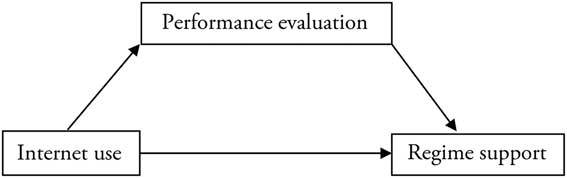
Given the selective nature of government control and the resultant mixed online information about government and politics in China, we do not limit our attention to the direct effect of internet use on political attitudes. Instead, we investigate both the direct effect of the internet on viewers’ support for the regime and the indirect effect of the internet on regime support that works by influencing viewers’ evaluation of government performance in various policy areas. The causal relationship between internet use and regime support in our analytic framework is shown in Figure 1.
Causal Relationship between Internet Use and Regime Support

Based on the discussion of the challenges of the internet and government control in the previous section, we develop the following hypotheses with regard to the effect of internet use in China:
Hypothesis 1: The direct effect of internet use on regime support is positive.
This is so because key political institutions and figures that constitute the core of the party-state regime in China are largely insulated from both negative reporting and critical discussions. Moreover, the state has been proactively promoting a positive image of the regime through various means.
Due to the relaxed censorship related to criticism of government agencies in charge of specific affairs, the internet in contemporary China is filled with negative reporting and critical deliberations about government in policy areas. We therefore have the following hypothesis:
Hypothesis 2: Exposure to the internet decreases viewers’ evaluation of government performance.
We then have the following, most important, hypothesis of this research:
Hypothesis 3: Exposure to the internet decreases regime support through lowering evaluation of government performance.
This hypothesis is of primary interest to us. The literature on political support has often differentiated between ‘specific support’ and ‘diffuse support’. In this traditional framework, citizens’ evaluation of government performance is a measure of specific support – that is, support for specific authorities and institutions at a given moment. Support for the regime as a whole, in contrast, is diffuse support that is directed at the underlying order of the political system. In democratic countries, the difference between the two types of support is meaningful and necessary. People who are discontented with the policies, actions and performance of specific government institutions or officials do not necessarily reject the fundamental values, rules and order of the political system in which political authorities reside (Easton Reference Easton1975; Gibson and Caldeira Reference Gibson and Caldeira1992; Seligson and Muller Reference Seligson and Muller1987). This is so partly because democratic countries have installed institutions that enable citizens to attribute policy consequences to specific parties and individuals, but not to the political system as a whole. However, scholars have also noted that object-specific attitudes can influence support for the regime. Easton, for instance, pointed out that ‘if discontent with perceived performance continues over a long enough time, it may gradually erode even the strongest underlying bonds of attachment’ (Easton Reference Easton1975: 445).
We believe that, in authoritarian regimes such as China, the decline of specific support can erode diffuse support, more so than in democratic countries. The authoritarian system is characterized by a natural fusion between ruling authorities and the regime due to the lack of office alternation and power-sharing. The alternation of the ruling party in China, for instance, would in fact be equivalent to the replacement of the authoritarian regime. The party can change the particular government leadership because of its poor performance and thus remain in power. But one-party rule and the inseparability between the party and the government make citizens less likely to attribute the responsibility to one specific government institution or leader and more likely to blame the political system itself. The close connection between a specific government and the regime leads to a strong linkage between citizens’ evaluation of government performance and their general support for the regime.
The relationship between government performance evaluation and regime support is further reinforced by the fact that government performance in authoritarian China has become a key source of legitimacy. Public opinion studies have consistently shown that Chinese citizens support their political system far more than would be expected in an authoritarian regime (Chen Reference Chen2004; Chen and Dickson Reference Chen and Dickson2008; Chen et al. Reference Chen, Zhong, Hillard and Scheb1997; Gilley Reference Gilley2006; Shi Reference Shi2001). Among various reasons for this high level of regime support, the most important one is that the Chinese state has been able to outperform the expectation of what an authoritarian regime can usually achieve (Chen and Zhong Reference Chen and Zhong1998; Shi Reference Shi2001; Wang Reference Wang2005; Yang and Tang Reference Yang and Tang2010). This performance-based support, however, is sensitive to fluctuations in government output. When performance fails to meet the expectations of the public or is framed that way by critical reporting and discussion on the internet, the basis of political support and regime legitimacy will be shaky.
Data, variables, measurement and estimation method
To investigate the effect of the internet on political support in China, we conducted a survey in the greater Beijing region between November 2011 and February 2012. This survey covered both urban and rural populations in the area. We carried out the survey in cooperation with the Beijing Academy of Social Sciences (BASS). We selected the sample with a combination of probability proportional to size (PPS) and multistage sampling techniques. We first chose street-level units (jiedao, or township equivalence in Beijing) within each of 10 surveyed district units (qu, or county equivalence in Beijing) using the PPS technique. A total of 36 street-level units were thus randomly chosen. From each of these street-level units, we randomly selected four residential communities (or villages). Finally, we randomly chose 10 individuals from each of the sampled communities. The response rate of this survey is 92% and the total number of respondents in our sample is 1,318. Given that the survey was conducted only in the Beijing area, we are cautious not to generalize our findings to regions other than metropolitan areas in China.
A legitimate concern for survey-based research in China is whether survey responses are reliable. The interviewees might give politically acceptable answers out of fear of retribution. We believe that, in our sample, the responses are reliable. Firstly, the questionnaires were collected by an academic agency, and the survey was conducted in a confidential way so that individual respondents would have no reason to worry about political persecution. Secondly, our confidence in the reliability of our survey is further reinforced by the distributional pattern of the variables we use. For instance, for the evaluation of government performance, the distribution of the raw data indicates that Beijing residents do show a large variation in their attitudes. For various policy areas they responded with very low evaluations of performance. Even for the three variables that we use to gauge general regime support, only a moderate percentage of respondents expressed the highest level of support (30%, 22% and 18% respectively). All these patterns indicate a weak influence of the fear factor in our survey.
Internet use
We measured internet use by the respondents’ indication of the importance of the internet for obtaining political information. The question reads: ‘When obtaining information about politics, which of the following ways is the most important?’ We recoded the choice of the internet as 1 and other choices as 0. We prefer this measurement because it focuses on the political use of the internet. Most internet users in China, as in other countries, browse the internet for other purposes – such as entertainment and social networking. We checked the robustness of our findings in an analysis using the frequency of general internet use. The question reads: ‘How frequently do you use the internet?’ The answers range on a four-point scale from ‘never’ to ‘most frequently’. The sample distribution is highly skewed. More than half of the respondents use the internet every day. We therefore recoded this variable into a dichotomous one with 1 for those who use the internet every day and 0 for others. The summary statistics of this variable and others used in this study is reported in Table 1.
Summary Statistics

Source: Authors’ collection.
Government performance evaluation
In our survey, respondents were asked to evaluate government performance in 10 policy areas: controlling inflation, promoting employment, decreasing income inequality, managing the housing market, maintaining social order, providing medical care, ensuring fairness of taxation, providing social security, improving the environment and controlling corruption.Footnote 2 They ranked the government performance in each area on a scale from 1 to 5. Their evaluations demonstrate high internal consistency (Cronbach’s alpha: 0.85). The evaluation of these 10 areas together provides a good indication of respondents’ overall evaluation of government performance. We thus generated a composite index of performance evaluation by summing their responses and rescaling it to range from 0 (the lowest evaluation) to 10 (the highest evaluation).
Regime support
We measured respondents’ general support for the political system based on the extent of their agreement with the following three statements: ‘I believe the Communist Party represents my interests’; ‘I support the existing political system’; and ‘My political opinions are in agreement with the values promoted by the party and the state’. The respondents indicated their agreement on a scale from 1 to 5. The responses were recoded such that a higher score indicates a higher level of agreement. We created an index of regime support by summing the responses to the three statements and rescaling it from 0 (the lowest level of regime support) to 10 (the highest level).
Other variables
To control for the effect of other factors, we first included a variable that measures the extent to which the respondents follow political news (1 to 4). The inclusion of this variable controls for the effect of the general use of the media, especially the traditional media. In addition, we controlled for two sets of factors. The first one is socioeconomic background, including age (in years), gender (0, female; 1, male), education levels (four levels: 1–4), urban residence (0, rural Hukou; 1 urban Hukou), household income (12 levels: 1–12), self-perceived social status (four levels: 1–4), and membership of the Communist Party (0, no; 1, party member). The second set includes two attitudinal factors, interpersonal trust and political efficacy, which are supposed to be associated with political support (Brehm and Rahn Reference Brehm and Rahn1997; Mishler and Rose Reference Mishler and Rose2001).
Mediation analysis
As illustrated in Figure 1, exposure to the internet has a direct effect on regime support; it also has an indirect effect via influencing the mediating variable, performance evaluation. The most appropriate method at our disposal was mediation analysis. Mediation analysis calculates the average effect of treatment as in conventional methods, and it also quantifies the effect of a treatment that operates through a particular mechanism. We adopted a method of mediation analysis recently developed by Kosuke Imai et al. (Reference Imai, Keele, Tingley and Yamamoto2011). This method calculates the average causal mediation effect (ACME), average direct effect (ADE, i.e. the effect of the independent variable on the dependent variable through other unidentified mechanisms) and average total effect (ATE, i.e. the sum of ACME and ADE) through simulating the predicted values of unobserved mediating and outcome variables from the observed variables based on sampling distribution of model parameters. The calculation is based on quasi-Bayesian Monte Carlo approximation.Footnote 3
Analyses and results
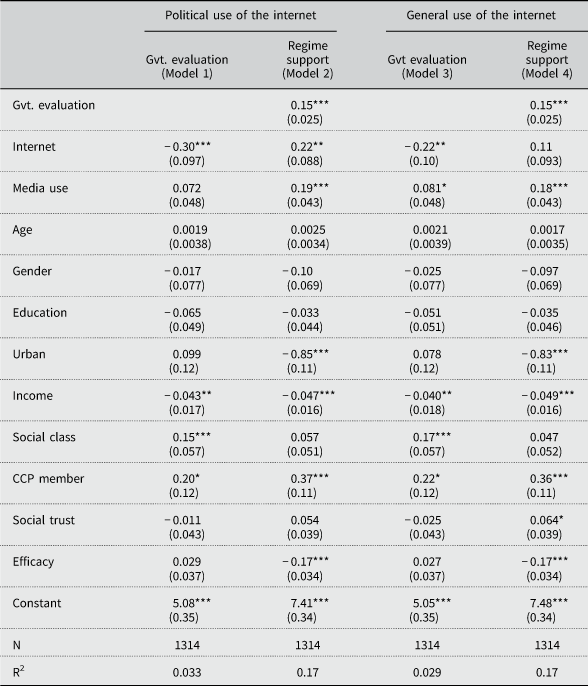
Table 2 presents the results of the two analyses of OLS models for the observed mediator variable (government performance evaluation) and outcome variable (regime support), respectively. In Model 1 and Model 2, we use the political use of the internet as the treatment variable. From the observed data, Model 1 estimates the effect of internet use on government performance evaluation, and Model 2 estimates the effect of both internet use and government performance on regime support.
The Effect of the Internet on Performance Evaluation and Regime Support

Source: Authors’ collection.
Notes: Regression coefficient (b); numbers in parentheses are standard errors.
*** p<0.01; ** p<0.05; * p<0.1.
From the regression results, we can tell that internet use is negatively associated with government performance evaluation (Model 1) and positively associated with regime support (Model 2). Moreover, government performance evaluation is positively associated with regime support (Model 2). All of these associations are statistically significant. With a one-unit increase in internet use (i.e. changing from not using the internet as the major source of political information to using it as the major information source), there is a 0.30 unit decrease in evaluation of government performance and a 0.22 increase in regime support, confirming Hypotheses 1 and 2 respectively. And a one-unit increase in government evaluation is associated with a 0.15 unit increase in regime support.Footnote 4 Taking these results together, we can further suspect that the indirect effect of internet use on regime support through influencing performance evaluation is negative. We resort to mediation analysis for a formal test of these different effects.
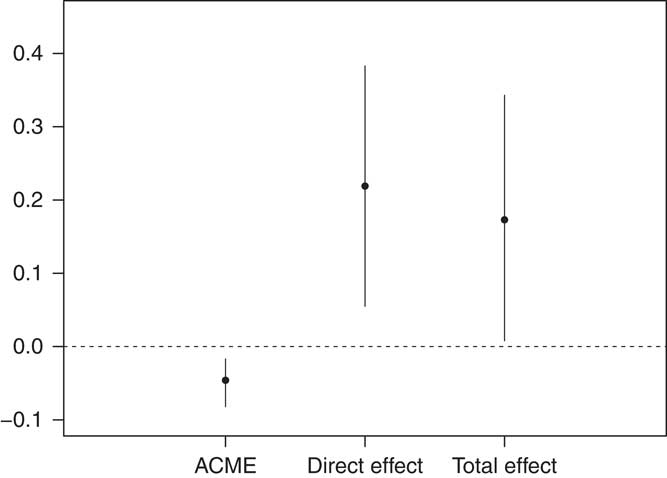
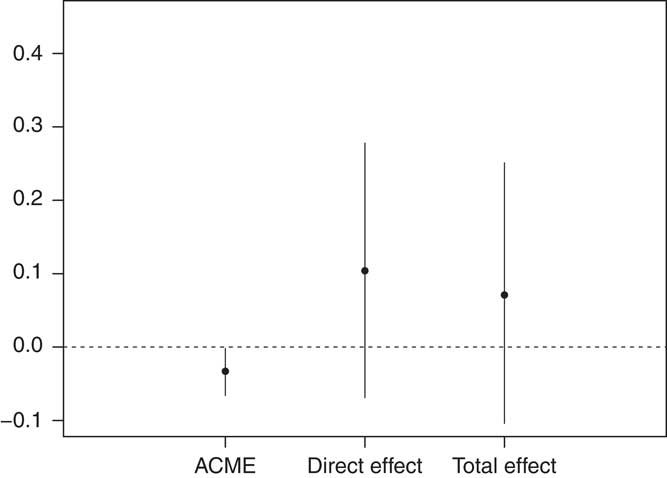
Specifically, based on the two regressions over the observed data, we simulate model parameters. For each draw of parameters, we first simulate the values for the mediator and then the values for outcome variable given the simulated values of the mediator. Next, we compute ACME, ADE and ATE from each draw of the simulated data. Finally, we obtain the point estimate (i.e. mean) and their confidence intervals from the computation of all the simulated data. Figure 2 presents the summary statistics of different effects from the simulated results. The black dots are point estimates. The spike lines represent confidence intervals.
Causal Mediation Analysis of the Effect of Political Use of the Internet

Figure 2 shows that, first, ACME is negative and its 95% confidence intervals are below 0. This finding indicates that the indirect effect of the internet on regime support that is mediated by government performance evaluation is negative and statistically significant, thus confirming Hypothesis 3. Exposure to political information on the internet, therefore, does undermine regime support by decreasing internet users’ evaluation of government performance. Secondly, ADE is positive and statistically significant at the 5% level. This indicates that the direct effect of internet use on regime support is to the benefit of the regime. It therefore proves that the government control on negative reporting and critical discussion of high-profile political institutions is effective through mechanisms other than influencing performance evaluation. The overall favourable tone of the information about the regime does help the state to nurture political support from internet users.
Finally, we are interested in the total effect (ATE) of the internet on regime support – that is, the sum of positive direct effect and negative indirect effect. Mediation analysis shows that ATE is positive and statistically significant. This finding indicates that the positive direct effect of the internet is greater than the negative effect that is mediated by the decreased government performance evaluation. The government’s efforts to control information, especially that related to key political institutions and figures, and to boost regime support are so effective that they are able to offset the harm brought about by the negative reporting and critical discussion of low-profile government agencies and their policies.
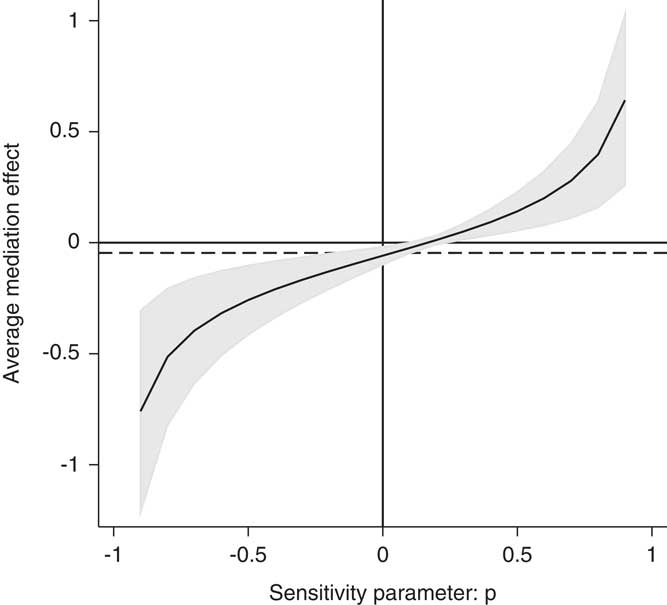
In causal mediation analysis, an important assumption, sequential ignorability, is required for identification (Imai et al. Reference Imai, Keele, Tingley and Yamamoto2011). This assumption cannot be tested by the observed data, but Imai et al. (Reference Imai, Keele, Tingley and Yamamoto2011) proposed a sensitivity analysis to quantify the exact condition where ACME equals 0. This condition is based on the correlation (ρ) between the error for the mediation model and that for the outcome model. Figure 3 presents the graph result of this sensitivity analysis. It shows that for the estimated ACME to be 0, there must be an unobserved confounding factor that affects both performance evaluation and regime support in the same direction and makes the correlation between the two error terms greater than 0.17.
Sensitivity Analysis Note: Solid line is ACME, plotted against sensitivity parameter. The shaded areas represent 95% confidence intervals. The dashed line is the estimated ACME when the sequential ignorability assumption is made.

We now switch to general use of the internet as the independent variable. In Model 3 and Model 4 of Table 2, we conduct the same set of analyses of the observed data. The results show that general use of the internet, like political use, is negatively associated with the evaluation of government performance (Model 3), and performance evaluation is positively associated with regime support (Model 4). However, different from the analysis in Model 2, the general use of the internet is not directly associated with regime support with statistical significance (Model 4).
To provide a more rigorous test, we again resort to a mediation analysis. Figure 4 presents the results. The results show that, first, the indirect effect (ACME) that is of primary interest to this study is statistically significant and negative. It confirms that the decrease in evaluation of government performance caused by internet exposure can erode regime support. Secondly, however, different from the previous analysis presented in Figure 2, both the direct effect (ADE) and the total effect (ATE) are not significant. This indicates that, firstly, due to the fact that the focus of government control is largely limited to political information of political significance, general use of the internet, which often is not directly related to politics, does not promote political support. Secondly, the efforts of the government to portray a positive regime on the internet are not powerful enough to offset the negative influence of the general use of the internet. In short, the analysis using general internet use indicates, on the one hand, relatively weaker influence of state control, and, on the other hand, the more robust indirect effect of internet use.
Causal Mediation Analysis of the Effect of General Use of the Internet

Discussion and conclusion
With the absence of visible political changes in a number of authoritarian countries, many scholars suggest that a censored internet can help consolidate authoritarian rule. Seva Gunitsky (Reference Gunitsky2015: 42), for example, argues that, using internet-based strategies such as counter-mobilization, authoritarian regimes can transform the internet ‘from an engine of protest to another potential mechanism of regime resilience’. Using China as a critical case, in this study we have argued and shown otherwise. Even with the tightest government control in place, the information on the internet still can contribute to undermining the basis of authoritarian rule. A consistent finding of this study is that via internet users’ decreasing evaluation of government performance in policy areas, the internet indirectly undermines their support for the regime. We also found that the direct effect of internet use on regime support is positive, and this support-boosting effect of the internet overcomes its negative effect on government performance evaluation. The overwhelmingly positive direct effect, however, fails to stand when we use a broader measurement of internet use – that is, regular use of the internet. This discrepancy indicates that while the state is effective and successful in censoring political domains, it fails to forestall the detrimental effect of the internet in other spheres that are less politically relevant.
The negative mediating effect of the internet entails important implications. Politically, while it might be true that the state’s control of the internet and the direct support-promoting effect of the internet are ‘politics as usual’ as in the broader political communication in China, the internet still poses a fundamental challenge to the basis of public support for the regime. The government can effectively identify a few high-profile issues and events either to filter the information or to frame the direction of online discussions. The alternative information and deviant frames of low-profile issues or seemingly politically safe ones, however, are ubiquitous and are more difficult to control. Using those issues as platforms, dissident netizens take full advantage of the internet to express their views. The government thus becomes liable for many issues or problems that are not directly related to politics. Given the indispensable role of digital media in China’s economy and social lives, it becomes nearly impossible for the state to block completely all the information about the government and politics. As a result, the basis of the regime’s legitimacy can be gradually eroded.
In a broader sense, therefore, our study indicates the imperative to move beyond visible political outcomes (activism, protests and regime breakdown) and to explore the more complex and nuanced political effects of the internet in authoritarian countries. Specifically, more scholarly attention should be paid to how the spread of the internet can reshape the attitudinal landscape of the population. While attitudinal change itself is not sufficient for collective actions (and we do not claim so based on this research), the growth of the internet contributes to potential political change in that it alienates the citizens from the regime by eroding the ability of states to monopolize information and arguments. The internet produces ‘change over years and decades, not weeks or months’ (Shirky Reference Shirky2011: 30). Only with the identification and explication of such a long-term gradual attitudinal makeover caused by the internet as exemplified in this study, can we claim how much the internet actually contributes to the final political drama, which requires a large range of other factors.
Before we conclude, we have several caveats for the findings and implications of this research. Firstly, the data were collected at one time point and in only one area of China. Therefore, we do not intend to generalize our findings to non-metropolitan areas. Secondly, the measurement of the mediating variable can be inadequate. Although we intend to capture the evaluation of government performance comprehensively, it is possible that not all policy areas can be equally connected to the government. Moreover, while we have tried to address the reliability of the survey responses following the practice of the field, it still poses a large challenge to our study, as it does for any other study that relies on surveys in authoritarian environments. In particular, if respondents are more likely to use self-censorship when answering questions about their support for the regime but feel freer to criticize government policies openly, the estimated effect of internet use would be biased. To further address this problem, other methods, such as a list survey experiment, could be used in combination of survey-based research.
Acknowledgements
This research has been supported by the National Natural Science Foundation of China (Grant no. 71774106) and the Program for Innovative Research Team of Shanghai University of Finance and Economics (No. 2014110344).
 ,
 ?:
 ;
 ;
 ;
 ;
 ;
 ;
 ;
 ;
 ;
 .