

1. Introduction
A long view of the sociolinguistic and dialectological literature finds a debate over the importance of urban spaces to these fields. Whereas most early dialectological work focused on rural spaces (see Kurath, Reference Kurath1949; inter alia), recent work in variationist sociolinguistics since that of Labov (1966/2006) predominantly concerns urban spaces. I suggest, however, that both views share an approach to metropolitan areas in one key respect. By restricting their analysis to rural communities, dialectological studies that pre-date Labov (1966/2006) exclude both major cities and their early suburbs. In this way, such studies treat metropolitan areas as a uniform whole. At the same time, variationist sociolinguistic studies often assume suburbs share the dialect of a city (there are, of course, exceptions such as Britain, Reference Britain2005 and Dodsworth, Reference Dodsworth2008). In this way these studies also claim metropolitan areas to constitute a uniform whole. To take metropolitan areas as uniform is a loaded assumption; while urban theorists like Brenner (Reference Brenner2002, 2013) see the urban as a ‘city-region’ that includes suburbs within a larger agglomeration, there are, at the same time, valid reasons why the spatial and social geographies of metropolitan areas should be taken into account when studying language variation and change.
This paper calls attention to two such reasons—patterns of suburban development and metropolitan fragmentation—and attempts to situate these phenomena within the context of sociological and historical thought about metropolitan areas. Suburban development is a dynamic process, which means that linguistic change in developing suburbs involves changing space as well. Meanwhile, metropolitan fragmentation serves to make the distances between urban and suburban spaces, while small in Euclidean terms, take on a rather large social reality (this is not to mention that suburban sprawl makes some of these distances quite large in fact). For language variation and change research in metropolitan areas, this means that similarity across a metropolitan area should not be assumed a priori. I illustrate this in a case study focusing on three features of the Northern Cities Shift (NCS)—raised trap, fronted lot, and lowered thought—in English of the St. Louis metropolitan area. Specifically, I explore how these features spread throughout the region in apparent time, with particular consideration to how this relates to suburban development in St. Charles County, Missouri. I show that these three features diffused throughout Greater St. Louis in three different ways. Phonological conditioning of lot-fronting differs between urban and suburban speakers. Retreat from urban dialect features is led in the suburbs. Each of these findings highlights the need to consider the geography of metropolitan areas more deeply in sociolinguistic analysis. I suggest, for example, that demographic outcomes of postwar suburban sprawl may be implicated in the retreat from urban dialect features. At the same time, the findings reflect the need to consider how place changes over time. Suburban development means that many metropolitan speakers and rural speakers are separated by time but not space, as suburban residents of a neighborhood today grew up on what was a rural farm fifty years prior. That place itself changes over time should be taken into account by researchers.
2. Background
2.1 Metropolitan fragmentation and suburban development
Metropolitan areas include both urban and suburban spaces. In this section, I explore suburbs in particular with respect to their historical development and propensity to fragment metropolitan areas. I take this approach because while urban spaces are well-discussed in the variationist literature, suburban spaces are less well-described. The weight of showing that the geography of metropolitan areas should be more fully considered thus falls upon suburbs. In much of the United States,Footnote 1 middle- to upper-income residents live outside of the city and choose to commute into the central city (Jackson, Reference Jackson1985). As such, patterns of urban sprawl in suburbs include subdivisions made up of large homes on large lots (Duany, Plater-Zyberk, & Speck Reference Duany, Plater-Zyberk and Speck2010). In his comprehensive history of American suburbanization, Jackson (Reference Jackson1985) offers four general factors of archetypical suburbs: non-farm residential function, middle- and upper-class residents, daily commuting to the city for workers, and low population density relative to the city. Although there is debate over how to define suburbs (Nicolaides & Wiese, Reference Nicolaides and Wiese2006), these factors for the most part constitute American suburbs as a subset of suburbs in general.
During the late 18th and early 19th centuries, American cities had the low-income, low-density population on the urban fringe typical of global suburbs (Muller, Reference Muller1976). The largest cities, like New York City, Philadelphia, and Boston, were highly congested and growing increasingly dense, with affluent residents living in the center. These cities, along with major cities in the United Kingdom like London, began the trend of American-style suburbanization in the early 19th century. This development included population growth on the urban periphery and population loss in the urban center (Jackson, Reference Jackson1985:20), in large part due to migration of higher-status individuals from the center to the periphery. The earliest American-style suburbs were thus commuter suburbs in which higher-status individuals commuted to the urban center. During this period of development, commuter suburbs were spaces of privilege, and by the 1870s ‘suburb’ lost the negative connotation associated with the low-income spaces on the urban fringe (Jackson, Reference Jackson1985:71). By this point, suburbs became desirable spaces to reside in. Subsequent development in the late 19th and early 20th centuries was affected by technological innovations in transportation. These innovations made suburbs available to a wider range of socioeconomic statuses. Cheap public transportation like streetcars enabled working-class residents to relocate to streetcar suburbs (Jackson, Reference Jackson1985:103).
Popularly imagined suburbs do not typically include the early commuter and streetcar suburbs and rather focus on developments in the 20th century. Automobile suburbs made use of the widespread adoption of the automobile to enable suburban development to spread out away from major transportation lines. Between the 1920s and World War II, these suburbs grew rapidly along main roads and highways (Jackson, Reference Jackson1985:164–65). During the 1920s, for example, the suburbs of the 96 largest cities in the US grew twice as fast as the central cities themselves (Jackson, Reference Jackson1985:175). After the Great Depression, such development was supported by federal housing policy, as the Home Owners Loan Corporation (HOLC) and Federal Housing Administration (FHA) created and backed long-term mortgages that subsidized middle-class movement to suburbs (Jackson, Reference Jackson1980). Zoning and racial covenants during this period led to widespread economic and racial segregation of suburbs (Muller, Reference Muller1976).
After World War II, postwar suburbs built on the innovations of automobile suburbs to begin a period of rapid suburbanization. Under the GI Bill, the Veterans Administration backed mortgages in a program derived from the FHA (Jackson, Reference Jackson1985:233). This program enabled white residents of all income levels to afford to buy a house. The reason it was able to do so was the mass production of housing stock in subdivisions like Levittowns. During the 1950s, the suburban population grew ten times as fast as the population in the central cities they surrounded. In addition to the plentiful housing, Jackson suggests that postwar suburbs shared three characteristics: low density, architectural similarity, and economic and racial homogeneity (Jackson, Reference Jackson1985:238–241). The homogeneity grew out of FHA policies, which were predicated on the belief that mixed-race neighborhoods would result in lower property values. The effective result of this was that mortgages for suburban homes were only available to whites (Abrams, Reference Abrams1955). This meant that the rampant segregation implemented in automobile suburbs was cemented in postwar suburbs. Postwar suburbs grew into the early 1970s.
In recent decades, suburban development has continued to outpace urban growth. This sprawl has in some respects simply been a continuation of postwar suburbanization (and in fact Duany et al. (Reference Duany, Plater-Zyberk and Speck2010) view them as one and the same): subdivisions of mass-produced, architecturally similar housing stock continue to be built further and further out from the central city. Segregation remains entrenched, although access to suburbs has increased dramatically for both economic and social minorities (Nicolaides & Wiese, Reference Nicolaides and Wiese2006). Much of the suburban development discussed above involves migration from the central city to the periphery of the same metropolitan area. However, development can also come from movement outside of the metropolitan area. A not-insignificant amount of population growth in the metropolitan area also is the result of formerly rural towns becoming suburban-like.
As Nicolaides & Wiese (Reference Nicolaides and Wiese2006) note, the demographic patterns found in suburbs are intentional, and serve to reify, shape, and perpetuate social hierarchies. Particularly in the Northeast and Midwest, suburban areas are divided into many municipalities and highly fragmented politically. Even when not fragmented in this way, metropolitan areas are often highly segregated, both racially and economically. Racial segregation arose as a result of housing policy (Lipsitz, Reference Lipsitz1995), both federal (redlining within the FHA) and local (zoning ordinances and racial covenants) (Jackson, Reference Jackson1985; Silver, Reference Silver, Thomas and Ritzdorf1996). Because sprawl involves isolated residential subdivisions which contain houses that cost roughly the same, suburbanization and sprawl serve to segregate people by income bracket as well (Duany et al., Reference Duany, Plater-Zyberk and Speck2010). This means that while a metropolitan area may be diverse, it consists of a set of racially and economically homogeneous municipalities (Harris & Lewis, Reference Harris and Lewis2001).
It is important to note that the political structure of the metropolitan area varies across the US. This is because urban areas have differed in their approach to growth. Cities can expand in population both through growth within the city limits and by annexing space outside of the city and incorporating its population. The older cities of the Northeast and Midwest ceased to expand through annexation during the 19th century. In turn, residents of spaces that had not been annexed were frequently incorporated as municipalities early on in their development in order to avoid being annexed by other existing municipalities. As a result, suburban development in the Northeast and Midwest has resulted in fragmented metropolitan areas in which the central city is surrounded by dozens of smaller municipalities. For example, Nassau County, New York, had 65 municipalities in 1940 (Teaford, 1997:15), and this is only one county adjacent to New York City. By contrast, the younger cities of the Sun Belt and West continue to expand through annexation in the present day, and therefore such development is often technically within a single city (Jackson, Reference Jackson1985). This does not mean there are no suburbs in these spaces; as in the Northeast and Midwest, much of the growth in these cities is low-density suburban sprawl, and neighborhoods are racially and economically fragmented. This means that urban/suburban dynamics, suburban development, and metropolitan fragmentation run deeper than political boundaries.
Suburban development and metropolitan fragmentation make suburbs more than merely low-density extensions of the central city. As such, metropolitan areas are complex spaces with respect to both diachronic and synchronic linguistic variation. From a diachronic perspective, a given space may change its relation to the central city as it develops from rural to suburban. When considering language change in such spaces, the timing of when change occurs thus affects the interpretation of that change. Similarly, even if a metropolitan area comes to share the same dialect features, fragmentation suggests that the small distances between the city and its suburbs, or between suburbs themselves, have a social reality that may cause the adoption of an innovation in part of the area to take time to spread to another.Footnote 2 From a synchronic perspective, there is a similar potential effect of fragmentation: the social distance between spaces in a metropolitan area may result in place-based variation within the region. Research in which speakers are sampled from throughout a metropolitan area should at least consider these potential effects before subsequently treating the region as a single unit.
2.2 Models of linguistic diffusion
The implications of suburban development and metropolitan fragmentation for diachronic variation in particular call attention to how linguistic innovations diffuse throughout a metropolitan area. There are three main mechanisms by which diffusion has been proposed to occur between cities and towns. Hierarchical diffusion is based on population (Gordon, Reference Gordon2001), best exemplified by the gravitational model (Trudgill, Reference Trudgill1974). In this, features diffuse from a large city to nearby smaller cities, depending on both population and distance. In this way, a larger town may adopt features from an urban center earlier than a smaller town closer to the urban center. By contrast, contagious diffusion is based on face-to-face contact (Gordon, Reference Gordon2001). This may be seen by something like the wave model, which focuses primarily on distance alone. Features diffuse outward from an urban center such that locations near the city adopt the change before locations lying further away. The difference between the gravitational and wave models is that the wave model predicts a small town close to the urban center will adopt features before a larger, further-out town, while the opposite is predicted by the gravitational model. Within the context of metropolitan areas, both of these models predict innovations to begin in the central city and diffuse to suburban spaces. Whereas mechanisms of hierarchical and contagious diffusion assume that innovations begin in urban centers and diffuse outward, contrahierarchical diffusion appears to proceed in the opposite direction. In Oklahoma, some changes appear to diffuse from small regional towns to large cities (Bailey, Wikle, Tillery & Sand, Reference Bailey, Wikle, Tillery and Sand1993). Frazer (Reference Frazer1983) finds a similar pattern on a much smaller scale, showing that fronting of mouth diffused from very rural towns to somewhat urbanized small towns in rural Illinois. Such a mechanism would predict innovations to enter a metropolitan area through the suburbs, whether the innovation originates in them or diffuses to them from rural spaces outside of the metropolitan area.
The above mechanisms of diffusion rely only on the distance between locations and population size to progress. Johnson (Reference Johnson2007) observes that a fourth mechanism of diffusion emerges when one is attentive to social processes such as population flows caused by relocation of speakers from another area. He illustrates this mechanism of relocation diffusion in a study of eastern Massachusetts, where Boston has the low back merger, unlike nearby parts of New England. These nearby parts are developing this merger, however, which Johnson attributes to movement from Boston and its near suburbs. As this happens, the large number of migrants to the area allows for diffusion of the merger. Such migration is typical of suburban development; residents of the central city move out to formerly rural spaces and bring them into the metropolitan area. It is thus possible that the example of relocation diffusion found by Johnson is in fact quite common.
2.3 Greater St. Louis
This paper considers Greater St. Louis as a case study of diachronic variation within a metropolitan area. The spatial and social geographies of Greater St. Louis are representative of those found in US metropolitan areas. As I outline below, the region has seen a high degree of suburban development, and is highly fragmented. It thus makes for an ideal case study.
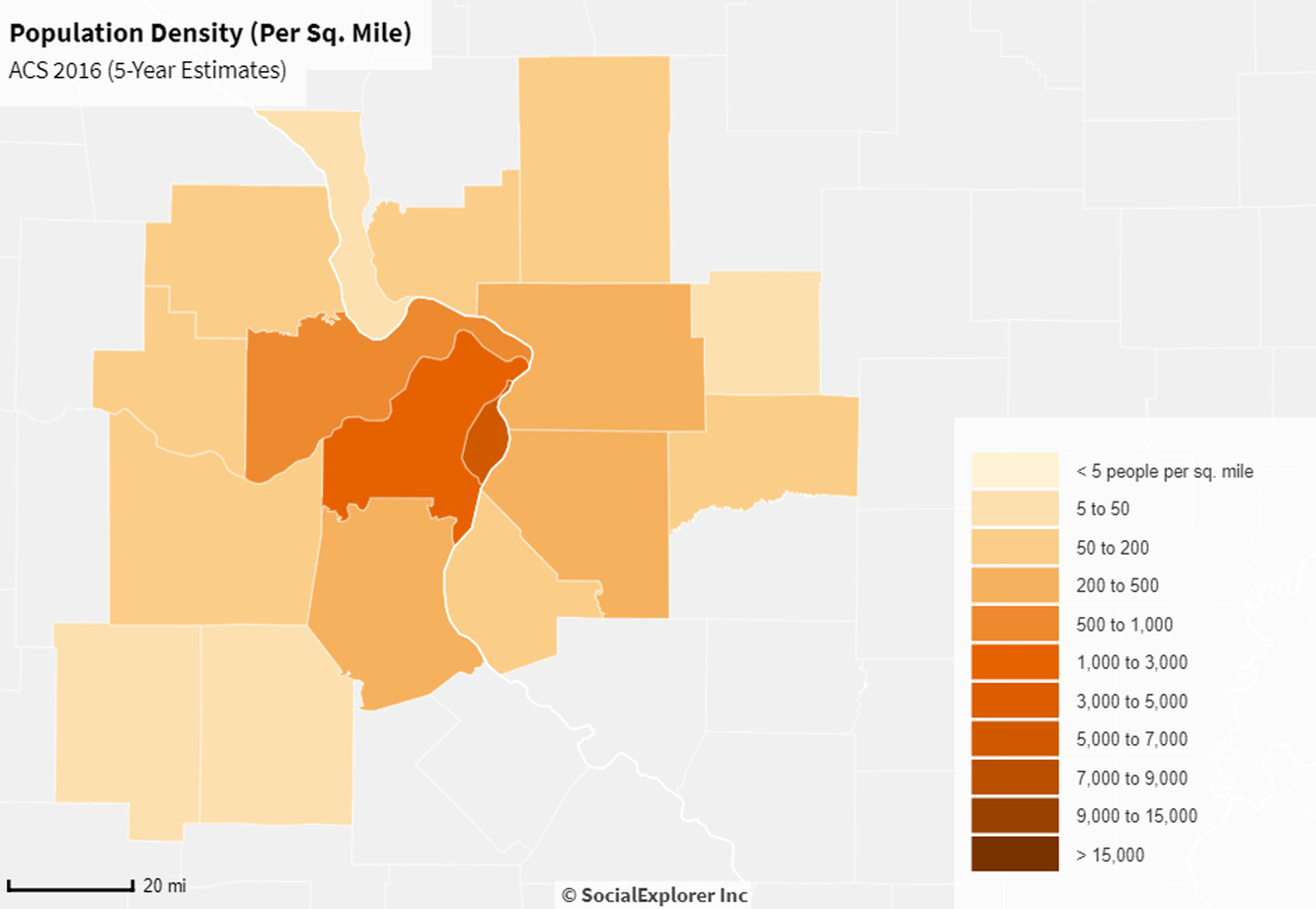
Greater St. Louis is highly suburbanized and is prototypical of suburban sprawl and metropolitan fragmentation. More than 85% of the metropolitan area’s population resides in suburbs: the City of St. Louis had 319,294 residents in 2010 (United States Census Bureau, 2010), whereas the population of Greater St. Louis as a whole is over 2.8 million. As is the case for many metropolitan areas within the US, the stark difference in population is due in large part to massive suburban development in the postwar era. Much of the suburban population originally migrated from the City of St. Louis as a result of White Flight. The raw numbers make this readily apparent; the City of St. Louis has lost over 60% of its population since its peak at the end of World War II (856,796 according to the 1950 US Census). Because suburbs have a lower population density, the suburban space of Greater St. Louis is quite expansive. In addition to the City of St. Louis, nine counties in Missouri and eight in Illinois, comprising a region that spans roughly 120 miles/200 km from east to west, are considered to be part of the metropolitan area by the US Census Bureau (see Map 1; the City of St. Louis is the small teardrop in the middle). Among these, a span of roughly 60 miles/100 km, mostly in St. Louis County and St. Charles County, Missouri, and Madison County and St. Clair County, Illinois, makes up a contiguous urbanized area along with the city.
County divisions and population density of Greater St. Louis, as defined by US Census Bureau (ACS 2016, prepared by Social Explorer)

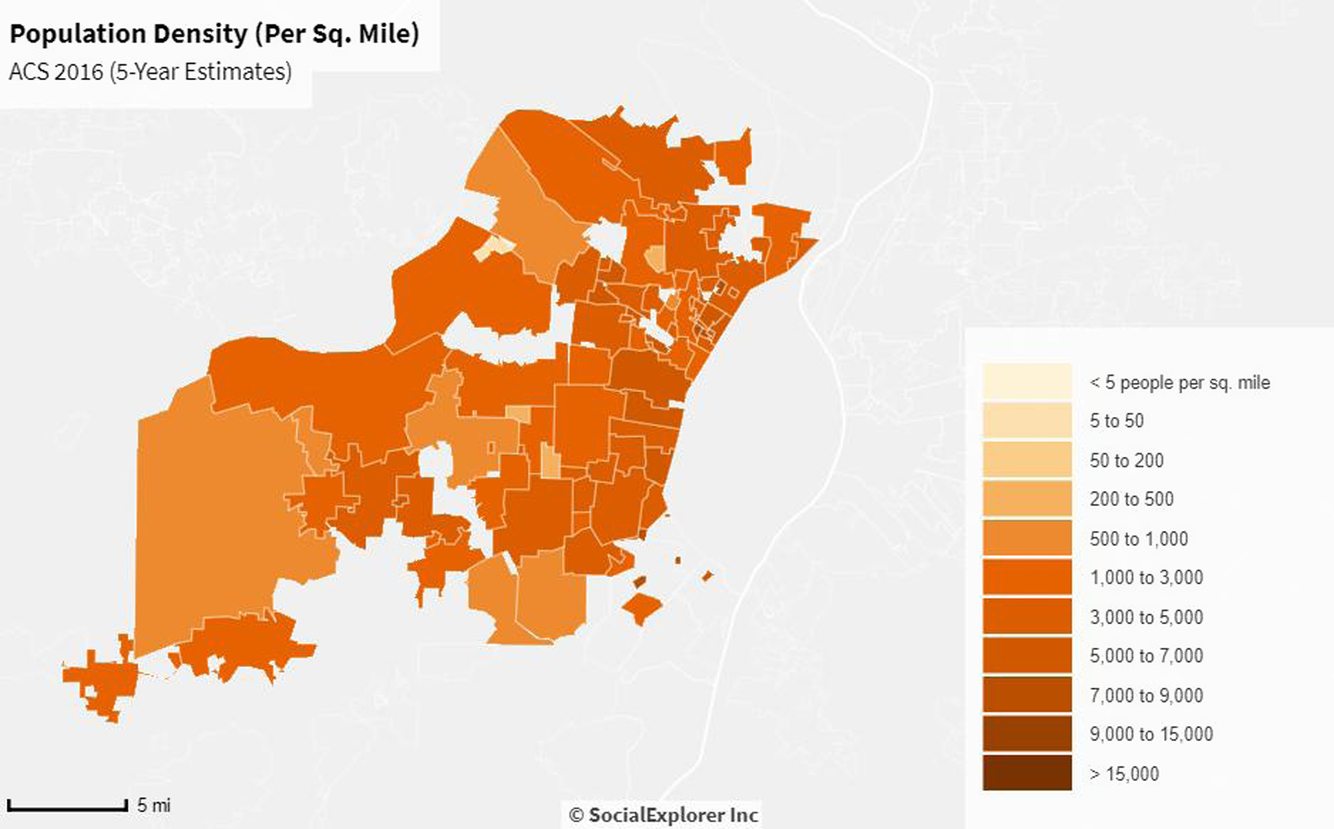
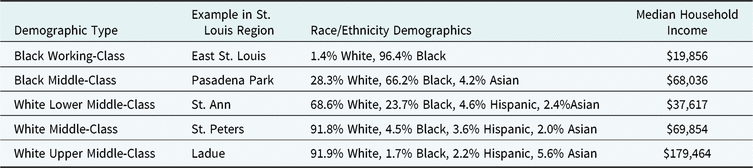
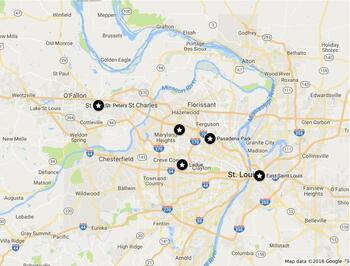
During the 19th century and first half of the 20th century, St. Louis was a large Midwestern city,Footnote 3 and as such, suburbanization there progressed much like in other large Midwestern and Northeastern cities such as Chicago, Detroit, and New York (see Teaford, 1997). During the 20th century, for example, suburbs in large Midwestern and Northeastern metropolitan areas incorporated rapidly in order to avoid annexation by the city and especially each other, and St. Louis was no different: St. Louis County alone has 90 municipalities (Map 2). Many of these municipalities provide their own services; there are 57 police departments, 81 municipal courts, and 43 fire districts in St. Louis County (Better Together, 2017). Incorporation allowed municipalities to set zoning ordinances and other policies that were racially and economically biased. For example, much of Ladue was zoned in the 1930s for single-family houses with lot sizes of 1.8 to 3 acres, with most of the remaining area zoned for single-family homes with .67 acre lots. Relatively little of the municipality was zoned for multi-family homes or single-family homes on quarter- to half-acre lots (Gordon, Reference Gordon2008:133). This zoning practice effectively limited residence in Ladue to the upper- and upper-middle class. As a result of policies like those in Ladue, the St. Louis region is highly segregated, and individual suburbs are largely homogeneous (Table 1, Map 3).
Ninety municipalities of St. Louis County, Missouri. Population density is added to assist in disambiguation of borders (ACS 2016, prepared by Social Explorer)

Demographics of selected suburbs in Greater St. Louis

Location of suburbs in Greater St. Louis listed in Table 1

As in other metropolitan areas (see Rothstein, Reference Rothstein2017 for discussion), movement to the suburbs of Greater St. Louis increased in the 1930s as a result of the HOLC and the FHA offering and insuring long-term mortgages. Jackson (Reference Jackson1980) shows how this occurred in Greater St. Louis. These federal initiatives subsidized housing construction in suburbs, and most of the mortgages taken out in Greater St. Louis during this time period were for housing in suburban St. Louis County (see Gordon, Reference Gordon2008 for additional discussion). Movement to suburbs was especially rapid after World War II. The GI Bill subsidized mortgages (Jackson, Reference Jackson1985), but redlining and lending discrimination meant it was primarily whites who were able to take advantage of this. Redlining was the practice of grading neighborhoods for both housing quality and price stability. It was believed that African Americans or Jews in a neighborhood would lower property values, and racially heterogeneous neighborhoods’ grades suffered as a result. The FHA did not insure mortgages in low-grade neighborhoods, and banks were thus reluctant to lend in these areas (Abrams, Reference Abrams1955). The outcome was that African Americans especially were locked out of the housing market. This, combined with racial animus, meant that the expansive postwar suburbanization in Greater St. Louis resulted in White Flight from the urban core (see Gordon, Reference Gordon2008 for details). There was a massive decrease in the white population within the City of St. Louis, which corresponded to a massive increase in the white population in St. Louis County. This correspondence is no coincidence; between 1960 and 1970, the City of St. Louis showed a 34% loss of the white population due to migration, yet the metropolitan area as a whole lost only 0.7% of the white population to migration (Williams, Reference Williams1973:15). This shows that the vast majority of White Flight from the city remained in Greater St. Louis.
I say that racial animus played a role in White Flight because we see it in subsequent waves that did not involve subsidized mortgages. As the city’s population fell, middle-class African Americans came to leave the city for the inner suburbs. Much of this movement was due to urban renewal policies in the City of St. Louis that targeted African American neighborhoods like Mill Creek for destruction (Gordon, Reference Gordon2008). The migration of African Americans to the suburbs triggered a second wave of White Flight beginning in the 1970s, in which whites in North St. Louis County moved further west to West St. Louis County and St. Charles County (situated west-northwest of St. Louis County). Much of this migration, especially in St. Charles County, had the effect of engulfing formerly rural towns in addition to suburban development of farmland.
3. Methods
3.1 Field sites
Our goal is therefore to test whether diachronic variation is influenced by patterns of suburban development or metropolitan fragmentation in Greater St. Louis. As such, we want to compare urban and suburban speakers from the region in apparent time. In light of this, sociolinguistic interviews were conducted in three field sites in Greater St. Louis. Because location is the key social factor under consideration, the field sites were selected to maximize the informativity of the factor. This functionally means selecting sites that are relatively balanced in demographics with respect to race/ethnicity and socioeconomic status. Balancing field sites in this way allows us to be more confident that any effects of location are due to location rather than social class or some other factor (“more confident,” of course, should certainly not be taken to mean “absolutely confident”). Field sites were selected to include part of the City of St. Louis, in addition to some older and newer suburbs in Greater St. Louis.
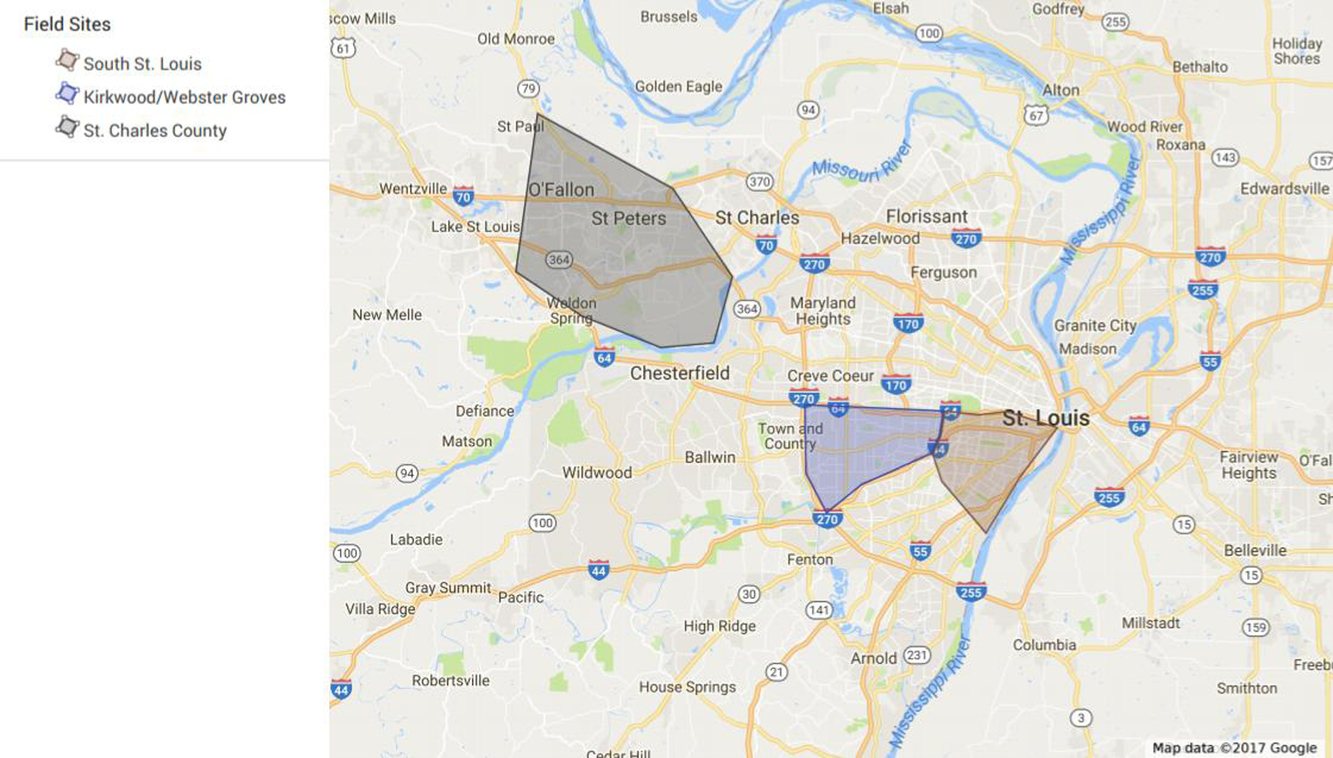
The newer suburbs comprise the urbanized parts in the eastern half of St. Charles County (roughly O’Fallon to the Missouri River), excluding the City of St. Charles.Footnote 4 This region was predominantly farmland prior to suburban development, which began in earnest around 1970. Note that this means an apparent time study including speakers born before and after 1970 is an apparent suburbanization study; when considering the spread of linguistic features to St. Charles County, we must consider whether the site was part of Greater St. Louis when the feature arrived. The older suburbs developed around the turn of the 20th century as streetcar suburbs and lie within a coherent region between Interstates 64 and 44 to the north and south, and inside of Interstate 270. In this area, suburbs are more racially homogenous, making them comparable to St. Charles County. There are several municipalities within this region; two major ones are Kirkwood and Webster Groves. I will refer to this region as Kirkwood/Webster Groves moving forward. The field site within the City of St. Louis was South St. Louis, the region within the city limits south of I-64. While some individual neighborhoods have strong local identities, the entire area south of I-64, and especially south of I-44, is spoken of as a single region with its own cultural practices. These practices extend beyond ethnicity. For example, while some speakers grew up in Dogtown, an Irish neighborhood, and Dutchtown, a German neighborhood, they share a common experience of ‘South St. Louis.’ As such, I consider both neighborhoods to be predominantly white neighborhoods in South St. Louis. Map 4 shows the location and area of these field sites.
Field sites in Greater St. Louis

Given how fragmented Greater St. Louis is, these field sites represent a reasonably coherent sample. In St. Charles County, we have a white middle class in a region that developed quite recently. Much of South St. Louis is white and middle class, although some neighborhoods are more racially mixed than others. Kirkwood/Webster Groves again is predominantly white. Our main concern is whether the three field sites are close enough in social status; St. Charles County is wealthier than South St. Louis, as is Kirkwood/Webster Groves. Perhaps more troubling, Kirkwood and Webster Groves have a strong local identity and prestige as upper-middle class suburbs. The field site centered on these suburbs could be summarized as comparable to St. Charles County in demographics and wealth, but not prestige. That being said, such issues will arise in any within-region comparative study. I believe results from Kirkwood/Webster Groves can still be compared to St. Charles County and South St. Louis, but the region’s status should be taken into account when interpreting results.
3.2 Recruitment and recording
Participants were recruited through social networks, local civic organizations, and flyers left in libraries and other public spaces. In keeping with the goal of minimizing the effect of other social factors, this study focuses on white women who grew up (roughly ages 6 to 18) in one of the three field sites. Speakers who moved within Greater St. Louis while growing up, whether into or out of a field site, were excluded.Footnote 5 Like Becker (Reference Becker2010) and Strelluf (Reference Strelluf2014), I do not disqualify speakers on the basis of their families being new to the area. Because suburban development was both a local and national phenomenon, to exclude speakers on this basis is infeasible and erases part of the story of the local population. I also accept speakers who moved away from Greater St. Louis and back again, including both speakers who went to college and came back immediately and speakers who moved elsewhere for an extended period of employment. More importantly, this means I do not require speakers to remain in the same field site they grew up in. Because their location is taken to be whichever field site they lived in between ages 6 to 18, speakers who moved within Greater St. Louis as adults are included as members of their childhood location. This is crucial especially with speakers from South St. Louis, as White Flight decimated the population of the city. Many speakers who grew up in the city live outside of its borders now. Similarly, there is a great deal of movement within Greater St. Louis as a whole because residents move for access to desired housing and schools.
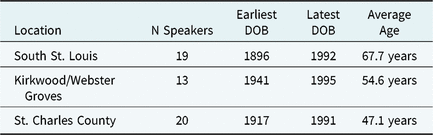
This study draws from 52 recordings in total (Table 2). These include 48 sociolinguistic interviews, which were conducted at the participants’ choice of time and place, and lasted approximately 45 to 120 minutes. All interviews were recorded as.wav files with a 16 bit, 44.1 kHz sampling rate using either a Zoom H4 Handy recorder (15 recordings), a Zoom H5 Handy recorder and Shure SM93 omnidirectional lavalier microphone (31 recordings), or the H5 recorder alone (2 recordings). Although this variability in recording format does preclude the use of these recordings in the analysis of some phonetic material like amplitude, it is fine for vowel formants. The sample is supplemented by four oral histories. Becker (Reference Becker2010) notes that oral histories are similar in form and content to sociolinguistic interviews, and her study of New York’s Lower East Side utilizes a corpus of oral histories that she collected. In her study of the St. Louis Corridor, Friedman (Reference Friedman2014) primarily relies on sociolinguistic interviews for her analysis but supplements the data with oral histories to fill gaps in her corpus. I follow this approach and include two oral histories from women born in the 1920s in St. Charles County, which I obtained from the St. Charles County Historical Society (Oral History Project). I additionally include two oral histories from women born around the turn of the 20th century in South St. Louis (The State Historical Society of Missouri).
Outline of population sample to be analyzed

At least fifteen minutes of each interview, beginning approximately 10 minutes into the recording, were transcribed for analysis. An undergraduate research assistant transcribed the majority of recordings; I transcribed seven interviews and the four oral histories. The transcribed interviews were automatically force-aligned using FAVE (Rosenfelder, Fruehwald, Evanini, Seyfarth, Gorman, Prichard, & Yuan Reference Rosenfelder, Fruehwald, Evanini, Seyfarth, Gorman, Prichard and Yuan2014), and a Praat script was used to extract formants for each vowel in 10% intervals (9 measurements total). Raw data was normalized using the Lobanov (Reference Lobanov1971) method of converting individual speakers’ vowels to z-scores. The normalized measurements were rescaled to Hz by multiplying the normalized measurement by the mean of speaker overall standard deviations and adding the mean of speaker overall means.
3.3 Variables
I focus on three variables: F2 of the lot vowel, F1 of the thought vowel, and F1 of the trap vowel. These vowels are widely recognized as the first three components of the Northern Cities Shift (NCS), which includes the raising and fronting of the trap vowel, fronting of lot, lowering of thought, backing and/or lowering of dress, and backing of strut (Labov, Reference Labov1994; Gordon, Reference Gordon2001; Labov, Ash & Boberg, Reference Labov, Ash and Boberg2006). Which vowel moved first is a matter of debate (see Labov, Reference Labov1994 and Gordon, Reference Gordon2001 for competing views); this is largely irrelevant for our purposes. The NCS is primarily found in cities surrounding the Great Lakes. Recent work has found the NCS to be in retreat in many of these locations (Syracuse: Driscoll & Lape, Reference Driscoll and Lape2015; Lansing, MI: Wagner, Mason, Nesbitt, Pevan & Savage, Reference Wagner, Mason, Nesbitt, Pevan and Savage2015; inter alia). The only non-Great Lakes metropolitan area with the shift is St. Louis (Goodheart, Reference Goodheart2004; Labov et al., Reference Labov, Ash and Boberg2006). St. Louis is linked to Chicago with respect to the NCS via a narrow corridor along I-55 (Labov et al., Reference Labov, Ash and Boberg2006; Friedman, Reference Friedman2014), and Labov (Reference Labov2007) suggests that this is because the NCS diffused to St. Louis from Chicago.
In addition to being raised and fronted, the NCS trap vowel is often diphthongized. This diphthongization, called “Northern breaking” by Labov et al. (Reference Labov, Ash and Boberg2006), involves the vowel beginning in high front position and gliding inward toward [Ə]. In recognition of this, I use the formant measurement at 20% of the vowel duration. The goal is for the measurement to be sufficiently early that the glide has not occurred, but sufficiently late that co-articulatory effects are mitigated. Unstressed and pre-/r/ tokens, as well as those of function words, were excluded (n = 3173).
NCS trap is distinguished from other trap systems in that the vowel is raised/fronted in all environments. This contrasts with the complex short-a splits of New York and Philadelphia (Becker, Reference Becker2010; Labov, Fisher, Gylfadottír, Henderson & Sneller, Reference Labov, Fisher, Gylfadottír, Henderson and Sneller2016); the nasal system found in much of the US, in which the vowel is raised only in pre-nasal position; and the continuous system in which pre-nasal tokens are raised and voiceless velar obstruents are not, but there is no clear allophonic distribution (Labov et al., Reference Labov, Ash and Boberg2006). Despite being raised in all environments, NCS trap is sensitive to the following phonological context. As such, tokens were coded for the following environments of voicing (voiced or voiceless), place of articulation (coronal, labial, or dorsal), and manner of articulation (nasal, stop, fricative, or /l/). Affricates are treated as stops in this analysis.
The analysis of lot and thought uses the measurement at 40% of the vowel duration. As with trap, unstressed and pre-/r/ tokens, as well as those of function words, were excluded (n = 3446 for lot, 2308 for thought). Tokens of both vowels are coded for the following phonological environment, as nasals and /l/ can cause the retraction and/or raising of the vowel they follow (Baranowski, Reference Baranowski, Bayley, Cameron and Lucas2015). As such, the following context is coded as a nasal, /l/, or obstruent. Syllable structure is also considered in the case of pre-/l/ tokens because of potential variation in the production of the liquid. In many Englishes, the liquid is variable between the clear [l] and dark [ł]. The clear variant is typically syllable-initial, and the dark variant syllable-final (Baranowski, Reference Baranowski, Bayley, Cameron and Lucas2015; Sproat & Fujimora, Reference Sproat and Fujimora1993). The production is especially variable intervocalically, although Lee-Kim, Davidson & Hwang (Reference Lee-Kim, Davidson and Hwang2013) find that morphological factors influence the darkness of the liquid such that pre-boundary /l/ (cool-est) is darker than post-boundary /l/ (coup-less). Because dark /l/ involves more retraction and lowering of the tongue body than light /l/, we may hypothesize that speakers would have a comparatively retracted vowel when preceding dark /l/. While production of /l/ in Greater St. Louis is beyond the scope of this paper, its influence on the low back vowels should nonetheless be considered. Because syllable structure is only relevant for pre-/l/ tokens, this was coded as part of the following consonant factor (i.e., nasal, obstruent, open pre-/l/, or closed pre-/l/).
4. Potential outcomes
The mechanisms of diffusion discussed in section 2.2 represent potential patterns of sound change that we may encounter in Greater St. Louis. If we find evidence of sound change, we should therefore expect to find one or more of the following trajectories of sound change in the region:
1. Change begins in South St. Louis, and diffuses to the suburbs via wave or hierarchical diffusion
2. Change begins in the suburbs, and diffuses to South St. Louis contra-hierarchically
3. Greater St. Louis adopts changes at the same time (In this case, St. Charles County would be expected to participate after 1970, but not before)
4. South St. Louis features are brought to suburbs in relocation diffusion as they develop due to White Flight (Because Kirkwood/Webster Groves already developed by the time our speakers were born, this would apply primarily to St. Charles County)
Wave and hierarchical diffusion are grouped together because it is not possible to distinguish these patterns in the sample under study. Kirkwood/Webster Groves had a larger population than St. Charles County during the most relevant period for our analysis, and is physically closer to the City of St. Louis. We would thus expect features to diffuse from the city to Kirkwood/Webster Groves before diffusing to St. Charles County under both models.
5. Results
I follow the approach of Labov, Rosenfelder & Fruehwald (Reference Labov, Rosenfelder and Fruehwald2013) to report results. In their study of sound change in Philadelphia, Labov et al. use locally weighted regression (loess) as an analytic tool. Locally weighted regression is a method of non-parametric regression that combines regression models of small subsets of the data set into a larger model. While these are difficult to summarize with a formula or table of effects, the visualization itself is quite informative. Labov et al. (Reference Labov, Rosenfelder and Fruehwald2013) report their results by giving a loess plot that includes 95% confidence intervals around the trendline, in addition to a prose explanation of the pattern. Even without a summary table, this suffices as reporting of results and a statistical analysis, as change over time can be readily seen by the reader. This gives us a way to compare diachronic variation in three locations when there is not a clear linear relation between age, location, and formant values. I supplement this with linear mixed effects regression (Bates, Maechler, Bolker & Walker, Reference Bates, Maechler, Bolker and Walker2014) to account for phonological effects. I discuss results for each vowel below. As will be seen, each NCS feature diffused through Greater St. Louis differently.
5.1 Lot
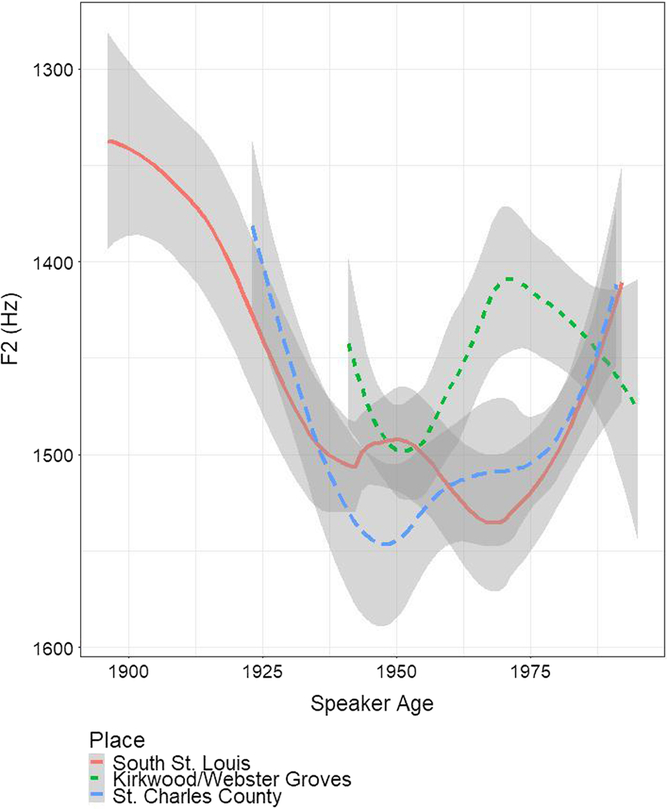
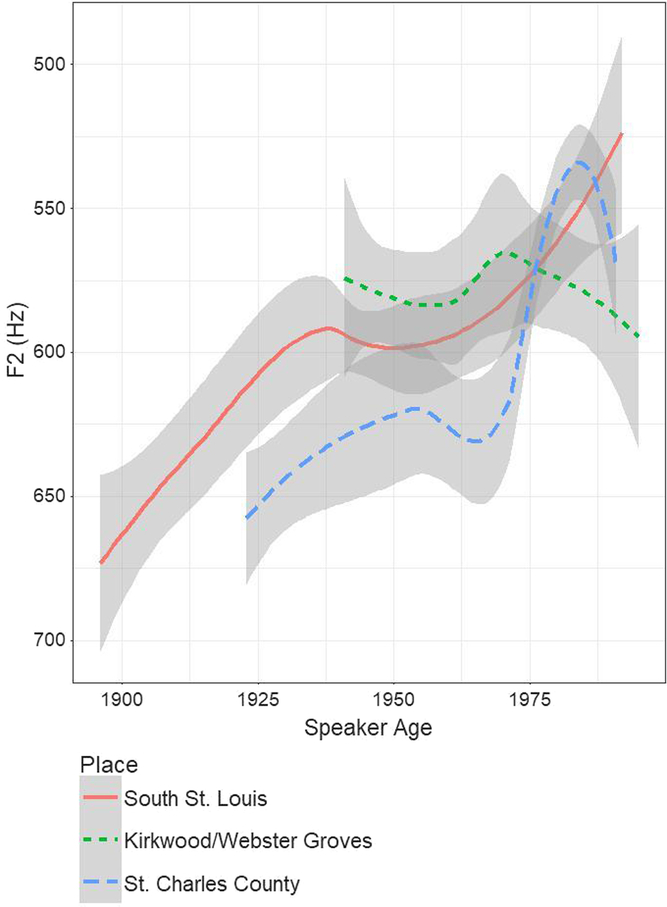
This sample of speakers finds the advance of and the subsequent retreat of lot-fronting (Figure 1). As seen, pre-obstruent lot fronted to 1500+ Hz during the first half of the 20th century. The data we have shows no significant difference in fronting between South St. Louis and St. Charles County, although it appears that additional data from older speakers could reveal that St. Charles County lagged behind South St. Louis in lot-fronting. Kirkwood/Webster Groves appears to more clearly lag in fronting. This is odd: St. Charles County was a rural space outside of the St. Louis metropolitan area during this period, yet if Kirkwood/Webster Groves did lag behind South St. Louis in fronting, it lagged behind St. Charles County as well. The vowel has backed among speakers born after 1975. However, note the F2 values; while younger speakers have clearly engaged in backing, the average lot token for the youngest speakers is still more than 1400 Hz. While the trend is certainly retreat from NCS lot, the feature is still present in Greater St. Louis. Within our sample, the retreat was led by Kirkwood/Webster Groves.
Fronting of pre-obstruent lot over time in Greater St. Louis

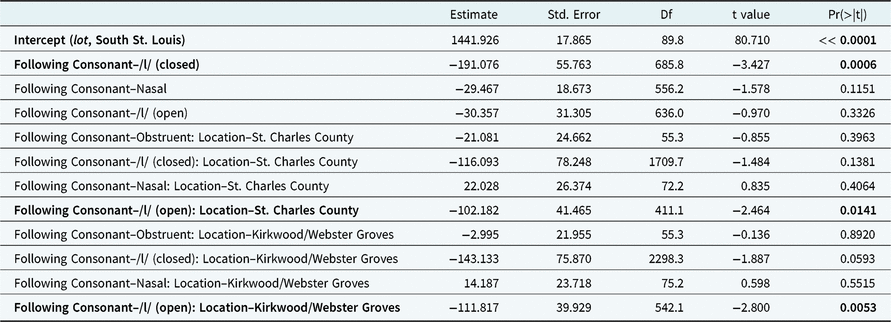
I use a linear mixed effects regression model to determine whether location interacts with any phonological conditioning. Fixed effects were the following consonant and the interaction between location and following consonant, while random effects were speaker and lexical item. Neither location nor speaker age were included as fixed effects; Figure 1 showed that speaker age has a nonlinear effect, and therefore cannot be appropriately modeled by linear regression. Because location and age interact, the potential main effect of location should also be set aside. Phonological conditioning, however, should be linear regardless of location, so the location/following consonant interaction can be included. Pre-obstruent tokens of lot uttered by a speaker from South St. Louis were used as a baseline. This baseline is relatively fronted (Table 3). At about 1440 Hz, the estimate baseline token is more of a back central vowel. Phonological context is important; tokens preceding /l/ in closed syllables are significantly backed, with an effect size of nearly 200 Hz. Conditioning varies by location. St. Charles County and Kirkwood/Webster Groves both back tokens preceding /l/ in open syllables by around 100 Hz compared to South St. Louis speakers.
Phonological conditioning of lot-fronting in Greater St. Louis

This result shows that even though lot-fronting and its retreat have progressed similarly throughout Greater St. Louis, particularly with respect to South St. Louis and St. Charles County, there is an urban/suburban split in the conditioning of variation that reflects a phonological difference between the locations. The backing of pre-/l/ tokens in South St. Louis appears to be phonetic: co-articulation with /l/ results in backing, but in open syllables /l/ is treated as the onset of the following syllable and therefore co-articulation is lessened. In contrast, the more general backing of pre-/l/ tokens in the suburbs may be phonological: the vowel is backed before /l/, regardless of co-articulation or syllable position.
5.2 Thought
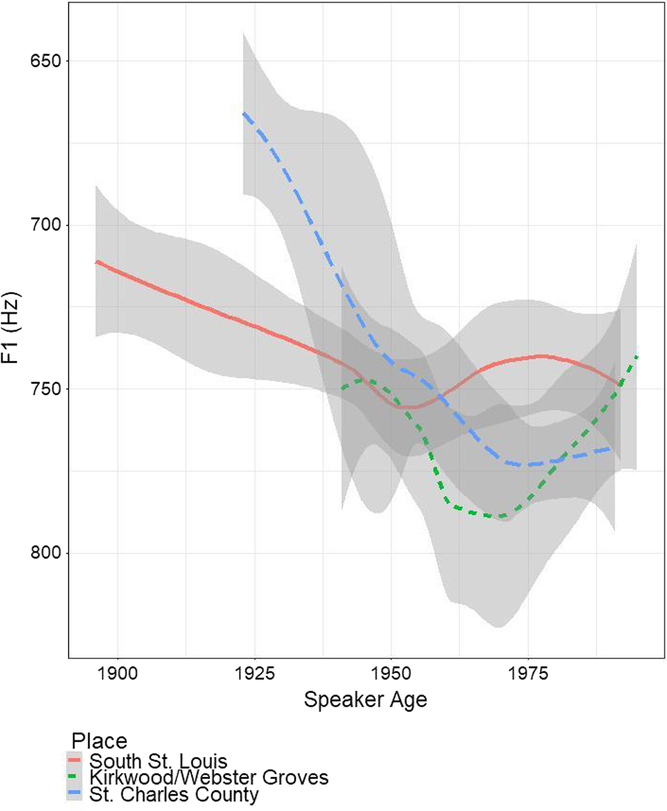
In contrast to lot, thought shows clear evidence that St. Charles County lagged in lowering (Figure 2). The oldest speakers in St. Charles County have a higher vowel than their peers in South St. Louis. South St. Louis shows gradual lowering in the first half of the 20th century, whereas the lowering was much more abrupt in St. Charles County. Speakers born around 1950 had similar F1 values for thought, indicating that by this point the entire region had a lowered vowel. Note that this means thought-lowering diffused to St. Charles County while it was still rural. There is insufficient data to determine when thought-lowering began in Kirkwood/Webster Groves. While the vowel has stayed relatively stable in South St. Louis since, the suburbs appear to have lowered it further since 1950. However, there is a great deal of variability such that we cannot draw definitive conclusions. The feature is not in retreat, as there is no evidence of the thought vowel raising among younger speakers.
Lowering of pre-obstruent thought over time in Greater St. Louis

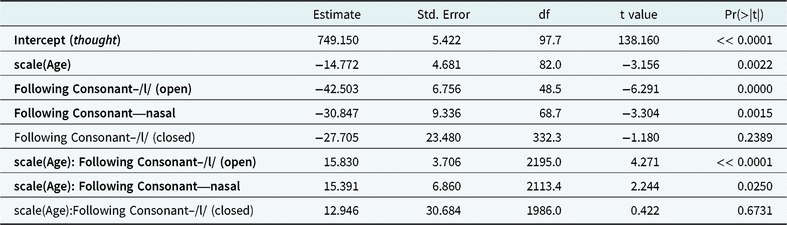
Unlike lot, thought shows no influence of location on phonological conditioning. A linear mixed effects regression model was again run. Because the trajectory of change does not involve the advance and retreat of thought-lowering, it can be more reasonably approximated as linear. As such, this model initially included speaker age (scaled to z-scores), location, the following consonant, as well as speaker age/following consonant, location/following consonant, and speaker age/location/following consonant interactions, as fixed effects. Speaker and lexical item were again used as random effects. A stepdown process found that the best model included the random effects, speaker age, following consonant, and the speaker age/following consonant interaction. Location was left out of the final model entirely. This means that outside of the observed diffusion to St. Charles County, location does not appear to significantly influence production of the thought vowel.
The baseline of pre-obstruent thought is low, and the main effect of age shows that the vowel has lowered over time. This model finds that pre-nasal and pre-/l/ tokens are raised compared to pre-obstruent tokens in closed syllables (Table 4). While the model predicts pre-/l/ tokens in open syllables to also be raised, this term does not reach significance. The interaction between speaker age and following consonant essentially cancels out the effect of speaker age for pre-nasal and pre-/l/ tokens. That is, the vowel has minimally lowered over time in these contexts, in contrast to the pre-obstruent context. Older speakers thus have a narrower range of thought production than younger speakers.
Phonological conditioning of thought-lowering in Greater St. Louis

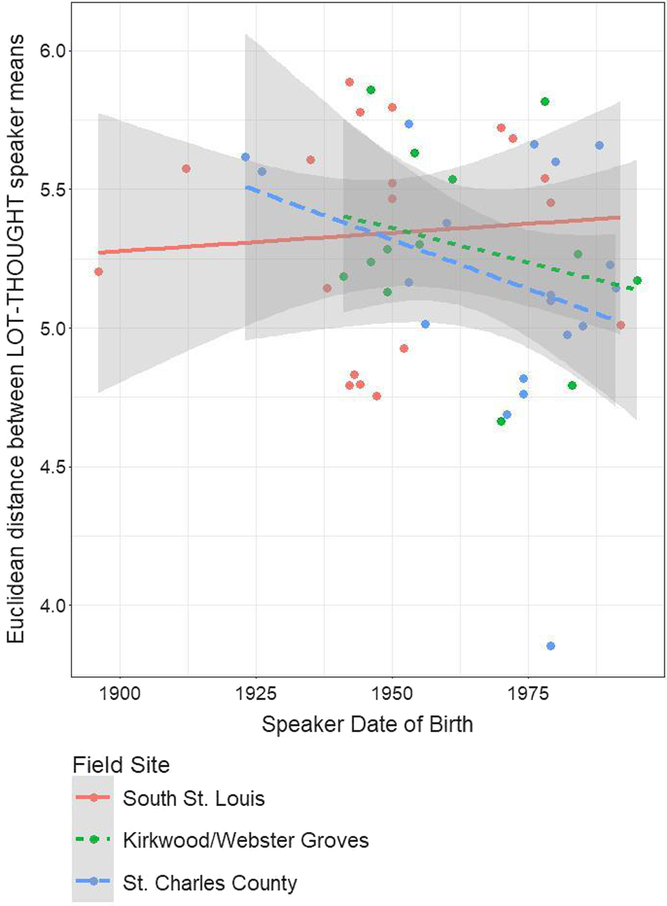
That lot-fronting, but not thought-lowering, is in retreat would suggest that Greater St. Louis is abandoning the low back system of the NCS entirely, in favor of the low back merger. This does not actually appear to be the case. I use the Euclidean distance between mean values of vowels to look at the status of the merger. To calculate Euclidean distance, we treat F1 and F2 of a vowel as x/y coordinates of a point in Cartesian space (see Wong, Reference Wong2012 for a similar example). The distance between two vowels is then calculated using the distance formula for points in two-dimensional space:  $\sqrt {{{\left( {{x_1} - {x_2}} \right)}^2} + {{\left( {{y_1} - {y_2}} \right)}^2}}$. Because Euclidean distance can range from fairly small (∼10 Hz) to fairly large (∼400 Hz) values, I use the log of speakers’ Euclidean distances rather than the raw data. This transformation does not affect the basic interpretation of the measurement: larger values represent more distinct vowels, and smaller values represent less distinct vowels.
I consider the Euclidean distance between lot and thought for each environment that was previously coded for (lot-thought, don-dawn, doll-tall, dollar-taller). In each case, I use linear regression to look for effects of speaker age, location, and their interaction on ED. There is only one environment for which there are any significant results: dollar-taller. Although few speakers produced sufficient tokens of both dollar and taller to be included, enough did that a clear pattern based on location emerged. While there is a large distance between the pair in South St. Louis (intercept = 6.154), both St. Charles County (β = −0.754, p = .0020) and Kirkwood/Webster Groves (β = −0.658, p = .0049) have a smaller difference (r2 = 0.627). These results correspond to an ED of 470.596 Hz in South St. Louis, but 221.406 Hz in St. Charles County and 243.715 Hz in Kirkwood/Webster Groves.Footnote 6 As such, this result does not indicate merger or shift towards merger, but simply that the vowels are closer in the suburbs than in South St. Louis. This difference appears to correspond to the urban/suburban split in phonological conditioning of lot-fronting. As such, it supports the claim that while speakers throughout Greater St. Louis largely share the fronted lot and lowered thought vowels of the NCS, they nevertheless have structural differences in their low back system.
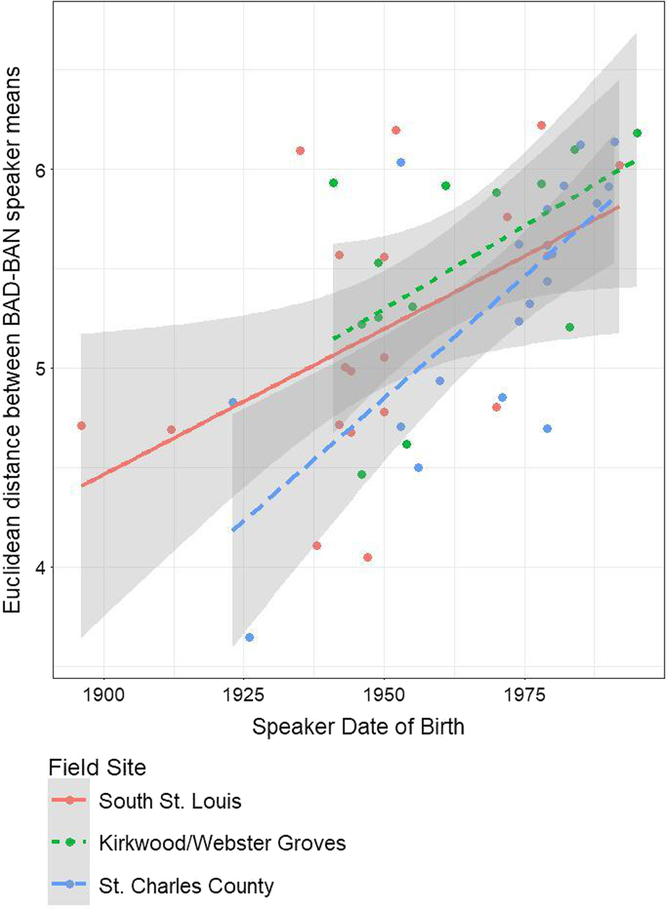
Figure 3 shows the relative lack of change in the pre-obstruent case; the trendlines for the suburbs are not significant, and with the exception of one speaker from St. Charles County who does appear to have the merger, the ED for every speaker corresponds to at least 100 Hz. The difference between the two vowels thus appears to be above the threshold for perception for nearly all speakers. In Greater St. Louis, then, we may say that the distinction in production of the low back vowels is weak, but maintained. In a way, this result mirrors that of Wong (Reference Wong2012), who finds that Chinese Americans in NYC are lowering the thought vowel in apparent time, but not adopting the low back merger. She suggests that this finding perhaps reflects the reversal of NYCE thought-raising (i.e., lowering enough to not be recognizable as NYCE thought), rather than full-fledged lowering (i.e., lowering that continues towards merger). We can frame lot’s change in Greater St. Louis in the same way: lot-fronting may be in retreat from the NCS feature among younger speakers, but it is not (yet) involved in full-fledged backing that would result in the low back merger.
Euclidean Distance between pre-obstruent lot and thought over time in Greater St. Louis

5.3 Trap
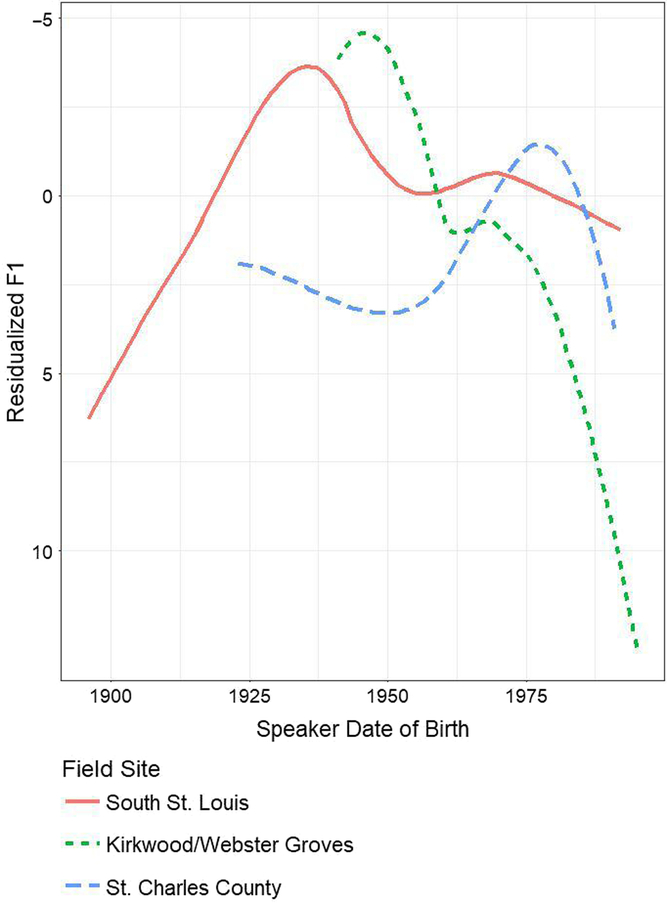
Our previous approach to visualizing change over time in the three locations runs into difficulty with trap. Because even the NCS version of the vowel displays conditioning effects of several phonetic environments, to attempt to include all three locations as well as conditioning factors on a single loess plot would render it unreadable, as we would need to either triple the number of trendlines on a single plot or separate the plots by location or conditioning factor. My solution is to residualize a linear mixed effects model that does not include age or location even as interaction terms, with the approximate formula (Vowel_Formant∼Language-Internal_Factor + (1|Word) + (1|Speaker)), and then report a loess plot of the residuals. Residualization is a method of expressing the variance in data not yet explained by a model. When a model fully explains a data set, that is, any variability in an observed sample regresses to the predicted mean with a sufficiently large sample, the mean of the model’s residuals is zero. When there is an explanatory factor missing from the model, the mean of the residuals is non-zero, and the residuals are correlated with this missing factor. Residualization thus can be used to control for known explanatory factors in order to test whether other collinear or non-linear factors also influence the data. This approach has been used in a variety of linguistic studies. For example, in their study of French and Portuguese plural alternations, Becker, Clemens & Nevins (Reference Becker, Clemens and Nevins2017) residualize acceptability judgments to account for effects of the number of syllables and type of vowel in the base of nonce French plurals, while MacKenzie (Reference MacKenzie2012) uses residualization in her study of variation in English contractions to determine which of several collinear language-internal factors, like syllable count and word count, have a significant effect on surface forms.
By residualizing our model, we control for effects of speaker, lexical item, and phonological environment. Our loess plot thus tests the data for solely the effects of location and speaker age. The biggest apparent difference between this and previous plots is in the y-axis: where previous plots show Hz values for vowel formants, the plot of residuals shows a different scale. This is because residuals show the difference between a model’s predicted and actual values rather than ‘real’ data. Residuals are a measure of the difference between a token measurement and its predicted value in a model. The predicted value is derived by adding the estimated effect size β for any applicable effects to the estimated intercept. As such, the predicted value varies by token type. This means that two tokens with the same residual value will not necessarily have the same measured value. Therefore, the loess plot of a residualized model only shows the relative trajectory of change over time. This is not a problem for us, as our concern with speaker age and location as language-external factors is rooted in how sound change progresses in the locations relative to one another.
Figure 4 shows the effect of age and location on the residualized model. We see that speakers from South St. Louis born after 1950 have residuals close to zero (the y-axis scale is reversed to approximate the traditional style of lower F1 values being higher up). This contrasts with the South St. Louis speakers born before 1935; these oldest speakers have a lower trap than predicted by the model. The apparent time trap raising appears to show the adoption of NCS trap in South St. Louis during the early 20th century, or at least that the oldest speakers included in the sample did not have a raised trap vowel. Kirkwood/Webster Groves shows a similar peak to South St. Louis, perhaps lagging a bit. Because there are comparatively few speakers from Kirkwood/Webster Groves in the sample, it is unclear whether the suburb actually lagged behind South St. Louis in adopting NCS trap. Kirkwood/Webster Groves shows a transition among younger speakers toward a lower trap than predicted by the model. St. Charles County shows an extended period with a lower trap than in either Kirkwood/Webster Groves or South St. Louis, before abruptly shifting to a period with residuals around zero among speakers born after 1970. This shift indicates that the vowel abruptly raised in St. Charles County at this time. Such a shift suggests that the area lagged behind South St. Louis and Kirkwood/Webster Groves in adopting NCS trap while it was a rural space, but quickly adopted the NCS system as the area developed. Like in Kirkwood/Webster Groves, in St. Charles County trap appears to be lowering in apparent time among the youngest speakers.
Change in residualized trap over time in Greater St. Louis

The location-based differences shown in the residualized plot, particularly the sudden shift in St. Charles County led by speakers who grew up during suburban development, are replicated when we consider specific linguistic environments. For example, Figure 5 shows this pattern for pre-nasal tokens. As was the case for the residualized model, St. Charles County appears to have a lower vowel than in Kirkwood/Webster Groves or South St. Louis prior to 1970, around which point the vowel abruptly raises.
Height of pre-nasal trap over time in Greater St. Louis.

In a broad sense, St. Charles County’s adoption of NCS trap means that prior to suburban development there, there were location-based differences in phonological conditioning of F1. Nonetheless, it is worth considering the question of such location-based differences in more detail. As was the case with lot, the effect of speaker age and its interaction with location is too nonlinear to be included in a linear regression. This is not the case for the interaction between phonetic environment and speaker age. As such, a linear mixed effects regression model was initially run in which location and the following consonant’s manner of articulation, place of articulation, and voicing were fixed effects. Also included as fixed effects were interactions between manner of articulation and speaker age (scaled to z-scores), manner of articulation and location, place of articulation and speaker age, place of articulation and location, voicing and speaker age, and voicing and location. As with lot and thought, speaker and lexical item were included as random effects. A stepdown process found that the model best fitting the data included the random effects, as well as the fixed effects of manner of articulation, place of articulation, voicing, and the interactions between manner of articulation and speaker age and place of articulation and speaker age. Note the absence of location effects, whether as a main effect or interaction term.
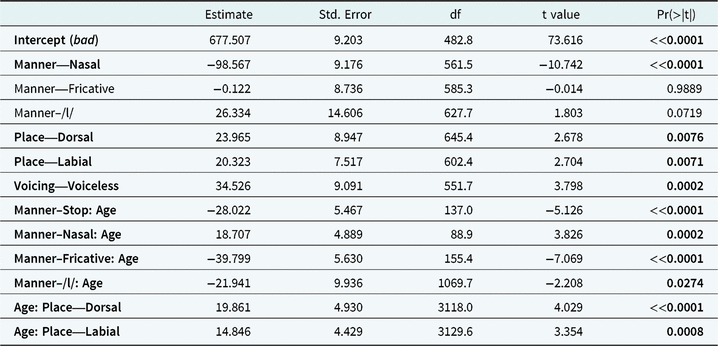
A look at the model results shows why there is no apparent effect of location. The main effects of manner of articulation, place of articulation, and voicing show a pattern similar to other samples involving the NCS (cf., for example, Labov et al., Reference Labov, Ash and Boberg2006). The vowel is raised overall, but compared to the baseline of a voiced coronal stop (bad), it is lower when preceding dorsals, labials, and voiceless consonants, and higher when preceding nasals (Table 5). The interaction between manner of articulation and age indicates that trap is lowering in apparent time when preceding stops, fricatives, and /l/, and raising in apparent time when preceding nasals, while the interaction with place of articulation indicates that trap is raising in apparent time when preceding dorsals and labials. Overall, these effects strongly suggest that Greater St. Louis is shifting from NCS trap to a nasal trap system. Such a shift is strong enough that St. Charles County’s initial adoption of NCS trap and its preceding vowel system are not stark enough differences from South St. Louis and Kirkwood/Webster Groves to also appear as a location-based effect in the regression model. The shift to a nasal system is confirmed by the Euclidean distance between pre-nasal and pre-oral tokens (Figure 6). Linear regression shows this to be a regional trend, as there is a main effect of speaker age (scaled to z-scores) on log-Euclidean distance but none of location (intercept = 5.323, β = −0.366, p << 0.0001, r2 = 0.3298). While Figure 6 is suggestive of a location-based difference in the timing of this shift, it does not reach significance in the linear model.
Phonological conditioning of trap-raising in Greater St. Louis

Euclidean Distance between pre-oral and pre-nasal trap over time in Greater St. Louis

5.4 Summary
In our exploration of the three NCS vowels lot, thought, and trap in Greater St. Louis, we find three different patterns with respect to their spread through the region. lot-fronting appears to have entered the region as a whole fairly quickly, lagging perhaps in Kirkwood/Webster Groves. It was present in St. Charles County while the space was still quite rural. Although this feature spread throughout the region quickest of the three features under discussion, it is the only feature in which an urban/suburban split in phonological conditioning of the feature is present and maintained. thought-lowering entered South St. Louis at a similar time to lot-fronting, but diffused to St. Charles County later. However, St. Charles County was still rural when thought-lowering was adopted. trap-raising appeared as part of the NCS trap system in South St. Louis and Kirkwood/Webster Groves at fairly close points in time, perhaps lagging slightly in Kirkwood/Webster Groves. In contrast to lot and thought, which appear to have spread via wave or hierarchical diffusion, NCS trap did not appear in St. Charles County until suburban development began. That the feature appeared quite abruptly at this point suggests that it diffused to St. Charles County via relocation diffusion.
lot-fronting and NCS trap are in retreat. In the case of lot, this is a slight backing that does not lead to the low back merger. This means that the NCS low back system is still intact. In contrast, Greater St. Louis is abandoning the NCS trap system in favor of a nasal trap system. Both retreats are led in the suburbs, particularly Kirkwood/Webster Groves.
6. Discussion
Thus far, we have shown that different patterns of diffusion which have been previously observed in other locations do in fact occur in Greater St. Louis. This is not at all a trivial finding. Consider that the standard assumption in many urban sociolinguistics studies, such as Labov et al. (Reference Labov, Ash and Boberg2006), is that metropolitan areas behave as a single unit. Finding evidence of wave/hierarchical diffusion and relocation diffusion within a single metropolitan area challenges this assumption in two ways. First and foremost, we find evidence of diffusion within a metropolitan area. This alone suggests that we cannot treat the metropolitan area as a single unit in variationist studies. At the same time, these results also show that we cannot simply assume that all linguistic features diffuse throughout a metropolitan area in the same manner, as we find evidence of different types of diffusion within the same metropolitan area.
I previously suggested that there were two clear reasons to consider the geographies of metropolitan areas in variationist analyses: suburban development and metropolitan fragmentation. I suggest now that both of these factors may play a role in our results. This role is played perhaps most obviously by suburban development with respect to trap-raising. This feature spread to St. Charles County during the same time period that St. Charles County saw rapid development spurred by White Flight from St. Louis County and the City of St. Louis. The abrupt change in trap production in St. Charles County suggests that the spread was a result of relocation diffusion. That is, suburban development brought trap-raising to St. Charles County. This shows that the changing social geography of a given space plays a role in linguistic change, as the older speakers from St. Charles County grew up in a rural space, while younger speakers grew up in a suburban space, even though they grew up more or less in the same area.
We may want to attribute results involving wave or hierarchical diffusion to metropolitan fragmentation. Note, however, that metropolitan areas, particularly those in the US, are large. As mentioned previously, Greater St. Louis covers nearly 200 km from east to west, and the contiguous urbanized area within this region covers nearly 100 km. It is perhaps to be expected that if innovation began in one part of the metropolitan area, it could take some time to diffuse throughout the region. Two aspects of our results do seem to be potentially attributable to metropolitan fragmentation, however. The first is the location-based structural variation in lot-fronting. That the urban/suburban split came into being, and especially that it persisted, would appear counter-intuitive if we did not take Greater St. Louis to be fragmented enough that while it is a coherent region in some ways, it is at the same time made up of a constellation of separate places.
The second part of our results potentially attributable to metropolitan fragmentation is that Kirkwood/Webster Groves appears to lag behind both South St. Louis and St. Charles County in lot-fronting. Such a result is not compatible with any pattern of diffusion. It is, however, compatible with a rapid, socially stratified change. Recall that one concern with including Kirkwood/Webster Groves in our sample was that this field site has a higher social status than South St. Louis or St. Charles County. It is possible, then, that if lot-fronting was largely a change from below that spread rapidly through Greater St. Louis (and beyond, considering that St. Charles County was rural when it adopted lot-fronting), it would lag in reaching speakers of higher social status. Because Greater St. Louis’ fragmentation means that it is segregated both by race and class, such a result would appear to be location-based: higher status suburbs like Kirkwood/Webster Groves would lag in adopting the feature, as we find to be the case.
That different stages of the NCS diffused through Greater St. Louis differently is noteworthy. Because we often take chain shifts to have a phonological basis (Gordon, Reference Gordon2011), we would have expected otherwise. Regardless of whether each NCS stage spread through the region at once or separately, we would expect them to diffuse in the same way. For example, if we are correct in believing lot-fronting to be a change from below, we would expect each NCS stage to be a change from below. But if that were the case, why would thought-lowering spread to St. Charles County via wave/hierarchical diffusion, but trap-raising via relocation diffusion? Wouldn’t trap-raising have also reached St. Charles County while it was rural? It seems that perhaps this feature entered the region as a change from above, or else somehow came to be marked as urban and resisted until the rapid influx of migrants during suburbanization. That these features spread throughout Greater St. Louis differently may be evidence in support of Labov’s (Reference Labov2007) claim that the NCS spread to St. Louis in a piecemeal manner. That is, perhaps these results are indicating that lot-fronting and thought-lowering entered Greater St. Louis at a different time or in a different manner from trap-raising. However, because Labov’s claim is rooted in the exploration of individual speakers’ vowel spaces, which was not undertaken here, I leave further discussion of this possibility to future work.
In contrast to the spread of NCS features, the recent retreat from NCS features occurs in a roughly similar manner. Both the backing of lot and shift to a nasal trap system (as indicated by the lowering of trap seen in the loess plot of a residualized model, if not by the linear model of pre-nasal/pre-oral ED) are led in the suburbs. More specifically, the population from Kirkwood/Webster Groves shows the first sign of retreat for both vowels. While St. Charles County lags behind Kirkwood/Webster Groves in the retreat from trap-raising, it still leads South St. Louis in this respect.
This consistency is especially noteworthy because such a retreat from NCS features seems to be a common pattern within the US. Similarly to our findings, Driscoll & Lape (Reference Driscoll and Lape2015) find that retreat from the NCS in Syracuse is led in its suburbs. The postwar retreat from the NCS in fact seems to be the norm, as it has also been documented in Lansing, MI (Wagner et al., Reference Wagner, Mason, Nesbitt, Pevan and Savage2015), and Buffalo, NY (Milholland, Reference Milholland2018). Furthermore, the timeline of retreat from sound changes in Philadelphia reported in Labov et al. (Reference Labov, Rosenfelder and Fruehwald2013) also lines up with postwar suburbanization, as does the retreat from the Southern Vowel Shift in Raleigh, NC (Dodsworth & Kohn, Reference Dodsworth and Kohn2012). I suggest that this pattern is no coincidence: rapid suburbanization in the postwar era helped to trigger the retreat from urban linguistic features.
There are two factors that explain why this might be the case. First, the movement to suburbs is largely, but crucially not solely, due to White Flight from a central city. Additional migration comes from the broader surrounding area, as well as some from the nation at large. The resulting suburban population, then, is a mix of natives, urban transplants and non-local non-natives. In such a situation, we might expect to encounter a situation of dialect leveling and koineízation, as found in the New Town of Milton Keynes by Kerswill & Williams (Reference Kerswill and Williams2000, 2005), which tends to select unmarked features. The second possibility is that retreat from urban features represents a change from above. As such, we expect it to be led by the upper middle class, a large percentage of whom live in the suburbs. These factors are not exclusive, and while the data presented in this paper supports both, it cannot speak to the relative likelihood of one or the other. In all likelihood both factors contribute in part.
7. Conclusion
Metropolitan areas are geographically complex regions, and the two factors of suburban development and metropolitan fragmentation play an important role in shaping the social geography of these regions. This paper offers a case study showing that they may play a role in diachronic and synchronic linguistic variation within Greater St. Louis. We observe a role for suburban development in the relocation diffusion of the NCS trap vowel to St. Charles County. Metropolitan fragmentation appears to play a role in the urban/suburban structural variation with respect to lot-fronting, as well as the apparent lagging of Kirkwood/Webster Groves in adopting this feature. While additional data on the spread of NCS features throughout Greater St. Louis would provide welcome clarification of some of the more tentative claims in this paper, I advocate the study of the complexities of metropolitan areas in other spaces as well. Such studies will contribute greatly to our understanding of the postwar retreat from many urban features across the United States, which appears to be connected to postwar suburbanization.
Acknowledgements
Thank you to John Singler, Renée Blake, Robin Dodsworth, Gregory Guy, and Laurel MacKenzie for helpful comments on an earlier version of this paper. This paper derives from a project funded by NSF grant BCS-1651102 DDRI.