Introduction
According to the lexical quality hypothesis (Perfetti, Reference Perfetti2007; Perfetti & Hart, Reference Perfetti, Hart and Reitsma2002) children’s lexical knowledge, or knowledge about words in a language, is central to both word reading (Ricketts, Nation & Bishop, Reference Ricketts, Nation and Bishop2007; Verhoeven, van Leeuwe & Vermeer, Reference Verhoeven, van Leeuwe and Vermeer2011) and reading comprehension (Ouellette, Reference Ouellette2006; Quinn, Wagner, Petscher & Lopez, Reference Quinn, Wagner, Petscher and Lopez2015; Verhoeven & van Leeuwe, Reference Verhoeven and van Leeuwe2008). In turn, morphology is essential to children’s developing lexical knowledge (e.g., Rabin & Deacon, Reference Rabin and Deacon2008). Indeed, children’s sensitivity to morphemes – the smallest units of meaning in words – helps children to both acquire new words (Anglin, Reference Anglin1993; Carlisle, Wagner, Muse & Tannenbaum, Reference Carlisle, Wagner, Muse and Tannenbaum2007) and determine word meanings (Bertram, Laine & Virkkala, Reference Bertram, Laine and Virkkala2000; Freyd & Baron, Reference Freyd and Baron1982; McCutchen & Logan, Reference McCutchen and Logan2011).
Young children’s oral and written language productions suggest that they develop morphological representations without formal instruction about morphological structure. For instance, there are multiple reports that children as young as two may produce new words by adding suffixes (e.g., a 2;4 year old eating soup: “I am souping”; Clark, Reference Clark, Wanner and Gleitman1982; see also Clark & Hecht, Reference Clark and Hecht1982). Moreover, spellings of children in the first grade suggest that they are aware of morphological relations in the absence of explicit classroom instruction (Carlisle, Reference Carlisle and Feldman1995; Carlisle & Nomanbhoy, Reference Carlisle and Nomanbhoy1993; Deacon & Bryant, Reference Deacon and Bryant2006; Wolter, Wood & D’zatko, Reference Wolter, Wood and D’zatko2009; for review see Pacton & Deacon, Reference Pacton and Deacon2008). For example, first-grade American-English speaking children were more likely to correctly spell the letter t, pronounced as /d/, in the middle of words when it was the end of a base word in two-morpheme words (e.g., dirty) than in one-morpheme words (e.g., duty; Wolter et al., Reference Wolter, Wood and D’zatko2009; see also Bryant, Nunes & Snaith, Reference Bryant, Nunes and Snaith2000). Thus, the way in which children say and spell words suggests that they develop morphological representations early in an implicit way without explicit instruction.
Clearly there is a role of morphology in multiple aspects of children’s language development and yet very little is known as to how children develop morphological representations of their language. Children’s development of morphological representations requires the identification of morphological relatedness between words and currently there are two competing hypotheses as to how children do this. In this paper, we focus specifically on the role of meaning overlap between morphologically related words in the development of this identification process.
Theoretical Assumptions of Morphological Development
According to a first hypothesis, children’s processing of morphemes relies primarily on form characteristics – that is, their phonology and orthography (form hypothesis). In a highly cited review, Rastle and Davis (Reference Rastle and Davis2008; see also Carlisle & Fleming, Reference Carlisle and Fleming2003; Deacon, Conrad & Pacton, Reference Deacon, Conrad and Pacton2008) suggested that language exposure may allow learners to detect statistical regularities between sounds and letters that support the development of morphological representations. This hypothesis is based on Saffran, Aslin and Newport’s (Reference Saffran, Aslin and Newport1996) work on the role of distributional cues in oral language development. Rastle and Davis (Reference Rastle and Davis2008) describe a hypothesized mechanism by which exposure to complex words in writing could facilitate the development of morphological representations. They suggest that readers are sensitive to orthographic probabilities, and the frequency of bigrams and trigrams may influence how children learn which letter sequences cohere as morphemic units. This prominent hypothesis, originally formulated for written language, can be transposed to the development of oral language: in that phonological probabilities could influence the development of morphological representations. Repeated exposure to morphologically complex words in a language could lead children to identify morphemic boundaries within these words and thereby develop representations of morphemes in memory without explicit knowledge about the linguistic nature of these units. That is, low frequency biphones could serve as markers of probable boundaries between morphemes (e.g., in English /pf/ in helpful), while frequently occurring biphones (e.g., in English /fǝ/ in helpful) could be identified as probable sounds within a morpheme. In summary, according to this hypothesis, the initial stage of developing representations of morphemes depends on the child’s recognition of recursive orthographic and/or phonological elements within words that is independent of meaning processing.
According to a second hypothesis, children rely on the form as well as the meaning overlap between morphologically related words to develop morphological representations (form and meaning hypothesis). Schreuder and Baayen (Reference Schreuder, Baayen and Feldman1995) argue that children’s discovery of morphemes within words is a two-stage process based on the ability to identify units that converge in both form and meaning. Children first detect recurring units that systematically share form and meaning (e.g., identifying herb across herbal, herbalist, herbicide). These frequently occurring patterns then develop as concept nodes in memory, which lead to the development of corresponding morphological representations. This model predicts a gradual extraction of morphology when phonological/orthographic and semantic representations are co-activated. According to this hypothesis, form and meaning serve a joint role and overlap in the development of morphological representations. This form and meaning hypothesis continues to be influential with more recent advocacy by Merkx, Rastle and Davis (Reference Merkx, Rastle and Davis2011).
These two hypotheses converge on the important role played by the sharing of form (phonological and orthographic) between two morphologically complex words in identifying morphological relatedness between words. They diverge, however, in the role of meaning overlap as it relates to the sequence of meaning processing in development. The form hypothesis considers meaning overlap between morphologically related words to be taken into account only later in development while the form and meaning hypothesis assigns it a central role from the beginning of development. It is therefore crucial to identify the influence of meaning overlap as it uniquely contrasts the form hypothesis from the form and meaning hypothesis, and thus help us to better understand how morphological representations develop.
Empirical Evidence of Morphological Development
One of the most direct ways to examine the influence of meaning overlap between morphologically related words on the development of morphological representations is to ask children about established morphological relations between word pairs. For instance, Derwing and Baker (Reference Derwing, Baker and MacNamara1977, Reference Derwing, Baker, Fletcher and Garman1979) asked children “Do you think that the word teacher comes from teach?”. Similarly, Rubin (Reference Rubin1988) asked children “Is there a little word in teacher that means something like teacher?” (see also Carlisle & Fleming, Reference Carlisle and Fleming2003). These kinds of tasks are most often implemented with children third grade and beyond. This is likely because of the considerable metalinguistic demands of asking about possible morphological relations between words, even with child-friendly terms such as “comes from”.
Evidence to date from these direct tasks offers preliminary insight into the linguistic features that influence the development of morphological representations, although these insights are without conclusive answers. In Derwing and Baker’s (Reference Derwing, Baker and MacNamara1977, Reference Derwing, Baker, Fletcher and Garman1979) task mentioned above, some of the word pairs were phonologically related but not related in meaning (e.g., bashful-bash), others shared a semantic relationship but little (or no) phonological overlap (e.g., puppy-dog), and still others were clearly morphologically related, with similarity on both phonology and meaning (e.g., teacher-teach). The participants’ answers reflected potential shifts across age groups. For children in third- through sixth-grade the phonological overlap between items was twice as important in predicting decision scores as in adults. In contrast, meaning overlap remained a stable predictor across these groups. These results suggest that the decisions about the morphological relatedness of words are more based on similarity in sound for third- through sixth-grade children than for adults, although the statistical significance of these effects were not tested.
Further evidence of this trend comes from a study of English-speaking children in first and third grades. Carlisle and Fleming (Reference Carlisle and Fleming2003) asked children to judge the relations between two words (e.g., “Is there a little word in hilly that means something like hilly?”). All word pairs shared a phonological relationship: half of these word pairs also shared a morphological relationship (e.g., hilly-hill) and the other half did not (e.g., silly-sill). In both conditions, the longer word ended with a plausible suffix. Although detailed results by condition were not reported, the authors explain in the discussion that first-grade children were more likely than older children to consider two words to be related when they had a phonological overlap alone. It is not clear if this effect was statistically reliable, but it encourages us to consider the possibility that first-grade children relied more on phonological overlap between two related words than their older peers when developing morphological representations, as also reported by Derwing and Baker (Reference Derwing, Baker and MacNamara1977, Reference Derwing, Baker, Fletcher and Garman1979).
On the whole, findings from the few studies to date suggest that children pay more attention to form than to meaning overlap between morphologically related words when developing morphological representations. However, the design of these studies does not provide a clear understanding of the conditions under which children take into account meaning overlap to develop morphological representations. Carlisle and Fleming (Reference Carlisle and Fleming2003) did not include control pairs of words that shared only phonological or meaning overlap without morphological overlap; this means that we cannot isolate effects of morphological, phonological and meaning overlap on task performance. These conditions were included by Derwing and Baker (Reference Derwing, Baker and MacNamara1977, Reference Derwing, Baker, Fletcher and Garman1979), who reported descriptive statistics of the participants’ judgments without testing whether these achieved statistical significance across conditions. Moreover, these studies did not include children younger than the first grade; this leaves changes across reading development unclear, despite its centrality as a point of contention for theories. As such, these results do not provide enough clarity to allow us to distinguish between the two hypotheses proposed in the literature. We are not yet able to confirm as to whether both form and meaning play a central role from the beginning of development of morphological representations (e.g., Schreuder & Baayen, Reference Schreuder, Baayen and Feldman1995), or whether there is a shift from an early reliance on form towards meaning overlap (e.g., Rastle & Davis, Reference Rastle and Davis2008).
Sentence Plausibility Judgments as Cues to Morphological Development
As we take on the need to work with younger children, particularly as we aim to explore factors that change over age, we turn to other more child-friendly tasks. For instance, in a task used with younger children, participants are asked to judge whether a sentence such as “A person who teaches is a teacher” makes sense (Carlisle & Nomanbhoy, Reference Carlisle and Nomanbhoy1993; see also Carlisle, Reference Carlisle and Feldman1995). Certainly, this task gives far less direct insight than asking children whether words are morphological related or not – as is the case when they are asked whether words ‘come from’ one another or not (Derwing & Baker, Reference Derwing, Baker and MacNamara1977, Reference Derwing, Baker, Fletcher and Garman1979) or contain a little word that means something like another word (Carlisle & Fleming, Reference Carlisle and Fleming2003). And yet, sentence plausibility tasks like these reduce metalinguistic demands on young children and thus can be completed with children as young as six years of age (Carlisle, Reference Carlisle and Feldman1995; Carlisle & Nomanbhoy, Reference Carlisle and Nomanbhoy1993).
In this type of task, carefully chosen manipulations of the meaning overlap between the words in the sentences can provide insights into the linguistic mechanisms involved in task performance. According to Carlisle and Nomanbhoy (Reference Carlisle and Nomanbhoy1993, p. 183), this task measures children’s “sensitivity to semantic and phonological similarity in identifying members of a word family.” As such, according to these authors, performance on sentence plausibility can help identify the specific linguistic factors influencing the establishment of morphological relations between words. The assumption is that decisions about sentence plausibility are influenced by the joint activation of the two target words which are more or less related, depending on the structure of morphological representations.
Manipulations to date with this task have contrasted pairs of words that are morphologically related with a shared meaning overlap (e.g., teacher-teach) or not (e.g., dollar-doll; Carlisle & Nomanbhoy, Reference Carlisle and Nomanbhoy1993; Carlisle, Reference Carlisle and Feldman1995). These word pairs were then included in sentences. Descriptive results provided by Carlisle and Nomanbhoy (Reference Carlisle and Nomanbhoy1993)Footnote 1 indicate that, in a sentence plausibility task, kindergarten children are more likely to accurately report that sentences make sense when the target words are morphologically related (e.g., “a person who teaches is a teacher”) than to note that sentences do not make sense when they share only phonological overlap (e.g., “a person who makes doll is a dollar”). In line with the results from tasks with higher metalinguistic demands (Carlisle & Fleming, Reference Carlisle and Fleming2003; Derwing & Baker, Reference Derwing, Baker and MacNamara1977, Reference Derwing, Baker, Fletcher and Garman1979), these findings indicate that phonological overlap tends to mislead kindergarten children: they do not always pay attention to meaning overlap between morphological relatives when making their judgments.
The extent to which these decisions directly reflect morphological representations is certainly a matter for debate, and yet there are clear advantages to this simplified version of the task with its reduced metalinguistic demands. This is particularly the case as we strive to work with young children. In the work that we report here, we take advantage of this task to explore the influence of the degree of meaning overlap between morphologically related words to examine how this overlap affects sentence judgments in young school-aged children. We can then speculate from these effects as to the factors that affect the development of morphological representations.
Cross-Language Comparisons of Morphological Development
The studies conducted thus far have all been implemented with children speaking English as a first language. There are, however, cross-language differences in the way children perform metalinguistic tasks. For instance, French-speaking children outperform English-speaking children matched for age in a sentence completion task involving morphologically complex words and pseudo-words (Duncan, Casalis & Colé, Reference Duncan, Casalis and Colé2009). Cross-language differences also appear to influence lexical decisions. In a study of third- and fourth-grade English- and French-speaking monolingual children, it was found that children’s lexical decision task performance benefited from the presence of morphemes in words, and was disturbed by the presence of morphemes within pseudowords (Casalis, Quémart & Duncan, Reference Casalis, Quémart and Duncan2015). Critically, the influence of the morphological structure of words was observed as positively impacting the accuracy and latency responses in French-speaking children, but only in accuracy in English-speaking children.
This higher level of sensitivity for morphological structure of French-speaking children compared to English-speaking children (matched for age and grade) is most likely the consequence of linguistic differences between the two languages. The derivational systems of English and French differ on several aspects that may influence the development of morphological representations (Duncan et al., Reference Duncan, Casalis and Colé2009). The French language has more morphologically complex words than English language (75% versus 55%, respectively) (Rey-Debove, Reference Rey-Debove1984). There also are more affixes in French than in English, and suffixes may be easier to extract in French than in English due to the consistent and fixed pattern of final stress in French words that may enhance the perceptual salience of derivational suffixes (Duncan et al., Reference Duncan, Casalis and Colé2009). In contrast, the inconsistency of English stress patterns may result in more challenging suffix extracting in that many English suffixes impose a phonological change in the lexical stress of the base word that renders the derivation phonologically less transparent or opaque (e.g., explain vs. explanation; Duncan et al., Reference Duncan, Casalis and Colé2009).
These linguistic particularities of the two languages may lead to differences in the way English- and French-speaking children develop morphological representations. Among these particularities, the transparency of the derivation could modulate the way meaning overlap between words influences the development of morphological representations. There is reason to believe that languages with phonological inconsistency in morphological derivation (here: English) require a greater use of meaning overlap to detect similarities between morphological relatives than languages with more consistent phonological patterns in morphological derivation (here: French). This hypothesis is based on models of reading aloud (e.g., Coltheart, Rastle, Perry, Langdon & Ziegler, Reference Coltheart, Rastle, Perry, Langdon and Ziegler2001; Plaut, McClelland, Seidenberg & Patterson, Reference Plaut, McClelland, Seidenberg and Patterson1996). According to these models, greater reliance on meaning information occurs when the correspondences between graphemes and phonemes are opaque compared to languages where the correspondences are transparent. The same reasoning can be applied to the processing of morphologically complex words; in languages where morphological derivation is phonologically transparent (i.e., in French), reliance on meaning overlap may be less central to the development of morphological representations than in languages where morphological derivation is more opaque. These cross-language differences highlight the need to investigate the influence of language characteristics on the development of morphological representations.
The Current Study
In this study, we used a sentence judgment task to track whether and when the degree of meaning overlap between morphologically related words influences the development of morphological representations in children who speak either English or French as a first language. We focused specifically on the role of meaning overlap since it is on this point that the two hypotheses previously proposed in the literature differ. To do so, the degree of meaning overlap between morphologically related words was precisely manipulated. Quémart, Gonnerman, Downing and Deacon (Reference Quémart, Gonnerman, Downing and Deacon2018) used such a design to evaluate the implication of morphological form and meaning in children’s reading (following Gonnerman, Seidenberg & Andersen, Reference Gonnerman, Seidenberg and Andersen2007). In a cross-modal priming experiment, these researchers manipulated the form overlap between primes and targets that varied according to whether they were related by phonological overlap only (e.g., rock-rocket), morphological overlap with varying meaning overlapFootnote 2 (e.g., wait-waiter; farm-farmer), and semantic overlap only (e.g., car-automobile). In addition, these researchers investigated how children processed the degree of meaning overlap between morphologically related words (low meaning: wait-waiter, moderate meaning: late-lately, or high meaning: farm-farmer). The use of three levels of meaning overlap revealed that the amount of priming in children in third-through fifth-grade children depends on the degree of meaning overlap between morphologically related words.
In the current study, manipulated conditions of phonological, morphological, and meaning overlap were included to track the influence of meaning overlap between related words in the development of morphological representations. These conditions were those of Quémart et al. (Reference Quémart, Gonnerman, Downing and Deacon2018) and included word pairs with phonological overlap only (e.g., You use a rock to make a rocket) and those with semantic overlap only (e.g., When you drive a car, you drive an automobile). Three morphologically-related conditions were implemented that included paired words that shared the form of morphological relatedness, and, critically varied in meaning overlap; some had low meaning overlap (low meaning condition, e.g., A person who will wait is a waiter), others moderate meaning overlap (moderate meaning condition, e.g., When it is late, it is lately), and still others had high meaning overlap (high meaning condition, e.g., A person with a farm is a farmer).
Our sentence judgment task was adapted from Carlisle (Reference Carlisle and Feldman1995) and Carlisle and Nomanbhoy (Reference Carlisle and Nomanbhoy1993) and required students to provide their judgment of sentence plausibility using a five-point rating scale ranging from "silly" to "makes sense." Unlike judgment tasks such as those by Derwing and Baker (Reference Derwing, Baker and MacNamara1977, Reference Derwing, Baker, Fletcher and Garman1979), in which children are required to understand metalinguistic knowledge and asked explicitly whether one word is related to another, we used the less metalinguistic version adapted by Carlisle and colleagues (Carlisle, Reference Carlisle and Feldman1995; Carlisle & Nomanbhoy, Reference Carlisle and Nomanbhoy1993) for younger children. This adapted task consists of judging orally presented sentences as to whether they are correct or incorrect in terms of meaning (e.g., A person who makes dolls is a dollar: Does this sentence make sense or is it silly?).
If children rely on the meaning overlap between morphologically related words to make a decision on sentence plausibility, then the plausibility judgment score should increase in step with an increase in meaning overlap. Conversely, if children rely mainly on phonological overlap, then the plausibility judgment scores should only be affected by form overlap: sentences with word pairs related only on phonology (e.g., rock-rocket) and morphology (low meaning, moderate meaning and high meaning conditions) should be considered more plausible than sentences using word pairs sharing semantic overlap only (e.g., car-automobile). Moreover, if the presence of affixes is taken into account by children in judging sentence plausibility (regardless of meaning), then they should judge sentences in the morphological with low meaning overlap (low meaning condition) as more plausible than sentences in the phonological overlap only condition, even though the phonological and meaning overlap is identical between these two conditions. The comparison between these two conditions will help us to understand the contribution of suffixes in the judgments of sentence plausibility.
We implemented this design in a cross-sectional study with children in kindergarten and second grade to investigate the emergence of the influence of meaning overlap during development. This point is central because the two aforementioned theoretical frameworks propose divergent hypotheses on the question of the emergence of morphological representations. According to the form and meaning hypothesis, the meaning overlap between two morphologically related words (and more precisely the convergence between form and meaning overlap) stimulates the development of morphological representations. On the other hand, according to the form hypothesis, meaning overlap plays a later role during development. To contrast the two hypotheses, it is therefore essential to test children as early as possible, while keeping in mind the limitations we can face with children of this age. Most of the studies published in peer-reviewed forums so far were conducted with children in the first year of elementary school; the main exception was the study by Carlisle and Nomanbhoy (Reference Carlisle and Nomanbhoy1993) that also included children in kindergarten. We tested younger children, specifically those the last months of kindergarten, with methods adapted for this age range (Carlisle, Reference Carlisle and Feldman1995; Carlisle & Nomanbhoy, Reference Carlisle and Nomanbhoy1993). This enabled us to assess children before they had significant experience with written language, given the influence of literacy development on linguistic representations (Huettig & Pickering, Reference Huettig and Pickering2019). We compared the responses of these kindergarten children with those of children enrolled in the second year of elementary school in a cross-sectional design to capture developmental changes. If children rely primarily on meaning overlap between morphologically related words to develop morphological representations (form and meaning hypothesis; Schreuder & Baayen, Reference Schreuder, Baayen and Feldman1995) then an influence of the degree of meaning overlap should be observed in both kindergarten and second-grade children. On the other hand, if meaning overlap is taken into account only later in the development (form hypothesis, Rastle & Davis, Reference Rastle and Davis2008), then its effect may only be apparent in the second grade.
Finally, we explore whether differences in the way languages represent morphological information influence the way children process morphologically complex words (Casalis et al., Reference Casalis, Quémart and Duncan2015; Duncan et al., Reference Duncan, Casalis and Colé2009). To examine the extent to which language characteristics – and more specifically phonological consistency in morphological derivation – modulate children’s development of morphological representations, we conducted this study in children learning either English or French as a first language. Although the research findings described above support the belief that cross-language differences shape the way morphemes are identified in words, we lack adequate evidence to inform precise hypotheses on the development of morphological representations. We can however rely on models of visual word recognition that propose a greater reliance on semantic information to recognize words with opaque rather than transparent grapheme-phoneme correspondences (Coltheart et al., Reference Coltheart, Rastle, Perry, Langdon and Ziegler2001; Plaut et al., Reference Plaut, McClelland, Seidenberg and Patterson1996). We can apply this reasoning to formulate hypotheses as to the impact of morphological derivation transparency on the judgment of sentence plausibility. If the influence of meaning overlap on the development of morphological representations does not depend on the transparency of the derivational system, then its influence should be observed in the same way in both languages. In contrast, if meaning overlap between morphologically related words is more central to developing morphological representations when derivational morphology is more opaque, then the degree of meaning overlap should play a more important role in plausibility judgments in English than in French.
Method
Participants
The participant groups included 83 children in kindergarten and 108 children in second grade. Among the kindergartners, 45 spoke English as a first language and 38 spoke French as a first language. Mean ages for the English- and French-speaking kindergarten children were 6;0 (SD = 2.56 months) and 5;6 (SD = 3.43 months), respectively. For the second-grade children, there were 48 children who spoke English as a first language and 60 children who spoke French as a first language. Mean ages for English- and French-speaking children were 7;10 (SD = 3.45 months) and 7;7 (SD = 3.94 months), respectively. For practical reasons, the experiments were carried out in the same academic year (kindergarten and second grade) but later in the year in English language compared to French language. As a consequence, the English-speaking children were older than the French-speaking children in kindergarten, t(82) = 5.54, p < .001 and in second grade, t(107) = 2.65, p = .009. Therefore, we entered age as a covariate in the subsequent analyses.
The English-speaking participants were tested in the areas of Toronto (Canada) and Missoula, MT (USA) and the French-speaking participants were tested in the area of Poitiers (France). They were enrolled in standard language programs, with no instruction in a second language. Parental consent and child assent according to respective University Institutional Review Boards was obtained prior to the start of the study.
Stimuli
Forty pairs of words were selected in each language and were divided into five conditions according to phonological, morphological, and meaning overlap between words. Phonological overlap corresponded to the proportion of phonemes in common between the two words of the pair. In the study, the children only heard and did not see the written word form and thus only phonological form, and not orthographic form overlap was controlled. We use the term morphological overlap to refer to pairs of words with a real (e.g., wait-waiter) or pseudomorphological (e.g., fold-folder) overlap (Gonnerman et al., Reference Gonnerman, Seidenberg and Andersen2007): they shared the same initial letters (that could be a root) and the final letters in the longer word could be a suffix. Finally, meaning overlap was calculated from the mean overlap scores obtained from another group of participants in a previous study: Quémart et al. (Reference Quémart, Gonnerman, Downing and Deacon2018) asked French-speaking and English-speaking fourth- and fifth-grade children the extent to which two words were related in meaning on a scale ranging from 1 to 7. The pairs of words were therefore selected according to the ratings obtained in this previous study.
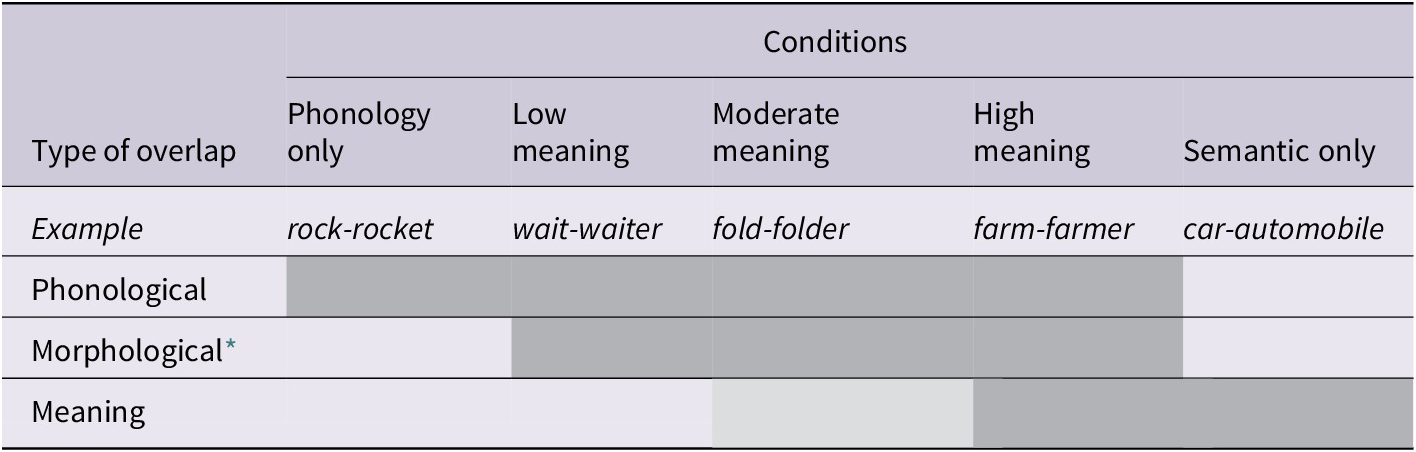
Table 1 shows examples of stimuli. The stimuli of the phonology-only condition overlapped in terms of phonology only (e.g., in English: rock-rocket; in French: four-fourmi, “oven-ant”). The stimuli of the low meaning (e.g, in English: wait-waiter; in French: pot-potage, “jar-potage”), moderate meaning (e.g., in English: fold-folder; in French: pays-paysage, “country-landscape”) and high meaning (e.g., in English: farm-farmer; in French: feuille-feuillage, “leaf-foliage”) morphological conditions shared a phonological and morphological overlap, and varied in terms of meaning overlap (from low to high). And finally, the stimuli of the semantic only condition (e.g., in English: car-automobile; in French: chapeau-casquette, “hat-cap”) overlapped in terms of meaning only.
Distribution of the pairs of words in the five conditions according to their type of overlap

Note. In dark grey: High overlap; in light grey: moderate overlap; in blank: no overlap.
* Morphological overlap refers here to pairs of words with a real or pseudomorphological overlap (Gonnerman et al., Reference Gonnerman, Seidenberg and Andersen2007)
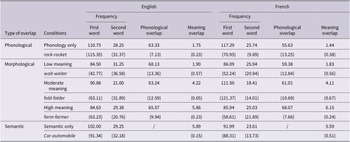
Table 2 reports the characteristics of frequency, phonological overlap, and meaning overlap as a function of the language and the condition. The pairs of words were matched for meaning overlap (i.e., mean child’s ratings of meaning overlap on a scale from 1 to 7) across languages. There was no effect of language on meaning overlap, F(1, 70) = 1.003, p = .320. The main effect of the condition on meaning overlap was significant, F(4, 70) = 329.415, p < .001, reflecting item selection. Bonferroni post-hoc tests show that the meaning overlap was lower in the low meaning than in the moderate meaning condition (p < .001) and in the moderate meaning than in the high meaning condition (p < .001). In addition, there was no difference in meaning overlap between the phonology only and low meaning conditions (p = .462) and between the high meaning and semantic only conditions (p = .484). Finally, there was no interaction between language and condition in terms of meaning overlap, F(4, 70) = 1.151, p = .340.
Mean base word and derived word frequency, phonological overlap, and meaning overlap (child ratings) according to the Condition and the Language (standard deviations in parentheses)

Note. Frequency (occurrences per million words) is given by Zeno database (Zeno, Ivens, Millard & Duvvuri, Reference Zeno, Ivens, Millard and Duvvuri1995) in English and Manulex Infra (Peereman, Lété & Sprenger-Charolles, Reference Peereman, Lété and Sprenger-Charolles2007) in French. Phonological overlap corresponds to the proportion of phonemes shared between two words. Meaning overlap was defined on a scale from 1 (not related) to 7 (extremely related).
The pairs of words were also matched for phonological overlap (i.e., the proportion of phonemes shared between the two words of the pair) in the phonology only and the three morphological conditions (there was no phonological overlap in the semantic only condition). There were no within-pair phonological alterations in the items in French. In English, within-pair syllable stress was maintained for all derivations, with the exception of one instance in the form only condition (cart-cartoon) and the high meaning condition (locate-location Footnote 3 ). In addition, phonological overlap was complete (i.e., the phonemes of the base word were the same in the derived word) in all conditions with the exception of one instance in the high meaning condition (locate-location). Phonological overlap depended neither on condition, F(3, 56) = 1.69, p = .153, nor on language, F(1, 56) = 1.21, p = .316. In addition, there was no interaction between condition and language on phonological overlap F < 1.
Finally the pairs of words were matched for frequency (i.e., the number of occurrences of a given word per million words). There was no effect of the condition, no effect of the language and no interaction between the condition and the language on the frequency of the longer word and on the frequency of the shorter word (all Fs < 1 and all ps > .466).
The 40 pairs of words selected in each language were placed in sentences for the purpose of the plausibility judgment task. Consistent with previous tasks (Carlisle, Reference Carlisle and Feldman1995; Carlisle & Nomanbhoy, Reference Carlisle and Nomanbhoy1993) and considered to BE developmentally appropriate for young school-age children (Randall, Reference Randall1985), sentences templates were developed and applied according to the four contexts of 1) instrumental, 2) descriptive, 3) agentive, and 4) diminutive forms (e.g., agentive context sentence template of: If you VERB you are a NOUN, instrumental context template of: You use a NOUN to make a NOUN) (see Appendix B). Initial sentence templates for each context were first developed for the word-pair conditions of semantic only, high meaning, and moderate meaning conditions and included syntactical constructions that reflected the syntactic forms of Carlisle and Nomanbhoy’s (Reference Carlisle and Nomanbhoy1993) original task with words and types of present-tense grammatical structures limited in number and complexity. For the form only and low meaning sentences, we chose sentence templates for the word type pairs that were parallel to the same word type as in the moderate meaning or high meaning pairs (with minimally added content words when possible for added clarity). For example, the form only word-pair condition: You use a rock to make a rocket parallels the moderate meaning word-pair condition: You use a fold to make a folder. In each language, the 40 sentences were divided into two sets of 20 sentences.
In order to limit the possible impact of sentence construction on the judgments made, we distributed sentence contexts and syntactic constructions as equally as possible in the five conditions as well as in the two languages. Despite our best efforts, a perfect distribution of words across all conditions with exact matches of sentence templates was not possible for this current study. This limitation was because the word-pairs chosen for inclusion in this study were based on their level of meaning overlap and not grammatical morphology. Such word-pairs matched by morphological relatedness ratings across both languages at times belonged to different grammatical categories, and thus required different sentence templates. As a way to mitigate this challenge, we limited the number of sentence-structure templates that could be used. This limited set of sentence templates, however, at times resulted in awkward sentence constructions that may have impacted children’s responses to our task. We recognize this limitation and discuss the implications and future research recommendations in the discussion section of this paper.
Procedure
The participants were tested individually in a quiet room of their school. They were asked to judge on a five-point scale whether the sentences that were given orally by the experimenter were plausible or not. The five-point scale (presented in Figure 1) consisted of five faces of different colors associated to different expressions: the leftmost face was red and represented an expression of silliness, while the rightmost face was green and represented an expression of happiness. The three faces in-between depicted a continuum of expressions from mid-silliness (light red) to mid-happiness (light green). Children were told orally that each scale point was associated to a specific answer regarding sentence plausibility, from left to right: Silly, Sort of silly, Not sure, Sort of makes sense and Makes sense. Children were asked to point to the face along the continuum that corresponded to their judgment regarding sentence plausibility, and no words were written below the faces. The English-speaking children made a decision on the English sentences and the French-speaking children made a decision on the French sentences.
The five-point Likert scale

Three training sentences were first presented to the participants to ensure that they understood the instructions and the scale. The two sets of sentences were then presented successively to the participants, with a short pause between the two sets. The order of presentation of the two sets of sentences was counterbalanced. The total duration of the task was 20 minutes.
Results
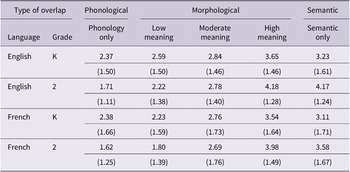
Children’s sentence ratings were analyzed with linear mixed effect models using the clmm() function from the ordinal package (Christensen, Reference Christensen2015) in the statistical analysis software R (R development core team, 2012). The children’s sentence ratings were coded to numbers from 1 (Silly) to 5 (Makes Sense). Mean sentence ratings were calculated and entered as the dependent variable in the model, while Grade (Kindergarten, Grade 2), Condition (Phonology only, Low meaning, Moderate meaning, High meaning, Semantic only), and Language (English, French) were the categorical independent predictors. The results are presented in Table 3.
Descriptive results

Note. K: Kindergarten; 2: Second grade
Model comparison was applied to evaluate whether inclusion of the three explicative variables and their interaction was validated by the data. Models were fit to the data using restricted maximum likelihood estimation. Model fitting was performed by initially specifying a model that included age as fixed factor (in order to control for the lack of matching in age between English-speaking and French-speaking kindergartners) and the random factors (participants and pairs of words). The model was progressively enriched by adding successively the three explicative variables and their interactions (the three two-way interactions and the three-way interaction). The best fitting model was defined as the most complex model that significantly improved the fit over the previous model. The addition of Condition significantly improved model fit (χ2(4) = 95.88, p < .001) but the addition of Grade or Language did not (χ2(1) < 1 and χ2(1) = 1.30, p = .254, respectively). The addition of the interaction between Grade and Condition improved model fit (χ2(5) = 283.04, p < .001), but improved models were not found for the two-way interactions between Grade and Language or between Condition and Language, or the three-way interaction between Grade, Language and Condition (χ2(3) = 4.49, p = .213, χ2(5) = 7.45, p = .189 and χ2(10) = 11.92, p = .290, respectively).
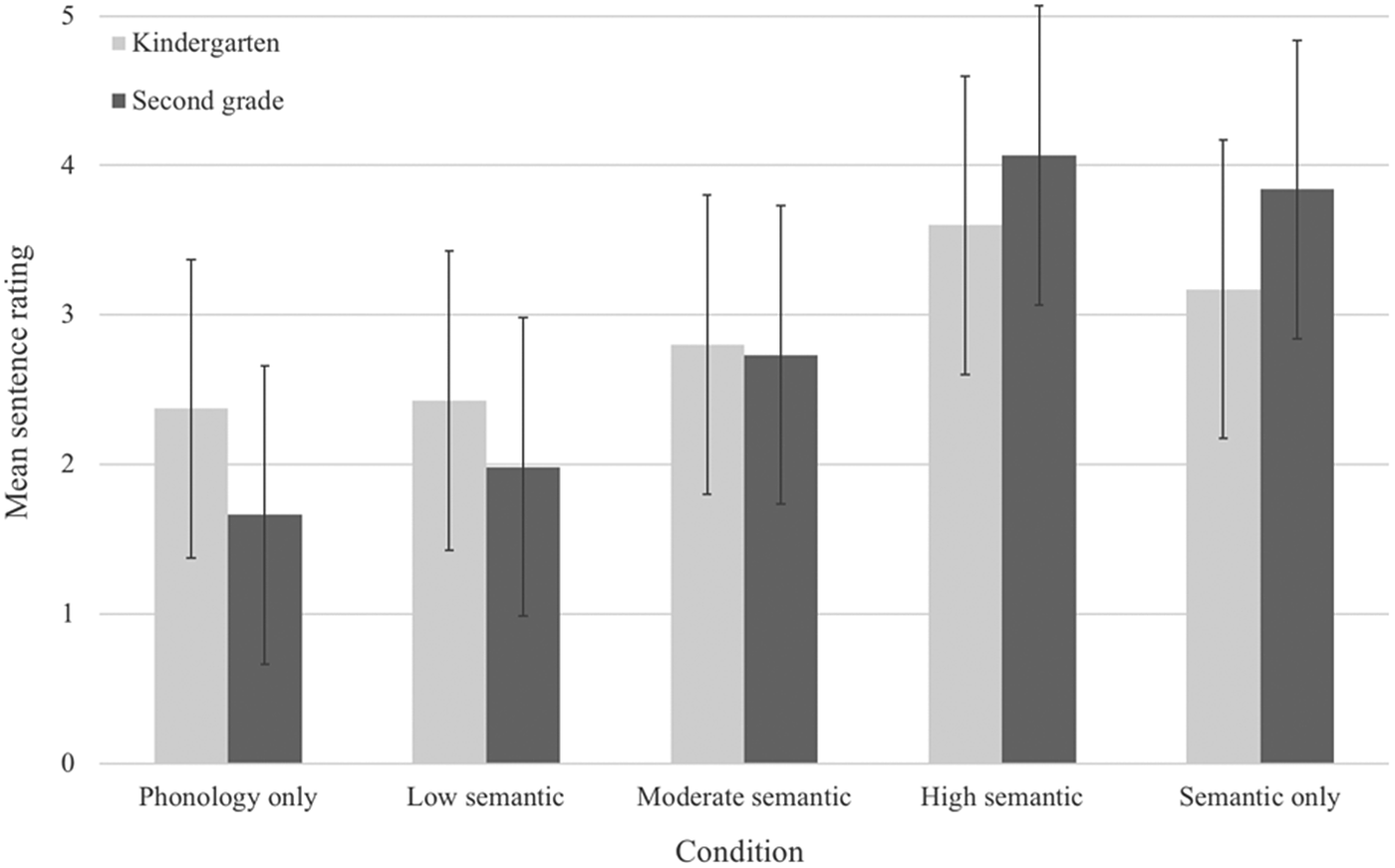
The following results are reported for the best-fitting model and the final model included Condition and the interaction between Condition and Grade as fixed effects, and Participants and Items as random factorsFootnote 4. Mean ratings as a function of grade and condition are presented in Figure 2.
Mean sentence ratings as a function of grade and condition

Since there was an interaction between condition and grade, we examined the effect of condition separately for each grade and the effect of grade separately for each condition.
In kindergarten, there was no difference in terms of sentence plausibility ratings between the phonology only and low meaning condition, z < 1. The sentences were rated as less plausible in the low meaning than in the moderate meaning condition, β = 0.50, SE = 0.18, z = 2.73, p = .006 and again in the moderate meaning than in the high meaning condition, β = 0.99, SE = 0.18, z = 5.41, p < .001. Finally, kindergarten children judged the sentences in the high meaning condition as more plausible than in the semantic only condition, β = 0.56, SE = 0.18, z = 3.05, p = .002.
For second-grade children, the difference between the phonology only and low meaning conditions was not significant, β = 0.55, SE = 0.31, z = 1.80, p = .072. The sentences were judged less plausible in the low meaning than in the moderate meaning condition, β = 1.08, SE = 0.31, z = 3.52, p < .001, and in the moderate meaning than in the high meaning condition, β = 1.97, SE = 0.31, z = 6.41, p < .001. Finally, the sentences were judged as plausible in the semantic only condition as in the high meaning condition, β = 0.33, SE = 0.31, z = 1.07, p = .287.
Overall, these results show that plausibility judgment scores increase with the degree of meaning overlap between word pairs in both groups. This is particularly clear with graded effects of increasing meaning overlap within the morphological conditions. Differences emerge in that kindergarten children are not significantly influenced by the type of form overlap (presence or absence of morphemes in words) while the second-grade children tend to make this distinction in their judgments.
Investigating the grade effects within each condition also helps to clarify differences in performance based on grade level. Kindergarten children rated the sentences in the phonology only and in the low meaning conditions as more plausible than second-grade children (β = 1.44, SE = 0.272, z = 5.29, p < .001 and β = 0.65, SE = 0.20, z = 3.29, p < .001, respectively). By contrast, kindergarten children rated the sentences in the high meaning and semantic only conditions as less plausible than second-grade children (β = -0.36, SE = 0.15, z = –4.71, p < .001 and β =, –0.99, SE = 0.15, z = –6.58, p < .001, respectively). And finally, there was no difference between both groups in sentence rating in the moderate meaning condition (z < 1). In summary, kindergarten children find sentences containing items related only by phonology to be more plausible than second-grade children. On the other hand, second-grade children find sentences containing items related in meaning more plausible than kindergarten children.
Discussion
The aim of this study was to understand how children develop representations about the morphology of their language, with specific attention to the influence of meaning overlap between morphologically related words. This question is motivated by the co-existence of two hypotheses, one giving a central role to meaning overlap in the development of morphological representations (form and meaning hypothesis, e.g., Merkx et al., Reference Merkx, Rastle and Davis2011; Schreuder & Baayen, Reference Schreuder, Baayen and Feldman1995) and the other giving a secondary role to meaning overlap in the development of morphological representations (form hypothesis, e.g., Carlisle & Fleming, Reference Carlisle and Fleming2003; Deacon et al., Reference Deacon, Conrad and Pacton2008; Rastle & Davis, Reference Rastle and Davis2008). We contrasted these hypotheses in two studies, one in English and one in French, in which we asked children in kindergarten and second grade to complete a sentence plausibility judgment task (Carlisle, Reference Carlisle and Feldman1995; Carlisle & Nomanbhoy, Reference Carlisle and Nomanbhoy1993) with words varying across key dimensions of phonological, morphological, and meaning overlap (Quémart et al., Reference Quémart, Gonnerman, Downing and Deacon2018).
First, our results suggest that children appear to take meaning overlap into account when processing morphologically related words that are presented orally. The use of three levels of meaning overlap made it possible to show that as early as kindergarten, children’s plausibility judgments are influenced by the meaning overlap between morphologically related words; children’s ratings were graded across the low, moderate, and high meaning conditions. The more meaning overlap between morphologically related words, the more the sentences were rated as plausible by the children while at the same time phonological overlap is kept constant. This result is consistent with the findings of Quémart et al. (Reference Quémart, Gonnerman, Downing and Deacon2018) who showed that the amount of cross-modal (oral-visual) priming depends on the degree of meaning overlap between morphologically related words in third-through fifth-grade children. The present study takes this a step further by revealing graded effects with far younger children than in prior studies (Gonnerman et al., Reference Gonnerman, Seidenberg and Andersen2007; Quémart et al., Reference Quémart, Gonnerman, Downing and Deacon2018).
Second, the influence of meaning overlap appears to be modulated by children’s grade. Although both groups showed graded effects, second-grade children found sentences that included pairs of words in the high meaning and semantic only conditions more plausible than kindergarten children did. In contrast, kindergarten children tended to consider sentences with word pairs that were only phonologically related to each other more plausible than second-grade children did. Children therefore seem to rely on the same information when performing the task, while giving different weight to phonological and meaning information in both groups: kindergarten judgments are based more on phonological overlap, while those of the older children are based more on meaning overlap. This result extends previous work by Derwing and Baker (Reference Derwing, Baker and MacNamara1977, Reference Derwing, Baker, Fletcher and Garman1979; see also Carlisle & Fleming, Reference Carlisle and Fleming2003) by showing that the transition between kindergarten and second grade is a particularly important one.
Third, comparison of the phonology only and low meaning conditions also provides insight on the development of morphological representations. Indeed, the only difference between these two conditions lies in the presence of a suffix at the end of one of the words of the pairs in the low meaning condition (e.g., waiter vs rocket), while at the same time these two conditions are strictly identical in terms of phonological and meaning overlap. The contrast of these two conditions makes it possible to determine when, in the course of development, suffixes acquire a particular status in the lexicon that could influence children’s judgment. No significant difference in judgment was observed in kindergarten children between these two conditions. It therefore appears that kindergarten children do not yet consider suffixes as units that might have special status in sentence judgments. For second-grade children, the difference between these two conditions was not significant (p = .072), which prevents us from concluding here about the influence of morphological units with equivalent phonological and meaning overlap. A lack of consideration of suffixes in both groups can be explained by the participants’ grade level. It is possible that at this stage, children do not yet consider – even implicitly – that the presence of a suffix is an important sign of morphological construction and do not rely on this type of cue to judge that a sentence makes sense. Several masked priming studies showed that in second graders, morphological processing is based primarily on the presence of an embedded stem within words (e.g., rock in rocket; wait in waiter), regardless of the presence of a suffix at the end (Hasenäcker, Beyersmann & Schroeder, Reference Hasenäcker, Beyersmann and Schroeder2016, Reference Hasenäcker, Beyersmann and Schroeder2020). Sensitivity to suffixes might therefore be acquired over grades.
Finally, the pattern of our results was consistent across both English and French. Since most of the studies conducted to date on this issue have focused on the English language (e.g., Carlisle & Fleming, Reference Carlisle and Fleming2003; Derwing & Baker, Reference Derwing, Baker, Fletcher and Garman1979), it was important to examine the extent to which language could modulate the effects. Contrary to our expectations, language characteristics, and more specifically phonological consistency in morphological derivation, did not modulate children’s reliance on meaning overlap to make their judgments. This finding at first appears inconsistent with research demonstrating cross-language differences between English and French in morphological awareness tasks (Duncan et al., Reference Duncan, Casalis and Colé2009). French children between the ages of five and eight know a broader range of suffixes and are better able to generalize morphological knowledge to novel contexts than English-speaking children. Cross-language differences also have been observed in lexical decision tasks, where French-speaking children in third and fourth grade appear to have faster access to morphological representations than fourth-grade English-speaking children (Casalis et al., Reference Casalis, Quémart and Duncan2015). By contrast, we show here that language morphology does not significantly affect sentence plausibility judgments. Unlike our current study, however, the two studies mentioned above did not investigate specifically the influence of meaning overlap between morphologically related words on morphological processing. We suspect that the characteristics of productivity and morphological transparency affect certain aspects of morphological processing (morphological awareness, ease of access to representations) but not the identification of members of a word family. In the future, the use of other paradigms adapted to very young children could shed further light on this point.
The results summarized above shed light on the theoretically contentious question of the development of morphological representations. They indicate that kindergarten children do not develop morphological representations solely on the basis of phonological overlap between words. In both languages, they also rely on meaning overlap when they are asked to judge sentence plausibility. An early influence of meaning information in the acquisition of morphological knowledge has been pointed out previously by Merkx et al. (Reference Merkx, Rastle and Davis2011) through a paradigm of artificial language learning in English-speaking adults. Meaning information has also been shown to influence French-speaking children’s visual word recognition of morphologically complex words from third grade (e.g., Quémart, Casalis & Colé, Reference Quémart, Casalis and Colé2011; Quémart et al., Reference Quémart, Gonnerman, Downing and Deacon2018) and to facilitate the explicit and intentional manipulation of morphemes though in a very limited way at the beginning of elementary school in Chinese (Hao, Chen, Dronjic, Shu & Anderson, Reference Hao, Chen, Dronjic, Shu and Anderson2013). Testing a group of kindergarten children revealed that the meaning overlap between morphologically related words modulates the activation of representations very early in the development, as suggested by Schreuder and Baayen (Reference Schreuder, Baayen and Feldman1995). According to these authors, morphological representations indeed result from children’s ability to identify units that converge in form and meaning. The greater the convergence, the higher the level of activation and the more children judge that two words are related. In other words, the strength of the connections between morphologically related words depends on the importance of the meaning overlap between them, and the weight of these connections influences the processing of oral language as early as in kindergarten. This influence is at least partly independent of the transparency of the derivational system.
From a developmental perspective, children appear to learn to rely on meaning overlap gradually when processing oral language. This finding is important because relatively little is known about how word meaning influences lexical access according TO children’s development, despite its centrality in theoretical predictions (Merkx et al., Reference Merkx, Rastle and Davis2011; Schreuder & Baayen, Reference Schreuder, Baayen and Feldman1995). Gradual consideration of meaning overlap may reflect the progressive enrichment of children’s semantic networks during development. It seems that semantic networks develop as children’s vocabularies grow, since adding new words to the lexicon implies a reorganization of semantic networks (Steyvers & Tenenbaum, Reference Steyvers and Tenenbaum2005). Indeed, this is consistent with research showing less cohesive and less efficiently structured semantic networks in children with slow vocabulary growth trajectories than with fast vocabulary growth (Beckage, Smith & Hills, Reference Beckage, Smith and Hills2011). Deeply known words have a greater number of connections to other words and, thus, have more elaborated meanings (Hadley, Dickinson, Hirsh-Pasek & Golinkoff, Reference Hadley, Dickinson, Hirsh-Pasek and Golinkoff2019). The increase in vocabulary during development and consequently the enrichment of the semantic network could therefore explain why meaning information is increasingly taken into account by children. Therefore, it could be vocabulary level, rather than age or grade level, that explains the results of our current study. Future studies that explicitly assess the relationship between plausibility judgments and children’s vocabulary may help to answer this question.
Methodologically, our results demonstrate the value of the sentence judgment task to the examination of the development of morphological representations in children. The influence of the condition on children’s ratings suggests that kindergarten children are both able to implicitly compare the two target words in the sentences when performing the task and to rely on this comparison to provide their judgment. This type of implicit judgment task in which there is inclusion of word pairs in sentences where children are required to judge sentence plausibility seems more appropriate for kindergarten children (Carlisle, Reference Carlisle and Feldman1995; Carlisle & Nomanbhoy, Reference Carlisle and Nomanbhoy1993) than judgment tasks in which children are asked to explicitly determine whether one word is related to another. One added value of this task is that it also allowed us to examine the development of morphological representations in a way that is perhaps more representative of the materials children are confronted with in everyday life (i.e., in sentence contexts rather than as isolated words). Kindergarten children are also capable of using a scale to provide nuanced judgments based on their own comparison of the items included in the sentence. These results therefore provide interesting methodological perspectives in particular in preschoolers.
An important challenge in this study was the creation of sentences from a limited number of possible words (frequent words, with different meaning overlap for each condition, with phonological transparency, and comparable in English and French). As a result, some sentences had awkward constructions because it was the selection of words and matched word-pair related ratings across languages that prevailed over the selection of sentences. This needs to be considered as a limitation of our study and the results should be cautiously interpreted as we cannot rule out that children may have reacted to the awkwardness of sentence syntax and not necessarily meaning overlap in our experimental task. To overcome this issue, it will be necessary to conceptualize simultaneously sentence construction and item selection, a challenge that awaits future researchers.
Despite the limitations, this study provides insights into the linguistic mechanisms that support the development of morphological representations across two languages. From kindergarten onwards and across languages, children appear sensitive to the phonological and meaning overlap of morphologically related words. This awareness of meaning overlap between morphologically related words may increasingly shape morphological representations during development.
Supplementary Materials
To view supplementary material for this article, please visit http://doi.org/10.1017/S0305000922000356.
Competing interests
The authors declare none