

Negative interpersonal events, such as being ostracised, bullied, rejected, or humiliated are powerfully aversive experiences (Leary, Springer, Negel, Ansell, & Evans, Reference Leary, Springer, Negel, Ansell and Evans1998). The core emotional response to such events is hurt feelings. Some of these events, such as explicit rejections, are severe enough to erode the relationship in which they occur, making it easy to understand why such events would be deeply painful to the victim. However, events that appear less distressing, such as forgetting an anniversary, also have the capacity to induce intense hurt (Leary & Springer, Reference Leary, Springer and Kowalski2001). The large number of situations that can be considered hurtful have provoked a search for the common denominator that triggers this emotion. While there are a variety of approaches to understanding the origins of hurt feelings (e.g., Feeney, Reference Feeney2005; Solomon & Knobloch, Reference Solomon and Knobloch2004; Vangelisti, Reference Vangelisti, Fine and Harvey2006), two of the major explanations of hurt define the core of this emotion in a similar manner. The ‘relational denigration’ approach suggests that hurt is caused by the ‘perception that another individual does not regard his or her relationship with the person to be as important, close or valuable as the person desires’ (Leary et al., Reference Leary, Springer, Negel, Ansell and Evans1998, p. 1225). Similarly, the ‘relationship transgression’ explanation argues that hurt is caused by an appraisal that the perpetrator of an event has violated established relational norms or rules, victimised the injured person, and heightened his or her sense of vulnerability (Vangelisti, Reference Vangelisti, Manusov and Harvey2001). It is argued here, however, that both social contextual and individual difference factors need to be considered. The purpose of the studies presented here is to examine the interaction of the type of hurtful event, the relational importance of the source of hurt (perpetrator), and individual differences in hurt-proneness.
Predictors of the Intensity of Hurt Feelings
Several authors have developed typologies of hurtful events and communications that are argued to be universal across all perpetrators (Leary et al., Reference Leary, Springer, Negel, Ansell and Evans1998; Vangelisti, Reference Vangelisti, Cupach and Spitzberg1994; Vangelisti, Young, Carpenter-Theune, & Alexander, Reference Vangelisti, Young, Carpenter-Theune and Alexander2005). These studies have demonstrated that hurtful events fall into a number of distinct types that predict variance in the intensity of hurt feelings. The relationship between these event types and hurt intensity has supported the relational devaluation and relationship transgression explanations of hurt. The most common events linked to hurtful experiences are those associated with rejection, humiliation, embarrassment, and bullying, and include relational transgressions such as deception, betrayal, infidelity and conflict (Malachowski & Frisby, 2015; Vangelisti et al., Reference Vangelisti, Young, Carpenter-Theune and Alexander2005). Generally, the types of events that elicit the most hurt are also those most closely and consistently associated with damage to the victim's sense of worth to their relational partners, such as betrayal and dissociation events. Conversely, the events that tend to elicit less hurt are those that can be less closely or consistently tied to a victim's sense of social worth, such as aggression, deception, and teasing (Leary & Springer, Reference Leary, Springer and Kowalski2001; Leary et al., Reference Leary, Springer, Negel, Ansell and Evans1998; Vangelisti et al., Reference Vangelisti, Young, Carpenter-Theune and Alexander2005).
The relationship that the victim has with the perpetrator of a hurtful event has received less attention as a predictor of the intensity of hurt feelings. Both the relational devaluation and relationship transgression perspectives suggest that people more important to the victim should have a greater ability to cause hurt, as the victim values their opinion more and has more to lose if the relationship dissolves. Leary and colleagues (Reference Leary, Springer, Negel, Ansell and Evans1998) found that the victim's relationship with the perpetrator of a hurtful event significantly predicted the intensity of hurt from that event, with people more important to the victim, such as romantic partners and family members, causing more hurt than those who had a less intimate relationship with the victim, such as acquaintances. However, Snapp and Leary (Reference Snapp and Leary2001) paradoxically found that rejection by new acquaintances, who had a minimal level of familiarity with the victim, elicited higher hurt than rejection from acquaintances with a higher level of familiarity. This suggests that the relationship between hurt intensity and perpetrator importance may not be entirely straightforward.
Finally, a number of individual differences variables have been examined as predictors of the intensity of hurt feelings. From the relational devaluation and relationship transgression perspectives, people who are more sensitive to cues of social rejection or more dependent in relationships should be more inclined to feel hurt from any event. This has been supported by findings that individual differences traits that predispose people to have insecurities about their social worth, such as hurt-proneness, rejection sensitivity and self-esteem, have been associated with a greater predisposition to feeling hurt or a higher intensity of hurt feelings (Downey & Feldman, Reference Downey and Feldman1996; Kang, Downey, Iida, & Rodriguez, Reference Kang, Downey, Iida, Rodriguez and Vangelisti2009; Leary & Springer, Reference Leary, Springer and Kowalski2001; Murray, Rose, Bellavia, Holmes, & Kusche, Reference Murray, Rose, Bellavia, Holmes and Kusche2002).
A limited amount of work has examined combinations of these variables in predicting the intensity of hurt feelings. A number of studies have examined the impact of the type of hurtful event when enacted by specific perpetrators. Hurtful events that are specific to different relationship types (e.g., romantic partner, offspring, friend) have been defined, such as infidelity in romantic relationships (Feeney, Reference Feeney2004) and misconduct in parent-child relationships (Mills, Nazar, & Farrell, Reference Mills, Nazar and Farrell2002). The existence of such events suggests that there is a meaningful interaction between the type of hurtful event and who is committing it.
Additionally, Vangelisti and colleagues (Reference Vangelisti, Young, Carpenter-Theune and Alexander2005) have examined the relationship between individual differences and hurtful events. They found that, after controlling for relational satisfaction and the intent of the perpetrator, the association between hurtful events and self-esteem varied as a function of type of event. Events that were most closely tied to the victim's sense of social worth (relational denigration, humiliation, and intrinsic flaw) were significantly and negatively correlated with self-esteem. This is consistent with the literature demonstrating the link between individual difference variables in sensitivity to negative social cues, such as rejection sensitivity and hurt proneness, and self-perceptions of lower social worth (Downey & Feldman, Reference Downey and Feldman1996; Fitness & Warburton, Reference Fitness, Warburton and Vangelisti2009), but also indicates the need to consider contextual factors.
The Present Research
The existing research demonstrates that the relational devaluation and relationship transgression explanations are both supported as partial accounts of the cause of hurt feelings. However, these explanations are largely focused on the social context and do not take into account individual beliefs that victims may hold that may influence the perception of relational devaluation. In the current research, we propose to consider the social situational factors underlying hurt in conjunction with individual differences in the degree to which hurt is perceived. It is clear from the extant literature that research into the interactive effects of the social adequacy predictors on the intensity of hurt feelings is in its infancy. No studies to date have simultaneously analysed the unique contributions of the type of hurtful event, the importance of the perpetrator to the victim, and individual differences in predicting hurt feelings, or their possible interactions. It is important to understand the relative contributions of these predictors, as well as the ways in which they interact, in order to understand both the importance of each predictor and whether certain combinations of predictors can be particularly damaging.
Two studies based on community samples were conducted. In each of these studies, the type of hurtful event, perpetrator importance, and victim individual differences (in the form of hurt-proneness) were measured. These studies differed in their methodological approaches, with Study 1 using a series of scenarios that manipulated the hurtful stimulus and Study 2 using the actual, recalled hurtful events of participants. These two studies each tested the following hypotheses:
-
1. Replicating previous studies, the type of hurtful event, the importance of the perpetrator and victim hurt-proneness will have significant bivariate relationships with the intensity of hurt feelings. Hurtful events more closely connected to diminished social adequacy (relationship denigration/humiliation), higher perpetrator importance (relationship closeness), and higher levels of individual differences in hurt-proneness will be associated with greater intensity of hurt feelings.
-
2. When considered simultaneously, the type of hurtful event, the personal importance of the perpetrator, and hurt-proneness will all add significantly to the prediction of the intensity of hurt feelings.
-
3. A number of significant interactions between type of hurtful event, perpetrator importance, and hurt-proneness in predicting the intensity of hurt feelings will be found, including a three-way interaction between the type of hurtful event, perpetrator importance, and hurt-proneness. It is expected that hurt proneness will play a greater role in experienced hurtfulness when an event has low hurt potential (ill-conceived humour) and is perpetrated by someone with low personal importance.
STUDY 1
Simultaneous Effects of Predictors of Hurt Intensity Using Scenarios
In order to assess the hypotheses, it was important that the full spectrum of hurtful experiences was represented, from slightly hurtful to extremely painful. Drawing on existing literature (Leary et al., Reference Leary, Springer, Negel, Ansell and Evans1998; Vangelisti et al., Reference Vangelisti, Young, Carpenter-Theune and Alexander2005), a series of scenarios were created that varied by perpetrator importance and event severity. A similar methodology has been used in a study of the impact of hurtful events in family environments (Vangelisti, Maguire, Alexander, & Clark, Reference Vangelisti, Maguire, Alexander and Clark2007).
Method
Participants
Five hundred and twenty-five volunteers from a community sample participated in Study 1. As the vast majority of these participants reported as female, male participants were excluded, leaving 475 female participants in the final sample. The study was advertised using social media (Facebook) and participants were encouraged to invite others in their social network to consider completing the survey. Participants were aged from 18 to 89 years (M = 34.05, SD = 11.38). As participants were asked about hurtful scenarios perpetrated by a romantic partner, a close friend and an acquaintance, only participants with a current romantic partner were recruited for this study. Mean relationship length with romantic partners was 7.55 years (SD = 8.72), 12.24 years with close friends (SD = 13.43), and 3.16 years (SD = 4.23) with acquaintances.
Procedure
Participants completed an online questionnaire administered using SurveyGizmo online survey software. Participants were asked to imagine their current romantic partner, a current close friend, and a current acquaintance. They were then asked to read the hurtful scenarios and imagine they were perpetrated by these specific people, and to rate how hurtful these events would be if they had happened to them. To help them imagine these specific people committing these events, participants were asked a number of questions about each perpetrator, including their initials, age, and gender, before reading the hurtful scenarios associated with that perpetrator (Leary et al., Reference Leary, Springer, Negel, Ansell and Evans1998; Vangelisti et al., Reference Vangelisti, Young, Carpenter-Theune and Alexander2005). Participants were asked a number of questions about how they perceived their relationship with each perpetrator. Finally, they were asked to complete a number of validated scales measuring a range of individual differences and relationship variables. Only those variables relevant to the current research will be presented here.
Measures
Type of hurtful event
The type of hurtful event had two levels of severity based on the findings of Vangelisti and colleagues (Reference Vangelisti, Young, Carpenter-Theune and Alexander2005). ‘Low hurt’ scenarios were designed to represent ill-conceived humour (e.g., joking about clumsiness, childhood photos), while ‘high hurt’ scenarios were designed to represent both relational denigration and humiliation (e.g., partner forgetting special date night, not being invited to friends party). Both event types were presented for each of the three perpetrators (Romantic Partner, Close Friend, Acquaintance), making six scenarios in total. The scenarios were designed to be as thematically equivalent as possible across all three relationships and were developed from an initial, larger pool, based on examples of hurtful events in the literature, stories found on internet forums, and by asking associates to volunteer personal accounts. These initial scenarios were subjected to evaluation using focus groups and pilot testing until the final six scenarios were reached.
Importance of the perpetrator
The importance of the perpetrator of the event was assessed using the item ‘How important would you consider this relationship is to you at the current time?’, to which participants responded on a 7-point Likert scale (1 = not at all, 4 = moderately, 7 = extremely). Importance ranged from 1 to 7 in the current sample (M = 5.19, SD = 1.81).
Hurt-proneness
Hurt-proneness was measured using the six-item Hurt-Proneness Scale (HPS; Leary & Springer, Reference Leary, Springer and Kowalski2001). The items in the HPS are designed to assess the frequency with which people's feelings are hurt. Higher scores indicate greater hurt-proneness. The HPS showed good internal reliability in the current study (α = .81) and ranged from 6 to 30 (M = 19.03, SD = 4.71).
Hurt intensity
After reading each of the six scenarios, participants were asked to imagine that each scenario happened to them and to rate how hurt they would have felt. This was assessed using a single item, ‘How emotionally hurt would you have felt?’, to which participants responded on a 7-point Likert scale (1 = not at all, 4 = moderately, 7 = extremely; Feeney, Reference Feeney2004, Reference Feeney2005; Leary et al., Reference Leary, Springer, Negel, Ansell and Evans1998). The intensity of hurt ranged from 1 to 7 (M = 4.52, SD = 2.09).
Results
Analyses were conducted in Stata v11 (StataCorp, 2009) and R v2.15.1 (R Core Team, 2012). First, age was examined for its relationship with the variables of interest and no significant relationships were found. A paired-samples t test was then conducted to examine whether hurtful event type significantly predicted differences in the intensity of hurt feelings. Type of event was a strong and significant predictor of the intensity of hurt feelings, t(1424) = -54.966, p < .001, d = 1.47, with the scenarios that represented relational denigration and humiliation (M = 5.81, SD = 1.52) causing more hurt than those representing ill-conceived humour (M = 3.24, SD = 1.77).
The bivariate relationship between the intensity of hurt feelings and the importance of the perpetrator was assessed using a two-level, multilevel model. This type of analysis is required as the within-subjects measurement of type of hurtful event and the importance of perpetrator violated the assumption of homogeneity of regression slopes (Field, Miles, & Field, Reference Field, Miles and Field2012; Tabachnick & Fidell, Reference Tabachnick and Fidell2007). The necessity of using a multilevel modelling approach was confirmed by calculating the intraclass correlation (ICC) between the level of relationship with the perpetrator (i.e., romantic partner, close friend and acquaintance) and hurt intensity, where ICCs that exceed .1 indicating that the assumption has been violated. The ICC for these data was .193, justifying the inclusion of the level of relationship with the perpetrator as the Level 2 variable and the importance of the perpetrator as the Level 1 variable in a multilevel model predicting the intensity of hurt. This model demonstrated that importance was a weak but significant predictor of hurt feelings (Table 1), with higher levels of perpetrator importance corresponding with higher levels of hurt.
Bivariate Relationships Between Hurt Intensity (Outcome Variable) and the Predictor Variables Type of Hurtful Event, Importance of the Perpetrator and Hurt-Proneness (HPS), Study 1 (N = 475)

Note: **p < .01, ***p < .001
Finally, a multilevel model was used to assess the bivariate relationship between the intensity of hurt feelings and victim hurt-proneness, with the HPS as the Level 1 predictor and the relationship with the perpetrator as the Level 2 predictor. The model demonstrated that hurt-proneness was a weak but significant predictor of hurt feelings (Table 1), with higher levels of victim hurt-proneness corresponding with higher levels of hurt. The results of these three analyses confirm hypothesis 1.
Simultaneous Relationships Between Predictors and the Intensity of Hurt
A multilevel model was constructed to analyse the simultaneous contribution of the predictors to variance in hurt intensity, with the level of relationship with the perpetrator included as a Level 2 variable and the type of hurtful event, importance of the perpetrator, hurt-proneness, and all possible interactions as Level 1 predictors. While the length of the relationship with the perpetrators was considered as a covariate, its weak relationship with hurt (Table 1) meant it was excluded. All continuous variables were centred before being included in the model. The final model was constructed using a build-up strategy, where the Level 1 predictors were added sequentially to a model containing the Level 2 predictor (Raudenbush & Bryk, Reference Raudenbush and Bryk2002). Maximum likelihood estimation was used as the focus of the model was the Level 1 predictors on the outcome, and this method allows for the direct, statistical comparison of nested models (Field et al., Reference Field, Miles and Field2012; Tabachnick & Fidell, Reference Tabachnick and Fidell2007). The results demonstrated significant model improvement with the addition of all terms except the two-way interaction between the importance of the perpetrator and hurt-proneness. As such, the final model included all interactions between the Level 1 predictors (Table 2). Partially confirming the second hypothesis, the final simultaneous model demonstrated significant main effects for the type of hurtful event and hurt-proneness, but not for the importance of the perpetrator. Consistent with the third hypothesis, the three-way interaction between type of event, importance of perpetrator and hurt-proneness was significant, as were all three possible two-way interactions between these variables.
Multilevel Model Demonstrating the Relationship Between Type of Hurtful Event, Importance of Perpetrator, Hurt-Proneness and the Intensity of Hurt Feelings, Study 1 (N = 475) Level 2 Effects (Relationship with the Perpetrator) Note: This demonstrates the variance in the intercept across the different levels of relationship with the perpetrator. Level 1 Model (Averaged over Relationship with the Perpetrator) Note: *p < .05, **p < .01, ***p < .001.

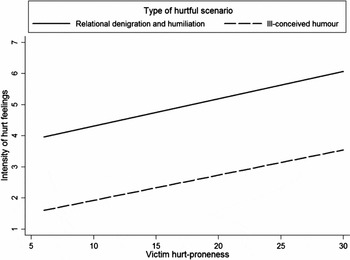
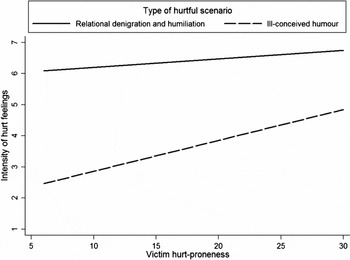
To increase the ease of interpreting the final model, importance was mean-split into a binary variable, and the two-way interactions between the type of hurtful event and hurt-proneness were plotted by low perpetrator importance (Figure 1) and high perpetrator importance (Figure 2). Figure 1 demonstrates that at low perpetrator importance, the pattern between hurt-proneness and the intensity of hurt was almost identical for the ill-conceived humour and relational denigration/humiliation scenarios. The pattern of these slopes suggests that when the perpetrator is not very important to the victim, hurt-proneness moderates the intensity of hurt from both event types in a similar manner, with people higher in hurt-proneness experiencing more hurt at these events. However, when examining the same relationship for events committed by a perpetrator high in importance to the victim, a different pattern was found for the two event types. The pattern in Figure 2 suggests that the relationship between hurt-proneness and hurt intensity for the ill-conceived humour scenarios was similar to that for low importance perpetrators. However, this relationship differed for the relational devaluation/humiliation scenarios, where hurt-proneness did not appear to have a strong effect on the intensity of hurt.
Linear regression slopes between victim hurt-proneness and the intensity of hurt feelings when perpetrators are of low importance to the victim, plotted separately for ill-conceived humour and relational denigration and humiliation scenarios, Study 1 (n = 225).

Linear regression slopes between victim hurt-proneness and the intensity of hurt feelings when perpetrators are of high importance to the victim, plotted separately for ill-conceived humour and relational denigration and humiliation scenarios, Study 1 (n = 250).

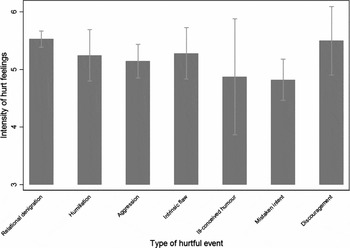
The mean levels of hurt reported for each of the types of hurtful events in Study 2 (N = 380). Error bars represent the standard error of the mean.

Post-hoc simple slopes analyses were conducted to confirm these interpretations of the graphs. For low perpetrator importance, the relationship between hurt-proneness and hurt intensity was similar for both the ill-conceived humour (parameter estimate = 0.084, t(671) = 6.613, p < .001) and relational denigration/humiliation scenarios (parameter estimate = 0.089, t(671) = 7.210, p < .001) and also for ill-conceived humour scenarios at high perpetrator importance (parameter estimate = 0.097, t(746) = 7.836, p < .001). For all three slopes, hurt-proneness had a weak but significant effect on the intensity of hurt. However, as suggested by the graphs, the relationship between hurt-proneness and hurt intensity for relational denigration/humiliation scenarios at high perpetrator importance was substantially weaker, although it remained significant (parameter estimate = 0.028, t(746) = 3.889, p < .001). The results of the three-way interaction therefore indicate that at the highest levels of hurt, when an act that represents relational denigration and humiliation is being committed by a person who is important to the victim, individual differences in hurt sensitivity become a much less important predictor of hurt. Rather, in reaction to such events, victims at all levels of hurt-proneness report elevated levels of hurt.
STUDY 2
Simultaneous Effects of Predictors of Hurt Intensity Using Recalled Situations
The results of Study 1 demonstrate that the severity of hurtful events may impact substantially on the intensity of hurt feelings. However, while it is clear from the previous study that relational denigration/humiliation and ill-conceived humour events dictate how much hurt a person feels from a hurtful event, these results do not indicate how often these event types are represented in hurtful interactions. Study 2 was designed to overcome this limitation. Using a self-report methodology (Leary et al., Reference Leary, Springer, Negel, Ansell and Evans1998; Vangelisti et al., Reference Vangelisti, Young, Carpenter-Theune and Alexander2005), this study aimed to examine how the type of hurtful event, when represented by recalled hurtful events, interacts with the importance of the perpetrator and hurt-proneness in predicting hurt intensity. Thus, the results of this study seek to examine how relevant these predictors of hurt are to people's ‘real-world’ experiences of hurtful events.
Methods
Participants
Four hundred and five people from a community sample took part in this study. However, as with Study 1, the majority of these participants were female, therefore the male participants were again excluded. This left 380 female participants in the final sample. Recruitment for this study took place at the same time as Study 1, and participants were recruited in an identical manner. Participants were aged from 18 to 64 years (M = 34.95, SD = 10.56). Again, only participants in a current romantic relationship were recruited for this study. Mean relationship length was 8.49 years with romantic partners (SD = 8.08), 11.32 years with close friends (SD = 9.64), and 4.01 years (SD = 4.82) with acquaintances. Hurtful events in romantic relationships had occurred an average of 3.00 years (SD = 4.72) ago, 3.96 years (SD = 6.56) ago in close friendships, and 1.65 years (SD = 3.34) ago in acquaintanceships.
Procedure
Participants completed an online questionnaire, administered using SurveyGizmo online survey software. Participants were asked to imagine their current romantic partner, a current close friend, and a current acquaintance. They were then asked to recall the most hurtful interaction they had with each of these people. Participants were asked the same questions about each of these perpetrators as in Study 1 before recalling the hurtful event. Participants were also asked a number of questions about their relationship with each perpetrator, both currently and at the time of the hurtful event. Finally, the same validated scales used in Study 1 were again used in Study 2. Only those variables relevant to the current research will be presented here.
Measures
Type of hurtful event
Participants were asked a number of open-ended questions about each hurtful event, using a very similar methodology as Leary and colleagues (Reference Leary, Springer, Negel, Ansell and Evans1998) and Feeney (Reference Feeney2005). One of the authors of this paper (J.L.B.) read the narratives of hurtful events and classified each into one of the 14 categories of hurtful events created by Vangelisti and colleagues (Reference Vangelisti, Young, Carpenter-Theune and Alexander2005). A rater who was an expert in psychological research, but who was independent of this study and unaware of the study hypotheses, coded 80 of these narratives in each of the three relationships. Both the author and the independent rater gave two classifications to these events: a primary classification for the category they felt most accurately described the event, and a secondary classification for an alternative category. Interrater reliability for the primary classifications was assessed using Cohen's kappa, which, due to the highly uneven cell sizes, was weighted by the count of congruence between raters per cells (Landis & Koch, Reference Landis and Koch1977). A substantial amount of agreement was displayed between coders (χ = .725). Where disagreement occurred, the first author of this study examined the secondary classifications and adjusted the primary classifications in reference to these.
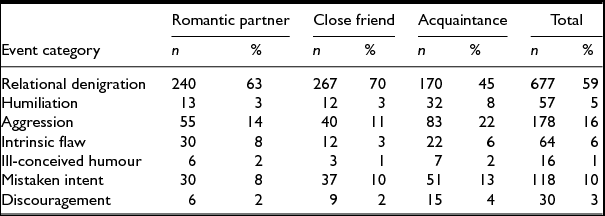
Due to the large number of categories, the number of events falling into some of the cells was very low. In order to increase the numbers per cells, the initial 14 categories were collapsed into groups based on the factors in Vangelisti and colleague's (Reference Vangelisti, Young, Carpenter-Theune and Alexander2005) hurtful events questionnaire. All of the categories from the questionnaire except Shock were used, as none of the initial 14 categories were felt to accurately fit into this group. This process left 7 categories of hurtful events; although, as Table 3 demonstrates, some of these categories still had very low numbers.
Frequency Per Cell For Type of Hurtful Event and Relationship for the 7 Category Hurtful Events Typology, Study 1 (N = 380).

Note: The events are derived from Vangelisti et al. (Reference Vangelisti, Young, Carpenter-Theune and Alexander2005), pp. 458–459, where a more detailed description of each category can be found. This 7 category classification is made up of the following factors from Vangelisti and colleagues’ (Reference Vangelisti, Young, Carpenter-Theune and Alexander2005) 14 category classification: relational denigration = rejection, betrayal, relational depreciation, and indifference; humiliation = humiliation; verbal/non-verbal aggression = personal attack and inappropriate communication; intrinsic flaw = undermining of self-concept and truth-telling; ill-conceived humour = ill-conceived humour; mistaken intent = behavioural criticism, moral affront, mistaken intent; discouragement = shattering of hope.
Importance of the perpetrator
Participants were asked how important each perpetrator was to them at the time the event occurred (‘How important would you consider your [romantic relationship/friendship/acquaintanceship] was to you at the time this hurtful experience occurred?’), which was responded to on a 7-point Likert scale (1 = not at all, 4 = moderately, 7 = extremely). Importance ranged from 1 to 7 (M = 5.00, SD = 2.08).
Hurt-proneness
As with Study 1, hurt-proneness was measured using the HPS. The HPS showed good internal reliability (α = .81), and ranged from 6 to 30 (M = 19.03, SD = 4.62).
Hurt intensity
After recalling each of the events, participants were asked to rate how hurt they felt at the time it occurred. This was again assessed using a single item (‘How emotionally hurt did you feel by this event?’) to which participants responded on a 7-point Likert scale (1 = not at all, 4 = moderately, 7 = extremely). Hurt intensity ranged from 1 to 7 (M = 5.36, SD = 1.88).
Results
Analyses were conducted in Stata v11 (StataCorp, 2009) and R v2.15.1 (R Core Team, 2012). The type of event did not significantly predict the intensity of hurt feelings using a repeated-measures ANOVA, F(6, 1126) = 1.046, p = .393, η2 = .006.
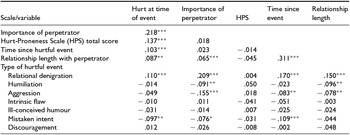
As with the Study 1 analyses, a multilevel model was used to assess the bivariate relationship between the intensity of hurt feelings and the importance of the perpetrator, with importance as the Level 1 predictor and the relationship with the perpetrator as the Level 2 predictor. The utility of accounting for perpetrator relationship level in a multilevel model was again assessed using the ICC, which was 0.493 in these data. The model demonstrated that importance was a weak but significant predictor of hurt feelings (Table 4), with higher levels of perpetrator importance corresponding with higher levels of hurt.
Bivariate Relationships Between Hurt at the Time of the Event (Outcome Variable), the Predictor Variables Type of Hurtful Event, Relationship with the Perpetrator and Hurt-Proneness and the Covariates Time Since Event and Length of Relationship, Study 2 (N = 380)

Note: *p < .05, **p < .01. Intercorrelations between types of hurtful events are not shown, as these correlations only reflect the dummy coding of the hurtful events.
Another multilevel model was used to assess the bivariate relationship between the intensity of hurt feelings and hurt-proneness, with the HPS as the Level 1 predictor and the relationship with the perpetrator as the Level 2 predictor. The model demonstrated that hurt-proneness was a weak but significant predictor of hurt feelings, with higher levels of victim hurt-proneness related to higher levels of hurt (Table 4). These results partially confirm hypothesis 1.
Simultaneous Relationships Between Predictors and the Intensity of Hurt
A multilevel model was again constructed to assess the simultaneous influence of the predictors on hurt intensity. The level of relationship with the perpetrator was included as a Level 2 variable, and the type of hurtful event, importance of the perpetrator, victim hurt-proneness, and all possible interactions of these variables as Level 1 predictors in a model predicting the intensity of hurt feelings. The small cell sizes for ill-conceived humour and discouragement event types meant they were unlikely to give reliable estimates in an interaction model; as such, these event types were excluded from this model. Type of event was converted into a dummy coded matrix, where relational denigration was used as a comparison group for the other four categories of hurtful events. In this study, both the length of the relationship with the perpetrator and the time since the hurtful event demonstrated significant relationships with hurt intensity (Table 4) and were therefore considered for inclusion as covariates.
The results demonstrated significant model improvement with the addition of the perpetrator importance and hurt-proneness main effects, the two-way interactions between type of hurtful event and perpetrator importance and between perpetrator importance and hurt-proneness, and the covariate time since hurtful event. However, the three-way interaction between type of event, perpetrator importance, and hurt-proneness demonstrated that this interaction was significant, qualifying the other results. In addition, time since hurtful event was retained as a covariate, but length of relationship with perpetrator was removed from the model.
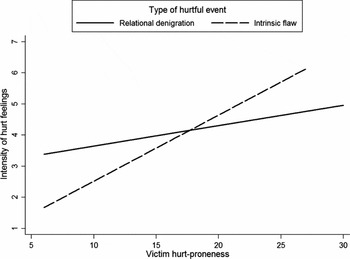
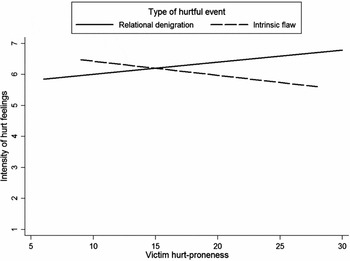
The final simultaneous model (Table 5) demonstrated significant main effects for the importance of the perpetrator and hurt-proneness, but not for any of the hurtful event types, confirming the hypotheses that the closeness of relationship (personal importance) and individual susceptibility to hurt partially account for the experience of hurt. The three-way interaction between the type of hurtful event, perpetrator importance and victim hurt-proneness was also significant when comparing the relational denigration and intrinsic flaw categories. In order to understand this complex interaction, importance was mean-split and the two-way interactions between the relational denigration and intrinsic flaws events and hurt-proneness were plotted by low (Figure 4) and high (Figure 5) perpetrator importance. The graphs suggest that the relationship between hurt-proneness and hurt intensity was contingent on perpetrator importance for intrinsic flaw events, with a moderate positive relationship between these variables at low perpetrator importance compared to a weak relationship at high perpetrator importance. In contrast, perpetrator importance did not appear to regulate the relationship between hurt-proneness and hurt intensity for relational denigration events, with a weak relationship between these two variables at both levels of perpetrator importance.
Multilevel Model Demonstrating the Relationship Between Type of Hurtful Event, Importance of Perpetrator, Hurt-Proneness and the Intensity of Hurt Feelings, Study 2 (N = 475) Level 2 Effects (Relationship with the Perpetrator) Note: This table demonstrates the variance in the intercept across the different levels of relationship with the perpetrator. Level 1 Model (Averaged over Relationship with the Perpetrator) Note: **p < .01, ***p < .001. aTypes of hurtful events are contrasted with the relational denigration category.

Linear regression slopes between victim hurt-proneness and the intensity of hurt feelings when perpetrators are of low importance to the victim, plotted separately for ill-conceived humour and relational denigration and intrinsic flaw events, Study 2 (n = 170).

Linear regression slopes between victim hurt-proneness and the intensity of hurt feelings when perpetrators are of high importance to the victim, plotted separately for ill-conceived humour and relational denigration and intrinsic flaw events, Study 2 (n = 194).

Post-hoc simple slopes analyses confirmed these findings. The relationship between hurt-proneness and hurt intensity for intrinsic flaw events differed for the two types of perpetrator importance, increasing from a non-significant relationship at high perpetrator importance, (parameter estimate = -0.045, t(34) = -1.100, p = ns) to a significant, although still modest, relationship at low perpetrator importance (parameter estimate = 0.212, t(23) = 3.437, p < .01). Perpetrator importance, however, did not influence the relationship between hurt-proneness and hurt intensity for relational denigration events, with the two variables sharing weak, although significant, relationships for both high (parameter estimate = 0.039, t(405) = 3.221, p < .01) and low (parameter estimate = 0.057, t(265) = 2.581, p < .05) perpetrator importance.
The significant three-way interaction between type of event, importance of the perpetrator, and hurt-proneness indicates that the relationship between hurt-proneness and hurt intensity is similar at low and high perpetrator importance for very hurtful events, such as relational denigration, with a weak association at both levels of perpetrator importance. The relationship between hurt-proneness and the intensity of hurt for intrinsic flaw events, however, was influenced by perpetrator importance. At low perpetrator importance, hurt-proneness and hurt intensity had a weak but strongly significant relationship for intrinsic flaw events. However, for high perpetrator importance, this relationship became very weak and non-significant. This result demonstrates that the intensity of hurt feelings at intrinsic flaw events perpetrated by low importance perpetrators is moderately influenced by hurt-proneness, but that hurt-proneness no longer moderates this relationship when an intrinsic flaw event is committed by a perpetrator of high importance.
Discussion
The two studies presented here set out to examine how the combination of the type of hurtful event, the personal importance of the perpetrator, and individual differences in hurt-proneness predict the intensity of experienced hurt feelings. The results generally replicated the bivariate relationships found in previous studies (Leary & Springer, Reference Leary, Springer and Kowalski2001; Leary et al., Reference Leary, Springer, Negel, Ansell and Evans1998; Vangelisti et al., Reference Vangelisti, Young, Carpenter-Theune and Alexander2005) and importantly, supported the predicted multivariate relationships proposed.
The type of hurtful event was a significant bivariate predictor of hurt in Study 1. This finding demonstrated that when relational denigration/humiliation scenarios were contrasted with ill-conceived humour scenarios, the type of event was a powerful explanation of variance in hurt intensity. Relational denigration and humiliation events demonstrate to the victim that not only does the perpetrator not value the relationship they share with the victim, they also potentially reduce the victim's social value in the eyes of those that witness the humiliation. As such, they are attacks to the core of victim social self-worth, reducing the victim's security in the current relationship, and putting in doubt their ability to recruit future support (Leary & Springer, Reference Leary, Springer and Kowalski2001; MacDonald, Reference MacDonald, Corr and Matthews2009). In contrast, ill-conceived humour events do not clearly communicate that the perpetrator does not value their relationship with the victim, and could even be seen as a demonstration of relational intimacy or camaraderie (Leary & Springer, Reference Leary, Springer and Kowalski2001). Where hurtful joking or teasing is seen as conveying a criticism, the humour used to deliver this information may soften its impact, and may convey that the perpetrator is concerned about the victim's feelings (Leary et al., Reference Leary, Springer, Negel, Ansell and Evans1998; Vangelisti et al., Reference Vangelisti, Young, Carpenter-Theune and Alexander2005).
Previous findings on the salience of perpetrator identity to the intensity of hurt feelings were also replicated in the significant relationships between hurt and the importance of the perpetrator in both studies, with more important perpetrators associated with more hurt (Leary et al., Reference Leary, Springer, Negel, Ansell and Evans1998). Hurtful events committed by those important to the victim are likely to attack their self-worth in several ways. First, because people trust and value the opinions of those close to them, and indeed, largely structure their sense of value around these positive connections, criticism or rejection coming from such a person, this holds more weight than if a similar behaviour is enacted by someone unimportant to the victim (Leary et al., Reference Leary, Springer, Negel, Ansell and Evans1998). In addition, hurt may also signal that important social rewards are being compromised or withdrawn, a concern that is more salient in important relationships where members derive many benefits from each other (Leary & Springer, Reference Leary, Springer and Kowalski2001; MacDonald, Reference MacDonald, Corr and Matthews2009). Finally, all events are rooted in the history that the victim shares with the perpetrator of a hurtful event, with people closer and more intimate with the victim having more ammunition to hurt them. However, the converse of the perpetrator having access to such information is that victims have an expectation that those close to them should know these vulnerabilities and to avoid them, and therefore can less easily excuse hurtful acts as unintentional or accidental (Leary et al., Reference Leary, Springer, Negel, Ansell and Evans1998). Hurtful events perpetrated by those close or important to victims therefore cause greater concerns than those less important to the victim for two reasons: because the message of diminished social acceptability is clearer, and because what is being threatened is much greater in terms of the benefits derived from that specific relationship.
Victim hurt-proneness also had a weak but significant relationship with hurt in both studies. This relationship confirms that individual differences exist in hurt sensitivity, with people higher in hurt-proneness reporting more hurt than those lower in this trait. Such individual differences in hurt seem to be tied to variance in how much emphasis people place on others valuing their relationships with them. Leary and Springer (Reference Leary, Springer and Kowalski2001) found that hurt-proneness correlated highly with measures of social acceptance and approval, suggesting that hurt-proneness reflects individual differences in how people evaluate the damage a hurtful event is causing to their social value.
A key finding in this article was the fact that the relative importance of the type of hurtful event and the importance of the perpetrator changed, depending on the methodology that was used. In Study 1, when scenarios were used to induce hurt feelings, the type of hurtful event was the most important predictor of hurt. The difference in the intensity of hurt in response to scenarios describing situations characterised by relational denigration and humiliation versus those marked by ill-conceived humour was very large, explaining 25% of the variance in hurt as a main effect in the full model. However, the importance of the perpetrator was not a significant main effect in this model. In comparison, the importance of the perpetrator became a significant main effect in Study 2, while the type of hurtful event did not have a significant relationship with hurt at all, either in the bivariate relationship or as main effect in the full model.
This pattern can be explained by examining the mean levels of hurt reported across event types between the two studies. The lowest mean level of hurt across event types was considerably higher in Study 2 than Study 1. This suggests that the type of event was not predictive of hurt in Study 2 because all of the events elicited similarly high levels of hurt. As shown by this study, and that of Leary and colleagues (Reference Leary, Springer, Negel, Ansell and Evans1998), when people are asked to think of a highly hurtful event, they generally select events such as betrayals, rejections and relational denigrations. These events most clearly communicate that the victim has behaved in a way that is unacceptable to the perpetrator and that their continued social acceptance is in question, supporting the explanation that perceptions of social inadequacy are at the core of hurt feelings (Leary & Springer, Reference Leary, Springer and Kowalski2001; Vangelisti et al., Reference Vangelisti, Young, Carpenter-Theune and Alexander2005). The fact that the importance of the perpetrator did not become a powerful predictor of hurt in Study 2 suggests that the core aspect of hurtful events that is appraised is whether there is a threat to social acceptability, reflected in the type of event. Once this threat has been established, the implication of this threat is then evaluated, as reflected in influence of the importance of the perpetrator.
Finally, the significant three-way interactions between type of hurtful event, the importance of the perpetrator, and victim hurt-proneness suggest that the processes that regulate the appraisal of a hurtful event as a threat to social acceptability interact. Certain combinations of these predictors are unlikely to lead to high levels of hurt for the majority of people, such as when an acquaintance with low social influence commits a hurtful act or when someone more important is hurtful in a way that is clearly accidental. These lower threat hurtful events are susceptible to the influence of individual differences, with people sensitive to cues of social undesirability feeling threatened by even low-level hurtful events that most people would be relatively unaffected by. On the other hand, when threats to social self-worth are sufficiently clear and costly, such as when people important to the victim are demonstrating an obvious lack of regard or value for their relationship with the victim, individual differences in hurt sensitivity become much less relevant to the intensity of hurt. At such levels of threat to social acceptability, all victims feel highly hurt, and their resulting emotional pain motivates them to rectify this interpersonal breach (MacDonald, Reference MacDonald, Corr and Matthews2009; Vangelisti et al., Reference Vangelisti, Young, Carpenter-Theune and Alexander2005).
Limitations and Future Directions
This study has several limitations that restrict the conclusions that can be drawn from the results. First, only a useable female sample was obtained for both studies, limiting the conclusions that can be drawn about hurt feelings across the population. A similar community sample including a representative group of men will be necessary in future work to fully explore how well these findings represent a universal experience of hurt and how much is specific to women. A casual examination of published studies reveals that males appear to be under-represented in the research on hurt feelings and, although there is little reason to believe that there are major gender differences in the causes of hurt feelings, further research should seek to confirm this. Second, the retrospective design of Study 2 prevents any interpretation of the data in terms of causality. Future studies should employ a longitudinal design to more robustly assess the influence of each of the predictors on hurt. Third, only the individual difference factor of hurt-proneness was assessed here. Clearly, other individual difference variables, such as the standard personality factors (i.e., Big 5) and interpersonal factors (i.e., rejection sensitivity, attachment style), may also interact with social variables in determining hurtful experiences (e.g., Feeney, Reference Feeney2005; Nakamura, Reference Nakamura2014). Finally, a statistical issue that limited the conclusions that could be drawn from the Study 2 data was the very small cell sizes for some of the hurtful events. This appeared largely due to the fact that participants were asked to report on a time that they were most hurt by each of the perpetrators, limiting the reporting of events to those seen as very hurtful (i.e., relational denigration events). While this is in and of itself an important piece of information, it may be of interest to future researchers to examine how event types contribute to the full spectrum of hurt feelings.
Further, while the combined results of the studies presented here can be argued to be consistent with the central role of social/self-worth in hurt feelings, this relationship was not assessed directly in either study. While previous research has examined the link between self-esteem and hurtful experiences with respect to type of event (Vangelisti et al., Reference Vangelisti, Young, Carpenter-Theune and Alexander2005), rejection sensitivity (Downey & Feldman, Reference Downey and Feldman1996), and closeness (Murray et al., Reference Murray, Rose, Bellavia, Holmes and Kusche2002), there is a need to extend research to look at the potential interactions between these factors and self-esteem and other indicators of social worth.
The fact that both contextual and individual difference factors emerge as significant predictors of hurt lends support to the view that interventions for dealing with hurt in relationships could be beneficially targeted at both the individual and at the couple, where appropriate. Reducing an individual's susceptibility to hurt (hurt-proneness) through strategies to alter perceptions or interpretations of events as being hurtful would seem appropriate where the person reports experiencing hurt across a wide range of events and types of relationships, from acquaintances and close friendships to romantic relationships. However, if the hurt being experienced primarily results from relational denigration and/or humiliation then it may be more beneficial to target changing the hurtful behaviour rather than the victim's propensity to perceive events as hurtful. Intervention research employing appropriate and targeted individual and couples therapy strategies around the issue of hurt feelings would further enhance our understanding of the role of hurt in relationship functioning.
Conclusion
This article has shown that the key predictors of hurt interact in their effects on variations in hurt intensity. This finding demonstrates that certain highly hurtful events, such as when the event is a direct and clear attack on social self-worth by someone important to the victim, are universally distressing to all people and are relatively resistant to the victim's individual predisposition to experience hurt feelings. On the other hand, those with an increased sensitivity to experiencing hurt do indeed report more hurt when faced with even relatively low level hurtful events perpetrated by those of relatively low personal importance. These findings are important in understanding how hurt feelings are generated from events, suggesting that a victim's evaluation of hurtful events is multidimensional and contextual and that we need to consider the ‘what’ (event) and ‘who’ (perpetrator), along with intrapersonal factors and personal histories of relationship experiences when seeking to understand the origins of hurt feelings.
Financial Support
This research was partially supported by an Australian Postgraduate Award to the first author.
Conflict of Interest
None.
Ethical Standards
The authors assert that all procedures contributing to this work comply with the ethical standards of the relevant national and institutional committees on human experimentation and with the Helsinki Declaration of 1975 as revised in 2008.