Introduction
Plectocarpon is a widespread genus of conspicuous lichenicolous ascomycetes belonging to the Arthoniales. The generic delimitation, particularly from lichenicolous Opegrapha, is still unclear (Diederich & Etayo Reference Diederich and Etayo1994; Ertz et al. Reference Ertz, Christnach, Wedin and Diederich2005). Since the monograph of Ertz et al. (Reference Ertz, Christnach, Wedin and Diederich2005), five new species have been described in the genus Plectocarpon: four lichenicolous species on hosts belonging to Hypogymnia (Zhurbenko et al. Reference Zhurbenko, Diederich and Otnyukova2008), cf. Siphula (Etayo & Sancho Reference Etayo and Sancho2008), Stereocaulon (Kukwa et al. Reference Kukwa, Etayo and Flakus2012) and Usnea (Etayo Reference Etayo2007), and the only lichenized species of the genus, P. syncesioides Cáceres & Lücking (Cáceres Reference Cáceres2007), that needs further study regarding its generic placement. Plectocarpon hypogymniae Zhurb. & Diederich is known from Siberia whereas the other four were described from South America, already known as the richest region for the genus (Ertz et al. Reference Ertz, Christnach, Wedin and Diederich2005). A total of 37 species are currently accepted in the genus. In Macaronesia, a biogeographical region comprising five main archipelagos (the Azores, Madeira, the Canary Islands, the Salvagem Islands and Cape Verde), Plectocarpon is represented by only three taxa: Plectocarpon lichenum (Sommerf.) D. Hawksw., the most widespread species of the genus, P. macaronesiae Diederich et al. and P. scrobiculatae Diederich & Etayo (Ertz et al. Reference Ertz, Christnach, Wedin and Diederich2005). None of these are known from Cape Verde.
During field trips by the second author to Cape Verde in 2006, an unknown species of Plectocarpon inhabiting thalli of Dirinaria was collected. It turned out to be new to science and is described here.
Materials and Methods
Hand-cut sections were investigated microscopically on material mounted in water, 5% KOH and Lugol's solution (1% I2) without (I) or with (K/I) KOH pre-treatment. Measurements of asci and ascospores all refer to material examined in KOH. Ascospore measurements do not include the gelatine perispore and are indicated as (minimum–)  (–maximum), all values rounded to the nearest multiple of 0·5 µm, followed by the number of measurements (n); the length/breadth ratio of the ascospores is indicated as l/b and given in the same way. For other characters, the minimum and the maximum values are given.
The New Species
Plectocarpon dirinariae Ertz & van den Boom sp. nov.
MycoBank No.: MB 800252
Species similar to Plectocarpon scrobiculatae, but differs by ascomata with a blackish labyrinthiform surface, without radiating loculi, not inducing basally constricted galls, longer asci, slightly narrower ascospores, and a different host lichen.
Types: Cape Verde, Santo Antão, SW of Vila das Pombas (village), NE part of Figueiral de Paúl valley, area of Lombo de Luzia (village), NE vertical wall, on Dirinaria applanata, 25°2·7′W, 17°7·8′N, 180 m, 21 July 2006, P. & B. van den Boom 36895 (BR—holotypes; hb. van den Boom—isotypes).
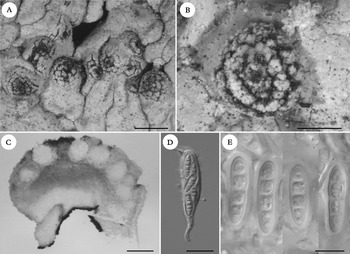
Plectocarpon dirinariae (holotype). A & B, ascomata on the host thallus; C, section through an ascoma; D, ascus with ascospores; E, ascospores. Scales: A=1 mm; B=0·5 mm; C=200 µm; D=25 μm; E=10 μm.

Ascomata on the upper surface of the host thallus, dispersed, rarely 2–4 confluent, rounded, moderately to strongly convex, bursting through the host cortex by more or less black concentric rings often becoming labyrinthiform, with whitish to pale grey remnants of the host cortex present between them, basally not or slightly constricted, without elevated host margin, without pruina, 0·6–1·0(–1·4) mm diam.; galls inconspicuous from the outside but visible in section. Hymenium hyaline, not or slightly exposed, 130–170 µm tall, I+ red, K/I+ blue, multilocular in vertical section; loculi globose, surrounded by a stromatic tissue that is hyaline to pale orange, rarely brown near the surface or in very old ascomata, K−; epihymenium yellowish to pale brown, I+ red, K/I+ blue. Paraphysoids richly branched and anastomosing, 2·0–2·5 µm diam., apically not or slightly enlarged, up to 3 µm diam. Asci narrowly clavate, 4–6(–8)-spored, with a tiny apical K/I+ blue ring, 70–100×15–22 µm (n=14). Ascospores hyaline, oblong, 3-septate, with cells of about equal length, not or occasionally constricted at the median septum, (15·0–)18·5–22·0(–25·0)×(4·5–)5·0–6·5(–7·0) µm, l/b ratio 3–4 (n=50), overlapping in 2–3 rows in an ascus; gelatinous perispore distinct, hyaline, 1·5–2·0 µm thick, brown pigmentation not observed.
Pycnidia not observed.
Distribution, ecology and host. Known only from the type locality in Cape Verde (island of Santo Antão), in a valley with different plantations of bananas, coffee and sugar-cane and scattered mixed trees. The new species was collected from an antropogene wall of stones (c. 2 m high) rather poor in lichens. On natural rocks nearby, several Peltula species were collected, such as P. euploca (Ach.) Poelt, P. obscurans (Nyl.) Gyeln., P. omphaliza (Nyl.) Wetmore, P. patellata (Bagl.) Swinscow & Krog and P. rodriquesii (Cromb.) Büdel. Plectocarpon dirinariae inhabits the upper surface of thalli of Dirinaria applanata (Fée) Awasthi. It seems to be commensalistic, as it does not cause any visible necrotic areas on the host thallus.
Notes. The new species is easily distinguished from all other Plectocarpon species by non-pruinose, strongly convex ascomata, non-carbonized sterile stromatic tissue and 3-septate ascospores. Plectocarpon dirinariae keys out in Ertz et al. (Reference Ertz, Christnach, Wedin and Diederich2005: 20) with P. cristalliferum Christnach et al. and P. scrobiculatae Diederich & Etayo. Both species differ from the new species by their reddish brown ascomata. In addition, P. scrobiculatae has ascomata inducing basally constricted galls, shorter asci (50–75 µm), slightly wider ascospores (6–8 µm) and is confined to Lobaria scrobiculata (Scop.) DC., a lichen host having cyanobacteria as photobiont. Plectocarpon cristalliferum (on Sticta) is very different by having ascomata containing conspicuous crystal aggregates, small asci (30–40 µm long) and narrower ascospores (3·5–4·5 µm wide). Plectocarpon macaronesiae, a species endemic to Macaronesia, differs by flat to slightly convex ascomata, a sterile stromatic tissue that is dark greenish to black in the upper part, K+ green intensifying, a dark greenish epihymenium, mainly 6–8-spored and shorter asci (50–60 µm), and different host lichens (Lobaria). The recently described species P. stereocaulicola Kukwa et al. differs by ascomata inducing the formation of galls with a constricted base, a sterile stromatic tissue carbonized in the upper part, an I+ blue hymenial gel, mainly 8-spored asci and larger ascospores (20–28×6·5–8·0 µm).
We wish to thank very warmly Cyrille Gerstmans for his help with the technical part of the manuscript. The study was financially supported by the Fonds National de la Recherche Scientifique, Belgium (FNRS) / FRFC grant 2.4567.08.