




No CrossRef data available.
Article contents
Learning nonnative names: The effect of poor native phonological awareness
Published online by Cambridge University Press: 19 July 2005
Abstract
This research investigates the influence of phonological awareness on the learning of vocabulary in a foreign language. Thirty-seven Chinese-speaking third graders with high phonological awareness and 37 with low phonological awareness participated in multitrial word learning tasks involving nonnative sounding (English) new names paired with novel referents. The children also participated in three additional associative learning tasks: learning to associate novel native sounding names, familiar native names, and unfamiliar visual shapes with unfamiliar referents. Results indicated that children with lower phonological awareness learned both the novel nonnative names and the novel native names less accurately than children with higher phonological awareness and required more learning trials. However, these two groups did not differ in learning to associate familiar names or unfamiliar visual shapes with novel referents. The findings suggest that poor phonological awareness might slow nonnative acquisition of vocabulary via difficulty in constructing new phonological representations for new words.
Information
- Type
- Articles
- Information
- Copyright
- © 2005 Cambridge University Press
To adults who are proficient readers and writers, it seems quite obvious that spoken words are composed of strings of discrete phonological segments. However, for children the insight that words are composed of discrete segments comes gradually, often as a result of literacy instruction. To many young children, and even to some adolescents and adults, a word is a word, distinguishable from other words holistically in terms of pitch contours, rhythm, stress, increased duration, and strong–weak template; however, the segmental details of the word are obscured by the overall phonological shape of the word. Knowledge of the discrete sound segments of language, that is, phonological awareness, has been found to relate to poor performance on a number of language processing tasks, such as naming objects and pictures (Catts, 1989; Manis, Seidenberg, & Doi, 1999; Snowling, van Wagtendonk, & Stafford, 1988; Swan & Goswami, 1997; Wolf & Bowers, 1999), holding verbal information in working memory (Brady, 1991), perceiving fine speech distinctions (Adlard & Hazan, 1998; Brady, Poggie, & Rapala, 1989; de Weirdt, 1988; Manis et al., 1997; Reed, 1989), repeating nonsense words (Catts, 1986; Metsala, 1999), reading (Goswami, 2002; Stanovich & Siegel, 1994), and learning new words (de Jong, Seveke, & van Veen, 2000; Hu, 2003).
A distinction between phonological awareness and phonemic awareness is often made in the developmental literature, particularly to quantify the depth with which a child is aware of the sound structure of language (Adams, 1990; Goswami, 2000; Goswami & Bryant, 1990; Stahl & Murray, 1994). The participants in the current study were native speakers of Chinese, and this distinction between phonological and phonemic awareness may not be particularly relevant with these children. The dominant syllabic structure in Mandarin Chinese is consonant–vowel (CV). In most cases, the C and the V correspond to the onset and the rime of the word. (In English, with a CVC word, for example, the onset would be C and the rime VC.) The syllable structure of Chinese makes it difficult to determine whether a child's understanding of C and V is at the onset–rime level or at the phonemic level. In this article, discussion of children's phonological awareness is used to refer to the child's insight into the subsyllabic units of the spoken word, be it at the phonemic level or at the onset–rime level.
Because poor phonological awareness has been shown to relate to poorer performance on a variety of language tasks, the current study considered the influence of native phonological awareness on another domain of language learning, the learning of nonnative words, in other words, learning of foreign language words. Native phonological awareness (phonological awareness in first language [L1]) was examined in this study for several reasons. First, phonological awareness is basically transferable from one language to another language (e.g., Cisero & Royer, 1995; Comeau, Cormier, Grandmaison, & Lacroix, 1999; Durgunoglu, Nagy, & Hancin–Bhatt, 1993). If a child realizes that words in his or her native language lexicon can be divided into component sounds, the child can apply that awareness to foreign language. Because for most children phonological awareness develops initially in the L1, the initial learning of foreign language would be influenced by phonological awareness in the L1 and not the foreign language. If a child has little or no knowledge of foreign language, then there would not be phonological awareness specific to foreign language that would assist in learning. This situation may differ for children whose literacy instruction is provided in their second language (L2) or for children who are given sufficient exposure to the second language (Guron & Lundberg, 2003).
Second, although phonological awareness is essentially transferable from one language to another language, there are studies indicating that experience with a particular language affects how phonological representations are implicitly and explicitly structured (Caravolas & Bruck, 1993; Cheung, Chen, Lai, Wong, & Hills, 2001). Given that the purpose of this study is to evaluate the role of phonological awareness in the very early learning of novel nonnative words and given that the child participants differed considerably in their experiences with the nonnative language, a finding of the relationship between nonnative phonological awareness and nonnative vocabulary learning would be less interesting. The relation may be nothing more than the spurious effect of the common variance in experience with the nonnative language.
Third, we sought to delineate the relationship between native and nonnative language processing abilities. It is not surprising that researchers have reported that the overt or subtle native language learning differences of high school and college students with language learning disabilities affect learning of a foreign language (Chen, 1999; Ganschow, Sparks, & Javorsky, 1998; Ganschow, Sparks, Javorsky, Pohlman, & Bisho–Marbury, 1991; Simon, 2000; Sparks & Ganschow, 1993, 1995). Specifically, foreign language learners who have poor phonological skills are likely to experience immediate and significant difficulty when they try to learn a foreign language (Ganschow et al., 1991; Sparks, Ganschow, & Pohlman, 1989; see also Meschyan & Hernandez, 2002). The concomitant existence of native and foreign language difficulties among high school and college students, however, does not say much about how native language abilities affect foreign language learning in the first place. To be able to model the interplay between native and foreign language acquisition comprehensively, it is important to know which aspect(s) of native language processing influences which aspect(s) of foreign language learning. This relation must be evaluated in the absence of obvious language impairment in the L1. Given that phonological awareness has been identified as a locus of many language problems, it is logical to explore foreign language learning differences with respect to native phonological awareness abilities in populations with typical language learning abilities.
Theoretically, the ability to represent a spoken word segmentally should facilitate word learning in a nonnative language. Hearing and repeating unfamiliar sequences of nonnative sounding syllables and segments is a familiar task to those who try to learn the lexicon of a nonnative language. However, although it is not so difficult for learners to process the overall prosodic features of the new word, the subsyllabic segments are often elusive. To be able to access individual segments in a novel sequence of sounds (i.e., a new word) thus seems the first, and to many learners, the most frustrating step in acquiring nonnative vocabulary. Children who have more developed phonological awareness in their native language can be expected to have greater access to the segments of the nonnative language than children who have poorer phonological awareness.
Recent work by Hu (1999, 2003) provides some direct support for the importance of native phonological awareness in nonnative word learning. Phonological memory was found to be concurrently and predictively related to the word recall and pronunciation learning of a nonnative language initially tested at age 5, whereas the measures of phonological awareness were not. However, the phonological awareness measures emerged as significant predictors when the words were taught again 6 months later, after the variance due to the native reading ability, phonological memory, and initially tested nonnative word learning ability was controlled. These results provide preliminary evidence that phonological awareness may play a specific role in nonnative vocabulary acquisition.
There were three limitations in Hu's study (2003), however. First, the participants were young; most were prereaders when they were tested. These children demonstrated very limited phonological awareness at the subsyllabic level. The relationship between phonological awareness and nonnative word learning may not be replicated in older children with more mature and stable phonological awareness. Perhaps the acquisition of nonnative vocabulary depends on a certain minimum of insight into the internal components of a spoken word, beyond which individual differences in phonological awareness are less crucial. Second, the children's existing vocabulary knowledge was not measured. Even though test words in Hu (2003) were chosen from rather obscure nonnative words that children were unlikely to have encountered, it is plausible that the relationship between native phonological awareness and nonnative word learning was mediated more broadly by children's nonnative vocabulary knowledge. Under the pressure to discriminate between two phonological systems and to sort out the phoneme constancy of two languages, children who knew more nonnative words might have developed a deeper insight into the phonological structure of language, be it specific to the nonnative language or to language in general. This awareness, arising from experience with nonnative vocabulary, in turn, might have simultaneously facilitated the development of native phonological awareness and the nonnative word learning ability. Third, to succeed in the associative learning task of nonnative vocabulary employed in Hu (2003), a child had to be able to establish a stable phonological representation for the new word for subsequent production and had to be able to map the phonological representation onto the correct referent. Given that Hu (2003) did not differentiate these two processes, it remained unclear how poor phonological awareness can affect nonnative vocabulary learning.
The current study aimed to provide a more direct investigation of the relationship between native phonological awareness and nonnative word learning. The three questions that were left unanswered in Hu (2003) were addressed by examining the following three hypotheses. First, phonological awareness also plays a role in nonnative word learning among children whose phonological awareness has reached a more stable, mature stage. Second, the relation between native phonological awareness and nonnative vocabulary learning is unique and independent of the child's extant vocabulary knowledge of the nonnative language. Third, poor native phonological awareness affects the acquisition of new nonnative words via deficiency in the construction of new phonological forms rather than difficulty in mapping a phonological form onto a referent.
In this study, participants were third grade Chinese-speaking children, older than the 5-year-old preschoolers recruited in Hu (2003). Many studies have shown that the experience with reading an alphabetic orthography is crucial to the development and stabilization of phonological awareness (Foy & Mann, 2003; Goswami & Bryant, 1990; Morais, Cary, Alegria, & Bertelson, 1979; Morais, Castro, Scliar–Cabral, Kolinsky, & Content, 1987; Prakash, Rekha, Nigam, & Karanth, 1993). Experience with the reading of a logographic orthography has also been shown to be related to the development of phonological awareness (Cheung & Chen, 2004; Ho & Bryant, 1997; Ho, Law, & Ng, 2000; Hu, 2004; Hu & Catts, 1998; Siok & Fletcher, 2001). Reading instruction in Taiwan starts with an introduction of zhuyin fuhao, a set of phonetic symbols, which are printed alongside Chinese characters as an aid for pronouncing characters. With at least 3 years of experience in reading zhuyin fuhao and Chinese characters, children's phonological awareness was expected to have reached a fairly stable stage when they were tested. Moreover, by third grade it is likely that the phonological awareness tasks reliably tapped into children's varying skill levels and that floor effects would not be a confounding issue.
Factors that might complicate the interpretation of the relationship such as phonological memory and nonnative vocabulary knowledge were directly assessed and used as covariates in statistical analyses. Phonological memory was included because it was found to support vocabulary acquisition in L1 as well as in foreign languages (Avons, Wragg, Cupples, & Lovegrove, 1998; Cheung, 1996; Gathercole & Baddeley, 1990; Gathercole, Service, Hitch, Adams, & Martin, 1999; Service & Kohonen, 1995). However, studies also showed that such skills such as phonemic segmentation are crucial if new phonological forms are to be accurately encoded in phonological memory (Metsala, 1999; Snowling, Chiat, & Hulme, 1991).
Finally, in addition to the associative learning task of nonnative vocabulary, three additional associative learning tasks that allowed for an examination of the locus of the effect of phonological awareness on nonnative vocabulary learning were created. If phonological awareness influences nonnative vocabulary learning through its effect on the construction of new phonological forms, then children with poor phonological awareness should have difficulty learning to associate novel native names and novel nonnative names with novel referents, both of which involved the construction of new phonological forms. However, they should not have difficulty learning to associate familiar names or novel visual shapes with novel referents because these two tasks do not require the construction of new phonological forms. If, on the other hand, phonological awareness influences nonnative vocabulary learning through its effect on semantic mapping rather than through its effect on the construction of new phonological forms, then children with poor phonological awareness should have difficulty with all the four associative learning tasks.
METHODS
Participants
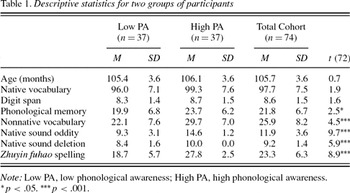
A group of 148 Chinese-speaking third graders from eight classes participated in the study over the course of third and fourth grade. Their mean age was 8 years, 10 months (8;10, range=8;2–9;3) when they were first tested. The fall testing ran from early November to late December and the spring testing ran from mid-April to early June. The participant selection tests were given in the fall of third grade and the control tasks in the spring of third grade. In the fall of fourth grade the nonnative name learning and native name learning tests were given and in the spring the familiar name learning and visual name learning tests were given. Permission for participation was obtained from the school and the parents. The children were administered a set of participant selection tests in groups of 15–20. The selection tests were a native sound oddity task, a native sound deletion task, and a zhuyin fuhao spelling task. The children were selected and categorized according to their performances on these three native phonological awareness tasks. The score on each task was converted to a z score, and then each child's scores on the three tasks were averaged. Children with z scores below the 25th percentile were classified as having low phonological awareness (Low PA), and those with z scores above the 75th percentile were classified as having high phonological awareness (High PA). Forty-one children were categorized as Low PA and 38 were categorized as High PA. Three children in the Low-PA group and 1 child in the High-PA group left the school during the study, leaving 38 in the Low-PA group and 37 in the High-PA group completing all the tasks. One child in the Low-PA group was excluded from the analyses because of his particularly low verbal IQ as measured by the Chinese version of the Peabody Picture Vocabulary Test—Revised (PPVT-R; Lu & Liu, 1998). Thus, data are reported only for the remaining 74 children (37 in the Low-PA group and 37 in the High-PA group), who completed all the tasks. The Low-PA group did not represent a group of children who were slow in general verbal processing. In this study, the two groups of children did not differ on the PPVT-R, a test of verbal IQ, t (72)=1.9, p > .05, or digit span, t (72)=1.6, p > .05 (Table 1). Tests in this study were given by two graduate students who were blind to the purposes of the present study and the grouping status of the children.

Note that in this study the participation selection tasks (i.e., phonological awareness) were administered a year before the associative learning task was given. This arrangement was made for two reasons. The first was purely pragmatic. Time constraints did not allow the administration of the various measures within one semester. In the second, it was assumed that the children would not change phonological awareness group during the intervening year because studies have revealed that deficits in phonological awareness persist from early childhood to adulthood (Bruck, 1992; Pennington, van Orden, Smith, Green, & Haith, 1990) and phonological awareness abilities are quite stable across the early elementary years (Torgesen, Wagner, & Rashotte, 1994; Wagner, Torgesen, Laughton, Simmons, & Rashotte, 1993; Wagner, Torgesen, & Rashotte, 1994). An extended period between the phonological awareness tasks and the outcome measures also allowed us to investigate the long-term effect of poor phonological awareness on the associative learning of foreign words. Indeed, the two groups of children identified in the fall of the third grade were given two measures of L1 phonological awareness individually in the spring of the third grade to make sure that the initial grouping procedure was valid. Group performances differed significantly in these two individually administered measures of phonological awareness (initial consonant deletion and initial consonant substitution), indicating the initial grouping status was stable over time.
In Taiwan, English education officially begins at different ages in different counties. In Taipei where the children in the study resided, English education began in the third grade. (Currently, as a result of policy change, English education starts in the first grade in Taipei.) The children in this study participated in a 40-min English class in school each week over the course of the 2 years of this study; in addition, many children went to private after-school English programs. Thus, children widely differed in terms of their experience with the English language.
Participant selection tasks
Native sound oddity
This test was similar to the oddity task adopted in Hu and Catts (1998) and Siok and Fletcher (2001), but it was adapted as a group test with a forced choice procedure with a chance level of 33%. In this task, the children heard 16 sets of three one-syllable words (e.g., bi [pen], ban [plank], gou [dog]). In half of the sets, one word in each set of three words did not start with the same consonant as the other two (in this case gou). In the other half, the odd word did not rhyme with the others. The experimenter orally presented the three test words in each set three times, each time pointing to the corresponding numbers 1, 2, and 3 on an enlarged version of the answer sheet. The child's task was to circle the number on an answer sheet that represented the odd word. The position of the odd word was varied randomly in positions 1–3 across trials (max=16).
Native sound deletion
The experimenter read a disyllabic word twice (e.g., shou-pa [handkerchief]) and asked the children what was left if the initial consonant of the word was deleted. The initial consonant was read as its sound value rather than its corresponding zhuyin fuhao name. The experimenter read the two choices, pointing to the corresponding numbers 1 and 2 on an enlarged version of the answer sheet. The child was asked to circle on an answer sheet the number that represented the correct choice. There were 10 trials (max=10).
Zhuyin fuhao spelling
In this task, the child was required to spell in zhuyin fuhao a wordlike stimulus read by the experimenter. This task was included because of its close association with phonological awareness among Chinese speakers (Hu & Catts, 1998; Read, Zhang, Nie, & Ding, 1986; Siok & Fletcher, 2001). All the wordlike stimuli were monosyllabic: 10 were high-frequency words, 13 low-frequency words, and 10 pseudowords (max=33).
Control tasks
Phonological memory
In this task, children repeated bisyllabic Chinese-sounding pseudowords. Thirty-six syllables were constructed by combining one of six consonants b, d, k, g, zh, and sh with one of six rimes u, a, ai, au, an, and ang. The consonants and vowels could be freely combined with each other without violating the phonological rules of Mandarin. Two syllables were combined into a bisyllabic pseudoword, and each pseudoword was assigned a tonal structure. Thus, a total of 36 syllables were combined to form 18 words. None of the successive syllables in a pseudoword were assigned Tone 3. In Mandarin, when two syllables with Tone 3 occur in succession within a word, the tone of the first syllable changes to Tone 2. Because the stimuli used in this task were pseudowords, the change of tone would make it difficult to document the child's response. There was a total of six trials with three pseudowords in each trial (18 different words). In each trial, the child listened to the bisyllabic pseudowords spoken by the experimenter. The child was instructed to repeat the pseudowords immediately in the order that they had been presented. The child's responses were audiorecorded and later were transcribed by two college graduates. The child's performance was scored in terms of the number of syllables recalled correctly in the correct position (max=6 trials × 6 syllables per trial=36). The test–retest reliability of the task obtained for first graders in an earlier study (Hu & Catts, 1998) was .85.
Digit span
The experimenter read a sequence of digits (from 4 to 12 digits) to the child at the rate of 1 digit per second, and the child was asked to repeat the sequence of digits in the same order. There were two consecutive trials at each sequence length. The task was discontinued when the child failed to repeat two trials of the same length consecutively. The scoring was based on the maximum number of digits that the child could recall.
Native vocabulary
The Chinese version of the PPVT-R (Lu & Liu, 1998) was used to measure the child's receptive vocabulary of the native language. The Chinese PPVT-R consists of a series of 175 plates, each containing four line drawings of objects or actions. For each plate, the experimenter provided a stimulus word orally. The child was asked to respond by pointing to the line drawing on the plate that best illustrated the meaning of the stimulus word. Test administration proceeded until the test error criterion was reached.
Nonnative vocabulary
The nonnative vocabulary task was developed by Lee (2000). The task consisted of a series of 40 plates, each containing four line drawings of objects or actions. For each plate, the experimenter provided an English word orally. The child was required to respond by circling the line drawing on the plate that best illustrated the meaning of the stimulus word (max=40). The reliability of the task (Spearman–Brown) is .90.
Associative learning tasks
There were four multitrial associative learning tasks: (a) a nonnative name learning task, (b) a native name learning task, (c) a familiar name learning task, and (d) a visual name learning task. The first two tasks required the child to verbally produce three pseudowords as names for three cartoon figures, thus involving the construction and production of new phonological forms. The third task also involved reproduction of the given names, but the names were already familiar to the child. The fourth task required the child to learn to associate three unfamiliar visual shapes as names for three cartoon figures. Given that the purpose of the study was to determine whether children with poorer phonological awareness had difficulty in learning nonnative names due to their particular difficulty in constructing new phonological forms rather than in mapping a set of forms onto a set of referents, we made the four tasks comparable in terms of the demands in mapping (i.e., mapping three forms onto three cartoon figures) but different in the forms required to be learned.
A pool of 12 cartoon figures was created and judged by an independent group of third graders as novel figures with which no known names were associated. The 12 figures were then randomly divided into four sets of three figures so that a unique set of figures could be used in each learning task. In each task, there were three names to be learned; the three names were paired with three cartoon figures. The pairing of the novel figures and names for each task was systematically varied so that the names to be learned in each task had an equal chance of being paired with the four sets of cartoon figures. By varying the pairing in this way, there was a control for any inherent factors (e.g., the distinctiveness of a particular cartoon, the salience of a particular pairing) that might affect children's associative learning. Within each task, the order of the three names to be learned varied from trial to trial in the same fixed way for all children.
Nonnative name learning
Each child was individually taught three new nonnative names with the accompanying pictures of the referents. The nonnative names were derived from the three English names Patsy, Roger, and Ellis by interchanging the syllables across the names. Two sets of three novel English names were created. One included Rotsy, Elger, and Palis; the other included Rolis, Pager, and Eltsy. The phonological structures of these names are different from Chinese and thus, they would not be treated as unfamiliar Chinese new names. To ensure that Chinese-speaking children did not have difficulties in articulating these names, the names were first tested on a different group of Chinese third-graders (N=10) by eliciting immediate repetition of the names. These children did not demonstrate obvious difficulties in articulating these names. Half of the children learned one set of the English names and the other half learned the other set. For each of the three names, the examiner showed the child a picture of the referent and labeled the picture with its name. The child was asked to repeat the name. No feedback was given as to the correctness of the child's pronunciation, so that every child would receive an equivalent amount of instruction (i.e., input). Nonetheless, the accuracy in immediate repetition was recorded. When the child had been given the opportunity to repeat the names of all three pictures, the three pictures were shown again in a different order and the child was asked again to name the pictures without an immediately preceding model. The accuracy of the child's production attempts to name the pictures was scored and audiorecorded for later transcription by a college student who was blind to the purposes of the study. The interscorer reliability was .96 for 20% of the sample. Thus, a single trial consisted of the adult saying each of the three names, the child attempting to repeat each name, and the child being shown the pictures a second time and asked to produce the name without an immediately preceding model. A maximum of 10 trials was administered; the trials were discontinued if the child named all three pictures correctly in 2 consecutive trials. A correct name was defined as a production with no obvious phoneme replacements, omissions, or additions (max=30). The children did not show difficulty in articulating these foreign names as evidenced by their 98% accuracy rate in the immediate repetition of the test stimuli. Group differences in immediate repetition were not significant, t (72)=1.5, p > .05. The reliability of the task (Spearman–Brown) is .93.
Native name learning
The task was similar to the nonnative name learning task, except that the targets were the three Chinese names Pi-su, Zhai-le, and Li-cao, which were created according to the phonotactic and prosodic constraints of the Chinese language. Like the nonnative name learning task, a maximum of 10 trials was administered; the trials were discontinued if the child named all three pictures correctly in 2 consecutive trials. A correct name was defined as a production with no obvious phoneme replacements, omissions, or additions (max=30). The reliability of the task (Spearman–Brown) is .90.
Familiar name learning
In this task, the child learned to associate familiar native names with unfamiliar cartoon figures. The task was included to test whether the two groups of children differed in their ability to attach a familiar linguistic label to an unfamiliar referent. The words to be learned were three familiar fruit names: ping-guo (apple), li-zi (pear), and liu-ding (orange). The task was similar to the nonnative name learning task. A maximum of 10 trials was administered. The task was discontinued after the 10th trial or if the child named the three cartoon figures correctly in 2 consecutive trials (max=30). The reliability of the task (Spearman–Brown) is .86.
Visual name learning
The visual name learning task was similar to the aforementioned associative learning tasks, but this task involved no verbal learning. The task evaluated whether the two groups of children differed in associative learning abilities when the learning involved no verbal materials. The child was presented with three unfamiliar cartoon figures, each accompanied by a doodle drawing. Neither the cartoon figures nor the doodle drawings were readily nameable in the child's native language. The child was told that the doodle drawings were the graphs of a strange language, which represented the names of the cartoon figures. The child had to learn to associate the cartoon figure with its corresponding graphic name. After the initial presentation of the pairing of the cartoon figures and the doodle drawings, the child was presented again with the same set of cartoon figures though in a different order and with the accompanying doodle drawings. The child was then given three cards, each with one of the doodle drawings on it. The child had to match each of the doodle drawings with its corresponding cartoon figure. The number of correct matches was scored. Thus, a single trial involved the presentation of the pairing of the cartoon figures and the doodle drawings (the presentation phase), the presentation of the cartoon figures again and the child's being asked to match the cartoon figures and the doodle drawings (the test phase). The task stopped after the 10th trial, or if the child correctly paired drawings to figures in 2 consecutive trials (max=30). The reliability of the task (Spearman–Brown) is .88.
RESULTS
Table 1 presents statistics about participant characteristics. The two groups of children differed on the three phonological awareness measures, t (72)=9.7, p<.001, for native sound oddity; t (72)=5.9, p<.001, for native sound deletion; t (72)=8.9, p<.001, for zhuyin fuhao spelling, validating the grouping procedure of the present study. As expected, the two groups of children differed in phonological memory, t (72)=2.5, p<.05, and nonnative vocabulary, t (72)=4.5, p<.001. Individual differences in these two abilities were controlled statistically in the following analyses. In spite of differences in phonological awareness, phonological memory, and nonnative vocabulary knowledge, children in the Low-PA group and in the High-PA group did not differ in age, native receptive vocabulary, or digit span.
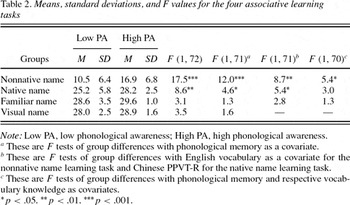
In order to guard against Type I errors due to multiple univariate testing, a repeated-measures multiple analysis of covariance (MANCOVA) with group status as a fixed factor, associative learning task as a repeating factor, and memory as a covariate was conducted to evaluate whether children with High PA consistently performed better than children with Low PA across the four associative learning tasks. Memory was included in the model because the four tasks all involved memory learning. Vocabulary knowledge was not included as a covariate in the overall MANCOVA because not all of the four tasks involved the knowledge of the native or nonnative vocabulary. Follow-up analyses were conducted using separate univariate analyses of variance (ANOVAs) and ANCOVAs for the four associative learning tasks to evaluate further differences between groups within each associative learning. Vocabulary knowledge was included as a covariate in the relevant individual ANCOVA model.
Given that the groups were extreme (below the 25th and above the 75th percentiles), it is important to check that the covariates had the same relation to the dependent variables. An informal examination of the scatterplots, separately for the four associative learning tasks against each of the covariates (i.e., memory or vocabulary knowledge), indicated parallel linear bands across the graphs with no obvious departures from linearity. We also tested whether there were interaction effects between group and the covariates for each of the associative learning tasks. An interaction effect would indicate that the group regression lines had different slopes. However, no significant interaction effects were identified (all ps > .05).
The results of the MANCOVA on the two groups (High PA vs. Low PA) and the four task variables (nonnative name, native name, familiar name, and visual name) yielded a significant main effect of group status, F (1, 71)=14.7, p<.001, and a main effect of task, Wilks' lambda, F (3, 69)=16.12, p<.001. There was also a significant interaction effect between group status and task, Wilks' lambda, F (3, 69)=3.0, p<.05. As displayed in Table 2, individual ANOVAs revealed that children with High PA performed significantly better than children with Low PA in nonnative name learning, F (1, 72)=17.5, p<.001, and native name learning, F (1, 72)=8.6, p<.01. However, there was no evidence that children with High PA performed better than children with Low PA in familiar name learning, F (1, 72)=3.1, p > .05, and visual name learning, F (1, 72)=3.5, p > .05. In addition, group differences in nonnative learning remained significant after controlling for the variance due to phonological memory, F (1, 71)=12.0, p<.001, for the variance due to nonnative vocabulary, F (1, 71)=8.7, p<.01, or for the variance due to the combined effect of phonological memory and nonnative vocabulary, F (1, 70)=5.4, p<.05. Group differences in novel native name learning remained significant after controlling for the variance due to phonological memory, F (1, 71)=4.6, p<.05, or that due to native vocabulary, F (1, 71)=5.4, p<.05, although not after controlling for the variance due to the combined effect of phonological memory and native vocabulary, F (1, 70)=3.0, p > .05. These results indicated that children with poorer phonological awareness had difficulty in associative learning only when the materials to be learned involved novel, verbal information.

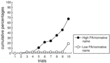
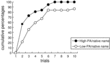
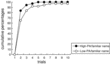
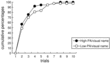
Figures 1–4 present the cumulative percentage of children who reached the criterion (successful learning in two consecutive trials) from Trial 1 to Trial 10 in the four associative learning tasks. Figure 1 presents the performance of children with High PA and those with Low PA in the nonnative name learning task. Children with High PA demonstrated a quicker and more accurate acquisition of the three nonnative names within the testing trials of the study. There was no evidence that group differences diminished with the increased learning practice of additional trials. Figure 2 presents the performance of the two groups of children in the native name learning task. As in the nonnative learning task, children with Low PA demonstrated slower mastery and more error-prone performance in the native name learning task. Again, there was no evidence that group differences diminished with the increased learning practice of additional trials. However, compared with Figure 1, it is clear that both groups of children learned the native names more quickly than the nonnative names.

The cumulative percentages of children reaching the criterion in nonnative name learning

The cumulative percentages of children reaching the criterion in native name learning

The cumulative percentages of children reaching the criterion in familiar name learning

The cumulative percentages of children reaching the criterion in visual name learning
Figure 3 presents children's performance in the learning of familiar names. In contrast to the two novel name learning tasks, children with Low PA were comparable to children with High PA in learning to associate familiar phonological forms with unfamiliar referents. Figure 4 presents children's performance in the visual name learning task. There was no obvious evidence that children with Low PA were slower and less accurate than children with High PA in learning to associate unfamiliar visual forms with unfamiliar referents.
DISCUSSION
This study was designed to investigate the influence of native phonological awareness on vocabulary learning in a nonnative language. The first objective was to ask whether this relationship was evident not only when children were quite young and many had limited phonological awareness (Hu, 2003) but also when children's phonological awareness abilities had become more established (i.e., in the third and fourth grades). The second objective was to evaluate the effect of children's extant vocabulary on the relationship. The third objective was to address the hypothesis that poor native phonological awareness affected the acquisition of nonnative words via a deficiency in the construction of new phonological forms.
In general, the results of the study were consistent with Hu (2003), that poor phonological awareness of one's native language adversely affected the acquisition of new vocabulary in a nonnative language. Children who demonstrated poorer awareness of the sound structure of their native language were found to be poorer learners of nonnative words as compared to children who were more phonologically aware. In accordance with Hu (2003), the effect of phonological awareness was significant after controlling for variation in phonological memory, which has been shown to be a robust predictor of word learning ability (Avons et al., 1998; Cheung, 1996; Gathercole & Baddeley, 1990; Gathercole et al., 1999; Service & Kohonen, 1995).
In addition, the present study extended the findings of Hu (2003) and provided evidence that the relation is not age specific, evident only when phonological awareness begins to emerge. The connection between native phonological awareness and nonnative word learning was established in a group of third grade children who had more developed, more fine-tuned, and more explicit awareness of the sound structure of the language than the preschoolers in Hu (2003). Likely, the study participants had developed more advanced phonological awareness skills as a result of experience with reading and/or cognitive maturation. The children had three years of experience in reading the logographic script and the sound-based script (zhuyin fuhao). Despite the greater skill overall in phonological awareness, there was nevertheless a wide range of individual differences in the children's phonological awareness. Importantly, the present findings did not reveal a diminishing effect of native phonological awareness, suggesting that the influence of native phonological awareness on nonnative vocabulary learning extends beyond initial learning in the nonnative language and persists into the elementary school years. One remark may be added as to the relationship between phonological awareness and nonnative word learning. In this study, phonological awareness was measured in the first half of Grade 3 and nonnative word learning was measured 1 year later in Grade 4. By measuring over time, we have assumed that the relationship between variables of interest remained constant because of the persistence of the phonological awareness deficits demonstrated in the reading literature (Bruck, 1992; Pennington et al., 1990). With the 1-year interval between phonological awareness and nonnative word learning, the results seem to suggest the possibility that difficulty in phonological awareness may have long-term observable effect in nonnative learning in line with the research on foreign language learning difficulties (e.g., Ganschow et al., 1998). This possibility certainly needs to be substantiated in future research.
The inclusion of the measure of extant nonnative vocabulary knowledge in the present study helped discern whether the relation found in the earlier studies was an artifact of individual differences in the child's prior experience with the nonnative language. Presumably, a large vocabulary in a language can enhance further vocabulary learning in that language via two paths. First, the large vocabulary can have direct influence by increasing the likelihood of finding close approximations in memory to the words to be learned. Second, the large vocabulary can have indirect influence by increasing the phonological awareness of the nonnative language, thereby facilitating the construction of phonological representations for a novel word in the nonnative language. The results of the present study do not refute the possibility that current nonnative vocabulary knowledge might play a role in the acquisition of new nonnative vocabulary. Children with poorer phonological awareness had smaller receptive vocabulary in the nonnative language than children with better phonological awareness. However, the ANCOVA results suggested that the relation between native phonological awareness and nonnative vocabulary learning could not be completely attributable to individual differences in the children's prior nonnative vocabulary knowledge. Group differences in associative learning of the nonnative names with novel referents were significant after controlling for the variance due to English vocabulary.
Finally, there was evidence that the difficulty children with poorer phonological awareness encountered in the learning of new nonnative vocabulary derived from the difficulty in the construction of a phonological representation for the new word rather than from the mapping of the phonological representation onto the referent. In the present study, children with a less developed sense of the sound structure of the native language did not show a consistent deficit in associative vocabulary learning, but instead revealed a selective deficit in learning the association of novel verbal stimuli with novel referents. They performed comparably to children with better phonological awareness in the task that required them to learn to associate three familiar names with three novel referents, indicating that they were proficient in mapping verbal stimuli onto new referents when the demands were limited to three stimulus pairs. They also performed comparably to children with better phonological awareness in the task that required them to learn to associate three novel visual names with three novel referents, indicating that they were proficient in mapping novel nonverbal stimuli onto new referents, again, when the demands were limited to three stimulus pairs. They were, however, less capable of learning to associate three novel nonnative verbal stimuli with three novel referents. They were also less capable of learning to associate three novel native names with three novel referents. It appeared that children with poor phonological awareness only had difficulty when the learning involved new phonological forms, but not old phonological forms or new nonverbal information.
Caution should be taken that there were ceiling effects in the native name learning and visual name learning tasks. Group differences might emerge if the tasks became more demanding, for example, if the tasks involved learning more than three pairings. Thus, it may be premature to conclude that the two groups of children did not differ in their ability in the associative learning of familiar names or visual names. However, given that the mapping demands were comparable across the four associative learning tasks in terms of the number of pairings required to be learned, the group differences in some tasks but not in others allowed us to conclude tentatively that the difficulty that children with poorer phonological awareness encountered in the learning of nonnative vocabulary had roots in the construction of new phonological representations rather than in the mapping of the forms onto the referents.
Research on phonological awareness is plagued by difficulties in establishing direction of causation (Castles & Coltheart, 2004). One crucial question is whether poor performance on phonological awareness could be a consequence of reduced ability in general cognitive skills. Most phonological awareness tasks involve skills other than the ability to segment and match phonological strings. The tasks used in the current study were no exception. Many children with poorer phonological awareness did poorly on measures of phonological memory and nonnative vocabulary. Poor performance on nonnative word learning could then be a consequence of reduced general cognitive abilities rather than a specific cognitive deficit in phonological awareness. There are two aspects of the data that lead us to reject this view. First, the two groups of children, although differing on phonological awareness, did not differ in the native vocabulary measured by the PPVT-R or digit span. Second, if children with poorer phonological awareness had a deficit in general cognitive ability, difficulty in all of the associative learning tasks would have been expected.
In summary, this study further clarifies the contribution of native phonological awareness to nonnative word learning. Poor phonological awareness adversely affects the construction of a stable phonological representation for a new word, and thus adversely affects the acquisition of new words. The influence of phonological awareness is unique and cannot be explained by individual differences in the vocabulary knowledge of the nonnative language. It is not age specific; it is evident when the child starts to become phonologically aware and also when the child's phonological awareness becomes more mature. Children can bring to the foreign language acquisition task considerable knowledge of phonological structure derived from experiences with native language processing. This is an important aspect of children's cognitive–linguistic abilities that is brought to the task of learning a foreign language.
Most previous studies focused on the interference of native language on the perception or the pronunciation of the nonnative language. Many researchers have assumed that when children start to learn a nonnative language, they have developed a mature, well-specified phonological system for the L1, and thus L2 learning difficulties are attributed to interference from the L1. The results of the present study suggest that this assumption should be reconsidered carefully. Our understanding of nonnative vocabulary acquisition will be enhanced by consideration of a different perspective, one that considers the development of native phonological awareness in concert with the lexical processes of the nonnative language. The extent to which a child has developed phonological awareness may account for the varying levels of success young children experience in learning a foreign language. Explicating this relationship between native phonological awareness and nonnative vocabulary learning may influence instructional strategies. For example, it may be worth exploring whether strengthening a child's phonological awareness skills has a positive impact on subsequent foreign language learning. In addition, it would be interesting to explore this relation across time, as children become increasingly proficient in a nonnative language.
ACKNOWLEDGMENTS
This research was supported in part by grants from the National Science Council of Taiwan (NSC892411H133010, NSC902411H133010, NSC912411H133006). The authors thank the people and institutions that helped locate the children, the parents who gave their consent, and the children who participated in the study.
References
Adams M.
1990.
Beginning to read: Thinking and learning about print.
Cambridge, MA:
MIT Press.
Adlard A., &
Hazan V.
1998.
Speech perception in children with specific reading difficulties (dyslexia).
Quarterly Journal of Experimental Psychology: Human Experimental Psychology,
1,
153–
177.Google Scholar
Avons S. E.,
Wragg C. A.,
Cupples L., &
Lovegrove W. J.
1998.
Measures of phonological short-term memory and their relationship to vocabulary development.
Applied Psycholinguistics,
19,
583–
601.Google Scholar
Brady S.,
Poggie E., &
Rapala M. M.
1989.
Speech repetition abilities in children who differ in reading skill.
Language and Speech,
32,
109–
122.Google Scholar
Brady S. A.
1991.
The role of working memory in reading disability.
In S. A. Brady &
D. P. Shankweiler (Eds.),
Phonological processes in literacy: A tribute to Isabelle Y. Liberman
(pp. 129–
151).
Hillsdale, NJ:
Erlbaum.
Bruck M.
1992.
Persistence of dyslexics' phonological awareness deficits.
Developmental Psychology,
28,
874–
887.Google Scholar
Caravolas M., &
Bruck M.
1993.
The effect of oral and written language input on children's phonological awareness: a cross-linguistic study.
Journal of Experimental Child Psychology,
55,
1–
30.Google Scholar
Castles A., &
Coltheart M.
2004.
Is there a causal link from phonological awareness to success in learning to read?
Cognition,
91,
77–
111.Google Scholar
Catts H. W.
1986.
Speech production/phonological deficits in reading disordered children.
Journal of Learning Disabilities,
19,
504–
508.Google Scholar
Catts H. W.
1989.
Phonological processing deficits and reading disabilities.
In A. G. Kamhi &
H. W. Catts (Eds.),
Reading disabilities: A developmental language perspective
(pp. 101–
132).
Boston, MA:
College Hill.
Chen T.-Y.
1999.
A case study of a Chinese student with English learning disabilities.
In T.-L. Huang,
J. Katchen,
W.-Y. Dai, &
Y.-N. Leung (Eds.),
The Proceedings of the Eighth International Symposium on English Teaching
(pp. 271–
282).
Taipei, Taiwan:
Crane.
Cheung H.
1996.
Pseudoword span as a unique predictor of second-language vocabulary learning.
Developmental Psychology,
32,
867–
873.Google Scholar
Cheung H., &
Chen H.-C.
2004.
Early orthographic experience modifies both phonological awareness and on-line speech processing.
Language and Cognitive Processes,
19,
1–
28.Google Scholar
Cheung H.,
Chen H.-C.,
Lai C. Y.,
Wong. O. C., &
Hills M.
2001.
The development of phonological awareness effects of spoken language experience and orthography.
Cognition,
81,
227–
241.Google Scholar
Cisero C. A., &
Royer J. M.
1995.
The development of cross-language transfer of phonological awareness.
Contemporary Educational Psychology,
20,
275–
303.Google Scholar
Comeau L.,
Cormier P.,
Grandmaison E., &
Lacroix D.
1999.
A longitudinal study of phonological processing skills in children learning to read in a second language.
Journal of Educational Psychology,
91,
29–
43.Google Scholar
de Jong P. F.,
Seveke M.-J., &
van Veen M.
2000.
Phonological sensitivity and the acquisition of new words in children.
Journal of Experimental Child Psychology,
76,
275–
301.Google Scholar
de Weirdt W.
1988.
Speech perception and frequency discrimination for good and poor readers.
Applied Psycholinguistics,
9,
163–
183.Google Scholar
Durgunoglu A. Y.,
Nagy W. E., &
Hancin–Bhatt B. J.
1993.
Cross-language transfer of phonological awareness.
Journal of Educational Psychology,
85,
453–
465.Google Scholar
Foy J. G., &
Mann V.
2003.
Home literacy environment and phonological awareness in preschool children: Differential effects for rhyme and phoneme awareness.
Applied Psycholinguistics,
24,
59–
88.Google Scholar
Ganschow L.,
Sparks R. L., &
Javorsky J.
1998.
Foreign language learning difficulties: An historical perspective.
Journal of Learning Disabilities,
31,
248–
258.Google Scholar
Ganschow L.,
Sparks R. L.,
Javorsky J.,
Pohlman J., &
Bisho-Marbury A.
1991.
Identifying native language difficulties among foreign language learners in college: A “foreign” language learning disability?
Journal of Learning Disabilities,
24,
530–
541.Google Scholar
Gathercole S. E., &
Baddeley A. D.
1990.
The role of phonological memory in vocabulary acquisition: A study of young children learning new names.
British Journal of Psychology,
81,
439–
454.Google Scholar
Gathercole S. E.,
Service E.,
Hitch G. J.,
Adams A.-M., &
Martin A. J.
1999.
Phonological short-term memory and vocabulary development: Further evidence on the nature of the relationship.
Applied Cognitive Psychology,
13,
65–
77.Google Scholar
Goswami U.
2000.
Rhyme and analogy in beginning reading: Conceptual and methodological issues.
Applied Psycholinguistics,
21,
63–
93.Google Scholar
Goswami U.
2002.
Phonology, reading development and dyslexia: A cross-linguistic perspective.
Annals of Dyslexia,
52,
141–
163.Google Scholar
Goswami U., &
Bryant P. E.
1990.
Phonological skills and learning to read.
Hillsdale, NJ:
Erlbaum.
Guron L. M., &
Lundberg I.
2003.
Identifying dyslexia in multilingual studies: Can phonological awareness be assessed in the majority language?
Journal of Research in Reading,
26,
69–
82.Google Scholar
Ho C. S. H., &
Bryant P.
1997.
Phonological skills are important in learning to read Chinese.
Developmental Psychology,
33,
946–
915.Google Scholar
Ho C. S.-H.,
Law T. P.-S., &
Ng P. M.
2000.
The phonological deficit hypothesis in Chinese developmental dyslexia.
Reading and Writing: An Interdisciplinary Journal,
13,
57–
79.Google Scholar
Hu C. F.
1999.
Predicting foreign language word learning from first language phonological abilities.
In T.-L. Huang,
J. Katchen,
W.-Y. Dai, &
Y.-N. Leung (Eds.),
Proceedings of the Eighth International Symposium on English Teaching
(pp. 123–
134).
Taipei, Taiwan:
Crane.
Hu C. F.
2003.
Phonological memory, phonological awareness, and foreign language word learning.
Language Learning,
53,
429–
462.Google Scholar
Hu C. F.
2004.
The development of phonological representations among Chinese-speaking children.
Taiwan Journal of Linguistics,
2,
103–
130.Google Scholar
Hu C. F., &
Catts H. W.
1998.
The role of phonological processing in early reading ability: What we can learn from Chinese.
Scientific Studies of Reading,
2,
55–
79.Google Scholar
Lee P.-F.
2000.
Chinese bilingual children's word definition skill.
Unpublished master's thesis,
National Taiwan University,
Taipei.
Lu L., &
Liu H. H.
1998.
Chinese adaptation of Dunn, L. M., & Dunn, L. M. (1981).
Peabody Picture Vocabulary Test–Revised.
Taipei, Taiwan:
Psychological Publishing.
Manis F. R.,
McBride–Chang C.,
Seidenberg M.,
Keating P.,
Doi L. M.,
Munson B., &
Petersen A.
1997.
Are speech perception deficits associated with developmental dyslexia?
Journal of Experimental Child Psychology,
66,
211–
235.Google Scholar
Manis F. R.,
Seidenberg M. S., &
Doi L. M.
1999.
See Dick RAN: Rapid naming and the longitudinal prediction of reading subskills in first and second graders.
Scientific Studies of Reading,
3,
129–
157.Google Scholar
Meschyan G., &
Hernandez A.
2002.
Is native-language decoding skill related to second-language learning?
Journal of Educational Psychology,
94,
14–
22.Google Scholar
Metsala J. L.
1999.
Young children's phonological awareness and nonword repetition as a function of vocabulary development.
Journal of Educational Psychology,
91,
3–
19.Google Scholar
Morais J.,
Cary L.,
Alegria J., &
Bertelson P.
1979.
Does awareness of speech as a sequence of phonemes arise spontaneously?
Cognition,
7,
323–
331.Google Scholar
Morais J.,
Castro S. L.,
Scliar–Cabral L.,
Kolinsky R., &
Content A.
1987.
The effects of literacy on the recognition of dichotic words.
Quarterly Journal of Experimental Psychology, 39A,
451–
465.Google Scholar
Pennington B. F.,
Van Orden G. C.,
Smith S. D.,
Green P. A., &
Haith M. M.
1990.
Phonological processing skills and deficits in adult dyslexics.
Child Development,
61,
1753–
1778.Google Scholar
Prakash P.,
Rekha D.,
Nigam R., &
Karanth P.
1993.
Phonological awareness, orthography, and literacy.
In R. Scholes (Ed.),
Literacy and language analysis
(pp. 55–
70).
Hillsdale, NJ:
Erlbaum.
Read C. A.,
Zhang Y.,
Nie H., &
Ding B.
1986.
The ability to manipulate speech sounds depends on knowing alphabetic reading.
Cognition,
24,
31–
44.Google Scholar
Reed M. A.
1989.
Speech perception and the discrimination of brief auditory cues in reading disabled children.
Journal of Experimental Child Psychology,
48,
270–
292.Google Scholar
Service E., &
Kohonen V.
1995.
Is the relation between phonological memory and foreign language learning accounted for by vocabulary acquisition?
Applied Psycholinguistics,
16,
155–
172.Google Scholar
Simon C.
2000.
Dyslexia and learning a foreign language: A personal experience.
Annals of Dyslexia,
50,
155–
187.Google Scholar
Siok W. T., &
Fletcher P.
2001.
The role of phonological awareness and visual–orthographic skills in Chinese reading acquisition.
Developmental Psychology,
37,
886–
899.Google Scholar
Snowling M.,
Chiat S., &
Hulme C.
1991.
Words, nonwords, and phonological processes: Some comments on Gathercole, Willis, Emslie, and Baddeley.
Applied Psycholinguistics,
12,
369–
373.Google Scholar
Snowling M. J.,
van Wagtendonk B., &
Stafford C.
1988.
Object-naming deficits in developmental dyslexia.
Journal of Research in Reading,
11,
67–
85.Google Scholar
Sparks R., &
Ganschow L.
1993.
Searching for the cognitive locus of foreign language learning difficulties: Linking first and second language learning.
The Modern Language Journal,
77,
289–
302.Google Scholar
Sparks R., &
Ganschow L.
1995.
A strong inference approach to causal factors in foreign language learning: A response to MacIntyre.
The Modern Language Journal,
79,
235–
248.Google Scholar
Sparks R.,
Ganschow L., &
Pohlman J.
1989.
Linguistic coding deficits in foreign language learners.
Annals of Dyslexia,
39,
179–
195.Google Scholar
Stahl S., &
Murray B.
1994.
Defining phonological awareness and its relationship to early reading.
Journal of Educational Psychology,
86,
221–
234.Google Scholar
Stanovich K. E., &
Siegel L. S.
1994.
The phenotypic performance profile of reading-disabled children: A regression-based test of the phonological-core variable-difference model.
Journal of Educational Psychology,
86,
24–
53.Google Scholar
Swan D., &
Goswami U.
1997.
Picture naming deficits in developmental dyslexia: The phonological representation hypothesis.
Brain and Language,
56,
334–
353.Google Scholar
Torgesen J.,
Wagner R., &
Rashotte C.
1994.
Longitudinal studies of phonological processing and reading.
Journal of Learning Disabilities,
27,
276–
286.Google Scholar
Wagner R.,
Torgesen J.,
Laughton P.,
Simmons K., &
Rashotte C.
1993.
Development of young readers' phonological processing abilities.
Journal of Educational Psychology,
85,
83–
103.Google Scholar
Wagner R.,
Torgesen J., &
Rashotte C.
1994.
Development of reading-related phonological processing abilities: New evidence of bidirectional causality from a latent variable longitudinal study.
Developmental Psychology,
30,
73–
87.CrossRefGoogle Scholar
Wolf M., &
Bowers P. G.
1999.
The double-deficit hypothesis for the developmental dyslexia.
Journal of Educational Psychology,
91,
415–
438.Google Scholar
Descriptive statistics for two groups of participants
Means, standard deviations, and F values for the four associative learning tasks
The cumulative percentages of children reaching the criterion in nonnative name learning
The cumulative percentages of children reaching the criterion in native name learning
The cumulative percentages of children reaching the criterion in familiar name learning
The cumulative percentages of children reaching the criterion in visual name learning
 You have
Access
- 27
- Cited by