Anxiety is one of the most common psychiatric disorders in the early school years, affecting approximately 12% of primary school children (Costello, Egger, Copeland, Erkanli, & Angold, Reference Costello, Egger, Copeland, Erkanli, Angold, Silverman and Field2011). Of the different types of childhood anxiety, social anxiety disorder (SAnxD) is both common (2.2% in children aged 6–12; Costello et al., Reference Costello, Egger, Copeland, Erkanli, Angold, Silverman and Field2011) and disabling. The condition involves persistent fear of situations that require social interactions and of being observed or of performing in front of others. Social anxiety in childhood is also notable, as it is likely to persist, and it is related to increasing difficulties through development, including low self-worth, loneliness, and depression (Rubin & Mills, Reference Rubin and Mills1988). Given its high prevalence, impairment, and future risks, understanding the development of SAnxD is a matter of concern. It is clear that a multilevel perspective is required, and it is essential that individual child characteristics and environmental influences and their interaction be taken into account, that they be considered within a longitudinal framework, and that data from multiple sources are included to characterize children's adjustment.
The current paper reports on a prospective longitudinal study of children of mothers with social anxiety (who were therefore at increased risk for SAnxD themselves) and a control group of low-risk children of nonanxious mothers. This study has included direct assessment of both child characteristics and parenting through infancy. Here, we report on the children's adjustment at 4 to 5 years, as they made the transition to school. Together with continuing consideration of early child characteristics, we examine the role of maternal “meaning making” around this ecologically valid and potentially challenging developmental task through analysis of maternal picture book narratives.
Predictors of Child Social Anxiety: Early Child Characteristics
Studies of the predictors of social anxiety in school-age children and adolescents have shown a number of factors to be important. First, there is evidence for the role of certain child characteristics, the most notable being the temperamental disposition of behavioral inhibition (BI; Biederman et al., Reference Biederman, Rosenbaum, Bolduc-Murphy, Faraone, Chaloff and Hirshfeld1993; Hirshfeld et al., Reference Hirshfeld, Rosenbaum, Biederman, Bolduc, Faraone and Snidman1992; Turner, Beidel, & Wolff, Reference Turner, Beidel and Wolff1996).
This profile of child behavior can be reliably measured via objective assessments in infancy: at 4 months, it is manifest as infant distress and reactivity to novel, or increasing, environmental stimulation (Calkins, Fox, & Marshall, Reference Calkins, Fox and Marshall1996; Kagan & Snidman, Reference Kagan and Snidman1991), and at 14 months, it is manifest as fearful, inhibited, and withdrawn behavior in the face of novelty, especially of a social kind (Kagan, Reznick, & Snidman, Reference Kagan, Reznick and Snidman1987). For children who are behaviorally inhibited in infancy, the risk of child SAnxD is significantly increased (Kagan & Snidman, Reference Kagan and Snidman1999; Rubin, Burgess, & Hastings, Reference Rubin, Burgess and Hastings2002; Warren & Simmens, Reference Warren and Simmens2005). This increased risk may come about as a direct development of earlier BI, but it may also arise through indirect routes. Thus, it may either provoke further experiences, and particularly certain parenting practices (described below), that themselves contribute to the occurrence of the disorder, or BI may render the child more vulnerable than other children to the negative effects of such experiences (Belsky & Pluess, Reference Belsky and Pluess2009; Lonigan & Phillips, Reference Lonigan, Phillips, Vasey and Dadds2001).
Second, an early child characteristic regarded as posing a risk for later child anxiety, albeit one that is primarily environmentally rather than genetically determined, is an insecure attachment to the parent. This increased risk has been considered particularly likely where the child has developed an ambivalent pattern of insecurity in infancy (Carlson & Sroufe, Reference Carlson, Sroufe, Cicchetti and Cohen1995), where the associated preoccupation with the parent's availability and extreme distress at separation have been seen as promoting overdependency on the parent, limiting the child's capacity to develop effective strategies for coping with challenges (Bowlby, Reference Bowlby1973, Reference Bowlby1980; Chorpita & Barlow, Reference Chorpita and Barlow1998; Chorpita, Brown, & Barlow, Reference Chorpita, Brown and Barlow1998). Thus, it has been proposed that attachment insecurity, as with a behaviorally inhibited temperament, not only may directly raise the risk for future anxiety but also may make the child more vulnerable to the effects of subsequent difficult experiences. Two recent reviews (Brumariu & Kerns, Reference Brumariu and Kerns2010; Colonnesi et al., Reference Colonnesi, Draijer, Stams, Van der Bruggen, Bögels and Noom2011) have broadly confirmed these predictions; nevertheless, associations were only modest, and greater support is evident in relation to anxiety disorder in preadolescence and adolescence than in earlier childhood. Further, these reviews have highlighted the need for greater understanding of whether it is specific additional adverse experiences that might render an insecure child more vulnerable to anxiety disorder, or the accumulation of more general ones. There is also a need for further longitudinal research to clarify the role of insecurity in the development of child anxiety.
Predictors of Child Social Anxiety: Parenting
Aside from early temperament and attachment insecurity, certain parental factors have been found to be important risk factors for child social anxiety. First and foremost is the parent's own social anxiety, with children of affected parents being at substantially increased risk for the disorder themselves (Lieb et al., Reference Lieb, Wittchen, Höfler, Fuetsch, Stein and Merikangas2000). Although some of this risk may be genetically mediated (Gregory & Eley, Reference Gregory and Eley2007), including via temperamental vulnerability (Saudino, Reference Saudino2005), specific aspects of parenting in anxious populations are also considered relevant to the intergenerational transmission of anxiety, including social anxiety. Two parenting dimensions have been seen as particularly important. The first is a lack of autonomy promotion, or encouragement of the child to engage with potentially challenging situations. This dimension is associated with overprotective or overcontrolling parenting and is likely to limit the child's competence and his or her ability to manage difficulties, which may lead to increased anxiety in the face of challenge (McLeod, Wood, & Weisz, Reference McLeod, Wood and Weisz2007).
A second key parenting dimension considered to be a risk factor for child anxiety is the parent's communication to the child of threat concerning the environment (Rachman, Reference Rachman1977, Reference Rachman1991). This process can take place by observing others' fearful behavior (vicarious learning), or via transmission of negative information. The behavioral communication of threat as a route of fear acquisition has been well established in both animal research (Mineka, Davidson, Cook, & Weir, Reference Mineka, Davidson, Cook and Weir1984), and in human infants. Gerull and Rapee (Reference Gerull and Rapee2002) showed, for example, that experimentally elicited maternal expressions of fear and disgust led to 15- to 20-month-old infants' increased avoidance of novel threatening stimuli (i.e., a rubber snake and spider), and we showed the same effect for infant avoidance of an unfamiliar stranger (de Rosnay, Cooper, Tsigaras, & Murray, Reference de Rosnay, Cooper, Tsigaras and Murray2006). Such negative parenting behaviors associated with child anxiety have been found to occur more commonly if the child is behaviorally inhibited (Hirshfeld, Biederman, Brody, Faraone, & Rosenbau, Reference Hirshfeld, Biederman, Brody, Faraone and Rosenbaum1997; Murray et al., Reference Murray, DeRosnay, Pearson, Bergeron, Schofield and Royal-Lawson2008), consistent with the idea that child characteristics may play a role in shaping how parents behave. In turn, when parents exhibit these behaviors, young children with inhibited, fearful temperaments are more affected by them than are nonfearful individuals (de Rosnay et al., Reference de Rosnay, Cooper, Tsigaras and Murray2006). Together, these findings emphasize the importance of longitudinal research that tracks parent–child relationships from early in the child's life in order to tease out the relative contributions of parenting behaviors and child characteristics to the development of anxiety.
Studies that have most reliably shown associations between the parenting dimensions described above and child anxiety have generally made direct observations of parent–child interactions, often during experimentally staged, mildly challenging tasks (Hadwin, Garner, & Perez-Olivas, Reference Hadwin, Garner and Perez-Olivas2006; McLeod et al., Reference McLeod, Wood and Weisz2007; Rapee & Spence, Reference Rapee and Spence2004; Wood, McLeod, Sigman, Hwang, & Chu, Reference Wood, McLeod, Sigman, Hwang and Chu2003). Such observational studies have largely focused on behavioral manifestations of parents' lack of autonomy promotion/encouragement (e.g., taking over tasks before the child has a chance to engage with them [e.g., Hudson & Rapee, Reference Hudson and Rapee2001; Moore, Whaley, & Sigman, Reference Moore, Whaley and Sigman2004]) and the modelling of fearful and anxious responses (e.g., facial and postural displays; de Rosnay, Cooper, Tsigaras, & Murray, Reference de Rosnay, Cooper, Tsigaras and Murray2006; Gerull & Rapee, Reference Gerull and Rapee2002; Murray et al., Reference Murray, DeRosnay, Pearson, Bergeron, Schofield and Royal-Lawson2008, Reference Murray, Lau, Arteche, Creswell, Russ and Zoppa2012). Nevertheless, these parenting behaviors are ultimately likely to be driven by cognitions that may be expressed purely verbally (Bögels, van Dongen, & Muris, Reference Bögels, van Dongen and Muris2003; Creswell, Murray, Stacey, & Cooper, Reference Creswell, Murray, Stacey, Cooper, Silverman and Field2011). These include cognitions about the environment (particularly its threat and negativity; Creswell, O'Connor, & Brewin, Reference Creswell, O'Connor and Brewin2006; Kortlander, Kendall, & Panichelli-Mindel, Reference Kortlander, Kendall and Panichelli-Mindel1997; Lester, Field, Oliver, & Cartwright-Hatton, Reference Lester, Field, Oliver and Cartwright-Hatton2009) and those about the child (especially their needs and competencies; Cobham & Dadds, Reference Cobham and Dadds1999; Kortlander, Kendall, & Panichelli-Mindel, Reference Kortlander, Kendall and Panichelli-Mindel1997; Rubin, Cheah, & Fox, Reference Rubin, Cheah and Fox2001) and their likely response to threat (Barrett, Rapee, Dadds, & Ryan, Reference Barrett, Rapee, Dadds and Ryan1996; Cobham & Dadds, Reference Cobham and Dadds1999).
The transfer of anxious cognitions
It is significant that maternal and school-aged children's anxious cognitions are highly correlated, especially with regard to threat interpretations (Creswell & O'Connor, Reference Creswell and O'Connor2006; Creswell, Schniering, & Rapee, Reference Creswell, Schniering and Rapee2005). A number of studies have attempted to investigate the way in which parents may communicate and transfer such cognitions and interpretation biases to their school-aged children. This has typically been done by providing standard vignettes or ambiguous stimuli concerning potentially challenging situations, which parent and child then discuss together. These studies have found that, compared to parents of nonanxious school age children, those whose children have an anxiety disorder show particular discourse features: the endorsement or encouragement of child avoidance of potential threat (Barrett et al., Reference Barrett, Rapee, Dadds and Ryan1996; Chorpita, Albano, & Barlow, Reference Chorpita, Albano and Barlow1996; Dadds, Barrett, Rapee, & Ryan, Reference Dadds, Barrett, Rapee and Ryan1996), more catastrophizing comments (Moore, Whaley, & Sigman, Reference Moore, Whaley and Sigman2004), less reference to positive emotional states, and more discouragement of discussion of difficult emotions (Suveg et al., Reference Suveg, Sood, Barmish, Tiwari, Hudson and Kendall2008; Suveg, Zeman, Flannery-Schroeder, & Cassano, Reference Suveg, Zeman, Flannery-Schroeder and Cassano2005).
Although this research has not generally taken a developmental approach, and the direction of effects (i.e., parent–child vs. child–parent) is therefore unclear, it is notable that the distinctive parental discourse features identified by Barrett and colleagues (Reference Barrett, Rapee, Dadds and Ryan1996) and Chorpita and colleagues (Reference Chorpita, Albano and Barlow1996) were associated with a subsequent increase in children's anxious cognitions and symptoms, suggesting an enhancement of child anxiety as a function of such parent–child conversations. Such a conclusion is consistent with experimental findings on the influence of verbal information concerning potential threat on children's anxious beliefs and behaviors (e.g., Field, Hamilton, Knowles, & Plews, Reference Field, Hamilton, Knowles and Plews2003; Field & Lawson, Reference Field and Lawson2003; Field, Lawson, & Banerjee, Reference Field, Lawson and Banerjee2008; Lawson, Banerjee, & Field, Reference Lawson, Banerjee and Field2007; Muris, van Zwol, Huijding, & Mayer, Reference Muris, van Zwol, Huijding and Mayer2010; Remmerswaal, Muris, & Huijding, Reference Remmerswaal, Muris and Huijding2013). They are also consistent with research with nonclinical populations in which naturalistic conversations have been studied in order to elucidate the “meaning-making” function of parental discourse (Oppenheim, Reference Oppenheim2006; Oppenheim, Koren-Karie, & Sagi-Scwartz, Reference Oppenheim, Koren-Karie and Sagi-Schwartz2007).
Although interesting findings have been produced by the studies of information transfer and parental discourse style associated with child anxiety, two aspects of this research potentially limit its usefulness. First, while these observational and experimental studies of parenting possess greater validity than those using questionnaires (McLeod et al., Reference McLeod, Wood and Weisz2007), it is unclear whether conclusions based on interactions elicited in relation to vignettes concerning hypothetical situations and experimental stimuli extend to real-life experiences of direct relevance to child anxiety and to everyday parent–child interactions (Epstein, Reference Epstein1980; Greco & Morris, Reference Greco and Morris2002). This concern has led to a call for more ecologically valid, naturalistic studies (Bögels & Brechman-Toussaint, Reference Bögels and Brechman-Toussaint2006). Second, although evidence about the possible role of parental discourse, or meaning making, in child anxiety has accumulated in relation to children of school-age, little research of this kind has been conducted with younger, preschool children who are at risk for, or who already experience, anxiety. Although such meaning making may be particularly clear during conversations with older children who are linguistically fluent, younger children may actually be more dependent on their parents to acquire a sense of the significance of events. This may be especially true in relation to future events that are unfamiliar and potentially challenging.
The transition to school as a context for studying parental transmission of anxiety
Starting school is an ecologically valid event that may be particularly valuable to investigate in young children who are vulnerable to social anxiety by virtue of their parent's disorder. Thus, while starting school is a normative event, it is also one that presents a range of challenges, including establishing new social relationships with other children and school staff. There are several reasons why children of socially anxious mothers might be at particular risk for experiencing difficulties at this time. Although the mother's disorder may make it hard for her to support her child in practical ways (e.g., networking with other families to help her child integrate with other children, modelling positive social skills in the school environment), it is likely that, during daily family conversations, socially anxious mothers will communicate their own negative cognitions and threat interpretations to the child about the prospect of going to school. Given that transfer of negative information to children about potential environmental threat increases child fearfulness and anxiety, such communications with the preschool child about the transition to school might similarly contribute to the child's own negative cognitions and anxiety. The transition to school is, therefore, a potentially important arena in which to study parental meaning-making processes and the questions of whether these processes are affected by parental anxiety, and can account for any raised risk of problems experienced by children of anxious parents.
Parental narrative discourse as a particular form of meaning making
Research with nonclinical populations suggests that naturalistic conversations in which the parent constructs a narrative may be particularly fruitful in accessing clinically relevant parental cognitions about the meaning of key experiences, such as the child's forthcoming transition to school. The term narrative refers to an account that is developed into a structural whole with clear links between the components, rather than more fragmented, often fleeting and unfocused conversations (Bruner, Reference Bruner1990, Reference Bruner, Angus and McLeod2004). In the preschool period, as children's language develops and their experiences undergo more complex cognitive and affective processing, parental conversational narratives stand to take on increasing significance. Several aspects of parents' discourse during conversational narratives appear to be stable characteristics of their interactive style (Dunn, Bretherton, & Munn, Reference Dunn, Bretherton and Munn1987; Rudek & Haden, Reference Rudek and Haden2005; Ruffman, Slade, & Crowe, Reference Ruffman, Slade and Crowe2002), and a large body of research has shown how such narratives provide a coherent framework for the child's understanding of the temporal and causal structure of experience and build links between the child's internal states and their actions (Fivush & Nelson, Reference Fivush and Nelson2006). In particular, parental elaboration of child experience not only affords it meaning but also serves to socialize the child about the circumstances in which particular emotions arise (Denham, Zoller, & Couchoud, Reference Denham, Zoller and Couchoud1994), thereby becoming part of the child's self-understanding (Fivush & Nelson, Reference Fivush and Nelson2006; Haden, Reference Haden2003) as well as informing their responses to the environment and expectations of others (Fivush, & Nelson, Reference Fivush and Nelson2006; Oppenheim, Emde, & Warren, Reference Oppenheim, Emde and Warren1997). Research has shown that the nature of parental discourse is a significant predictor of future child functioning; for example, mental state talk by the parent predicts child emotion understanding, theory of mind comprehension, and speech to peers during social interactions (Denham et al., Reference Denham, Zoller and Couchoud1994; Dunn, Brown, & Beardsall, Reference Dunn, Brown and Beardsall1991; Fivush, Reference Fivush1991; Haden, Haine, & Fivush, Reference Haden, Haine and Fivush1997; Peterson & McCabe, Reference Peterson and McCabe1992; Ruffman, Slade, Devitt, & Crowe, Reference Ruffman, Slade, Devitt and Crowe2006). Such maternal discourse with the child is a better predictor of child sociocognitive outcome than general parental behavior, suggesting that it may be a critical context for sociocognitive development (Raikes & Thompson, Reference Raikes and Thompson2006; Ruffman et al., Reference Ruffman, Slade, Devitt and Crowe2006).
To date, most studies of parental narratives have concerned past events and experiences, and relatively little is known about the role of conversations about the future. Nevertheless, parents do talk to their preschool children about the future just as much as they do about the past (Benson, Reference Benson, Haith, Benson, Roberts and Pennington1994; Lucariello & Nelson, Reference Lucariello and Nelson1987), and future-oriented conversations are likely to be a critical forums in which transitions or upheavals, like starting school, are negotiated. Although preschool children (aged 4 years) can independently conceptualize the future in terms of hypothetical events, for novel future events (such as starting school), they are likely to be particularly dependent on their parent to scaffold and support their mental representations because they are less able to draw on generalized event scripts for these experiences that would help them understand and predict what will happen (Hudson, Reference Hudson, Lucariello, Hudson, Fivush and Bauer2004). Further, this dependency may be especially marked in the context of child vulnerability, conferred either by virtue of inhibited temperament, or by attachment insecurity.
The Current Study
We previously reported on the development of children of a community sample of mothers with SAnxD (also known as social phobia), along with a nonanxious control group, whom we studied from birth to 2 years. The assessments made at 2, 10, and 14 months focused on both infant temperamental vulnerability and mother–infant interactions, the latter assessed during the potential social challenge of an unfamiliar adult making an approach and then engaging with the infant. These observations had shown that during a period of mother–infant engagement before the stranger's entry, socially anxious mothers were just as sensitive toward their infant as were nonanxious control mothers (Murray, Cooper, Creswell, Schofield, & Sack, Reference Murray, Cooper, Creswell, Schofield and Sack2007). During the stranger episode, however, the anxious mothers' difficulties became clearer: Compared to control mothers, those with SAnxD displayed more behavioral manifestations of anxiety and showed less encouragement to their infant to respond positively to the stranger. Consistent with the wider literature, these patterns of maternal responsiveness were, in turn, predictive of reduced infant social responsiveness to and increased avoidance of the stranger, and together with infant temperamental vulnerability, they mediated the association between the maternal disorder and infant outcome (Murray et al., Reference Murray, Cooper, Creswell, Schofield and Sack2007, Reference Murray, DeRosnay, Pearson, Bergeron, Schofield and Royal-Lawson2008).
When the children were 4 to 5 years old, families were seen for a series of assessments around the children's transition to school. Among these, and before the school start, we used a doll play (DP) procedure to examine child representations. We found that the children of mothers with social anxiety were significantly more likely to have negative representations of going to school than children of nonanxious mothers (Pass, Arteche, Cooper, Creswell, & Murray, Reference Pass, Arteche, Cooper, Creswell and Murray2012). Such negative representations predicted teacher reports of internalizing problems at the end of the first school term. What we have not previously reported are the maternal and child predictors of these negative representations about school. In the current paper, we examine this issue and widen our inquiry to include a broader range of child anxiety outcomes. We address the following questions: (a) whether maternal SAnxD affects the way in which mothers communicate the meaning of the potentially challenging event of starting school, using a conversational narrative task; (b) whether maternal narratives about school predict the children's DP representations of the school experience as well as child internalizing problems and SAnxD; and (c) whether mothers' narratives account for any associations between maternal anxiety and these child outcomes. During our investigation of these children in infancy, we had assessed their BI, and we also assessed the quality of attachment to their mothers. In the present investigation, therefore, we were also able to address the question of the contribution of these early child characteristics to maternal narratives as well as to the children's outcomes. We examined whether BI and attachment insecurity were associated with more adverse maternal interactions and child outcomes and also whether these child characteristics moderated, and in this case make the child more vulnerable to, any negative effects of maternal social anxiety and narratives on child functioning.
In order to obtain naturalistic maternal narratives about the child's forthcoming school experience, we used a picture book as a prompt. Picture books are commonly used by parents with their preschool children, and this method is particularly effective in eliciting parental talk concerning emotions and cognitions with children of this age (Dyer, Shatz, & Wellman, Reference Dyer, Shatz and Wellman2000). Thus, 2 months before the child attended school, we asked the study mothers to relate a narrative to their children about the forthcoming event, using a picture book depicting a child who was starting school.
In the light of theories concerning the transmission of anxiety and the previous empirical findings discussed above, we tested the following hypotheses:
Hypothesis 1:
In their narratives about starting school, compared to nonanxious control mothers, socially anxious mothers would show fewer positive features (i.e., encouragement/autonomy promotion), and more negative features (i.e., attribution of threat to the environment and of vulnerability to the child, more promotion of avoidance in the face of threat, and more failure to resolve expressions of child anxiety), and these effects of maternal SAnxD on narrative style would be further increased in the context of child BI and insecure attachment.
Hypothesis 2:
Low rates of positive encouragement and high rates of negative narrative features would predict both more negative child DP representations of going to school and more child anxiety (i.e., diagnosed SAnxD, and maternal and teacher reports of internalizing problems).
Hypothesis 3:
These associations between maternal narrative style and adverse child outcome would be particularly evident in children who were behaviorally inhibited or insecurely attached to their mother.
Hypothesis 4:
Narrative features characteristic of socially anxious mothers would mediate differences in child outcome between the children of socially anxious and nonanxious mothers.
Method
Sample
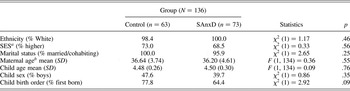
Mothers were part of a longitudinal study concerning maternal social anxiety and child development, with 96 mothers with SAnxD and 94 nonanxious controls recruited from a community sample screened in pregnancy (for details, see Murray et al., Reference Murray, Cooper, Creswell, Schofield and Sack2007, Reference Murray, DeRosnay, Pearson, Bergeron, Schofield and Royal-Lawson2008). These mothers and children were followed up through the first 2 years and then again in a series of four assessments at ages 4 to 5 years (mean = 4.72 years, SD = 0.36). For this most recent follow-up, which was timed to take place around 2 months before the child was due to start school, mothers were recontacted, and 77 in the SAnxD group and 67 in the control group were seen again (80.2% and 71.3% of those originally recruited, respectively). Mothers gave written informed consent. The study was approved by the Berkshire Research Ethics Committee and the University of Reading Ethics and Research Committee. All but eight (four from each group) provided useable narrative data for the current paper. The two groups were demographically similar and mostly had low levels of risk (see Table 1).
Demographics by group

Note: SAnxD, Social anxiety disorder.
a Socioeconomic status (SES) based on maternal occupation (Standard Occupation Classification, 2000), with 1, 2, and 3 defining higher SES.
b Age at follow-up.
Procedure
The current round of follow-up assessments was conducted at two time periods. First, about 2 months before the child started school, mother–child pairs visited the research unit, when maternal narratives concerning starting school and child DP representations of school were assessed. For the maternal narratives, the mother was invited to talk to her child about the forthcoming transition to school, using a picture book as a prompt. For child representations, a trained researcher used a semistructured interview to ask the child about going to school, using a model school and dolls as prompts. There was no time limit for either assessment, and each generally lasted about 10 min. Narrative interactions and DP sessions were video recorded and transcribed for independent coding.
Second, near the end of the first school term, at approximately 4 months after the preschool assessment, teachers were asked to complete questionnaires concerning child behavior. In a second research unit visit, the mother was interviewed and administered questionnaires about the child, and a second researcher assessed maternal mental state by interview and questionnaire. An assessment was made of child verbal IQ.
Measures
Maternal variables
Mental state
As a recruitment into the study, current maternal social anxiety was assessed using the Structured Clinical Interview for DSM-IV Diagnoses (First, Spitzer, Gibbon, & Williams, Reference First, Spitzer, Gibbon and Williams1995), administered by a trained psychologist. Mothers also completed questionnaires concerning social anxiety symptoms, the Social Interaction and Anxiety Scale and the Social Phobia Scale (Mattick & Clarke, Reference Mattick and Clarke1998). Interviews were audiotaped and discussed with senior clinicians to confirm diagnoses. Twenty randomly selected tapes were independently rated to confirm reliability (κ = 0.89).
Narratives
A picture book, based on Lucy and Tom Go to School by Shirley Hughes (Reference Hughes1973), was constructed featuring a focal child who is starting school. Separate versions were produced for girls and boys. Apart from the final picture, which ended on an unambiguously positive note, the pictures included a range of school themes of potential relevance to child social anxiety and were selected with the particular aim of elucidating the two key parenting dimensions of encouragement and attribution of threat. Text was minimal but served to guide the mother to include particular topics (e.g., “talk about how this child feels,” in which the child in question is indicated by a colored spot). The themes included preparation for school the day before, walking to school, entering school, putting coats in the cloakroom, saying goodbye to the mother, meeting the teacher, classroom activities, a show-and-tell session, and a playground that included a naughty bullying child and some children laughing. The final picture showed the focal child back at home playing with toy figures.
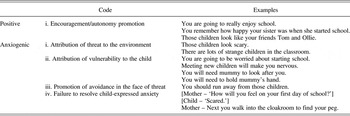
Individual maternal and child utterances were identified from transcripts and audio recordings on the basis of intonation, pauses, and grammatical cues. Each utterance was rated for the presence/absence of five mutually exclusive codes. One narrative code was positive: encouragement (or autonomy promotion), where the mother sought to highlight positive aspects of the situation, typically making links to the child's previous positive experiences. Four negative narrative codes were used that were hypothesized to be anxiogenic: attribution of threat to the environment, attribution of vulnerability to the child, promotion of avoidant strategies in the face of threat, and failure to resolve expressed child anxiety. Examples of these codes are shown in Table 2 (the coding scheme is available from L.M. and J.P.).
Narrative codes and examples

Maternal utterances were coded only if clearly instigated by the mother, except for “failure to resolve child anxiety.” This last was coded when the child initiated the topic of threat or anxiety and the mother failed to respond (by changing topic, or by ignoring the child); a count was made of such child anxious statements, and the percentage followed by maternal lack of resolution computed. A second rater coded 10% scripts. (κ = 0.93–1.00).
Child variables
BI 14 months
This was assessed as present/absent according to the paradigm of Kagan and colleagues (Reference Kagan, Reznick and Snidman1987) in which latencies to approach and fear or distress toward novel stimuli are assessed (for details, see Murray et al., Reference Murray, DeRosnay, Pearson, Bergeron, Schofield and Royal-Lawson2008). Trained researchers scored the tapes; 20 randomly selected tapes were scored by both (κ = 1.00).
Attachment 14 months
Attachment was assessed using the Strange Situation Procedure (Ainsworth, Blehar, Waters, & Wall, Reference Ainsworth, Blehar, Waters and Wall1978), a widely used and well-validated measure. Videotapes of the procedure were scored by two trained raters who classified the infants as secure, insecure–avoidant, resistant, or disorganized, using the established coding schemes (Ainsworth et al., Reference Ainsworth, Blehar, Waters and Wall1978; Main & Solomon, Reference Main, Solomon, Greenburg, Cicchetti and Cummings1990). Twenty randomly selected videotapes of the procedure were scored by both raters (κ = 0.86).
DP representations
A script, broadly following the themes covered in the picture book used by the mothers to talk to their child about school, was used to ask the child about going to school. It comprised four story stems culminating in potentially anxiety-provoking events and a final positive story stem (not coded). The four potentially anxious stems were (a) arriving at school and then separating from mother, (b) a social performance task (showing your drawing in class), and (c, d) two social evaluations (other children laughing while you are showing your drawing and hearing children laughing in the playground when you approach). In the final positive stem, play moved to a dolls' house, where the child doll character enacted its “favorite and happy time.” After each stem, the child was invited to respond and say what happened next and how they would feel in that situation. Videotapes were coded by two trained researchers for the presence/absence of 15 predefined child responses relevant to anxiety. These comprised expressions of child vulnerability and dependency on mother, maternal negative response to school, child performance negativity, performance avoidance, anxious interpretation of others' responses, and negative/avoidant social responses. Scores on the 15 variables were used to create a binary measure (most negative 40% children). A random sample of 20 assessments was independently coded and showed good agreement (κ = 0.92; for details, see Pass, Reference Pass2010; Pass et al., Reference Pass, Arteche, Cooper, Creswell and Murray2012).
Mental state
Child SAnxD was ascertained by interview with the mother using the Anxiety Disorder Interview Schedule, Parent Version (ADIS-P, Silverman, Saavedra, & Pina, Reference Silverman, Saavedra and Pina2001), a semistructured parents' interview for child and adolescent disorder meeting DSM-IV criteria that is reliable with preschool children (Dodd, Hudson, Morris, & Wise, Reference Dodd, Hudson, Morris and Wise2011). Interviews were audiotaped, and discussed with senior clinicians to confirm diagnoses. Twenty randomly selected tapes were independently rated (κ = 1).
Mothers completed the Internalizing Scale of the Child Behavior Checklist (CBCL) to provide a continuous measure of child problems. This covers withdrawn, anxious-depressed behavior, and somatic symptoms (Achenbach, Reference Achenbach1991). Teachers similarly provided reports on the Internalizing Problems Scale of the teacher adapted version of the CBCL, the Teacher Report Form 1½–5 version.
Verbal IQ
This was assessed by prorating scores on the Comprehension, Arithmetic, Vocabulary, and Similarities Scales from the revised Wechsler Preschool and Primary Scale of Intelligence—Revised (Wechsler, Reference Wechsler1990).
Different researchers administered and/or coded the narrative transcripts and each child assessment, all blind to maternal group. Maternal mental state was similarly assessed by researchers who were blind to original maternal social anxiety status and child outcomes.
Data analytic strategy
Linear or logistic regressions, as appropriate, were used to investigate effects of maternal social anxiety status on narratives about school and the extent to which child BI and attachment moderated these effects. Effects of demographic (sex, parity, and socioeconomic status) and child BI, attachment and IQ were controlled for whenever appropriate. We also examined whether maternal social anxiety status and maternal narratives predicted child outcomes, either directly or moderated by child BI or attachment. Where relevant, we investigated whether maternal narratives mediated effects of maternal group on child outcome, using the methods of Preacher and Hayes (Reference Preacher and Hayes2004, Reference Preacher and Hayes2008). Confidence intervals for indirect effects were accelerated bootstrapped confidence intervals (BCa), based on 5,000 samples.
Results
Maternal mental state
Consistent with other longitudinal research (e.g., Degonda & Angst, Reference Degonda and Angst1993), at the 4-year follow-up, 42 of the 73 index group mothers in the current study no longer met full DSM-IV criteria for SAnxD. Nevertheless, compared to controls, mothers not meeting full criteria at the current round of assessments still had more social anxiety symptoms on the Social Phobia Scale (t = –5.45, p < .001, R 2 = .23; control M = 6.69, SD = 7.56; index M = 16.00, SD = 9.61) and more social interaction difficulties on the Social Interaction and Anxiety Scale (t = –10.82, p < .001, R 2 = .54; control M = 12.79, SD = 7.13; index M = 30.67, SD = 9.52). Mothers were therefore retained in their original groupings.
Child characteristics by group
BI
Overall, 35 (26.32%) children were classified as having high BI at 14 months. There was no difference on the basis of original maternal social anxiety status in the rate of high BI: controls N = 15 (24.59%), index N = 20 (27.78%), χ2 (1) = 0.173; p = .68.
Attachment
Ninety-five (72.52%) children were classified as securely attached at 14 months. The number of participants in the insecure subgroups were as follows: avoidant N = 12 (9.16%), ambivalent/resistant N = 15 (11.45%), and disorganized N = 9 (6.87%). Given the small numbers in each insecure subgroup, we defined children as insecure versus secure. These rates did not differ by maternal original social anxiety status: secure controls N = 43 (71.67%), and secure index N = 52 (73.24%), χ2 (1) = 0.040; p = .84.
Verbal IQ
There were no differences between the children of socially anxious and nonanxious mothers in terms of verbal IQ. Scores were M = 108.47 (SD = 10.17) for controls and M = 108.58 (SD = 12.30) for index group children, F (1, 130) = 0.003, p = .953.
Maternal narratives
Compared to nonanxious mothers, socially anxious mothers spoke less to their children. Although the magnitude of difference in utterances was not large (index M = 154.40, SD = 60.58, vs. controls M = 179.78, SD = 53.18), it was significant (t = –2.58, p = .011, R 2 = .05), and so frequencies of narrative variables were calculated as proportions of each mother's speech corpus. The volume of child utterances during the narratives did not differ by maternal group (t = –0.41, p = .685, R 2 = .001; index M = 61.11, SD = 32.61, vs. control M = 63.22, SD = 27.29). With regard to narrative variable characteristics, the one positive measure, encouragement/autonomy promotion, was normally distributed and was treated as continuous. The negative variables were skewed, and each of their distributions showed a binary format was appropriate, as follows: attribution of threat, attribution of vulnerability, and promotion of avoidance were all split to define the highest scoring 30% mothers versus the rest; because “failure to resolve child anxiety” occurred less frequently, being shown by only 30 (22.06%) mothers, it was split as present versus absent. In general, negative narrative variables showed the predicted associations with each other, apart from the relationship between “promotion of avoidance” and “attribution of threat” (r = –.05). Otherwise, correlations between them ranged between r = .17 and .37; all were negatively associated with the positive variable, maternal encouragement (r = –.08 to –.17). Given these low to moderate associations, we considered the narrative measures separately in initial analyses.
Before examining the effects of maternal social anxiety, we first checked to see whether demographic and child characteristics were related to narrative variables, and some associations emerged. Mothers were more likely to show a high rate of attributions of vulnerability to girls than boys, 38.96% versus 18.64%, respectively; Wald = 6.31, p = .012, odds ratio (OR) = 0.36, 95% confidence interval (CI) = 0.16–0.80, and to children with insecure versus secure attachments, 44.44% versus 25.26%, respectively; Wald = 4.41, p = .036, OR = 2.37, 95% CI = 1.06–5.29. In addition, mothers were marginally more likely to use high levels of attribution of threat when talking to behaviorally inhibited versus noninhibited children, 42.86% versus 25.51%, respectively; Wald = 3.61, p = .058, OR = 0.46, 95% CI = 0.20–1.02, and, albeit marginally, to children who were insecurely versus securely attached, 41.67% versus 26.32%, respectively; Wald = 2.85, p = .091, OR = 2.00, 95% CI = 0.89–4.47. Children of mothers showing high rates of promotion of avoidance tended to have higher verbal IQ's than children of mothers who did not, M = 111.28, SD = 9.77, versus M = 107.38, SD = 11.79, respectively; Wald = 3.20, p = .074, OR = 1.03, CI = 1.00–1.07, and they were more likely to be later versus firstborns, 42.50% versus 25.00%, respectively; Wald = 4.02, p = .045, OR = 0.45, 95% CI = 0.21–0.98. Child and maternal age and socioeconomic status were unrelated to narratives.
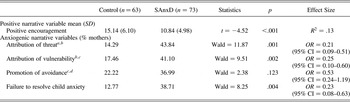
The effect of maternal social anxiety status on narratives was then examined, with any relevant demographic/child variables (p < .1) included as covariates. As seen in Table 3, regarding encouragement/autonomy promotion, index group mothers showed significantly lower levels of this positive narrative measure to their child than control group mothers. With regard to negative narrative variables, compared to the control group mothers those in the index group were more likely to show high levels of attribution of threat to the school environment and of vulnerability to their child, and they more often failed to resolve their child's expressed anxiety. It is important that there was no group difference in the rate of the children's own expressed anxiety (control M = 3.17, SD = 3.35; index M = 3.47, SD = 3.46; t = 0.50, p = .620, R 2 = .002). There was no difference between the two maternal groups in terms of maternal promotion of avoidance. This same pattern of differences in narrative style was observed between the controls and the subgroup of 42 index group mothers who no longer met full diagnostic criteria (none of these mothers had met diagnostic criteria beyond the child's first 2 years), nor did this subgroup's narratives differ from those of index mothers whose disorder continued up to the current assessment.
Maternal narratives by group

Note: SAnxD, Social anxiety disorder; OR, odds ratio; 95% CI, 95% confidence interval.
a Behavioral inhibition covariate.
b Infant attachment covariate.
c Parity covariate.
d Child verbal IQ covariate.
Examination of whether either child BI or child attachment moderated the effect of maternal group on narrative variables showed no significant effects (all ps > .25).
Maternal narratives, and group, in relation to child outcome
Having established differences between mothers with SAnxD and control group mothers in the way they spoke to their children about going to school, we then examined the children's outcomes in relation to both maternal social anxiety status and the mothers' narratives. Given the low frequency of several narrative variables, and to avoid multiple comparisons, we focused on the two principal categories of parenting relevant to child anxiety in the literature: encouragement/autonomy promotion and attribution of threat (Creswell et al., Reference Creswell, Schniering and Rapee2005; McLeod et al., Reference McLeod, Wood and Weisz2007). These same two variables, behaviorally expressed, had also been shown to relate to maternal social anxiety and infant behavior in our earlier reports on this sample (Murray et al., Reference Murray, Cooper, Creswell, Schofield and Sack2007, Reference Murray, DeRosnay, Pearson, Bergeron, Schofield and Royal-Lawson2008).
Child DP representations
No demographic or child characteristic was associated with child DP in the current sample. We had previously shown (Pass et al., Reference Pass, Arteche, Cooper, Creswell and Murray2012) that, after controlling for the effect of sex (boys were more negative than girls), children of mothers with SAnxD were significantly more likely than control group children to show negative DP about school. This group difference (although not the sex difference) also applied to the slightly smaller number with both complete maternal narrative and DP data in the current report, although the effect of group was somewhat reduced (Wald = 3.25, p = .071, OR = 0.49, 95% CI = 0.23–1.06). Neither infant BI (p = .20) nor attachment (p = .75) moderated the relationship between maternal disorder and children's DP responses.
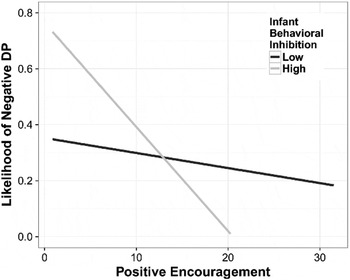
When the relationship between mothers' narratives and child DP was examined, lower levels of positive encouragement were found to predict negative DP representations, with means (standard deviations) of maternal encouragement being 11.30 (5.47) and 13.59 (6.00) for children with and without negative DP, respectively (Wald = 4.10, p = .043, OR = 0.93, 95% CI = 0.87–1.00). Maternal attribution of threat was not associated with child DP (p = .98). The relationships between the two narrative measures and DP were unaffected by child attachment (both ps >.30). However, while child BI did not affect the association between attribution of threat and DP, it did moderate the relationship between maternal positive encouragement and child representations (Wald = 3.75, p = .053, OR = 1.25, 95% CI = 1.00–1.56). For children who were low in BI, the level of maternal encouragement had no effect on DP (b = –0.03, 95% CI = –0.10 to 0.05, Wald = –0.713, p = .47), with risk for negative representations of school generally being moderate. By contrast, for children who were high in BI, the effect of maternal encouragement was significant (b = –0.25, 95% CI = –0.46 to –0.04, Wald = –2.313, p = .02): Those whose mothers showed low encouragement had a markedly increased risk of having negative representations about school, whereas, if mothers of high BI children were very encouraging, their risk for having negative representations of school was particularly low. This relationship is illustrated in Figure 1.
Likelihood of negative doll play (DP) representations according to maternal positive encouragement and infant behavioral inhibition (BI).

Having found this association, we then investigated whether maternal encouragement, moderated by child BI, mediated the relationship between maternal social anxiety status and negative child DP; this relationship was confirmed. Thus, when the effects of maternal social anxiety status and of encouragement moderated by BI were considered together, only the latter remained a marginal predictor of child DP (group: p = .22; Encouragement × BI Wald = 3.78, p = .052, OR = 1.25, 95% CI = 1.00–1.57), with the indirect effect of maternal social anxiety status on child DP through maternal encouragement being found only in highly inhibited children, low BI: b = 0.05 (BCa 95% CI = –0.31–0.55); high BI: b = 1.02 (BCa 95% CI = 0.25–2.50).
Child SAnxD –ADIS-P
No demographic or child characteristics were associated with child SAnxD. However, there was an effect of maternal group: Children of index mothers were more likely to be diagnosed with SAnxD than children of controls: index N =11 (15.28%) versus control N = 0 (0.0%), Wald = 4.56, p = .033, OR = 23.00, 95% CI = 2.88–297.59. Neither BI (p = .93) nor attachment (p = .48) moderated this association.
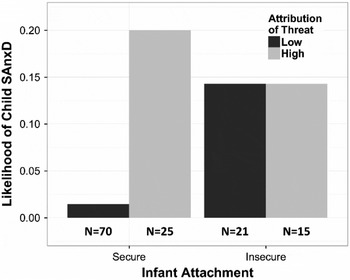
When the relationship between maternal narratives and child SAnxD was examined, no effect of maternal encouragement was found, either directly or moderated by child BI or attachment (all ps > .34). Nevertheless, the effect of maternal threat attribution was significant: Children whose mothers showed high attribution of threat were more likely to have a diagnosis of SAnxD than children of mothers who did not show high threat attribution (17.50% vs. 4.30%, respectively; Wald = 5.543, p = 0.019, OR = 0.21, 95% CI = 0.06–0.77). However, this relationship was moderated, marginally, by child attachment (Wald = 3.588, p = .058, OR = 17.00, 95% CI = 0.91–318.81). Thus, only in securely attached children was mothers' use of attribution of threat significant (b = 2.83, 95% CI = 0.63–5.04, Wald = 2.519, p = .01): for those securely attached children whose mothers did not show high threat attribution, risk of social anxiety was very low, whereas for securely attached children of mothers who did use high levels of threat attribution, the risk of disorder was high. For insecure children, by contrast, risk for disorder was raised regardless of maternal threat attribution (b = 0.00, 95% CI = –1.93 to 1.93, Wald = 0.000, p = 1.00; see Figure 2). Investigation of the pathway between maternal social anxiety status–attribution of threat (with and without the moderation of child attachment), child SAnxD did not show mediation. Unlike attachment, BI did not moderate the relationship between maternal threat attribution and child disorder (p = 1.00).
Likelihood of child social anxiety disorder (SAnxD) according to level of maternal attribution of threat and infant attachment.

CBCL internalizing problems
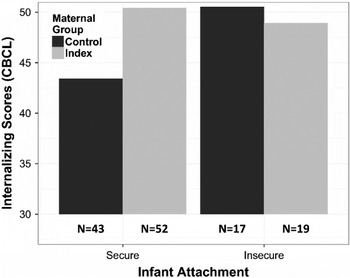
Mothers completed CBCL questionnaires for 119 children. Scores were log-transformed to achieve normality. No demographic or child variables were associated with CBCL Internalizing T scores. There was a significant effect of maternal social anxiety status on internalizing difficulties, with index group children having higher levels than controls, index M = 50.25 (SD = 8.93), control M = 45.34 (SD = 10.26), t = 2.94, p = .004, R 2 = .07. This relationship was not influenced by child BI (p = .96), but child attachment did have an effect (t = 1.96, p = .053, R 2 = .11). Thus, the effect of maternal disorder was significant for securely attached children, means: index = 50.43 (SD = 9.09) versus control = 43.41 (SD = 9.18), b = 0.15 (95% CI = 0.06–0.24), t = 3.457, p = .001, but not for those who were insecurely attached, means: index = 48.93 (SD = 8.93), controls = 50.53 (SD = 12.04), b = –0.02 (95% CI = –0.18 to 0.15), t = –0.206, p = 0.84 (see Figure 3).
Means of scores on the Child Behavior Checklist (CBCL) Internalizing Problems Scale, according to maternal grouping and infant attachment.

With regard to effects of maternal narratives, attribution of threat was not associated with internalizing scores (p > .84), but lower levels of maternal encouragement did predict higher levels of these symptoms (t = –2.878, p = .005, R 2 = .07). Neither BI nor attachment moderated the effects of maternal narratives on internalizing scores (all ps > .40).
Examination of the potential mediating role of lower maternal encouragement in the association between maternal social anxiety status and child internalizing problems showed a significant indirect effect of maternal status on child internalizing problems through maternal encouragement, b = 0.03 (BCa 95% CI = 0.002–0.067); K 2 = 0.06 (BCa 95% CI = 0.01–0.15). Nevertheless, the extent to which encouragement accounted for the maternal social anxiety effect was only small, and maternal status and encouragement both remained predictors of internalizing scores (group: t = 2.12, p = .036, R 2 = .07; encouragement: t = –2.03, p = .045, R 2 = .03), reflecting partial mediation.
TRF internalizing problems
Teachers completed TRF questionnaires for 121 children. Scores were log-transformed to achieve normality. There were no effects of demographic or child variables on internalizing scores nor were there significant effects of group (p = .50), or moderation of group by either BI (p = .20) or child attachment (p = .81).
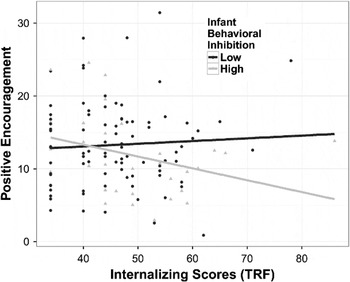
There was no main effect of either maternal positive encouragement (p = .35) or attribution of threat (p = .19) on TRF internalizing scores. Child attachment did not moderate the effect of maternal narrative variables (both ps >.39); however, BI, although not moderating the effect of attribution of threat (p = .58), did moderate the effects of maternal encouragement (t = –2.34, p = .021, R 2 = .06). An association between low maternal encouragement and higher teacher-reported internalizing scores was present for those children who were high BI, b = –0.01 (95% CI = –0.02 to –0.01), t = –3.526, p = .001, whereas for children who were low BI, mothers' level of encouragement had no effect, b = 0.001 (95% CI = –0.01 to 0.01), t = 0.450, p = .65 (see Figure 4).
Scores on the Teacher Report Form (TRF) Internalizing Problems Scale, according to level of maternal positive encouragement and infant behavioral inhibition (BI).

When the timing of maternal disorder was considered in relation to child outcome we found, just as with maternal narratives, that the same pattern of results described above for the index group as a whole also applied to those children whose mothers no longer met full diagnostic criteria by the time the children were 2 years old. Furthermore, there were no significant differences in outcome between index group children whose mothers had remitted by 2 years and those whose disorder had persisted beyond this time.
Discussion
In this prospective longitudinal study, we examined how SAnxD affected the way mothers communicated to their children the meaning of the potentially socially challenging topic of starting school, an event which the children were soon going to face. We used a picture book to elicit maternal narratives about the school experience and then coded what the mothers said on dimensions of parenting relevant to the transmission of anxiety. We also investigated how both maternal disorder and these narratives related to the children's development, that is, the children's own representations of school and the occurrence of SAnxD and internalizing problems. In addressing these questions, we considered it important to take account of two key child characteristics measured directly in infancy, BI and insecure attachment, both of which have been proposed to raise the risks for the development of anxiety (Murray, Creswell, & Cooper, Reference Murray, Creswell and Cooper2009).
As predicted, we found that child characteristics were associated with mothers' narrative style. Thus, mothers of children who had been classified as insecurely attached were more likely to attribute vulnerability to their child and to use more threat attributions. More threat attributions also tended to be more evident among mothers of children who were behaviorally inhibited. However, even when these child characteristics were taken into account, clear differences emerged in the way socially anxious and control mothers discussed school. In line with predictions, we found that, compared to nonanxious mothers, those who were socially anxious were less encouraging of their child in their talk about starting school. Thus, control group mothers would typically draw on their child's previous positive experiences and provide links between these and the forthcoming transition. For example, they might note physical similarities between a child depicted at school in the picture book and an actual child well known to the family, or they might comment on how the children in the book were engaged in an activity at school that the study child enjoyed. In using this narrative feature, therefore, nonanxious mothers effectively guided their children to see starting school as something that would be enjoyable and as falling within the child's existing realm of experience and competence. By contrast, such encouragement strategies were less frequent in the narratives of index mothers; they were more likely to describe the experience of going to school as one that their child might find difficult to manage and one that carried potential threat. For example, a picture depicting a school helper escorting the children across the road could invite comments such as “that lady is there to make sure you don't get killed when you go to school.”
Although the two groups of children expressed similar levels of worry about the forthcoming transition, how the mothers responded to such expressions differed according to the mother's own social anxiety, with index group mothers more often ignoring their children's evident concern. It is important to note that these differences between socially anxious and nonanxious mothers still held when account was taken of whether or not mothers still met full diagnostic criteria for SAnxD beyond the child's second year. Whether this effect was a function of the high anxious symptomatology of remitted mothers or of residual cognitive characteristics of those who have experienced disorder is unclear, but it is in any case consistent with evidence of sustained impairments in previously anxious individuals (Mathews, May, Mogg, & Eysenck, Reference Mathews, May, Mogg and Eysenck1990), including in the parenting role (Cooper & Eke, Reference Cooper and Eke1999).
The one narrative feature we had hypothesized to be more common in the socially anxious mothers that did not show a significant group effect was the promotion of avoidance of threat. This may have arisen because some picture book material (especially the picture of the naughty bullying boy) actually encouraged adaptive promotion of avoidance, thus masking the anxious use of this strategy. It is interesting that use of this maternal narrative feature was also unrelated to use of the principal negative narrative variable, attribution of threat, reinforcing the view that the material presented may not have elicited promotion of avoidance in the manner intended.
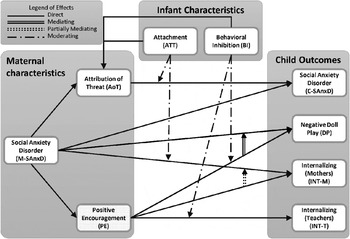
Turning to the children's development, we found that the key narrative features of encouragement and attribution of threat collectively and significantly predicted all aspects of child outcome assessed. However, in several cases these effects of narratives obtained only in subgroups of children. These associations, and their relationship to the mothers' social anxiety status, are represented schematically in Figure 5. Thus, while mothers' level of threat attributions predicted child SAnxD overall, this relationship was only significant for children who were securely attached to their mother. While lower levels of maternal encouragement predicted higher levels of child internalizing problems, according to both maternal and teacher reports as well as the child's negative representations of school in DP, in the latter two cases this association was confined to children who were behaviorally inhibited. Children of mothers who had experienced social anxiety (regardless of whether the maternal disorder still met full diagnostic criteria beyond the child's second year) had poorer outcome than controls on all but teacher-reported internalizing problems, and for the two outcomes that had been predicted by maternal encouragement (i.e., negative DP, and CBCL internalizing problems), this narrative feature mediated, and partially mediated, respectively, their relationship with maternal disorder.
Summary of effects. The maternal social anxiety disorder (Maternal-SAnxD) predicts a decrease in mothers' positive encouragement (PE) and an increase in their attribution of threat (AoT); the latter is also higher with children with insecure attachment (ATT) and children with high behavioral inhibition (BI). The probability of child (C-)SAnxD is increased by the presence of M-SAnxD, and, for children with secure ATT, by high maternal AoT; the probability of C-SAnxD in insecure children is heightened, regardless of maternal AoT. Maternal SAnxD increases the likelihood of children having negative doll play (DP) representations. This effect is mediated in children with high behavioral inhibition (BI) by maternal PE; in these children, the lower the PE, the higher the likelihood of negative child DP representations, and vice versa. In children with secure ATT, M-SAnxD brings about higher internalizing mother (INT-M) levels; but for those with insecure ATT, INT-M is not affected by M-SAnxD. The overall effect of M-SAnxD on INT-M is partially mediated by maternal PE: the lower the PE, the higher the INT-M. In children with high BI, lower maternal PE brings about higher levels of INT-M.

A number of our findings require particular comment. It is striking that our results from narratives with 4- to 5-year-old children closely parallel those from our earlier investigation of this sample in infancy. However, in infancy it was socially anxious mothers' behavioral communications of threat and lack of encouragement regarding a potential social threat (in this case an unfamiliar adult) that mediated associations between the maternal disorder and infant social avoidance, an effect that was, as in the current follow-up, also related to infant temperament (Murray et al., Reference Murray, Cooper, Creswell, Schofield and Sack2007, Reference Murray, DeRosnay, Pearson, Bergeron, Schofield and Royal-Lawson2008). This parallel underscores the centrality of meaning-making processes (Tronick & Beeghly, Reference Tronick and Beeghly2011), whereby the child's interactions with their caretakers from earliest development help scaffold their representations and engagements with the world. Where the principal caretakers' responses are consistently pathological, starting at the level of expressed affect and behavior, and then becoming more verbally communicated as in the narratives we observed, the child may develop elevated risk for mental health problems.
Our findings on the effects of maternal narratives build on previous studies of the mechanisms affecting the development of anxiety in two main ways. First, they bear on research on how information concerning threat is transmitted. This issue has most often been addressed in relation to the first two of Rachman's key pathways to fear acquisition, namely direct conditioning and vicarious exposure (Rachman, Reference Rachman1977, Reference Rachman1991). However, a feature of research using narratives is the potential that it offers to focus on the influence of verbal information transfer. This specific process has received relatively limited research attention, especially using naturalistic tasks, with most research combining both verbal and nonverbal behavioral information transfer in coding. The results of our study suggest, however, that verbal information transfer itself is an important route to consider in relation to children as young as 4 years.
Second, a question raised by our findings is whether different narrative forms carry specific meaning-making functions, since in our study our two key narrative variables predicted different child outcomes. Thus, as noted above, where mothers had described school in terms conveying threat, children were at raised risk of having SAnxD; where mothers had been less encouraging about school, children had more negative representations of starting school and higher levels of maternal and teacher reports of internalizing symptoms. This specificity of association requires replication. However, it is possible that the former feature of threat attribution, with its strong communication of there being something definite to be feared, may be particularly likely to set up child avoidance, a core feature of SAnxD. By contrast, where mothers were less encouraging, it was not that the child was told that there was something definite to fear but rather that there was little in the mother's communication to make them feel enthusiastic, or feel that they would want to positively engage with the environment, and this may have underpinned a more general negativity. Further work on the effects of these different narrative forms on child understanding and adjustment would be a valuable line of investigation, as would research on nonverbal vocal communication, such as intonation and voice quality, which have also been implicated in the intergenerational transmission of affective disorder (in this case, depression; Murray, Marwick, & Arteche, Reference Murray, Marwick and Arteche2010). The extent to which particular dimensions of maternal narratives might be relevant to other psychiatric disorders is unknown. It is possible that the associations we found between maternal psychopathology and narrative style may be particularly readily identified in the case of SAnxD, where the associated cognitions can be relatively clearly specified. Whether other parental disorders, like depression, might similarly entail systematic disturbances in narrative style requires investigation.
In considering the richness of the material we obtained from the mothers' narratives about going to school, it is worth noting that we found the shared picture book methodology to be highly suitable for eliciting relevant maternal speech and for allowing examination of how mothers construed and communicated their child's forthcoming experience. Picture book sharing may have an advantage over less structured observational frames in that it affords some constraint on the focus of speech, through selection of the material, while at the same time providing sufficient prompt material to ensure a sizeable corpus of data. It is, moreover, a medium frequently used by parents to engage with their children and is therefore one with which children are familiar and comfortable.
Some of our findings regarding the role of child characteristics merit further comment. It was notable that children of mothers who were socially anxious had no raised risk for insecurity. Although this result might appear unexpected, it is important to bear in mind both our findings from infancy (Murray et al., Reference Murray, Cooper, Creswell, Schofield and Sack2007) and our recent report of maternal behavior during play with the child at 4 to 5 years (Murray et al., Reference Murray, Lau, Arteche, Creswell, Russ and Zoppa2012); at both these time points, index mothers were no less sensitive toward their children than nonanxious mothers unless there was a provocation that specifically challenged their disorder. In the main, therefore, both index and control group children received sensitive, responsive care, consistent with the generally high rates of secure attachments we observed. It is also worth noting that the mothers in our sample generally had low levels of background risk, and therefore parenting was not under strain.
A second feature of our results concerning attachment also requires comment: children who were securely attached were particularly affected by whether their mother was socially anxious or used a high level of threat attributions about school. If their mother was not socially anxious or did not show a high level of threat attributions, these secure children's levels of internalizing problems and risk for SAnxD were very low. However, their outcome was significantly worse in the presence of each of these maternal difficulties, and this was particularly marked in the case of their having high risk for SAnxD where mothers used high levels of threat attribution. One possible explanation for this finding is that secure children, being more emotionally open and likely to rely on their mother as a figure of trust, may be highly disposed to take on board their mother's interpretations of the world. Insecure children had levels of disorder that were relatively high, regardless of threat attributions in their mothers' narratives.
Our finding that behaviorally inhibited children were more vulnerable to the negative effects of low levels of maternal encouragement, in terms of both their DP representations of school and teacher reported internalizing problems, is wholly consistent with the wider literature on the associations between this temperamental characteristic, parenting, and child anxiety (Murray et al., Reference Murray, Creswell and Cooper2009). However, what was more striking was the finding that, in terms of their DP representations, inhibited children appeared to benefit more from their mothers' being highly encouraging than did noninhibited children. This finding was (as indicated above) entirely in line with our previous report for these children in infancy, where behaviorally inhibited infants whose mothers were highly encouraging showed the least increase in avoidance of the stranger over time (Murray et al., Reference Murray, DeRosnay, Pearson, Bergeron, Schofield and Royal-Lawson2008). This may illustrate the phenomenon of differential susceptibility as described by Belsky and Pluess (Reference Belsky and Pluess2009), with such susceptibility encompassing that certain temperamental traits (or genetic variability) may confer not only greater vulnerability to negative environments but also a greater capacity to benefit from positive environments. In the current case, then, it might be more appropriate to think of child inhibition as a kind of sensitivity, with its positive, as well as negative connotations.
Although our study had a number of strengths, including its longitudinal design with direct assessments of early child characteristics, and the ecologically valid nature of our narrative and DP assessments around a naturally occurring potential social challenge, there were also some limitations. Two of our outcome assessments relied on information derived from the mothers (CBCL and the ADIS-P), and while both involve well-established assessment procedures, and both showed systematic relationships to objectively measured predictors, some degree of caution is required in interpreting the relevant findings, given the potentially confounding effects of the maternal disorder. A further limitation of our study was that we did not examine the role of fathers or other family members who might have compensated for difficulties experienced by the mothers. Thus, it seems likely that, if a mother experiences social phobia and the child's father does not, the father will become more involved in supporting their child's social adjustment, including his or her entry into school. To this extent, our study may have underestimated the direct effects of maternal SAnxD on the child.
Clinical implications of narrative findings
Research has accumulated to show that, for parental behavior during book sharing associated with child language and literacy, considerable progress can be made in training parents to adopt more effective practices (e.g., Cooper et al., Reference Cooper, Vally, Cooper, Radford, Sharples and Tomlinson2013; Reese, Sparks, & Leyva, Reference Reese, Sparks and Leyva2010). Some studies have also shown benefits of training mothers in specific conversational techniques for promoting more responsive, elaborated, and emotion-rich discourse with their young children (Peterson, Jesso, & McCabe, Reference Peterson, Jesso and McCabe1999; Reese & Newcombe, Reference Reese and Newcombe2007). Moreover, preliminary work with conduct disorder children offers promising evidence that speech relevant to child emotional problems might also be amenable to change (Salmon, Dadds, Allen, & Hawes, Reference Salmon, Dadds, Allen and Hawes2009). Thus, given the association we found between child anxiety and the way in which the socially anxious mothers spoke to their children about starting school, the question arises whether intervention at the level of maternal narratives could help break cycles of transmission of potentially anxiogenic meanings. Such intervention work would also constitute a useful scientific tool for better understanding the role of maternal narratives in child development.