Acute kidney injury is a frequently encountered complication of paediatric cardiac surgery, with the reported incidence being 15–55%. Reference AlAbbas, Campbell and Skippen1–Reference Rigden, Barratt and Dillon3 Among these cardiac surgery associated-acute kidney injury cases, 3–5% require renal replacement therapy. Reference Rigden, Barratt and Dillon3,Reference Pedersen, Hjortdal and Christensen4 Cardiac surgery associated-acute kidney injury negatively contributes to both the short-term outcomes in the ICU and to long-term outcomes following discharge from the ICU. Reference Pedersen, Hjortdal and Christensen4–Reference Kandler, Jensen and Nilsson6 This negative impact of cardiac surgery associated-acute kidney injury was demonstrated for both children and adults. Reference Kandler, Jensen and Nilsson6–Reference Just, Alborzi and Godde8 Cardiac surgery associated-acute kidney injury’s negative clinical impacts may result from fluid overload and electrolyte imbalances, which may not adequately respond to medical management with diuretics. Reference Just, Alborzi and Godde8–Reference Mah, Hao and Sutherland10 Most importantly, despite the improvements in surgical methods, the cardiopulmonary bypass machine and post-operative ICU care, the outcomes of children with severe cardiac surgery associated-acute kidney injury requiring renal replacement therapy after cardiac surgery remain poor and without much improvement, with reported mortality being 55–75%. Reference Pedersen, Hjortdal and Christensen4,Reference Blinder, Goldstein and Lee5,Reference Mah, Hao and Sutherland10,Reference Bellomo, Auriemma and Fabbri11 One of the contributors to this noted increased mortality may be secondary to excessive fluid overload negatively impacting the cardiac function and recovery, leading to prolonged duration of mechanical ventilation, poor wound healing, longer period of having the chest open, and increased risk of infections. Reference Bellomo, Auriemma and Fabbri11–Reference Griffin, Teixeira and Ambruso14
There is evidence in both paediatric and adult cardiac surgery literature that early start of renal replacement therapy may improve outcomes for those patients who are at high-risk for acute kidney injury. Reference Liu, Davari-Farid and Arora15,Reference Kwiatkowski, Menon and Krawczeski16 There are no established protocols for prophylaxis of acute kidney injury during cardiac surgery. Reference Mohaupt and Kramer17,Reference Schetz, Bove and Morelli18 There are emerging biomarkers for the early detection of post-operative acute kidney injury, such as serum cystatin C or urinary neutrophil gelatinase-associated lipocalin, but these are not universally utilised. Reference Zappitelli, Krawczeski and Devarajan19–Reference Parikh, Devarajan and Zappitelli21 Moreover, the interpretation of “early” is different in various publications and single centre protocols. Therefore, there developed a trend in some paediatric centres to place a peritoneal dialysis catheter following cardiopulmonary bypass and start peritoneal dialysis or use the catheter for abdominal drain purposes within the first post-operative 24–48 hours for better fluid management in patients high-risk for acute kidney injury. Reference Kwiatkowski, Menon and Krawczeski16,Reference Sorof, Stromberg and Brewer22 There are several retrospective studies reporting better outcomes with intra-operative catheter placement and/or early peritoneal dialysis in newborns and young infants following cardiac surgery. Reference Kwiatkowski, Menon and Krawczeski16,Reference Sorof, Stromberg and Brewer22,Reference Bojan, Gioanni and Vouhe23 One prospective randomised controlled study demonstrated that early start of peritoneal dialysis is safe and allows for superior post-operative fluid management with improved clinical parameters when compared to medical management with furosemide. Reference Kwiatkowski, Goldstein and Cooper24 On the contrary, there have been reports stating early post-operative peritoneal dialysis may not be beneficial and may be associated with complications. Reference Ryerson, Mackie and Atallah25–Reference Namachivayam, Butt and Millar27 Therefore, the currently available evidence in medical literature is conflicting and the search is still on for the identification of the post-operative population who would most benefit from early peritoneal dialysis.
We had a change in our unit protocol by the beginning of 2012 with the start of a new cardiothoracic surgeon in Children’s Hospital of Mississippi at University of Mississippi Medical Science Campus. With the discretion of our surgeon, all newborns and young infants who are evaluated as high-risk for acute kidney injury received peritoneal dialysis catheter placement following cardiopulmonary bypass while still in the operating room. Post-operatively, these were either started on peritoneal dialysis or the peritoneal dialysis catheters were utilised as abdominal drains depending on the urine output and the degree of fluid overload. The decision to start peritoneal dialysis was made by the surgeon and the intensivist. This decision requires a lot of expertise and is not always quantifiable. Therefore, we conducted a retrospective chart review to identify some objective, quantifiable predictors for early peritoneal dialysis start following paediatric cardiac surgery in our centre. If there were to be some surrogate objective markers successfully predicting early peritoneal dialysis start, this information may be instrumental in lateral transfer of expertise to centres that are planning to utilise post-operative early peritoneal dialysis. To our knowledge, objective predictors of post-operative early peritoneal dialysis start have not been investigated before.
Materials and methods
Sample review
The institutional review board of the University of Mississippi Medical Science Campus approved the study protocol (IRB#: 2021-0628). Retrospective chart review was performed using the data from a single-centre paediatric cardiac ICU database. A total of 64 patients met inclusion criteria and seven patients had to be excluded because their medical record was not in electronic format and/or their qualifying surgeries dated prior to 2012. Data was collected on 57 cases, younger than six months of age with peritoneal dialysis catheter placement after congenital heart surgery between January 1, 2012 through December 31, 2015. All data were provided to the investigators and the statistician using REDCap in de-identified format to ensure health record confidentiality. Outcomes were measured through the first post-operative 24 hours.
Demographic and clinical data included gestational age, weight, height, and age at time of surgery, type of congenital cardiac disease, and type of surgical procedure and Risk Adjustment in Congenital Heart Surgery-1 score (RACHS-1 score). Pre-operative fluid balance, whether the subjects were diagnosed with acute kidney injury prior to surgery, and the need for pre-op mechanical ventilation support were recorded. We obtained pre- and post-operative renal function data, time to peritoneal dialysis initiation after surgery, cardiopulmonary bypass times and aorta cross-clamp times, post-operative central venous pressure, and urine output for the first post-op 8 hours and first 24 hours. Other relevant laboratory values such as serum haematocrit, albumin, lactate, bicarbonate, creatinine, and blood urea nitrogen were collected for both pre-op and post-op periods. The recoded haemodynamics data included the systolic blood pressure, diastolic blood pressure, and mean arterial pressure for both pre-op and post-op periods. The urine output and the fluid balance in the first post-op 8-hour shift were included in the dataset.
Surgery
The same paediatric cardiothoracic surgeon performed all the surgeries for the study period. The certified clinical perfusionist team and the cardiothoracic anaesthesia team were the same throughout the study period. All children in the study underwent surgical treatment of their lesions utilising cardiopulmonary bypass and/or with clamping of the aorta as with coarctation of aorta. Hypothermia was used where needed and hypothermic circulatory arrest was used in children with single ventricle diagnosis undergoing first and second-stage repairs. At the end of surgery, a Dacron single-cuffed straight silicone rubber acute peritoneal dialysis catheter (Tenckhoff catheter©, Cook Medical Inc., Bloomington, IN, USA) was inserted following the completion of cardiopulmonary bypass under general anaesthesia below the umbilicus and clamped to drainage.
Post-operative period
Patients were followed for urine output, peritoneal catheter output, chest tube and mediastinal tube outputs, arterial blood gases, central venous pressure, and systemic arterial pressure and the data were recorded hourly as the unit protocol. A urinary catheter was inserted into the bladder in the operating room and remained during the 48-hour post-operative period for all patients. Systemic arterial pressures were continuously measured in the radial or femoral artery and central venous pressures were measured using a central venous catheter. IV Fluids were used to maintain central venous pressure and to rescue arterial hypotension episodes. Plasma-Lyte© (Baxter Healthcare Corporation, Deerfield, IL, USA), 0.9% normal saline, and albumin 5% were the main solutions utilised.
Peritoneal dialysis
Clinical indications that suggested to start early peritoneal dialysis were oliguria (< 1 ml/kg/hour) for more than 8 hours unresponsive to fluid administration and to furosemide 1 mg/kg/dose iv challenge and worsening post-op fluid balance. The ultimate decision to start peritoneal dialysis was made by the lead cardiothoracic surgeon in conjunction with the cardiac ICU attending physician. Nephrology was consulted for peritoneal dialysis procedure recommendations and prescriptions. Manual continuous cyclic peritoneal dialysis was performed by the bedside nurses. The initial peritoneal dialysis prescription was fill volume of 10 ml/kg, 1.5% dextrose Dianeal (Baxter Healthcare, McGaw Park, Ill) with 45 minutes fill and dwell times and 15 minutes drain time, as a continuous dialysis. The closed-circuit system was used for peritoneal dialysis and the circuits were set by dialysis nurses every 72 hours. Those subjects for whom peritoneal dialysis was not initiated, the catheters were left open for passive drainage as clinically indicated.
Definitions and abbreviations
Immediate post-op: This refers to the laboratory and blood pressure values that were obtained as the first set after arrival to cardiac ICU and stabilisation. This time period is represented as “_0.” For example, Sys blood pressure_0 represents immediate post-op systolic blood pressure.
Immediate pre-op blood pressure: These are the most recent blood pressure readings prior to operating room, obtained by non-invasive method.
Urine output_0: Urine output in the first post-op 8 hours (ml/kg/hour).
Fluid balance_0: Fluid balance in the first post-op 8 hours (ml).
Fluid overload: Described as per cent increase from pre-op weight. Intake (litre) – output (litre) / pre-op weight (kg) X 100
Pre-op acute kidney injury: This is defined by neonatal modified Kidney Disease Improving Global Outcomes criteria for acute kidney injury (31,32,33). Lowest serum creatinine between 48 hours to 7 days prior to surgery was taken as baseline. Urine output data was not available for most cases and therefore not utilised.
Young infant: Infants younger than six months yet older than one month of age.
Delta serum creatinine (delta creat) = post-op creatinine_0 – pre-op creatinine/pre-op creatinine
Statistical analysis
All categorical data were summarised using relative frequencies with percentages and their difference between the peritoneal dialysis groups were tested using Chi-squared test (or Fisher’s exact test where the cell counts were below 5). Continuous data were summarised as median and interquartile range. Interquartile range was represented as [1st quartile; 3rd quartile]. Differences between the groups were tested using Mann-Whitney U test. Variables which showed significant association with the two peritoneal dialysis groups were chosen in the multivariate logistic regression. Univariate logistic regression was also carried out for the selected variables. Odds ratio was used as effect size and presented along with 95% confidence interval. All P values were assessed at the 2-tailed 0.05 significance level. All analyses were performed using R Statistical Software (v4.2.1; R Core Team 2022). 28
Results
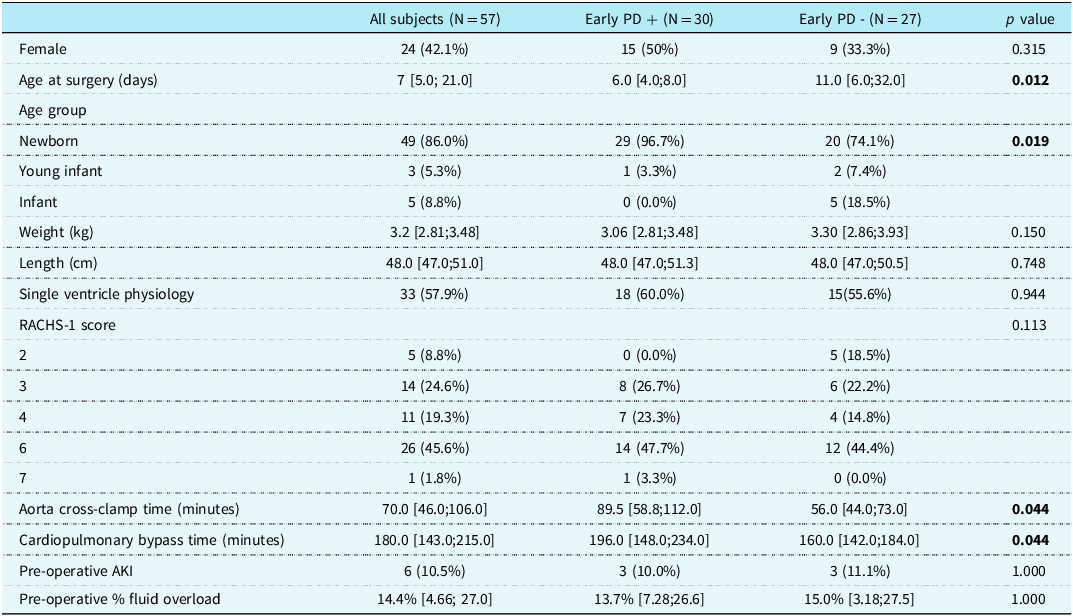
There were 57 newborns and young infants less than 6 months of age who were selected for this study. All of these 57 subjects had peritoneal dialysis catheter placed in the operating room following their cardiac surgery and cardiopulmonary bypass. Compared to the peritoneal dialysis – group, the peritoneal dialysis + group was younger at the time of surgery (6 days versus (versus)11 days, p = 0.012) and had more newborns in the group (29% versus 20%, p = 0.019). The two groups were statistically indifferent for gender, weight, and height distribution. There was no statistically significant difference for pre-operative (pre-op) % fluid overload and for the incidence of pre-op acute kidney injury between the two groups. Table 1 summarises these demographic findings.
Demographics and surgery data

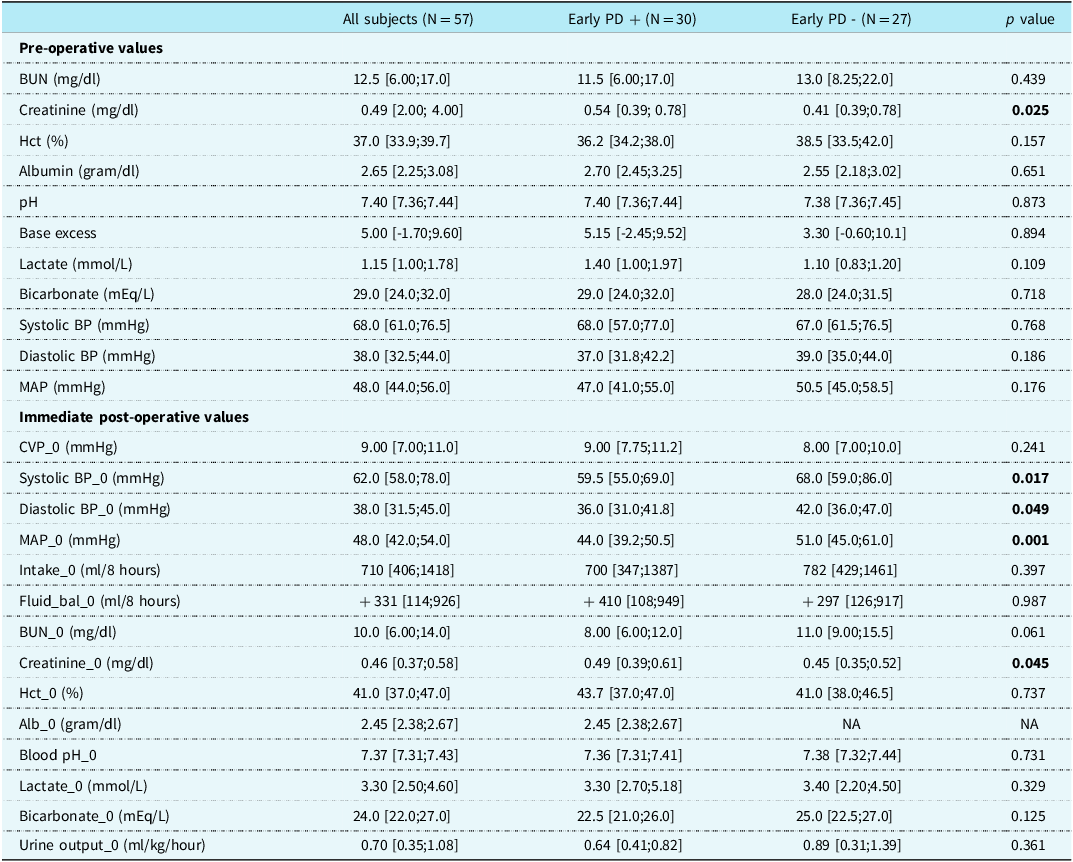
The peritoneal dialysis + group had higher serum creatinine at pre-op evaluation compared to the peritoneal dialysis – group (0.54 versus 0.41, p = 0.025). There was no statistically significant difference in pre-op blood urea nitrogen, haematocrit, albumin, lactate, and bicarbonate levels between peritoneal dialysis + and peritoneal dialysis – groups. Haemodynamically, both groups were comparable for systolic, diastolic, and mean arterial blood pressures obtained immediately prior to surgery. Table 1 summarises these comparisons.
Both groups had similar number of subjects with single ventricle physiology and had statistically indifferent RACHS-1 score distribution (p = 0.113). The surgery periods were compared according to cardiopulmonary bypass exposure times and aorta cross-clamp times. Peritoneal dialysis + group had significantly longer cardiopulmonary bypass times (196.0 min [148.0; 234.0] versus 160.0 min [142.0; 184.0]; p = 0.044) and aorta cross-clamp times (89.5 min [58.8; 112.0] versus 56.0 min [44.0; 184.0]; p = 0.044) compared to the peritoneal dialysis – group, respectively.
During the immediate post-operative period, peritoneal dialysis + group demonstrated lower systolic blood pressure (Sys blood pressure_0) (59.5 mmHg [55.0; 69.0] versus 68.0 mmHg [59.0; 86.0]; p = 0.017), lower diastolic blood pressure (Dias blood pressure_0) (36.0 mmHg [31.0; 41.8] versus 42.0 mmHg [36.0; 47.0]; p = 0.049) and lower mean arterial pressure (mean arterial pressure_0) (44.0 mmHg [39.2; 50.5] versus 51.0 mmHg [45.0; 61.0]; p = 0.001). The fluid balance for the first post-operative 8 hours (urine output_0) was trending higher for the peritoneal dialysis + group, not reaching statistical significance (410 ml versus 297 ml, p = 0.987). The immediate post-op serum creatinine was higher for the peritoneal dialysis + group (0.49 versus 0.45 mg/dl; p = 0.045) compared to peritoneal dialysis – group. Both groups were oliguric during post-op 8 hours, however, the mean urine output was trending to be lower for the peritoneal dialysis + group versus peritoneal dialysis – group (0.64 versus 0.89 ml/kg/hour; p = 0.361, respectively). There was no statistically significant difference in immediate post-op blood urea nitrogen, haematocrit, lactate, and bicarbonate levels between peritoneal dialysis + and peritoneal dialysis – groups. Table 2 summarises the comparative pre-op and immediate post-op predictors for the two groups. Immediate post-op serum albumin was not measured as per unit protocol.
Pre-operative and immediately post-operative laboratory and haemodynamic parameters

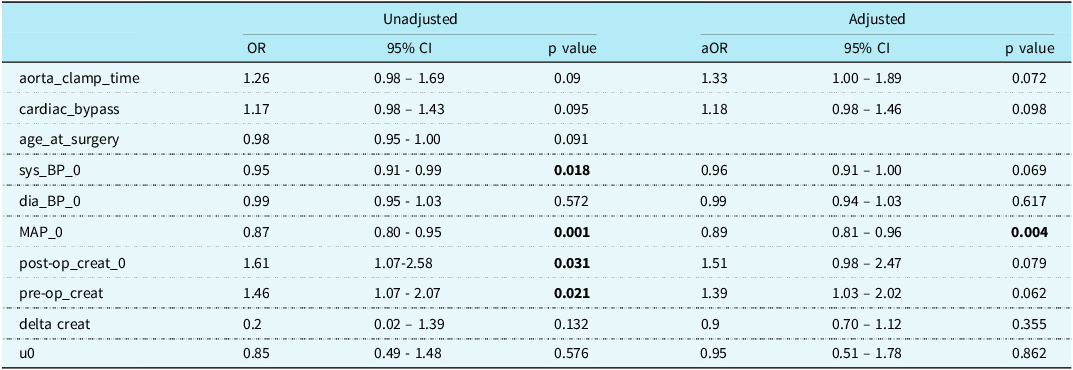
In the univariate regression model, pre-op serum creatinine (odds ratio = 1.46, p = 0.021), post-op serum creatinine (odds ratio = 1.61, p = 0.031), systolic blood pressure_0 (odds ratio = 0.95, p = 0.018), and mean arterial pressure_0 (odds ratio = 0.87, p = 0.001) successfully predicted peritoneal dialysis +. There was a trend for longer aorta cross-clamp time and longer cardiopulmonary bypass time suggesting higher risk for peritoneal dialysis +, (odds ratio = 1.26 and odds ratio = 1.17, respectively) but these did not reach statistical significance. Diastolic blood pressure_0, age at surgery, urine output during post-op 8 hours (urine output_0) and change in serum creatinine during surgery (delta creatinine) did not predict peritoneal dialysis +. Finally, during multiple logistic regression, only mean arterial pressure_0 remained a statistically significant predictor of peritoneal dialysis + (adjusted odds ratio = 0.89, 95% confidence interval [0.81; 0.96], p = 0.004) after p values were adjusted for age at surgery. The univariate and multiple logistic regression model results are demonstrated in Table 3.
Univariate (Unadjusted) and multivariate logistic regression (Adjusted) models for the predictors of early peritoneal dialysis +. Aorta cross-clamp time and cardiopulmonary bypass time duration in 25 minutes increments, age at surgery 1 day increments, systolic blood pressure, diastolic blood pressure and mean arterial pressure in 1 mmHg increments, pre-op serum creatinine and post-op serum creatinine in 0.1 mg/dl increments,and urine output 1 ml/kg/hour increments. Delta serum creatinine (delta creat) = post-op creatinine_0 – pre-op creatinine/pre-op creatinine

In multivariate logistic regression, p values were adjusted for age at surgery only.
sys_blood pressure_0: Immediate post-operative systolic blood pressure in cardiac ICU (mmHg).
dia_blood pressure_0: Immediate post-operative diastolic blood pressure in cardiac ICU (mmHg).
MAP_0: Immediate post-operative mean arterial pressure in cardiac ICU (mmHg).
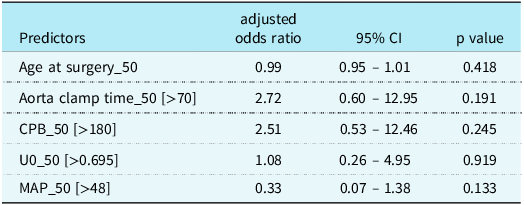
As further analysis, we detected the 50th percentile (median) values for the predictors of peritoneal dialysis + outcome and evaluated their predictive value in a binary way. The median post-op urine output (urine output_0) and median age at surgery for this group were minimally influential. However, the median aorta cross-clamp time and cardiopulmonary bypass time positively predicted the outcome, while the median mean arterial pressure_0 negatively predicted the outcome. Subjects with aorta cross-clamp time > 70 min were 170% more likely to be in peritoneal dialysis + group (OR, 2.7; 95th confidence interval [0.6; 12.95]) as compared to peritoneal dialysis – group. Similarly, children with cardiopulmonary bypass time > 180 min were 151% more likely to be in the peritoneal dialysis + group (odds ratio, 2.51; 95th confidence interval [0.53; 12.46]). On the contrary, children with mean arterial pressure_0 > 48 mmHg were 67% less likely to be peritoneal dialysis + (odds ratio, 0.33; 95th confidence interval [0.07; 1.38]). None of these predictors were able to reach statistical significance. Table 4 summarises these findings.
Multivariate logistic regression models for the predictors at the 50th percentile threshold cut-offs. Age at surgery in days, aorta cross-clamp time and cardiopulmonary bypass time in minutes, urine output in ml/kg/hour, and mean arterial pressure in mmHg.

Discussion
In this retrospective study, we worked with a cohort of 57 newborns and young infants from a single paediatric centre who underwent cardiac surgery and received peritoneal dialysis catheter following the cardiopulmonary bypass disconnection. After early clinical evaluation, those who were thought to be at high-risk for acute kidney injury and fluid overload were started on peritoneal dialysis during the first post-op 24 hours. The clinical indications to start peritoneal dialysis were oliguria (<1 ml/kg/hour) for more than 8 hours, which is unresponsive to fluid administration and furosemide and worsening post-op fluid balance. We detected higher pre-op serum creatinine, higher post-op serum creatinine, lower Systolic blood pressure_0, and lower mean arterial pressure_0 as statistically significant objective predictors of early peritoneal dialysis + following cardiac surgery. Lower mean arterial pressure_0 was able to predict peritoneal dialysis + in the multivariate regression model and mean arterial pressure_0 > 48 mmHg decreased the risk of peritoneal dialysis + by 3 times. These findings may shed some light on objective quantifiable indications for early peritoneal dialysis start for newborns and young infants who are at high-risk for cardiac surgery associated-acute kidney injury.
Acute kidney injury and fluid overload are common complications of paediatric cardiac surgery. Reference Blinder, Goldstein and Lee5–Reference Picca, Principato and Mazzera7 Both of these complications may potentiate each other’s progression and contribute to increased morbidity. Reference Just, Alborzi and Godde8–Reference Mah, Hao and Sutherland10 Furthermore, following cardiac surgery, the need for excessive fluid resuscitation, cardiopulmonary bypass-associated capillary leak syndrome, and low cardiac output syndrome further contribute to both acute kidney injury and fluid overload. Reference Bellomo, Auriemma and Fabbri11,Reference Mohaupt and Kramer17,Reference Wang29 Persistent and worsening positive fluid balance and fluid overload negatively impact the cardiac function and the post-op recovery period. Reference Mah, Hao and Sutherland10,Reference Bellomo, Auriemma and Fabbri11,Reference Wang29 Therefore, effective management of the fluid overload following cardiac surgery is crucial. Reference Mah, Hao and Sutherland10,Reference Wang29 Most centres utilise loop diuretics to potentiate urine output. Reference Bellos, Iliopoulos and Perrea12,Reference Kwiatkowski, Goldstein and Cooper24 However, in the past three decades, in some paediatric centres, there has been a trend to start peritoneal dialysis early during the post-op period for optimal fluid management. Reference Sorof, Stromberg and Brewer22,Reference Kwiatkowski, Goldstein and Cooper24 There are reports of improved outcomes for those newborns and young infants receiving early peritoneal dialysis following cardiac surgery. Reference Pedersen, Hjortdal and Christensen4,Reference Blinder, Goldstein and Lee5,Reference Kwiatkowski, Menon and Krawczeski16 One study reported decreased mortality with early peritoneal dialysis use (23). Similar positive outcomes were also reported with early post-op renal replacement therapy from adult cohorts. Reference Liu, Davari-Farid and Arora15 Since early predictors of fluid overload and acute kidney injury are not universally available, identification of objective indications of early peritoneal dialysis start using data obtained from post-op standard of care may optimise peritoneal dialysis start timing for this high-risk population. Reference Zappitelli, Krawczeski and Devarajan19,Reference Parikh, Devarajan and Zappitelli21,Reference Wang29,Reference Zappitelli, Bernier and Saczkowski30
Despite being a non-randomized retrospective cohort, the peritoneal dialysis + and PD – groups were very comparable prior to surgery in our study. peritoneal dialysis + group was younger by five days, while both groups’ mean age was qualified as newborns. The pre-operative demographic, clinical, and laboratory data being similar add strength to our results. Therefore, despite being formed by post-op clinical decisions, these two groups were reasonably comparable during the pre-op stage.
Higher pre-operative serum creatinine being a predictor for peritoneal dialysis + is a novel finding for paediatric cardiac surgery cohorts. In previous paediatric studies, lower pre-op serum creatinine has been reported as a risk factor for post-op acute kidney injury. Reference Zappitelli, Bernier and Saczkowski30–Reference Jefferies and Devarajan32 The given explanations were dilution due to fluid overload, less muscle mass due to malnutrition, decompensated heart failure, and poor heart function at baseline. Reference Jefferies and Devarajan32 It is also related to mathematical factors as the lower start creatinine presents with higher percentage of rise with any actual rise in the value, due to acute kidney injury classifications taking the baseline creatinine as the start point. Reference Zappitelli, Ambalavanan and Askenazi33–Reference Kellum, Lameire and Aspelin35 Therefore, with a different primary outcome, which is early post-operative peritoneal dialysis requirement, determined by poor urine output and early fluid overload, the lower baseline eGFR leading to early peritoneal dialysis + may be more physiologically sound. Oliguria may be taken as a surrogate marker for acute kidney injury. Therefore, in summary, the lower pre-operative eGFR being a predictor for peritoneal dialysis + may stand more in-line with established renal physiology concepts compared to lower pre-operative serum creatinine being a risk factor for post-operative acute kidney injury.
The other predictors of peritoneal dialysis + were lower post-op systolic blood pressure and mean arterial pressure. Perioperative hypotension and haemodynamic instability are reported risk factors for acute kidney injury and fluid overload due to poor renal perfusion. Reference Hori, Hogue and Adachi36–Reference Xu, Liu and Li38 Both groups were indifferent when compared for their pre-op systolic blood pressure, diastolic blood pressure, and mean arterial pressure. The impact of events during surgery may disturb this balance and create a statistically significant difference in the post-op values. At the same time, mean arterial pressure mean value of more than 48 mmHg was a negative predictor for peritoneal dialysis +, decreasing the chance of peritoneal dialysis start by three times. The post-op invasive blood pressure measurements are universally standardised and therefore these mean arterial pressure thresholds can easily be tested across different centres to see if they can predict peritoneal dialysis start. Since the blood pressure data, obtained by invasive methods, are so readily available during post-op care, our suggested predictive factor, mean arterial pressure > 48 mmHg, may quickly make a positive impact at bedside. Prior to reaching bedside, this finding needs to be reproduced in larger prospective studies.
Both cardiopulmonary bypass times and aorta cross-clamp times are well-described risk factors for post-op cardiopulmonary bypass-acute kidney injury. Reference Hall, Stafford and Rocker13,Reference Xu, Liu and Li38–Reference Liu, Liu and Liang40 The reason we did not get these predictors statistically significant in the univariate analysis is likely due to our small sample size. When evaluated as binary outcome taking the median durations, longer than median cardiopulmonary bypass duration (>180 min) increased the chance of peritoneal dialysis + by 2.5 and longer than median aorta cross-clamp duration (>70 min) increased the chance of peritoneal dialysis + by 2.7. Both these interventions have significant impacts on renal perfusion of the newborns and young infants during surgery, causing likely duration-dependent kidney insult and injury. Reference Wernovsky, Wypij and Jonas39–Reference Lannemyr, Bragadottir and Krumbholz42 The good news is that this information is readily available during post-op period. Therefore, formulating these durations into the risk stratification system may help their embracement at the bedside.
There are several limitations to this study. Most commonly, this is a retrospective clinical cohort without randomisation. The group selection was made with clinical criteria of oliguria and fluid overload by physicians taking care of the patient, therefore, the primary end-point may have been physician-dependent. The threshold to start peritoneal dialysis was low as of our clinical practice in the unit. As a final limitation, this cohort is almost from a decade ago. The subtle changes in the standard post-operative care for these newborns and young infants during the past ten years may make some of our clinical and laboratory findings less applicable in today’s practice. The strengths of our study are that the cardiac surgeon and the intensive care team were the same throughout the study. All peritoneal dialysis was started within 24 hours after surgery and if peritoneal dialysis was not started in the early phase, those patients were not required to start peritoneal dialysis later in the first post-op three days. The clinical and laboratory data are part of standard of care in most cardiac ICUs these days, therefore, these findings can easily be extrapolated to other centres.
Conclusions
In conclusion, when assessing newborns and young infants who are at high-risk for fluid overload and acute kidney injury following cardiopulmonary bypass, higher pre-op serum creatinine, higher post-op serum creatinine, lower systolic blood pressure_0, and mean arterial pressure_0 may be used as surrogate markers for optimal timing and use of peritoneal dialysis. The important negative predictive value of having mean arterial pressure_0 > 48 mmHg for peritoneal dialysis start requirement is a novel finding. Following our study and analysing our results, we hypothesise that haemodynamic fragility during early post-operative period is the most important predictor of early peritoneal dialysis requirement for newborns and young infants following cardiac surgery. This risk is not easily determined prior to or during surgery, as almost half of the infants being evaluated as “high-risk” and got peritoneal dialysis catheter placed did not require early peritoneal dialysis following surgery. However, placing these catheters in the operating room may still be advantageous as peritoneal dialysis can be started at the time of detected clinical deterioration without any extra intervention. Moreover, these catheters may be helpful in fluid management as abdominal drains.
In our study, these predictors were significant in the presence of post-op oliguria and worsening fluid overload. These novel objective predictors may help in the clinical decision-making and may help standardise the indications for early peritoneal dialysis start following cardiac surgery. The single-centre nature of our results, which may have been impacted by the practice patterns of our institution and the physicians, suggests the importance of performing similar investigations in multicenter approach. Our results underscore the need for diligent prospective studies to determine surrogate markers for newborns and young infants who will most benefit from early post-op peritoneal dialysis start.
Competing interests
None.