Introduction
Substance use disorders are common in young people who have recently had their first episode of psychosis (FEP) (Cantwell et al. Reference Cantwell, Brewin, Glazebrook, Dalkin, Fox, Medley and Harrison1999; Sembhi & Lee, Reference Sembhi and Lee1999; Lambert et al. Reference Lambert, Conus, Lubman, Wade, Yuen, Moritz, Naber, McGorry and Schimmelmann2005). In this population, cannabis is the most commonly used illicit drug, with typical rates of 35–45% for current use (Sembhi & Lee, Reference Sembhi and Lee1999; Lambert et al. Reference Lambert, Conus, Lubman, Wade, Yuen, Moritz, Naber, McGorry and Schimmelmann2005; Wade et al. Reference Wade, Harrigan, Edwards, Burgess, Whelan and McGorry2006). This is a cause for concern since there is evidence that drug use in this group is associated with increased negative clinical outcomes, in terms of delayed remission, more relapses and suicidal behaviour, violence, social instability and homelessness (Cleghorn et al. Reference Cleghorn, Kaplan, Szechtman, Szechtman, Brown and Franco1991; Linszen et al. Reference Linszen, Dingemans and Lenior1994; Verdoux et al. Reference Verdoux, Liraud, Gonzales, Assens, Abalan and van Os2001; Sorbara et al. Reference Sorbara, Liraud, Assens, Abalan and Verdoux2003). Given that the pattern of illness established during the ‘critical period’ following the FEP may determine the long-term prognosis of the condition (Birchwood et al. Reference Birchwood, Todd and Jackson1998), there are particular concerns that persistent cannabis use may precipitate durable adverse consequences for people with psychosis. Hence recent research efforts have focused on attempting to reduce the cannabis consumption of people at an early stage of the illness in order to prevent longer-term negative impact. To date there have been four published randomized controlled trial (RCT) studies that have evaluated interventions to reduce cannabis use in young people with a FEP (Edwards et al. Reference Edwards, Elkins, Hinton, Harrigan, Donovan, Athanasopoulos and McGorry2006; Bonsack et al. Reference Bonsack, Gibellini Manetti, Favrod, Montagrin, Besson, Bovet and Conus2011; Hjorthøj et al. Reference Hjorthøj, Fohlmann, Larsen, Arendt and Nordentoft2012a ; Madigan et al. Reference Madigan, Brennan, Lawlor, Turner, Kinsella, O'Connor, Russell, Waddington and O'Callaghan2013). The interventions have used either motivational interviewing (MI) alone (Bonsack et al. Reference Bonsack, Gibellini Manetti, Favrod, Montagrin, Besson, Bovet and Conus2011) or a combination of MI and cognitive behavioural therapy (CBT) (Edwards et al. Reference Edwards, Elkins, Hinton, Harrigan, Donovan, Athanasopoulos and McGorry2006; Hjorthøj et al. Reference Hjorthøj, Fohlmann, Larsen, Arendt and Nordentoft2012a ; Madigan et al. Reference Madigan, Brennan, Lawlor, Turner, Kinsella, O'Connor, Russell, Waddington and O'Callaghan2013) with intervention periods ranging from 3 to 6 months. Only one of these studies found the intervention to confer an advantage over the control condition in terms of reducing cannabis, and this was not sustained at follow-up (Bonsack et al. Reference Bonsack, Gibellini Manetti, Favrod, Montagrin, Besson, Bovet and Conus2011). None of the interventions improved clinical outcomes, although in one study the treatment group had better Quality of Life scores post-treatment (Madigan et al. Reference Madigan, Brennan, Lawlor, Turner, Kinsella, O'Connor, Russell, Waddington and O'Callaghan2013).
It has been suggested that due to the complexity of the problem, only longer or more intensive treatments may be of value for people with psychosis (Baker et al. Reference Baker, Hides and Lubman2010). To take forward this area of research we conducted an RCT to evaluate a long-term intervention (24 sessions delivered over 9 months) aimed at reducing cannabis use in a sample of people with recent-onset psychosis. Our primary hypothesis was that the long-term intervention would be superior to both brief therapy and treatment as usual (TAU) in terms of cannabis reduction. Additionally, we examined the impact of the interventions on a range of secondary clinical outcomes.
Method
Ethical approval was obtained from the Cumbria & Lancashire B Research Ethics Committee (08/H1015/82). The Current Controlled Trials no. is ISRCTN88275061.
Design
A pragmatic rater-blind RCT of brief MI-CBT plus standard care compared with longer-term MI-CBT plus standard care and standard care alone was conducted. The trial is reported in accordance with the Consolidated Standards of Reporting Trials (CONSORT) guidelines for non-pharmacological trials (Schulz et al. Reference Schulz, Altman and Moher2010).
Sample size
For the primary outcome of frequency of cannabis use, if the intervention was successful we would expect to see a clinically significant reduction equivalent to 5 days of use relative to the control group (Hjorthøj et al. Reference Hjorthøj, Fohlmann, Larsen, Arendt and Nordentoft2012a ). Assuming a standard deviation of 5 at baseline, a sample of 29 participants in each of the three groups was required to have a 90% chance of detecting this difference in three pairwise comparisons using a significance level of 0.05 (nQuery Advisor, 2012; Statistical Solutions Ltd, Republic of Ireland).
Participants
Participants were recruited from Early Intervention Services in five mental health trusts in the North West of England. Inclusion criteria were: aged 16–35 years; meeting Diagnostic and Statistical Manual of Mental Disorders, fourth edition (DSM-IV) criteria for non-affective psychotic disorder; DSM-IV diagnosis of cannabis dependence or abuse; cannabis use of at least 1 day per week in at least half the weeks in the 3 months prior to assessment; having stable accommodation; sufficient English to complete the assessments; no significant history of organic factors implicated in the aetiology of psychotic symptoms; and able to give informed consent.
Procedure
The research team worked proactively with early intervention teams to identify potentially eligible service users. Following written informed consent, diagnostic and substance use eligibility were confirmed with the Structured Clinical Interview for DSM-IV Axis I disorders (SCID-I; First et al. Reference First, Spitzer, Gibbon and Williams1997) and a checklist to determine frequency and amount of substance use. Participants meeting inclusion criteria completed baseline assessment measures. Random allocation to brief therapy plus standard care, long therapy plus standard care, or to standard care alone was performed using an independent remote service. Participants were randomized within each National Health Service (NHS) trust to one of the three study arms using computer-generated randomized permuted blocks, after stratifying by gender and living with family versus not living with family.
Intervention
The psychological therapy consisted of integrated MI-CBT and was largely based on the treatment employed in a previous trial (Barrowclough et al. Reference Barrowclough, Haddock, Wykes, Beardmore, Conrod, Craig, Davies, Dunn, Eisner, Lewis, Moring, Steel and Tarrier2010). Participants in the brief intervention condition were offered up to 12 sessions of MI-CBT over 4.5 months; participants in the long-term intervention condition were offered up to 24 sessions over 9 months. Interventions were delivered at the participants' preferred location, typically their own home. Sessions were audiotaped when participants consented and subsequently used for the evaluation of treatment fidelity and for therapist supervision. Therapy was delivered in accordance with the treatment manual. As with the earlier therapy (Barrowclough et al. Reference Barrowclough, Haddock, Wykes, Beardmore, Conrod, Craig, Davies, Dunn, Eisner, Lewis, Moring, Steel and Tarrier2010) emphasis was placed on initiating and maintaining engagement. Phase 1 of the intervention – ‘motivation building’ – concerned engaging the patient, eliciting and understanding their perspective in relation to life goals, and exploring and resolving ambivalence so as to facilitate motivation for change. Information and feedback from assessments were incorporated into this process, utilizing a motivational style, to support the formulation of a shared understanding in relation to each person's concerns, their cannabis use and mental health difficulties. Adaptations from the 2010 intervention included youth-friendly and cannabis-focused information materials in the form of purpose-made DVDs and a cannabis information booklet produced by lifeline.org.uk (http://www.exchangesupplies.org/shopdisp_A37.php). In phase 2 of the intervention, a plan for change was developed. Where the person was open to change in cannabis use, CBT techniques from both the psychosis and substance use evidence base were used to help the patient implement and maintain changes. For those not identifying substances as problematic, the intervention was sufficiently flexible to allow therapists to work with other patient-led problems. In such cases, the therapist would continue to assist the patient to link substance use to their concerns using MI techniques. Both interventions attempted to progress through both phases. However, the long intervention was designed to allow more time in phase 2 to develop the change plan and particularly the use of CBT within the plan. Progress was communicated to the participants' care coordinator at two liaison meetings attended by both the therapist and the participant. Standard care from the Early Intervention Services involved in the study is compliant with the Mental Health Policy Implementation Guide (Department of Health, 2001) and included intensive case management and crisis response.
Training and monitoring of trial therapists
The trial therapists all had experience in conducting CBT with people with first-episode psychosis. They undertook training and supervised practice of MI with at least two clients with psychosis and achieved a ‘competence’ rating for at least one therapy tape rated on the Motivational Interviewing Treatment Integrity scale (Moyers et al. Reference Moyers, Martin, Manuel, Hendrickson and Miller2005). Weekly supervision was provided using recorded therapy sessions and discussion of individual cases. Treatment fidelity was assessed by an independent rater using a sample of 20 recordings, each from a different participant, randomly selected from a pool of 289 recorded sessions. Fidelity was rated on the MI-CBT fidelity scale (Haddock et al. Reference Haddock, Beardmore, Earnshaw, Fitzsimmons, Nothard, Butler, Eisner and Barrowclough2012).
Assessment of outcomes
Research assistants blind to treatment allocation conducted outcome assessments for all available participants at baseline and at 4.5 months (end of brief therapy), 9 months (end of long therapy) and 18 months after treatment allocation. To maintain the blind, research and therapy staff members were housed in different locations, assessment and therapy data were stored separately and participants and care coordinators were reminded not to divulge information that might lead to ‘unblinding’. In total, there were 56 instances (38 participants) of the blind being broken and a new ‘blind’ assessor was allocated in all but seven occasions when assessments were rated by a blind rater via digital recording.
Substance use
The primary outcome was ‘number of days abstinent from cannabis’ in the preceding 30 days as determined by the Timeline Followback (TLFB) assessment (Sobell & Sobell, Reference Sobell, Sobell, Litten and Allen1992). Additional substance use outcomes from TLFB included total consumption of cannabis (g) and ‘average daily weight (g) of cannabis consumed per cannabis-using day’, ‘number of days abstinent from all substances’ over the preceding 30 days and changes in these measures from baseline to each follow-up. TLFB has good reliability and validity in dual-diagnosis populations (Barrowclough et al. Reference Barrowclough, Haddock, Wykes, Beardmore, Conrod, Craig, Davies, Dunn, Eisner, Lewis, Moring, Steel and Tarrier2010; Hjorthøj et al. Reference Hjorthøj, Fohlmann, Larsen, Gluud, Arendt and Nordentoft2012b ).
The Readiness To Change Questionnaire (RTCQ; Rollnick et al. Reference Rollnick, Heather, Gold and Hall1992) was used to assess motivation to change substance use, categorizing respondents as being in a ‘pre-contemplation’, ‘contemplation’ or ‘action’ stage of change. In order to assess the validity of participants' self-report measures, care coordinators completed a brief version of TLFB and the drug use scale of the Clinician Rating Scales (Drake et al. Reference Drake, Mueser, McHugo, Sederer and Dickey1996). These were conducted at baseline, and at 4.5, 9 and 18 months. Additionally, 29% of participants consented to give hair samples subsequently examined by a specialist hair analysis company for the presence of cannabis.
Symptoms and functioning
The Positive and Negative Syndrome Scale (PANSS; Kay et al. Reference Kay, Fiszbein and Opler1987) was used to assess positive, negative and general symptoms. Functioning was assessed using the Global Assessment of Functioning (GAF) scale (APA, 1994). Anxiety was assessed using the Beck Anxiety Inventory (Beck et al. Reference Beck, Brown, Epstein and Steer1988) and depression from the Calgary Depression Scale for Schizophrenia (Addington et al. Reference Addington, Addington and Matickatyndale1993).
All assessors rated 10 ‘gold standard’ video-recorded PANSS interviews before conducting trial assessments. Mean intraclass correlation coefficients (ICCs) were high, indicating excellent inter-rater reliability: positive subscale 0.87; negative 0.86; general 0.87; total 0.89; and for the GAF 0.94. Ratings were monitored throughout the trial as part of supervision and ICCs remained high: positive subscale 0.90; negative 0.85; general 0.90; total 0.95.
Relapse and hospitalization
Data on the frequency and duration of relapses and hospitalizations were obtained from psychiatric case notes. Relapse was defined as an exacerbation of psychotic symptoms that lasted for longer than 2 weeks and resulted in a change in patient management (increased observation by the clinical team, increase in antipsychotic medication, or both). Admissions made for pre-planned changes in medication were not included. Research assistants were trained to protocol and extracted hospitalization and relapse data from six test cases. Inter-rater reliability across assessors was excellent, with 100% agreement on admission (yes/no), number of admissions and numbers of weeks in admission. ICCs for relapse variables were also high, with 0.86 obtained for relapse (yes/no) and 0.97 for number of relapses.
Additional measures
The SCID-I (First et al. Reference First, Spitzer, Gibbon and Williams1997) was used to determine clinical diagnoses and substance use disorders. Duration of untreated psychosis (DUP) was determined via case note review according to standardized criteria adapted from the National Evaluation of Early Intervention Services study (Birchwood et al. Reference Birchwood, Lester, McCarthy, Jones, Fowler, Amos, Freemantle, Sharma, Lavis, Singh and Marshall2013). Adherence to medication was assessed using the Drug Attitude Inventory (Hogan et al. Reference Hogan, Awad and Eastwood1983), a self-report questionnaire that correlates closely with clinician-rated adherence (Hogan & Awad, Reference Hogan and Awad1992); therapeutic alliance was assessed using the 12-item short-form version of the Working Alliance Inventory (WAI) (Tracey & Kokotovic, Reference Tracey and Kokotovic1989).
Data analysis
Data were analysed in accordance with intention-to-treat principles, using all available data. Due to skewed data, non-parametric tests were used to compare TLFB variables between the three groups. One-way analyses of variance (ANOVAs) compared the three groups on change in cannabis use variables from baseline to each follow-up. Mixed-model repeated-measures ANOVA using baseline scores as covariates was used to compare the three groups on the various cannabis use and symptom measures. In each case the total variation was split into variation between the three groups, three times, group × time interaction, and residual variation. Additionally, multiple imputation was used for any missing data on the follow-up measures using regression on age, gender, locality (NHS trust) and baseline data for the same measure. A total of 10 random imputations were used per missing item of data in order to adjust the standard errors and eliminate the bias that would be introduced by single imputation. Number of relapses and hospitalizations were compared using the χ2 test, and time to relapse and hospitalization were compared using the Kaplan–Meier log rank test for survival data.
Multiple regression with the reduction in total cannabis use as the dependent variable was used to examine treatment effects in different subgroups based on various putative correlates (e.g. Hjorthøj et al. Reference Hjorthøj, Fohlmann, Larsen, Arendt and Nordentoft2012a ): male gender; not having higher education; living alone; black and ethnic minority; unemployed; DUP greater than 4 months; non-adherent to antipsychotic medication; heavier cannabis use and poly-substance use. We also examined whether therapy attenders (using a cut-off of those who attended two or more sessions) differed from those who did not attend (fewer than two sessions). All analyses included total cannabis use at baseline, the correlate under investigation and its interaction with therapy at each follow-up. The multivariate analyses were adjusted for missing data caused by non-completion of follow-up assessments using inverse probability sampling weights. The weights were calculated using logistic regression with assessment, completed or not, as the dependent variable and covariates, age, gender, trust and intervention group, in order to generate a probability of completing the assessment at 4.5, 9 or 18 months. These factors were chosen because they were significantly related to missingness. The follow-up results were then weighted using the reciprocals of these probabilities.
Ethical standards
The authors assert that all procedures contributing to this work comply with the ethical standards of the relevant national and institutional committees on human experimentation and with the Helsinki Declaration of 1975 (revised 2008).
Results
Participants
A total of 325 participants were referred to the study as potentially eligible: 138 declined to be screened and 43 did not meet eligibility criteria; 144 consented to take part, 34 of whom withdrew consent prior to randomization; 110 completed all baseline assessments and were randomized. Data on the primary outcome were collected for 83 participants (75.5%) at 4.5 months, 79 (71.8%) at 9 months and 76 (69.1%) at 18 months. Full data on relapse and hospitalization were available for 108 participants (98.2%). See Fig. 1 for participant flow through the trial.
Consolidated Standards of Reporting Trials (CONSORT) diagram showing participant flow through the trial. TAU, Treatment as usual; DNA, did not attend. aAttended two or fewer sessions of therapy.

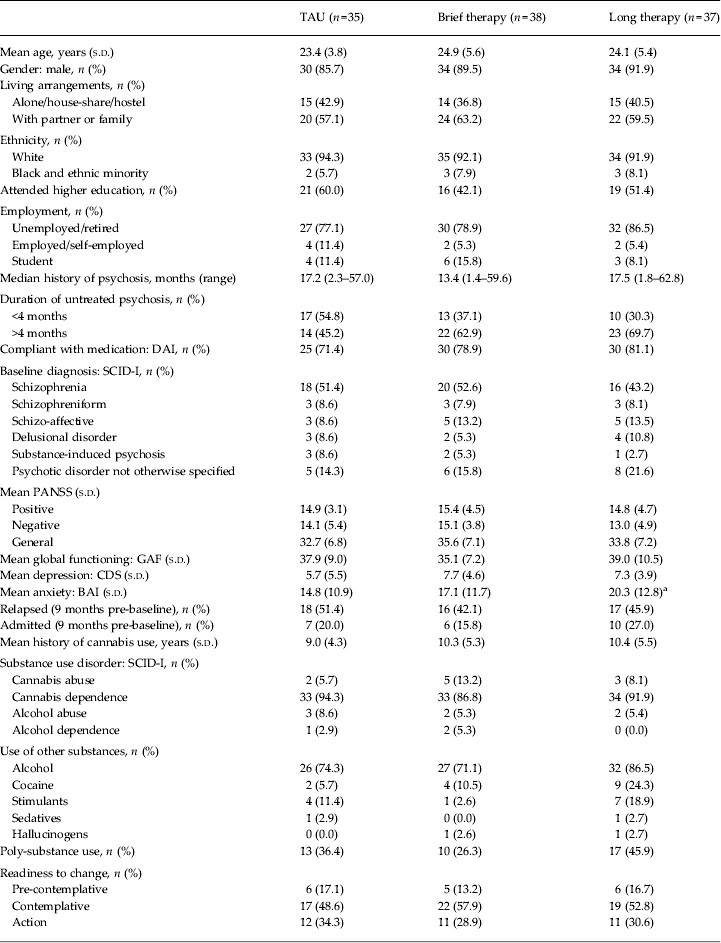
Participants were mostly male and aged in their mid-twenties (Table 1). The majority were unemployed, had a history of psychosis of less than 18 months and had been using cannabis for around 10 years, having begun using cannabis in their early teenage years. The majority met criteria for cannabis use dependence and more than a third were using multiple substances. Fewer than a third entered the trial at an action stage of change according to the RTCQ. There were no statistically significant differences between the three treatment groups on any baseline measures.
Demographic, psychiatric history and baseline substance use variables in the three treatment arms

TAU, Treatment as usual; s.d., standard deviation; DAI, Drug Attitude Inventory; SCID-I, Structured Clinical Interview for DSM-IV Axis I Disorders; PANSS, Positive and Negative Syndrome Scale; GAF, Global Assessment of Functioning; CDS, Calgary Depression Scale; BAI, Beck Anxiety Inventory.
a Missing data for one patient in the long therapy group (patient refused).
Validity of substance use self-reports
The agreement between cannabis use identified in hair samples and cannabis use reported by participants was κ = 0.61. There were significant (p < 0.001) associations between participants' reports and care coordinator reports as regards total weight (g) of cannabis consumed at each time point, with an average ICC of 0.61. There were also significant associations between care coordinator reports on the clinician rating scale and weight of cannabis consumed as reported by participants (ρ = 0.44).
Treatment delivered and treatment fidelity
The median number of therapy sessions delivered to participants was 10.25 (0–12 sessions) for those allocated to brief therapy and 11.0 (0–24 sessions) for long therapy. Of the participants, 15 (20%) attended two or fewer therapy sessions: seven allocated to long therapy and eight to brief therapy. The number of items rated as compliant on the treatment fidelity scales ranged from 14/16 (87.5%) to 16/16 (100%) across the 20 digitally recorded sessions rated. WAI scores indicated good therapeutic alliance (mean total scores for therapists and clients, respectively, were 62.3 (s.d. = 10.1) and 65.3 (s.d. = 9.5). There was also strong agreement between therapist and client scores (r = 0.84, p < 0.001).
Outcomes
Primary outcome
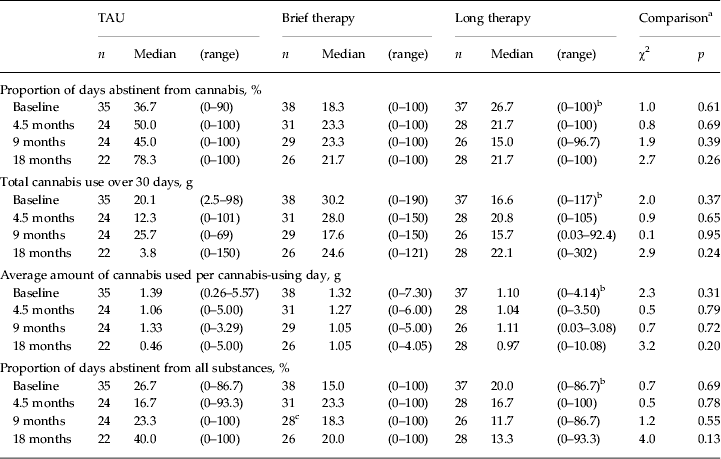
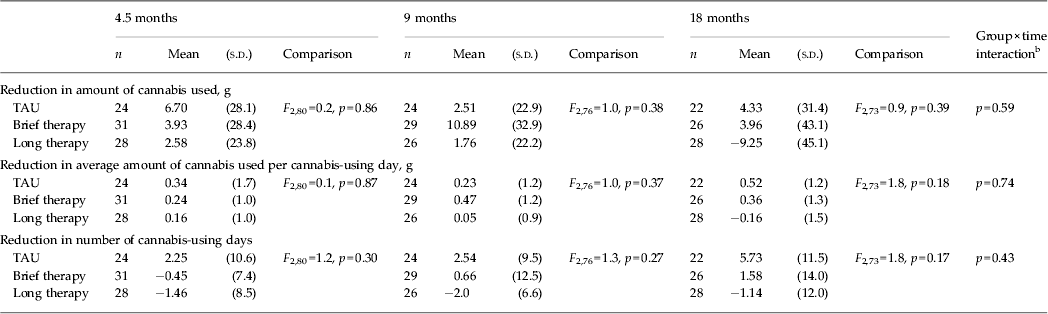
For percentage days abstinent from cannabis use, total use (g), average daily use per cannabis-using day and percentage days abstinent from all substances there were no statistically significant differences between the three treatment groups at any of the three follow-up points. However, as can be seen from Table 2, there was a small reduction in frequency and amounts of cannabis use, with the exception of the long therapy condition where we saw an increase in self-reported cannabis consumption at the 18-month assessment point. Analysis of cannabis use variables over time revealed no significant interactions between treatment groups and time, indicating no differences with regard to change in cannabis use (Table 3).
Frequency and amount of substance use as measured by Timeline Followback

TAU, Treatment as usual.
a Comparison of the three groups using the Kruskal–Wallis test.
b Three participants were abstinent for the 30 days prior to baseline but met inclusion criteria regarding substance use (cannabis use of at least 1 day per week in at least half the weeks in the 3 months prior to assessment).
c Missing data at 9 months on days abstinent from all substances for one patient who completed cannabis data.
Change in cannabis use from baseline to the three follow-up assessments – TLFB most recent 30 days a

TLFB, Timeline Followback; s.d., standard deviation; TAU, treatment as usual; ANOVA, analysis of variance.
a The Table shows the p values from the results of mixed-model repeated-measures ANOVA comparing the three groups on the three cannabis use variables over time. Positive values for the mean indicate a reduction from baseline to follow-up, and negative values for the mean indicate an increase.
b From mixed-model ANOVA with multiple imputations for missing data.
Secondary outcomes: symptoms, functioning, admission and relapse
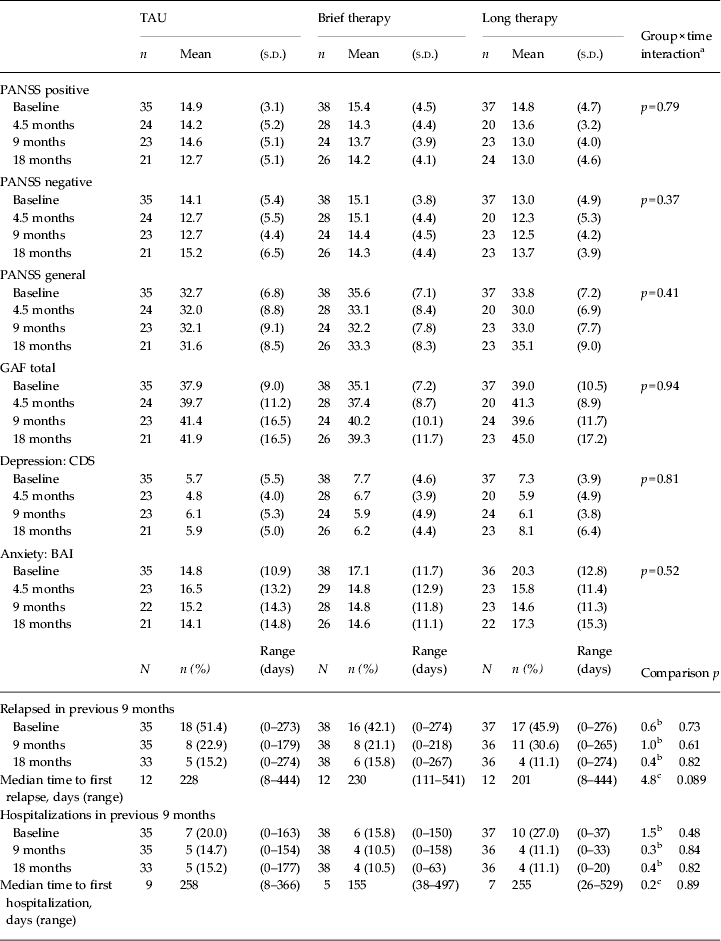
There were no statistically significant differences between the three groups in terms of PANSS symptoms, global functioning, hospital admission or relapse (Table 4).
Symptoms, functioning, relapse and hospitalization

TAU, Treatment as usual; s.d., standard deviation; PANSS, Positive and Negative Syndrome Scale; GAF, Global Assessment of Functioning; CDS, Calgary Depression Scale; BAI, Beck Anxiety Inventory; ANOVA, analysis of variance.
a From mixed-model ANOVA with multiple imputations for missing data.
b Comparison of the three groups using the χ2 test, degrees of freedom = 2.
c Comparison of the three groups using the Kaplan–Meier log rank test for survival data.
Subgroup analyses
Exploratory analyses to examine outcomes in subgroups that had previously been identified as having different trajectories in treatment showed that none of the main group effects was significant at any of the three follow-up times, and none of the interactions between the putative correlates tested was significant (results not shown).
Discussion
The study found that neither the extended nor the brief interventions of integrated motivational interviewing and cognitive therapy conferred benefit in terms of reductions in frequency or amount of cannabis use when compared with TAU. Moreover, our interventions did not result in improvements in any of the clinical outcomes that we assessed, including symptoms, functioning, hospital admissions or relapse.
We predicted that participants would gain more benefit from a prolonged period of intervention, and placed great efforts in firstly establishing and then maintaining engagement in therapy. We had focused on such engagement efforts in a previously reported study where we evaluated integrated MI and CBT with an older sample of people with established psychosis using a range of substances (Barrowclough et al. Reference Barrowclough, Haddock, Wykes, Beardmore, Conrod, Craig, Davies, Dunn, Eisner, Lewis, Moring, Steel and Tarrier2010), and in the current study further developed these strategies. These included therapists seeing people in their own homes at times to suit participants' convenience, rescheduling missed appointments, and using a range of strategies to avoid resistance in those with low motivation to reduce cannabis. However, whilst the median number of sessions attended was close to the maximum 12 for those in brief therapy, those offered the longer intervention only attended a median of about 50% of the available 24 sessions. Across both therapy conditions, we also found that 20% attended only two sessions or fewer, and we found no evidence of a significant correlation between number of therapy sessions and changes in any of the cannabis use variables or any of the symptom or functioning variables. The ratings of therapeutic alliance were good, suggesting that the participants did not have problems with the particular therapists themselves, but rather some were reluctant to engage in therapy, or to continue engagement when this required them to have appointments over a protracted time period. This finding is perhaps unsurprising, given that the majority of participants were not seeking treatment for cannabis and not at an action stage for change in their drug use.
There was large variation in the pattern of amount and frequency of cannabis use in participants in all groups over time, and no significant differences were detected. However, overall there was a small reduction in frequency and amounts of cannabis use, with the exception of the long therapy condition where we saw an increase in self-reported cannabis consumption at the 18-month assessment point. It is not possible to conclude whether this observation was attributable to factors associated with the long therapy, or to chance findings. However, our results do contradict the belief that more extensive interventions are more beneficial for this client group.
Our rates of take up of offered sessions were not dissimilar to the four previous published RCT studies that have evaluated interventions aimed at reducing cannabis use in young people with recent-onset psychosis using either motivational interviewing (MI) alone (Bonsack et al. Reference Bonsack, Gibellini Manetti, Favrod, Montagrin, Besson, Bovet and Conus2011) or a combination of MI and CBT (Edwards et al. Reference Edwards, Elkins, Hinton, Harrigan, Donovan, Athanasopoulos and McGorry2006; Hjorthøj et al. Reference Hjorthøj, Fohlmann, Larsen, Arendt and Nordentoft2012a ; Madigan et al. Reference Madigan, Brennan, Lawlor, Turner, Kinsella, O'Connor, Russell, Waddington and O'Callaghan2013). These rates ranged from close to 100% for the very brief intervention of Bonsack et al. (Reference Bonsack, Gibellini Manetti, Favrod, Montagrin, Besson, Bovet and Conus2011) to 76% for the 3-month therapy of Edwards et al. (Reference Edwards, Elkins, Hinton, Harrigan, Donovan, Athanasopoulos and McGorry2006) and 67% for the 6-month more extensive therapy of Hjorthøj et al. (Reference Hjorthøj, Fohlmann, Larsen, Arendt and Nordentoft2012a ). The pattern that emerges for individual therapy is of decreasing take up of sessions the longer the therapy, whilst the group CBT format of Madigan et al. (Reference Madigan, Brennan, Lawlor, Turner, Kinsella, O'Connor, Russell, Waddington and O'Callaghan2013) had only 46% who agreed to attend groups.
Consistent with the findings of the study reported here, previous interventions for cannabis use in young people with psychosis appear to confer no or very limited advantage over control conditions. Only one small sample study with this patient group reported a reduction in cannabis use for the intervention group and this was not sustained at follow-up (Bonsack et al. Reference Bonsack, Gibellini Manetti, Favrod, Montagrin, Besson, Bovet and Conus2011). None of the interventions improved clinical outcomes, although in the group therapy study the treatment group had better subjective Quality of Life scores post-treatment (Madigan et al. Reference Madigan, Brennan, Lawlor, Turner, Kinsella, O'Connor, Russell, Waddington and O'Callaghan2013).
There was no evidence in our study of differences in outcome in the various subgroups we examined, including the subgroups reported by Hjorthøj et al. (Reference Hjorthøj, Fohlmann, Larsen, Arendt and Nordentoft2012a ) to have different trajectories in treatment, such as younger and unemployed participants and heavier users of cannabis. We note, however, that Hjorthøj et al. (Reference Hjorthøj, Fohlmann, Larsen, Arendt and Nordentoft2012a ) interpreted their subgroup analyses without having first found evidence of significant interactions between subgroup and treatment group, which casts doubt on their conclusions.
A number of factors need to be taken into account in understanding the issues that probably contribute to the rather disappointing results in this area of treatment evaluation. First, problems in finding adequate therapeutic interventions for people with cannabis disorders are not confined to the field of mental health. Only a few RCTs evaluating treatments where participants in treatment do not have mental health problems have been conducted. Response rates for cannabis treatment, even for motivated, self-referred treatment samples, have not been impressive, and low abstinence rates at outcome suggest that cannabis dependence is not easily treated with psychotherapy interventions (Denis et al. Reference Denis, Lavie and Auriacombe2008). There are some indications that for those seeking treatment, providing vouchers to reward negative urine screens (contingency management, CM) may improve outcomes when used in combination with other psychotherapeutic interventions; and that family-based interventions may be helpful, at least for adolescents (Copeland & Swift, Reference Copeland and Swift2009). Second, a recent Australian study found that many regular cannabis users do not feel treatment is required, are not ready to stop using, and would feel stigmatized by accessing treatment (Gates et al. Reference Gates, Copeland, Swift and Martin2012). We saw such characteristics in our sample where many were not at an action phase for changing cannabis use at the start of the study. This suggests that we need to better understand the reasons why people do not want to stop using cannabis. Previous research suggests that cannabis use expectancies regarding the benefits of cannabis are strongly and consistently associated with failure to quit (Boden et al. Reference Boden, McKay, Long and Bonn-Miller2013). There is good evidence that people with psychosis perceive positive effects from their substance use (Schofield et al. Reference Schofield, Tennant, Nash, Degenhardt, Cornish, Hobbs and Brennan2006; Gregg et al. Reference Gregg, Barrowclough and Haddock2009a , Reference Gregg, Haddock and Barrowclough b ), including a means of coping with or reducing psychotic and affective symptoms and enhancing social interactions, and our therapists reported that the majority of participants reported deriving considerable benefits from cannabis use. Consistent with this research are reported findings from longitudinal studies that cast doubt on the commonly held belief that worse clinical outcomes for cannabis users with established psychosis are specifically due to the cannabis use (Zammit et al. Reference Zammit, Moore, Lingford-Hughes, Barnes, Jones, Burke and Lewis2008). Further, it would seem that not everyone will demonstrate durable symptomatic improvements from reducing cannabis (Barrowclough et al. Reference Barrowclough, Emsley, Eisner, Beardmore and Wykes2013). We conclude that it may be better for interventions to focus on problems associated with drug use, such as social and life-style issues, physical health problems and medication non-adherence, rather than on reducing the amount or frequency of cannabis use, particularly for people who are not identifying themselves as ready to change.
Strengths and weaknesses of the study
This is the largest RCT to date that has evaluated a therapy for reducing cannabis consumption in young people with recent-onset psychosis. Our follow-up of 18 months was substantially longer than other comparable studies. The sample was recruited from both urban and rural populations, and participant characteristics were comparable with those in previous studies and were largely representative of people using cannabis in early intervention services in the UK (Barnett et al. Reference Barnett, Werners, Secher, Hill, Brazil, Masson, Pernet, Kirkbride, Murray, Bullmore and Jones2007). They were predominantly young men in their twenties who were all current and mainly heavy cannabis users at the outset of the study, had been using cannabis for many years, often in combination with other drug or alcohol use, and were not seeking treatment for their drug use, the majority having low motivation to change at the outset of the study. The therapists were well trained and supervised and achieved good treatment fidelity ratings on a valid and reliable scale. We employed reliable and valid assessment measures for both self-report and observer-rated outcomes. One limitation was that black and ethnic minority groups may have been under-represented. We should also note that although we used both multiple imputation and inverse sampling weights to adjust for missing follow-up data, based on factors that we had previously determined were significantly related to missingness, the large amount of missing data at the three follow-ups means that this remains a limitation of the study. Actual data were only obtained at 18-month follow-up on 26, 28 and 22 patients in brief therapy, long therapy and TAU groups, respectively, which means that missing values were imputed for almost a third of the patients, and also that the study was underpowered compared with our initial sample size estimates.
Conclusions
Notwithstanding issues of sample size and attrition that are commonly associated with this type of trial, this was a methodologically robust study, and our findings are consistent with those in the published literature. We can conclude that integrated MI and CBT for people with cannabis use and recent-onset psychosis does not reduce cannabis use or improve clinical outcomes. Moreover, offering a more extended intervention does not confer any advantage. There are suggestions from the general cannabis research field that specifically targeting those seeking help with their drug use, reducing positive expectancies of use, employing family-based interventions when applicable, and using CM may improve the effectiveness of psychological therapy. For those not ready to reduce or quit cannabis, targeting associated problems rather than the cannabis use per se may be the best current strategy for mental health services to adopt.
Acknowledgements
We are grateful to the staff in the participating NHS trusts who assisted with the trial, to the research assistants who completed the assessments and to the trial participants.
This article represents research commissioned by the UK's National Institute for Health Research (NIHR) under its Programme Grants for Applied Research scheme (RP-PG-0606-1302). The views expressed are those of the authors and not necessarily those of the NHS, the NIHR or the Department of Health.
Declaration of Interest
None.