Introduction
Psychiatric medication is an essential component of the treatment of many mental health conditions (Cowen et al. Reference Cowen, Harrison and Burns2012). Prescribing practices change in response to the development of new efficacy evidence; the emergence of previously poorly understood side effects; the appointment of new doctors; the influence of key opinion leaders; the marketing of new agents; cost and a myriad of other factors (Rosholm et al. Reference Rosholm, Gram, Isacsson, Hallas and Bergman1997; Pincus et al. Reference Pincus, Tanielian, Marcus, Olfson, Zarin, Thompson and Zito1998; Kaye et al. Reference Kaye, Bradbury and Jick2003; Hamann et al. Reference Hamann, Langer, Leucht, Busch and Kissling2004; Jureidini & McHenry, Reference Jureidini and McHenry2009; Mars et al. Reference Mars, Heron, Kessler, Davies, Martin, Thomas and Gunnell2017). The prescribing of psychiatric medications, particularly antidepressants, has been increasing over the past 20 years (Ilyas & Moncrieff, Reference Ilyas and Moncrieff2012; Mars et al. Reference Mars, Heron, Kessler, Davies, Martin, Thomas and Gunnell2017).
In Ireland primary care doctors prescribe the majority of antidepressant and sedative medications and the proportion of the Irish population using these medications grew between 2006/2007 and 2010/2011 (NACD & PHIRB, 2012). Psychiatrists prescribe a greater proportion of mood stabilisers and antipsychotics (Pincus et al. Reference Pincus, Tanielian, Marcus, Olfson, Zarin, Thompson and Zito1998). However there is very little information available on the particular medication choices made by psychiatrists with regard to these and other psychiatric drugs and how these have changed over time.
We set out to examine the prescribing of one community mental health service and how this changed over a 12-year period.
Methods
The Cluain Mhuire Community Mental Health Service is a publicly funded adult mental health service in South County Dublin serving a catchment population of 195 000 people in 2016, which had increased by ~10% since 2006 (Central Statistics Office, Reference Castle, Aubert, Verbrugge, Khalid and Epstein2017). The full range of secondary mental health care, including inpatient care, is provided by the service to adults up to age 65 as well as graduates (those over 65 with a history of attending the service in the 10 years before they turned 65). At any one time, the service has about 1500 active cases, at least half of whom have severe enduring mental illnesses (Douglas & Feeney, Reference Douglas and Feeney2016). The service has three community mental health teams, each of which includes two consultant psychiatrists, one senior registrar and two registrars. Out of six, five consultant psychiatrists remained in place throughout the study period. There is also a clinical nurse specialist who can prescribe certain antipsychotic medications. The service uses a comprehensive electronic patient record (EPR) for all clinical records: the Mental Health Information System (MHIS) (St John of God Hospitaller Ministries, 2014). In 2004 an electronic prescribing component was introduced as part of the EPR and since that time only electronic prescriptions have been used for community prescribing.
We used Business Intelligence software (Oracle, 2005) to provide us with the numbers of prescriptions written for each medication in each year from 2005 to 2016. The lists were examined by hand by the authors as there were often multiple spellings of both generics and brands that needed to be combined. Sodium valproate, valproic acid, Epilim and other versions were combined as ‘valproate’. Where there was uncertainty, the decision to include or discard results was agreed between the authors. For example there were a small numbers of prescriptions written for “Zuc” which very likely meant Zuclopenthixol but the authors felt that these should be excluded as this was not sufficiently clear. Inpatient prescribing has remained paper based so was not included. We were unable to access individual patient information or details of the prescription written such as doses or the length of time the medication was prescribed for. Where medications could be prescribed in different forms, for example tablet and long-acting injection, figures were combined as they could not be reliably distinguished.
Data were analysed using SPSS version 21 (IBM Corp., 2013). We used simple statistics to describe the data. For the purposes of examining changes over time, we divided the data into two 6-year time periods; 2005–2010 and 2011–2016. As this was a complete data set and we were not seeking to make inferences about the prescribing of other services, we did not use additional statistical methods which would have assumed that this data was a sample from a larger set (Gibbs et al. Reference Gibbs, Shafer and Dufur2015). Approval for the study was granted by the St John of God Ethics Committee.
Results
Antipsychotics
Prescriptions for all antipsychotic medications fell by 7% between 2005–2010 and 2011–2016. Olanzapine was the most commonly prescribed medication in every year studied but prescription numbers fell from 12 573 in 2005–2010 to 9466 in 2011–2016 (−25%). Numbers of quetiapine, clozapine, paliperidone and aripiprazole prescriptions increased, while those for risperidone, sulpiride, amisulpride and ziprasidone fell. Overall, atypical antipsychotic prescriptions fell from 26 083 for 2005–2010 to 25 371 for 2011–2016 (−3%), mostly accounted for by olanzapine. Table 1 demonstrates these results.
Numbers of prescriptions for atypical antipsychotics by year

Haloperidol was the most commonly prescribed typical antipsychotic. Overall the number of prescriptions for typical antipsychotics fell by 29% between 2005–2010 and 2011–2016, while those for haloperidol increased by 18% and those for chlorpromazine fell by 75%. Table 2 displays these results.
Numbers of prescriptions for selected typical antipsychotics by year

Mood stabilisers
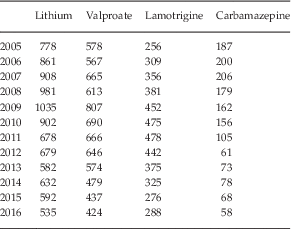
Between 2005–2010 and 2011–2016 prescriptions for mood stabilisers fell from 12 704 to 9551 (−25%). Prescription numbers for individual mood stabilisers changed as follows: lithium (−32%), valproate (−18%), lamotrigine (−2%) and carbamazepine (−59%). Table 3 displays these results.
Numbers of prescriptions for mood stabilisers by year

Antidepressants
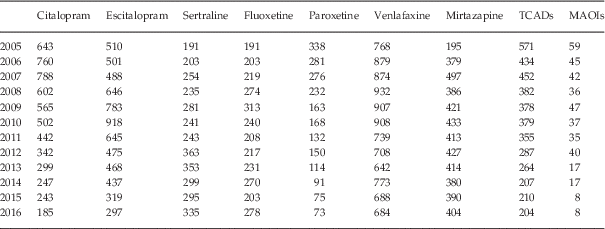
Total prescriptions for all antidepressant medications declined between 2006–2010 and 2011–2016, from 23 001 to 17 355 (−25%). The most marked reductions were for tricyclic antidepressants (−40%) and monoamine oxidase inhibitors (−53%) but decreases were also seen for selective serotonin reuptake inhibitors (−32%) and venlafaxine (−20%). At the same time mirtazapine prescriptions increased slightly (+5%). Table 4 displays details on selected antidepressants.
Numbers of prescriptions for selected antidepressants by year

MAOIs, monoamine oxidase inhibitors; TCADs, tricyclic antidepressants.
Sedatives
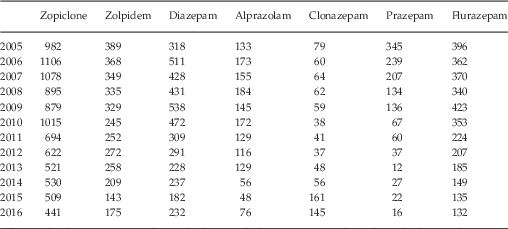
Prescriptions for benzodiazepines fell from 9371 in 2006–2010 to 4913 in 2011–2016 (−48%). Over the same period prescriptions for Z-hypnotics declined from 7976 to 4632 (−42%). Individual examples included: zopiclone −44%; zolpidem −35%; diazepam −45%; and flurazepam −54%. At the same time, clonazepam showed an increase (+35%). Table 5 displays details on selected examples.
Numbers of prescriptions for Z-hypnotics and benzodiazepines by year

Others
The number of prescriptions written for certain medications increased dramatically in percentage terms but modestly in absolute terms. Pregabalin prescriptions increased from 97 in 2006–2010 to 780 in 2011–2016 (+804%). Methylphenidate prescriptions increased from 29 in 2006–2010 to 225 in 2011–2016 (+775%). For some other medications, prescription numbers declined. Disulfiram prescriptions fell from 550 in 2006–2010 to 147 in 2011–2016 (−73%). Even more dramatic percentage declines were seen for acamprosate: down from 111 in 2006–2010 to 11 in 2011–2016 (−90%) and naltrexone: down from 151 in 2006–2010 to 0 in 2011–16 (−100%). Absolute numbers of prescriptions of dementia medications remained low throughout, for example Donepezil 36 in 2005–2010 and 55 in 2011–2016.
Discussion
This study demonstrates changes in prescribing patterns of psychiatric medications in one Irish community mental health service. The study has some serious limitations. The only data that we were able to obtain was for numbers of prescriptions. We could not access information on the duration of the prescriptions and they could have been for periods ranging from 1 day to 6 months; however, based on a review of current prescriptions, the vast majority would have been for between 1 and 6 months. Nor do we have any information on doses or the particular demographics of the population being prescribed for over the time period. However, we do know from the service’s EPR Dashboard (St John of God Hospitaller Ministries, 2017) that at the present time there are ~1500 patients attending, 51% of whom are female and who have an average age of 44. We also know there were 996 new referrals to the service in 2013 and that referral numbers have increased steadily over time. Annual numbers of referrals for psychotic disorders were relatively stable during the study period while those for emotional crises with suicidal ideation increased dramatically (Douglas & Feeney, Reference Douglas and Feeney2016). Despite the limitations, we think the results will be of general interest, will facilitate comparisons within other services and will allow for useful speculation on the reasons for the changes observed.
The numbers of prescriptions written for most medications declined over the study period. This fact is interesting of itself in that mental health services have been widely accused of inappropriately medicalising distress (Appiginesi, Reference Appignanesi2011; Whitaker, Reference Whitaker2011; O’Brien, Reference O’Brien2012). Interestingly the decline in prescription numbers occurred over the same period that the catchment population increased by 10% and referrals to the service increased by 50%. Most of these additional referrals involved emotional crises and talk therapy was sought in a much higher proportion than hitherto (Douglas & Feeney, Reference Douglas and Feeney2016). There was a small increase in the number psychologists employed by the service over the study period. It is reasonable to surmise from the data here that medical approaches to alleviating distress were not employed by the service in most of these cases.
One factor in the declining prescription numbers might be that up to 2011, patients of Dublin community mental health services received psychiatric medications free of charge if they were prescribed by their psychiatrist. In November 2011 this practice was stopped, eliminating any financial advantage to patients in receiving their prescriptions from a psychiatrist (My Irish Health, 2011). Also all patients with medical cards had to go to their GP from then on to have their prescription transcribed onto a GMS prescription. Our figures suggest that, at least for non-psychotic mental illnesses, these changes have caused more patients to seek their prescriptions from general practitioners. The Government focus in mental health has increasingly been on ‘facilitating and supporting earlier interventions at community and local level’ which could have had a knock on effect of reduced prescribing of psychiatric medications at all levels (thejournal.ie, 2017). A shift to less pharmaceutical industry promotion may also be having an impact (Appelbaum & Gold, Reference Appelbaum and Gold2010).
Concern about the side effect profiles of particular medications may have impacted on prescription numbers. Olanzapine has been strongly associated with metabolic side effects and this may have accounted for the major decline in its prescription numbers (Meyer & Stahl, Reference Meyer and Stahl2009). This fall off appears to have been compensated for by increases in quetiapine, aripiprazole, paliperidone and clozapine prescription numbers. In line with international trends and guidelines, atypical antipsychotics were increasingly favoured over typical (Monshat et al. Reference Monshat, Carty, Olver, Castle and Bosanac2010; Verdoux et al. Reference Verdoux, Tournier and Begaud2010). The numbers for certain atypical antipsychotics was likely bolstered by their increased use in bipolar disorder, depression and off-label for anxiety (Alexander et al. Reference Alexander, Gallagher, Mascola, Moloney and Stafford2011; Hayes et al. Reference Hayes, Prah, Nazareth, King, Walters, Petersen and Osborn2011). The increased prescription numbers for clozapine is encouraging in that studies indicate it remains under used in treatment resistant psychosis (Warnez & Alessi-Severini, Reference Warnez and Alessi-Severini2014). The prescription numbers for most typical antipsychotics fell considerably over the study period; only haloperidol bucked this trend. Cost may have been a factor here in that haloperidol has been found to be more cost-effective than atypical antipsychotics (Davies et al. Reference Davies, Lewis, Jones and Lloyd2007). Awareness of legal actions taken against drug companies making atypical antipsychotics could also be relevant to the fall off in the prescribing of certain medications (Field, 2010).
The decline in prescriptions for certain mood stabilisers echoes findings of some other studies and may be accounted for by trends towards increased use of lamotrigine and atypical antipsychotics in bipolar disorder (Walpoth-Niederwanger et al. Reference Walpoth-Niederwanger, Kemmler, Grunze, Weiss, Hörtnagl, Strauss, Blasko and Hausmann2012; Chang et al. Reference Chang, Wu, Huang, Chau and Tsai2016). Side effect concerns may also have played a role in the declining prescription numbers for certain antidepressants. For example, papers highlighting the potential for citalopram and escitalopram to cause cardiac arrhythmias at high doses may have contributed to the decline in their prescription numbers and the rise in sertraline’s (Funk & Bostwick, Reference Funk and Bostwick2013). The marked decline in tricyclic and monoamine oxidase inhibitor prescription numbers is in keeping with the literature (Mars et al. Reference Mars, Heron, Kessler, Davies, Martin, Thomas and Gunnell2017).
The decline in the number of prescriptions for Z-hypnotics and benzodiazepines likely reflects increased awareness of the potential for addiction and abuse with these medications (College of Psychiatrists of Ireland, 2012; Kapil et al. Reference Kapil, Green, Le Lait, Wood and Dargan2014). However, the increased prescription numbers for mirtazapine and pregabalin suggest that psychiatrists are looking to alternative classes of medications for sedative and anxiolytic effects, some of which may also have abuse potential; particularly pregabalin (Evoy et al. Reference Evoy, Morrison and Saklad2017).
The rise in prescription numbers for attention deficit hyperactivity disorder (ADHD) medications such as methylphenidate is perhaps surprising only in its modesty, given the increase in onwards referral of young adults already established on stimulant medications by Child and Adolescent Mental Health Services for treatment of ADHD, as well as the increase in new diagnoses of ADHD among adults (Castle et al. 2007; Centre for Disease Control and Prevention, 2016; Hughes et al. Reference Hughes, Hanrahan, Kavanagh and McNicholas2017). This could reflect a need for training for general adult psychiatrists in ADHD management (National Institute for Health and Care Excellence, 2016). The number of prescriptions of medications for dementia was surprisingly low given the reported rising prevalence of diagnoses, but perhaps indicates that the vast majority of these medications are prescribed by GPs, old age physicians and old age psychiatrists (Kearney et al. Reference Kearney, Cronin, O’Regan, Kamiya, Savva, Whelan and Kenny2011; Pierce et al. Reference Pierce, Cahill and O’Shea2014).
Up to 2008, the Cluain Mhuire Service had included an alcohol addiction assessment clinic but after the publication of the national mental health strategy, Vision for Change (Expert Group on Mental Health Policy, Reference Field2006) and the national addiction strategy (Department of Community, Rural and Gaeltacht Affairs, 2009), which envisaged a separation of mental health and addiction services, the Cluain Mhuire Service decided to wind down its alcohol clinic. This likely led to the observed fall off in prescription numbers for disulfiram, acamprosate and naltrexone. This separation has not been without controversy and service provision for alcohol addiction remains patchy and inequitable around the country (National Mental Health Conference, 2013).
In conclusion, this study has demonstrated that prescription numbers between 2005 and 2016 in one Irish community mental health service for some antipsychotic medications, for example olanzapine and most typical antipsychotics, declined, whereas those for others, for example quetiapine, aripiprazole, clozapine and haloperidol, increased. The service wrote fewer prescriptions for antidepressants, mood stabilisers and sedative medications from 2011 to 2016 than it did from 2005 to 2010. This is counter to most trends described nationally and internationally and may reflect an increased proportion of prescriptions being written by GPs and/or reduced reliance on medication to treat emotional distress. Due to the lack of demographic and other information on the patients being prescribed for, these trends cannot be generalised to other community mental health services; nonetheless it is interesting to speculate on the reasons for the changes observed.
Financial Support
This research received no specific grant from any funding agency, commercial or not-for-profit sectors.
Conflicts of Interest
The authors declare that there no conflicts of interest.
Ethical Standards
The authors assert that all procedures contributing to this work comply with the ethical standards of the relevant national and institutional committee on human experimentation with the Helsinki Declaration of 12 1975, as revised in 2008. The authors assert that ethical approval for publication of this research has been provided by their local Ethics Committee.