Introduction
In 1994, seven-year-old Megan Kanka was sexually assaulted and murdered by neighbour Jesse Timmendequas, a convicted sex offender recently released from prison. Kanka’s parents and victims’ rights advocates used this horrific event to highlight inadequacies in efforts to police released offenders and to promote alternatives (Simon Reference Simon2000). Taking advantage of the trial’s publicity, advocates turned it into a cause, successfully lobbying for sex offender notification legislation. In 1996, Congress passed Megan’s Law, requiring states to create and make available to the public a sex offender registry (Freeman-Longo Reference Freeman-Longo2002; Winick Reference Winick2003). Advocates used a heinous crime and the resultant high profile trial to advance their policy preferences.
There are many high profile trials, and many more crimes of sexual violence, but few successful reform efforts. If the drama and spotlight of a high trial creates an opportunity for activists to advance a cause, it is one that is only occasionally exploited successfully. We want to understand why activists sometimes successfully use a high profile trial to promote a policy agenda. Using the spotlight of such trials was one component in a broader campaign to end sexual violence; activists employed various strategies in multiple venues in their efforts. Some were dedicated to direct action, such as setting up rape crisis centres, while others worked towards educating the public, law enforcement and judges about common rape myths (Schechter Reference Schechter1982; Largen Reference Largen1985; Scott Reference Scott1993; Matthews Reference Matthews1994; Bevacqua Reference Bevacqua2000). Other activists fought for policy reform, lobbying legislators at the federal and state levels of government (Rose Reference Rose1977; Bevacqua Reference Bevacqua2000). We mean to make a contribution by examining one strategy activists sometimes used to make policy claims and effect policy change. We believe this investigation will shed light on the policy process in general, agenda setting in particular and the dynamics of activism in the United States.
We begin by reviewing relevant literature on agenda setting and social problem construction, we can conceptualise high profile trials as potential “focusing events” that offer activists a chance to advance their agendas. Next, we outline the case of the feminist movement against sexual violence as a particularly useful example of activists trying to use trials for their own political purposes. Using events data from the New York Times, the secondary treatment of 13 high profile rape trials from 1960 to 1997 and Qualitative Comparative Analysis (QCA), we examine the factors that help or hinder activists’ efforts to use the public attention of a trial to forward their cause. We see that both the nature of the particular case and the political context surrounding it affect the likelihood that a movement gains control of its meaning and advances policy reform. We conclude with a discussion of what this analysis says about activists and the policy process, calling for more research on the world surrounding a high profile trial.
Agenda setting and policy outcomes
Politicians, interest groups, advocates and activists generally have broad ambitions and limited resources. They decide which issues, and which aspects of those issues, to prioritise and which ones to put on the back burner, and they watch each other while they do so. They generally pick the issue, or element of an issue, that seems the most promising or urgent, and work hard to convince others that their judgements are correct. At the same time, these actors respond to the larger environment, a soup in which conditions, information and events float or sink (Cohen et al. Reference Cohen, March and Olsen1972).
The ways in which one issue, or element of an issue, float to the top of public attention and/or a policy agenda is the subject of a great deal of research and theorising across several disciplines. We pay particular attention to two overlapping literatures: one, located mostly in sociology, focuses on the construction of social problems, and another, mostly in political science, focuses on agenda setting.
A large point underscoring the literature is that focused attention is limited in virtually any venue (Hilgartner and Bosk Reference Hilgartner and Bosk1988). At a cognitive level, individuals can seriously consider only a limited set of problems at any time; “multi-tasking” leads to a diffusion of focus and efforts and ineffective action. Government attention is also limited; some advocates, bureaucrats and elected officials focus on one issue for extended periods of time, but meaningful policy change is contingent upon mobilising the attention and efforts of others outside the narrow world of specialists (Baumgartner and Jones Reference Baumgartner and Jones1993; Jones and Baumgartner Reference Jones and Baumgartner2005). In government and virtually all venues outside of it, access to meaningful space is limited such that attention to one set of issues crowds out others (Hilgartner and Bosk Reference Hilgartner and Bosk1988). For example, newspapers and television news shows have limited space for news, while pastors have limited time for sermons and moral instruction. Focusing on one issue means less time and attention for others. Even in the contemporary era, as the internet has made space cheap, attention becomes more limited and precious.
Given the limitations on focused attention, advocates for reform are eager to take advantage of opportunities to promote their cause. Focusing events, such as a crisis or disaster, present advocates with an opportunity to do so (Kingdon Reference Kingdon1995; Birkland Reference Birkland1997). Each of these events is “relatively rare, can be reasonably defined as harmful or revealing the possibility of potentially greater future harms, inflicts harms or suggests potential harms that are or could be concentrated on a definable geographical area or community of interest, and that is known to policy makers and the public virtually simultaneously” (Birkland Reference Birkland1997, 22).
There are many potential focusing events, but few turn out to play a critical role in the policy process. In addition to the intrinsic characteristics of events, the climate in which they emerge and develop is critical to the level and quality of attention they generate. In other words, an event that could be extraordinarily interesting and salient at one time might not be in a different context. Some scholars have addressed this directly. For example, Gamson (Reference Gamson1998) looks at the anti-nuclear power movement and examines why the Fermi accident in 1966 did not become a powerful symbol of the movement like the Three Mile Island accident did in 1979. The lack of anti-nuclear power discourse and organised opposition to nuclear power in the 1960s prevented Fermi from becoming a focusing event. Gamson (Reference Gamson1998, 215) concludes that, “events take their meaning from the discourse in which they are embedded”.
Advocates can use focusing events to make claims about the importance of a particular problem and the desirability and viability of particular solutions (Spector and Kitsuse Reference Spector and Kitsuse1977; Kingdon Reference Kingdon1995; Stone Reference Stone2002). Focusing events, and the attention they command, provide advocates with raw material they can use to construct a social problem and forward an agenda, ultimately making claims on matters of policy. Advocates can use these events to symbolise a larger social problem, which is critical to achieving widespread support (Stone Reference Stone2002). However, focusing events can symbolise many different social problems and may contribute to a struggle among various advocates to construct a problem and advance their own particular agenda (Stone Reference Stone2002).
Events, by themselves, generate neither mobilisation nor reform. In order to translate into political attention and reform, advocates must identify a key problem represented by the focusing event and attempt to attach a policy agenda to it. Successfully framing a focusing event means making it emblematic of a broader social problem and attaching it to a single, clearly defined, reform campaign. Armstrong and Crage (Reference Armstrong and Crage2006), for example, look at the construction of the Stonewall Riots. They find that several comparable events, including men at gay bars being harassed by police and reacting against them, preceded Stonewall and yet did not generate comparable attention. They argue that activists seized upon the event, creating interpretative schemas and commemorative events to promote those interpretations (Armstrong and Crage Reference Armstrong and Crage2006). Activists essentially made Stonewall, not other candidate events, critical to the gay and lesbian movement’s history and development.
Advocates must also neglect or even refute other potential problems to facilitate reform. Numerous social problems can be attached to most focusing events, and framing opportunities are available to various, and sometimes adversarial, advocates. When multiple groups attempt to frame an event, it leads to a framing contest. Winning a framing competition is critical to achieving policy reform, because those who assert control over the construction of the problem are better able to control the terms of the solution (Stone Reference Stone2002). For example, the Columbine High School shootings provided ample raw material for discussing many social conditions including racism, religious fundamentalism, sports cultures, mental illness and bullying (Larkin Reference Larkin2007). Advocates took hold of this event to try to promote their own understanding of social injustices. Organised Evangelicals, for instance, blamed secularisation for the massacre, and claimed that Christian students were the targets. Advocates of gun control also tried to exploit the event (Larkin Reference Larkin2007). When framing an event, advocates compete to publicise their interpretation of an event so as to advance their agenda rather than that of another actor (Kingdon Reference Kingdon1995; Stone Reference Stone2002). Those who succeed in attaching their preferred interpretation to a focusing event have gone a long way towards winning support for their preferred solutions.
In assessing why some focusing events produce a framing success for a particular movement or group of advocates, and why they sometimes then translate into policy reform, we should consider not only the nature of the events, but also the efforts of activists, their opponents and the broader political environment. In doing so, it is important for activists to find a piece of their larger agenda that somehow matches both the focusing event and the political climate.
Issue frontiers and the anti-rape movement
The anti-rape movement emerged from the radical wing of feminism. Early activists believed that rape was rooted in systems of power, inequality and male dominance (Gottschalk Reference Gottschalk2006). It was seen as a result (and symptom) of gendered structural inequalities in society; theorists argued that men used rape to keep women scared and powerless (Brownmiller Reference Brownmiller1975; Largen Reference Largen1985; Scheel Reference Scheel1997; Donat and D’Emilio Reference Donat and D’Emilio1998; Bevacqua Reference Bevacqua2000, Reference Bevacqua2008; Gottschalk Reference Gottschalk2006). Critical to this analysis was the belief that sexual violence was not an isolated or uncommon event committed only by sociopaths and strangers, but rather, a crime interwoven with patriarchal society (Matthews Reference Matthews1994; Bevacqua Reference Bevacqua2000). Activists argued that sexual violence would continue as long as patriarchy did.
A major aim of the anti-rape movement was to combat violence against women, although activists included child sexual abuse as an integrally related concern. Both were a product of male dominance, power disparities and social inequality, so sexual assault against women and child sex abuse were part of the same movement (Berrick and Gilbert Reference Berrick and Gilbert1991; Armstrong Reference Armstrong1994; Whittier Reference Whittier2001; Davis Reference Davis2005). Activists saw these as parts of the same whole, equating children’s liberation with women’s liberation (Davis Reference Davis2005). In the 1970s, Women Against Rape developed child sexual abuse prevention techniques modelled after self-defense strategies for women (Berrick and Gilbert Reference Berrick and Gilbert1991) and rape crisis centres extended their services to child victims (Davis Reference Davis2005). Activities such as these reflected anti-rape activists’ commitment to fighting violence against women and children, and more broadly, patriarchy.
Ending patriarchy in one fell swoop is no easy task. This goal is hard to explain, difficult to organise around and ill-suited for legislative action. The success of the anti-rape movement depended upon activists’ abilities to translate an ambitious agenda, reflecting a broad analysis of the world, to a narrower and easily understandable set of policy reforms. Activists reduced their litany of social wrongs and remedies to a simpler set of discrete steps they viewed as politically viable, or an issue frontier (Gornick and Meyer Reference Gornick and Meyer1998). Issue frontiers allowed activists to advance their agendas in steps. For instance, libertarian activists advocate a tax rate reduction as a route to broader reform. In the same vein, environmentalists seek to regulate carbon discharge and animal rights activists work to make raising eggs more humane. Each demand is only part of a broader agenda.
When framing a focusing event, advancing an issue frontier allows activists to generate support from those who support a discrete policy reform, but not necessarily a movement’s broader agenda. For example, advocating for parental consent and notification laws allows pro-life activists to obtain support from those who may not subscribe to the movement’s larger agenda to abolish abortion. Activists must find an issue frontier narrow enough to make broadly intelligible claims and modest enough to be politically viable, yet significant enough to mobilise people and be worth achieving (Meyer Reference Meyer2006).
Seeking partial victories by incrementally advancing issue frontiers is not limited to the anti-rape movement, or even to activists. Ainsworth and Hall (Reference Ainsworth and Hall2010) examine abortion policymaking in the US House of Representatives and find that legislators engage in strategic incrementalism to maximise political support and achieve incremental policy change. Of course, legislative policymaking is not completely analogous to activism. While legislators operate using a defined set of rules in a defined arena, activists operate in a larger social and political environment, often facing a wider range of obstacles. Even so, like activists, legislators must search for a unifying claim and advance issue frontiers that collectively help them achieve their broader policy goals.
When the anti-rape movement emerged in the early 1970s, activists began with a focus of providing a more humane response to rape victims and promoted reforms to make it easier to convict rapists. They also established Rape Crisis Centers throughout the country to provide services, information and support to victims, and to offer activists something useful to do while building community. Even as activists sought to fill in the gaps of the criminal justice system, they realised they were still dependent upon police and courts (Largen Reference Largen1985).
The first round of rape law reform made it easier to criminalise and prosecute rape perpetrated by strangers. Activists did not make distinctions based on the relationships between the victims and rapists, and rape law reform divided liberal and radical feminists. Liberal feminists advocated a narrow approach, focusing on rape perpetrated by strangers, while radical feminists advocated a broader approach that also addressed rapes committed by acquaintances, including spouses and dates (Marsh et al. Reference Marsh, Geist and Caplan1982). Ultimately, activists working on rape law reform took the narrow approach to secure broad support and incremental policy change. “Stranger rape” allowed activists to build broad coalitions that included conservative law and order legislators eager to get tough on crime and to win legislative victories (Marsh et al. Reference Marsh, Geist and Caplan1982; Berger et al. Reference Berger, Neuman and Searles1991).
The first round of rape law reform, which swept across American states during the 1970s, built on feminist activist efforts and elite campaigns for broader legal reform. In 1962, the American Law Institute published a national Model Penal Code (MPC) to standardise criminal law, which presented anti-rape activists with an opportunity to advance a piece of their agenda. The MPC encouraged states to standardise their criminal laws, and anti-rape activists exploited this event to press for rape law reform (Gornick and Meyer Reference Gornick and Meyer1998). Activists’ ambitions were broader than rape law reform, but they used the MPC to take their initial steps.
Although the first round of reforms improved the legal system’s treatment of women who had been raped and made it easier to prosecute some kinds of rapists, it was less effective in prosecuting husbands, boyfriends and acquaintances, and in addressing child sexual abuse. Anti-rape activists repeatedly tried to find new issue frontiers to repeat their mobilisation and legislative successes and advance their policy goals, prospecting with new issue elements and often trying to piggyback on high visibility focusing events, including high profile trials.
High profile trials as focusing events
High profile rape trials are one category of focusing events that provide possibilities for activists to advance an issue frontier. Given that they are relatively rare, depict harmful actions and signify the possibility of future harm, they qualify as focusing events (Birkland Reference Birkland1997). Moreover, they are confined to a particular geographical area or community and are known to the public and to policymakers at the same time (Birkland Reference Birkland1997). Although a trial is explicitly about finding a resolution to a particular case, its inherent drama, underscored by the adversarrial process of justice, provides a chance for activists to try to turn a case into a cause (Chancer Reference Chancer2005). Trials are venues in which facts are deployed, disputed and resolved, and where characters are paraded and judged. Witnesses give testimony, and attorneys explicitly offer competing interpretations of not only the facts, but also the motivations of the actors and the meaning of events.
Some trials become high profile because of the nature of the crime committed, including whether it was particularly violent or unusual, involves a celebrity or famous political figure or occurred within a prominent location. A murder trial featuring a famous record producer, for example, will generate more attention than other trials, and a rape in Central Park will likely draw more attention than one elsewhere (Chancer Reference Chancer2005). As high profile trials can play out over an extended period of time and attract a great deal of media coverage, they provide a limited social space within which activists can compete for attention. As such, they provide raw material for advocates to fight policy battles and a spotlighted venue in which those battles can take place.
Trials offer the promise of intensive attention and, thus, possibly, political impact (Christenson Reference Christenson1986; Harriman Reference Harriman1990; Belknap Reference Belknap1994); and they can expose basic dilemmas in society and provide a forum for their resolution (Christenson Reference Christenson1986). Trials also provide the chance to discuss issues that social movements seek to place on the public agenda (Cuklanz Reference Cuklanz1996), but successfully framing a high profile trial is rarely realised, particularly in the case of rape. Like other focusing events, high profile trials are susceptible to multiple interpretations and alternate claims. Advocates contest the facts, arguing, for example, about the trustworthiness of DNA evidence or police officers. They also contest the interpretations, arguing about whether race or gender provides greater cumulative disadvantages in the courtroom – or in society at large. The judicial system works to reduce causes into cases, and cannot provide the larger social and political resolutions activists seek, so successfully framing a trial is contingent upon moving a claim from the courtroom to other branches of government.
Data and methods
We use a two-part approach to understand why some pieces of the anti-rape movement’s agenda won public attention at particular times, and why activists were sometimes able to capitalise on high profile sex crimes’ trials and secure policy change. First, to examine the visibility of the movement and its specific foci, we use events data from the New York Times from 1960 to 1997 (Gornick and Meyer Reference Gornick and Meyer1999). The data set includes each editorial, letter to the editor, summary article and information report with the heading “sex crimes” in its abstract. It includes reported events and actions, including those of government authorities, movement activists and service organisations. We omit abstracts reporting only crimes and their trial proceedings, because we are concerned with political events and public policy, and these do not report legal reform. The data set also identifies high profile rape trials, which we define as any trial generating more than five political abstracts. Though a trial generating one or two abstracts could be interesting or important, our standard provides a reasonable number of cases to analyse and an operational threshold defining “high profile”.
There are limitations to using newspaper data to measure events, and like other scholars studying social movements, we face selection bias. One source of bias stems from selective reporting (Earl et al. Reference Earl, Martin, McCarthy and Soule2004; Ortiz et al. Reference Ortiz, Myers, Walls and Maria-Elena2005). Newspapers aim to make money, and they take the level of public interest into consideration when deciding which events to report (Ortiz et al. Reference Ortiz, Myers, Walls and Maria-Elena2005) and report only “newsworthy” events (Earl et al. Reference Earl, Martin, McCarthy and Soule2004). Characteristics of the event, such as its size, location and who is involved, dictate which events are reported (Kerbo and Shaffer Reference Kerbo and Shaffer1992; Earl et al. Reference Earl, Martin, McCarthy and Soule2004; Ortiz et al. Reference Ortiz, Myers, Walls and Maria-Elena2005). As such, some events obtain more coverage than others, while others may go unreported.
There are also biases in the reporting and prosecution of sexual assault, which are influenced by the characteristics of the crime and the race and gender of those involved (Chancer Reference Chancer2005). For example, Crenshaw (Reference Crenshaw1991) notes that there were 28 reports of rape or attempted rape involving women of colour the same week as a high profile rape in Central Park, yet none received media attention. Scholars find that sex crimes committed against women of colour are covered less frequently and less extensively than those against white women (Meyers Reference Meyers2007).
Finally, some cases are brought to trial while others are not, presenting another source of selection bias. However, courts are passive institutions and do not instigate social change; trial court judges are not policymakers, and our purpose is not to examine their role in shaping rape law. Rather, we mean to examine the extent to which activists use trials to advance an agenda in other political venues – state and federal legislatures – and press for policy reform.
Despite these limitations, we are confident that using newspaper data does not skew our findings. To minimise selection bias, our data source is a national newspaper, the New York Times, considered to be less biased than local or regional newspapers (Earl et al. Reference Earl, Martin, McCarthy and Soule2004). Several studies on the validity and reliability of the New York Times report that it is the single best newspaper source for events data (Kerbo and Shaffer Reference Kerbo and Shaffer1992; Ortiz et al. Reference Ortiz, Myers, Walls and Maria-Elena2005). Moreover, we are interested in measuring events, and these are likely to be reported in the newspaper (Earl et al. Reference Earl, Martin, McCarthy and Soule2004).
Given our interest in assessing activists’ abilities to use high profile rape trials to promote policy agendas, events data is appropriate for our purpose. These data tell us the extent to which activists can use trials to promote an agenda, which is our focus. Newspaper coverage reflects public interest, which is necessary for a trial to become a focusing event.
In the second part of the analysis, we examine high profile rape trials and the political outcomes of efforts focused around them. We use QCA to assess patterns of activist success in using trials to achieve their policy goals. QCA allows us to identify the combinations of various factors that precede a policy outcome (Ragin Reference Ragin2000, Reference Ragin2008; Rihoux and Ragin Reference Rihoux and Ragin2009, xix).
The politics of sex crimes
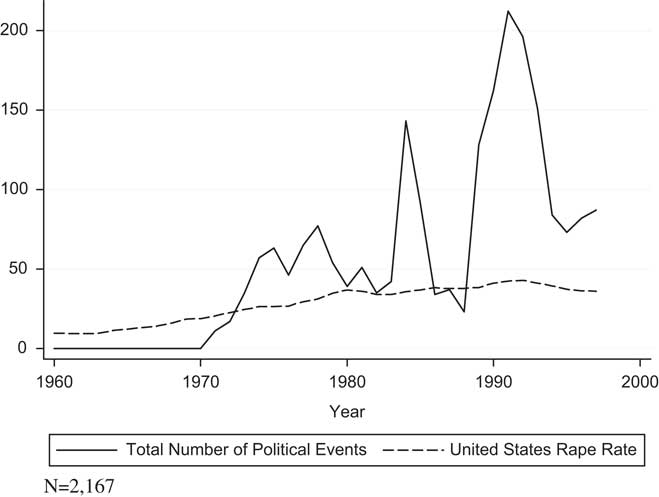
Figure 1 displays the annual reports of political events related to sex crimes and the national rape rate from 1960 to 1997.
Total number of political events per year and the United States rape rate, 1960–1997.

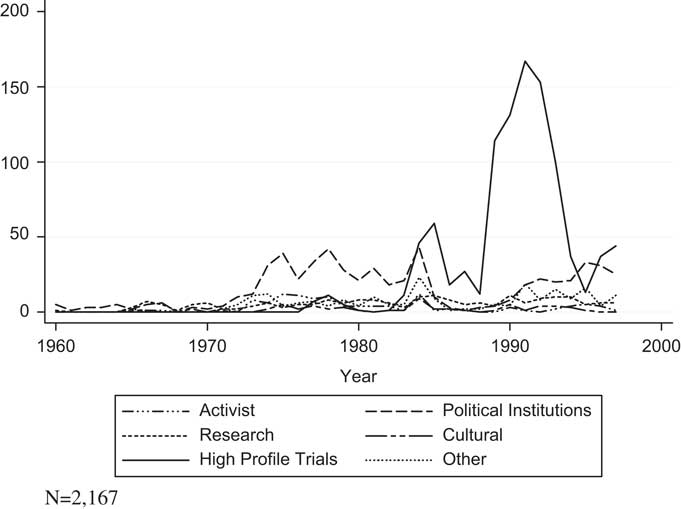
Political events coverage gradually climbed throughout the 1960s and 1970s, declined in the early 1980s and peaked in the mid-1980s. The national rape rate did not track similarly (Uniform Crime Statistics 2013), illustrating the disparity between reported rapes and rape coverage. There was a decline in attention to rape in the late 1980s, followed by another peak in the early 1990s. To determine the source of peaks and valleys, we report the variety of political events and the actors generating these events (Figure 2).
Types of political events per year, 1960–1997.

There were six types of political events: activists, political institutions, relevant research, cultural events, high profile trials and other events. Events generated by activists include protests, campaigns and organisational news. Political institutions address legal reform or public policy through a legislature or executive agency. Cultural events include announcements or reviews of books, films and television shows. Relevant research refers to reports on sex crimes, and high profile trials are sex crimes involving a high profile actor.
Most political events surrounded high profile trials, though political institutions were also responsible. Few events were generated by activists, research, cultural events or by other means. There were 2,167 political events, with nearly half generated by high profile rape trials. Political institutions produced 587 political events, relevant research created 201 events and activists generated 115 events. Cultural events led to 59 events, and 211 political events emerged by other means, such as confessions or interviews.
Our data suggest that high profile rape trials presented the most frequent opportunities for activists to make claims. Before the late 1970s, trials occurred, but none generated political events. Organising around trials engendered a few political events in the late 1970s, and then became a major source of political events in the mid-1980s before sharply declining in the mid-1990s. High profile rape trials became a dominant source of attention, providing an opportunity for activists to use the spotlight to advance an issue frontier and secure policy change. In the following section, we take a closer look at why they were sometimes able to do so.
High profile rape trials
High profile rape trials attracted a great deal of attention. Activists were often eager to take advantage of the media spotlight. This category of trials includes sex crimes involving a high profile actor or case, and they are high profile for a variety of reasons. They may involve a celebrity, or they may be particularly novel or violent. In winning policy reforms, activists must negotiate two stages of the policy process (Soule and King Reference Soule and King2006). First, they must successfully frame the event and win the framing competition to define the terms and importance of the case at hand. The second step is taking that preferred interpretation to the legislature and pressing for policy reform.
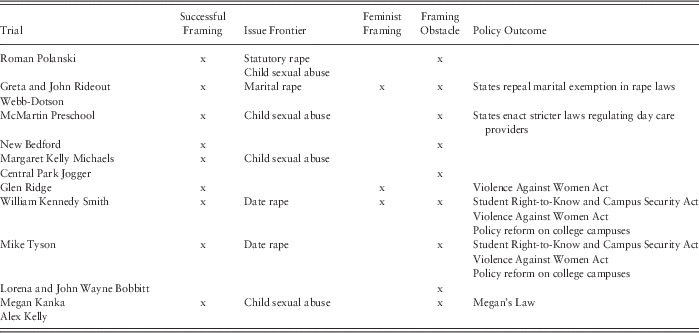
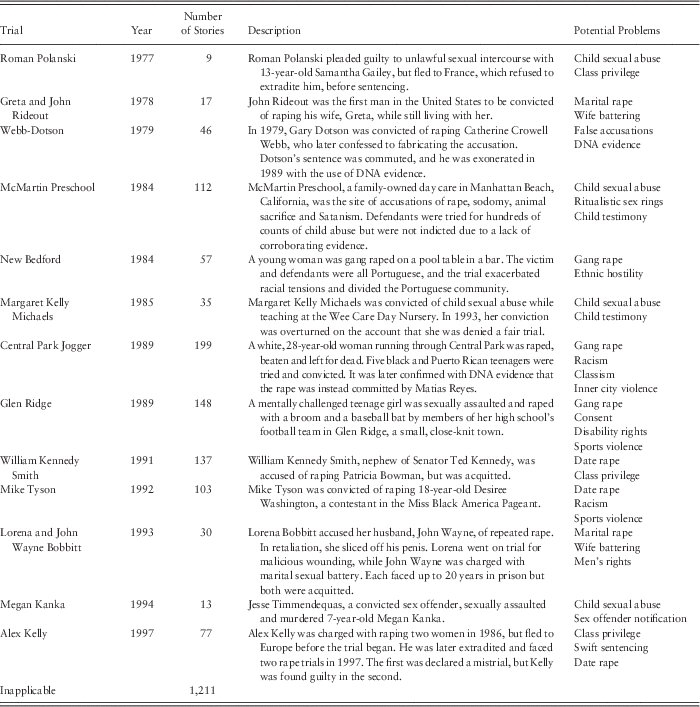
Below are summary reports on the 13 high profile trials in this period.Footnote 1 We identify whether the trial was successfully framed for the issue frontier. We also note if the trial contained a feminist frame or obstacles to successful framing and if the trial preceded a policy outcome (Table 1).
High profile rape trials, successful framing, issue frontier, feminist framing, framing obstacle and policy outcome

High profile trials provide an opportunity for activists to do interpretive work before a large audience. When a trial is successfully framed, it represents activists’ preferred issue frontier, or element of sexual violence consonant with the movement’s agenda. One measure of successful framing is whether there is increased attention to an issue frontier following a high profile trial, which demonstrates that activists successfully attached their policy agenda to a trial while refuting competing frames.
Successful framing helps advocates mobilise, pressure legislators and promote policy change. Of the 13 high profile trials, seven were successfully framed and generated attention to an issue frontier: Roman Polanski, Greta and John Rideout, McMartin Preschool, Margaret Kelly Michaels, William Kennedy Smith, Mike Tyson and Megan Kanka. The Rideout trial coincided with an increase in attention to marital rape, and the Polanski trial provoked increased attention to child sexual abuse and statutory rape. McMartin Preschool, Margaret Kelly Michaels and Megan Kanka coincided with increased attention to child sexual abuse. The Tyson and Smith trials both corresponded with an increase in attention to date rape. Anti-rape activists mobilised around the Glen Ridge trial, but there was no increase in the attention given to gang rape more generally.
Of the successfully framed trials, Rideout, Smith and Tyson contained feminist frames. These reflect feminist analyses of sexual violence, emphasising the structural rather than individual nature of the crime. Discourse surrounding feminist frames locates the source of the problem in societal factors rooted in patriarchy, power and inequality, not characteristics of individual perpetrators.
Feminist activists do not operate in an open field, and they face distinct obstacles (discussed in detail below) to successfully framing a trial. Nine trials contained a clear framing obstacle: Roman Polanski, Greta and John Rideout, McMartin Preschool, New Bedford, Central Park Jogger, William Kennedy Smith, Mike Tyson, Bobbitt and Megan Kanka. Identifiable obstacles, such as the facts of the trial or the deployment of competing narratives, impeded the anti-rape movement’s ability to effectively project a feminist rape frame. However, not all framing obstacles doom reform efforts; seven trials preceded a policy response: Greta and John Rideout, McMartin Preschool, Margaret Kelly Michaels, Glen Ridge, William Kennedy Smith, Mike Tyson and Megan Kanka.
Although the Glen Ridge trial did not generate attention to an issue frontier, it was associated with an outcome favourable to activists, the Violence Against Women Act of 1994. Then-Senator Joe Biden cited the Glen Ridge trial during debates on the Violence Against Women Act (Laufer Reference Laufer1994), but it was the only trial preceding a policy outcome that did not produce increased attention to an issue frontier.
QCA
In the next phase of our analysis, we employ QCA, a technique using the logic of Boolean algebra, which allows us to examine why some high profile trials preceded a policy outcome. The number of cases presented here is too small to conduct a traditional large-N statistical analysis, and QCA provides a formal and systematic analytical tool appropriate for studies with a small number of cases (Ragin Reference Ragin1987, Reference Ragin2000, Reference Ragin2008). QCA offers additional advantages. It is one of the most formalised tools for assessing whether the same factors we identify in the preceding qualitative analysis influence whether a trial precedes a policy outcome (Ragin Reference Ragin1987, Reference Ragin2000). In addition, QCA is a case-oriented method, which means that cases are analysed as “wholes” instead of sums of their parts (Ragin Reference Ragin1987). Cases are conceptualised as configurations, or combinations, of factors (Ragin Reference Ragin2000, Reference Ragin2008; Rihoux and Ragin Reference Rihoux and Ragin2009, xix). Therefore, instead of examining the individual influence of each factor on the outcome of interest, QCA allows researchers to examine how these factors interact and fit together to produce a policy outcome (Ragin Reference Ragin1987, 49).
Finally, QCA allows for “multiple conjunctural causation”, which means that there may be multiple pathways to a policy outcome (Berg-Schlosser et al. Reference Berg-Schlosser, De Meur, Rihoux and Ragin2009, 8). “Multiple” refers to the possibility that more than one combination of factors could lead to an outcome, and “conjunctural” means that each pathway may contain a different combination of factors (Berg-Schlosser et al. Reference Berg-Schlosser, De Meur, Rihoux and Ragin2009, 8). Our qualitative analysis suggests that there are different paths to policy reform, and QCA allows us to systematically test this possibility.
Despite QCA’s advantages, we recognise that it is sensitive to omitted variable bias (Seawright Reference Seawright2005, 17, 22). However, in an effort to ensure we have not excluded relevant variables in our analysis, we employ some of the “best practices” of QCA (Ragin Reference Ragin2005, 34). One is a deep, or “thick”, understanding of the cases (Ragin Reference Ragin2005, 34). Given our extensive research on the high profile rape trials under study, we are reasonably confident that we have not omitted theoretically relevant variables. Another best practice is a clear explanation of the data (Ragin Reference Ragin2005, 34), and in the following section, we discuss how we operationalise and measure each variable so that the results can be replicated.
Data are in dichotomous form, and a score of 1 indicates that a variable was present in the trial, while 0 means it was absent. The dependent variable, policy outcome, was coded as 1 if policy change followed a trial. We are concerned with potential policy outcomes at any institutional level, ranging from rules on college campuses to state and national legislation. A policy outcome occurs when an institution enacts a law or policy combating the problem framed in the high profile rape trial. For example, sex offender notification laws are an example of a policy outcome, and so are university policies governing sex crime reporting guidelines.
The stories variable was coded as 1 if the number of stories per trial was equal to or greater than the median number of stories, which is 57. To clarify, a story is not an event. An event is something that happened, while a story is a report of that event. For example, a high profile trial is an event, while any New York Times story of that trial is a report. Here, a story is about the trial, not about sexual assault more generally. One event can generate many stories – or not.
Successful framing was labelled as 1 if the trial was successfully framed by any group of advocates, and feminist framing was coded as 1 if the trial contained a feminist frame. Successful framing occurs when a clear and consensual frame emerges from the trial, and feminist framing occurs when anti-rape activists successfully frame a focusing event. The issue frontier variable was labelled as 1 if the trial coincided with attention to an issue frontier. We labelled framing obstacle as 1 if the trial contained a framing obstacle. To analyse these data, we use traditional QCA and the fuzzy set QCA program.
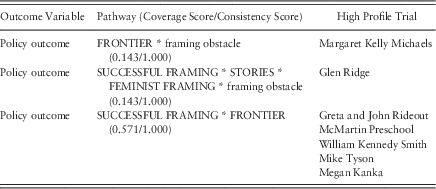
Table 2 presents the QCA results. We find that multiple configurations precede policy reform. Upper case letters indicate the presence of a particular variable, while lower case letters indicate that a particular variable is either absent or present at a low level. The asterisks denote “and”. When a variable is completely absent from a configuration, it is irrelevant to it.
Qualitative comparative analysis results presenting pathways to a policy outcome

Three configurations are associated with a policy outcome. In the first configuration, the presence of an issue frontier and no framing obstacle preceded a policy outcome. It is best illustrated by the Margaret Kelly Michaels trial, which generated a peak in attention to child sexual abuse but not a high number of stories. Feminist activists and other advocates did not exploit the Michaels trial, yet it still preceded a policy outcome. This may have occurred because the Michaels trial took place on the heels of the McMartin Preschool trial, which was successfully framed by advocates and preceded policy reform. The attention to McMartin and lack of attention to Michaels suggests that resources and attention are scarce, so advocates concentrate their advocacy efforts (Hilgartner and Bosk Reference Hilgartner and Bosk1988).
In the second configuration, successful framing, stories about the trial and feminist framing must each be present and in combination with no framing obstacle. The Glen Ridge trial fits this second configuration. Feminist activists were the sole advocates in this trial, so a feminist frame of consent dominated the trial discourse, which could have helped produce a policy outcome.
Local feminist organisations protested and attended the trial, making claims of violence against women and consent. Members of the Women’s Action Coalition and the National Organization for Women (NOW) marched outside the courtroom with signs reading, “RAPE IS VIOLENCE NOT SEX”, and Myra Terry, chapter president of NOW, announced, “Rape is a crime, not a sport, and they made this into fun, games and excitement” (Hanley Reference Hanley1992, B7). Activists were concerned that the rape would be painted as a case of fun and games and not violence.
They also made claims with respect to consent, the major point of dispute. “This is a pathetic eight-year-old in a woman’s body. How could she consent?” asked Myra Terry (Laufer Reference Laufer1994, 36). Carol Vasile and Christine McGoey, representing the Essex County chapter of NOW, observed the trial and circulated fact sheets to dispel common rape myths (Laufer Reference Laufer1994). “We were combating all these myths about rape. We had to hear that she was big breasted, she’s a Lolita, she asked for it, she wanted it, it was her idea, she did it before, every myth that you could possibly imagine”, said Vasile (Laufer Reference Laufer1994, 80).
Glen Ridge generated a high number of stories about the trial, and anti-rape activists had an open field in defining the case and raising issues surrounding the treatment of the crime. Vasile stated, “I don’t think our society even views rape as a crime because there’s no real punishment associated with it” (Laufer Reference Laufer1994, 79). Activists’ efforts may have motivated then-Senator Joe Biden to use the trial to illustrate the justice system’s failures to apprehend, convict and incarcerate violent criminals (Laufer Reference Laufer1994). One month after the trial, the Senate Judiciary Committee released The Response to Rape: Detours on the Road to Equal Justice, reporting that only 1% of rape cases go to trial (Laufer Reference Laufer1994). Senator Biden would later go on to introduce the Violence Against Women Act, passed in 1994.
In the final configuration, successful framing and an issue frontier precede a policy outcome, but a framing obstacle, the number of stories about the trial and feminist framing are irrelevant. The Rideout, McMartin Preschool, William Kennedy Smith, Mike Tyson and Megan Kanka trials fit this final configuration. This configuration suggests that framing obstacles do not doom policy reform efforts. In the following section, we take a closer look to understand why.
High profile trials and policy outcomes
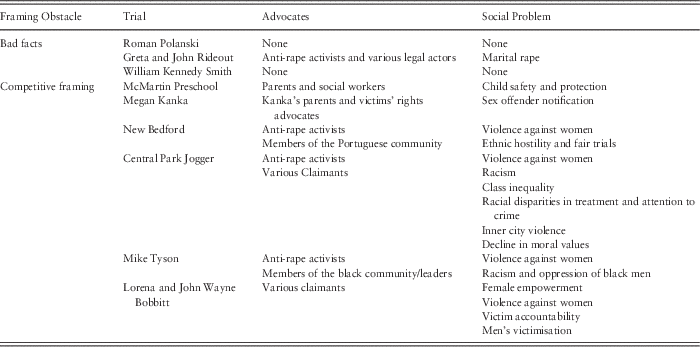
Closer analysis of our data and the secondary treatment of the trials reveal that activists face at least two distinct obstacles: bad facts and competitive framing. Bad facts, which refer to the raw material coming out of the trial, make it difficult for activists to advance and sustain a feminist rape frame. There are also instances in which other advocates attempt to use a trial to further their own political purposes, advancing a frame that competes with a feminist frame. We present the obstacles activists faced in the aforementioned trials below (Table 3).
High profile rape trials, framing obstacles and policy outcomes

Bad facts
The facts of a particular case may make it more difficult for activists to define the meaning of the trial, but they are not necessarily insurmountable. When the facts of the trial are bad, they provide a weak foundation for sustained action and make it difficult for activists to sustain a feminist frame. In the Polanski, Rideout, Smith and Bobbitt trials, the defense successfully introduced evidence that undermined the victim’s credibility and suggested the sex was consensual. The Rideouts, for example, had a tumultuous relationship, repeatedly parting and reconciling in public, making the marital rape frame harder to sustain. As a result, the facts of the case provided a weak foundation for activists to use a platform for reform.
Despite the difficult facts of the Rideout trial, activists used it to advance a marital rape frame and promote a policy agenda. Initially framed as a case of marital rape (Benedict Reference Benedict1993), facts introduced by the defense quickly weakened it. The Rideout’s relationship was characterised as a cycle of “quarrel, make up, have sex” (TIME 1979); and, after the trial, Greta and John reunited (Benedict Reference Benedict1993), a move that further undermined Greta’s credibility as a rape victim. John Rideout’s defense team portrayed Greta as a “feminist pawn” pressured to press charges by rape crisis advocates (Benedict Reference Benedict1993, 60). Greta’s motive for pressing charges was further called into question when the defense said she announced plans to get “rich and famous” by selling her story and signing a movie contract (TIME 1979).
The Rideout trial occurred when feminist activists were mobilising around violence against women in marriage. During the 1970s, activists worked to provide services and counselling to victims, and they pressed for legal change and better police responsiveness to victims (Tierney Reference Tierney1982). In 1978, Laura X founded the National Clearinghouse on Marital and Date Rape, an organisation dedicated to eradicating violence against women (Laura X Reference Laura1999). The Rideout trial helped bring nationwide attention to these salient issues that feminist activists were mobilised around, and it raised many questions. One was the question of what authority, if any, husbands had over their wives’ bodies (Benedict Reference Benedict1993). The Rideout trial also raised issues surrounding the legal treatment of rape in marriage. Among the general public, it was considered to be wrong, but there was little agreement with respect to the legal remedies (Cuklanz Reference Cuklanz1996). Perhaps above all, the trial brought attention to the reality that rape in marriage occurs and that something must be done about it (Cuklanz Reference Cuklanz1996).
Following the Rideout trial, states slowly began to eliminate marital rape exemptions in their rape statutes in the late 1970s (Siegel Reference Siegel1995). Though there was an existing movement dedicated to urging states to repeal the exemption, the trial helped generate attention to the issue of marital rape and spur this process (Siegel Reference Siegel1995). Its impact also had a ripple effect throughout society. Noreen Connell of NOW said that, “other married women will now be less hesitant to seek legal remedy if they are sexually assaulted by their husbands” (TIME 1979). Women’s groups were optimistic, citing legal reform as evidence that women resent what Nancy Burch, director of the Oregon Women’s Center, calls the “archaic notion that a woman is her husband’s property” (TIME 1979).
Competitive framing
Activists also face competitive framing, circumstances in which advocates seek to use the same trial for different purposes, counterframing the case or telling a different story about the trial’s meaning. Trials can be used to symbolise a larger problem, so advocates compete to situate the facts of a trial within their preferred narrative of cause and reform (Stone Reference Stone2002). To clarify, competitive frames are not “pro-rape” frames; rather, they compete with feminists’ interpretation of a trial.
Feminist frames define rape as a social problem stemming from systemic disparities in power, dominance and patriarchy, but a range of competitive frames deny this narrative and locate the problem elsewhere. For example, they may blame aberrant and troubled individuals for perpetrating sexual violence, offering poor policing as an alternative explanation for the crime. Such frames depoliticise and individualise the act of rape, treating offenders as deviants instead of members of a larger societal power structure (Corrigan Reference Corrigan2006). As an example, gun rights advocates would decry school shootings, but not support gun control measures as a solution. Competitive frames may also blame another social problem, such as racism or classism, for the crime.
Our data suggest that anti-rape activists must operate in an open field in order to successfully advance their agenda and win policy reforms. Further, this is true for any group of advocates – competitive framing hinders policy change when a clear and consensual problem and solution failed to emerge. When attempting to frame a trial, advocates may instead cloud the discourse around it.
Advocates organised around the Central Park trial, for example, to make claims about racism, seeking to use the trial for alternative political purposes. However, other advocates sought to do the same, raising issues of class inequality or the dangers of inner city violence, for example. This counterframing and counterclaiming makes it difficult for anti-rape activists to advance and sustain a gender-based claim, suggesting that even though they attempt to frame a high profile trial, their efforts may be eclipsed by other groups attempting to do the same. Not only that, but it makes it unlikely that any clear and consensual frame will emerge. Counterframes tend to undermine one another, ensuring that no frame resonates and leads to policy change (Chong and Druckmann Reference Chong and Druckman2007). Our data support this conclusion; multiple groups of advocates attempted to frame the Central Park Jogger trial, preventing the emergence of a common understanding of the event or a coherent policy agenda.
By contrast, in the Megan Kanka trial, for example, a single frame emerged, and so did a policy outcome. Kanka’s parents and victims’ rights advocates used the Kanka trial to construct child sexual abuse as a crime committed by strangers, notably recently released sex offenders. Though these groups of advocates had different objectives and values, they constructed a problem and solution that furthered each of their own goals. Victims’ rights advocates used it to attack the state’s faulty policing of sex offenders (Simon Reference Simon2000), and Kanka’s parents argued that Megan’s death was preventable. Had they known of Timmendequas’s history, they claim they would have taken extra measures to protect their daughter. They lobbied state legislators and urged them to pass notification laws, organised a vigil and founded the Megan Nicole Kanka Foundation, which launched the battle for sex offender notification laws (Barron Reference Barron1994; Hoffman Reference Hoffman1994; Frantzich Reference Frantzich2008). Maureen Kanka testified before Congress, persuading lawmakers to adopt notification laws so parents could be better informed and protect their children. “If pedophiles are going to be out on the street where they can accost children, then parents have the right to know if they live on our streets. My daughter Megan would be alive today if I had known that my neighbor was a twice convicted pedophile” (Simon Reference Simon2000, 1140).
Legislators responded to these claims (Freeman-Longo Reference Freeman-Longo2002). New Jersey was among the first wave of states to pass laws mandating more attentive supervision and harsher penalties for sex offenders (Simon Reference Simon2000; Frantzich Reference Frantzich2008). The US Congress followed suit and passed Megan’s Law in 1996, requiring all states to create a sex offender registry available to the public (Freeman-Longo Reference Freeman-Longo2002; Winick Reference Winick2003).
Discussion and conclusion
Promoting a policy agenda, or a piece of an agenda, is difficult in an environment where advocates face limited resources, public attention and time. There are many policy issues, but not all generate attention. Advocates are eager to take advantage of any opportunity to advance a policy agenda, and focusing events, such as a crisis or disaster (Kingdon Reference Kingdon1995; Birkland Reference Birkland1997), provide opportunities to do so. Such events can provide the tools to fight a framing battle in mass media and advance a reform agenda in state legislatures and Congress. When advocates attempt to frame a focusing event, they work hard to attach a larger meaning to that event, and they can sometimes use it to mobilise support for their interpretation and promote policy reform.
High profile rape trials are one category of focusing events, and we examined the extent to which activists can use the drama and spotlight surrounding a trial to advance a policy agenda. Most criminal cases do not become high profile trials, which emerge as a result of some combination of novelty, drama, location and celebrity. Nevertheless, trials, like other focusing events, are attractive because of the media attention they generate, often over an extended period of time.
Attempts to exploit high profile trials were one strategy in a much broader movement to end sexual violence, and we mean to add another component to this literature. Activists employed methods of direct action (Largen Reference Largen1985; Scott Reference Scott1993; Bevacqua Reference Bevacqua2000) and advocacy (Schechter Reference Schechter1982; Matthews Reference Matthews1994; Bevacqua Reference Bevacqua2000), as well as lobbying state and federal level lawmakers (Rose Reference Rose1977; Bevacqua Reference Bevacqua2000). In their efforts to promote policy change, the use of high profile trials complemented these other strategies, and we demonstrate why they were sometimes successful.
Trials are opportunities to advance a frame and a larger agenda, but there are no guarantees. Some trials precede waves of legal reform, while others do not. Activists often attempt to frame their political agendas, but they succeed only when operating in an open field – a rare occurrence considering that the facts of any trial suggest multiple issues and multiple policy reforms. While the facts of a trial provide activists with an opportunity to forward an agenda, they provide equal potential for other advocates, and sometimes adversaries, to do the same.
Activists faced at least two distinct obstacles in successfully framing a high profile trial. In some cases, the facts of the trial provided a shaky foundation for their broader political claims – in this case, a feminist rape frame. In other cases, similarly outraged advocates framed policy alternatives that failed to advance a broader feminist agenda. However, the results of our QCA suggest that there are multiple configurations to policy reform and that, although the facts of a trial and competitive framing do not necessarily doom policy reform, successfully framing a trial appears to be necessary to win the policy battle.
We examined one category of claimants and 13 trials in some detail. The results here are suggestive and call for broader evaluation. As several cases show, high profile trials offer an excellent opportunity to convert the media attention surrounding a trial into political and legislative energy. Activists can use a trial to turn public discussion to issues and policies they believe receive insufficient attention. Trials, and focusing events more broadly, are one way for activists to stand out in the larger social and political environment, which is cluttered with issues, claimants and problems. Of course, it is not the focusing event itself that does so; rather, a focusing event provides activists a chance to stand out and one they pass up at their own risk.
Acknowledgements
Earlier versions of this article were presented at the Social Movement/Social Justice Group at the University of California, Irvine, and the Annual Meeting of the American Political Science Association in Washington, DC in 2010. We appreciate the helpful comments presented there as well as those from Thomas Elliott, Josh Malnight and the anonymous reviewers.
High profile rape trial, year, number of stories, description and potential social problems.